Seafood Kebabs on Forbidden Rice

salmon kabab n

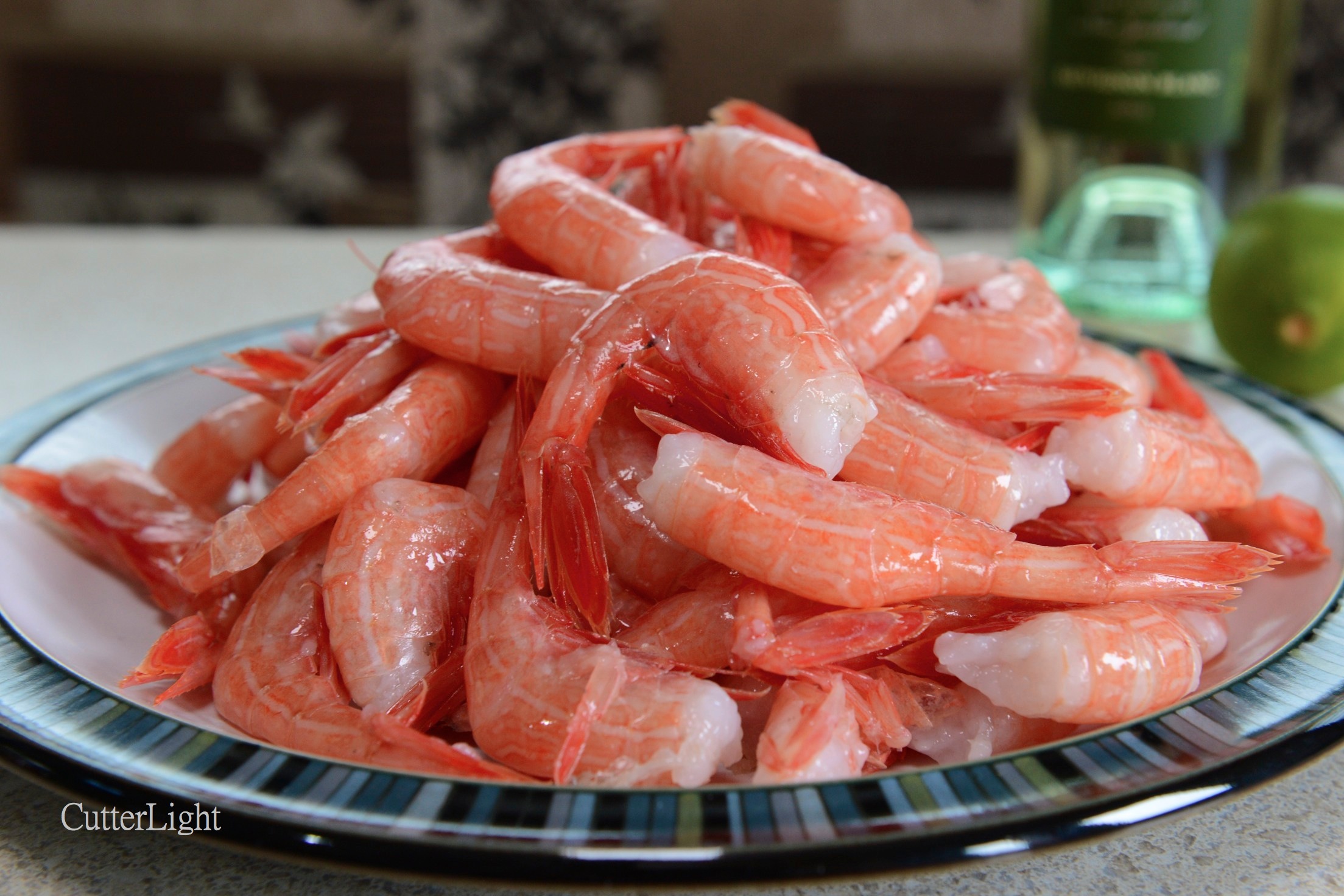
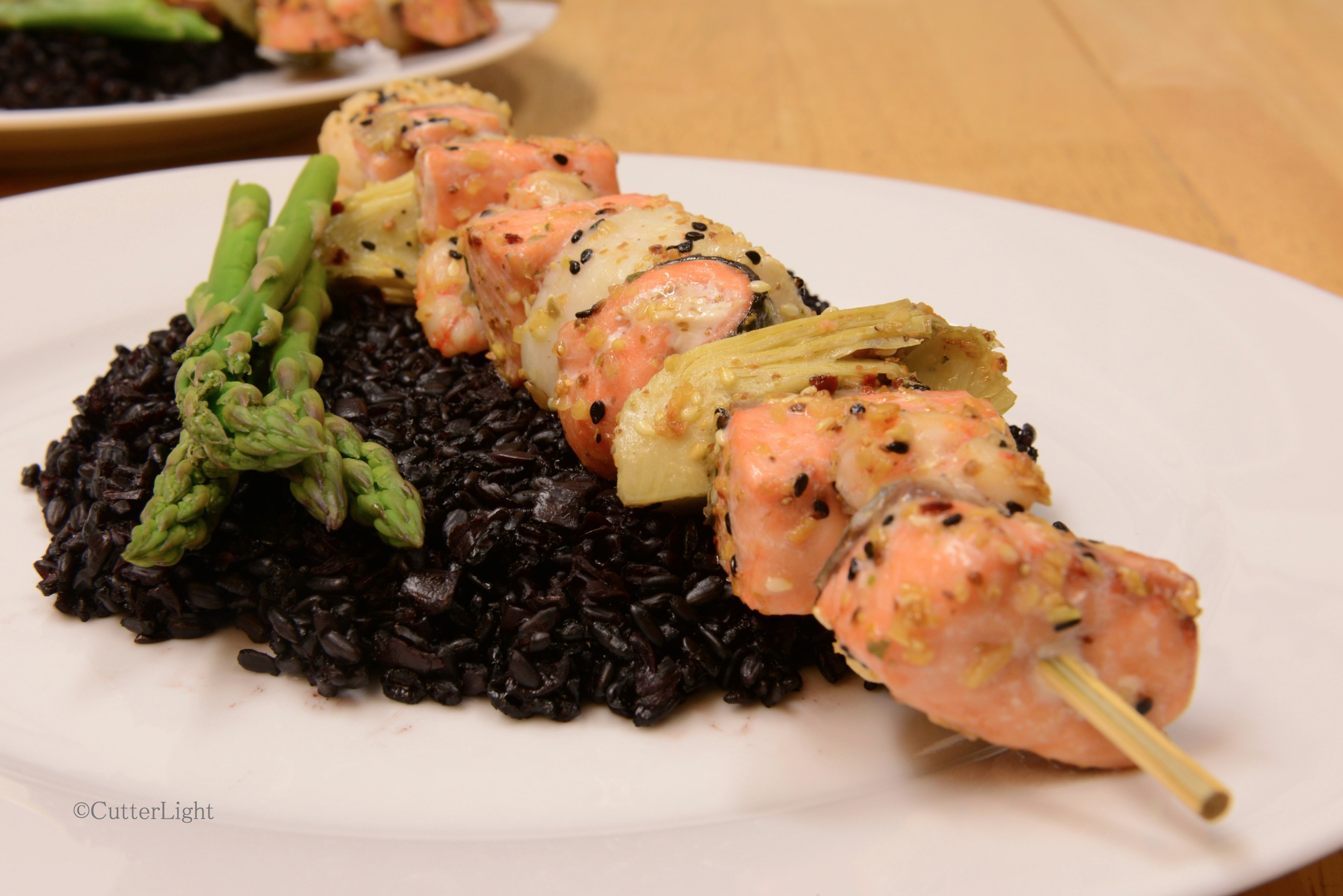
Seasoned cubes of wild Coho salmon, fat, succulent Kodiak scallops, sweet Alaska deep sea shrimp and artichoke hearts drenched in olive oil alternate on this broiled seafood kebab.

The early Persians were onto something. Skewered meats, seafoods and vegetables deftly seasoned and grilled or broiled to perfection are easy to whip up and always a hit. The variations on these Alaskan seafood kebabs are endless. We seasoned ours with a mixture of ginger, toasted sesame seeds, black sesame seeds, sea salt, sugar, garlic, pepper and a sprinkle of toasted coconut. Add a little soy sauce, too, and serve on a bed of nutrition-packed forbidden rice.

Seafood Kebobs

Ingredients

A dash or two each of

  • ginger (freshly grated or powdered)
  • toasted sesame seeds
  • black sesame seeds
  • sea salt
  • ground pepper
  • ground peppers such as chipotle or cayenne
  • garlic (fresh chopped fine or powdered)
  • toasted coconut
  • seafood such as chunks of salmon or other fish, whole scallops, prawns, etc.
  • vegetables such as cherry tomatoes, artichoke hearts, bell pepper, etc.
  • olive oil

Directions:

  1. Place broiler pan in oven and preheat on broil, or fire up grill.
  2. Combine ingredients in a mixing bowl and mix to thoroughly coat seafood and vegetables.
  3. Put food on skewers and place on preheated broiling pan or on hot grill. Cook for about 5 to 10 minutes, turning once or twice.
  4. Serve hot.

Smoked Salmon Avocado Dip: Tasty California-Alaska Fusion

smoked salmon avacado dip n
Served in avocado half-shells, this Alaskan twist on guacamole is as eye-catching as it is delicious! See the super quick and easy recipe below.

In our Arctic kitchen, homemade smoked salmon is an essential pantry staple for which there seems to be no end of uses. Mix a little in with the stuffing in deviled eggs to create salmon stuffed eggs, and you’ve never seen this standard party dish disappear so quickly. A smoked salmon and seafood frittata or smoked salmon crepes make a gourmet’s breakfast. Or stuff a Portabella cap with smoked salmon and a favorite cheese and fire up the grill for a dinner guests will savor.

Our most recent use for smoked salmon came about when Barbra returned from a trip to Anchorage with two large, perfectly ripe avocados. This turned out to be a “Why didn’t we think of this before?” dish that we pass along here.

Smoked Salmon Avocado Dip

  • Cut a soft, ripe avocado in half lengthwise. Use a spoon to gently scoop out the insides, taking care to not break the shell.
  • Place the avocado in a bowl and smash with a fork. Add approximately an equal amount of smoked salmon and some coarsely ground black or multi-colored pepper. Gently mix together. More avocado results in a creamier dip, more salmon makes for a chunkier dip.
  • Return mixture to avocado halves. Serve with crackers or tortilla chips and a favorite ale or lager.

Changes: With Feet in Two Worlds Now

Point Hope from plane n

From the air on the south side of the peninsula, our village of Point Hope is a small interruption in a vast, roadless, icy land. This photo was taken in late January from a little six-seat plane as we flew in from a trip to Anchorage. What’s missing in this picture? Sea ice. There should be a thick sheet of it in the foreground where this year there is only open water.

Back in early November, we made the decision that this would be our final year in Point Hope. We’ve loved living here, and the decision was not easy. The people of this village – our adopted hometown these past three years – have been kind and generous and fierce and proud, attributes we greatly admire. Our students have been wonderful, and when you teach in a building where from kindergarten through senior high there are fewer than 200 students, they all become your students. In our combined 30+ years of teaching, neither of us had ever bonded with students the way we bonded with the students of Tikigaq School.

freezing rain point hope n

Freezing rain turned this stalk of grass into a silvery jewel. Rain in January in Point Hope is not completely unheard of, but days in a row of such weather during what is usually the coldest month of the year is highly unusual.

In mid-December we turned in our resignations, not sure where we would go next, urged only be the sense that it was time for us to go. The pull is a feeling that is difficult to describe or explain. The letters of resignation were short, polite, appreciative, but with them we cut the cord. No safety net. No turning back. We began to focus on our next move.

Aurora feb 2014 a n

A few nights ago, the aurora borealis put on a show. This was not one of the dancing, colorful displays we’ve seen in the past, but a steady, emerald swath glowing just above the northern horizon. 

At first, we were limiting our consideration to Alaska, dreaming of a situation in the Southeast where we might live within an easy walk of our boats and our new school. Our free time was consumed wtih the routine but critical tasks associated with a job search: revising our resumés, shoring up our references, researching schools and communities, distilling our careers and lives into tightly written letters of introduction. As two souls with nomadic DNA and Gypsy blood caught in this modern “career path” world, it’s a process we’ve been through many times.

But this time around, there was a twist to the job hunting. We both constructed online career histories on Linkedin, a networking website for professionals. Out of the blue, Barbra received a query from a headhunter with an agency that places teachers, administrators and technology experts with overseas schools. Although the particular company the inquiring person represented didn’t interest us, it got us thinking.

What if…?

Could we…?

What would we do with our boats?!?

tikigaq old bones_new

Early morning light bathes whale bones in the ghost town of Old Tikigaq pink and gold after a night of fresh snow.

After careful research, we signed aboard with Search Associates, an agency that works with over 600 internationally-minded schools in 160 countries. While we lacked the experience with International Baccalaureate programs these schools desired, our backgrounds are rich in quality experience and our references are strong. We allowed ourselves to dream, and although we thought that in order to get our foot in the door we’d accept the right position in virtually any country, there were a few countries that were very much on our short list. Our dream list.

One of those countries was Mongolia. Several years ago, when we were living in Sacramento, our local Trout Unlimited chapter invited a guest who had recently made a film about fly fishing in Mongolia for lenok (an ancient form of trout) and taimen (the world’s largest trout/salmon). The vast, sparsely populated countryside was sublime. The rivers were pristine. The idea of a remote camp out on the steppes, the guides speaking Mongolian, the huge night sky filled with stars after a day spent pursuing species of fish few anglers will ever encounter, our stomachs filled with rock roasted meat, our minds pleasantly humming with yak-milk vodka, and beyond the camp neither a light nor a human sound for as far as one could see or hear, is an idea that has been growing in us ever since.

We are due in country on July 31. It appears that we’ve already found a nice apartment just a few minute’s walk from the International School of Ulaanbaatar in Mongolia’s capital of Ulaanbaatar. We’re thrilled. This is just the dose of “New” we’ve been craving.

A couple of weeks ago, we were in the Anchorage airport, flying back to Point Hope when we suddenly encountered a scent that, for us, will always be pleasantly, irresistibly memorable. Muktuk. Whale fat. We looked around and soon found a small group of people who appeared to be Eskimo pushing a cart loaded with coolers, no doubt the source of the mildly sweet, rich smell. “We’re two among 0.00000-something percent of people in the world who can instantly identify that smell,” I said to Barbra as we laughed about our arcane expertise.

This morning one of Barbra’s students, Dmitri, came to school wearing the same scent. “Wow,” Barbra said with a smile. “You smell like muktuk!”

“Yeah,” Dmitri smiled back. “It’s good, isn’t it.”

Little stories like that keep us wanting to explore and experience.

pt hope from plane dawn n

Sunrise over Point Hope, a village by the Chuckchi sea.

Swiss Spitzbueben Cookies Featuring Alaskan Wild Blueberry Jam

spitzbueben cookies_n

Two thin, crispy cookies sandwich delicious homemade Alaska blueberry jam. This “anytime” cookie is too good to reserve for holiday cookie trays!

When we received a Christmas package from our friends at Alaskagraphy, we knew that these crispy vanilla cookies would be the perfect canvas for the flavor-packed wild blueberry jam they included. Experiment with your own jam creations!

Swiss Spitzbueben Cookies

Ingredients

  • 5 tbsp unsalted butter, softened
  • 1/2 cup confectioners sugar
  • 1 tsp vanilla extract
  • pinch salt
  • 1 egg white
  • 1 1/2 cups all-purpose flour
  • 1/2 cup Alaskan blueberry jam, or jam of your choosing
  • 2 tbsp confectioners sugar, for dusting

Directions

  1. In bowl of stand mixer, beat butter until soft and fluffy.
  2. Add sugar,  vanilla, and salt. Beat until completely mixed.
  3. Add egg white. Beat until completely mixed.
  4. Add flour. Mix until flour is incorporated completely.
  5. Turn dough out onto plastic wrap. Cover tightly and refrigerate for 30 – 60 minutes.
  6. Preheat oven to 400 degrees F. Cover baking sheets with parchment paper.
  7. Roll dough out on parchment-covered surface to about 1/4 inch thickness.
  8. Cut shapes with cookie cutters. Keep in mind that you need two cookies for each sandwich and the top cookie needs to have a smaller shape cut out in order for jam to show through.
  9. Bake cookies for 6-8 minutes. Cookies should just brown at bottom edges.
  10. Jam needs to be thick. If it is runny, cook down jam over medium heat for a few minutes. Spread jam on bottom cookie and place second cookie with cut-out atop first.
  11. Dust cookies with powdered sugar when cool.

Recipe makes approximately 1 dozen spitzbueben.

Ginger Pear Cranberry Sauce: Delicious on Roasted Turkey or Duck

cranberry sauce ginger pear n

Top row: pear butter, smoked salmon, cloudberry jam. Second row: Arctic blueberry jam, cranberry sauce, cloudberry jam. Third row: Arctic blueberry jam, pear butter, smoked salmon.

Small batch canning has become a perfect way to preserve many foods in our Arctic home. We anticipate that this skill will transfer nicely to our galley kitchen aboard the sailing vessel Bandon.

We recently read an article about items that are supposedly “not worth the time to make in your own kitchen.” The three items that topped this rather specious list were yogurt, pasta and jam. Of course, we heartily disagree on each count. The hands-on time for our delicious homemade yogurt is about 15 minutes, and while it takes a little longer to turn out a few servings of pasta, the time invested results in noodles that trump any store-bought variety. And jam can be made between dinnertime and bedtime – including the processing time in the water bath. Knowing where your hand-picked berries and self-harvested salmon come from: priceless. As those in-the-know can attest, the rewards go beyond even that. Our meals are infused with memories of mornings in berry fields as we dip into our jam and of days on water and of the friends we shared fishing experiences with as we open jars of beautifully cured salmon.

Just in time for the holidays, we’ve added ginger pear cranberry sauce to our home-canned collection. We adapted the recipe from Full Circle Farms, which was thoughtfully tucked into a box containing our order of organic cranberries and D’Anjou pears. The spicy ginger and sweet stewed fruit was the perfect complement to roasted turkey.

Ginger Pear Cranberry Sauce

Ingredients

  • 7 tbsp brown sugar
  • 4 tbsp red wine vinegar
  • 1 ½ tsp powdered ginger
  • pinch salt
  • 3 firm D’Anjou pears, seeded and cut into ½-inch cubes
  • 6 tbsp granulated sugar
  • 2 tsp dried lemon zest
  • 2 tsp dried orange zest
  • 1/3 cup lemon juice
  • 1/3 cup orange juice
  • ¾ lb organic cranberries

Directions

  1. In a medium saucepan, combine brown sugar, vinegar, ginger, and salt.
  2. Bring to a boil over moderate heat.
  3. Add pears. Cover and cook until pears are crisp-tender, about 10 minutes.
  4. Remove pears with slotted spoon and set aside, leaving liquid in pan.
  5. Add granulated sugar, zests, juices and cranberries to pan.
  6. Simmer over medium heat, stirring often, until cranberries pop.
  7. Reduce heat and add pears back to mixture.
  8. Cook for at least 5 minutes to allow flavors to mix. Cook longer if a thicker sauce is desired.

Makes about 4 cups of sauce.

Point Hope, Alaska: Traditional Inupiat Dancing and Drumming

The dancers in this short video are 6th grade students at Tikigaq School in Point Hope, Alaska, an Inupiat village 200 miles above the Arctic Circle. They are performing traditional songs and dances, passed down through the generations, sung in their native language.

The annual school Christmas program in Point Hope is a little different than in most communities. Yes, there are seasonally popular songs and carols, but many of them are sung in Inupiaq, the language of the Tikigaqmuit, the Inupiat Eskimo people of this small whaling community on the edge of the Chukchi Sea. There is also lots of drumming, singing and dancing performed according to traditions that extend back in time beyond memory. The drums – which resonate much more loudly than one might suspect them capable of at first glance – are made from material such as the membrane of sea mammal organs stretched over wooden frames. The beautiful mukluks (boots) many of the participants wear are hand sewn from seal, caribou, beaver and other natural materials.

The dances celebrate the past and the present. Aaka Irma (Irma Hunnicutt), who volunteered her time to come to our school and teach the students these dances, has an honored place as an elder in this village. Although the students speak mainly English in their day-to-day lives, these celebrations give them the opportunity to honor their language and heritage. This is a place where traditions are still passed down generation to generation; where some of the clothing and much of the food is still provided by the surrounding land and sea; where traditions are alive and vibrant and honored.

On this occasion, the students and Aaka Irma invited their classroom teacher to dance with them.

Pumpkin Risotto with Spicy Scallops

risotto w scallops n

Creamy risotto flavored with seasonal roasted pumpkin and topped with spicy scallops warm up an icy Arctic evening.

With our shared goal of making risotto this year, Arborio rice went on the annual shopping list, and recently when a tiny, 1.5 pound pumpkin arrived in our Full Circle Farms box, we decided to make it a featured ingredient in our first attempt at homemade risotto. The idea to pair spicy scallops with the risotto stemmed from the visual impact we thought they’d have: white scallops dusted with ground peppers, nutmeg and cinnamon atop a mellow-orange base. The visual was complimented by the blend of textures and flavors of this dish. Compared with more usual methods for preparing rice, the risotto was a bit labor intensive. But the results left us anticipating making this dish again soon, perhaps next time with Alaska sweet shrimp.

Pumpkin Risotto with Spicy Scallops
Serves 4

Ingredients: (We use our own blend of spices, but any good Thai-style blend such as Penzeys Spices Bangkok Blend works well.)

  • 1¼ cups pumpkin purée
  • 2 tbsp heavy cream
  • 1 tbsp spice blend, such as Penzeys Bangkok Blend
  • 6 tbsp unsalted butter, divided
  • 5 cups chicken broth (We use Better than Bouillon.)
  • 2 tbsp extra virgin olive oil
  • 1 medium onion, diced
  • 1 clove garlic, minced
  • 2 cups Arborio rice
  • 2 tbsp goat cheese, softened
  • ¼ cup parmesan cheese, grated
  • salt and pepper to taste
  • seared scallops (see below)
  • candied bacon (see below)

Directions

  1. Stir together pumpkin purée and cream in a small pot and bring to a simmer. If it seems too thick, stir in a few tbsp of chicken broth.
  2. Simmer for about 5 minutes. Remove mixture from heat. Season with spice blend, salt and pepper.
  3. Add ¼ cup of butter to the pumpkin mixture, 1 tbsp at a time. Stir until smooth.
  4. Pour the pumpkin mixture into a bowl and set aside.
  5. Pour the chicken broth into a medium pot and warm over low heat.
  6. Place a large pan such as a sautoir (a sauté pan with high, straight sides) or a pot over medium heat and melt the remaining 2 tbsp butter and olive oil.
  7. Add the onion and garlic and sauté for about 3 minutes.
  8. Add the rice and sauté for 3 to 5 minute or until each grain of rice is coated in oil and there is a white dot in the center of each grain.
  9. Begin adding the warm broth to the rice, one ladleful at a time, stirring frequently.
  10. Each time the liquid evaporates, add another ladle of broth and continue to stir.
  11. Continue to add liquid and stir until the rice is al dente, 20-25 minutes.
  12. Stir in the pumpkin mixture until completely combined.
  13. Stir in the goat cheese and parmesan until smooth. Season with salt and pepper.
  14. Place 3 seared scallops atop a portion of risotto.
  15. Finish dish with candied bacon just prior to serving.

Spicy Scallops

Ingredients

  • 12 large scallops, cleaned
  • 1 tbsp spicy seasoning mix, for example Penzeys Bangkok blend (Optional: add sesame seeds to the spice blend)
  • salt to taste

Directions

  1. Heat oil in a heavy skillet over medium-high heat.
  2. Lightly roll each scallop in spice mix and sprinkle with salt
  3. Using tongs or chopsticks to maneuver scallops, quickly sear each one on each side – a few seconds on each side. Do not overcook.
  4. Serve immediately.

Candied Bacon

Ingredients

  • 4 strips of thick cut bacon, chopped into micro pieces
  • 2 tbsp brown sugar

Directions

  1. Heat skillet over medium high heat
  2. Add the bacon to the pan and cook until the fat has rendered off and the bacon has just become crispy.
  3. Drain all but 2 tsp of grease from the pan and return to the stove, over medium heat.
  4. Sprinkle brown sugar over the bacon and stir vigorously until the sugar melts and coats the bacon.
  5. Spread the candied bacon onto a sheet pan lined with parchment and allow to cool and slightly harden.

November Light: Old Tikigaq and Project Chariot – 160 Hiroshimas in the Arctic

umiak sunrise n

November 29, 12:46 p.m.: Framed below a seal skin umiak whaling boat, the sun edged itself above the southern horizon and lingered for just two hours and 24 minutes. On December 7, the sun will stay below the horizon and remain there for 28 days.

In 1958, under the direction of Edward Teller, the U.S. Atomic Energy Commission (AEC) devised a plan to detonate a series of nuclear devices 160 times the force of the bomb dropped on Hiroshima. These bombs were to be exploded just 30 miles southwest of the Inupiat village of Point Hope, Alaska. Teller’s plan – if an action so dangerous and misguided can even be called such – was to blast out a harbor in this far north coastline. The United States government didn’t bother to tell the local residents of this scheme. Nor did they take into consideration that the land in question dId not belong to the United States government; it was and still is sovereign Inupiat territory.

old tikigaq bones nov light n

Whale bones mark a sod igloo buried in snow in the ghost town of Old Tikigaq, which was abandoned in the mid 1970’s. Although the sun is only in the sky briefly in November, it is a glorious time of year. This is the November light we have been waiting for.

A caribou hunting party stumbled across AEC engineers and para-military personnel encamped at the mouth of Ogoturuk Creek, near Cape Thompson. That’s when the questions and the lies began.

grass snow dawn n

Grass silhouetted against the southern sky just before dawn, the frozen sea stretching to the horizon near Point Hope, Alaska.

In the end, Teller’s heartless plan was stopped. The bombs were never detonated. The experiment to determine how much radiation local flora, fauna and humans could survive was never carried out.

This is a story of heroes. There was Howard Rock, the co-founder of the Tundra Times, a highly educated, literate Inupiat leader who wrote the first, insistent letters to the United States government demanding that this plan be immediately halted. There were the white scientists from the University of Fairbanks, Pruitt and Viereck, who raised their voices against the project, and in standing up for the Inupiat people and standing against the government were fired by University President, William Wood, who played a less noble role in this story. There were the millions of citizens in the United States and all over the world who were in the streets, protesting nuclear tests of this kind. And there are the people of Point Hope who stood up to the government then and who are still fighting to force the United States government to tell the whole story of Project Chariot.

Because this story is not over.

old tikigaq house winter n

Over time, as erosion steadily ate away the finger of land jutting into the Chukchi Sea, the old town had to be abandoned. This fall, the entire area was inundated with water when high winds and hurricane force gusts pushed sea water over the rock sea wall protecting the north side of the point.

Although Teller lost his bid to detonate the world’s most destructive arms, in what feels like a tit-for-tat payback, under his direction, in secret, another group of engineers and military personnel were dispatched to the Project Chariot site. This time, they spread radioactive waste on the ground and in the stream. And they buried something there. Something in large, sealed drums.

To this day, the United States government has refused to divulge what was buried.

Since that time, the incidence of cancer has been higher than the national norm among the people of Point Hope. Higher than it should be, even taking into consideration other factors. These are some of the best people we’ve ever had the honor to be associated with. Kind, generous, resourceful, resilient, tough. Their government owes them answers.

whale jaw arches dawn n

Tell-tale tracks leave evidence that an Arctic fox was patrolling Old Tikigaq just before we hiked out. These whale bone jaws located near the airstrip a mile and a half from town welcome visitors to Point Hope. The area around Point Hope is one of the oldest continuously inhabited places in the Americas – maybe the oldest. While many Inupiat (Eskimo) cultures were nomadic, here the animals came to the people. The point of Point Hope formerly extended far to the west out into the Chukchi sea, bringing the land in close proximity to migratory paths of seals, whales, walruses, char, salmon and other fish. Two impressive capes, Thompson to the south, Lisburne to the north, are home to tens of thousands of sea birds. To the east, Point Hope is situated near the migratory route of thousands of caribou. The sea and the land are the garden that has sustained people here for thousands of years.

For more about Project Chariot, see the book The Firecracker Boys by Dan O’Neill. And although it is difficult to obtain a copy, there is an excellent, 73-minute documentary film titled Project Chariot, copyrighted 2013 NSBSD & Naninaaq Productions: UNCIVILIZED FILMS.

Homemade Goat Cheese

goat milk cheese n

With powdered goat milk, you can make delicious goat milk cheese virtually anywhere. This ball is slated for a hearty layered beet salad and a spicy lamb (or caribou!) pizza.

After last year’s success with homemade “ricotta,” we included powdered goat milk (widely available) in our annual shopping list. We love the flavor and texture of soft cheeses, and with some recipes there is no adequate hard cheese substitute. At the end of summer, we sent a small quantity of various soft cheeses up to our Arctic home. Since it doesn’t matter if they get crumbly, these cheeses are good candidates for the freezer till they’re needed. But that supply has come to its end, and so it was time to try making our own goat cheese.

Following our own directions for a ricotta-style cheese, the hands-on time for creating this cheese took just five minutes. The remainder of the time needed is for draining the whey – a process that took about eight hours. The resulting cheese was creamy, mildly tangy in just the right way, and ready for salads, pizza or crackers and smoked salmon. Slightly salting the finished cheese improves its flavor and shelf life.

Soft Homemade Goat Cheese

Ingredients

  • 1 cup powdered goat milk
  • 4 cups water
  • 2 tbsp white vinegar
  • salt to taste

Directions

  1. Mix powdered milk and water well in a medium pot.
  2. Over medium heat, bring the milk to between 165 degrees F to 180 degrees F.
  3. Remove pot from heat.
  4. Stir in vinegar. Milk should curdle. (This is the whey separating).
  5. Cover pot with clean dish towel and let sit for 2 hours.
  6. Lay a piece of cheesecloth over a sufficiently large container. (I used a 4 cup food storage container.) Secure the cheesecloth in place with a rubber band.
  7. Pour contents of pot onto cheesecloth. Whey should drain through, while curds remain in cheesecloth. You can toss the initial drained whey.
  8. Place container in refrigerator overnight to continue draining. It does not matter if the container is covered or not.
  9. In the morning, turn out cheese ball that is in cheesecloth to a larger bowl and mix in salt, to taste.
  10. Store goat cheese covered in refrigerator.

Recipe makes approximately 1 1/2 cups of goat cheese.

First Sea Ice, Point Hope 2013

snow arc point hope beach n

Wind and cold sculpted this mixture of sea spray and snow into a delicate arch. The sea ice has been late in coming to the Chukchi Sea this year. This photo was taken at 3:00 p.m. with the winter sun already skimming low on the horizon. Our month of day-long darkness will begin December 6.

The thick, slushy sea ice hisses and softly moans as it moves with the current past ice already frozen fast to shore. The hissing is vaguely reminiscent of a soft autumn breeze filtering through the dry leaves of oaks and maples in my native Pennsylvania. The moans sound like the muted voices of whales deep below the sea. All else is still, the ice stretching out as far as one can see. There is no wind, and there is no other sound.

sea jelly caught in ice n

This sea jelly, entombed in shore ice, is about the size of a polar bear’s paw.

We searched for signs of life, perhaps a seal out on the ice or a snowy owl coursing the shoreline, or even the tracks of an Arctic fox. There is nothing, just the steady hiss of the ice as it flows before us. We walk along the pebbled beach for maybe a mile and finally spot a small group of ravens. Tough birds, making a living up here during the winter.

point hope frozen beach n

If you look closely among the rocks along the Point Hope Beach, it’s common to find jade. Less common are fragments of mastodon tusks.

first sea ice 2013 n

Thick ice prevents the shore from eroding during winter storms. Polar bears depend on the ice to hunt seals. Things are changing up here. The ice seems to be coming later, and there is less of it. Red foxes are becoming more common, pushing out their smaller Arctic cousins. Once winter truly locks up the sea and the sun sinks below the horizon, there is no place on earth that is quieter. It is cold and stark but beautiful. 

sea jelly caught in ice b n

We don’t always take our big cameras along on walks. Today we relied on “Little Blue,” our Cannon PowerShot D10, our trusty point and shoot.