Spawning salmon attract opportunistic Dolly Varden char looking for easy pickin’s of fresh roe. It’s the perfect opportunity to grab a fly-rod, a handful of beads and hit the water.
Chignik Lake’s main road begins at the dirt airstrip on the west side of the village and terminates at the riverside boat landing to the east. The 3.3 miles in-between, often marked with clumps of bear scat, moose tracks and even wolf prints, runs past a tiny post office on the ground floor of the postmaster’s home and a clinic only occasionally manned by itinerate healthcare providers who fly in from other villages. Along the way, the mostly dirt road winds past a school with a total enrollment of 19 students, a tiny Greek Orthodox church, a community center and a sparse collection of houses that are home to the village’s 50 or so inhabitants. Patches of salmonberries, alders and fireweed edge most of the road, which at one point crosses a crystalline stream that fills up with spawning char each fall.
The only practical ways in and out of the village are by bush plane or boat. And so, when a friend told us he’d be flying into the sister village of Chignik Bay and suggested we come down for some fishing, we needed to hitch a ride on someone’s skiff in order to make the 16-mile run down the Chignik River, through Chignik Lagoon, around the headlands and into Chignik Bay. Fortunately this didn’t present a problem, as we’re virtually the only two people in the village who don’t have an aluminum Lund v-hull with an outboard motor – the Chignik Lake version of a pickup truck

Chignik resident Clinton Boskofsky runs his 18’ aluminum skiff down the Chignik River on a sunshine-filled day in early fall.
A few bald eagles eyed us cooly from bank-side perches as the skiff bounced down the remote river toward the Alaska Gulf. Two weeks ago on this same river I’d seen a handful of bears drawn by thousands of sockeye salmon teaming in the shallows, their bodies crimson red, heads moss green. But today salmon were scarce and the bears had moved up into the feeder streams where the fish were still spawning.
Gradually, the brisk fall air took on a familiar briny scent as we approached the lagoon. The bones of an old gillnetter fishing boat rested along the southern shoreline and an abandoned cannery came into view on the opposite side, vestiges of a not-so-distant past.

“Love this smell!” Barbra called out over the steady hum of the outboard.
“Tide’s out a little, flat calm. No bears I guess, but it’s a good day to see otters!” I called back.
Sure enough, as we broke into open water, a raft of sea otters popped up their heads to give us a curious look.

Puffins, kittiwakes, murres, gulls, cormorants, auklets and leaping salmon were also in the mix of wildlife as we hung a right, arced around the headlands and cruised into Chignik Bay. Surrounded by a semi-circle of mountains, the evening light over the village was fading fast. As the bow of the skiff nosed into the gravel beach with a metallic crunch, our friend Jerry walked down to greet us.
“Any fish up in the creek?” I asked him.
“I dunno,” he replied. “I just got here myself. Haven’t been up to look yet. I guess we’ll find out tomorrow morning.”
Work in Mongolia having pulled us away from our adopted state for the past two years, it had been awhile since we’d last seen our old friend. With lots of drinking… er… catching up to do, we ended up getting a late start the next day. Fortunately, it wouldn’t matter. If salmon were in the stream the Dollies would be close behind, sucking up any loose eggs that failed to get buried in the spawning redds. The char wouldn’t be fussy as long as we showed them beads approximating the size and color of the roe they were feeding on.
Shortly after lunch the next day, the three of us were standing on a bridge at the edge of Chignik Bay village overlooking Indian Creek’s pellucid waters. A month ago, this very stretch of the stream had been thick with spawning pink salmon. That run was over. With and without polarized sunglasses, we strained our eyes hoping to catch a tell-tale flash or shadow below the rippled surface.
“There’s a salmon!” I looked to see where Jerry was pointing.
“Oh, yeah!” Barbra exclaimed. “There’s a few!”
Mildly irritated that I still hadn’t found the fish, I narrowed my eyes and kept looking. Gradually, almost magically, some of the multi-colored stream bed rocks I’d been staring at began to reveal themselves as animate objects, little light-gray torpedoes casting faint shadows. Pinks. Looking more closely, other, smaller shapes subtly shifting in the current materialized. Dollies.

Colored rocks below a rippled surface paint a mosaic on Indian Creek.
Each of us rigged up with a standard 9’ leader terminating in a 5x tippet, threaded on an egg-sized bead somewhere in the orangish-red spectrum, tied on a small black hook, pinched down the barb and affixed a hot pink, fingernail-sized strike indicator a few feet above the egg. A translucent silicon stopper inserted into the bead would allow us to keep the egg in place a couple of inches above the hook.
Fishing beads is fairly straightforward. When salmon spawn, the female uses her caudal fin – her tail – to dig out a depression in the stream’s gravel bed. This nest is called a redd. As she deposits her eggs, a male releases milt. The female then moves upstream and again uses her tail to push gravel over the fertilized eggs. Thus buried, the eggs will remain well oxygenated and safe from predators until they hatch in the coming months.

Male Dolly Varden in brilliant fall spawning colors. Note the orange bead “egg” just below its jaws. In a few hours of fishing covering two days, the three of us caught dozens and dozens of char from 10 to 19 inches. We kept 10 fish for the kitchen – a few small fish to charcoal grill whole and three larger fish for other recipes. (See Rustic Char and Dolly Varden Shioyaki.)
But there are invariably eggs that drift out of the redd before they can be buried. Mergansers, gulls, sculpins, trout, char and ravens are among a host of opportunists that seek out these loose eggs. On Indian Creek we encountered American dippers, a fascinating songbird able to hop into a stream and walk along the bottom, availing themselves of drifting roe.

Dollies are fall spawners and the abdomen of this beautifully-marked female is swelled with her own eggs.
The objective is to present the bead so that it gently bounces along the bottom as a natural egg would. A cast straight upstream or quartering upstream is generally most effective. When a char intercepts the bead, the strike indicator floating with the current will hesitate. With a small, sharp, barbless hook, simply lifting the rod while tightening the line is sufficient to achieve a hookup.

This male Indian Creek Dolly Varden was stuffed to the gills with fresh salmon roe. Note the red dot on the egg closest to the Dolly; it indicates that the egg has been fertilized.
The next morning, with a few hours to spare before our boat ride was scheduled to show up, we decided to have another go at Indian Creek. This time we wanted to give our tenkara rods a try. It’s origins in Japan, tenkara angling exemplifies simplicity at its finest.
There is no reel. Instead, a long line is attached directly to the tip of a light, delicate but strong, telescoping rod. Our tenkara rods are about 12 feet in length but telescope down to a mere 21 inches. The entire set-up weighs less than 2 1/2 ounces. Rated for a maximum tippet strength of about five pound test, these rods are perfect for hiking and stream exploring in pursuit of fish of a few inches up to a couple of pounds. Between the long rod, a slightly longer line and an outstretched arm, a cast of nearly 30 feet is achievable – plenty long enough to cover the water on streams, small rivers and even the weedy margins of a lakeshore.
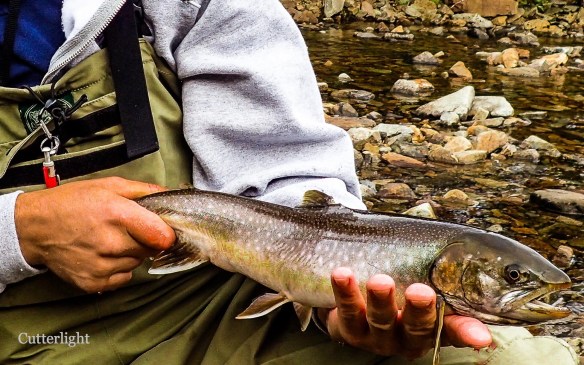
Jerry took this stunning female Dolly on a tenkara rod and a bead. Rod, line, lure and pristine water… Angling doesn’t get any more beautifully simple.
Fishing over the same water we’d hit the previous day, we expected fewer fish. Happily, that wasn’t the case. In fact, our two largest char came on the tenkara rods. And for the second day in a row, except for a pair of dippers and a belted kingfisher, we had the stream to ourselves.

So how did this fascinating member of the trout and char clan come to be called “Dolly Varden?” Glad you asked.
It seems that sometime in the 1870’s anglers on northern California’s McCloud River were catching a species of brightly-colored trouty-looking fish. Admiring the brilliant spots and colorful markings, the anglers called them “calico trout” after the floral-patterned cloth. A group of fisherman were looking over a catch of these “calico trout” and lamenting that there wasn’t a better name for them when a 16-year old girl, the daughter of local resort owners, happened along. The girl had been reading Charles Dickens’ Barnaby Rudge in which there is a character by the name of Dolly Varden. This character was named for the feminine fashion of the time, a muslin dress worn over a brightly colored petticoat. In fact, the girl had recently received a dress and petticoat in that very style. “Why not call them ‘Dolly Varden?’” she suggested.
The name stuck, and so this most colorful salmonid came to known by a most colorful name.

The eponymous Dolly Varden fashion of the 1870s…

…And an exquisite specimen of Salvalinus malma – the Dolly Varden char.
Back in the skiff heading home, a squall packing icy rain hit us square in the face as we rounded the cape. We pulled jacket hoods tight and hunkered down, following Clinton’s directions to shift our weight against changes in wind and current in order to keep the boat on an even keel. No complaints. A few fish iced down in a small tub, time on a beautiful piece of water, a friendship renewed… And we never take for granted how fortunate we are to live in this land of staggering abundance.

Sleeves rolled up and arms elbow deep in Indian Creek’s frigid waters, I snapped a few frames not sure what, if anything, I’d get. There appear to be four species of salmon as well as a couple of dozen char in this shot.
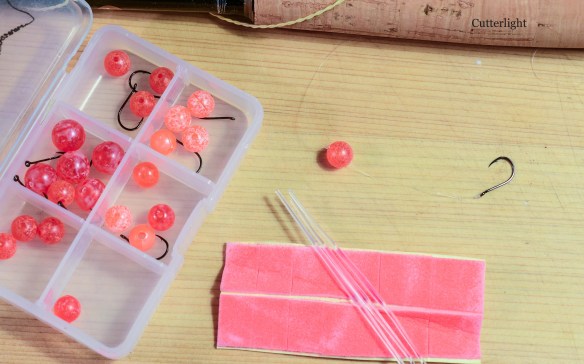
A basic bead kit includes a box with a few beads and a few short-shank hooks, silicon toothpicks (if you’ve been using wood, try silicon), and a card of self-adhesive strike indicators. (There are 12 pink, fingernail-sized self-adhesive foam squares on this card.) The strike indicators can be slid up and down the line depending on water depth. The bead, pegged to the line with a silicon toothpick (inserted and trimmed close to the egg) can also be slid. Note that the egg is affixed about two inches above the hook. This positioning ensures that fish are consistently and neatly hooked in or just outside the jaw, minimizing injury. A pack of small split-shot sinkers to keep the egg near the bottom is also handy. There’s still one more step before this rig is finished – can you spot it?
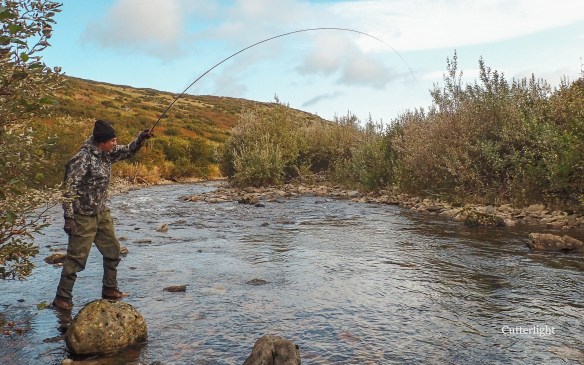
Look Ma! No reel! Determined fighters, even small Dollies put a nice arc in a tenkara rod. My connection with genus Salvalinus, the chars, began when I was about seven years old and caught my first brook trout, S. fontinalis, on Minister Creek in Pennsylvania. It’s an arbitrary thing, I suppose, to have a favorite fish, but if I had to name mine…