Ink and Light: “Winter Hunt” and Shakespeare’s Poem for Runners

saker-khustai-n

Winter Hunt: Saker Falcon, Kustai National Park, Mongolia

Prized by falconers for their beauty and power, Saker Falcons are endangered due to black market trading and habitat loss. They are the national bird of Mongolia.

           (From) The Winter’s Tale 
      Jog on, jog on, the foot-path way,
        And merrily hent the stile-a:
      A merry heart goes all day,
        Your sad tires in a mile-a.
William Shakespeare – lines from The Winter’s Tale, 1623

In otherwise good health, Shakespeare (1564-1616) died 3 days shy of 52. Many of his plays were published posthumously. According to one source, Shakespeare’s death followed a night of heavy drinking with Ben Johnson and Michael Drayton. An apocryphal tale or not, all of his plays contain references to drink.

Ink and Light: Framed in Light and “Something like a Raven”

x-framed-in-light-copy-n

Framed in Light: Umiaks and Northern Lights, Point Hope, Alaska

                   …in silence                  where all things
      and all beings reach                 back into time before iron and oil.
        dg nanouk okpik – Tulunigraq: Something like a Raven, 2012

Whaling crews of the Inupiat Eskimo village of Point Hope still hunt on the Chukchi Sea from traditional umiaks – small whaling skiffs with wooden frames and bearded seal skin hulls.

dg nanouk okpik is an Inupiaq-Inuit poet from Alaska’s North Slope. Nanouk is Polar Bear and Okpik is Cloudberry in the Inupiaq language. Her book Corpse Whale was published by the University of Arizona Press in 2012.

Ink and Light: “A River Runs through It” and Spring Snow in in the World’s Coldest National Capital

x-snow-dancers-copy-n

Snow Dancers: Ulaanbaatar, Mongolia – 2016

At over 4,400 feet in altitude, Ulaanbaatar, Mongolia, is the world’s coldest national capital city. Lows of -20° F and lower – sometimes much lower – are common.

She was as beautiful a dancer
as he was a fly caster.
Norman Maclean – A River Runs Through It, 1976

Norman Maclean (1902-1990) was 70 when he began writing A River Runs Through It and Other Stories. Rejected by every major publishing firm, the novella and two accompanying short stories were finally accepted by Chicago University Press where Maclean had taught in the Department of English. The book, which was almost instantly recognized as a classic, became the first piece of fiction the CU Press published.

Ink and Light: “For John Clare” and a Redpoll in Mongolia

x-thin-air-n

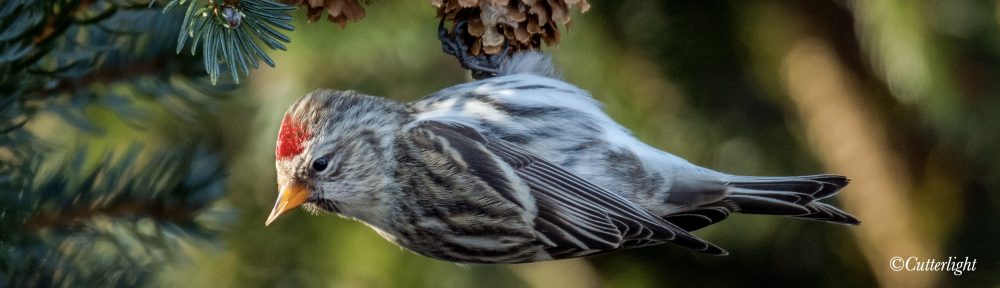
Thin Air: Common Redpoll, Ulaanbaatar, Mongolia

Redpolls breed in Arctic regions around the world, descending into lower latitudes in winter. A bird of the North, they generally are uncommon south of Canada.

For John Clare
The whole scene is fixed your mind,
the music all present,
as though you could see
each note as well as hear it.
John Ashbery, lines from For John Clare, published in 1969

John Ashbery’s (1927-) poetry has earned nearly every major award including the Pulitzer. The subject of this poem, John Clare (1793-1864), emerged from difficult early years to write beautiful poetry about the natural world before later being institutionalized for insanity.

Salinger’s Overlooked Masterpiece: Franny and Zooey

franny-sunshine

Salinger had a gift for placing his protagonists in certain, very specific places from which the rest of the world is held at arm’s length. In the case of the Glass family, to which Franny and Zooey belong, he went a step further and created an existence from which the rest of the world is barred from admission. No one is seen as quite good enough, interesting enough, self-aware enough, insightful enough or honest enough to be permitted into this singularly insular family. Except, of course, for the reader.

In Franny, the short story that opens Franny and Zooey, Salinger takes us to a vantage point from which we are permitted to observe and eavesdrop on a small table in a small restaurant where on a weekend break from college the protagonist is studying her date’s attempt to coax his frogs’ legs into position so he can have a proper go at them. She, meanwhile, barely touches the sandwich that has been set before her, preferring to chain-smoke while the two of them engage in distracted, fragmented but revealing conversation.

screen-shot-2016-11-11-at-10-34-39-am

The precision characteristic of much of Salinger’s writing could be distracting – if not downright annoying – in the hands of a less skilled author. The temptation would be to skim past much of the descriptive detail. But we don’t. Like detectives, we’re glued to every gesture, every phrase, searching for clues, knowing that even one passage carelessly glossed over might mean missing a vital element to the story unfolding before us. We sense almost immediately upon meeting Franny that something is wrong with her – or if “wrong” is too strong, then at least unbalanced. 

This installment of the Glass family saga was first published in The New Yorker in 1955. The novella-length Zooey, set almost entirely in the bathroom(!) and living room of the Glass’ apartment, was published in the same magazine a year later. In Zooey, it is almost as though the precisely detailed descriptive passages become the plot itself as every nuance reveals a lead.

screen-shot-2016-11-11-at-10-22-57-am

The two stories were bound together in book form in 1961. Although Franny and Zooey spent 25 weeks atop the New York Times Best Seller List, a number of reviews gave it harsh treatment. These rather peevish lines in 1961 from John Updike in the New York Times capture a general feeling expressed by others: “The author never rests from circling his creations, patting them fondly, slyly applauding. He robs the reader of the initiative upon which love must be given.”

Joan Didion crankily called the stories “spurious,” and slammed the pedantic nature of Salinger’s writing, likening Franny and Zooey to “self-help copy… for Sarah Lawrence girls.” (Ouch.) Alfred Kazin dismissed the writing as “cute.” Maxwell Geismar opined that the writing in Zooey was “appallingly bad,” and George Steiner dismissed the novella as “shapeless self-indulgence.”

Barbra and I had both, independently, read Franny and Zooey many years before we met each other. The book stayed with us (as did It’s a Perfect Day for Bananafish for me, the first installment of Salinger’s Glass family stories). Neither of us had any idea that the book had met with such disfavor when we added it our list of books to read together.

We found the work to be a quick, riveting read (and were amazed to later discover that some critics had groused that it was too long). I found myself comparing it with Fitzgerald’s The Great Gatsby for the very specific sense of place and character it portrays while remaining artistically fresh and thematically timeless. Zooey in particular is a masterpiece, and by that I mean that if writing were displayed in museums in the manner in which paintings are displayed, it would occupy a hallowed place beside a handful of other great post-modern works of fiction.

Searching the internet for positive reviews, we were gratified to find that forty years after the book came out, Janet Malcolm had come to the conclusions similar to those we’d come to. In Justice to J. D. Salinger, (The New York Review of Books, June 2001) she identified Zooey as “arguably Salinger’s masterpiece” and went on to write:

screen-shot-2016-11-11-at-9-34-40-am

Our view is that Franny and Zooey belongs in the canon of great American post-modern literature. Going beyond American shores in the genre, this is an excellent book to pair with a reading of Italo Calvino’s If on a winter’s night a traveler.

Writing for Readers who Love Reading – Italo Calvino’s “If on a winter’s night a traveler”

if-on-a-winters-night-calvino-n

‘The ultimate meaning to which all stories refer has two faces: The continuity of life, the inevitability of death.” From Italo Calvino’s If on a winter’s night a traveler, quoted in the film Stranger than Fiction.

I first encountered If on a winter’s night a traveler when I was stationed in Japan onboard USS Blue Ridge, reading voraciously during my free time at sea in an effort to prepare myself for college once my hitch was up. Published in Italian in 1979, Calvino’s masterpiece had just been translated into English. Did I come across it on a visit to the foreign literature section of Maruzen bookstore in Tokyo’s Nihonbashi district? Did my sister who was working on a master’s degree in literature send a copy to me? I don’t recall. But by the time I was a few chapters into it, I sensed that I was reading a book that would endure among the important works of postmodern literature. An “anti-novel,” some have called it, for the rules of narrative it challenged and broke. When writers and literature professors caution that readers should avoid asking the question, “What is this piece of writing about?” this is the kind of writing they have in mind.

As such, the fragmented journey Calvino takes readers on is not everyone’s cup of tea. An otherwise positive 1981 New York Times review concluded by pouting that the book contains “…a sadness of its central subject, the absence of the artist, Dickens, Tolstoy, Stendhal, Dostoyevsky…” whom the reviewer appreciated for the more linear plots they crafted.

Nevertheless, notice the names on the list Calvino’s work was being compared to: Giants.

Some years ago Barbra and I came across the film Stranger than Fiction, the story of one Harold Crick (Will Ferrell) who comes to realize that he has become trapped in a novel as the protagonist and that his life is being whimsically determined by the novel’s author. In his attempt to extricate himself from this predicament, Harold ends up in the office of literary professor Jules Hilbert (Dustin Hoffman) who, swinging on the pivotal phrase “Little did he know…,” offers Calvino’s observation that ‘The ultimate meaning to which all stories refer has two faces: The continuity of life, the inevitability of death'” and observes that Harold’s first task is to figure out whether the novel in which he is entangled is a comedy or a tragedy. This is one of our favorite films, and I suspected that Barbra would love Calvino.

And so we finally got around to reading If on a winter’s night a traveler, taking turns chapter by chapter against a Chignik Lake background of darkening fall nights, hot cups of tea and a little chocolate.

If on a winter’s night is packed with quirky juxtapositions, startlingly inventive metaphors, precise language, a metaphysical examination of the act of reading and light romance. These elements are masterfully woven together, if not by a plot, exactly, then by threads that pull the reader ever deeper into a literary mystery about a literary mystery. There, I used the word “about.” That’s enough. This is a book that will delight and fascinate readers who love to read.

It’s All in the Details – Super Rich Chocolate Chip Brownies and the Writing Process

brownies-chocolate-chip-n

Moist, cakey, fudgy… forget the description, just give me some of that!

Sometimes the lines get blurred between teaching elementary students and baking. *Warning* Do not read the following blog on an empty stomach. In writing, young students often find it difficult to add appropriately intriguing details to their writing. In order to teach these skills, I often model an example by writing in front of them. I will write something very simple like “My favorite dessert is a brownie sundae.” I will explain that interesting writing about food should make the reader hungry. They usually agree that my initial example didn’t accomplish this goal. Then I will write something like the following –

Imagine a brownie. Not just any brownie. This one is cooling from the oven. Its texture is somewhere between a rich chocolate cake and gooey chocolate fudge. The warm brownie has been saturated with melted chocolate chips that have been baked into this brownie. Atop this brownie mountain is a scoop of custardy French vanilla ice cream speckled with seeds from real vanilla beans. Homemade whipped cream with a faint aroma of vanilla is on top of the ice cream. Hot, thick fudge is dripped over the top of the dessert. It is warm enough to slightly melt the ice cream, but not hot enough to hurt your tongue. Of course, the whole sundae is topped with salty peanuts and a sweet, red maraschino cherry.

By the time I get to the description of the fudge, the students are usually squirming in misery. And my point is made.

The centerpiece and foundation of this favorite dessert is the brownie. Many people are staunch cakey brownie lovers. In the other camp are those who demand the gooey fudgy brownie. This brownie recipe results in a balance of moist cake texture with enough gooeyness to satisfy those who need that intense dense brownie. Enjoy this brownie in your favorite sundae – or straight from the oven. Do let it cool a bit before you dig in!

Super Rich Chocolate Chip Brownie

Ingredients

  • 2 cups granulated sugar
  • 5 large eggs
  • 1 cup canola oil (or other light vegetable oil)
  • 1 tsp vanilla extract
  • 1 1/3 cups all purpose flour
  • ½ cup Dutch processed cocoa powder
  • generous pinch salt
  • 1 cup semi-sweet chocolate chips

Directions

  1. Grease a 9 x 13 inch glass baking dish. Set aside.
  2. Preheat oven to 350 degrees F (175 degrees C).
  3. In a large bowl, stir together sugar, eggs, oil, and vanilla extract.
  4. Sift flour, cocoa powder and salt into egg mixture.
  5. Mix until moistened, do not overmix.
  6. Evenly spread batter into prepared baking dish.
  7. Sprinkle chocolate chips over batter.
  8. Bake for 30 minutes. Brownies will start to pull away from edge of dish when finished.
  9. Be patient. Allow to cool a bit before cutting.

Cranberry Days

cranberry-miniature-xtra-close-n

Framed in a boggy, wet miniature world between yellowing willow leaves and a lime-green horsetail stalk, clusters of ripe low-bush cranberries (lingonberries) push up through densely growing crowberry plants. Chignik Lake, Alaska.

The savannah sparrows that have been passing through in small flocks are absent today. The last of their kind, they’ve joined the white-crowned, golden-crowned and fox sparrows along with the wrens and warblers that flew south back at the beginning of the month. With most of the passerines gone, the shrikes, too, will soon go, following their prey. It’s been two weeks since we’ve seen sandhill cranes and at least that long since loons were gliding across the lake. This morning following a spectacular, fiery red sunrise, the light broke almost white. Winter light.

Making my way through the village toward the trail to the berry meadow, I spot a kingfisher perched stalk-still on a dead alder along the lake. A few glaucous-winged gulls wheel and soar low over the lake, calling listlessly as others sit placidly rocking on the windblown water. In the sky overhead, a pair of ravens show off their vocals with deep, resonating qua-orks and are gone. As the trail enters the dense growth of willow, salmonberry, alder and fireweed stalks gone to cottony seed, I can’t help but notice the absence of birdsong. Not even the chickadees are out. A mile later, up in the bog, there is only wind blowing through the raggedy last of the cotton grass and bowing the sedges in undulating, yellow-green waves.
 crane-track-2016-n

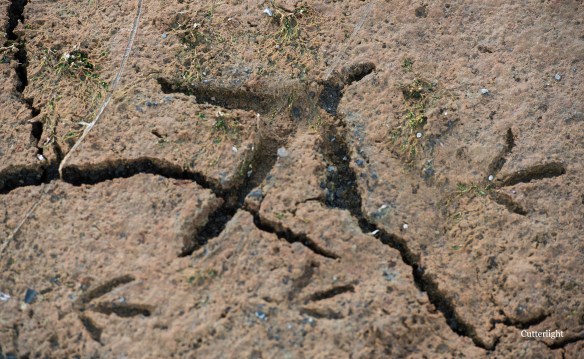
Remains of summer: Sandhill crane footprint and raven tracks on the edge of an ephemeral pond near the berry bog.

I enter the berry meadow quietly from downwind and scan for moose and bears. There are tracks and other sign in the soft mud, but no animals. A sudden gust sprinkles my face with cold, misting drizzle.

I pull a five-cup container from my backpack and begin walking the edges of the watery meadow looking for mounds of crowberry plants. Cranberries seem to like growing among these mosslike plants. It’s not long before I find the perfect mound. Looking carefully among the needle-shaped crowberry leaves, I see the tell-tale maroon that gives away the berries I’m after. As my eyes hone in on this specific shade of red, I see more. And then lots.
moose-track-1st-meadow-n

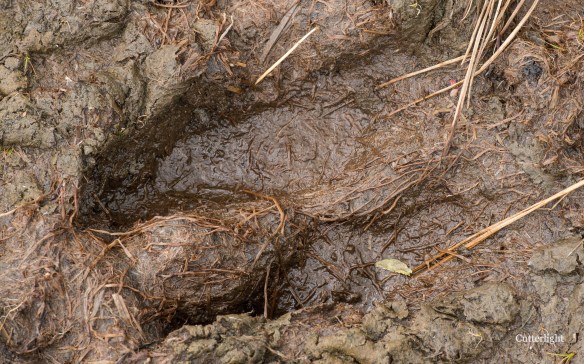
We sometimes find moose tracks at the berry bog as they come to feed on nutrient-rich sedges.
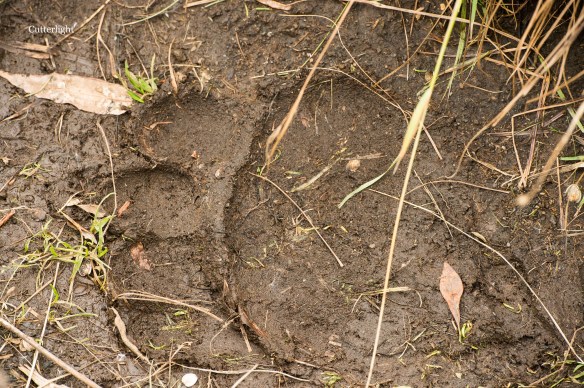
bear-track-1st-meadow-9-19-n

Brown bears (grizzlies) come to the meadow looking for the same thing that draws me – an abundance of bog-loving blueberries, crowberries and cranberries. Even with the nearby river and feeder streams brimming with salmon and charr, it’s common to find piles of bear scat loaded with little but berries and berry seeds.
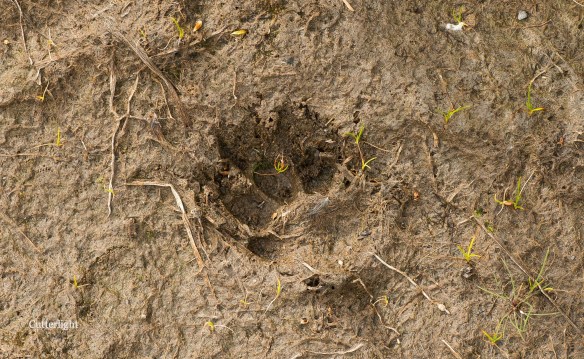
fox-track-1st-meadow-n

Red foxes love berries too, and are frequent visitors.

Picking goes fairly quickly and by lunchtime I’ve filled two containers with perfectly ripe, agreeably tart, firm berries. These I’ll clean and add to the two-and-a-half quarts Barbra and I picked yesterday, making well over a gallon. Freezing these lingonberries will sweeten them up a bit. After that, we’ll turn them into syrup to add to our Soda Stream fizzed water and into sauces for grilled pork cutlets, roasted chicken and Thanksgiving turkey. 

cranberries-in-moss-berries-n

Wild geranium leaves turned orange-red add a splash of color to one quart and one cup of low-bush cranberries… No one with a stash of gold ever felt wealthier.

While picking, my mind follows its own path in and out of dialogs and dreams but I try to remain vigilant to the possibility of animals. In addition to bears, moose, foxes and an array of birds, wolves, too, occasionally travel through the meadow. Just as I top off the second container, I hear a succession of three distinctive snorts directly downwind. Something has picked up my scent. A bear? A moose? I slowly stand and look. Whatever made the noise is buried deep in alders some distance away. I probably won’t get a look, but just in case I check the settings on my camera, make sure my canister of bear spray is handy, and pack up for the mile-long walk home.

Along the trail back to Chignik Lake, crimson fireweed stalks accent the gold of autumn willows. Up on the mountains, the season’s first snow.

As I come around a bend in the trail a snipe explodes into the air, it’s back marbled in browns and streaked with white. Sunshine breaks through the September clouds and the meadow and hills and distant mountains light up. I recall a story about a boy who fell asleep, and when he woke couldn’t determine if he was still asleep and dreaming, or wide awake in a new land.
The Magic of Freshly Cured Ikura (Salmon Roe Caviar)

ikura fresh in clear glass n

In The Bell Jar, Sylvia Plath describes eating an entire bowl of caviar by herself. Which sounds a little piggish. Certainly we would never do such a thing. No, never. The happy little seal… well, he’s not talking.

Making your own ikura (salmon roe caviar) is easy.  The recipe, linked below, continues to be one of Cutterlight’s most popular.

Click here for the recipe: Ikura: Curing Salmon Eggs

This batch came from a Sockeye salmon, and although chum salmon eggs are the traditional choice due to their large size, the ripe eggs of any species of salmon or trout work well.

C’mere and give us a kiss

mountain sheep give us a kiss n

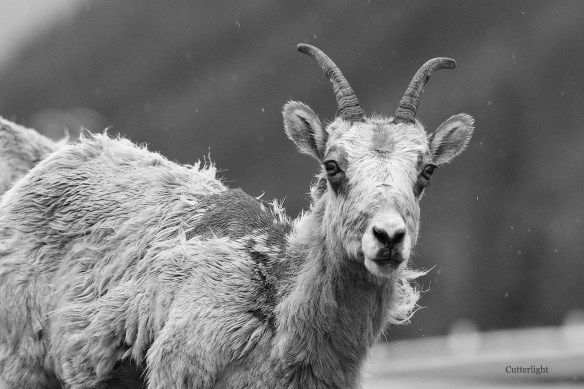
We’ve all been there – mornings when you’re out of cigarettes and reduced to digging through an overflowing ashtray; mornings when you can’t find your Scotch glass… or the sash for your robe. Your lipstick’s smeared from the night before, your head is pounding, you can’t even look at food and you just want to know that you’re still loved. (Stone Sheep Ewe on a rainy day in Alberta, Canada)