Unknown's avatar

About Jack & Barbra Donachy

Writers, photographers, food lovers, anglers, travelers and students of poetry

Corrupting a Child into the Art of Angling: a Journey from Granny Knots to 8-Weights

The 2018 cover of the Southwest Alaska Fishing Regulations featuring my photography: I was out on the ice last winter when I happened upon these two cuties (Barbra’s students) trying their luck for Dolly Varden Char and smelt on Chignik Lake. Teaching a young person to fish is an action that can have long legs and far-reaching positive consequences.

My father started my little sister and me with granny knots, #6 hooks, 10 lb test line, wine cork bobbers and solid fiberglass poles sans reels. Hers had a red handle. Mine was green. Half-a-mile below our house down the winding Route 322 hill lay Piney Dam Reservoir, an impoundment on western Pennsylvania’s Clarion River which, back in those days, was fairly fishless thanks primarily to acid runoff from coal strip mines and effluent from a paper mill 60 miles upstream. This was in the days before President Nixon’s executive order establishing the Environmental Protection Agency. The river looked clean – but the acid runoff left it relatively sterile, bereft of the web of aquatic weeds, tiny crustaceans and insect that make up a healthy ecosystem. These days, the coal mines are mostly gone, grown over with mixed forests of white pine and oak and other hardwoods that have reclaimed the landscape from the war-zone look I remember from childhood. Thanks to EPA regulations, the mining operations that remain are much more responsibly operated. Meanwhile, the paper mill modernized, also guided by EPA regulations. Now trout, bass, muskellunge, decent-sized panfish and, I’m told, even walleyes swim in waters that back in my day held little more than a few stunted sunfish, perch, shiners and bullheads.

Given time, if the Earth isn’t damaged too much, it can heal.

On the sunny side of the valley at the foot of the old 322 bridge was a small, wooden, long-abandoned dock. The steps leading down the steep embankment were rotting and coming apart. The dock itself wasn’t in much better shape. But unclaimed, we called it ours, as in “Let’s go fishing at our dock.”

Even digging up a coffee can’s worth of worms in preparation for those trips was an adventure, and with my dad being a biologist, something of a science lesson as well. For starters, we discovered that there were different kinds of worms; the little red ones worked best. And turned up by Dad’s spade would be other creatures: beetles and beetle larvae, centipedes and millipedes and alien-looking chrysalises. Sometimes garter snakes and little green snakes would glide out of the weeds ahead of us, and a rock turned over might reveal mice tunnels, big black crickets or shy red-backed salamanders with their protruding, otherworldly eyes.

There are four indispensable characteristics an adult must possess if he or she expects to successfully corrupt a child into the art of angling:

  1. The adult must know where there are fish an inexperienced child would be able to catch…
  2. …and he or she must know how to catch those fish in the easiest manner conceivable.
  3. Once conditions one and two have been met, the adult must possess the abundance of patience necessary to allow the young person to figure out how to catch those fish.

To his credit, although my dad took along his own outfit, after casting far from the cover of the dock out into featureless water where there would be no fish, he would set his rod down, ignore it, and focus on my sister and me. That way, if one of us might say, “Dad, you should fish too,” he could truthfully reply, “I am fishing.”

There were always a few panfish hanging out in the dock’s shade – diminutive bluegills and pumpkinseeds, a shiner or two, and our favorites for their combination of size, brilliant orange fins and qualities on the table, yellow perch. The shiners, too bony to deal with, went back into the water. As for the rest of the fish, five-inches was enough to make a “keeper,” and those went on a hand-made stringer. As long as we didn’t fish it too often, the dock could be counted on for a meal’s worth of fish.

The fourth characteristic necessary to develop an enthusiastic young fisherman is probably the most important. The adult must know when enough is enough. My sister and I were diligent in our attention to our wine-cork bobbers, staying with them as they rocked in the wake of ski boats, not moving our eyes from them for long minutes when they just sat there on placid water doing nothing. We didn’t miss many bites. But as time went by and we thinned the dock’s population of fish, bites became fewer and further between. The sun climbed higher and grew hotter. Small stomachs started to growl.

My father seemed to have a sixth sense for impeccably timing the question, Are you ready to call it a day?

No! Not yet! Let’s stay! Just one more? We’d plead.

Well, my dad would wisely say while enthusiasm was still running high, We’ve got enough for a meal. Your mother’s going to be wondering where we are. It’s time to go.

Aw-ww! That’s the response you hope to hear from someone you’re trying to teach anything to when it’s time to call it a day. Aw-ww, in at least two syllables.

Weeks went by between our trips to the dock, but my sister and I never lost track of whose turn it was to carry the stringer back to the car and triumphantly in through the kitchen door. Down in the basement, Dad would spread out yesterday’s Pittsburgh Press and we’d get to watch as he cleaned the catch. Too small to bother filleting, he’d scale the fish and gut them and remove their heads, so that by the age of six I knew enough about fish anatomy to pass a biology exam. We’d even open their stomachs to examine the dragonfly larvae, midge pupae and other tiny animals they fed on.

Upstairs in the kitchen, Mom made them Appalachian style – rolled in cornmeal seasoned with salt and pepper and fried golden brown and so crisp their tails were like potato chips. The three of us unerringly remembering whose plate the catch-of-the-day belonged on – usually a nice perch. Bread and butter and a big salad of lettuce, tomatoes and cucumbers from my dad’s garden rounded out the meal. Those summertime meals of fresh fish and garden salad are far and away my favorite childhood food memory.
Leftovers? Or Canned Salmon’s all You’ve Got? No Worries. Salmon Avocado Sandwich

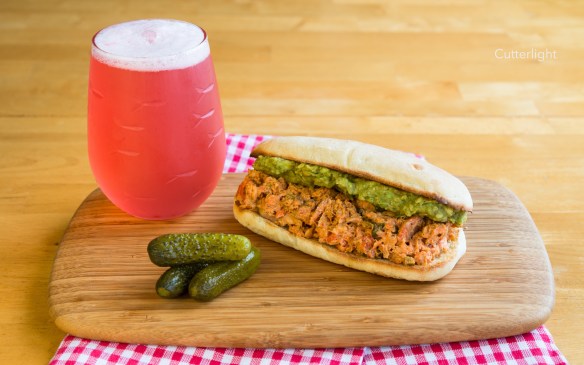
Whip up this restaurant-worthy salmon sandwich in no time with a can of salmon, an avocado, and a couple of ingredients you probably already have on hand. Serve it with something creative from your Soda Stream (that’s a Currant Fizz in the photo) or a glass of sparkling water with a slice of lemon.

Canned salmon is cost-effective, convenient and delicious. In fact, a lot of us who catch all the salmon we need to get us through the year can our own. It’s great in salmon burgers, salmon dip, salmon sausage, as a pasta topping or in any number of other recipes. When we lived in Mongolia, canned Alaskan salmon was the only salmon readily available. We always have this versatile, tasty ingredient in our pantry. Of course, you can easily make this sandwich with grilled or broiled salmon – or leftovers. We’ve made this sandwich with all of that, and have found king, red, silver and pink salmon all to work nicely. For environmental reasons, we don’t use Atlantic salmon.

Ingredients & Directions for Salmon Spread (makes 2 sandwiches)

In a bowl, combine.

Taste for salt and seasoning and set aside.

Ingredients & Directions for Avocado Spread

In a bowl, combine:

  • 1 avocado
  • 1 tsp lime juice
  • 1/2 tsp chipotle based spice mix
  • a little Cholula Chili Lime or similar hot sauce

Spread the two spreads on a toasted bun. Serve with tangy beverage such as sparkling water with a slice of lemon or a crisp ale.

Red Crossbill Feeding on White Spruce Cone Seeds, Chignik Lake, Alaska Peninsula

A young male Red Crossbill feeds on the seeds of a White Spruce cone it has picked up from the ground and carried to a nearby bough. In the background, the happy chattering of Redpolls and Pine Siskins can be heard. See below for a photo of this species’ unique bill.

In late fall, a mixed flock approximately 50 Pine Siskins and 15 Red Crossbills showed up at the White Spruce Grove here in Chignik Lake. As both species are rarely seen beyond coniferous forests of pine, hemlock, fir or spruce trees, we were surprised to find them one morning busily calling back and forth and feeding on spruce cone seeds in the stand of 20 White Spruce trees we call “The White Spruce Grove.” In fact, as best as I can determine, the photographs we’ve gotten of these birds are the first ever captures of either of these species in the Chigniks – or perhaps anywhere out on the Alaska Peninsula.

Crossbills and conifers have coevolved in a complex relationship in which different crossbill morphs (types of crossbills) have evolved bills specifically adapted to the particular type of cones they feed on. Thus one population of crossbills might have bills adapted for opening Ponderosa Pine cones, while another population might be adapted to open hemlock cones. White Spruce trees are not native to the Chigniks; they were planted here by residents decades ago when Chignik Village changed from existing as a hunting and fishing camp to a place of year-round residence. The original seedlings came from Kodiak Island. It is likely that the Red Crossbills that visited us made their way from Kodiak Island, or from some other White Spruce forest in Southwest Alaska. 

Although about 30 Pine Siskins remain as I write this, all but two of the Red Crossbills have vanished. Hopefully most have moved on to more suitable habitat on Kodiak Island or on the Alaska mainland, but with a Sharp-shinned Hawk and Northern Shrikes showing up from time to time and with resident Great Horned Owls ever on the lookout for an easy meal, given the lack of wariness most crossbills exhibit it is possible that some may have fallen to predators.

The feeding habits of these crossbills is fascinating. Their oddly configured bills are adapted specifically for prying open cones and pulling out the seeds. Although they frequently perch on the cones and feed in every position conceivable, including hanging upside down, crossbills often employ a more active feeding strategy. Foraging on the ground, they choose an especially seed-packed cone that has fallen from the tree. Taking this cone in their claws or bill, they fly to a nearby branch and dine on the seeds in the safety of the tree. When they’re finished, they drop it to the ground and search for another such cone. After a session of such feeding, they retreat deep into the safety of the tree to digest their meal at leisure.

So the next time you’re in a northern coniferous forest and a conifer cone drops to the ground, look up. You might catch a glimpse of a crossbill that has just finished its meal.

Reference: The Cornell Lab of Ornithology Handbook of Bird Biology, 3rd Ed, Lovette & Fitzpatrick

Rise and Roast! Sunday Morning Stout Slow Cooked Moose

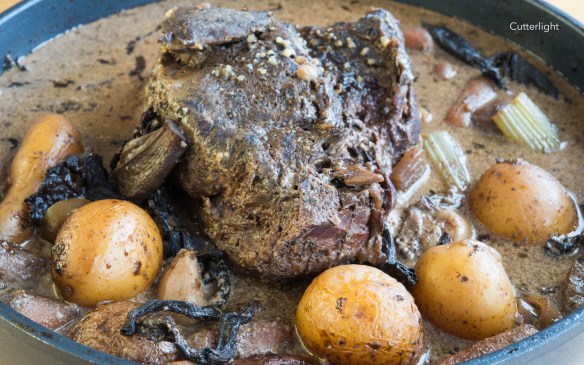
Aromas of mushrooms, tarragon, Italian herbs and root vegetables pulled together with a sweet, rich coffee stout make the temptation to steal a taste of this moist, nearly falling apart roast irresistible.

With winter hurling itself at us one more time last weekend and with a two-and-a-half pound cut of moose in the fridge, I decided it would be the perfect day to try something new – a slow-cooked roast. While I had in my imagination something beef brisket like, moist and practically falling apart, having never cooked anything like that, I wasn’t really sure how to go about the task. The cut of moose I had was very lean. Meanwhile, Barbra’s home-brewed Sunday Morning Stout, a rich, sweet, dark beer with a hint of coffee had just finished bottle-aging. How about a slow-cooked Sunday Morning Moose Roast?

I’m happy to report that after six hours in the oven, the roast came out moist, flavorful and pulling apart with ease. That evening, we served this dish on rice with a wonderful bottle of Malbec while snow fell outside our dining room window. Over the following days, the moose was featured in omelets, pulled moose barbecue sandwiches (yum!), on lumaca rigata pasta (the hollow shape captured the broth perfectly), and, once the moose meat was gone, as a hearty vegetable soup.

This dish was surprisingly easy. Although I prepared it in a sauteuse in the oven, I’m sure this recipe would work well in a slow cooker. Canned soup soup or broth could be substituted for the from-scratch broth described below, but don’t skimp on the stout. Use a generous amount of a good one. Beef or lamb would no doubt be delicious in this recipe as well. Add a few chunks of rutabaga or parsnips for additional flavor.

Sunday Morning Moose Roast

You will need an oven-safe sauteuse with a lid or a lidded pot large enough to hold the meat and vegetables. Alternatively, a slow-cooker can be used.

Ingredients

  • 2 to 3 pound cut of meat suitable for roasting. I used moose shoulder.
  • 4 cups dehydrated mushrooms* (or use 1 pound fresh mushrooms and beef or mushroom broth)
  • 1 cup cream
  • 16 ounces of a favorite stout beer (I used a coffee stout)
  • small whole potatoes
  • (optional) rutabaga, parsnips or other root vegetables, cut into chunks
  • 3 shallots, sliced (or substitute 1 sweet onion)
  • 1 bulb garlic, cloves peeled and slightly crushed, but left whole
  • carrots cut into chunks (or use baby carrots)
  • 2 or 3 stocks of celery, cut into 1 1/2 inch pieces
  • Worcestershire Sauce
  • freshly cracked black pepper
  • sea salt
  • tarragon
  • Italian herb blend
  • extra virgin olive oil

Directions

  1. Place oven rack on next to lowest level. Preheat oven to 220° F.
  2. Season meat liberally on all sides with cracked pepper and sea salt. Set aside.
  3. Place dehydrated mushrooms in a sauteuse or other sufficiently large pan and add water to hydrate – about 6 to 8 cups. Bring to a boil, then cover and reduce heat to simmer till mushrooms are tender.
  4. Remove mushrooms and set aside but keep the mushroom broth.
  5. Stir cream into the mushroom broth, add tarragon, Worcestershire sauce and sea salt to taste. Continue cooking at a high simmer until broth is slightly reduced.
  6. Stir in stout and add Italian herb blend. Continue simmering over low heat.
  7. Meanwhile, in a separate frying pan, heat olive oil over medium heat. Add shallots and garlic and sauté until just soft. Add shallots and garlic to mushroom broth.
  8. Remove pan from heat. Place seasoned meat into broth.
  9. Add mushrooms and all the vegetables except for the celery, arranging them in the liquid around the meat. There should be sufficient liquid to cover just over half the roast.
  10. Cover the pan and place into oven.
  11. After 4 hours, add the celery. Cover and continue cooking for two more hours.
  12. After 6 hours, remove pan from oven. Taste broth to determine if additional salt or seasonings are needed.
  13. Serve over rice, on pasta or as is. Accompany with the same stout used in cooking, or with a full-bodied red wine such as a Zinfandel, Cabernet or Malbec.

*The Dried Gourmet Mushroom Mix from the Wild Mushroom company works particularly well in this dish.

Sunshine on a Snowy Day – Raspberry Lemon Curd Bars

Sunshine on a winter’s day… Lemon bars drenched in tangy-sweet raspberry jam

I love chocolate – in every form, flavor, and dish. I love dark, white, and milk chocolate. Except for a weird, avant-garde chocolate bar infused with pepper (??), I can’t think of a chocolate creation I haven’t enjoyed. Almost neck-in-neck with chocolate are desserts made with lemon. The difference with lemon is that it not only has a wonderfully tart flavor, but it also has a strong seasonal connection to summer. One bite or sip of lemon brings me back to sunshine splashed afternoons and evenings cooled by gentle breezes sitting in our little piece of paradise behind our home in California among Meyer lemon trees. When we moved to Alaska, I even made up a gallon’s worth of Meyer lemon simple syrup in order to ease the separation from those prolific trees.

As we hit the middle of March, our minds drift toward Spring! In our former life, I would be itching to get the planting pots and garden beds ready. In Chignik Lake, I’m ready to pull the Pack Rafts out and head down nearby rivers. Mother Nature has had three little words in response to these inclinations…”Not. So. Fast.” All the snow we didn’t see this past winter has been just now swirling around our windows and creating lovely white drifts. Our lake iced over, started to thaw, and is now covered in ice again.

As Jack tends to his culinary diversion, a slow-cooked moose roast, I decide on my own diversion…one that will bring a little sunshine into our home. I took a tried and true lemon curd bar recipe from my Williams and Sonoma Baking Book and adapted it with items from my bush pantry. All I can say is Wowee! After the initial mix of sweet and tart lemon, you are rewarded with a blanket of pure raspberry bliss. A definite blast of summer, in the best way possible.

Raspberry Lemon Curd Bars

Ingredients

Crust

  • 1 cup all-purpose flour
  • 1/3 cup granulated sugar
  • pinch salt
  • pinch cinnamon
  • ½ cup unsalted butter, melted

Filling

  • ¾ cup granulated sugar
  • 2 tbsp all-purpose flour
  • pinch salt
  • 3 large eggs (I used powdered eggs)
  • ½ cup lemon juice (I used good quality bottled lemon juice)
  • 3 tbsp heavy whipping cream

Topping

  • Raspberry jam (I used freezer jam which has a much brighter color and flavor)
  • Confectioners’ sugar

Directions

  1. Make crust.
  2. Preheat oven to 350° F (180° C).
  3. Grease an 8-inch square glass baking dish.
  4. Mix crust ingredients together.
  5. Press dough into bottom of baking dish.
  6. Bake for 20 minutes. Crust should be a pale golden color.
  7. Let the crust cool in the baking dish on a wire rack while you prepare filling.
  8. Reduce oven temperature to 325° F (165° C).
  9. Whisk together filling ingredients.
  10. Pour the mixture over the baked crust.
  11. Bake until filling is set, about 20 minutes. It may slightly jiggle when dish is shaken.
  12. Let lemon bars cool in the dish on a wire rack for at least 30 minutes.
  13. When ready to serve, run a knife around the edge of the pan. Cut into 12 or 16 rectangles.
  14. Remove from dish with a spatula and place pieces to be served on a serving dish.
  15. Spoon desired amount of jam on each piece.
  16. Dust each piece with confectioners’ sugar right before serving.

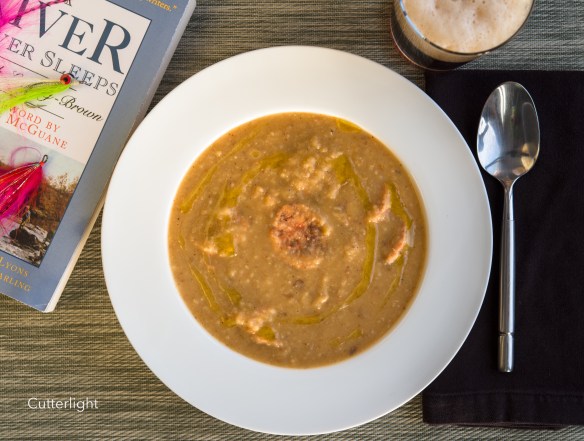
Not yet done with Winter: White Bean & Butternut Salmon Sausage Soup

A great read,* a hot bowl of soup, memories of last fall and dreams of summer…

A cold snap has fallen on Chignik Lake. Middle March, and once again our our world in this remote corner of Alaska is blanketed in snow. This morning we woke to find our lake glassed off with ice, the flocks of Goldeneyes and Scaup that had gathered in the view out our window gone to find open water. Now and then our resident family of otters appears on the ice to take advantage of new fishing opportunities in mid-lake openings, happy to bask in the late morning sunshine. The silver bright salmon of last autumn have long since spawned and died.

As recently as January there were still a few late-run salmon clinging to life in feeder streams. Even those fish are gone by now, returned to gravel stream beds, becoming nutrients in the web of life their offspring will soon depend upon. Even the char have disappeared, huddled together somewhere in deep water, waiting for spring.

March is a month for tying flies and sorting through gear, a month for evening games of Scrabble and tucking into a good book. March is a month when the next generation of salmon are stirring in their redds and you imagine those tiny fish and even though the water is covered with fresh ice,  you think to yourself, “Spring is coming.”

March is a good time to make big pots of soups and big plans for summer. This soup is one of our favorites. I prepared the salmon sausage without using eggs and I added chorizo to give it some zip. I seasoned the sausage with an Italian herb blend and added additional ground fennel, which came through nicely. It’s soup, so experiment with ingredients to make it your own.

White Bean & Butternut Salmon Sausage Soup

Ingredients

  • 6 cups white beans (3 16oz cans)
  • 1 butternut squash, roasted or steamed until tender, rind removed, cut into cubes (or used canned pumpkin or squash)
  • 6 cloves of garlic, sliced thin
  • 1 shallot, sliced thin (or substitute a small sweet onion)
  • 3 cups chicken broth (enough broth to thin the bean & squash mixture)
  • 1 or 2 lbs salmon sausage (see recipe here). Or substitute any sausage.
  • sea salt
  • 1 tablespoon of a favorite spicy mix featuring powdered chipotle (See “Jack’s”)
  • olive oil

Directions

  1. Add a tablespoon or 2 of olive oil to a frying pan and heat over medium heat. Add the shallots and garlic and sauté until soft. Remove from heat and set aside.
  2. Using a stick blender, food processor or conventional blender, purée the beans, squash, garlic and shallots, adding chicken broth as you do this to create a thick soup.
  3. Add the purée to a large pot. Add additional chicken broth to achieve desired consistency. Stir in seasonings, bring to a simmer and cook for a few minutes. Taste to determine how much salt is needed and if additional seasoning is required.
  4. Add the salmon sausage and gently stir in. Allow to simmer for a few more minutes.
  5. Ladle into serving bowls, drizzle with a favorite olive oil, and serve piping hot.

*A River Never Sleeps, Roderick Haig-Brown, 1946

The Connections between Bears and Us: BEARTREK

“When we try to pick out anything by itself, we find it hitched to everything else in the Universe.” John Muir

Follow bear biologist extraordinaire Chris Morgan from the wild’s of the far north to the mountain deserts of Peru to the jungles of Borneo in this superbly filmed and narrated full-length wildlife documentary. Deeply passionate in his vision to positively affect the world, Chris’s premise is that if people understand and appreciate bears in all their amazing diversity, they will take action to help these fascinating animals, which will in turn help to safeguard our shared environment.We watched the film for free on Amazon Prime.

I (Barbra) have had the opportunity to interview Chris Morgan with students on two different occasions, a testament to how generous Chris is with his time and how dedicated he is to bringing his message to young people.

Have a wildlife documentary you’d like to let others know about? Leave a comment below!

Intrepid Trepidations

Staring at my readied bike loaded with gear for this summer’s epic adventure, I am filled with… fear, excitement, anxiety, worry, nerves…

I’ve read so many articles and blogs and books about traveling. The common theme in these stories is excitement. The stories often have a dramatic edge. In the spirit of excitement, there is often reckless abandonment of caution and unplanned success. The stories are invigorating and inspiring – always with a happy ending. As my bike stares back at me, daring me … I find myself thinking that I’ve never read the version of the story that started with a daunting case of nerves. This seems to be my story.

The inspiration for this summer’s adventure began a few lifetimes ago. When I was young, my family used to camp. I remember watching bicyclists loaded with camping gear trekking along California blue roads from the window of our VW Camper. I loved to ride my bike. And I was instantly in love with the idea of being self-sufficient on two-wheels trekking anywhere I wanted to go.

Anyone who has known me over the past few decades could testify that I am an adventurous person. I have been known to get up and go do something based on very little information, sometimes on just an idea that something would be fun. I have had many happy endings to those stories, just like those I have read. So why worry now?

I stare at my bike. Its panniers and fork bags puffy with camping gear. As if in answer to my question, the front fork bag of my bike falls off and spills.

It’s the logistics of this trip that make it like no other. I’ve always been able to fill a backpack or a suitcase and go. But this summer, the adventure includes more than what can be packed in a backpack. We’ve planned a trip that involves bicycling around a foreign country for three months. The activities on the trip are to include sightseeing, culinary adventures, fishing, photography, backpacking and maybe even pack rafting. Aside from test packing and other activities we can do to get ready while in Alaska, the additional logistics are mind boggling. In order to get this trip started, there is the first leg – which seems to be the most daunting of the logistics – we need to maneuver all of our gear from our tiny village of Chignik Lake, through the city of Anchorage and all the way to the north island of Hokkaido, Japan. The other part of the logistics is planning for daily mileage and making sure we are in good enough shape to pull off this physical adventure.

All this planning is, of course, in theory. I have so many questions… How many miles can we realistically bike? Can we carry all the gear we want to carry? Are we over packing? Are we forgetting something critical? Will our gear be safe from thieves? Will we be able to find campgrounds as easily as we hope? Will the roads be safe to ride on? Are we going to have trouble transporting our gear with the airlines? Is this too big an undertaking?

So, Jack and I sat down to tackle, not the questions, but the psychology behind the questions. Our discussion centered around the question, “Do we really want to take on a trip so far outside of our comfort zone?” The answer, it turned out, was a resounding Yes!

So, plane tickets have been purchased. The first test packing has been completed. Our trip itinerary is coming together. The bike and treadmill workouts are underway. And the faith that we are resourceful people is the response to those questions that really can’t be answered until we begin the journey.

And now I propose a toast: Here’s to another summer of epic proportions living well off the beaten path. Cheers!

Progressivism Always Prevails. Reasons for Optimism in the Aftermath of 17 Preventable Deaths

Above: The future. Below: I wrote the following letter to my daughter, Maia, and share it here. Have faith. Our side always wins in the long-run. Always.

Dear Maia,

I spent a good bit of the latter part of this past week looking at the images and listening to the voices out of Douglas High School in Parkland, Florida. It is incomprehensible to me that a teenager who can’t legally purchase a beer, or drive a car without a license, is able to legally purchase an assault weapon with the capacity to fire dozens of deadly rounds in a single minute. In fact, it’s incomprehensible that any civilian is able to legally own such a weapon.

Incomprehensible, that is, until one considers that the single most powerful political lobby in Washington is the NRA and that they own nearly every single Republican politician – politicians who, apparently, value NRA campaign contributions (and promises of post-retirement speaking fees) more than they value the safety of American citizens including our children and young people. The top 10 recipients of NRA money in both the U. S. Senate and the U. S. Congress are all Republicans. (Rather than provide a link to verify this, I encourage readers to do their own research in order to get a real sense of just how deeply the NRA has its claws into our Republican politicians. )

And so it should be no surprise that in his role as House Speaker, Congressman Paul Ryan, (Republican, Wisconsin) will permit neither meaningful floor debate nor a meaningful vote on anything that would curb the lucrative sale of guns in this country. Or that in the aftermath of one mass shooting after another, the only pleas he makes are pleas for non-action.

In the past election, Donald Trump received over $30 million in direct and indirect campaign money from the NRA. And so, again, it should come as no surprise that Trump has promised the NRA he will never sign legislation undermining gun sales. “You have a true friend in the White House,” Trump told the NRA.

Who, in Parkland, Florida, among the 14 dead young people and the three teachers and coaches who loved these kids and laid down their lives to protect them, and their families, and their friends , have a “true friend” anywhere in the Republican Party? Or the next 17 dead? Or the next 17? Or the 17 after that?

Even the majority of gun owners do not want these current lax laws to exist. (Anything you suspect I’m making, up, you should research.) It’s an NRA thing. It’s a Republican thing. It’s a $32 billion dollar a year gun industry thing.

Money over lives in the GOP party of coal, tax breaks for the rich, opposition to national health care, hostility toward education, unending wars on our environment and indifference toward the DACA young people who came to the United States with their parents. Build a wall, like they did 2,000 years ago in China. Have a military parade, like they do in North Korea. And keep taking NRA money.

With fellow Americans voting for Republican majorities in the House, the Senate and (by a minority vote only possible in America) giving the presidency to Trump, how can I be optimistic?

Maia, remember what I told you about ISIL? That this terror-war waged by a minority of Muslims was the predictable outcome of a variety of international policies and that over time it would subside? You can Google maps of ISIL’s gains and losses; they began steadily losing ground a few years ago. This is one of the few areas where Trump has kept Obama-era policies in place, and ISIL’s demise is continuing.

At the same time, countries inviting people from war-torn nations to enter their borders and to experience life in free, Democratic societies – to benefit from higher education, to make friends, to see the world through a more progressive lens, to reduce fears and misunderstandings on all sides – are doing more to defeat terror than all the bullets and bombs combined. The people of Sweden, Germany, France and other countries accepting émigrés have taken risks in opening their borders. They are heroic for doing so.

And they are on the right side of history.

Over the long haul of history, progressivism always win. Always. As a species, we periodically subject ourselves to bloody crusades, anti-science/anti-legal-system dark ages, tribal holocausts, authoritarian reigns of terror and the predictable aftermath of colonialism/neocolonialism and slavery. But along the longer arc, we slough off these primitive instincts, allow our better angels to guide us…

…and we keep moving forward.

And now we are here – at a day and age when, despite pockets of evil, on a scale never before even imagined in human history more people than ever are enjoying freedom, prosperity, access to education, health care, self-expression and art. If we can begin to address population growth, it will only get better.

Out of every darkness, there has come a time when a new generation has wrested leadership from their elders and demanded a new course. The overwhelming majority among the current generation now coming of age are rejecting the Republican Party’s backward push to coal, bigotry, misogyny, unsustainable growth, and Feudal era solutions to 21st century challenges (the wall).

And senseless access to guns that serve no purpose other than to kill fellow human beings.

I’ve been listening to the voices out of Douglas High… Emma Gonzalez’s being one of the strongest (do Google her)… And my heart is full. I’m optimistic that change is coming. Maybe not tomorrow… but it’s coming.

Because over the long haul, we always move forward. Progressivism prevails. And in the pursuit of optimism, patience is a virtue.

Love, Dad

JD, Chignik Lake, Alaska

Burn Barrel Love (Valentine’s Day)

Burn Barrel Love, Chignik Lake, Alaska

Waking to heavy snowfall a few weeks ago, we went out looking for wildlife. At the White Spruce Grove, Pine Siskins, Chickadees, Golden-crowned Sparrows and Dark-eyed Juncos were happily filling up on cone seeds and the food in our feeders. We’d heard there was a lynx in the area, and there are always foxes and wolves just beyond the village. We didn’t see much – just this pair of Ravens hanging out and enjoying a snowy moment at one of their favorite meeting places.