Chasing the Elusive Perfectly Flaky Crust: Double-Crust Apple Apricot Pie

This rustic-style pie evoked images of apron-clad moms setting out steaming-hot baked goods on windowsills to cool. The scent of baked apple and cinnamon filled the entire house, contributing to the sense of nostalgia.

I’d always heard that baking the elusive flaky pie crust was so difficult, it wasn’t worth the time and effort. The standard advice was, “Buy pre-made crusts. They’ll come out better.” But as someone who has baked her own graham crackers, I wasn’t so easily deterred.

After doing some research, I began to understand why people shied away from making their own crusts. Fastidious attention to temperature of the ingredients seems to be the key. My first crusts came out fairly decent, but I wasn’t completely happy with the texture. Then this month’s Food & Wine magazine ran an article about making a perfectly flaky crust.

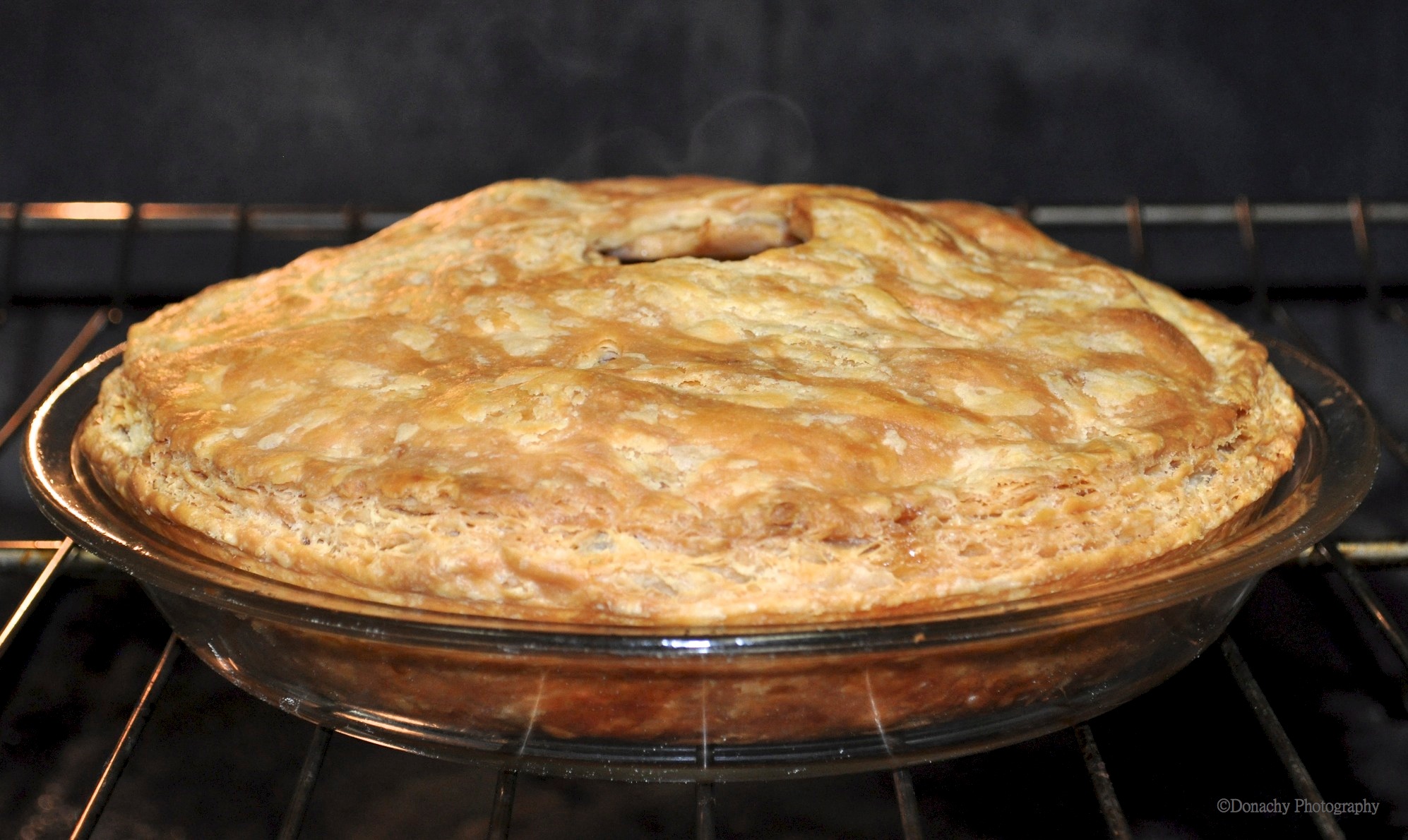
Along with directions for “perfectly flaky butter pie dough,” the magazine also had a recipe for a double-crust apple-apricot pie. Perfect! Granny Smith apples are available at our Native Grocery Store, and dried apricots are a staple in our pantry. The finished pie came out of the oven steaming with the scent of apples and apricot and with a golden-brown crust puffed up into a flaky  top.

Double-Crust Apple-Apricot Pie

Ingredients

  • 1 tbsp all-purpose flour
  • dough for two pie crusts (see link below for pie crust recipe and directions)
  • 1 egg white, beaten
  • 5 large Granny Smith apples, peeled, cored, quartered, and cut into thick slices
  • 1/2 cup granulated sugar
  • 1/2 cup diced dried apricots
  • 1 tsp finely grated orange zest
  • 1 tsp ground cinnamon

Directions

  1. Roll out a little more than half of the dough into a 13-inch disc. Transfer to a 9-inch glass pie dish.
  2. Roll out the remaining dough into a 12-inch disc and keep in refrigerator until you are ready for it.
  3. Preheat oven to 400 degrees F.
  4. In a large bowl, toss together apples, apricots, orange zest, flour, cinnamon and sugar.
  5. Pour apple mixture into crust.
  6. Brush edge of crust with egg white. This will help seal the two crusts together.
  7. Place second pie crust on top of first. Trim edges and decoratively crimp. Cut slashes in top crust to allow steam to vent.
  8. Place oven rack on lower third of oven. Place pie on a baking sheet and put in over to bake for 1 hour. Cover edges of pie with a pie ring or aluminum foil during last 20 minutes of baking to prevent burning.
  9. Remove pie from oven and allow to cool before serving.

We served this pie with extra rich vanilla ice cream, which was excellent. A slice of sharp cheddar cheese is another traditional option.

Recipe adapted from Food & Wine Magazine, November 2012 issue.

Alaska: Northern Lights in the Big Point Hope Sky

Named for the Roman Goddess of dawn, Aurora, and the Greek word for north wind, Boreas, Aurora Borealis events originate with the sun and are carried to Earth on solar winds.

Notice the seal skin boats in front of the snow fence in this photo looking northwest along the lagoon at Point Hope. The most common color for  Northern Lights is green – whitish green on nights of weak activity. Yellows, pinks, reds and purples are less common. Any color in the night sky is a thrill.

We have a phone tree set up so we can let each other know when the lights are out in force. When our phone woke us just after five AM this morning, we didn’t even pick up. We threw on warm clothes and coats (the windchill was below zero degrees Fahrenheit) put together the camera and tripod, and headed out the door. 

We walked away from the town’s lights, to the darkness near the lagoon, and set up. We took these shots with a 15 second exposure. When the lights are active, they move, constantly changing shape and color. 


The Arctic Foxes at Tikigaq Cemetery

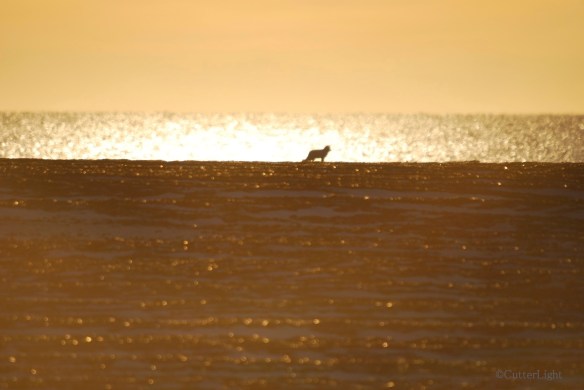
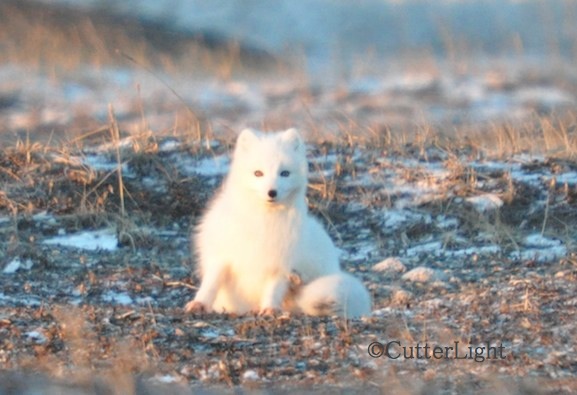
Stunning in their soft, white coats, Arctic foxes (Vulpes lagopus) are common in this part of Alaska. The size of a small dog and as soft on their feet as a cat, these omnivores forage on whatever is available, from berries to insects to small mammals and birds – and it appears, big, fat marine worms!

In the past few weeks, there have been spawning events on our beaches near Point Hope. A couple of weeks ago, we were hearing about small fish – probably capelin (smelt) – coming ashore with the surf. More recently, we’ve been finding large marine worms on the beach. The size of Ball Park Franks, the appearance of these worms has coincided with egg cases in areas of coarse sand and gravel. In turn, these spawning events have drawn numbers of snowy owls and Arctic foxes looking for easy meals to the point of land west of town.

Morning sunlight slants through the jawbones of bowhead whales commingled with crosses at the Tikigaq cemetery in Point Hope, Alaska.

Not so long ago, National Geographic Magazine ran an article about domesticating foxes. Apparently there’s been some success, as breeders in Russia select the most gentle, friendly, trainable and inquisitive offspring generation upon generation. At an average size of six to eight pounds, Arctic foxes would be just the right size to curl up on the sofa for an evening of popcorn and a movie.

Like ribs pushing up from the tundra, these bowhead jawbones mark the resting place of one of Tikigaq’s last shamans.

The diversity – and sheer number – of animals and plants that manage to hack a living out of this cold land amazes us. Far from being the vast, frozen desert the Arctic has often been described as, each season brings with it an astounding number and variety of flora and fauna to the land and sea around Point Hope. Tracks in the snow near our house reveal that we have a weasel or two living beneath our porch!

Quiche de Poireaux: Leek Quiche with Oysters and Smoked Salmon

Just a hint of spice is enough in this quiche that combines sautéed leeks, small oysters and smoked salmon.

When a friend recently bestowed upon us three large leeks, our thoughts converged on a family favorite: leek quiche. Craig Claiborne includes a recipe for this classic dish in his New York Times Cookbook. His Quiche de Poireaux includes ham, which, in our kitchen, had become bacon and more recently smoked salmon. One of the things we like best about quiche is its versatility, working equally well as a breakfast, lunch or dinner item.

When choosing oysters for this quiche, choose the smallest you can find. If fresh oysters aren’t available, canned oysters such as Pacific Pearl are an excellent substitute. Add spices sparingly so that the flavor of the sautéed leeks shines through. Accompanied by a lightly chilled glass of viognier, a morning with not much to do, and a crossword puzzle, this quiche makes an excellent breakfast or brunch entrée.

Ingredients:

  • 1 unbaked, standard-sized pie crust (or use one a bit deeper than usual)
  • 4 large eggs
  • 1/2 cup heavy cream
  • 3/4 cup milk
  • 2 large leeks, diced into thin circles
  • 6 oz extra small oysters (fresh or canned)
  • 3 oz smoked salmon, broken into chunks
  • 1 cup shredded Swiss, Gruyére or similar cheese
  • 2 healthy pinches ground smoked chipotle pepper
  • healthy pinch arbol or cayenne pepper
  • couple dashes paprika
  • 1/2 tsp teaspoon oregano
  • several grinds black pepper
  • 1/2 tsp smoked sea salt
  • 1 tbs olive oil
  • 1 tbs butter

Directions:

  1. Shape pie dough to pan. Cover and refrigerate to keep cool.
  2. Preheat oven to 400 degrees F.
  3. Heat a large frying pan over medium heat, add olive oil, butter and diced leeks. Stir occasionally, until leeks separate and are tender – about 5 minutes. Place in a bowl and set aside to cool.
  4. In a large mixing bowl, whisk eggs together till well-blended. Add seasonings, salt, pepper, milk and cream and stir together with a spoon. Stir in cheese and leeks. Last, gently stir in smoked salmon and oysters, taking care not to break them up.
  5. Remove pie shell from refrigerator and pour mixture into chilled shell. Place pie pan on baking sheet and put into preheated oven.
  6. Bake at 400 degrees for 15 minutes.
  7. Lower oven temperature to 375 degrees F. Cover exposed pie crust with foil or pie ring (to prevent crust from burning) and continue baking for 30 minutes, or until quiche is set. (The filling will no longer jiggle when gently shaken.)
  8. Remove from oven and let cool on a wire rack for 10 minutes before serving.

Serve with fresh fruit such as grapes, melon, sliced pears or other fresh fruit. Given the mildly spicy nature of this quiche, it would pair well with a viognier.

Hearty Bean, Roasted Squash and Sausage Soup

Hunks of crusty, toasted baguette and parmesan cheese accompany one of our favorite wintertime soups.

We don’t get many fresh vegetables up here in Arctic Alaska. Squash really shines. It ships well and keeps for months, so every August we fill a tub with an assortment of acorn, butternut and spaghetti squash, put in in the mail, and use them in pies, soups and entrées over the following months. Puréed butternut squash is a terrific way to thicken hearty soups. I do a version of bean and sausage soup every winter in my big soup kettle. This year’s was our favorite to date, and although ingredients on hand will always necessitate minor changes, we’ve now got a base recipe that’s a keeper.

Although ingredients can be freely substituted, the combination of smoked chipotle peppers and star anise is especially nice. Make this dish even tastier by roasting the squash and the tomatoes on a charcoal grill.

Hearty Bean, Roasted Squash and Sausage Soup

Ingredients:  Makes about 2 gallons. If you do not have whole peppers, substitute powdered cayenne or similar pepper, or use a good chili or Thai blend.

  • 1 medium butternut squash
  • 1o cups black and pinto beans (or use all black beans), soaked, tender and ready for cooking
  • 3 stars of star anise
  • 8 cloves garlic, chopped coarse or sliced
  • 3 smoked chipotle peppers, ground fine (use a food processor)
  • 1 ancho pepper, ground fine
  • 1 tbs oregano
  • 1/2 tbs thyme
  • 1 bay leave
  • two sweet onions, chopped coarse
  • several grinds black pepper
  • 1 1/2 pounds sweet corn
  • 1 pound sausage, sliced (I used chicken sausage.)
  • olive oil
  • chicken broth – enough to cover beans plus some additional broth to use when puréeing the squash. (I use Better Than Bouillon to make the broth.)
  • 2 pounds diced tomatoes, canned or fresh, seeds removed
  • smoked sea salt, to taste

Directions:

  1. Place a cooking sheet in an oven and preheat to 400 degrees F.
  2. Squash: Cut away the stem and slice into discs approximately one inch thick. Quarter these slices. Remove seeds and stringy flesh. Leave the skin on.
  3. Place the squash in a large pan, add olive oil, and toss till all pieces are well coated.
  4. Lightly oil the heated baking sheet in the oven and place the oiled squash pieces on the pan. Roast until thoroughly cooked through and soft – about 20 minutes.
  5. Place cooked squash on a large cutting board. When cool enough to work with, use a knife to remove the skin.
  6. Use a stick blender or food processor to purée the squash a few chunks at a time. Keep the mixture fairly thick.
  7. When all the squash has been puréed, place in a container and set aside.
  8. Meanwhile, in a large soup kettle combine the beans, star anise, garlic, chipotles, anchos, oregano, thyme, black pepper, bay leave, enough chicken broth to cover all the ingredients, and 2 tablespoons olive oil. Bring to a simmer, stirring occasionally, and continue cooking on a low simmer for about 20 minutes.
  9. Stir in the puréed squash.
  10. Add the tomatoes, corn and sausage. Add smoked sea salt, if needed.
  11. The soup is ready to serve, but will be even better if it rests for an hour or more.

Serve with freshly baked French baguettes. 

A Ghost Town, Grizzlies, and the Best Fish and Chips Anywhere

Patrolling Hyder, Alaska’s Fish Creek like she owns it, 600-pound Monica fattens up on a freshly subdued chum salmon.

With a population of fewer than 100 residents, Hyder, Alaska, bills itself as “The Friendliest Ghost Town in Alaska.” The town is one of those gems that is far enough off the beaten path to still be something of a secret, known mainly to the relatively few people who travel the Cassiar Highway in western British Columbia. Many of these travelers are on their way to or from Alaska, and not even all of these travelers are aware of what Hyder offers.

A prize for any grizzly, this beautifully marked chum salmon makes its way up the air-clear water of Fish Creek. 

In addition to rare opportunities to watch and photograph grizzlies up close from a safe vantage point (an elevated viewing deck runs along a short portion of Fish Creek), Hyder boasts what is surely one of the world’s most unusual destination restaurants. We’ve written about the Seafood Express in a previous post. Established in 1998, the school bus Jim and Diana Simpson converted into a restaurant continues to turn out the very best fish and chips we’ve ever had. Even when the salmon and bears aren’t in, the restaurant alone makes taking the turnoff to Hyder worthwhile. Jim, a fisherman by trade, supplies the fresh salmon, halibut, shrimp and prawns Diana magically transforms into perfectly crispy, golden-brown, airily light creations that seem to disappear in one’s mouth. Complimented by a bottle of Alaskan Amber Ale, lingering over a meal there is the perfect way to relax after a morning of nature watching while Rufous Hummingbirds trill musically from the nearby spruce and fir forest.

A female common merganser (Mergus merganser) leads her brood of chicks (next photo) down Fish Creek’s crystalline currents.

Merganser chicks scurry to keep up with their mother. This type of duck typically nests in tree cavities near water. They feed on small fish, insects and (I’m guessing) salmon eggs when they can find them.

Since 1998, the Seafood Express has been serving up gourmet-quality fish and chips

The viewing platform on Fish Creek provides one of the very few places in North America where people can routinely and safely view wild grizzlies from a fairly close distance. The platform is manned by knowledgable U. S. Forest Service Rangers. The best viewing is from late July through September.

A trip to Alaska through British Columbia by car, camper or motorhome is a trip of a lifetime. If your route takes you along the Cassiar Highway, Hyder should be a “must visit” destination!

For more, click here to see our iReport on CNN.

White Chocolate Chip Cherry Pecan Chunk Cookies

Cookies bursting with chewy cherry chunks, white chocolate chips and delicious pecans are so good straight from the oven and even better a couple of days later… if they make it that long! 

It was a cold, overcast afternoon 200 miles north of the Arctic Circle. After two late nights of work in a row, we  were rewarded with a two-hour head start on our weekend. All we needed was a cup of hot tea and some warm cookies to go with. What? No cookies? A quick perusal of the pantry revealed a bag of white chocolate chips, dried cherries, and pecan halves. Don’t worry, Jack, fresh warm cookies are on the way!

White Chocolate Chip Cherry Pecan Chunk Cookies

Ingredients

  • 12 tbsp unsalted butter, softened
  • 1 cup packed brown sugar
  • 1/2 cup granulated sugar
  • 2 eggs
  • 1 tsp vanilla extract
  • 3 cups all-purpose flour
  • 1 tsp baking soda
  • 2 tbsp milk
  • 1 cup chopped pecans
  • 1/2 cup dried cherries, chopped
  • 1 cup white chocolate chips

Directions

  1. Preheat oven to 350 degrees F.
  2. Cream together butter and sugars.
  3. Mix in eggs, one at a time.
  4. Mix in vanilla.
  5. Mix in milk.
  6. In a separate bowl, combine flour and baking soda.
  7. Stir flour into butter mixture until just combined.
  8. Use same bowl as flour to mix together nuts, cherries, and chocolate chips.
  9. Stir nut mixture into dough, until just combined.
  10. Drop by tablespoons onto parchment-covered baking sheets.
  11. Bake for 11 minutes.
  12. Let cool on wire racks.

Recipe adapted from food network.com.

Moose and Spinach Cannelloni with Homemade Ricotta and Homemade Pasta

New Traditions. Smothered in mozzarella and parmesan and topped with Kalamata olives, 10 individual cannelloni pastas stuffed with homemade ricotta cheese, ground moose, and spinach await dinner guests.

Cooking in bush Alaska requires a certain amount of ingenuity and flexibility. Last year when I made a couple of pans of moose lasagna, with no ricotta cheese on hand I substituted mozzarella and called it lasagna anyway. It was excellent. The hot, stringy mozzarella was reminiscent of a deep dish Margherita pizza.

When a friend gave me a few pounds of moose again this year, Barbra said, “I’ll make you ricotta cheese for your lasagna.” She also made the pasta – 20 five-inch-by five-inch squares, ready to be rolled around ricotta cheese, spinach, sautéed  moose burger and tomato sauce. This is not traditional cannelloni, but, like last year’s lasagna, has twin roots in Italy and Alaska.

A serving of two moose, spinach and ricotta cannelloni fresh out of the oven. Each cannelloni (literal translation, “big reed”) is a five-inch-long cylinder of fresh pasta wrapped around ricotta cheese and other ingredients. 

Moose and Spinach Cannelloni

Ingredients for one 13 x 9 inch baking dish:

  • 1/2 pound ground moose, sautéed in olive oil till browned
  • pasta to make ten 5 x 5 inch tubes (cannelloni). (Or substitute store-bought manicotti.)
  • three 6-oz. cans tomato paste with enough water to thin the sauce to the thickness of marinara sauce
  • fresh spinach, cut so that the leaves will easily fit into cannelloni tubes (or substitute frozen spinach)
  • 1 1/2 cups ricotta cheese
  • 1/4 pound mozzarella cheese grated (about 1 cup)
  • 1/4 cup parmesan cheese grated fine
  • 1 1/2 tablespoons Italian herbs, separated into 2 equal parts
  • 1 tsp ground fennel (optional)
  • 2 or 3 cloves garlic, minced
  • several grinds of black pepper
  • 2 tbsp olive oil
  • salt (optional)
  • additional mozzarella and parmesan cheese to top cannelloni before baking (optional)
  • Kalamata olives, sliced in half lengthwise (optional)

Directions:

  1. Preheat oven to 350 degrees F.
  2. Place tomato paste, garlic, olive oil, black pepper, half the Italian herbs, fennel (and salt, if desired) in a nonreactive bowl and mix together, adding water to thin till sauce is just pourable.
  3. Cover a 9 x 13 inch baking dish with a layer of tomato sauce. Set aside remaining sauce.
  4. Place ricotta, mozzarella and parmesan into a large bowl. Add remaining Italian seasoning, a few grinds of pepper and mix together well by hand.
  5. Shape a piece of ricotta blend so that it lays end-to-end across one of the pasta squares. Position a few pieces of spinach leaves next to the ricotta. Use a spoon to lay down a thin bed of tomato sauce Add moose meat. Roll the pasta into a tube, pinch/press closed and position the tube seam side down atop the tomato sauce in the baking dish.
  6. Repeat till all the pasta squares have been filled and placed in the baking dish. Cover the cannelloni with the remaining sauce.
  7. (Optional). If desired, sprinkle grated mozzarella and parmesan atop the sauce-covered cannelloni. Top with Kalamata olives.
  8. Cover baking dish with aluminum foil and place on center rack of oven. Bake for 30 minutes.
  9. Remove foil and finish baking for an additional 5 to 10 minutes – to melt and lightly brown the cheese.

Brown Sugar and Butter Plum Upside Down Cake – for Breakfast or Dessert

Persimmon slices add a splash of fall orange to a breakfast that will get you ready for weekend chores. 

For most of the year, we rely on the fresh fruits and vegetables that make their way up to Point Hope by way of  the school and the Native Store. This means most of the fresh fruit we get is of the type that travels well – apples, pears and occasionally kiwis. This week, purple plums arrived. They were a bit on the hard side, so instead of gobbling up our coveted fresh fruit right away, Jack and I set them aside to ripen with thoughts of baking something interesting.

The result was this scrumptious upside down plum cake featuring ample amounts of brown sugar and butter. A friend returning to Point Hope from the big city (Anchorage) brought back fresh persimmons, Jack fried eggs seasoned with his special blend of Italian herbs, and breakfast was on. This cake went equally well with homemade extra rich vanilla ice cream for an after dinner dessert.

Brown Sugar and Butter Plum Upside Down Cake

Ingredients

  • 12 tbsp softened unsalted butter
  • 1/2 cup packed light brown sugar
  • 5 medium plums, pitted and sliced
  • 3/4 cup granulated sugar
  • 1 tbsp lemon juice
  • 3 eggs
  • 1  1/3 cup all purpose flour
  • 1  1/2 tsp baking powder
  • 1/4 tsp salt
  • 1 tsp cinnamon
  • 1/2 cup whole milk

Directions

  1. Preheat oven to 350 degrees F.
  2. Place 4 tablespoons of butter in an 8-inch square cake pan and heat in oven until butter is melted.
  3. Remove pan from oven and sprinkle brown sugar evenly on bottom of pan.
  4. Arrange plum slices on top of brown sugar and set aside.
  5. In a large mixing bowl, cream remaining butter with sugar and lemon juice. Add eggs, one at a time, beating until combined.
  6. In a medium bowl, mix together flour, baking powder, salt and cinnamon.
  7. Add about 1/3 of flour mixture to butter mixture along with about 1/3 of the milk. Mix together. Repeat with second 1/3 and third 1/3 of flour and milk.
  8. Pour cake batter over plums. Spread evenly.
  9. Bake until a toothpick inserted in center of cake comes out clean, about 40 minutes.
  10. Let cool 10 minutes.
  11. Invert onto serving dish. Let cool slightly before serving.

Recipe adapted from the Cake Duchess.

Sunrise, Point Hope, Alaska

A mid-morning sunrise backlights the village of Point Hope, Alaska.

Two days after this serene morning dawned on Point Hope, the weather turned more extreme. As I write this, our home is shaking as winds out of the South East gust to 60 miles an hour – the “violent storm” category on the Beaufort scale, just below hurricane force winds.

But our home is snug. Steel cut oats for breakfast, perhaps moose stroganoff for dinner. A good day to get some reading and writing accomplished.

October 21st, 2012: Sunrise: 10:35 AM          Sunset 7:08 PM

We’re losing about nine minutes of daylight each day.