Whale Bones and Crosses, the Cemetery at Point Hope

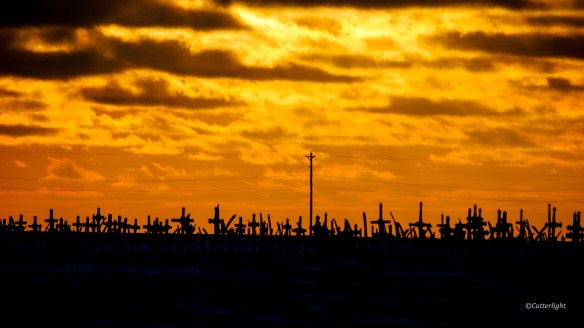
Whale Bones & Crosses, Point Hope, Alaska

Perhaps its most iconic landmark, the cemetery at Point Hope, Alaska, is enclosed in Bowhead Whale ribs positioned as one would a picket fence. The above image was made at 2:25 PM, November 7. At that time of year, there are slightly less than six hours between sunrise and sunset. By early December, the sun sinks completely below the horizon and will not show itself again for 32 days.

In 1890, three years after a commercial whaling base called Jabbertown had been established near the village, the first Christian missionary arrived in Point Hope. A doctor by profession, it is reported that John Driggs performed “heroic” medical work, but his attempts at converting the village’s inhabitants to his religious beliefs were unsuccessful. In fact, the Episcopal Church that sponsored him reported that Driggs had become “eccentric and absent” in his duties to proselytize. Nonetheless, by 1910 Christianity had become predominant throughout Arctic Alaska. By this point the new religion had been spread from village to village by converts among the Inupiat themselves.*

*See: The Inupiat and the christianization of Arctic Alaska, Ernest S. Burch, Jr., Etudes/Inuit/Studies,1994

Full Moon over Frozen Lake: Chignik Lake, Alaska

Full Moon over Frozen Lake – Chignik Lake,6:56 PM January 30, 2018

Twilight, that sliver of light between the day’s last direct sunlight and darkness, is often the prettiest light of the day. I was happy that Fred has his lights on. This shot was taken from the beach in front of our house. (Snowing here this morning, May 6.)

Four Days of Quiet Solitude (Except for the Hurricane-force Winds): The Cabin on Black Lake

Fire Mountain: Barbra got this beautiful photo of sunset rimming a mountain – possibly 8,200 foot Veniaminof Volcano, its top missing. That’s me left of center, shooting a closer perspective. During our stay at a nearby cabin, the forecast had been for temperatures in the mid 30’s (low single digits Celsius) and the usual 10 to 20 knot breezes. The subfreezing temperatures, heavy sleet and snowfall, and hurricane-force winds we experienced seemed to come out of nowhere.

Every night before we go to bed and every morning upon waking, I slide the dining room/living room window open and scan the lakeshore with a small, powerful spotlight. You never know what you’ll see. Though not necessarily at night, from these very windows we’ve seen brown bears, moose, foxes, owls, weasels, otters, eagles, falcons, beavers, a wolverine and a wolf, not to mention an array of waterfowl including cranes, swans, loons and ducks.

“You oughta take that spotlight and stay in my cabin up on Black,” Fred texted one morning. “You’d like it up there.” Fred’s Chignik Lake home sits atop a high bluff, big picture windows overlooking a good bit of Chignik Lake and the beginning of Chignik River. He spends a fair amount of time doing the same thing we do – scanning for wildlife.

Snow Bunting, Black Lake, Alaska. We’re told that in years past, Snow Buntings were common winter visitors to Chignik Lake. Recently, they’ve been scarce. Although the flock of three birds we came upon only gave me a chance for a couple of quick shots, I was happy to get this record for a project I’m working on to document area birds. (Stay tuned for more on this.) In addition to waterfowl, Black-capped Chickadees, Common Redpolls, magpies, eagles and a Northern Shrike rounded out the avian life we encountered. 

Fred’s text came on the last day of December, a few days before Barbra’s winter break was over. The two of us were antsy from days-on-end rain we’d been enduring through most of autumn and early winter. Fred’s offer wouldn’t change the weather, but it would change the scenery. We were in.

That evening we packed up our gear: down sleeping bags, rain gear, extra rain gear for when the first rain gear was soaked, cameras and binoculars, pens and journals, cookware, four days worth of dehydrated backpacking food, four sweet onions and four Fuji apples…

…and awoke the next morning to find that the weather had taken a nasty turn. Rain we can work with, but when winds started blowing spray off the whitecaps on the lake, there was no way Fred would be launching his skiff. “We’ll try again tomorrow,” we agreed. In retrospect, this squall which hadn’t been forecast should have tipped us off that our local weather patterns were unstable.

The following morning we rose early, hoping for the best. During winter, the sun doesn’t break over the mountains rimming our valley till sometime after 10:00 AM, but a flashlight cutting into the pitch black indicated that Fred and his friend Nick were already down at the beach getting the skiff ready. The wind had settled and a mist was falling under a lightless sky that swallowed the lake in inky darkness.

By nine o’clock the first crepuscular twilight silhouetted the mountains to the south. With breakfast behind us and a hint of light on the water, we loaded up the skiff and began the 18-mile run north up the valley. Pockets of near-freezing drizzle appeared and disappeared, prompting us to pull our hoods tight. The forecast – which up here is usually spot on – was for similar weather over the coming days with a few sun breaks mixed in. Ahh, sun breaks. This year, we’ve been living for sun breaks.

As we cut across the lake and proceeded up Black River, a loon and a few mallards and pintails lifted from resting places in coves and a pair of eagles were startled from their riverside perches. Most of the bears are denned up by this time of year, though here and there a few late-run salmon still cling to life in feeder streams. There’s always a chance of seeing a wolf.

Fins, January 2, 2018: The Chignik System is known to receive the latest salmon runs in North America. Still, we were amazed to find a few Coho in a nearby feeder stream near the cabin. More remarkable still, some of these fish appeared to spawning.

 A rim of shore ice at the mouth of the stream provided a dining table for otters, who left plenty of salmon scraps for ravens. Although we didn’t see the otters, evidence of their presence was everywhere. We also found signs of moose, foxes, weasels, hares and wolves. In fact, we have reason to suspect that at one point a wolf was just around the bend from us.
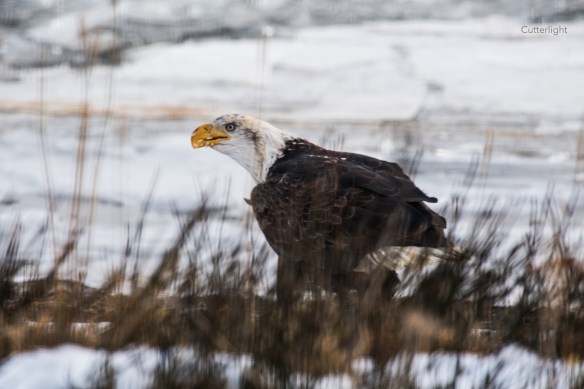
After the storm, a fully intact salmon carcass managed to find its way to the shore in front of our cabin – quite possibly plucked from a patch of open water and dropped by this very eagle. I grabbed this shot through a double-paned window – not ideal for a photograph, but what a handsome bird. The moment I opened the cabin door, she took off.

If you come across a single antler from a member of the deer family, it’s been shed, part of an annual process in which male deer, elk and moose grow antlers for the mating season and then lose them. If you come across an entire rack joined by skull bone, it’s the result of a kill. Some years ago, when Fred was scouting out the location for a cabin from his skiff, he came upon five wolves on a downed bull moose right on the beach where he hoped to one day build. Years later, someone found this rack in a nearby alder thicket – undoubtedly that same moose having been dragged there by the predators. 

Fred described the cabin he and a couple of friends had built as “sturdy, snug and cozy,” a spot-on description. Insulated from floor to roof and appointed with double-paned windows, the cabin’s 10 x 15 interior is just big enough to comfortably house a diesel heater, three-burner propane stove, hand-made wooden bed frames, small pantry, a table and three hand-made wooden stools. Snug and cozy. The lines looked square and sturdy, points that would soon be tested.

Once Nick got the heater going, the cabin was toasty warm in no time. Fred introduced us to the vagaries of the propane stove, pointed out the water catchment system (a bucket hanging near a roof gutter), and assured us once again that we were welcome to dip into any of the food in the pantry.
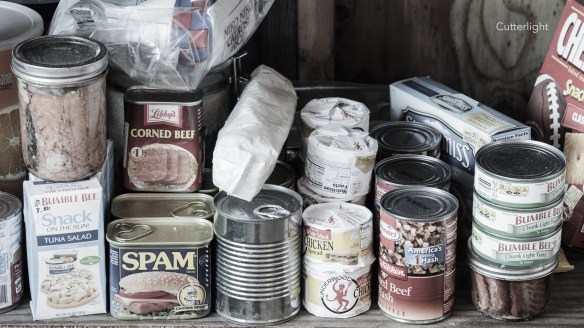
I muted the color in this pantry photo. The cabin’s door is never locked and the assortment of canned fish, deviled meat, rice and crackers could be a lifesaver for anyone caught in a sudden storm or out of luck with a dead engine. Although we brought plenty of our own food, I have to confess that the temptation of a skillet of fried Spam was more than I could resist, not having had this treat since childhood. It was, to my mild surprise, every bit as good as I remembered.

With winds pushing 100 miles per hour and sub-freezing temperatures, our water catchment system failed. Fortunately, the wind blew beautifully clear sheets of ice onto our shore.

Following two days of snow and sleet pushed by fierce, cabin-rattling winds, the sun rose serenely over a frozen lake Black Lake. Black River, which leads to Chignik Lake, begins in the gap between the mountains where the light is breaking through. If things didn’t warm up and melt the ice, there was doubt that Fred would be able to make across the lake in his skiff. Fortunately, by the next day the ice had thinned and lay in broken patches. We learned later that two of our neighbors in the village out on a different adventure had to be emergency rescued when the storm came up.

The view from the cabin shoreline after the storm passed: Although we didn’t get the waterfowl and wildlife encounters we’d hope for – and the weather certainly had our full attention for awhile – our four days on Black Lake were wonderfully memorable. And left us with this thought: Why aren’t we doing more landscape photography? New adventures lead to new thoughts, new studies, new goals. 

“Hope you guys get lucky and see some wildlife,” Fred said as he and Nick headed to the skiff. Motioning across the bay toward the far shore from where a racket of honking and quacking was issuing, he added, “Of course, those swans and ducks never stop chattering. They’ll keep it up all night.” I helped shove off the skiff, and as the last echoing hum of the boat was enveloped in the valley we’d just come up, we found ourselves wonderfully and utterly alone. Over the next four days, the only human-generated sound we would hear was the drone of a couple of bush planes flying into the village 18 miles to the south.
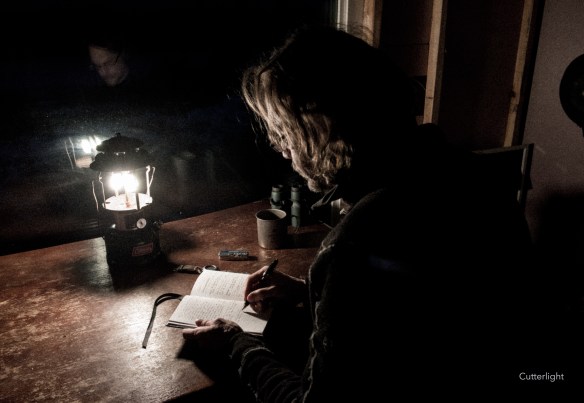
Sketching a novel outline at the cabin on Black Lake: Thirty-some years ago, aboard USS Blue Ridge, a friend and I made elaborate post-enlistment plans to go up into the Colorado Rockies, find a cabin, and live there for a year. We talked about the staples we’d need to lay in: flour, rice, coffee and so forth, the rifles and shotguns we’d take to hunt with, canning equipment, and the desirability of locating ourselves not overly far from a small town where we could reprovision as necessary. We would write. Fundamental to that objective would be pens and journals and a small, carefully selected library of literature. My friend got out a few months before I did… and disappeared. When I called the number he’d given me, his mother picked up the phone. She sounded distraught, with no idea where her son was. No one knew. I’m still not sure if we were kidding ourselves or if we’d really intended to go through with the plan, but either way I couldn’t see going it alone. When an acceptance packet came from the University of Colorado at Boulder, I took the door that was open. But I never completely let go of that idea… someplace quiet, off the grid, armed with books to read and journals to fill.

January 26, Chignik Lake, Alaska


Alaska White Bean Soup With Salmon Sausage and Reindeer Sausage

bean-salmon-reindeer-sausage-soup-022017-n

This zesty, robust soup will take the chill off even the coldest weather. 

We’d been thinking about creating our own salmon sausage for quite some time, but it took the beautiful recipes in our recently acquired copy of The Tutka Bay Lodge Cookbook to get off the stick. Turns out, there’s nothing to it. Use a food processor (or a stick blender with a nut chopper) to grind up salmon (or just chop it up fine with a sharp knife), mix in your favorite seasonings, and bind with egg whites. Tightly roll up this mixture to the thickness desired in plastic wrap, put a twist in the middle to separate the sausages, twist and tie off the ends, boil for 10 minutes, and voila! Salmon Sausage. Although we used Coho Salmon fillets from one of our summer catches, this same method would work beautifully with canned salmon. And there’s no reason to confine yourself to salmon. Chopped clams, halibut, rockfish, crab, scallops or some of Alaska’s spectacular deep water prawns could go into this sausage as well. We can’t wait to try this recipe again with some of our smoked salmon.

As to the soup… We created a minestrone-type broth using canned tomatoes. To that we added white beans, oven-roasted carrots, salmon sausage, reindeer sausage and Swiss chard. We also added sweet onions, colorful Swiss chard stems and garlic that had been sautéed in olive oil. Seasonings included oregano, marjoram, a little thyme and a splash of white wine. We finished the soup with smoked sea salt. Served with toasted sourdough bread and a homemade hefeweizen, this is a bowl that takes the chill off!

Sometimes it’s the Little Things: Farm Fresh Vegetables in Bush Alaska

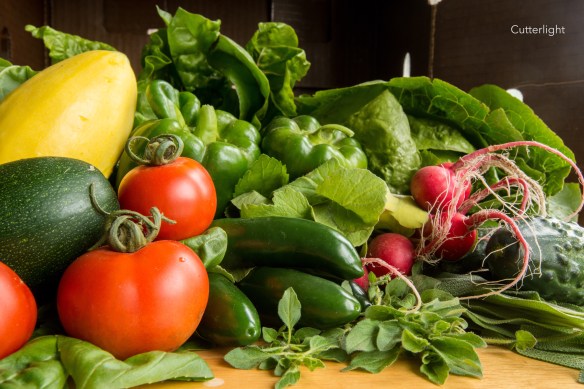
Courtesy of The Farm in Port Alsworth, a newly-arrived box of fresh vegetables fit to inspire any food-lover.

Once a week flown in a little bush airplane, a box shows up packed with freshly picked vegetables. It’s like having a birthday each week!

We’ve written a number articles about how we get food out to the tiny, remote Alaskan bush villages where we live. There’s a story about carefully packing a year’s worth of food from Costco into durable Rubbermaid tubs. More recently, we’ve been ordering much of our food from the Fred Meyer grocery store on Debarr Road in Anchorage. The people there take great care getting our groceries out to us, sending us impeccably wrapped and packed goods usually within about four days of the request. Amazon’s grocery store is another great way to get groceries, although sometimes that involves a wait of several weeks. When we lived in Point Hope we discovered a company in Washington called Full Circle, which mails farm fresh gourmet vegetables to select communities in Alaska. We would get multi-colored carrots and Swiss chard, yellow beets, and pink haricots verts. These premium veggies came at a premium price, but I will admit that after eating frozen vegetables our first year in the bush, we threw our budget to the wind in the name of fresher, tastier fare. Besides, it was fun to experiment in our cooking with colorful and interesting ingredients.

When we moved to Chignik Lake, we heard about “The Farm” in Port Alsworth. It was almost spoken as a whisper – a secret to be kept tight within an inner circle. The scoop was that they would sync orders with local flights and ship boxes filled with vegetables picked that very morning. Freshly picked veggies? Right to our door? The same day they’re picked? Our response – “What’s the phone number?” In the same secretive way we’d first heard about this magical place, we were handed a phone number. Imagine a folded slip of paper passed from one to another during a knowing handshake. When I looked up The Farm in Port Alsworth on the internet, I was surprised to discover that there was no evidence of such a place. I took out the note with the scrawled number and called.

“Hello?” an informal voice came through the receiver. Oh, dear. I must have a wrong number, I remember thinking. They should have answered the phone with a jaunty, “The Farm!” Right?

Tentatively I asked, “Is this The Farm?”

“Yes!” came the cheerful reply. Sometimes things in Alaska don’t come about the way one might imagine.

“The Farm” is actually “The Farm Lodge.” Located in Port Alsworth on beautiful Lake Clark, the lodge is operated by the same company that runs Lake Clark Air, which we regularly fly with. The lodge features a picturesque greenhouse, inviting grounds and accommodations for guests who travel to Port Alsworth for nature viewing, hunting and fishing expeditions. In addition to world class salmon fishing and wildlife photo opportunities, the lodge boasts excellent home cooked meals featuring, of course, their garden fresh vegetables. Since Chignik Lake is a regular stop for Lake Clark Air, we benefit from the surfeit of fresh produce grown in their greenhouse.

They may not have multi-colored beets or artisan green beans, but they nonetheless offer wonderful produce. We’ve received many of the crisp favorites one might find in a typical garden – cucumbers, green-leaf lettuce, tomatoes, chard, beets, radishes, bell peppers and sugar snap peas. With long hours of summertime daylight, Alaska is famous for the truly humongous size certain vegetables attain up here. The cabbage that came in our box last week was as big as a large mixing bowl – and yet it turned out to be only half the original head!

The only downside to The Farm’s service is that the growing season ends in October. But until then, we have all the fresh vegetables we can eat to go with meals of the equally fresh salmon we catch in the river in front of our house!

If you are in our area and would like to participate in The Farm Lodge’s special deliveries, here is the secret phone number (907) 310-7630.

Eight-Weights: Alaska Peninsula Summer Trek – Going Off the Grid for Salmon, Trout, Char, Grayling and Pike

Early last Friday morning we put the finishing touches on packing for this summer’s (potentially epic) fishing-centric trek on the upper Alaska Peninsula. Two Salsa Fargo bikes equipped with semi-fat tires, to be loaded with Big Agnes Rattlesnake Mountain Glow tent, down sleeping bags, Alpacka pack rafts, tenkara rods, fly rods, freeze-dried camping food, cookware, compact stove, minimal camera gear, blank writing journals, waders, rain gear, and (for me) just one extra pair of underwear. We then borrowed a pickup truck drove the gear to Chignik Lake’s airstrip and loaded it onto a Lake Clark Cessna headed for Nondalton.

I’ll turn 58 on this trip and I’m a little apprehensive – not as sanguine in my physical endurance and strength as I was in the old days. For the first time in my life, I am aware of physical limitations in a way I’ve never before felt those limitations. But I want to get out there and try this and see if I can handle it. I think I can handle it. If it comes together all right, this trip will set the stage for the next several summers. Fortunately, Barbra has greeted the prospects this summer holds forth with unbridled enthusiasm sufficient to douse my doubts. “Pace yourself,” a friend advised, and although that two-word phrase is anathema to the way I’ve gone about things most of my life, I have to concede that on this series of treks, it’s probably the most prudent recommendation I could receive.

Iliamna Lake is the epicenter of the world’s most prolific Sockeye Salmon nursery.

Nondalton is a perfect starting point. The Newhalen River threads together some of Alaska’s (and by extension, the World’s) most storied fly-fishing waters, including Lake Clark upriver and legendary Iliamna Lake downriver. Along with their nearly innumerable tributaries, the entire watershed constitutes the world’s greatest Sockeye Salmon spawning grounds and nursery. Oh, there are kings, silvers, pinks and chums, char, grayling, white fish and pike, too – and at the right time and place lots of them and large ones. But the keystone species is the Sockeye, and it’s because of these millions of spawning salmon and the ocean-borne nutrients they carry upriver each summer that the watershed is home to some of highest numbers of large rainbow trout found anywhere. Trout 18” and up are common. How far up? The Kvichak River, which flows out of Iliamna and into Bristol Bay, gave up a 23-pounder in 1999, and while there don’t seem to be as many super large trout as in the past, fish well over 20 inches are still abundant, as are large Dolly Varden Char, Arctic Grayling, Northern Pike and Lake Trout. In fact, when I ticked off a list of modestly-sized personal bests for the species we’ll be targeting this summer, our friend Jerry, who talked us into this trek, kind of laughed and replied, “You’re gonna break all those records right here on Six Mile.”

After exploring the Six Mile Lake area, the possibilities are practically limitless. Virtually every lake, stream and river in this part of the Bristol Bay watershed is a world class angling destination. So it’s almost a given that we’re going to catch a lot of fish. And camp, and hike, and pick wild berries, and raft, and swat mosquitoes and see bears and moose and cap an especially good day with a bourbon toast from a small flask a fair distance from anything that looks like civilization.

But it’s not all gonna be blueberry patches and easy trout. We might have to bush-whack into some places, and we won’t use guides or take float planes in to the best water. We’re determined to make the fishing our own, and that will mean fishless stretches at times as we explore, and it might mean tough going at times. That’s the price for getting off the beaten path.

If we each get a few personal bests this summer and have a few fish-after-fish-after-fish days, a few memorable wildlife sightings, a few meals of freshly caught fish… If we learn a few things, experience a few new things…

It’ll be a great summer.

JD

And with that, the staff of CutterLight is off on vacation for blessed weeks on end with no phone service, no computers and no news. Look for accounts of our adventures when we resume publishing toward the end of the summer. 

May 1 Plane Crash near Chignik Lake: A Tribute to our Bush Pilots

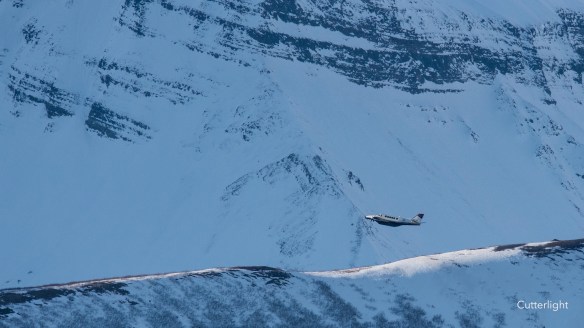
A nine-seater from Grant Aviation cuts through the mountains just after leaving Chignik Lake this past March.

They’ve been called Alaska’s cowboys, and life without them would range from difficult to impossible for those of us in the remote parts of Alaska that make up most of the state. They’re our bush pilots – the men and women who navigate the trackless wilderness between population hubs and the isolated communities we and thousands of other Alaskans call home. They bring us everything from mail to grocery staples to visitors (when we’re lucky enough to have them). With skill and confidence, these men and women navigate through weather that can change in a blink (it alternately was sunny, rained, snowed, hailed and rained again as I wrote this morning) and through winds most of us wouldn’t even want to take a walk in. We complain a little among ourselves when the planes don’t fly (earlier this year we went for over a week with no mail as our Brussels sprouts and other groceries languished in King Salmon) and we grumble when grounded flights mean truncated vacation time or a delay in friends reaching us. But we understand – safety first. And we know that if it’s possible to fly, the pilots serving Southwest Alaska – our pilots – will be in the air.

Yesterday we lost one.

By mid-afternoon word had swept through the village that a Grant Aviation plane – a Cessna Grand Caravan, the nine-seaters that are fairly standard in the bush – had gone missing. It was en route from Port Heiden to Perryville (see map at end of article), scheduled to arrive at 2:15 PM. At 2:00, just 15 minutes out of Perryville, the plane’s Emergency Locator sounded. The pilot, making a cargo and mail run, was the vessel’s only passenger.

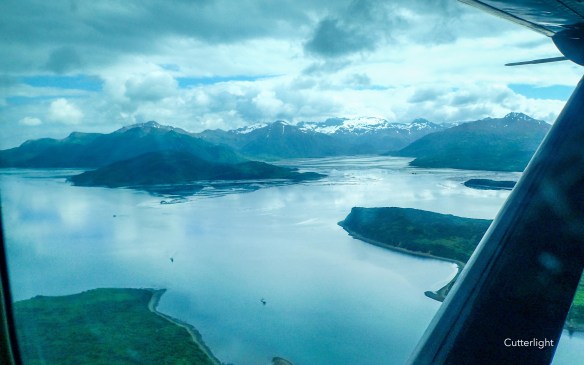
This photo was taken near Perryville, a coastal community about 28 miles southwest of Chignik Lake. The Aleutian Mountain Range sprawls across the Alaska Peninsula. It’s breathtakingly rugged country where high winds can spring up out of nowhere. The name Chignik means “Big Winds.”

Soon afterwards, a Coast Guard C-130 and an MH-60 Jayhawk helicopter began combing the mountainsides, tundra and lakes around Chignik Lake. In fact, the chopper landed here to take aboard volunteers to serve as additional pairs of eyes out the helicopter’s windows. At 5:49 PM, 3,000 feet up on a steep mountainside at a place known as Windy Pass, the wreckage was spotted. A rescue swimmer was subsequently lowered to the crash site where he confirmed that the pilot had died. Given the difficult terrain and cloud cover, recovery of the pilot’s body and the cargo he was carrying will be challenging.

Gabriele Cianetti, 54, the pilot of the downed Cessna 208B, touched many lives, including ours. Our thoughts and condolences go out to his family and friends as well as to his extended family at Grant Aviation. Additionally, our deep appreciation is extended to the men and women of the United States Coast Guard: Semper Paratus – Always Ready.

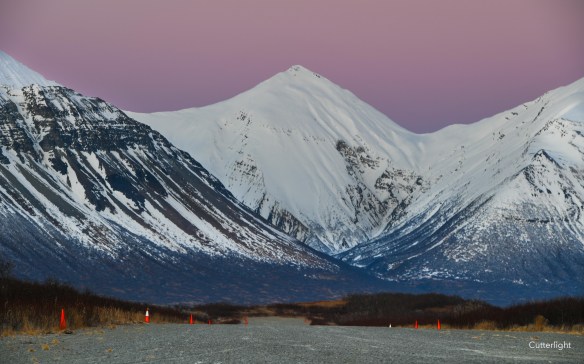
The Chignik Lake airstrip at dawn. The pilots who serve our community and Alaska’s other bush communities are true heroes in a land where air travel is not a luxury, but a necessity.

The above map includes Port Heiden, where the plane departed from and Perryville, where the plane was heading. Chignik Lake is marked in red.

Additional details for this article were pulled from KTVA news and Alaska Dispatch News.

Ink and Light: Double Limits! 120 Razor Clams & lines from Steve Kowit

Double Limits!* 120 Razor Clams near Whisky Gulch, Alaska

Big, tender and tasty, Razor Clams are avidly sought along Pacific Northwest beaches. The year these were dug, the limit in Alaska was 60 clams per person.

…drop to your knees now & again…
& kiss the earth & be joyful & make much of your time…
For although you may not believe it will happen,
you too will one day be gone.
I whose Levis ripped at the crotch for no reason,
assure you this is the case. Pass it on.
     Steve Kowit – Notice, 2000

– In 1966, Steve Kowit (1938-2015) sent the U. S. Army a letter: Were he drafted to fight, the letter stated, he would fight for the other side. He then married the love of his life and spent the next few years in Mexico and Central America before returning to the U.S. to live in California.

dg nanouk okpik’s Corpse Whale – Sifting through Myth and Time in the Far North

corpse-whale-n

Reading these poems is reminiscent of carefully digging through an archeological site located in Arctic permafrost as fossils, bones, carvings, memories and spirits emerge.

While looking for a few words to accompany a photo of umiaks (seal skin whaling boats) framed in Northern Lights I’d made a few years ago, I came across these lines from dg nanouk okpik’s poem “Tulunigraq: Something Like a Raven:”

screen-shot-2017-03-03-at-11-50-05-am

Okpik arranges her images across the page in a manner that forces the reader to go slowly, to breathe slowly, to see, and to hear, and as Barbra and I read, we felt ourselves being taken back – to Alaska’s North Slope, to the village of Point Hope and to other places we’d been in the far north, and then further back, to places we’ve never been – to old Tikigaq, to villages and settings scattered across Alaska and Greenland and beyond, to a time, indeed, “before iron and oil.”

Okpik’s writing is sure and precise, at times reminiscent of carefully sifting through an archeological dig, creating anticipation for what might be found and reverence for what is found. The place she invites the reader into is one of myth-making, spirituality, subsistence hunting and gathering, veneration of elders and ancestors and an intimacy with sinew and bone and cold. The landscape is of ice and sea, of magma cooling and the vast sweep of the tundra. Threaded through this are spirits and caribou, whales and ground squirrels, edible plants and seal oil lamps, Eucharist wafers and hooligan jigs. Okpik has given us poems that take us to places and to times few of us have experienced or will experience. The journey is mesmerizing.

Ink and Light: “Point Hope” – The Aurora Borealis & Jack London

x-point-hope-copy-n

Point Hope: Point Hope, Alaska

Solar winds disrupting Earth’s magnetic field cause the Aurora Borealis. They are often most spectacular on finger-numbingly cold nights in the depths of winter.

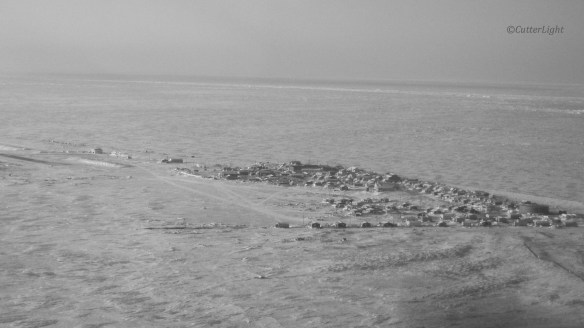
Point Hope is an Inupiaq Eskimo village of about 750 inhabitants located 200 miles above the Arctic Circle on Alaska’s North Slope. Originally known as Tikigaq (index finger for the slender peninsula that once extended into the Chukchi Sea before erosion took it away), the area is one of the oldest continuously inhabited places in North America. Subsistence hunting for caribou and Bowhead Whales continues to be an important part of the culture. With no roads existing beyond the village, the local airport (lit up in the above photo) is an important lifeline to and from the outside world.

…the aurora borealis flaming coldly overhead,
…the stars leaping in the frost dance,
…the land numb and frozen under its pall of snow…
Jack London – from The Call of the Wild, 1903

  – Jack London (1876-1916) was one of the first authors to become wealthy writing fiction. Mostly self-educated, after stints as a hobo, a sailor, and 30 days in the Erie County Penitentiary in the state of New York for vagrancy, he made his way to California where he attended high school and began writing in earnest.