Wild Trout and Salmon Make a Landscape More Beautiful: 10 Reasons We Use Our Alaska Permanent Fund Dividend to Support Trout Unlimited

orca baby and mother n

Reason #1: Because baby orcas need milk, and this mother needs a healthy diet of wild salmon to produce that milk. (Orca mother and offspring, Gulf of Alaska)

monica at samon creek n

Reason #2: Because Monica’s pregnant and eating for three. (Brown bear affectionately named Monica by local park rangers, Salmon Creek, Hyder, Alaska)

currants wild n

Reason #3: Because the ocean is full of nutrients which salmon embody as they return to their natal rivers and streams, and salmon forests thrive on salmon fertilizer courtesy of all the bears, eagles, mink, crows, ravens, otters, foxes and other animals that eat salmon. (Wild currants, Ptarmigan Creek, Kenai Peninsula, Alaska)

merganser common

.merganser chicks swimming clear water n

.

.

.

Reason #4: Because this merganser needs to find fresh salmon eggs to keep her brood well fed and growing. (Common mergansers, Salmon Creek, Hyder, Alaska)

camp meal on Deschutes n

Reason # 5: Because a meal cooked under starlight after a day of fishing with your best friend tastes better than that same meal would anywhere else. (Tumalo State Park, Deschutes River, central Oregon)

Turkeys along the American River - Copy (3) - Version 2 n

Reason #6: Because what’s good for salmon and trout rivers is also good for so many of the other things in life we love. (Wild turkeys, American River, Sacramento, California)

first king barbra n

Reason #7: Because farmed salmon can’t put a smile like that on a friend’s face. (Barbra Donachy, first king salmon, Resurrection Bay, Seward, Alaska)

Sea Lions at Bodega Bay n

Reason #8: Because we don’t want to live in a world where biodiversity is limited to what can be grown on a farm, raised in a pen, or crammed onto a feedlot. (Sea lions, California North Coast, Bodega Bay, California)

maia on deschutes n

Reason #9: Because girls who grow up fishing with their dads…

Maia with nice silver n

…become women who fish with their dads. (Above: Maia Donachy drifting an elk hair caddis in the Deschutes Canyon, central Oregon. Below: Maia with a hoochie-caught silver salmon gorged with herring, Cape Resurrection, Alaska)

And reason #10: Because salmon make a landscape more beautiful.

red salmon spawning w tail up n

red salmon spawning under water n

.

.

.

.

.

chum salmon on colorful streambed n

Top photos: spawning sockeye salmon. Bottom photo: spawning chum salmon.

About Trout Unlimited: For 54 years, TU has been a leader in ensuring that we have cold, clean rivers and streams for generations to come. From Northern California to Alaska’s Tongass Forest, from Bristol Bay to the Appalachian Mountains, TU has been instrumental in getting  dams removed from rivers where they do more harm than good, keeping mining and drilling out of our most fragile ecosystems, and protecting trout and salmon forests. At the same time, TU has been dedicated to educating and involving the next generation of environmental stewards – our children and grandchildren. As illustrated above, TU’s efforts benefit much more than trout and salmon. Click here to find out how you can become a member: Trout Unlimited.
Salmon Cheddar Soup with Lobster Mushrooms

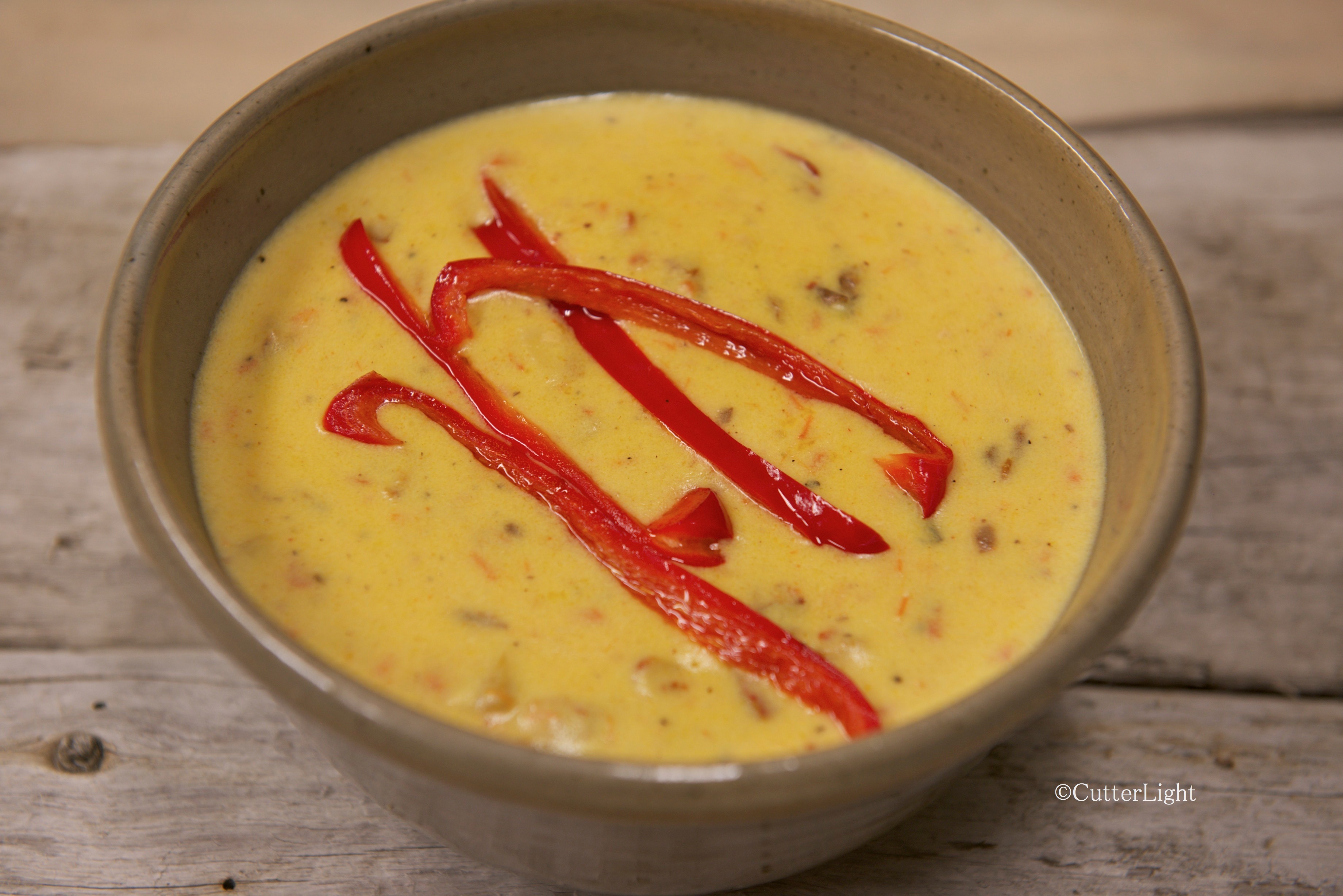
salmon cheddar soup n

With or without lobster mushrooms (see photo below), this quick, easy seafood soup is one of our wintertime favorites.

The inspiration for this recipe comes from A. J. McClane’s excellent cookbook, North American Fish Cookery. McClane’s original recipe is sans mushrooms and calls for lobster, but the basic stock – milk and cheddar cheese seasoned with nutmeg – lends itself to a variety of innovations. The first time we created this dish we substituted grilled steelhead for the lobster. Other iterations have featured broiled or grilled salmon, smoked salmon, and Alaska shrimp. In fact, we’ve never used lobster, and although freshly ground nutmeg remains a must in our soup, we usually spice it up with the addition of ground smoked chipotles or other peppers and smoked sea salt. Most recently we made this soup with our own canned smoked red salmon, lobster mushrooms and red bell pepper.

lobster mushroom salmon cheddar soup n

Ready for soup: a lobster mushroom, nutmeg, our own blend of smoked chipotles and other seasoning, and a jar of smoked Copper River red salmon.

Salmon Cheddar Soup

Ingredients

  • ¼ to ½ pound smoked salmon, grilled salmon, raw salmon, lobster or shrimp cut into ½-inch chunks. (If using raw seafood, allow for a few minutes cooking time in soup till done.)
  • 1¼ cups lobster mushrooms cut into chunks slightly smaller than the seafood. (Optional) These particularly mushrooms work well because they have a firm texture, nice color, and mild flavor.
  • Part of a red bell pepper cut into thin strips – 4 to 5 strips per serving. Sauté until tender and set aside.
  • 1/4 cup olive oil or butter
  • 3 tbsp flour, as a thickening agent. Rice flour works especially well, but all-purpose flour is fine.
  • 3 cups milk
  • 1¾ cups shredded cheddar cheese
  • 1/8 tsp ground nutmeg
  • 1/2 tsp ground smoked chipotle (optional)
  • freshly ground black pepper
  • sea salt or smoked sea salt
  • paprika (finishing garnish – a dash or 2 per serving)

Directions

  1. Place olive oil or butter in a large pot over medium heat.
  2. Add lobster mushrooms, a little salt, a couple grinds of pepper and sauté for about two minutes.
  3. Lower heat and vigorously stir in flour. Then add milk and seasonings, stirring until mixture begins to thicken and becomes hot. Do not allow to boil.
  4. Stir in seafood and cheddar cheese. Give the soup a taste and adjust seasonings as necessary.
  5. Serve piping hot, garnished with a few strips of bell pepper and a dash or two of paprika.

We enjoyed this soup with homemade biscuits.

Cedar-Planked Portabella Mushrooms Stuffed with Smoked Salmon and Manchego Cheese

mushroom 1_n

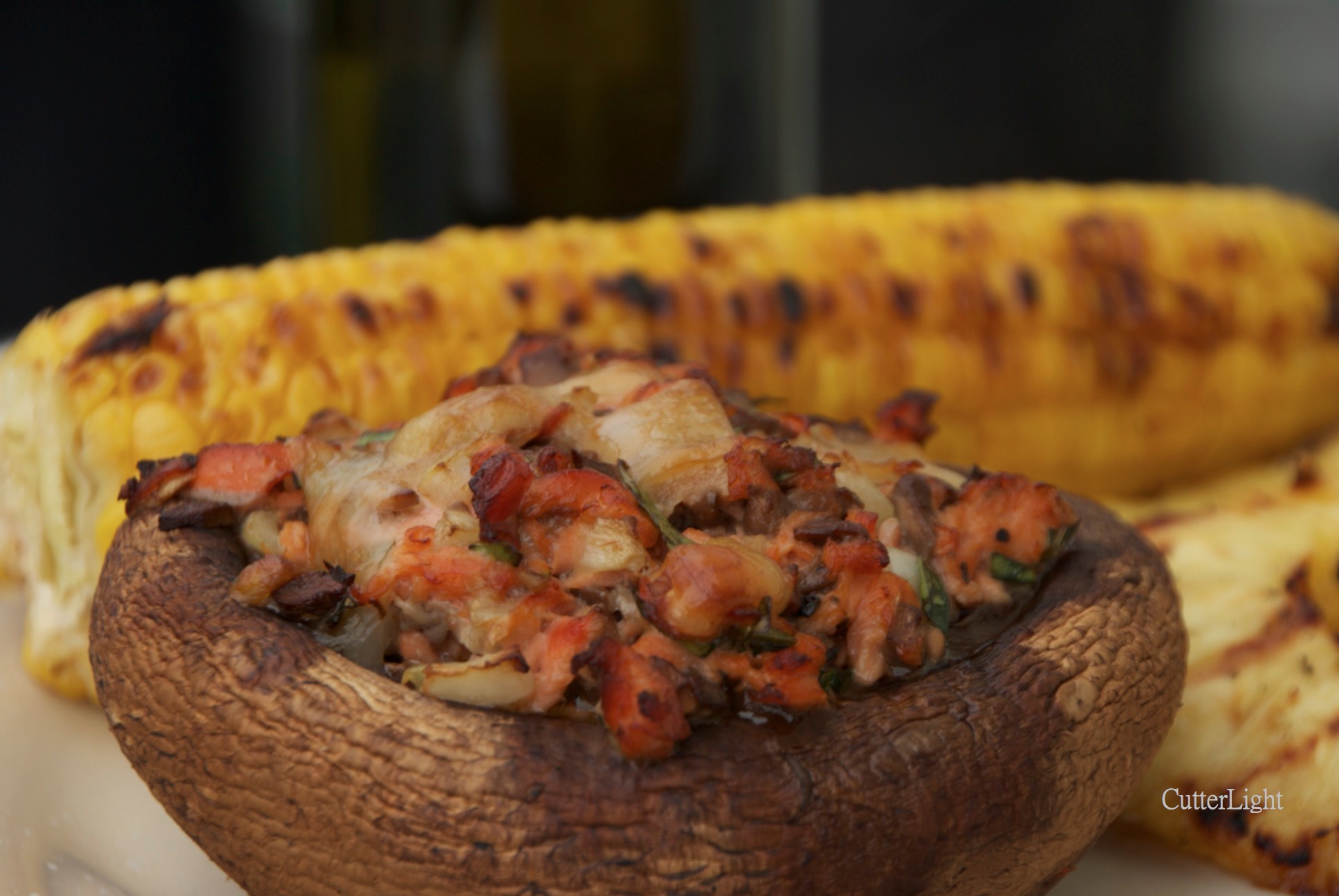
Simple and elegant, cedar plank cooking has been part of the Pacific Northwest since early native Americans first discovered this method. Food such as these these stuffed Portabella caps lend themselves to leisurely evenings complimented with good wine and good friends.

The most difficult thing in cedar plank grilling is remembering to soak the planks before you’re ready to fire up the  grill. Aluminum foil is the solution. Although it’s best to soak the planks hours in advance of cooking, they also work perfectly well soaked just a short time prior to going on the grill provided they’re placed in a shallow aluminum foil “boat” with a little liquid added. Fold up the corners of the foil, pour in a little water or water and white wine, and you’re ready! Grilled on cedar, salmon and other foods come out wonderfully moist and take on smokey, woodsy flavors.

mushroom 6_n

Grilled over charcoal, caramelized corn on the cob and pineapple rings go well with stuffed mushrooms.

cedar planked salmon_nRight: A split, whole king salmon self-bastes on cedar planks over hot charcoal.

Although cedar is popular, alder, hickory and boards from fruit trees work well too. Thoroughly cleaned, the boards can be used multiple times. Since plank cooking creates a barrier between the coals and the food, cooking time will be a little longer. In addition to preserving moistness and imbuing food with more complex flavors, planking typically results in more evenly cooked food than straight charcoal grilling.

Cedar-Planked Portabella Mushrooms Stuffed with Smoked Salmon and Manchego Cheese

Directions:

  1. Cut out the Portabella stems, chop course and place in a bowl. Add shredded or finely cubed Manchego cheese, finely chopped sweet onions, finely chopped garlic, tarragon, freshly cracked pepper, extra virgin olive oil, a small amount of sherry or white wine, and soy sauce or sea salt to taste. Mix thoroughly.
  2. Break up smoked salmon, cedar planked salmon, or any previously cooked salmon into small pieces and gently fold into the above mixture.
  3. Spoon mixture into mushroom caps and place on a cedar plank that has been well soaked. If desired, fashion a shallow aluminum foil boat slightly larger than the cedar plank and place 1/2 cup of water and white wine in the foil to help keep the plank moist.
  4. Grill over medium to medium-high heat for about 20 minutes, until a fork passes easily through the mushroom.

An Italian Amarone – a full-bodied red wine with lots of cherry – pairs especially well with a cedar-planked feast.

A Great Brine and Smoke – Soy Sauce, Brown Sugar and Seasonings for Salmon, Trout and other Fish

smoked salmon in rows_n

For the past couple of years, our brining and smoking method for salmon, trout, sturgeon and other fish has been the most popular article on our blog. Here it is again, with updated notes and photos.

If you’ve ever looked at those electric smokers sold in sporting goods stores and wondered if they did the job, the short answer is, “They do.” Our favorites are the Big Chief, Little Chief and Mini Chief models made by Smokehouse in Hood River Valley Oregon. Inexpensive, easy to use, easy to store and efficient, these smokers come with complete directions and a useful booklet that details the how-to of smoking and provides a number of recipes for fish, shellfish, poultry, meat, cheese, and even noodles, soup and breads.  My own most recent experiment with smoking was sea salt. It came out… smokey!

smoked salmon fillet_nTo obtain the best smoked fish, start with high-quality fish. Fresh fillets from bright fish make for a far better product than poorly cared for fillets from a badly handled fish. Also – and this is important -the method we use is not designed to kill parasites. It is recommended that fish be frozen at the lowest freezer setting possible for at least seven days before smoking them in order to ensure that they are parasite-free. You can read NOAA’s full recommendations here.

Below: A double batch of sockeye salmon in side-by-side Big Chief smokers.

smoking salmon double batch_n

For salmon, trout, sturgeon and similar fish with fairly firm meat, we marinate fillets in a wet brine for roughly six to 10 hours depending on the size and thickness of the fish or fillets. The fish can be brined in non-reactive glass, plastic or stainless steel (not aluminum) pans in the refrigerator or in a bucket or cooler with a couple of sealed Ziplock bags of ice thrown in to keep the mixture cool. Following are the step-by-step instructions we use for whole small trout and the fillets of salmon and other fish. The recipe can easily be modified to add other flavors or to finish the smoked fish with a sesame seed glaze.

Brine

Ingredients: For eight pounds of salmon, trout, sturgeon or other fish

  • 8 to 10 pounds fillets, skin on, rinsed, patted dry, cut into small pieces. A good size is about 3″ x 6″, but smaller or slightly larger is fine. Small trout can be cleaned and smoked whole.
  • 8 cups water
  • 2 cups soy sauce (Kikkoman is our favorite)
  • 1 1/2 cups brown sugar
  • 1/2 cup sea salt or kosher salt (Do not use iodized salt. It will impart an unpleasant flavor.)
  • 1 1/2 tbsp granulated garlic
  • 1 tbsp ginger

Directions:

  1. Mix brining ingredients together in a large bowl.
  2. Pour mixture over fillets, making sure they are covered, or until they float.
  3. Cover containers and marinate for about 8 hours (or overnight) in the refrigerator.
  4. Remove fillets from brine, pat dry with paper towels, and arrange on racks to dry for about an hour – until a glaze forms on the surface of the fish.
  5. Smoke fish according to your smoker’s directions with alder wood, mesquite, fruit tree or hickory chips. Check occasionally, keeping in mind that air temperature will influence smoking time. Typical smoking times range from 6 to 12 hours. A slightly wet product is best suited for many of the recipes we enjoy and for canning. For straight snacking, a drier product may be preferred.

Farmed Atlantic Salmon: The Deadliest Catch

If you believe that farmed salmon are part of a solution, to anything, we hope you’ll watch Salmon Confidential. If you believe farmed salmon are a healthy food choice, we hope you’ll watch this video.

The setting is British Columbia, Canada. The protagonists are wild salmon, river keepers, and scientists. The film is a fast-paced hour that will leave anyone who watches it and who cares about the food they eat, about our planet’s wild places, and about government transparency and its proper role in mega-farming of all descriptions with serious questions.

“…and the kid looks at you and says, how could there have been thousands of salmon here, you’re just an old man exaggerating. And then I have to correct him, not thousands, tens of thousands.” Russell Chatham in Rivers of a Lost Coast talking about one small west coast river

Overfishing and the Non-Solution of Aquaculture

This four-minute video presents the clearest, most accurate explanation of issues close to our hearts we’ve found: overfishing and the peril of aquaculture. We are emptying our seas at an unsustainable rate. But there are real solutions at hand:

  • Our governments need to follow science-based harvest recommendations.
  • Understand why aquaculture (fish farming) merely robs Peter to pay Paul, and for most species is not a solution.
  • Purchase local, wild fish whenever and wherever possible – even if it costs more.
  • Write a note to the FDA (click here) urging them to follow the American Fisheries Society’s names for fish species so that restaurants and retailers have to honestly tell consumers what we are purchasing.
  • Use your dollars to show commercial fishermen that you are willing to pay for responsibly harvested fish as opposed to farmed fish and fish harvested by nonselective, rapacious factory ship fishing.
  • Become educated and talk with your friends.
  • Forward or share this blog post/video.
  • Join Trout Unlimited or another conservation group that works to protect fish habitat. (Check Charity Navigator to ensure that the organization you choose spends its dollars responsibly.)
  • Learn to fish. A single person selectively targeting fish from local waters for personal/family consumption is still the most ecologically sustainable method of fish harvest.

Thanks for reading. Jack & Barbra

Smoked Anchovy and Salmon Pizza

Smoked Anchovy & Sage-Seared Salmon Pizza_n

Salmon seasoned with sage and briefly seared, smoked anchovies, shitake mushrooms and mozzarella cheese top a whole wheat crust brushed with garlic-infused olive oil.

The base for this elegant, satisfying pizza is a baked crust brushed with olive oil. This year, we’ve been experimenting with whole wheat crusts, and in this particular recipe it is perfect. Baked on a pizza stone, the whole wheat comes out light and crisp. The sage adds a wonderful aroma and flavor to this dish. This would be a great pizza to cook on a charcoal grill or in a cast iron frying pan with a lid in camp.

Ingredients:

  • 1 pizza crust, pre-baked
  • 2 cups shredded mozzarella cheese
  • 1/2 pound salmon fillet, skin on or off, cook’s choice. We prefer skin on.
  • 1 tin (2 oz) smoked anchovy fillets, oil drained and fillets separated
  • 2 tbsp tbsp pine nuts
  • garlic cloves. Small cloves can be left whole, large cloves cut into smaller pieces to make about 20 pieces of garlic.
  • two or three shitake mushrooms, sliced thin
  • 1 tsp dried sage
  • 1/2 tsp Italian seasoning
  • ground pepper
  • 3 very thin onion slices, cut in half
  • 2 tbsp extra virgin olive oil, preferably infused with garlic, but plain olive oil is fine
  • 1/2 tsp powdered garlic
  • additional Italian seasoning, to taste

Directions:

  1. Place a pizza stone on oven’s center rack and preheat to 400 degrees F.
  2. Ensure all bones are removed from salmon fillet. Rub sage into skinless side of fillet and set aside.
  3. In a medium-sized frying pan, heat a tablespoon of olive oil over medium heat. Add the onions, shitake slices, 1/2 tsp of Italian seasoning and ground pepper and briefly sauté. Onions should still be slightly crisp. Remove mixture to a plate to stop cooking.
  4. Return pan to medium heat and add garlic cloves and pine nuts. Sauté until garlic just turns soft and edges are light brown. Remove mixture to a plate to cool.
  5. Return pan to medium heat. Place salmon fillet sage side down and sear for 30 seconds. Use your hand or a spatula to apply light pressure to the fillet to ensure that it is evenly seared. Turn fillet over and sear the other side for 30 seconds. Remove to a cutting board to cool.
  6. Place 2 tablespoons extra virgin olive oil and 1/2 tsp powdered garlic in a small bowl and mix together. Using a pastry brush, brush olive oil onto the pizza crust.
  7. Sprinkle mozzarella cheese on the crust.
  8. Evenly sprinkle the mushrooms and onions atop the cheese.
  9. Arrange the anchovy fillets in a pinwheel on the pizza.
  10. Use very sharp knife to cut/separate the salmon along the grain of the fillet. Pieces should be 1 or 2 inches long. Arrange these pieces on the pizza.
  11. Add the pine nuts and garlic, and finish with a sprinkle of Italian seasoning.
  12. Bake for 10 minutes. Crust should be browned and the bottom should be crisp. Rest pizza for a few minutes before slicing to allow toppings to set.

Enjoy this pizza with a lightly-chilled Chardonnay or a cold Amber Ale.

Zaru Soba: Chilled Buckwheat Noodles with Seared Scallops and Ikura

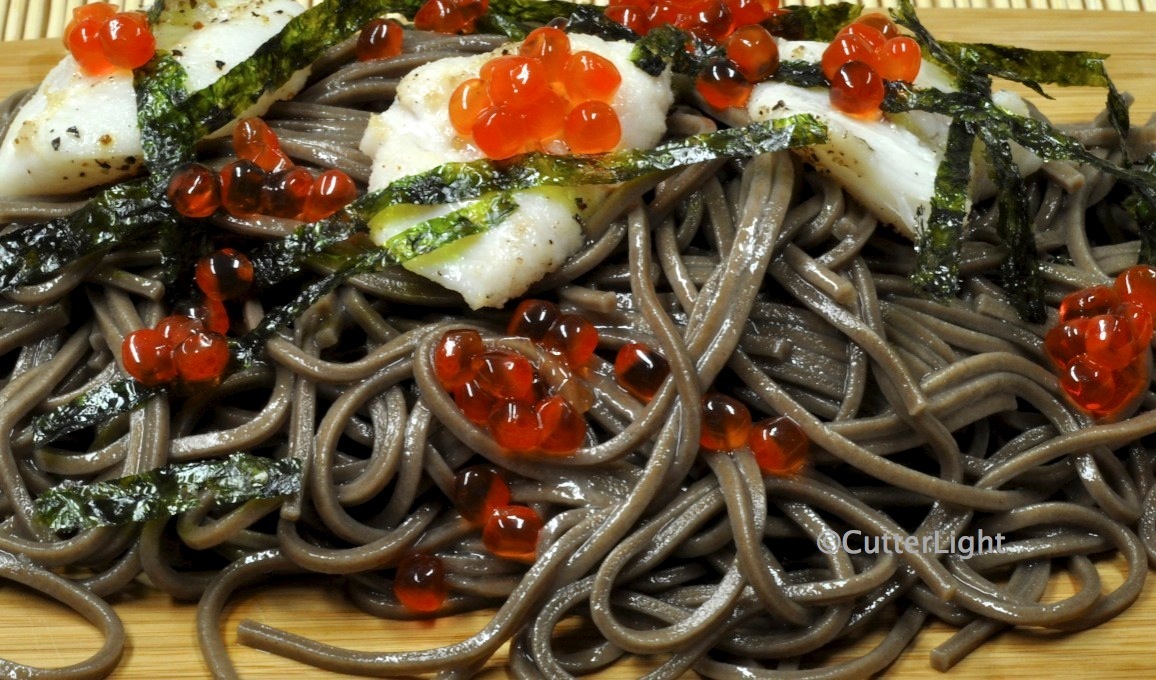
Buckwheat soba w seared scallops & ikura_n

Chilled buckwheat noodles topped with whatever imagination and taste comes up with and served with tsuyu dipping sauce combines the terms “gourmet” with “healthful.” Recipes follow.

A favorite food memory from the days I spent in Japan is the combination of sultry summer afternoons and lunches of refreshingly chilled buckwheat noodles. The first time I was served zaru soba in a Japanese restaurant, I knew I’d begun a life-long love affair.

Soba refers to thin noodles made from buckwheat, which in Japan is mainly grown in Hokkaido. Zaru refers to a seive-like bambo tray the soba is often served on, although these days it is popular to drain the soba in a colander and to then place the noodles on a tray or dish. Often served plain or with thin strips of nori and perhaps toasted sesame seeds, the noodles are almost always served with tsuyu, dashi, mirin and sweetened soy sauce mixture. The mixture is typically refrigerated or chilled with ice, and just prior to serving wasabi and scallions can be mixed in. Chopsticks are used to gather up a portion of soba which is then dipped into the tsuyu and, at least in Japan, the noodles are eaten with loud, appreciative slurps.

Buckwheat soba w seared scallops & ikura close_n

In addition to being tasty and very simple to make, soba is an especially healthful food. Easy to digest and packed with energy, soba contains all eight essential amino acids as well as antioxidants and important nutrients such as thiamine.

Soba and tsuyu are available at Asian grocers and in the Asian sections of many grocery stores. Tsuyu can be fairly easily made from scratch, provided you have on hand the necessary kombu, katsuo (bonito) flakes, mirin and soy sauce. Cooking up a serving or two of zaru soba – or several – for lunch or a light dinner is a breeze.

Zaru Soba with Seared Scallops and Ikura (for 2 servings)

Soba Ingredients:

  1. Two serving’s worth of soba (It generally comes packages with ribbons used to tie off serving-sized bundles.)
  2. Water to boil the soba
  3. Salt

Prepare according to package instructions much as you would pasta. Drain cooked soba in a colander and rinse thoroughly with cold water, using your hand or tongs to toss. Place rinsed, drained soba on plates, top with seared scallops, ikura and strips of nori and serve.

Seared Scallop Medallions

Directions:

  1. Select 4 large sea scallops. Cut them into medallions (approximately 1/8 inch (o.3 cm) thick.
  2. Dust medallions with seasonings of your choice. (We like a mixture of sesame seeds, chili pepper, powdered garlic, cinnamon and nutmeg. Commercially prepared Thai seasoning blends work very well.)
  3. In a frying pan, heat a tablespoon or two of olive oil over medium heat till a drop of water placed in the pan sizzles. Sear medallions on each side for just a few seconds. Use tongs or chopsticks to flip.
  4. Immediately remove medallions to a cool plate. Cover and refrigerate if they are to be used later.

ikura cured salmon eggs_nTo create sushi grade ikura in your own kitchen, see our article Ikura: Curing Salmon Eggs

Readers might also be interested in:

Alaskan Shrimp Harumaki with Lime-Infused Ponzu Dipping Sauce

Arctic Anpan Two Ways: Sweet Azuki and Caribou Cha Sui

Alaska Salmon Seafood Chowder with Fennel Sheefish Stock (and a Brief History of the Tomato)

Salmon & seafood tomato chowder_n

Pink salmon and sweet shrimp from the cold, clean seas of Alaska along with a terrific fish stock are key ingredients in this hearty, tomato-based seafood chowder. Made from a little of this, a little of that, and a lot of whatever the catch-of-the-day may have been, in many kitchens and galleys no two chowders are exactly the same. This one was especially tasty, and so we’ve provided the recipe, below.

Native to the Americas, tomatoes didn’t find their way to Europe until Spanish explorers took the fruit back in the late 1400’s or early 1500’s. Even after tomatoes found their way to Britain, leading horticulturalists there believed them to be poisonous. And so this versatile, luscious fruit was not generally consumed in Britain or her American colonies until the mid 1800’s.

It was in the 1800’s that Portuguese immigrants introduced tomato-based seafood chowders such as Manhattan clam chowder to New York and other American cities. Among the endless variations of this soup is the national dish of Bermuda: Bermuda fish chowder is built around a sumptuous combination of fish, tomato purée, onions, a healthy dollop of dark rum and sherry pepper sauce. 

See also: Manhattan-style Razor Clam Chowder

New England-style Alaska Clam Chowder

Alaska Salmon Seafood Chowder 

Ingredients: (makes about

  • 4 cups fish stock (see recipe below)
  • 1 1/2 pounds salmon, cut into 1/2″ or 3/4″ cubes (skin removed or not, chef’s choice)
  • 4 potatoes, diced into cubes smaller than the salmon cubes
  • 1 large onion, chopped semi-coarse
  • 1 cup carrots, chopped into discs
  • 3/4 cup celery, chopped coarse
  • 3/4 lb. shrimp, peeled and veins removed. Leave whole or cut to smaller pieces, depending on size of shrimp.
  • 3/4 lb. shellfish such as razor clams, other types of clams or oysters. Reserve juice to add to fish stock. (We used equal portions of clams and oysters)
  • 1 bay leaf
  • 1/2 tbsp oregano (dry)
  • ground pepper to taste
  • olive oil
  • smoked sea salt (to taste)
  • 1 lb. diced tomatoes (fresh or canned)
  • 6 oz tomato paste
  • 2 cups spinach leaves, chopped large (or use 1/2 cup frozen)
  • 5 cloves garlic, chopped into thin slivers
  • 1/4 cup good sherry or white wine (optional)

Directions:

  1. In a large kettle: Add fish stock, clam or oyster juice, bay leaf, oregano, ground pepper and tomato paste. Stir till paste is thoroughly mixed in.
  2. Add potatoes and tomatoes, ensuring that there is sufficient liquid to cover them. Add additional water, as necessary.
  3. Bring to a boil and then reduce heat to simmer. Continue cooking just until potatoes are tender.
  4. Meanwhile, in a large skillet: Add enough olive oil to cover skillet bottom. Add onions and cook for about 1 minute, stirring frequently. Add carrots and celery and continue stirring for about 3 minutes. Stir in garlic and continue cooking and stirring for 1 more minute – about 5 minutes total. Onions should be just turning translucent. Place in a bowl to prevent over-cooking and set aside.
  5. When the potatoes have just become tender, add sautéed onion mixture to soup. Add sherry or wine, if desired. Return soup to a simmer.
  6. Add salmon, shrimp and shellfish. At this point, we remove the pot from heat – the ambient temperature will cook the seafood sufficiently. (Seafood should be fresh or fresh-frozen.)
  7. Serve piping hot. This soup needs nothing, but a little freshly grated parmesan cheese, a few pieces of nori (dried seaweed), crackers or croutons make nice condiments.

Fennel Fish Stock

Ingredients:

  • 1 1/2 lbs. fish bones & head, cleaned, scaled, gills removed (preferably a white-meated fish such as striped bass, sea bass, snapper, porgy, rock fish, halibut, walleye, etc. We used sheefish.) It is important that the fish is fresh.
  • fennel – leaves and stalks from 2 stalks, chopped coarse (or use 1/2 tbsp fennel seeds or powdered fennel)
  • 1/2 tbsp thyme
  • 1 tsp rosemary
  • 1 bay leaf
  • 8 whole pepper corns
  • 1 tsp smoked sea salt
  • 1/2 cup coarsely chopped carrots
  • 1/2 cup coarsely celery
  • 1 sweet onion, coarsely chopped
  • 1/4 cup good sherry or white wine (optional)
  • water

Directions:

  1. Cut up fish bones and split fish head butterfly style so that everything can be lain as flat as possible in the bottom of a large kettle. 
  2. Place all other ingredients on top of the fish bones and head, arranging so that ingredients are fairly compact so that as little water as possible is needed to cover them.
  3. Cover ingredients with cold water. Bring to a boil over medium heat.
  4. As soon as pot is boiling, reduce heat to simmer. You may need to use a flame shield if stock is boiling too vigorously.
  5. Gently simmer for 20 minutes.
  6. Remove from heat and allow to stand an additional 15 minutes.
  7. Strain through a wire mesh colander and set stock aside.
  8. Stock can be placed into containers and frozen for later used, or used immediately.

Alaska Salmon Lox or Gravlax

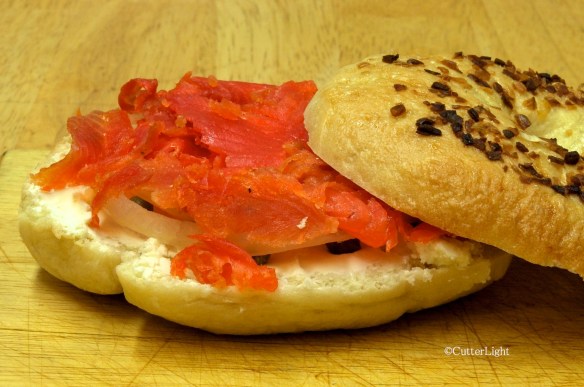
Lox on onion bagel_n

With a history dating back to the European Middle Ages, a number of methods for preparing lox and gravlax (or gravad lax) have evolved. We’ve settled on a dry-brining method that produces beautifully colored, deliciously flavored salmon fillets ready to be sliced translucently thin as on the above freshly made onion bagel.

Many cultures have a tradition of salting and burying fish, a technique that results in both preservation and fermentation. In fact, the origins of sushi can be traced back to fish prepared in this method. The grav of gravlax derives from the Scandinavian word for grave, and lax, salmon, has cognates in many old European languages. Thus gravlax literally means “buried salmon.”

Although preparing lox is somewhat labor intensive (the fillets are packed in salt under light pressure and liquid must be drained every 24 hours or so over a period of several days), since it isn’t smoked, anyone with a refrigerator can make it. Both sea salt and kosher salt produce good results, and we like to add a little brown sugar and black pepper. The dry brining method we prefer is known as “Scottish-style.” Other styles call for a wet brine. Dill, juniper berries and other seasonings are traditionally used in some recipes, but we prefer to add seasonings, if any, when the lox is being served.

In addition to traditional lox on a bagel with cream cheese, capers and a thin slice of onion, it’s also excellent on scrambled eggs, as a colorful finishing touch to deviled eggs, or as a wrap around any number of vegetables or other seafoods and served as an hors d’oeuvre.

Silver salmon head n

Always look for the freshest fish. Salmon should be bright with clear eyes and a pleasant smell reminiscent of the sea.

While historically lox was made with Atlantic salmon, these days, with Atlantic salmon populations in severe decline almost everywhere, the Atlantic salmon available in stores is farmed in places such as Norway, Scotland, British Columbia and Chile. For reasons rooted in flavor, sustainability and environmental impact, we prefer wild Pacific salmon. The salmon in the above photo is Coho (silver salmon), but any Pacific salmon species works well, as do large char. If you leave the skin on the fillets, it can later be used to create a crispy fried appetizer.

For the best presentation, lox should be sliced very thin. The best tool we’ve found for this job is a yanagiba – a Japanese sashimi knife. Our yanagiba has an extraordinarily sharp, nine-and-a-half inch blade. Both the sharpness and the length are important for slicing – not sawing – ultra thin pieces of salmon.

For a great recipe for smoked salmon, see:

Smoked Salmon with Soy Sauce and Brown Sugar Brine

For excellent homemade bagels, see: Bagels 3 Ways

———————————————————-

Homemade Lox

Ingredients

  • 1 lb. fresh salmon fillets, skin on. The fillets need not be scaled, but do take pains to ensure that all bones are removed.
  • ¼ cup coarse sea salt
  • ¼ cup brown sugar
  • 1 tbsp freshly ground black pepper

Directions

  1. Rinse fish and dry thoroughly.
  2. Remove any pin bones in fillet with tweezers or needle nose pliers.
  3. Mix together salt, sugar and pepper. (This recipe works well when multiplied. Our last batch was 5 pounds of fish.)
  4. Pack salt mixture around fish. You can do this skin side down.
  5. Sandwich two pieces of fish together, skin side out.
  6. Pack any leftover sugar mixture onto exposed fillet.
  7. Wrap sandwiched pieces tightly with plastic wrap. Leave sides slightly open so liquid can drain while the salmon cures.
  8. I use a poacher with a draining tray for the next step. Another method would be to place a steamer basket at the bottom of a plastic box. The idea is to create a raised place for the fish to set while being pressed from the top. This will allow the juice to drain away from the fish.
  9. Place sandwiched salmon in poacher.
  10. Place weight on top of all salmon pieces. I use large jars of jam or large containers of salt. I have seen pictures of people using bricks.
  11. Place poacher in refrigerator.
  12. For 7 days, every 24 hours pour off liquid from the bottom of the poacher and flip the fillet sandwiches.
  13. At the end of 7 days, take the salmon out of the plastic wrap and thoroughly rinse using really cold tap water.
  14. Thoroughly pat dry.
  15. Slice very thin and enjoy!
  16. Store leftovers in refrigerator or freeze in airtight containers.