
Whaling Festival Site, Point Hope, Alaska. The larger bones presented as arches are the jawbones of Bowhead Whales. Traditionally, the skull is returned to the sea so that the whale’s spirit is properly released. Point Hope, Alaska, August 12, 2012

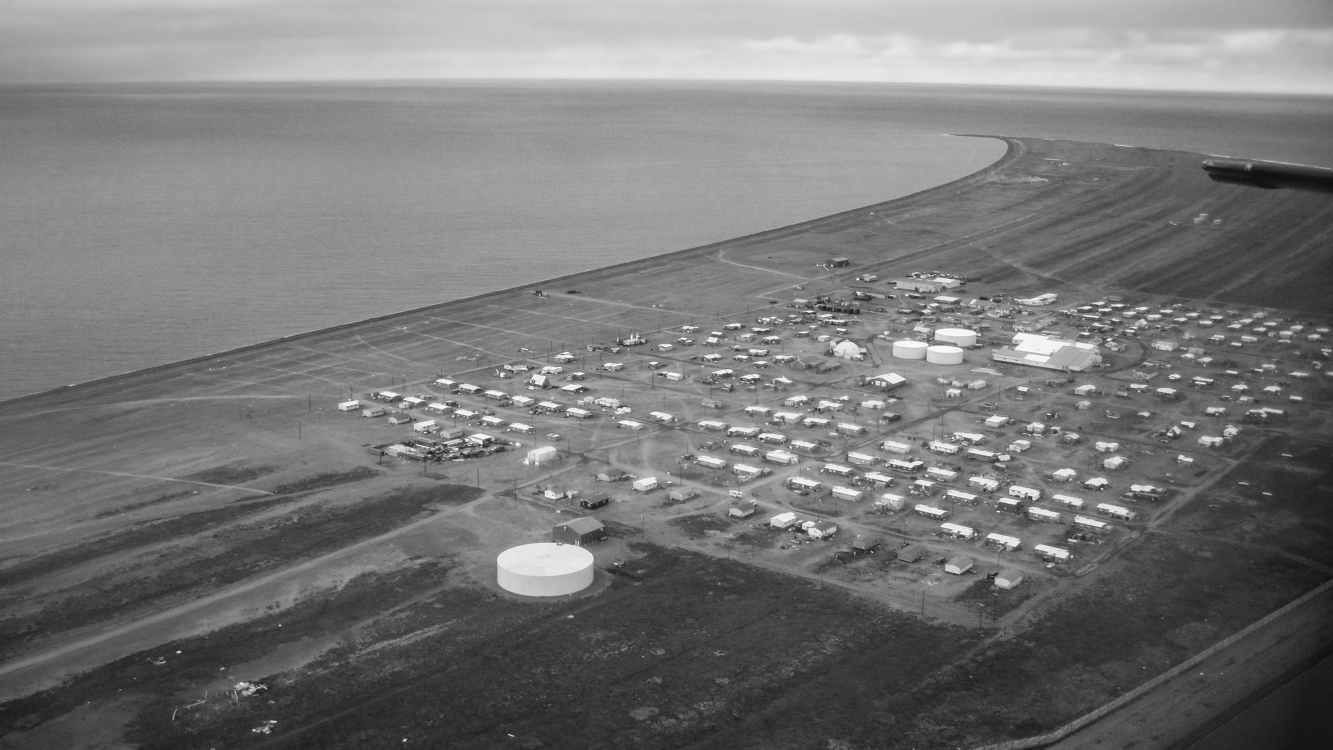
Modern-day Point Hope is located on a narrow peninsula hooking into the Chukchi Sea. In the not-so-distant past, the village was further out on the peninsula, but erosion caused by an encroaching sea has wiped away a good bit of the peninsula, and the old village, called Tikigaq (which means index finger – for the peninsula’s shape), was relocated further inland due to seawater inundation. With evidence of habitation going back at least nine thousand years, Tikigaq Peninsula is regarded as one of the very oldest continuously inhabited sites in North America.
The very essence of an Alaskan bush village is its isolation and remoteness. The only road leading out of Point Hope, Seven Mile Road, ends abruptly a good bit less then seven miles: 250 miles from Barrow, 572 miles to Fairbanks, 694 miles from Anchorage. Thus Point Hope exists as a neatly lain out grid of homes and other buildings surrounded on two sides by water and on one by the vast Arctic tundra. Polar Bears and Arctic Foxes are regular visitors. To experience life in a place so thoroughly separated from the rest of the world is perspective changing – and in an unexpected way, exhilarating.
Large ocean-going barges freight in everything from the school bus – which keeps children safe from both frostbite and Polar Bears – to heavy equipment and building supplies; planes bring in smaller items, including groceries and mail. Hunting and gathering provide a great deal of additional food. This subsistence take includes Bowhead and Beluga whale meat and blubber, caribou, ducks, geese, ptarmigan, salmon, char and grayling along with cloudberries (Rubus chamaemorus) a few blueberries and in some families, seaweeds.
Photographs in coming days will show more of the village and perhaps lend some insight into life there. Thanks for reading.

Chukchi Sea Red, Orange Blue 2011
This November 19, 2011 sunset looking out over a Chukchi Sea nearly frozen solid reminded us of a Mark Rothko painting. The quality of light in the far north is often breathtaking.
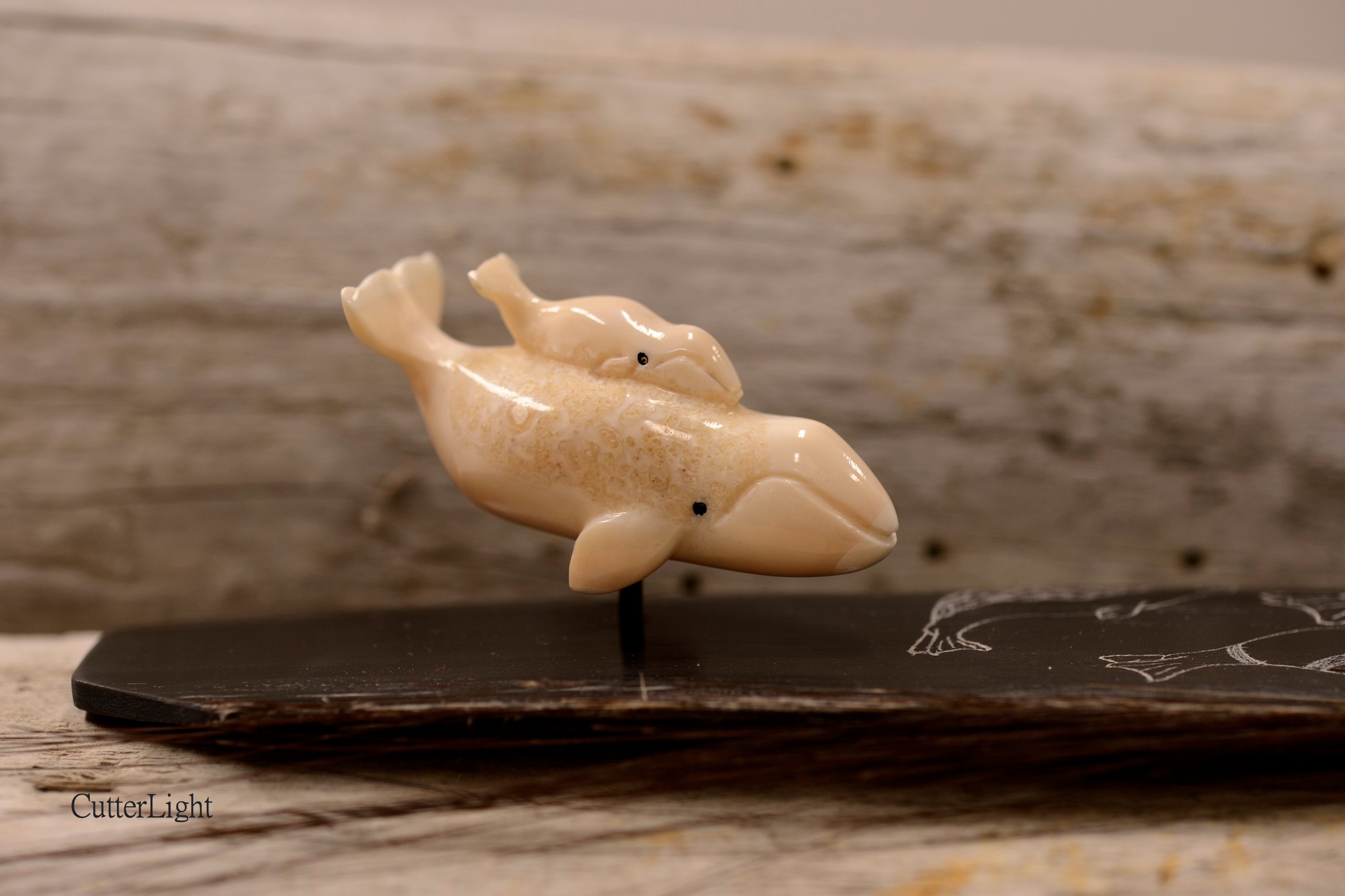
Bowhead whale mother and child: Walrus tusk ivory with bowhead whale baleen eyes set on bowhead whale baleen. The baleen is scrimshawed with marine animals commonly hunted for subsistence by the Inupiat people of Point Hope, Alaska.
As we’re preparing to leave Point Hope, we wanted a piece of local art to take with us – something that captures the spirit of Tikigaq (the traditional name of this village). Henry Koonook is both an outstanding carver and a friend, and so we commissioned this piece.
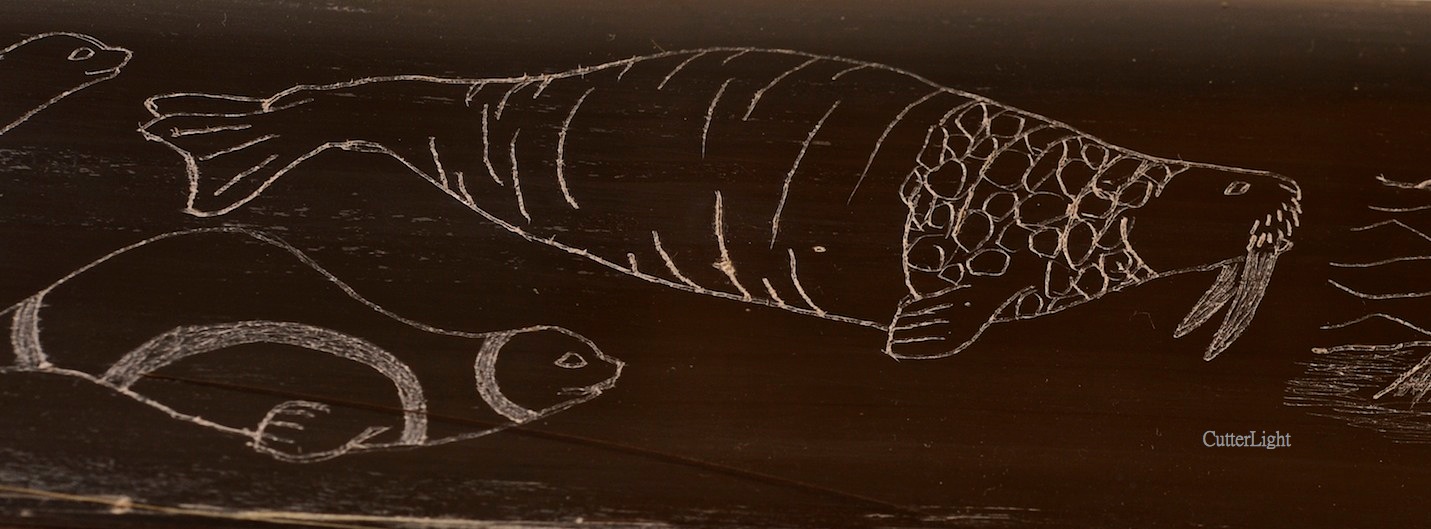
Detail, scrimshaw on baleen of ringed seal and walrus.
Henry still does most of his work with hand tools, using local natural media.
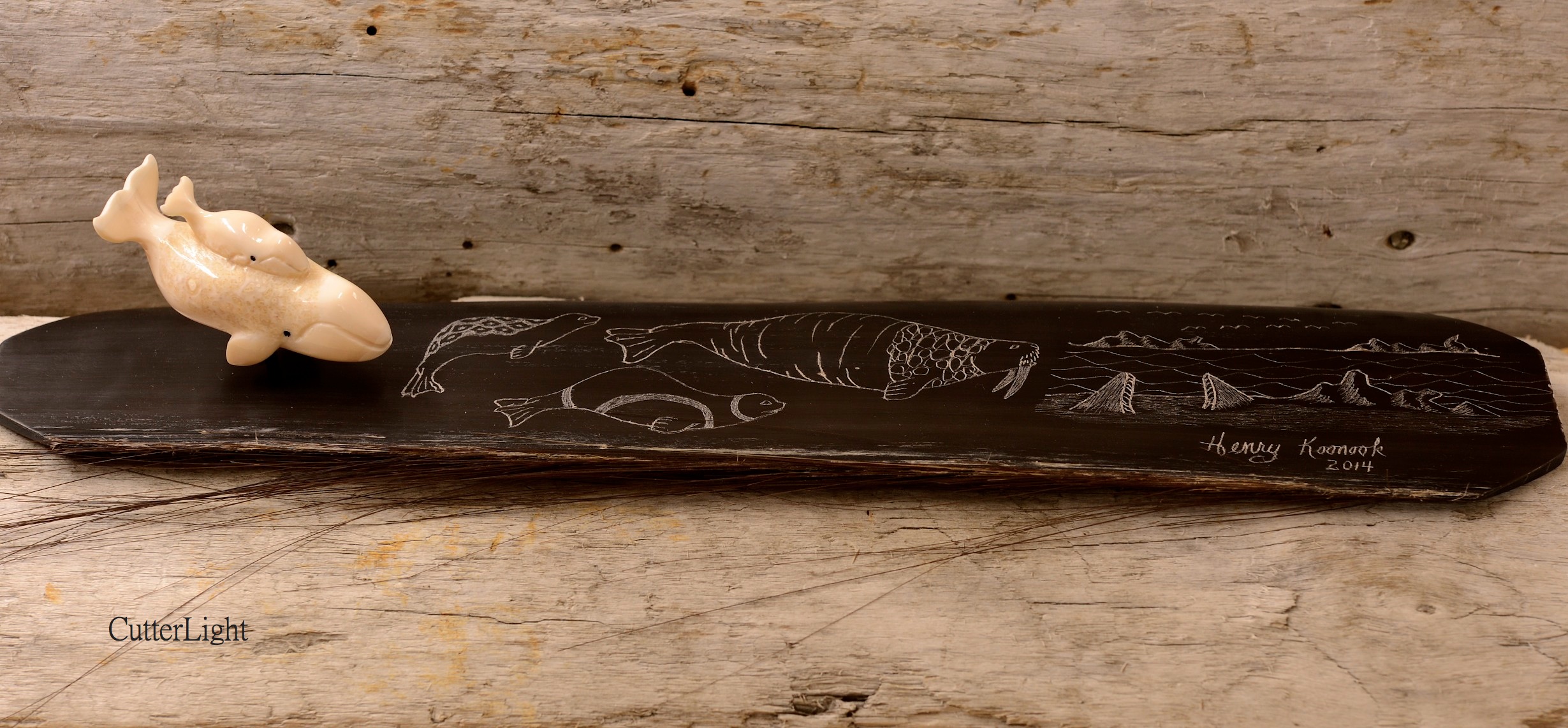
The entire piece measures about 11″ x 3″. Henry Koonook’s signature and the year the piece was created are visible in the lower right corner.
Bowhead whales constitute a vital part of the subsistence-based hunting and gathering culture in Point Hope. (Their numbers, which plummeted during the days when whaling boats from the world over pillaged the Chukchi Sea, are growing at a steady pace in recent years.) Seals and walruses are also culturally important. We are happy to take with us to our new home this piece of art that represent this beauty of this Arctic village by the sea.
The dancers in this short video are 6th grade students at Tikigaq School in Point Hope, Alaska, an Inupiat village 200 miles above the Arctic Circle. They are performing traditional songs and dances, passed down through the generations, sung in their native language.
The annual school Christmas program in Point Hope is a little different than in most communities. Yes, there are seasonally popular songs and carols, but many of them are sung in Inupiaq, the language of the Tikigaqmuit, the Inupiat Eskimo people of this small whaling community on the edge of the Chukchi Sea. There is also lots of drumming, singing and dancing performed according to traditions that extend back in time beyond memory. The drums – which resonate much more loudly than one might suspect them capable of at first glance – are made from material such as the membrane of sea mammal organs stretched over wooden frames. The beautiful mukluks (boots) many of the participants wear are hand sewn from seal, caribou, beaver and other natural materials.
The dances celebrate the past and the present. Aaka Irma (Irma Hunnicutt), who volunteered her time to come to our school and teach the students these dances, has an honored place as an elder in this village. Although the students speak mainly English in their day-to-day lives, these celebrations give them the opportunity to honor their language and heritage. This is a place where traditions are still passed down generation to generation; where some of the clothing and much of the food is still provided by the surrounding land and sea; where traditions are alive and vibrant and honored.
On this occasion, the students and Aaka Irma invited their classroom teacher to dance with them.

Friends who share a love of baking and cream-filled pastries dipped in chocolate ganache warmed up a rainy afternoon in our kitchen north of the Arctic Circle.
Perfectly turned out pastry puffs filled with delectable cream and dipped in chocolate ganache are the the stuff of home bakers’ dreams. Cream puffs and eclairs require a special dough called pâte à choux. Worked to exactly the right consistency, this dough bakes up light and flaky and leaves a hollow space in the center of the confection. Although we used traditional vanilla-flavored pastry cream, we also imagined filling these airy profiteroles with fresh whipped cream, homemade ice cream and even savories such as smoked salmon cream.
Making cream puffs and eclairs can’t be rushed. The pâte à choux dough requires time and attention in order to get it to the correct consistency as it cooks on the stove top. Next, it must be carefully piped onto a baking sheet and placed in the oven where it will finish. Creating the pastry cream is fairly easy, and making chocolate ganache is magical.
All that work, and between three bakers, three tasters and steaming mugs of of rooibos almond tea, our eclairs and puffs disappeared in short order.
Pâte à Choux
Ingredients
Directions
These will freeze nicely.
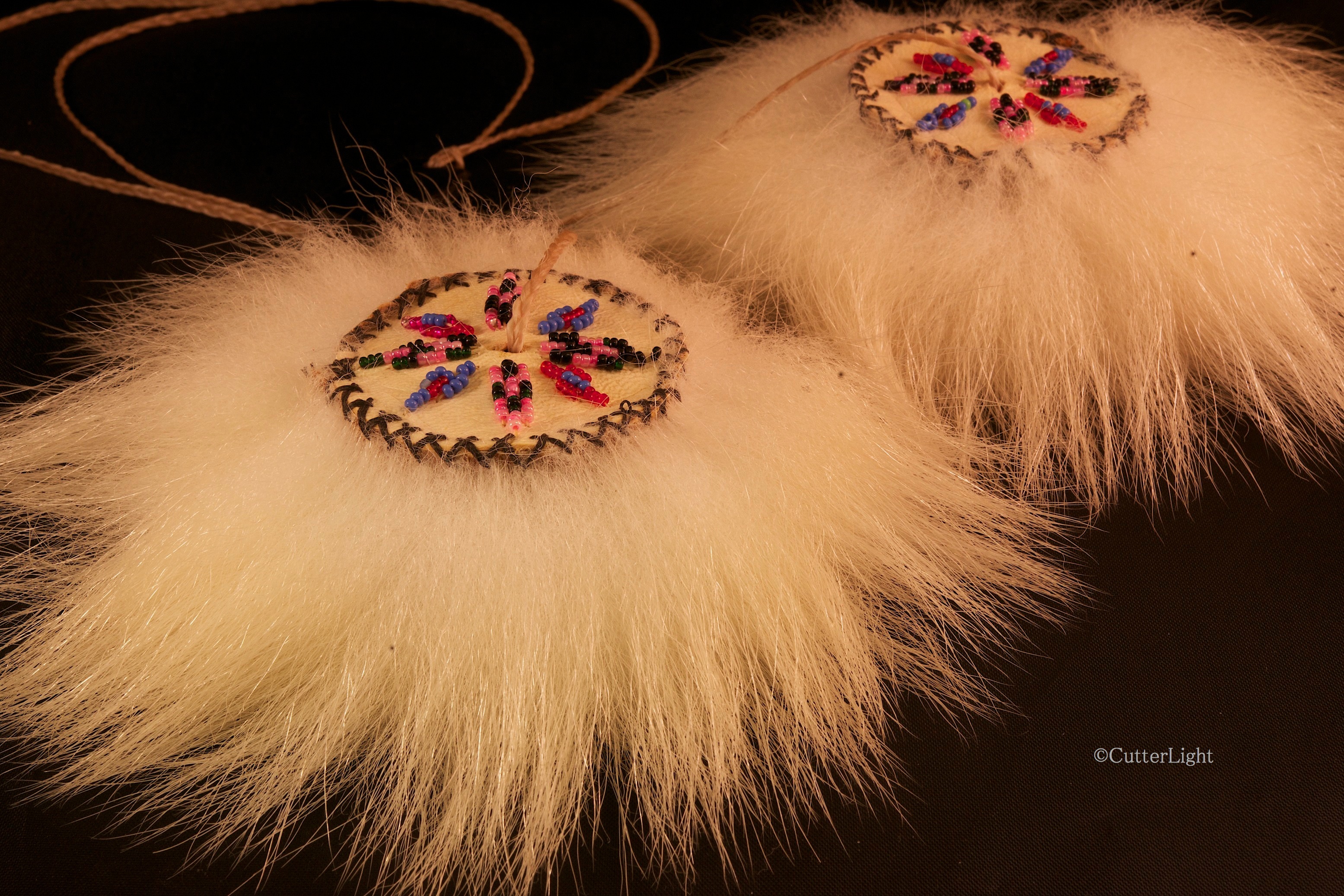
Fashioned from polar bear fur and finished with intricate beading, this Inupiat yo-yo has transcended it’s traditional purpose to become art. Based on a bola design, in olden times tools like this were made of rocks tethered together with sinew and were used to catch birds.
Beautifully crafted by Molly Oktollik, one of the elders here in the village of Point Hope, Alaska, this Inupiat “yo-yo” isn’t what most of us envision when we hear the word yo-yo. In former times, they were made of rocks held fast on sinew tethers and in the right hands were a formidable tool for catching birds. Ptarmigan, for one species, are often easy to get close to, and ducks and sea birds returning to their headland roosts typically fly in on a low trajectory.
These days yo-yos are crafted as pieces of art, or, when less elaborate, as toys. It takes a certain skill, but the two ends can be made to rotate in opposite directions – that is, with one end revolving around the center handle clockwise, and the other revolving counterclockwise. It’s a pretty cool trick if you can get it to work.
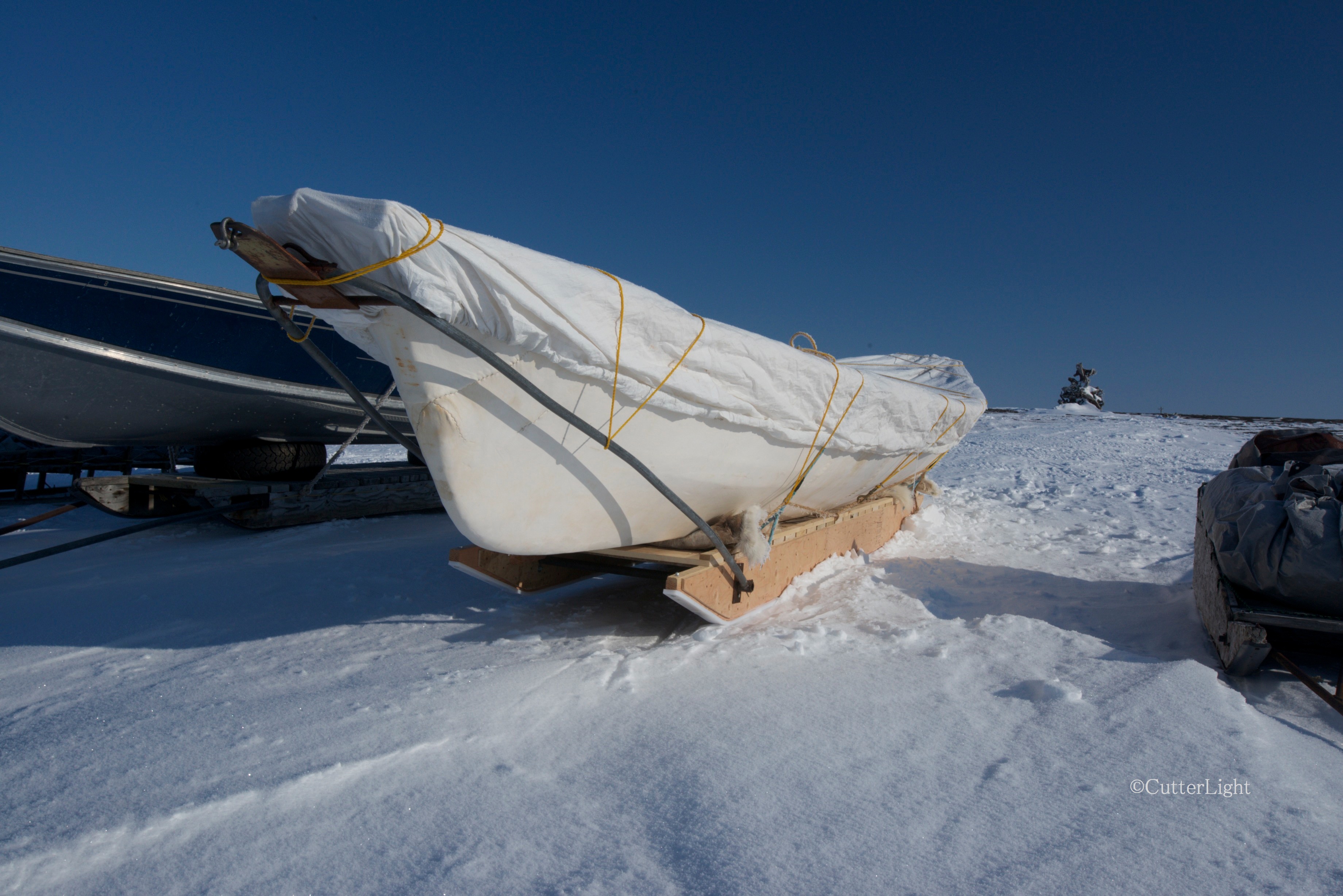
An umiak with its recently sewn seal skin stretched tight sits on the Chukchi Sea ice, waiting for whaling season to begin in March.
May 17, Point Hope, Alaska: Near-blizzard conditions forced a one-hour delay to the start of school yesterday, the day before the end of our school year. A little snow and high winds notwithstanding, all 30 of our 3rd, 4th and 5th grade students eventually arrived. It’s much more calm today. Scattered snow flurries have been breaking up an otherwise sunny day, and at 19 degrees Fahrenheit, the McKay’s buntings and gulls that showed up a few weeks ago when the weather was warmer (in the low 30’s) are out again. Looks like clear weather for our flight out tomorrow.

Near shore, the going is easy across the frozen sea. But the ice ridge on the horizon hints at the arduous work involved in breaking the trails that will allow whaling crews to get their boats and gear out to the lead (open water).
This marks our third year in Arctic Alaska. We’ll be back for a fourth in August. We’re up here in Point Hope at a time in our lives when Time to study, Time to write, and Time to hone our skills as photographers, writers and chefs is especially valuable. Yes, it’s cold – brutally so at times-, and there is the entire month in mid-winter when we do not see the sun. But that’s part of the narrative. So are the dazzling displays of northern lights, the sublimely sweet cloudberries that grow only in these extreme latitudes, and the Arctic foxes, snowy owls, polar bears and whales that are part of the fabric of life up here. Learning to stock a gourmet kitchen in the bush nearly 1,000 roadless miles from stores in Anchorage has prompted us to master “from scratch” cooking to a level of expertise I doubt we would achieved had we remained in our comfortable bungalow back in California.
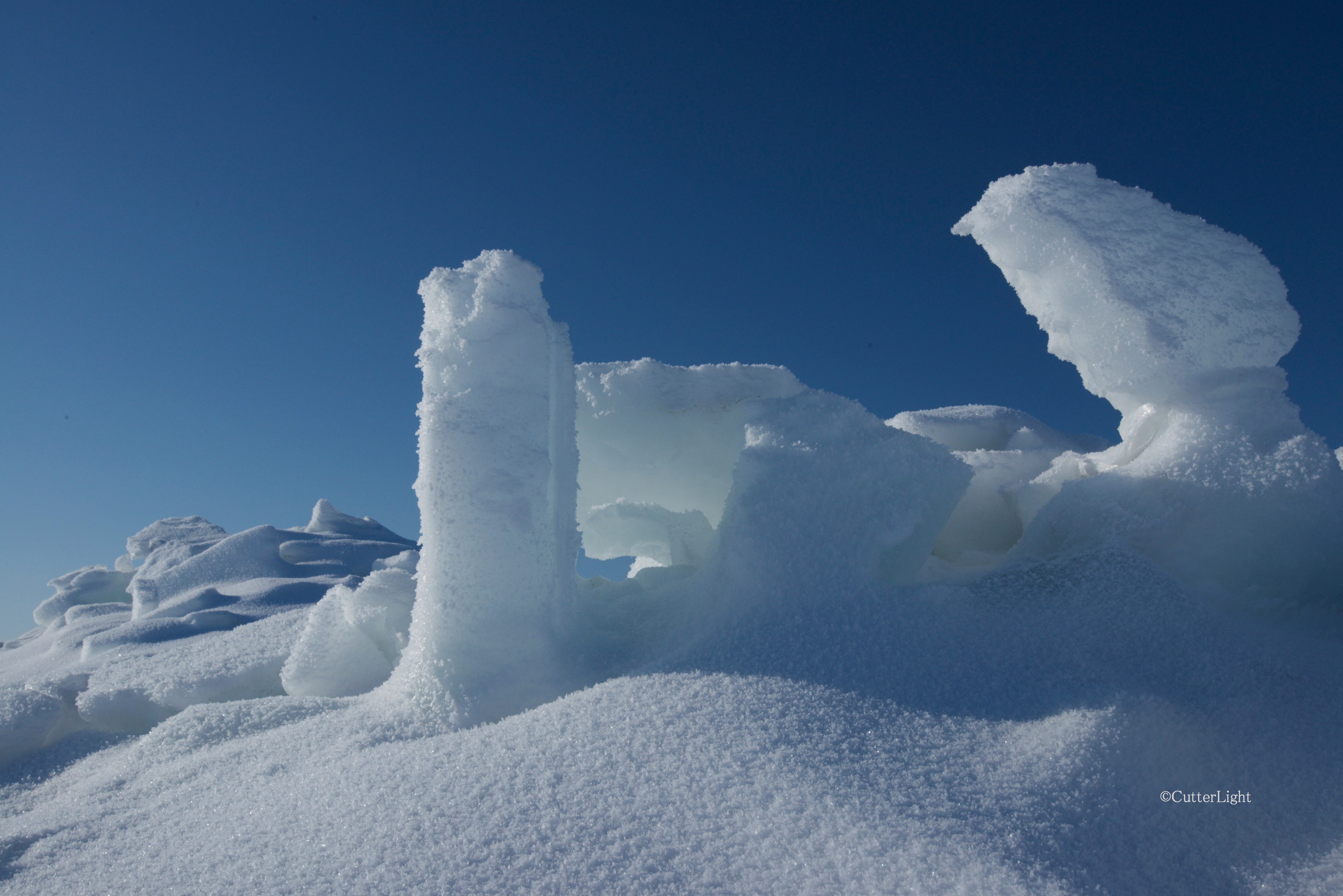
A fresh dusting of snow powders ice sculptures that were pushed up when shifting winds caused massive plates of ice to collide. Anytime you’re out on the ice, you’re mindful that another shift in the wind could push the ice apart again, leaving you stranded. You learn to keep an eye on the cracks.
By this time next week, we’ll be in Seward living aboard our summer home, the sailing vessel Bandon. Among other things we’re looking forward to is an intensive wine appreciation course we’ll be taking with another couple. We’re also eager to do some serious shooting with our new Nikkor 200-400 mm telephoto lens- a tool that should help us get intimate photographs of the amazing wildlife in and around Resurrection Bay. Daughter Maia will come up in July for our annual visit centered around fishing, hiking, great meals (and great conversation) and general catching up. The puzzles of turning out excellent meals from our small galley, figuring out where the salmon are in the nearby sea, experimenting with our new tenkara fly rods on smaller streams and maybe finally getting good photos of wary tundra swans are among other things that will keep us happily occupied in the coming months.
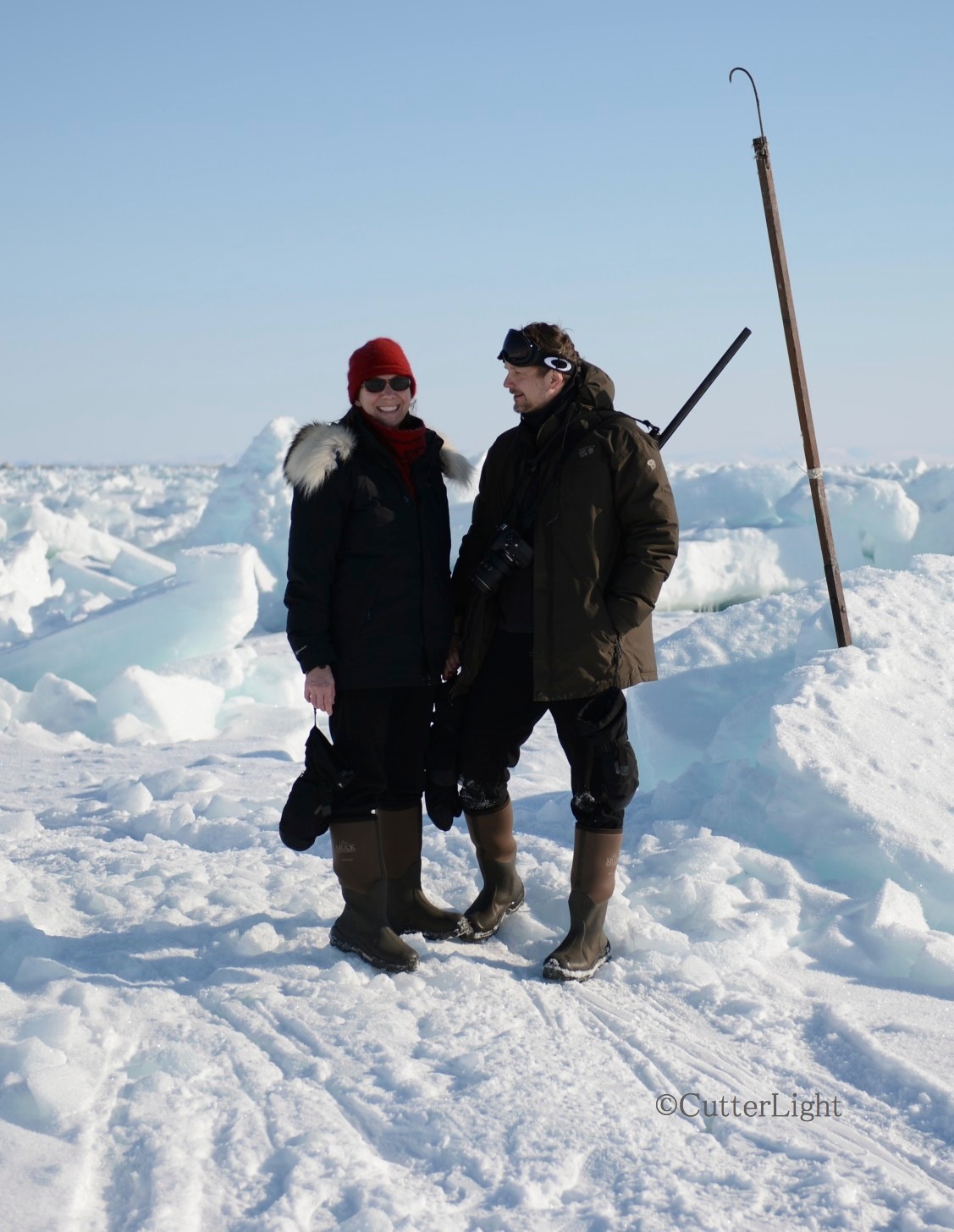
A whaling hook marks the trail out to the camps. This was a good year in Point Hope – five bowhead whales, lots of beluga whales, and everyone came back safe. Each whale represents tens of thousands of dollars worth of groceries that didn’t necessitate a river being drained for irrigation, fertilizer being spread (that ends up over-nutrifying nearby water systems), or a single drop of pesticide being sprayed. Nor were barrels of fossil fuel burned getting this food up here.
An important part of our summer in Seward involves seeing to our own provisions. When we return to Point Hope in August, we’ll bring with us 200 pounds of salmon, halibut, rockfish and lingcod fillets – enough for us and for gifts for our friends up here. We’ll also be making shopping runs to Costco and other stores and ship up the usual bags of flour, rice, beans and sugar as well as everything from jars of Kalamata olives to tins of anchovies.

Wherever this summer finds you, we hope you’ll be following your dreams or taking steps to make those dreams come true. And we hope you’ll continue reading CutterLight.
Sincerely, Jack and Barbra

This photo was taken on December 22, 2012, a day in the midst of the month during which the sun does not rise above the horizon in Point Hope, Alaska.
The sun dipped below the horizon 31 days ago on December 6 and did not rise again till yesterday, January 6. And yet, there was light each day, dim, brief, often breath taking.
We walked to the beach on one of those days when the sun didn’t rise. It was about 3:00 pm, and the sky was filled with shades of red, violet, amber and gold. The sea, which lies just 300 meters or so from our doorstep, is locked in ice. This time of year, polar bears are always a possibility as they roam the ice, searching for food.

Maia’s hand is dwarfed by a fresh polar bear paw print.
Edging the beach where ice met land was a fresh set of polar bear tracks. The evidence that we share this environment with these magnificent animals was thrilling – but also a reminder that caution is in order. We scanned in every direction as far as our eyes would take us. No movement. The bear had probably passed through in the dark of early morning.

Arctic foxes often follow polar bears in hopes of dining on scraps of the bear’s kill. Above, you can see the small paw prints of a fox near the bear’s tracks. Notice the tell-tale scrape marks in the snow on the forward edge of some of the bear tracks. Their long claws leave these scrapes as the bears amble along.
We waited and watched and listened. The wind moving over the seemingly endless frozen sea was all we could hear. In the distance to the east, we could see Cape Thompson’s snowy cliffs bathed in light etched against the pink horizon. As we walked along the edge of the sea, we found a murre, apparently exhausted, tucked into a snowy alcove against a bank of ice. The bird was lucky the fox had already passed by. Although the murre found the strength to take flight as we drew near, it is doubtful it went far. The Arctic winter is unforgiving.

Walking west, toward the sea, on a December day in Point Hope…
Daughter Maia was in the village for a two-week visit over winter break from college. Unfortunately, the Northern Lights didn’t cooperate, but the sky still put on some amazing displays.


Stunning in their soft, white coats, Arctic foxes (Vulpes lagopus) are common in this part of Alaska. The size of a small dog and as soft on their feet as a cat, these omnivores forage on whatever is available, from berries to insects to small mammals and birds – and it appears, big, fat marine worms!
In the past few weeks, there have been spawning events on our beaches near Point Hope. A couple of weeks ago, we were hearing about small fish – probably capelin (smelt) – coming ashore with the surf. More recently, we’ve been finding large marine worms on the beach. The size of Ball Park Franks, the appearance of these worms has coincided with egg cases in areas of coarse sand and gravel. In turn, these spawning events have drawn numbers of snowy owls and Arctic foxes looking for easy meals to the point of land west of town.

Morning sunlight slants through the jawbones of bowhead whales commingled with crosses at the Tikigaq cemetery in Point Hope, Alaska.
Not so long ago, National Geographic Magazine ran an article about domesticating foxes. Apparently there’s been some success, as breeders in Russia select the most gentle, friendly, trainable and inquisitive offspring generation upon generation. At an average size of six to eight pounds, Arctic foxes would be just the right size to curl up on the sofa for an evening of popcorn and a movie.
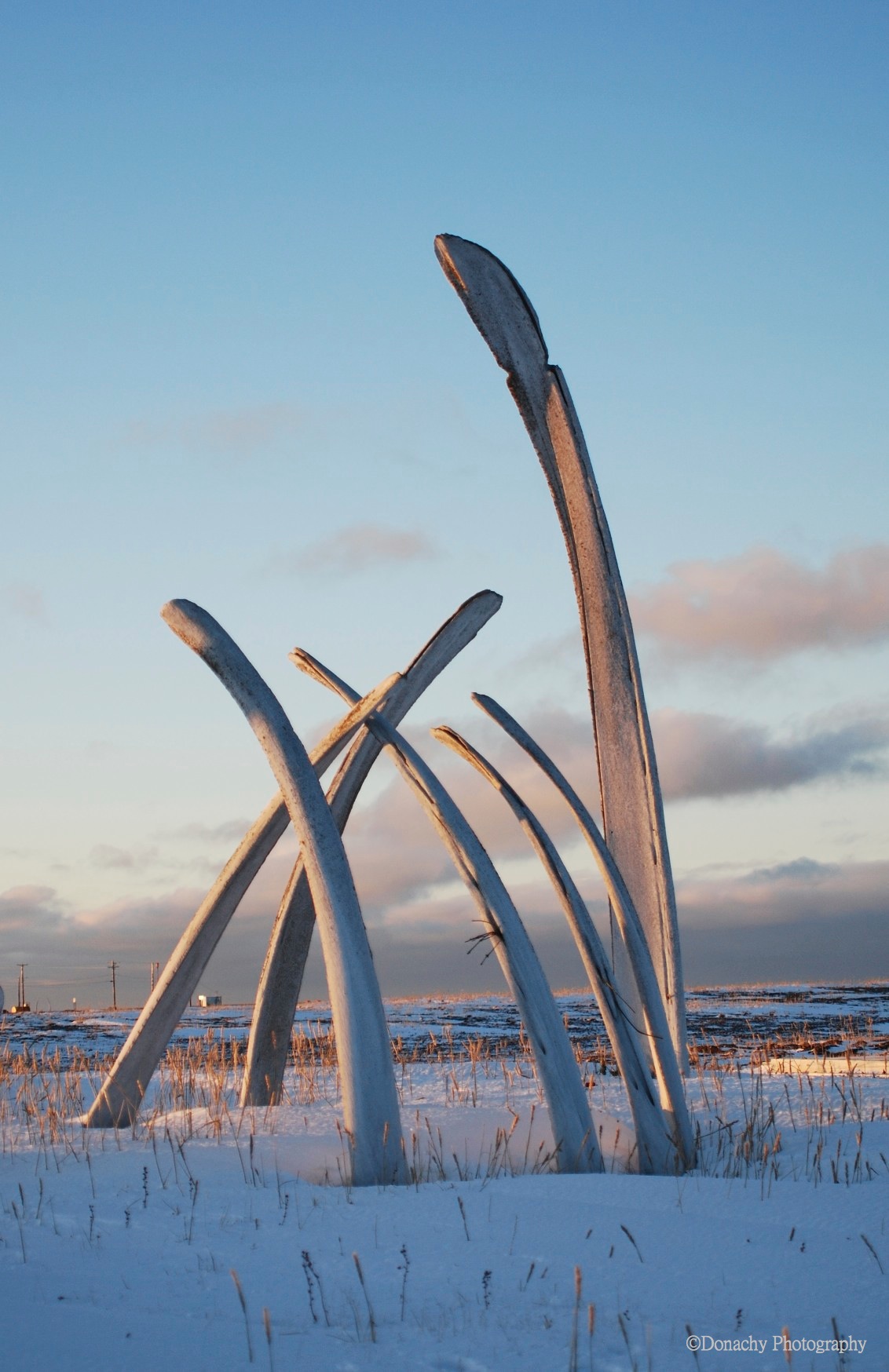
Like ribs pushing up from the tundra, these bowhead jawbones mark the resting place of one of Tikigaq’s last shamans.
The diversity – and sheer number – of animals and plants that manage to hack a living out of this cold land amazes us. Far from being the vast, frozen desert the Arctic has often been described as, each season brings with it an astounding number and variety of flora and fauna to the land and sea around Point Hope. Tracks in the snow near our house reveal that we have a weasel or two living beneath our porch!
 CutterLight