Unknown's avatar

About Jack & Barbra Donachy

Writers, photographers, food lovers, anglers, travelers and students of poetry

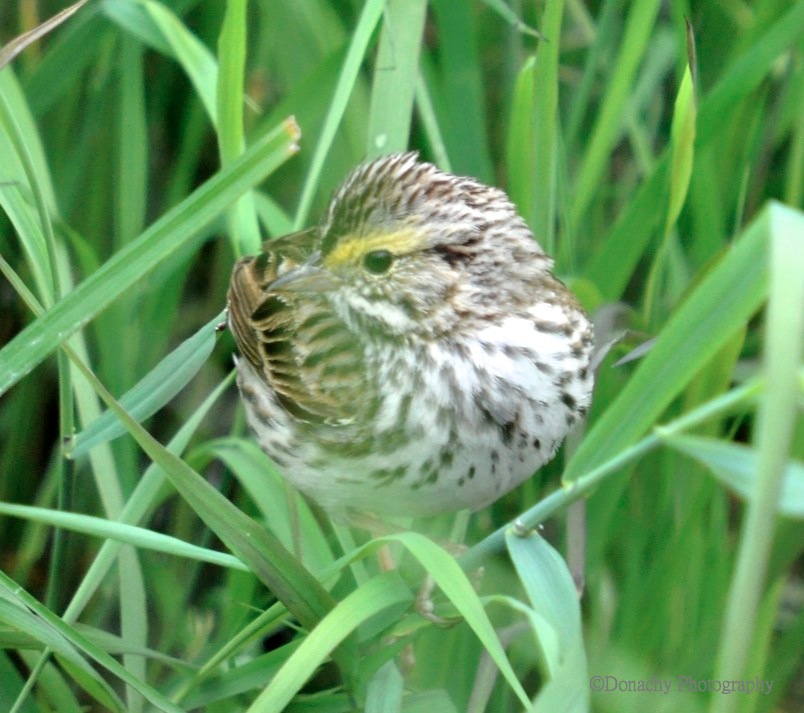
Savannah Sparrow

Savannah sparrows (Passerculus sandwichensis) are common and widely distributed in North America. The distinctive yellow lores (eye stripe) is the best way to distinguish savannah’s from other sparrows with streaked plumage.

All across North America – including all over Alaska – savannah sparrows are a common sight in open fields and marshes and in low brushy areas. Mainly seed eaters most of the year, they include insects in their diet as well, particularly during the breeding season. Their song has been described as “insect like,” and although it has a buzz to it, the description doesn’t really do it justice. Listen for the notes of the savannah’s high, buzzy song next time you’re in an open area. They can be hard to spot in the low brush and ground cover they call home, but when flushed, they usually fly just a short distance and may perch to take a look around. About five to six inches from beak to tail, savannah’s nest on or near the ground, laying  four to six blue-green eggs speckled with dark brown in cup shaped nests. The sexes are similar.

Incidentally, the species name sandwichensis comes from Sandwich Bay in Unalaska, Alaska. This photos was taken at Potter Marsh, near Anchorage.

Holster the Pistol, Take a Breath, Try it Again

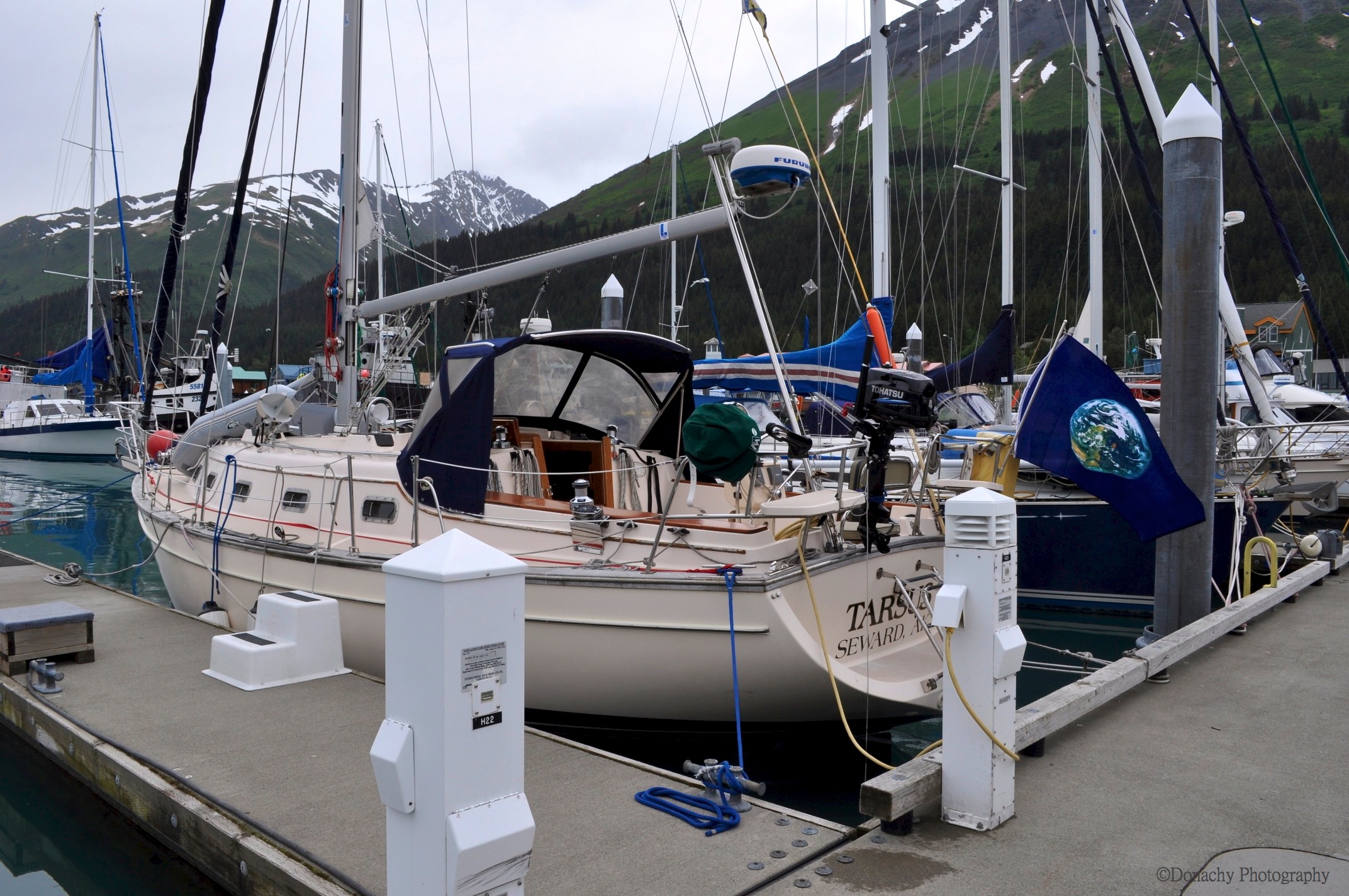
To the uninitiated, this photo may appear to be unremarkable. It’s a boat, tied to a dock. But this photo represents accomplishment and progress in small but important details in our seamanship. (We’re awaiting arrival of the new name letters we’ve ordered for the stern.)

The first time we docked Bandon, we were assigned a generously long, open slip at the end of H Dock in Seward. Nonetheless, having never docked a sailboat on our own before, bringing it in was intimidating. The boat’s 35 feet seemed to morph into 350 feet, and although there probably weren’t more than a handful of onlookers, it felt like we were in the middle of the Super Dome on Super Bowl Sunday, hearts in our throats.

There’s an art to docking, and some boats are easier to maneuver than others. Features such as twin engines and bow thrusters, which our Island Packet does not have, make precision docking easier. Features such as a full keel – which renders it all but impossible to turn the stern when in reverse – make the job more challenging. And then there are the prevailing winds pushing on the bow during the docking procedure, and the inevitable audience that inexperience seems to draw.

But the last time we brought the boat in – after a three-day cruise around Resurrection Bay – we managed to line it up and back it in… if not perfectly, at least competently. It felt good to make obvious progress with yet another aspect of seamanship. And there’s a real pay-off to docking stern first in our assigned slip: the prevailing winds are such that in the evening when we’re relaxing in our cockpit, the dodger (the canvas and clear vinyl hood above the companionway) acts as a windshield when the bow’s pointing south.

Take a walk along most docks, and it soon becomes evident that there are any number of ways to secure a boat to a horn cleat. Some work better than others. You don’t want to create a knot that might jam, but you don’t want a knot that will slip, either. The first few times we tied off, we pretty much guessed at what we were doing – resulting in the beginner’s mistake of too many wraps, and too many hitches. Now we get it: a couple turns of the line across the horns finished with a single weather hitch is both tidy and secure.

As with many things in life, if you’ve never been shown how to do something – including how to begin the task, what the process looks and feels like, and how the end product should appear – even simple tasks can prove challenging. Is this what it’s supposed to look like? and Why is this so difficult? become frequent refrains. Often times manuals appear to be written and illustrated for people who already have some expertise or background in the subject and make little sense until after you’ve figured out how something works.

Barbra rebedding a chainplate for the second time – the first go at it having gone quite wrong. We still may not have gotten it right, and will give it another go till we seal up the rain leak we’ve been trying to chase down. 

There’s nothing like having access to a patient, knowledgable mentor to walk one through the steps of new tasks – and to do so as often as needed until the task is mastered. But most of the time, a combination of self-study, intuition, trial and error and a willingness to occasionally screw up and break things suffices instead. The first time we set the anchor, I wanted to pull out a pistol and shoot the whole system in the fashion of General George Patton shooting a jeep that wouldn’t start. The windlass repeatedly jammed, we had a heck of a time holding the boat in position and for the life of us, we could not figure out when the anchor was on the bottom as the chain, heavy and dense, hung straight down from the bow. We put the engine in reverse, backed up until the chain went taut and our movement stopped, and then spent a fitful night worrying that the anchor wasn’t set at all and we’d wake up to find our boat grounded.

But the anchor held, and the next morning it came up with chunks of clay and mud clinging to it, indicating it had dug in just as it should have. The next time we set the anchor, the process went smoothly… leaving us wondering how in the world it could have been so difficult the first time.

And so it goes. With a lot of what we do, the first attempt is chaotic, filled with uncertainty and error and no small amount of frustration. But we think and communicate and debrief, and subsequent attempts go more smoothly and fill us with satisfaction and, yes, pride.

Each new thing we learn is a new thing we’ve learned. This summer, our task has been to begin to master some of the most basic elements of sailing, seamanship and boat care. The learning curve, for us, is steep. But by taking things in small steps, it seems achievable. Looking into the future, it is apparent that in sailing, we have found a pass-time and a lifestyle in which there will be no end to additional skills to master, knowledge to acquire, and experiences to cherish. That’s what drew us to this in the first place.

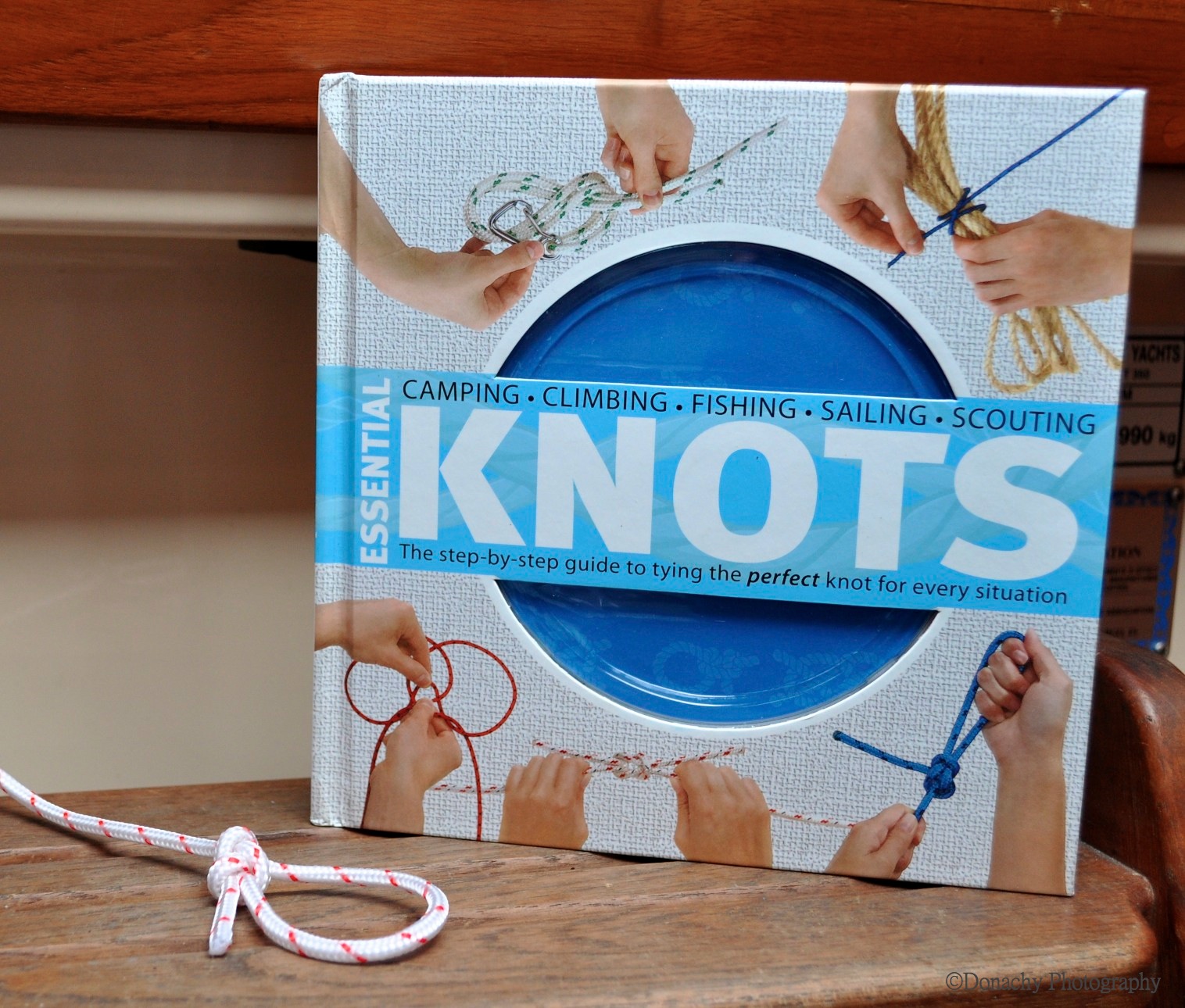
Knots are essential to sailing, and the bowline (above) is a classic with multiple uses. After consecutively tying this knot dozens of times, either one of us could probably tie it in our sleep.

Leftover S’mores Ingredients? Bake a S’mores Cheesecake!

After grilling s’mores for ourselves and our dock neighbors, we were still left with half a bag of marshmallows, a box of graham crackers, and a whole bar of dark chocolate. Such problems… Cheesecake was the answer to this problem!

Our galley kitchen is small. The counter space is measured in inches. Our pantry has just the basics. Our cookware and dishes are on the multifunctional and minimal side. We did outfit our little home with Denby dishes, which can be baked in. So, forget about the springform pan and the food processor in this preparation. What follows is how I made S’mores Cheesecake, galley style.

S’mores Cheesecake

Ingredients

Crust-

  • a little more than 1 cup of ground graham crackers. I ground the graham crackers using our coffee grinder.
  • 3 tbsp brown sugar
  • 1/4 cup melted unsalted butter
Cheesecake Filling
  • 8 oz. cream cheese, brought to room temperature
  • 2 eggs, also room temperature
  • 4 tbsp brown sugar
  • 1/4 cup of coarsely chopped dark chocolate bar

Topping

  • Marshmallows, quartered
  • 1/4 cup of coarsely chopped dark chocolate bar

Directions

  1. Mix graham cracker crumbs with 3 tbsp brown sugar and butter.
  2. Press into a well-buttered pasta bowl that can be baked (or springform pan if you are in a standard kitchen).
  3. In a medium-sized pot, beat eggs and remaining 4 tbsp. of brown sugar. I used brown sugar to add flavor in lieu of vanilla extract.
  4. Whisk in cream cheese until smooth. A mixer would have come in handy for this step. My arm was a little tired here.
  5. Mix in 1/4 cup of chopped dark chocolate. I did experiment with using a vegetable peeler to curl pieces of chocolate. Using a cutting board and a chopping knife was easier and turned out with equally good results.
  6. Pour cream cheese mixture into graham cracker crust and bake in a 320 degree F oven. My little oven may bake a little warmer than yours, so you may need to increase the temperature a bit.
  7. Bake for about 40 minutes, until the center is almost set.
  8. Evenly place marshmallows on top of cheesecake. Sprinkle with remaining 1/4 cup of chocolate. Bake for another 5 minutes, marshmallows should just be tanning.
  9. Remove from oven and let cool for about an hour. No matter how much Jack begs, tell him he can’t have any cheesecake until tomorrow.
  10. Refrigerate overnight. Fortunately, our camper is parked in the harbor parking lot and is equipped with a nice little fridge.

I was pleasantly surprised that we could pop the cheesecake out of the pasta bowl. I thought we were going to have to enjoy this dessert spoonful by spoonful. Who needs springform pans?!

Sandhill Cranes with Chick: Potter Marsh, Alaska

Driving to Anchorage from Seward recently, we spotted these sandhill cranes at Potter Marsh and decided to park the truck and walk out onto the boardwalk for a closer look.

Large birds are cool, and in North America, there aren’t many birds larger than Grus canadensis, sandhill cranes. Adults typically weight 8 to 10 pounds. The stand four to five feet tall and have wingspans of five-and-a-half feet to nearly seven feet. Sandhills are fairly common in the west, and in a few places can be viewed by the hundreds or even thousands. More frequently, they are seen here and there in pairs, in small groups, or as individuals.

The sexes are similar. Plumage ranges from drab gray to rusty brown. Aside from size, the most distinguishing characteristic is the red crown. (Click the photos for a larger view.)

We couldn’t quite make out what the adult bird is feeding the chick. Cranes are catholic in diet. Berries and seeds make up a large portion of their diet, but insects and other small animals figure in as well.

This chick will stay with its parents for 10 months or so – until just before next year’s breeding season when the parents will lay one to three eggs. Sandhills have a life expectancy of about seven years in the wild, but may live up to three times that long. Several subspecies occur throughout the U.S. and across the Pacific to Siberia. Accidentals have been reported in Europe.

Strawberry-Port Gallette with Sliced Almonds

Delicious first baking experience in the galley of our boat, Bandon. Strawberries marinated in brown sugar and port wine stuffed into a simple crust filled our little home with delicious smells and satisfied my need to bake.

Our boat is equipped with a gimbaled stove, which pivots and swings to remain level in spite of waves and wind in the harbor. The stove houses a tiny oven, which is perfect for baking for two. I love to bake and have had an itch to make something with the  beautiful strawberries I kept seeing at the store. We hadn’t had strawberries since last summer! After thirty minutes of baking, the first experiment emerged from the oven a success. The only thing that would have improved this dessert was a couple of scoops of  vanilla ice cream. Next time…

Strawberry Port Gallette

Ingredients

  • 1 cup all-purpose flour
  • 2 tbsp granulated sugar
  • 1/4 tsp salt
  • 3 tbsp unsalted butter
  • 2 cups sliced strawberries
  • 1/4 cup brown sugar
  • 2 tbsp port wine

Directions

  1. In a small bowl, stir together strawberries, brown sugar, and port. Set aside.
  2. In a medium bowl, mix flour, granulated sugar, and salt.
  3. Cut in butter to flour mixture. I mixed this by hand, literally, until the butter was well incorporated.
  4. Add a bit of water to form flour mixture into a dough ball (I used about 2 tbsp).
  5. Roll out dough to an 8″ circle. I didn’t have a rolling pin, so I pressed out the dough into 8″ circle onto a well-buttered cookie sheet.
  6. Place berries in a mound on the circle, leaving a 1-2″ border. I reserved some of the sugar-port juice to sauté the sliced almonds.
  7. Fold the 1-2″ border over fruit, leaving the strawberries exposed in the center.
  8. Bake at 375 degrees F until golden, about 30 minutes.
  9. While gallette is baking, sauté almonds in reserved sugar-port juice.
  10. When baking is complete, remove gallette from oven and sprinkle with sautéed almonds.

Violet-green Swallow

Violet-green swallows (Tachycineta thalassina) are common throughout the western U.S., Canada and Alaska. In flight, look for the distinctive white on the sides of the rump. When they perch, look for white cheeks with white extending above the eye to distinguish them from tree swallows (Tachycineta bicolor).

Depending on the light, violet-greens’ backs can appear to range in color from teal to metallic green to purple. This is the male, above.

Females’ colors, above, tend be a bit more muted than males. 

Look for violet-greens in open areas and semi-open areas where they feed on insects. They can be attracted to nesting boxes.


Grilled S’mores? Who Knew? A Better (messier) Campfire Snack

This twist on a summertime favorite kicks the s’mores experience up a couple of notches. Graham crackers, thick chunks of dark chocolate, and marshmallows are as good as you remember them when you were a kid. Maybe better.

Guilty as charged: hardly a summer goes by when we don’t have s’mores at least once. They’re a great campfire dessert. But when a friend recently suggested we try grilling our s’mores instead of only toasting the marshmallows, we figured that maybe tried-and-true had been improved.

Hot off the grill, these s’mores don’t look dangerous. But looks, as everyone knows, can be deceiving. What you’re seeing here is molten goo ready to start pouring all over your hands, mouth, face, shirt and jeans at the slightest touch.

The chocolate looks like it’s set. It isn’t. As soon as it’s even slightly disturbed, it turns to liquid. The molecular science behind this is beyond our ken, but one thought came to mind: there’s a market for the s’mores equivalent of lobster bibs! The cracker is toasted crispy and warm, and the marshmallows are perfectly heated through – gooey and never burned.

Don’t Bogart that Collar, My Friend: Yelloweye Rockfish Melts

A pan-toasted sourdough bun, a chunky heap of yelloweye rockfish, and Tillamook cheddar cheese along with a couple of grinds each of sea salt and pepper are all you need for a gourmet lunch. The collar meat of yelloweye has a texture and flavor reminiscent of lobster and in similar fashion puffs up when you cook it.

While crab or shrimp are the classic seafoods in a melt, firm, white-meated fish is every bit as good. Enter yelloweye rockfish (Sebastes ruberrimus) collar meat. The large, firm chunks of meat are perfect on melts. Lingcod, halibut, grouper, snapper and freshwater walleye are good candidates for this dish as well, and while collar meat is an excellent choice, any boneless portion of fish works fine.

I like to start with pan-toasted sourdough bread. Heat some olive oil in a frying pan, place in the bread and move the down side around so it become coated with the oil. Cook over medium-lowor low heat till it’s toasted golden brown. Sometimes I add a little butter or some garlic to the olive oil.

Meanwhile, in a separate pan where you’ve also heated a little olive oil, place the fish and cook it over medium-low heat.

If you’ve timed things right, the first side of the bread is toasted and ready to flip at about the same time the seafood is cooked through.

Flip the bread to toast the other side, place the hot, cooked seafood on the toasted side of the bread, cover with shredded cheddar cheese, add a few grinds of pepper and some sea salt, then cover the pan with a lid and continue cooking over low heat till the cheddar is melted.

A few slices of avocado or fresh fruit on the side, a cold lager, iced tea or freshly-squeezed lemon-ade, and you’ve got a quick and easy lunch that will be relished as much by most kids as by gourmets.

Orange-crowned Warbler, Potter Marsh near Anchorage

Oranged-crowned warblers (Vermivora celata) are fairly common, but it’s rare to get a good look at these tiny, active birds. Even less common is finding an individual with an identifiably orange crown. 

Color is often the first thing we go to when attempting to differentiate among like species. The perplexing thing is that color is often misleading.

The orange-crowned warbler’s orange crown is seldom visible. What birders typically see is a small, greenish-yellow-brown bird flitting through alders and willows. A warbler. But which warbler?

If you don’t see an orange crown, another tell is the complete absences of barring on the wings.

Orange-crowned warblers feed on insects, worms, nectar and berries. They’re ground nesters. What a thrill it would be to find a nest, tucked away beneath low-growing willows. When summer ends in Canada and Alaska and the Western United States, orange-crowns migrate to the southern U.S. and Central America.

We were lucky to catch this guy preening on an open branch at the edge of Potter Marsh, on the southern edge of Anchorage, Alaska. He stayed long enough for several photos. Before flitting off into the underbrush, he gave us one final view of his seldom-seen orange crown.

Rockfish in Sweet & Spicy Beans with Miso

Yelloweye rockfish poached in miso soup with black beens, sweet corn and summer squash. The broth is sweetened with honey and spiced with a Jamaican-style rub for a little heat to balance out the sweet.

In Japan, I was served a dish featuring carp cooked in sweetened beans. It was good, though a bit sweet to my tastes. Later, I began catching kurosoi, a black rockfish (genus Sebastes) common in northern Japan. After broiling a couple of them, I knew I had a good candidate to try in a spicier bean dish.

Two pound rockfish such as this yelloweye are perfect for a whole-fish-for-two dinner. A small zucchini, cut in half, scored, drizzled with olive oil and seasoned with herbs de provence, makes a nice side dish. 

A variety of firm, white-meated fish work well in this dish. Any of the rockfishes in genus Sebastes, black seabass, small stripers, snappers and porgy (sea bream) would be good choices. Any leftover broth from this dish can be served the following day as an excellent soup.

Rockfish in Sweet and Spicy Beans with Miso

For two diners…

Ingredients:

  • One rockfish (or other fish with firm, white meat) weighing about 1 1/2 to 2  pounds with scales, gills and entrails removed.
  • 1 pound of black beans
  • 1 cup of red miso soup broth (make it a little stronger than usual)
  • 1/2 tbsp Jamaican rub or other spicy seasoning featuring hot peppers. Cumin and oregano may be included in the seasoning, or may be added separately.
  • Several cloves of garlic, chopped coarse
  • 1/2 sweet onion, chopped coarse
  • sweet corn (one ear’s worth – about 1 cup)
  • 1 yellow squash (summer squash), sliced into circles, circles cut in half (optional)
  • sea salt to taste (the miso will add quite a bit of salt)
  • freshly ground black pepper, to taste
  • hot chili pepper, sliced thin or chopped fine – just a little for additional heat (optional)
  • two tablespoons honey
  • two tablespoons olive oil
Directions:
  1. Thoroughly clean the fish, pat dry with paper towels, and set aside.
  2. Over medium-low heat, prepare the miso broth in a pan large enough to hold the whole fish (an oblong poacher works best for this, but any large, round pan that has a lid will do).
  3. Stir in the honey until dissolved.
  4. Add the beans, onions, corn, spices (including slices of chili pepper), olive oil and freshly ground pepper. Taste. Add salt and more spices, if desired. Cover with a lid and bring to a simmer.
  5. Add the fish, working it down into the broth.
  6. Cover with a lid and maintain a simmer, reducing heat if necessary, and cook for about 7 minutes. Using two spatulas, carefully turn the fish so that both sides are cooked in the broth. Add the summer squash at this time. Continue simmering on low heat for another 10 to 13 minutes. The fish will be all but falling apart when done. (Cooking the first side for a shorter time before turning the fish will mean that the fish is firmer and therefore easier to turn over.)
  7. Carefully remove the fish to a serving platter. Arrange beans and vegetables around the fish and serve piping hot.
We enjoyed this fish with a red table wine from the state of Washington. Syrah, Malbec, or Merlot would pair well with this dish.

And don’t forget a colorful seasonal salad!