Learning to Play the Guitar at 60: La Grande Expérience (or Is it even Possible?)

It has been said that a guitar sounds good even when it is dropped. I suppose that depends on whether or not the guitar is in tune – and perhaps who is doing the dropping. It is also said that one is never to old to learn to play the guitar, a statement that seems to hinge to some extent on what is meant by the word “play.”

For much of my adult life, I have owned a guitar. My Poco, my grandmother, gifted me the money for my first one when I was 18. I took a couple of lessons, didn’t get far and allowed it to collect dust over the next couple of years until I enlisted in the U. S. Navy whereupon I sold it. My father opined that I should “accept the fact” that I was bereft of “any musical talent.” He’d made similar pronouncements at the outset of other ventures. To this day he cannot believe – will not accept – that I got into the college I got into, let alone that I graduated from it. His assessments always stung, but they generally proved to be nothing to go by. The fact is, I had never practiced much on any sort of musical instrument. So a hypothesis as to whether or not I had – or have – aptitude for such a thing has remained untested.

After leaving the navy I purchased a new guitar, another inexpensive but serviceable steel string acoustic. Like its predecessor, it remained tuned and otherwise barely touched until some years later when it was stolen from my vehicle during a cross country move.

A third guitar, a Fender DG 8S replaced that one. Like the two previous guitars it has a solid spruce wood top, retails for a modest price and gets decent reviews as a “beginner” guitar. It has come with me on successive moves from Astoria, Oregon to Sacramento, California, to two Eskimo villages in the Alaskan Arctic, to Mongolia and back to Alaska where it has resided on a stand in the corner of our living room. All the while it has been regularly dusted, generally kept in tune, and otherwise neglected. Thus, over the course of 32 years of on and off guitar ownership, I learned to play the C Major scale, the chords C, D, G and F (OK, I couldn’t really play the F chord), and, imperfectly, the first four very simple songs in Mel Bay’s Modern Guitar Method Grade 1, peaking with Sparkling Stella, aka Twinkle, Twinkle Little Star on page 11. Page 12 remained beyond me. I could barely read music and I never spent enough time with even the simple songs I “knew” to master them in any meaningful way. Evolving from a halting rendition of Twinkle, Twinkle to the blues-folk music I dreamed of playing seemed an impossible journey.

I suppose some of these old tapes and a few more were in my head this past New Year’s Eve when, with a beer in my belly and another in my fist, I found myself admiring the glow of decorative holiday lights reflecting on the polished spruce of my guitar. I had been putting together a compilation of goals for the coming year: run a half-marathon, send out at least five articles for publication, improve my fly-casting, etc. when a new thought suddenly presented itself.

Wouldn’t it be a neat trick to finally learn to play the guitar at the age of 60?

On January 1, I picked up the Fender and began practicing. It made my fingertips hurt – a stage I’d experienced in the past and had never gotten through. This time I stayed with it. Sixty-two days later, on March 3, I reached a small milestone: my first 100 hours of meaningful, purpose-driven practice – more practice… far more… than in the previous 59 years of my life combined on any musical instrument. The fingertips of my left hand now bear thickly calloused pads which are impervious to the steel strings’ bite. Both hands have developed newfound strength and dexterity and I’m gradually getting the hang of the patting-your-head-while-rubbing-your-stomach gymnastics necessary in guitar playing.

Meanwhile I’ve scoured the Internet searching for examples of people who picked up a guitar for (essentially) the first time in their 7th decade and went on to acquire any sort of meaningful mastery of it. The search results have not been encouraging.

I was unable to find even one such instance. Yes, there were examples of people who had played well in their younger days, set the instrument aside, and then returned to it later in life. But that’s an entirely different matter than starting virtually from scratch.

What I did find were repetitions of advice and “encouragement” which I found to be quite patronizing. One trope begins “Many of my older students…” Really? Well then pray, share with us an example in this day and age of Youtube videos.

Even more condescending is the repeated assurance that “Older students can derive great benefits from learning to play the guitar.” Articles written under this thesis generally go on to reveal that by “benefits” the author is referring to the kinds of advantages one might as readily derive from a walk in fresh air followed by a rousing game of Scrabble. In this vein, a 2016 Washington Post Article concludes with one such older student declaring, “My cats have stopped yowling, which I take as a good sign.” Really? That’s where the bar is set?

I like walking and I like Scrabble, but I’m not looking for “benefits;” I want to learn to play the guitar, and I want to know if, as I close in on 60, I may have waited too long.

I have read again and again that one is “never too old to learn to play the guitar.” Yet, there comes a point when one is too old to achieve meaningful mastery of new, complex skills. Memory, finger dexterity, hand speed and the ability to create new connections in one’s brain all deteriorate. I expected there to be research-based guidance and exemplars regarding this matter. The only worthwhile bit of information I’ve turned up is that others are asking this same question to little avail.

And so, what began on the evening of December 31, 2018 as a somewhat whimsical challenge to myself has morphed into La Grande Expérience – The Great Experiment. Starting with little or no previous experience:

Can a sexagenarian reasonably expect to achieve any sort of meaningful mastery of the guitar? Or must one concede that by that age, windows have closed and the best to be hoped for are vaguely defined “benefits?”

I will conclude for now with that question. I have left open what I mean by “meaningful mastery.” Nor have I said anything about my own progress over these past 62 days. I leave those subjects to future installments under this heading.

For now, I offer a thought and a question. Perhaps two questions. First, the thought.

If you are an older person – approaching or past 60 – and you have taken up or are considering taking up a new endeavor, I say whole heartedly, Go for it! I will cross the threshold of 60 in less than four months. In recent years I’ve added a number of new skills to my life: sailing, bike trekking, photography and birding to name a few. I’ve greatly expanded my skills as a home chef, brought to hand my first salmon caught on a fly (and many more thereafter), engaged in my first ever cross country skiing, made more progress with a foreign language in a few months than I had in all the years of high school and college classes combined and am presently in training to complete my first half-marathon in 10 years. All of these disciplines have added depth and joy to my life. It hardly matters that there are no prospective Olympic medals, National Geographic assignments or recognition as the next Lee Wulff in the offing. It feels good to be strong, to be opening new doors and to have the capacity to immerse myself in new worlds.

That being said…

Have you… or do you know of someone who has… achieved a reasonable degree of proficiency on the guitar (or other instrument) having picked it up as a beginner in their 60th year or later?

And this: drawing perhaps from your own experience, what advice do you feel might be offered to others who wish to acquire a new skill?

Planes, bikes, ferries & feet – Ready for 85 Days in Hokkaido, Japan

Nowhere in particular to get to… and all summer to get there.

May 19: We’d saved a couple fingers of bourbon for this, our final evening in Chignik Lake. Measured out in a pair of our favorite glasses, the mellow amber-brown glow of the whisky suited a similar mellowness that had settled over us as we looked around a clean, tidy home that only a few days before had been an explosion of camping gear, bikes, technical clothing, camera gear, panniers and check lists. Our bicycles and camping gear had already been flown to Anchorage where they were waiting for us at Lake Clark Air. Scheduled to fly out of Chignik Lake the following day, ahead of us was a five-day scramble in the big city of Anchorage in which to reconnect with friends, make last-minute adjustments to our bikes and have them boxed for air travel, and to pick up necessities ranging from fly-fishing leaders to all-purpose hiking/biking/street/camp shoes as well as a couple of dozen additional odds and ends. Oh, and to get one of the three store-bought haircuts we treat ourselves to each year.

And then on Saturday, May 26, we’ll board Alaska Air bound for San Francisco where we’ll switch to Japan Airlines into Chitose, Hokkaido. If all goes according to plan, we’ll spend the next 85 days exploring Hokkaido, Japan by bike.

Why Hokkaido? I suppose it comes down to the fact that both of us have wanted to do a bicycle trek ever since we were kids but never did. Lacking experience in this sort of thing, it made sense to go for it in a country known for being safe and for having a bicycle friendly culture. Factor in campgrounds that typically range in price from free to $5 or $6 dollars, a cool, comfortable summer climate, beautifully diverse landscapes featuring smoking volcanoes, snow-capped mountains, bird-rich marshes and forests, fields of flowers, six national parks, seaside villages and the distinct possibility that we just might get into some decent trout and char fishing.  Japan’s northernmost island seemed to us to be the best possible place to make this leap into a new way of travel.

Hokkaido’s cuisine surely ranks among the world’s finest. Regional seafood specialties include scallops, oysters, several species of crab, shrimp, salmon, squid and succulent, softball-sized sea urchins. As Japan’s agricultural capital, Hokkaido is also known for its fresh fruits and vegetables as well as local beef and pork, and people rave about the rich ice-cream. There may even be opportunities to sample wild game. Soba – those tasty buckwheat noodles that are especially delicious served cold – is made from local grain, and it seems that virtually every city, town and village has its own unique twist on ramen. Visions of donburi – bowls of rice piled high with a variety of colorful, fresh seafood – have been dancing in our heads for months. If that’s not enough, micro-brews have caught on, there’s a nascent wine industry and even a couple of world-class single malt distilleries. Every yen we don’t spend on campground fees is another yen we’ll be able to spend eating our way around the island. 

So stay tuned. We intend to publish throughout the summer – food experiences that inspire, new birds, exotic species of trout of char, encounters with wildlife and the challenges and successes we’re bound to encounter pedaling our way along sea coasts and through mountain villages. But the thing we’re most looking forward to is meeting new people and immersing ourselves in a new culture. I’ve been practicing my Japanese, to be sure. But if experience is any guide, connections trump vocabulary. We can’t wait to share our loves of fly-fishing, photography, birds, food, camping and hiking with friends we haven’t yet met, half-a-world away, who find similar joy and fascination in such things. Hopefully our journeys will bring us into conversations with soba masters, commercial fishermen, trout chasers, farmers, ranchers, biologists and people who call Hokkaido home and love living there.

Wherever the coming summer finds you, we wish for you days filled with pleasant adventures, good food and deepened connections old and new.

New Homes Available! Swallow Nesting Boxes at Chignik Lake

Construction Complete! Lovely one-room summer homes with lake and mountain views available now! Perfect for rearing a brood of chicks.

Reading John J. Audubon’s accounts of his journeys throughout the United States in search of every species of bird for his paintings, I’m always charmed by his portraits of communities and their abundant bird nesting boxes.

“Almost every Country tavern has a Martin box on the upper part of its signboard;” he wrote of 1840’s America, “and I have observed that the handsomer the box, the better does the inn generally prove to be.”

The prevalence of hollow gourds fashioned with holes and used as nesting sites in Native American villages is also well documented. Apparently the symbiotic relationship between swallows and humans goes back a long time and cuts across cultures. Virtually everyone seems to love these harbingers of spring, their artistic mastery of the air, and the serious damage they do to mosquito populations and to other annoying insects.

And so it is here in Chignik Lake. Upon moving here we were struck by the numerous swallow nesting boxes situated on posts, nailed to utility poles and affixed to buildings throughout the village. Here we have mostly Tree Swallows along with occasional Violet-green Swallows. In the absence of invasive species such as House Sparrows and Starlings – which take over nesting boxes -, and with a lake featuring copious hatches of midges and other insects, this is a perfect place for swallows to rear a brood of chicks. Magpies can be a scourge, so it’s important that nesting boxes not feature any sort of perch to allow them to access the eggs and chicks, but other than our Merlins, there are essentially no other serious threats to the swallows of Chignik Lake.

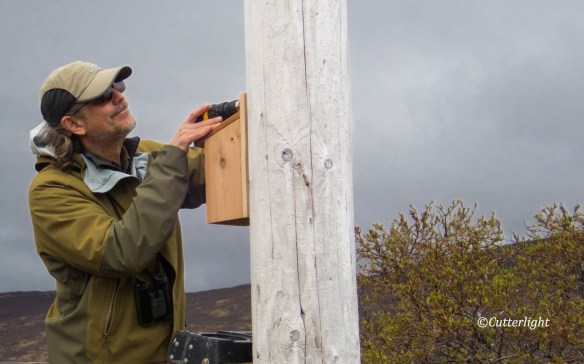
The major factor limiting the number of swallows Chignik Lake can accommodate is… accommodations. So this spring we did our part to help these birds out by putting up four new cedar nesting boxes. The first Tree Swallows showed up sometime around May 9, and the early birds have already begun choosing nesting sites. Our boxes may have gone up a bit late for this year’s birds, but after they’ve weathered for a year and the swallows have had an opportunity to check them out, we’re hopeful they’ll attract these welcome summer visitors in future years.

Location, location, location. High enough up, away from occupied buildings and busy roads, near a lake chock full of bugs, and a pesticide & herbicide-free environment. Heck, if we were Tree Swallows, we’d spend our summers here!

If you’d like to put up swallow nesting boxes in your area:

  • Place the boxes high enough off the ground to avoid predators
  • Although swallows like to feed and nest near water, position the boxes well back from the shore. Predators cruise shorelines.
  • Although swallows will at times happily nest in apartment-style boxes (a friend in Chignik Lake has a row of about a dozen boxes that fill up with residents every summer) it is generally recommended that for Tree Swallows and Violet-greens, boxes be placed at least 30 feet apart.
  • Do Not attach a roosting peg or ledge anywhere on the box. Swallows don’t need such a perch, but avian predators will use it to to prey on eggs and chicks.
  • Swallows prefer nesting boxes in open areas, at least 30 feet or so away from buildings. This is by no means a hard-and-fast rule, and don’t let a lack of open space prevent you from putting up nesting boxes. Boxes placed near shrubs and trees are likely to attract wrens, sparrows and other birds rather than swallows.
  • Do what you can to keep European Starlings and House Sparrows out of the boxes. These invasive species have had a negative impact on a number of native bird species. A hole diameter of 1⅛” – 1⅜” is said to be large enough for swallows but will keep starlings and sparrows out.
  • Keep cats indoors. This is a good general rule to protect wildlife, but is especially important if your aim is to attract birds. You don’t want to invite birds only to have them and their chicks fall prey to a pet.

Progressivism Always Prevails. Reasons for Optimism in the Aftermath of 17 Preventable Deaths

Above: The future. Below: I wrote the following letter to my daughter, Maia, and share it here. Have faith. Our side always wins in the long-run. Always.

Dear Maia,

I spent a good bit of the latter part of this past week looking at the images and listening to the voices out of Douglas High School in Parkland, Florida. It is incomprehensible to me that a teenager who can’t legally purchase a beer, or drive a car without a license, is able to legally purchase an assault weapon with the capacity to fire dozens of deadly rounds in a single minute. In fact, it’s incomprehensible that any civilian is able to legally own such a weapon.

Incomprehensible, that is, until one considers that the single most powerful political lobby in Washington is the NRA and that they own nearly every single Republican politician – politicians who, apparently, value NRA campaign contributions (and promises of post-retirement speaking fees) more than they value the safety of American citizens including our children and young people. The top 10 recipients of NRA money in both the U. S. Senate and the U. S. Congress are all Republicans. (Rather than provide a link to verify this, I encourage readers to do their own research in order to get a real sense of just how deeply the NRA has its claws into our Republican politicians. )

And so it should be no surprise that in his role as House Speaker, Congressman Paul Ryan, (Republican, Wisconsin) will permit neither meaningful floor debate nor a meaningful vote on anything that would curb the lucrative sale of guns in this country. Or that in the aftermath of one mass shooting after another, the only pleas he makes are pleas for non-action.

In the past election, Donald Trump received over $30 million in direct and indirect campaign money from the NRA. And so, again, it should come as no surprise that Trump has promised the NRA he will never sign legislation undermining gun sales. “You have a true friend in the White House,” Trump told the NRA.

Who, in Parkland, Florida, among the 14 dead young people and the three teachers and coaches who loved these kids and laid down their lives to protect them, and their families, and their friends , have a “true friend” anywhere in the Republican Party? Or the next 17 dead? Or the next 17? Or the 17 after that?

Even the majority of gun owners do not want these current lax laws to exist. (Anything you suspect I’m making, up, you should research.) It’s an NRA thing. It’s a Republican thing. It’s a $32 billion dollar a year gun industry thing.

Money over lives in the GOP party of coal, tax breaks for the rich, opposition to national health care, hostility toward education, unending wars on our environment and indifference toward the DACA young people who came to the United States with their parents. Build a wall, like they did 2,000 years ago in China. Have a military parade, like they do in North Korea. And keep taking NRA money.

With fellow Americans voting for Republican majorities in the House, the Senate and (by a minority vote only possible in America) giving the presidency to Trump, how can I be optimistic?

Maia, remember what I told you about ISIL? That this terror-war waged by a minority of Muslims was the predictable outcome of a variety of international policies and that over time it would subside? You can Google maps of ISIL’s gains and losses; they began steadily losing ground a few years ago. This is one of the few areas where Trump has kept Obama-era policies in place, and ISIL’s demise is continuing.

At the same time, countries inviting people from war-torn nations to enter their borders and to experience life in free, Democratic societies – to benefit from higher education, to make friends, to see the world through a more progressive lens, to reduce fears and misunderstandings on all sides – are doing more to defeat terror than all the bullets and bombs combined. The people of Sweden, Germany, France and other countries accepting émigrés have taken risks in opening their borders. They are heroic for doing so.

And they are on the right side of history.

Over the long haul of history, progressivism always win. Always. As a species, we periodically subject ourselves to bloody crusades, anti-science/anti-legal-system dark ages, tribal holocausts, authoritarian reigns of terror and the predictable aftermath of colonialism/neocolonialism and slavery. But along the longer arc, we slough off these primitive instincts, allow our better angels to guide us…

…and we keep moving forward.

And now we are here – at a day and age when, despite pockets of evil, on a scale never before even imagined in human history more people than ever are enjoying freedom, prosperity, access to education, health care, self-expression and art. If we can begin to address population growth, it will only get better.

Out of every darkness, there has come a time when a new generation has wrested leadership from their elders and demanded a new course. The overwhelming majority among the current generation now coming of age are rejecting the Republican Party’s backward push to coal, bigotry, misogyny, unsustainable growth, and Feudal era solutions to 21st century challenges (the wall).

And senseless access to guns that serve no purpose other than to kill fellow human beings.

I’ve been listening to the voices out of Douglas High… Emma Gonzalez’s being one of the strongest (do Google her)… And my heart is full. I’m optimistic that change is coming. Maybe not tomorrow… but it’s coming.

Because over the long haul, we always move forward. Progressivism prevails. And in the pursuit of optimism, patience is a virtue.

Love, Dad

JD, Chignik Lake, Alaska

Four Days of Quiet Solitude (Except for the Hurricane-force Winds): The Cabin on Black Lake

Fire Mountain: Barbra got this beautiful photo of sunset rimming a mountain – possibly 8,200 foot Veniaminof Volcano, its top missing. That’s me left of center, shooting a closer perspective. During our stay at a nearby cabin, the forecast had been for temperatures in the mid 30’s (low single digits Celsius) and the usual 10 to 20 knot breezes. The subfreezing temperatures, heavy sleet and snowfall, and hurricane-force winds we experienced seemed to come out of nowhere.

Every night before we go to bed and every morning upon waking, I slide the dining room/living room window open and scan the lakeshore with a small, powerful spotlight. You never know what you’ll see. Though not necessarily at night, from these very windows we’ve seen brown bears, moose, foxes, owls, weasels, otters, eagles, falcons, beavers, a wolverine and a wolf, not to mention an array of waterfowl including cranes, swans, loons and ducks.

“You oughta take that spotlight and stay in my cabin up on Black,” Fred texted one morning. “You’d like it up there.” Fred’s Chignik Lake home sits atop a high bluff, big picture windows overlooking a good bit of Chignik Lake and the beginning of Chignik River. He spends a fair amount of time doing the same thing we do – scanning for wildlife.

Snow Bunting, Black Lake, Alaska. We’re told that in years past, Snow Buntings were common winter visitors to Chignik Lake. Recently, they’ve been scarce. Although the flock of three birds we came upon only gave me a chance for a couple of quick shots, I was happy to get this record for a project I’m working on to document area birds. (Stay tuned for more on this.) In addition to waterfowl, Black-capped Chickadees, Common Redpolls, magpies, eagles and a Northern Shrike rounded out the avian life we encountered. 

Fred’s text came on the last day of December, a few days before Barbra’s winter break was over. The two of us were antsy from days-on-end rain we’d been enduring through most of autumn and early winter. Fred’s offer wouldn’t change the weather, but it would change the scenery. We were in.

That evening we packed up our gear: down sleeping bags, rain gear, extra rain gear for when the first rain gear was soaked, cameras and binoculars, pens and journals, cookware, four days worth of dehydrated backpacking food, four sweet onions and four Fuji apples…

…and awoke the next morning to find that the weather had taken a nasty turn. Rain we can work with, but when winds started blowing spray off the whitecaps on the lake, there was no way Fred would be launching his skiff. “We’ll try again tomorrow,” we agreed. In retrospect, this squall which hadn’t been forecast should have tipped us off that our local weather patterns were unstable.

The following morning we rose early, hoping for the best. During winter, the sun doesn’t break over the mountains rimming our valley till sometime after 10:00 AM, but a flashlight cutting into the pitch black indicated that Fred and his friend Nick were already down at the beach getting the skiff ready. The wind had settled and a mist was falling under a lightless sky that swallowed the lake in inky darkness.

By nine o’clock the first crepuscular twilight silhouetted the mountains to the south. With breakfast behind us and a hint of light on the water, we loaded up the skiff and began the 18-mile run north up the valley. Pockets of near-freezing drizzle appeared and disappeared, prompting us to pull our hoods tight. The forecast – which up here is usually spot on – was for similar weather over the coming days with a few sun breaks mixed in. Ahh, sun breaks. This year, we’ve been living for sun breaks.

As we cut across the lake and proceeded up Black River, a loon and a few mallards and pintails lifted from resting places in coves and a pair of eagles were startled from their riverside perches. Most of the bears are denned up by this time of year, though here and there a few late-run salmon still cling to life in feeder streams. There’s always a chance of seeing a wolf.

Fins, January 2, 2018: The Chignik System is known to receive the latest salmon runs in North America. Still, we were amazed to find a few Coho in a nearby feeder stream near the cabin. More remarkable still, some of these fish appeared to spawning.

 A rim of shore ice at the mouth of the stream provided a dining table for otters, who left plenty of salmon scraps for ravens. Although we didn’t see the otters, evidence of their presence was everywhere. We also found signs of moose, foxes, weasels, hares and wolves. In fact, we have reason to suspect that at one point a wolf was just around the bend from us.

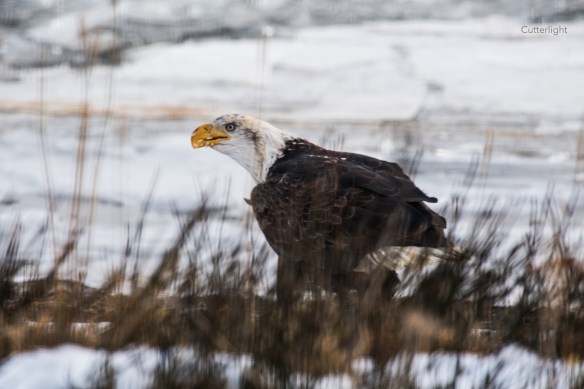
After the storm, a fully intact salmon carcass managed to find its way to the shore in front of our cabin – quite possibly plucked from a patch of open water and dropped by this very eagle. I grabbed this shot through a double-paned window – not ideal for a photograph, but what a handsome bird. The moment I opened the cabin door, she took off.

If you come across a single antler from a member of the deer family, it’s been shed, part of an annual process in which male deer, elk and moose grow antlers for the mating season and then lose them. If you come across an entire rack joined by skull bone, it’s the result of a kill. Some years ago, when Fred was scouting out the location for a cabin from his skiff, he came upon five wolves on a downed bull moose right on the beach where he hoped to one day build. Years later, someone found this rack in a nearby alder thicket – undoubtedly that same moose having been dragged there by the predators. 

Fred described the cabin he and a couple of friends had built as “sturdy, snug and cozy,” a spot-on description. Insulated from floor to roof and appointed with double-paned windows, the cabin’s 10 x 15 interior is just big enough to comfortably house a diesel heater, three-burner propane stove, hand-made wooden bed frames, small pantry, a table and three hand-made wooden stools. Snug and cozy. The lines looked square and sturdy, points that would soon be tested.

Once Nick got the heater going, the cabin was toasty warm in no time. Fred introduced us to the vagaries of the propane stove, pointed out the water catchment system (a bucket hanging near a roof gutter), and assured us once again that we were welcome to dip into any of the food in the pantry.

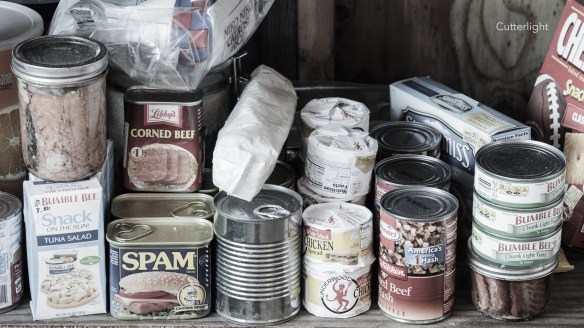
I muted the color in this pantry photo. The cabin’s door is never locked and the assortment of canned fish, deviled meat, rice and crackers could be a lifesaver for anyone caught in a sudden storm or out of luck with a dead engine. Although we brought plenty of our own food, I have to confess that the temptation of a skillet of fried Spam was more than I could resist, not having had this treat since childhood. It was, to my mild surprise, every bit as good as I remembered.

With winds pushing 100 miles per hour and sub-freezing temperatures, our water catchment system failed. Fortunately, the wind blew beautifully clear sheets of ice onto our shore.

Following two days of snow and sleet pushed by fierce, cabin-rattling winds, the sun rose serenely over a frozen lake Black Lake. Black River, which leads to Chignik Lake, begins in the gap between the mountains where the light is breaking through. If things didn’t warm up and melt the ice, there was doubt that Fred would be able to make across the lake in his skiff. Fortunately, by the next day the ice had thinned and lay in broken patches. We learned later that two of our neighbors in the village out on a different adventure had to be emergency rescued when the storm came up.

The view from the cabin shoreline after the storm passed: Although we didn’t get the waterfowl and wildlife encounters we’d hope for – and the weather certainly had our full attention for awhile – our four days on Black Lake were wonderfully memorable. And left us with this thought: Why aren’t we doing more landscape photography? New adventures lead to new thoughts, new studies, new goals. 

“Hope you guys get lucky and see some wildlife,” Fred said as he and Nick headed to the skiff. Motioning across the bay toward the far shore from where a racket of honking and quacking was issuing, he added, “Of course, those swans and ducks never stop chattering. They’ll keep it up all night.” I helped shove off the skiff, and as the last echoing hum of the boat was enveloped in the valley we’d just come up, we found ourselves wonderfully and utterly alone. Over the next four days, the only human-generated sound we would hear was the drone of a couple of bush planes flying into the village 18 miles to the south.

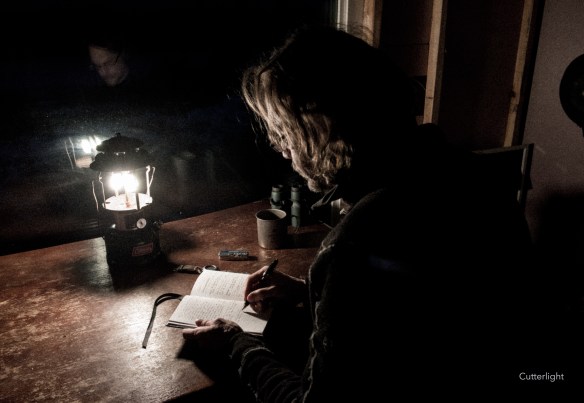
Sketching a novel outline at the cabin on Black Lake: Thirty-some years ago, aboard USS Blue Ridge, a friend and I made elaborate post-enlistment plans to go up into the Colorado Rockies, find a cabin, and live there for a year. We talked about the staples we’d need to lay in: flour, rice, coffee and so forth, the rifles and shotguns we’d take to hunt with, canning equipment, and the desirability of locating ourselves not overly far from a small town where we could reprovision as necessary. We would write. Fundamental to that objective would be pens and journals and a small, carefully selected library of literature. My friend got out a few months before I did… and disappeared. When I called the number he’d given me, his mother picked up the phone. She sounded distraught, with no idea where her son was. No one knew. I’m still not sure if we were kidding ourselves or if we’d really intended to go through with the plan, but either way I couldn’t see going it alone. When an acceptance packet came from the University of Colorado at Boulder, I took the door that was open. But I never completely let go of that idea… someplace quiet, off the grid, armed with books to read and journals to fill.

January 26, Chignik Lake, Alaska


Ink and Light: Chickadee Flamenco and thoughts on art and spring from Su Tung P’o

Chickadee Flamenco

What a wonderful talent – that can create an entire Spring
from a brush and a sheet of paper. If he would try poetry
I know he would be a master…
Su Tung P’o – On a Painting by Wang the Clerk of Yeng Ling, c. 1080

Also known as Su Shi, Su Tung P’o (1037-1101) was a Song Dynasty writer, calligrapher, painter, poet, statesman and noted gourmet. The dish “dungpo pork” is named for him.

Ink and Light: Spring Snow, a thought by C. S. Lewis… and how Do you pronounce that word that means “Artistic Blur” in photography?

Woman with Umbrella in Spring Snow: Ulaanbaatar, Mongolia

*Bokeh (暈け / ボケ) is a Japanese term meaning blur that began to gain popularity in American photography circles in the late 1990s. 

The only friend to walk with is one… who so exactly shares your taste
for each mood of the countryside that a glance, a halt, or at most a
nudge, is enough to assure that the pleasure is shared.
C. S. Lewis – from Surprised by Joy, 1955

Clive Staples Lewis (1898-1963), known as Jack, considered his last novel, Till We have Faces, to be his most mature and masterly work though it did not achieve commercial success.

*As is true of many Japanese words added to English, the pronunciation of “bokeh” is not always consistent with the original Japanese. This bothers some a lot, others a little and still others not at all. Many English speakers pronounce the word “boh-kuh” to rhyme with chocolate “mocha.” However, in Japanese the first syllable in bokeh  is pronounced with the “o” in hope and the second syllable is pronounced with a clipped (shortened) long “a” approximately between the ke in kettle and the kay in the name Kay. Almost like the word “bouquet:” long “o” and long “a,” but with the vowels clipped short and neither syllable accented. 

Ink and Light: The Gobi Desert’s Singing Dunes and Inspiration from Herman Melville

Khongoryn Els: The Singing Dunes, Gobi Desert, Mongolia

A trace of slate in the sand grains at Khongoryn Els results in vibrations that are not only easily audible, but which reverberate through one’s body.

…I am tormented
with an everlasting itch
for things remote.
Herman Melville – Moby-Dick; or, The Whale, 1851

Herman Melville (1819-1891) served aboard a whaling ship before deserting in the Marquesas. Although he knew his subject (the book draws from Melville’s own experience, The Bible, Shakespeare’s work, research into whaling, the actual account of a hard-to-catch white whale nicknamed Mocha Dick and the sinking of the American whaling ship Essex by a whale, Moby Dick received mixed reviews and was a commercial flop. Dedicated to Nathaniel Hawthorn “in token of my admiration for his genius,” the book sold just 3,200 copies in Melville’s lifetime and was out of print at his death. 

A year after Melville’s death, Moby Dick was reprinted by Harper and Brothers. Literati circles – mostly in New York – kept interest in the book (barely) alive over the next several years until it was rediscovered by larger audiences. Of the book, William Faulkner said that he wished he’d written it himself; D. H. Lawrence called it “the greatest book of the sea ever written,” and in time it found its place as an icon of American literature.

Ink and Light: Bohemian Waxwing and Lines from Robert Francis

Panache: Bohemian Waxwing, Ulaanbaatar, Mongolia

The red, waxy tips on the Bohemian Waxwings’ wings are actually flattened feather shafts. 

…beneath a silk-blue sky…
To sun, to feast, and to converse
and all together – for this I have abandoned
All my other lives.
Robert Francis – Waxwings, 1960

– Robert Francis (1901-1987) lived for 40 years in a two-room house he built in Amherst, Massachusetts. Of Francis, Robert Frost noted, “…of all the great, neglected poets, (he is) the best.”

Ink and Light: Double Limits! 120 Razor Clams & lines from Steve Kowit

Double Limits!* 120 Razor Clams near Whisky Gulch, Alaska

Big, tender and tasty, Razor Clams are avidly sought along Pacific Northwest beaches. The year these were dug, the limit in Alaska was 60 clams per person.

…drop to your knees now & again…
& kiss the earth & be joyful & make much of your time…
For although you may not believe it will happen,
you too will one day be gone.
I whose Levis ripped at the crotch for no reason,
assure you this is the case. Pass it on.
     Steve Kowit – Notice, 2000

– In 1966, Steve Kowit (1938-2015) sent the U. S. Army a letter: Were he drafted to fight, the letter stated, he would fight for the other side. He then married the love of his life and spent the next few years in Mexico and Central America before returning to the U.S. to live in California.