More Vegetables, Please! Spiced Carrot Cake with Rich Vanilla Cream Cheese Frosting

Packed with raisins, pecans and puréed carrots, this is a tasty way to enjoy a serving (or two) of carrots!

Living out in bush Alaska, there are certain ingredients that are a luxury in our pantry – like cream cheese. With recent outdoor temperatures agreeably mimicking a nicely chilled fridge, it was time to mail order dairy items requiring colder temperatures. Our here in Chignik Lake, Alaska, we’ve been relying heavily on the wonderful services of the mail order department at the Anchorage Fred Meyer (Debarr store). About every two weeks, we email a grocery list to the store and within four to five days, we receive  our items carefully wrapped or zip-top bagged for a nominal packing fee. A few weeks ago, we received heavy whipping cream, cream cheese and sour cream all nicely chilled in the belly of a little bush plane. Culinary feats take a bit of planning ahead, but with the cooperating weather, we can get most of what we need out here in tiptop condition. I can’t speak highly enough of our mail order friends in the Debarr Fred Meyer store!

If you’ve been following along, you’ll know that I periodically bake for my students. This has now become a time-honored tradition that has followed me through several schools. Last week, one of my students requested a cake for our “bake sale” (students can spend tickets they earn in class on a variety of rewards, including my baked creations). After my students polished off a bag of trail mix packed with raisins and nuts last week, I was confident that a carrot cake stuffed with nuts and raisins would be healthful and would be well-received by my young customers. Ok, and I like carrot cake, too, so I picked up my trusty Williams-Sonoma Baking Book to see what they had to say on the subject. Every recipe I’ve tried in this book has come out fantastically. The carrot cake recipe looked delicious. The one difference I noticed is that it called for puréed instead of shredded carrots. Pumpkin purée is a favorite, so why not a purée of carrots? Turns out the purée adds more moisture and the carrot flavor is slightly sweeter. I modified the recipe a bit and was highly pleased with the result. The cake was moist and smooth. The texture was only improved by the chopped nuts and raisins. What did the students say? They loved it! They especially liked the spice and the frosting, of course. If you won’t believe the kids, all the adults I shared the cake with agreed it was delicious!

Spiced Carrot Cake with Rich Vanilla Cream Cheese Frosting

Ingredients

  • 3/4 lb carrots, peeled and cut into 1/2 inch slices
  • 1 1/4 cups all purpose flour
  • 2 tsp baking powder
  • 1/2 tsp baking soda
  • generous pinch salt
  • 1 tsp ground cinnamon
  • 1/2 tsp mace (or substitute nutmeg)
  • 2 large eggs
  • 1 1/3 firmly packed light brown sugar
  • 1/2 cup whole milk
  • 1/2 cup unsalted butter, melted
  • 3/4 cup pecans, chopped coarse
  • 1/2 cup golden raisins
  • cream cheese frosting (see recipe below)

Directions

  1. Boil carrots until tender, about 10 minutes. Drain and let cool.
  2. Purée the carrots with a blender, stick blender or food processor. Set aside.
  3. Preheat oven to 350 degrees F (180° C). Line the bottom of an 8-inch square baking pan with parchment paper. Set aside.
  4. In a small bowl, whisk together flour, baking powder, baking soda, salt, cinnamon and mace.
  5. In a large bowl, whisk together eggs, brown sugar, milk and butter.
  6. Whisk the flour mixture into the egg mixture.
  7. Whisk in the carrot purée.
  8. Fold in the pecans and raisins.
  9. Pour batter into square baking pan.
  10. Bake 45 – 50 minutes in preheated oven. Cake will be lightly browned and wooden pick inserted into middle of cake will come out clean when cake is done.
  11. Let cake cool on a wire rack.
  12. Run a knife around edge of pan. Invert cake onto serving plate. Peel off parchment paper.
  13. Frost cake and serve right away.

Rich Vanilla Cream Cheese Frosting

Ingredients

  • 4 oz. cream cheese
  • 2 tbsp unsalted butter, melted
  • 3/4 cup powdered sugar
  • 3/4 tsp pure vanilla extract

Directions

  1. Using a mixer, beat all the frosting ingredients on medium speed until mixture is totally smooth and well-mixed.
  2. Alternatively, hand-mix all the frosting ingredients until smooth and totally mixed using a rubber spatula.

Ink and Light: “The meanest flower that blows…”

x-feather-fan-n

Feather Fan: Junco

To me the meanest flower that blows can give
Thoughts that do often lie too deep for tears.
William Wordsworth – Intimations of Immortality, 1807

Along with Samuel Coleridge, Wordsworth (1770-1850) is credited with founding English Literature’s Romantic Age. He was the country’s Poet Laureate from 1843 until his death.

Oyster Po’ Boy with Zesty Rémoulade and a Side of The World’s Best Bar Snack


oster-po-boy-w-fried-parsnips-n

The Carolinas meet California in a Po’ Boy that combines a favorite from each coast. Served up with our home-brewed hefeweizen. 

True, po’ boys originated in Louisiana, but the fried oyster sandwiches of my youth were served up in family-run seafood shacks on North Carolina’s Outer Banks. You had to remember to ask for unsweetened iced tea in those Southern establishments, shoes were optional – even the waitresses often went barefooted -, and a proudly displayed Department of Health rating of “C” was a guarantee that the seafood would be fresh, authentic and delicious.

A warm, soft bun slathered with tartar sauce or rémoulade, a wedge of lemon, and sides of fries and ‘slaw are traditional and tough to improve on. Some folks add lettuce, tomatoes, or pickles (or even the ‘slaw) for a little crunch, but when we chomp down on an oyster po’ boy, all we want is soft bun and even softer, deep-fried, juicy oysters. The crispy coating on the oysters is crunch enough. But how about a few slices of creamy avocado?

Oh, The World’s Best Bar Snack? That’s what Bill Briwa, Chef-Instructor at the Culinary Institute of America, calls deep-friend parsnips. These are a cinch to make, and, yeah, they just might be the World’s Best Bar Snack. Get the recipe here.

Rémoulade

Ingredients

Directions

  1. Mix the above ingredients together.
  2. Allow to sit for a few minutes so flavors come together.

Deep Fried Oysters

Ingredients

  • a dedicated deep-frying pot or a good stainless steel pot. For safety, the pot should be large enough so that the oil (see below) does not fill it more than half full.
  • cooking thermometer that attaches to the pot so you can monitor oil temperature
  • a slotted steel spoon or wire mesh (spider) for removing the oysters from the oil
  • cutting board or platter on which to rest oysters after they’ve been rolled in crackers
  • tongs
  • platter with paper towel to rest and drain fried oysters
  • a gallon-sized sealable plastic bag
  • 1 pint fresh oysters (The only way we can have fresh oysters in Bush Alaska is to freeze them. Happily, they freeze well.)
  • approximately 50 ounces cooking oil that withstands high heat Canola or peanut oil are good choices.
  • 3 eggs, well beaten in a bowl with fairly steep sides
  • 1/2 tbsp soy sauce
  • 1/2 tbsp Cholula or similar hot sauce
  • 1/2 cup all-purpose flour
  • 1/2 tbsp chili powder mixture, preferably one with chipotle, divided into two equal portions
  • 1/4 tsp salt
  • cracked pepper
  • 2 cups crushed saltine crackers (we use salted saltines)

Directions

  1. Drain oysters and set aside. You might want to gently roll them in paper towels to remove excess moisture.
  2. Add canola oil to a large pot and heat over high heat to 360° F (180° C). Keep an eye on the temperature, lowering burner heat as necessary. You can test the oil’s readiness for cooking by dropping in a pinch of crushed saltines. They should immediately sizzle.
  3. Meanwhile, add soy sauce, Cholula, and half of the powdered chili mix to the beaten eggs and whisk together.
  4. Add the flour, half the powdered chili mix, salt and pepper to the gallon-sized plastic bag, seal and shake well to mix. Pour the mixture into a shallow bowl or onto a plate.
  5. Place the crushed saltines in a shallow bowl or on a plate. A good way to crush them is to put them in a gallon-sized sealable plastic bag. Seal the bag, but leave a small opening so air can escape. Use a rolling pin to crush the crackers in the bag.
  6. Arrange items on your counter in the following order, leading toward the frying pot: oysters, flour mixture, egg mixture, crushed crackers, board/platter for resting oysters.
  7. Using tongs: Place an oyster into the flour mixture and thoroughly coat but give it a shake to let excess flour fall off. Then place the oyster in the egg mixture, thoroughly coat it, but hold it above the bowl for a moment to let excess egg drip off. Next, roll it in the crushed crackers, making sure it’s completely covered. Finally, set it on the board/platter to rest. Repeat till all oysters are ready to be fried.
  8. Hopefully you or your sous chef have been keeping an eye on the temperature of the cooking oil. 360° F is about right. Use tongs to carefully add oysters one at a time – no splattering. Keep adding oysters, but don’t overcrowd the pot. Try to keep them from touching each other – better too few oysters at a time than too many. Using tongs, gently turn the oysters to ensure that all side are evenly cooked to a golden brown. This will take 1 to 3 minutes. Don’t overcook them.
  9. Use a steel slotted spoon or a spider to remove fried oysters. Place on platter with paper towel to drain. You can keep them warm and crisp on the center rack of a warm oven, or loosely cover them with a towel.

The Po’ Boy

  1. It can be nice to toast the sandwich roll.
  2. Spread both sides with rémoulade. Arrange the fried oysters and give them a squirt of lemon juice from a lemon wedge. Top with slices of avocado. Drop the lemon wedge into your hefeweizen and dig in.

Broiled Salmon Udon – It’s all about the Noodle Bowls

broiled-salmon-udon-02-08-2017-n

For lunch or dinner, on a cold winter’s day nothing beats a bowl of agreeably slippery udon noodles served in piping hot miso soup. The trick is finding the right bowl.

Ramen, soba, udon – we are big fans of Asian noodles. In Mongolia our apartment came ready with two perfectly-sized bowls for serving up this kind of fare. Back in America, finding the right bowls proved to be much more of a challenge than we anticipated. The average soup/cereal/pasta bowl isn’t big enough, and the average serving bowl is too big.

With a bit of persistence we found just what we were looking for. Mrs. Lin’s Kitchen carries beautiful karakusa swirl noodle bowls in classic white and classic black. These bowls are made in Japan and reminiscent of higher-end noodle shops there. Karakusa is a traditional arabesque design of repeating swirls popular in Japanese ceramics. The bowls are simultaneously elegant and sturdy. Best of all they’re large enough to fill up with a true noodle soup meal.

And the people at Mrs. Lin’s know how to pack fragile items. Here in Chignik Lake, our post office is just a two-minute walk from our house – but it can be a treacherous walk, especially on days such as yesterday when the road and footpaths were covered in hard ice. On the return trip, my feet went up and I came down – hard – as did the box containing our brand new noodle bowls. I was fine, but I dreaded what I might find when I opened the box. We needn’t have worried. In fact, we don’t think we’ve ever seen anything packed quite so well.

Roasted Moose? Put it in a Pie and serve it with a Nut Brown Ale

moose-pie-2-01-17-n

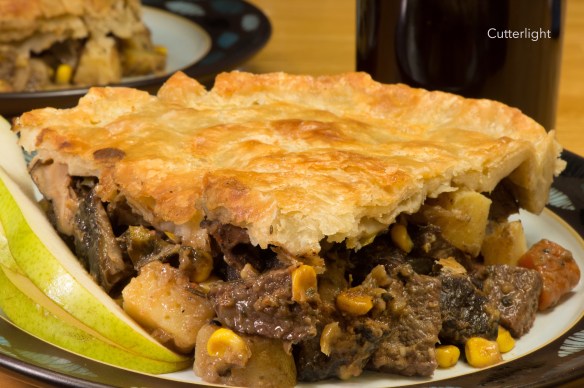
Tender roasted moose, caramelized onions, potatoes, parsnips and mushrooms pulled together with moose gravy, topped with a flaky, golden-brown crust and served with our home-brewed Nut-Brown Ale. That’s how we do it in Alaska.

This has been a good year for moose hunting in Chignik Lake, and while I’m not sure we’d know what to do with a twelve-hundred pound bull, anytime a friend offers up a few pounds, we’re in. This moose pie is a long-standing favorite recipe, easily adapted for other wild game or beef. Start with a pound of tender roast, toss in your favorite vegetables, add time-tested seasonings and a little gravy, top with a savory pie crust and bake at 375° F for about 25 minutes. Serves four Alaska-sized appetites.

Rustic Moose Pot Pie

Ingredients

  • 1 3/4 cups beef broth or moose broth
  • 1 bay leaf
  • 1 teaspoon dried rosemary
  • 1 2/3 cups potatoes, cut into 1/2″ cubes, skin on
  • olive oil
  • 1/3 cup flour
  • 1 pound roasted moose meat, cut into 1/2″ cubes
  • 1/2 cup sweet corn
  • 1/2 Brussels sprouts, quartered
  • 1/2 cup carrots, sliced into discs or chopped coarse
  • 1/2 cup parsnips, sliced 1/4 inch think x 1/2 inch
  • 1/2 onion, cut into slices and caramelized
  • 1/2 cup mushrooms, chopped coarse
  • 1/2 rounded teaspoon cumin
  • 1 teaspoon dried sage
  • 1/2 teaspoon thyme
  • several generous grinds freshly cracked black pepper
  • salt, to taste

Directions

  1. Place a baking sheet on the center rack of oven and preheat to 375 °F (190° C).
  2. Place broth in a pot, add bay leaf. Taste to determine if salt needed.
  3. Add potatoes. Simmer potatoes till just tender, but do not overcook. Save broth and remove potatoes to a large bowl.
  4. Meanwhile, in a large frying pan, add olive oil to cover bottom and bring to sizzling hot over medium/medium-high heat. Brown the mushrooms, remove and set aside. Add onions. Season with salt and pepper and cook till caramelized. Remove onions and set aside.
  5. Add additional olive oil to frying pan as necessary and continue heating over medium heat. Add Brussels sprouts, parsnips and carrots. Season with salt and pepper. Cook till Brussels sprouts are browned and all vegetables are just tender, stirring occasionally. Remove vegetables from pan and add to bowl with potatoes.
  6. Over medium-low heat, place approximately 4 tablespoons olive oil into a small frying pan. When oil is heated but not sizzling hot, briskly stir in flour a little at a time. Continue stirring until mixture thickens. Remove from heat.
  7. Heating beef broth over medium heat, stir in oil and flour mixture. Combine thoroughly. Simmer till reduced to a thick gravy.
  8. To the bowl that already has the potatoes and vegetables, add the moose meat, mushrooms, gravy and the remaining seasonings and mix together. (There are a number of ways to make a thick gravy. Try using a dark ale to deglaze the pan you used for roasting the moose.)
  9. Pour meat and vegetable mixture directly into a deep pie dish. Cover with a crust. Be sure to make holes in the crust to allow steam to escape. Brushing on a beaten egg will help create a golden brown crust.
  10. Place on baking sheet and bake at 375 °F for 25 – 30 minutes or until crust is golden brown.

Although a full-bodied red wine such as an old vine Zinfandel, Malbec or Cabernet is a classic choice with this dish, a full-bodied ale pairs equally well.

Fine Dining for Two: Broiled Char or Trout

broiled-char-n

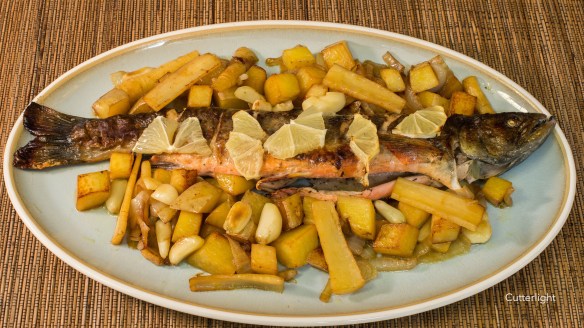
A hint of thyme compliments the delicate flavor of wild char, one or our favorite fish. No wild fish available? Look for Arctic Char at the fish market. They get high marks for being responsibly farmed and are delicious.

There’s something about wild char and trout that calls to simplicity. Among all species of fish, they are among the most demanding of unspoiled environments. Where streams, rivers and lakes are clean and lightly trammeled, these species often thrive, both their numbers and the setting they inhabit evoking bygone times. It is in such settings that light harvest of a few fish is sustainable.

When presented with such fish in the kitchen, the most basic ingredients are all that is wanted. Salt and butter, perhaps a little pepper or a pinch or two of an aromatic herb. A little lemon can be nice, too. Root vegetables such as potatoes, parsnips or rutabaga roasted or pan fried in olive oil and soy sauce make the perfect accompaniment on the serving platter.

Broiled Char or Trout for Two

Ingredients

    • 1 char or trout of about 16 to 18 inches (40 – 45 cm) (between 1 and two pounds, dressed)
    • fine sea salt (we use Grey Sea Salt in all of our salmon and trout recipes)
    • two light pinches of dry thyme (or about double that if you have fresh)
    • 1 lemon cut into thin slices, peel cut away
    • butter, sliced into thin pats
    • olive oil or canola oil
    • broiling pan. We use a Swiss Diamond cast iron griddle for this kind of broiling.

Directions

    1. Place a broiling pan near the top shelf in the oven and preheat on broil. You want the pan to be very hot when the fish is placed on it. This prevents the fish from sticking. Do not oil the pan yet.
    2. Rinse the fish in cold water and dry with paper towels. Make sure the gills and viscera have been removed.
    3. On a cutting board or platter, position the fish with its it’s open belly toward you.
    4. Using a very sharp knife, cut shallow, oblique slashes spaced about an inch apart (2.5 cm) down both sides of the fish. You want to break the skin without cutting all the way through to the body cavity.
    5. Rub fish inside and out with fresh lemon juice.
    6. Salt the fish inside and out. Sprinkle a little thyme inside the cavity on the sides.
    7. Place a few thin slices of butter inside the cavity and on top of the fish’s side.
    8. Place pieces of lemon on top of the fish’s side.
    9. Spread olive oil on broiling pan. A basting brush works well for this. Return pan to oven for about a minute to ensure that oil is very hot.
    10. Place fish on broiling pan or griddle. The fish should really sizzle when it hits the pan. Once the fish is on the pan, do not move it. (Moving a fish just after it hits a pan can cause it to stick to the pan.) Return to the oven and broil for 5 minutes.
    11. Remove pan from oven and gently flip the fish. Do this by rolling the fish on its back using spatulas. This will prevent the cavity from draining. Place additional pieces of butter and fresh slices of lemon on the up side of the fish and return to the oven. Broil for 3 or 4 more minutes.
    12. The fish is done when the slashes have opened, the skin is golden brown, the tail is crisp and the eyes are opaque.
    13. Serve with roasted root vegetables on warmed plates. Compliment with a light Chardonnay or a crisp ale.

Smokey, Spicy Mix: In Hearty Soups, as a Rub for Poultry and Pork, and on Salmon, our Go-To Seasoning

jacks-smokey-blend-n

Jack’s Mix: Nine herbs, spices and seasonings create a blend that adds deep flavor and an agreeable spike of heat to pumpkin soup, chicken breasts, pork, broiled salmon fillets, moose meat pizza and more. 

Every kitchen should have a few items like this in stock – a house dressing, a specialty dipping sauce, or a proprietary spice or herb blend. This is “the secret:” the bottle that invariably gets emptied first, the jar that has to be replenished again and again while other similar items languish with their contents intact.

In the case of Jack’s Mix, sure, there are a wide variety of commercial rubs available, and most of them are quite tasty. But we wanted something a little smokier in flavor and with a certain zip that would best compliment our style of cooking. And since we prefer to add salt as a separate item in cooking, we wanted a salt-free blend. So we came up with our own blend from a handful of ingredients we always have on hand.

Our message in this post is to encourage you to give it a try. Pick something you use frequently – salsa, an Italian herb blend, barbecue sauce, salad dressing or a spicy rub and instead of continuing to purchase Brand X at the store, start experimenting with your own creation. It’s fun, you’ll likely learn something valuable about the way flavors work together, and when a guest exclaims, “This _____ is fantastic! What kind is it?” You can smile and casually reply, “It’s mine, just a little something I threw together.”


Adzuki Maple Bars with Matcha Maple Frosting

maple-bars-w-azuki-and-matcha-frosting-n

Mmmmm – matcha green tea and sweet adzuki bean paste – a flavor combination we love add a Japanese twist to an American classic. Just the thing with piping hot green tea after a cold morning of birding.

Matcha green tea powder and adzuki beans may not be in everyone’s pantry, but they are always in ours. If you’ve been following this blog, you know that this flavor combination makes a regular appearance in our kitchen. When a friend gave me a recipe for maple bars, I couldn’t help imagining them stuffed with sweet adzuki bean paste (directions to make the paste here), and changing up the frosting recipe to include the zip of spiced matcha tea along with maple syrup. I think the original maple bar recipe somehow reminded me of cinnamon rolls. I’d made a version of cinnamon rolls where the adzuki bean paste was spiraled into a dough which in turn was infused with matcha tea powder. That was delicious! So why not tinker around with this maple bars?

Today’s recipe initially started out with my friend’s successful recipe. Her dough recipe is deliciously flavored with cinnamon. After baking, I sliced the rolls in half and spread them generously with adzuki bean paste. I did change up her maple icing and made more of a donut glaze that I then flavored with matcha green tea powder and real maple syrup. (Thank you JW for sending us some real Pennsylvania maple syrup!)

Matcha powder is used to make high quality green tea. I enjoy baking with this flavorful ingredient – adding it to breads, cookies, cakes, and even custard dishes. If you are not convinced that I really do enjoy this ingredient, just search “matcha” in the search bar on our blog and look at all the lovely recipes. 😉 I’m happy to report that both adzuki beans and matcha green tea powder are easy to procure – even in remote places like Chignik Lake, Alaska – thanks to the Internet.

Adzuki Maple Bars with Matcha Maple Frosting

Ingredients

Maple Bars

  • 1 1/2 cups milk
  • 1/3 cup unsalted butter
  • 4 tbsp granulated sugar
  • 2 tsp cinnamon
  • 4 1/2 tsp instant yeast
  • 2 large eggs, beaten
  • 4 3/4 cups all purpose flour
  • 2 cups sweet adzuki bean paste

Frosting

  • 1/4 cup unsalted butter
  • 1/2 cup real maple syrup
  • 1 cup powdered sugar
  • 1 tsp matcha green tea powder

Directions

  1. Combine milk, butter, sugar, and cinnamon in a medium saucepan.
  2. Stir over medium heat until butter is melted. Remove from heat.
  3. Let milk mixture cool slightly. Mixture should cool to about 110 8° F, or cooler.
  4. Pour milk mixture into a large mixing bowl. Stir in yeast.
  5. Stir beaten eggs into mixture.
  6. Stir in flour, one cup at a time.
  7. The last 3/4 cup of flour will need to be kneaded in.
  8. Once flour is well incorporated and dough can remain in the shape of a ball, let rise in the mixing bowl for an hour covered with plastic in a warm place with no draft.
  9. Punch down dough and roll out to about a 1″ thickness.
  10. Cut dough into 16 rectangular pieces. Place bars on baking sheet covered with parchment paper. Cover with plastic wrap and let rise for another 30 minutes.
  11. Heat oven to 425° F. Remove plastic covering and bake bars for 8 – 10 minutes. Finished bars should be lightly browned.
  12. Let bars cool on wire rack for 15 minutes before icing.
  13. Make icing by mixing together icing ingredients and stirring until smooth.
  14. Cut bread bars in half, like a sandwich.
  15. Spread adzuki bean paste on lower half of bar.
  16. Take top half and dip it into matcha maple frosting.
  17. Place dipped top part of bread onto bottom which has been prepared with adzuki paste.
  18. Serve immediately or  serve later the same day. Just make sure to cover them with plastic so they don’t dry out.

Uni & Ikura Amuse Bouche (Sea Urchin & Salmon Roe)

sea-urchin-amuse-bouche-n

Fresh from the sea, uni and ikura create a salty, savory combination.

Much as is true of most Japanese people, most Alutiiqs love virtually anything harvested from the sea. From octopus to chitons (locally known as bidarki), if it’s fresh from the ocean it’s likely to find its way onto the menu here in Chignik Lake. Sea urchins are highly prized.

And there’s really nothing to preparing them. Insert a small knife into the opening on the bottom of the shell, cut the shell open, and remove the bright yellow lobes, which are the urchins’ reproductive organs.  (They are not roe.) Most people are careful to remove the dark colored matter inside the shell, but the urchins we had were small and including this substance added, we thought, both a subtle additional flavor and contrasting color. In Alaska, we almost always have a jar or cured salmon roe on hand. This bright, salty, translucent salmon caviar is a perfect finishing touch on many dishes. For a popular recipe for making your own ikura, click here.

Oh, Daddy! Umami! Clam Fettuccine and Sea Urchin Amuse-Bouches

dorner-bay-clams-n-urchins-n

Fresh sea urchin appetizers, clams still wet with Chignik Bay brine, freshly made fettuccine, and  home-brewed Bavarian Weissbier – Ringing in 2017 Off the Beaten Path. Oh, Daddy! Umami! (Recipe below)

clam-fettucini-dorner-bay-n

When a friend showed up at our door on New Year’s Eve with a big bowl of fresh-from-the-sea clams and sea urchins, we immediately began planning out a celebratory dinner to greet 2017. While Barbra whipped up two servings of fettuccine, I set to work cleaning and preparing the seafood. A carafe of hot sake might have been perfect, but Barbra’s medium-bodied, slightly citrusy, Weissbier proved to be an excellent compliment to a shellfish feast that couldn’t have been any fresher.

sea-urchin-amuse-bouche-n

Umami Power: Sea urchin topped with salmon roe. Note to self: Stock a few bottles of sake for these occasions!

Clam Fettuccine for Two: This is a simple yet elegant dish. The standard butter and garlic mixture really comes to life with the addition of tarragon and a dash or two of grey sea salt.

Ingredients

  • Fettuccine
  • Cherrystone Clams, Butter Clams, Cockles or Ark Clams, rinsed to remove any debris. Clams should be closed tight. If a clam isn’t closed, give it a few vigorous taps. If it still doesn’t close, discard it, as it’s dead and may be unfit to eat.
  • Butter, preferably unsalted
  • Olive Oil
  • 4 large cloves of Garlic, chopped fine
  • 1/2 tsp dried Tarragon crumbled fine (or 1 tsp fresh chopped)
  • 1/4 tsp Coarse Grey Sea Salt
  • Nori (dried laver) cut into thin strips for garnish

Directions

  • Prepare the fettuccine as you normally would. Drain and then return to the pan with a little olive oil and toss together. This will prevent the noodles from sticking together.
  • In a small pan, heat about 6 tablespoons of butter and 2 tablespoons of olive oil over medium-low heat. Once butter has melted, place on very low heat to keep warm. Just before serving, return to medium heat, add the garlic, tarragon and sea salt and briefly cook while stirring. In about 30 seconds, you’ll begin to smell the aromas of the garlic and tarragon. Provided you have chopped the garlic fine, that’s all the cooking it needs.
  • Meanwhile, place clams in a metal strainer – one that will fit into a larger pot. Add an inch or so of water to the pot and place clams in strainer inside pot. The clams should be above the water so that they steam rather than boil. (Hint: If you place the clams inside a heat-proof bowl inside the strainer, you can save the juice from them as they steam open. The juice can be used in soups, sauces or in Bloody Mary Cocktails.) Cover clams with a lid and bring water to a boil. When clams are cooked, the shells will pop open. This generally takes about five minutes.
  • Meanwhile, place clams in a metal strainer – one that will fit into a larger pot. Add an inch or so of water to the pot and place clams in strainer inside pot. The clams should be above the water so that they steam rather than boil. (Hint: If you place the clams inside a heat-proof bowl inside the strainer, you can save the juice from them as they steam open. The juice can be used in soups, sauces or in Bloody Mary Cocktails.) Cover clams with a lid and bring water to a boil. When clams are cooked, the shells will pop open. This generally takes about five minutes.
  • Use a small knife to cut the clam’s abductor muscles away from the shell so that they can be easily eaten, but leave the clam meat inside the shell for a more attractive presentation.
  • Place the fettuccine on serving plates. (It helps to keep plates warm in the oven.) Arrange the clams on the plate. Pour the butter sauce on the clams and pasta. Add nori. Serve with slightly chilled Chardonnay or warm sake.