Unknown's avatar

About Jack & Barbra Donachy

Writers, photographers, food lovers, anglers, travelers and students of poetry

Fire in the Sky: Aurora Borealis Point Hope, Alaska

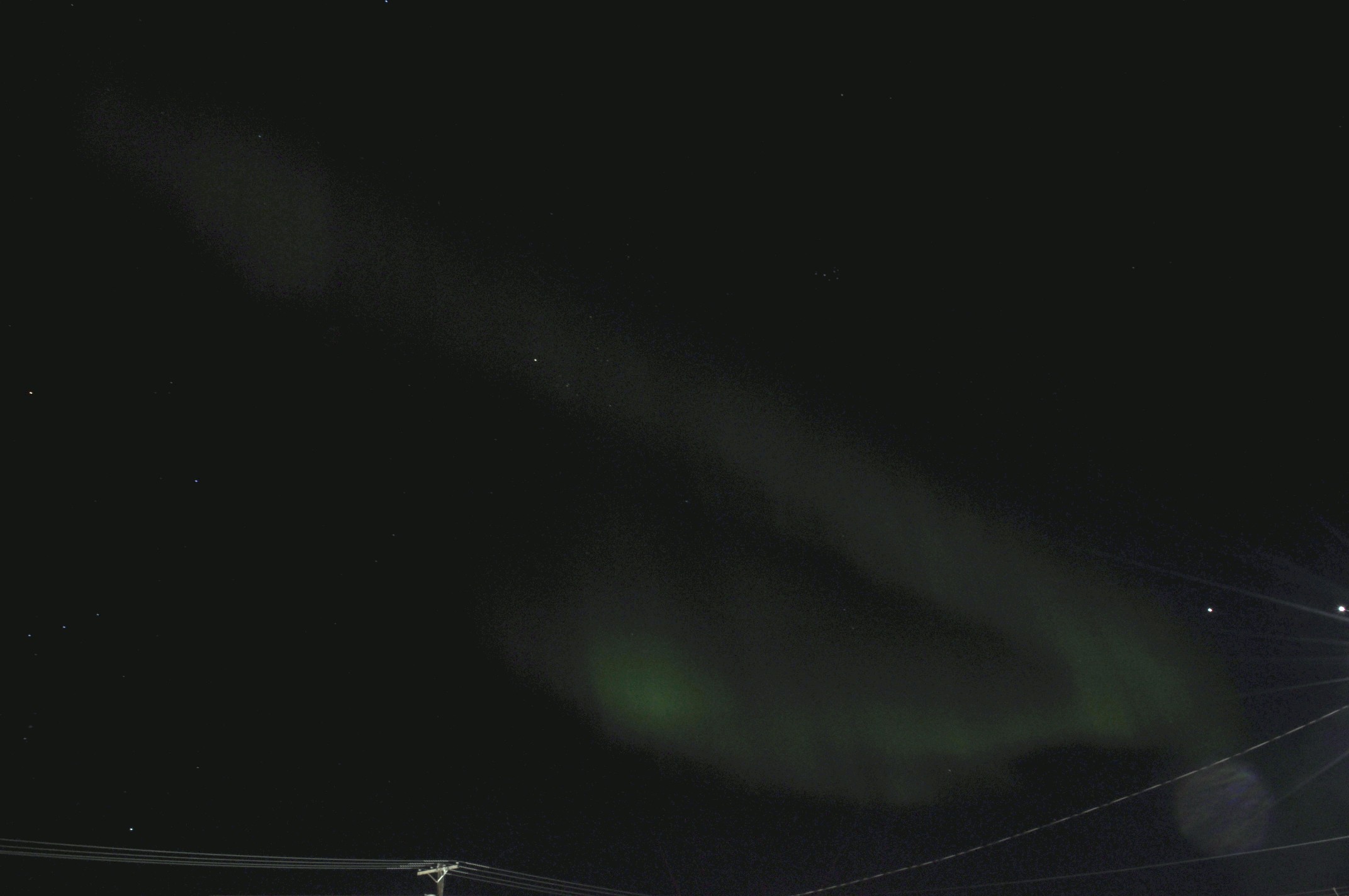
Mars hangs above a water silo aglow with lights from the school, a band of auroral light seeming to shoot from the silo like flames. (Click on photos for larger images.)

No photo – and certainly not our first attempts – can do justice to a northern sky on fire and dancing with the eerie green and purple glow of an Aurora Borealis. On this night 200 miles above the Arctic Circle, temperatures were an icy negative 10, pushed even lower by a steady breeze. As the sun sank below the frozen sea to the west, the full moon emerged in the east, close to Earth and huge, the color of a blood orange, hanging on the horizon. Jupiter and Venus were aligned, Mars glowed red as an ember against the black sky and Orion’s belt burned bright. Washing over it all was a breathtaking display of slowly moving green bands, some of them edged in purple, some of them jagged and electric, the band on the northern horizon streaked with pink mixed in with the green.

It’s not uncommon to see a bit of faint green or greenish yellow in the night sky up here. But what we were seeing on this night was of a different magnitude – a rare event tracing back to a spike in activity on the Sun a a few days ago. We made a few quick phone calls to friends. “Go outside and look up!” Meanwhile we got our camera and gear together, realizing, suddenly, that we weren’t  sure how to capture any of this. We met one of our friends in front of the school and walked with her toward the lagoon on the north side of town, away from the lights. In every direction, from horizon to horizon and straight overhead, what we saw stunned us. “This is amazing,” we kept repeating.

Note the three aligned stars of Orion’s belt to the left.

By the time we got our camera figured out, our fingers hurt with cold and the peak of the lights was past. But we still got some photos. A large part of photography is capturing light, and this was a quest for capturing light on a sublime scale.

Fireworks over the Columbia River while sharing a bottle of wine from a balcony at my apartment in Astoria, Oregon, tumblers of Scotch and a sky so impossibly filled with stars we felt like the deck of our mountain cabin in Yosemite was sailing through the Milky Way, a full moon hanging over a becalmed ocean on Prince William Sound with not another boat on the water, a campfire, mesmerizing, at our tent site at Oregon’s Sunset Bay State Park… night skies to come in remote anchorages on the Pacific… Our lives are filled with light.

Fishing and Camping along Oregon’s Deschutes River

Edged by a thin strip of green, the Deschutes River is born in mountains southwest of Bend. Brookies – aggressive and abundant – dominate the headwaters where it flows out of Little Lava Lake. When the river hits Crane Prairie Reservoir, rainbows (and largemouth bass) dominate. Once the river drops into canyon country north of Bend, redbands come into their own. Although canyon trout typically don’t run large, there’s a good chance you’ll have the water to yourselves, as we did. Further downstream, steelhead attract attention from fly fishermen who spend hours swinging flies in hopes of that one, elusive, electrifying grab. (Click on any of the photos for a larger view.)

In June of 2009, Maia and I spent a week camped along the Deschutes River near Bend, Oregon where we were enrolled in an Orvis Fly Fishing School – an experience we highly recommend to any parent-son/daughter, husband-wife or fishing partner team looking to boost their skills and knowledge. (We’d love to take one of their saltwater fly fishing or wing shooting schools in the future.)

Tumalo State Park proved to be an excellent location for our headquarters. Tent friendly, it was both quiet and conveniently close to Bend and the region’s excellent fly fishing. In addition to the Deschutes Canyon, we also explored the nearby Metolius River, Lava Lake, Little Lava Lake and the Upper Deschutes.

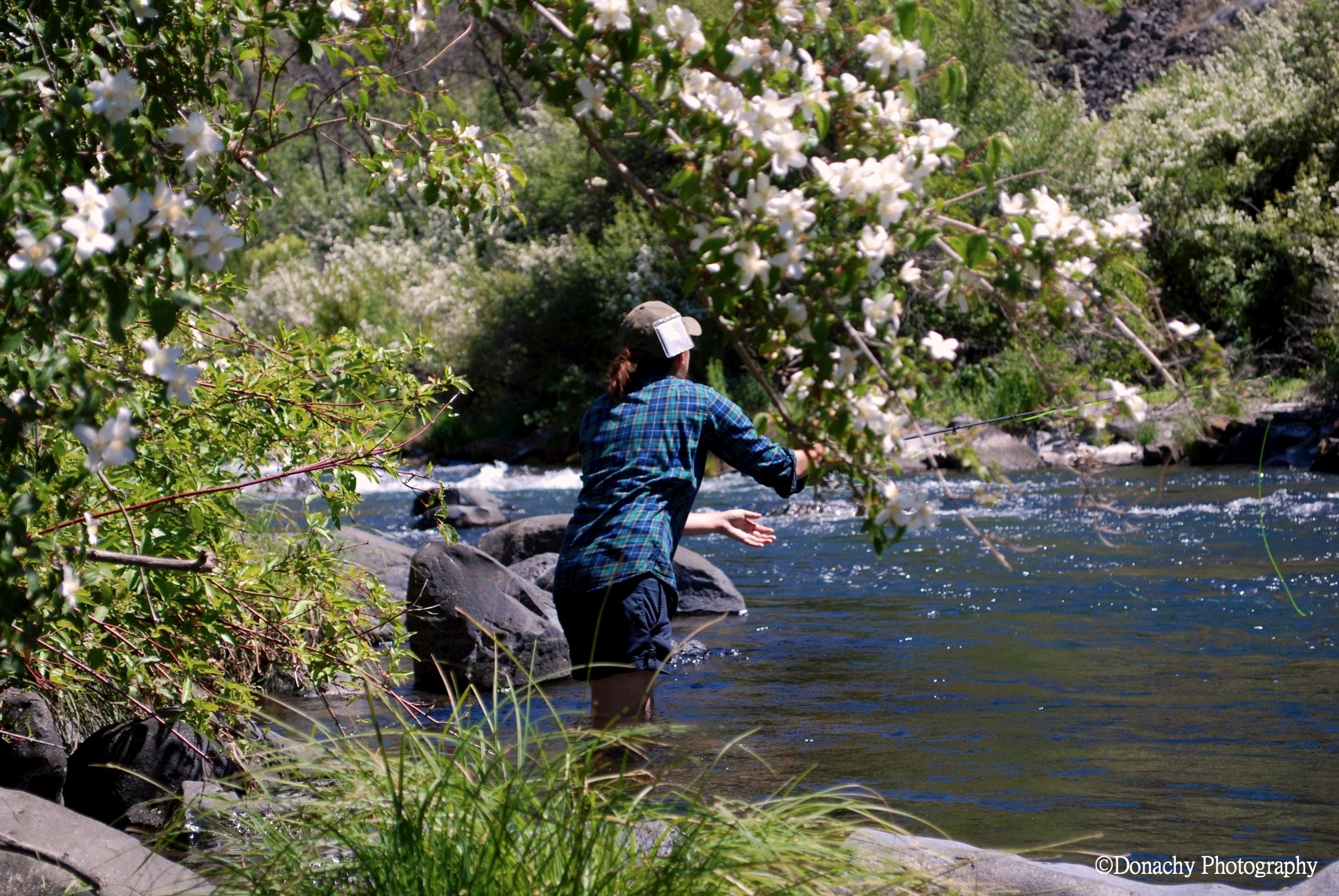
Fishing an elk hair caddis, Maia coaxed a pair of the Deschute’s redband trout from this canyon pool.

The redbands of the canyon are not large, but numbers are good, the water is beautiful and the setting is dramatic.

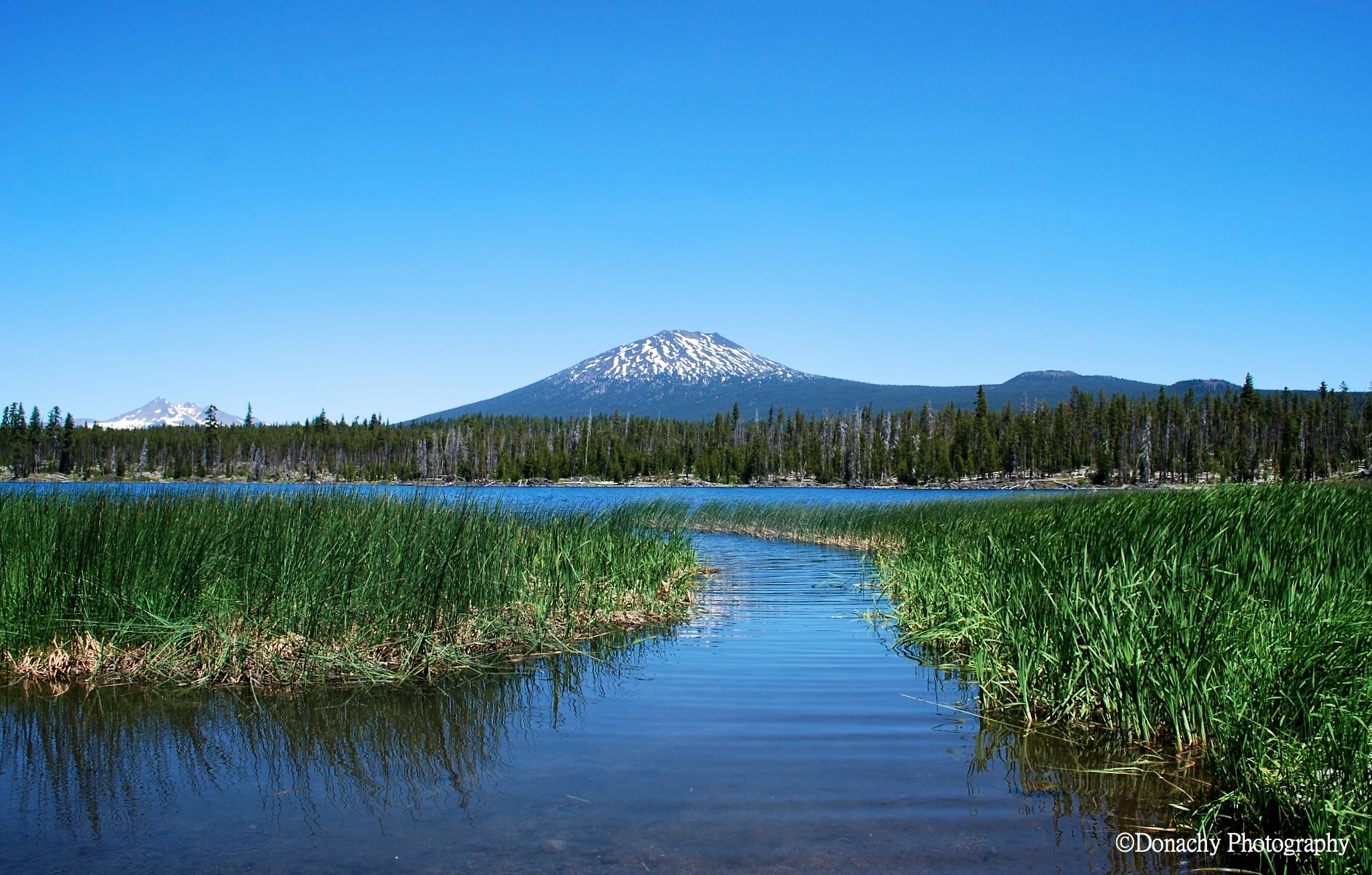
The float tube launch on Lava Lake seems to lay out a path to Mount Bachelor, one of Oregon’s premier ski destinations.

As Maia and I were preparing to launch our float tubes on Lava Lake, a fly fisherman who appeared to be in his 70’s was just coming in. “Wanna see what I’ll be having for breakfast?” he asked with a playful grin. He then pulled from a wet canvas creel a fat, 18 inch rainbow. The silvery fish had undoubtedly been stocked as a fingerling and grown heavy on a diet rich with scuds and aquatic insects. “Been coming here for decades,” he said. “Fishing’s still good, and you can’t beat the setting.” Since we were after a trout or two for dinner that night, we were heartened by his success. And sure enough, in addition to a couple of smaller trout, a rainbow just shy of two pounds fell to an bead head olive wooly bugger in the short time we spent on the lake.

After a dinner of salad, pan-friend New York strip steak, freshly caught trout and multi-colored Peruvian potatoes, we relaxed in front of our campfire enjoying a finger or two of Scotch, reminiscing about the day’s fishing, about the fishing we’d had other days going all the way back to afternoons spent float fishing for bluegills and bass on our home river in Japan when Maia was only three, and dreaming about trips we’d take in the future…

Until I lived in Oregon, I’d never seen garter snakes hunt fish. This one was working the margins of Lava Lake.

We had read about Hosmer Lake’s unique (and quite challenging) Atlantic Salmon and Brook Trout fishing. Kicking around in our float tubes in water only slightly less clear than air, we could see fish – big ones – nearly 20 feet deep. The white edges on their fins gave the brookies away; the others, we surmised, must be the salmon. The fish were beyond us on this particular day, but what a lovely piece of water. Excellent nature watching, too – birds, otters, wild flowers along the shore, and, of course, the fish in aquarium-like conditions.

In the week we spent sampling the fishing near Bend, we barely scratched the surface. In addition to miles of river, there are several lakes accessible by vehicle and numerous  hike-in fisheries. Area campground fees range from reasonable to downright cheap, and Bend itself is a cool city of about 80,000 that merits time set aside for exploration.

A Boat to Sail the Ocean Blue

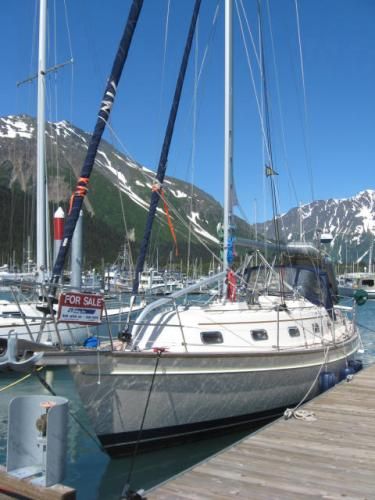
We fell in love with this 2002 Island Packet 350 last summer while visiting Seward. Here she is hauled out for survey on March 3.

Her tip-to-tip length is 37′ 10″, on deck she’s 35′, and at the waterline 29′ 4″. Her mast rises 48′ 3″ above the water. Rigged as a cutter, she’s also powered by a 38 hp Yanmar diesel engine. Displacement is eight tons. Gross tons: 12. 

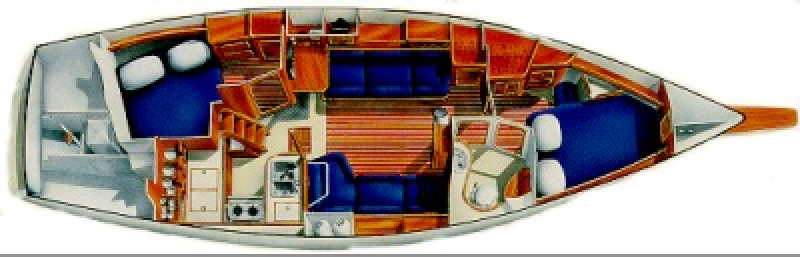
Below deck there are two staterooms (sleeping berths), one fore and one aft. The two settees convert to beds to sleep a total of six people. Teak deck, 6′ 4″ of headroom in the main cabin, and lots of storage space. The head, complete with shower, is located just aft of the forward stateroom. The fuel tank holds 50 gallons of diesel and the freshwater tank holds 100 gallons. There’s a dedicated navigation table, a dinette table that folds into a bulkhead when not in use, a smartly designed galley and easy access to the engine.

The gimbled two-burner stove with oven is the centerpiece of the galley. The narrow space allows the cook to wedge in and brace when the boat is moving. The microwave will go. 

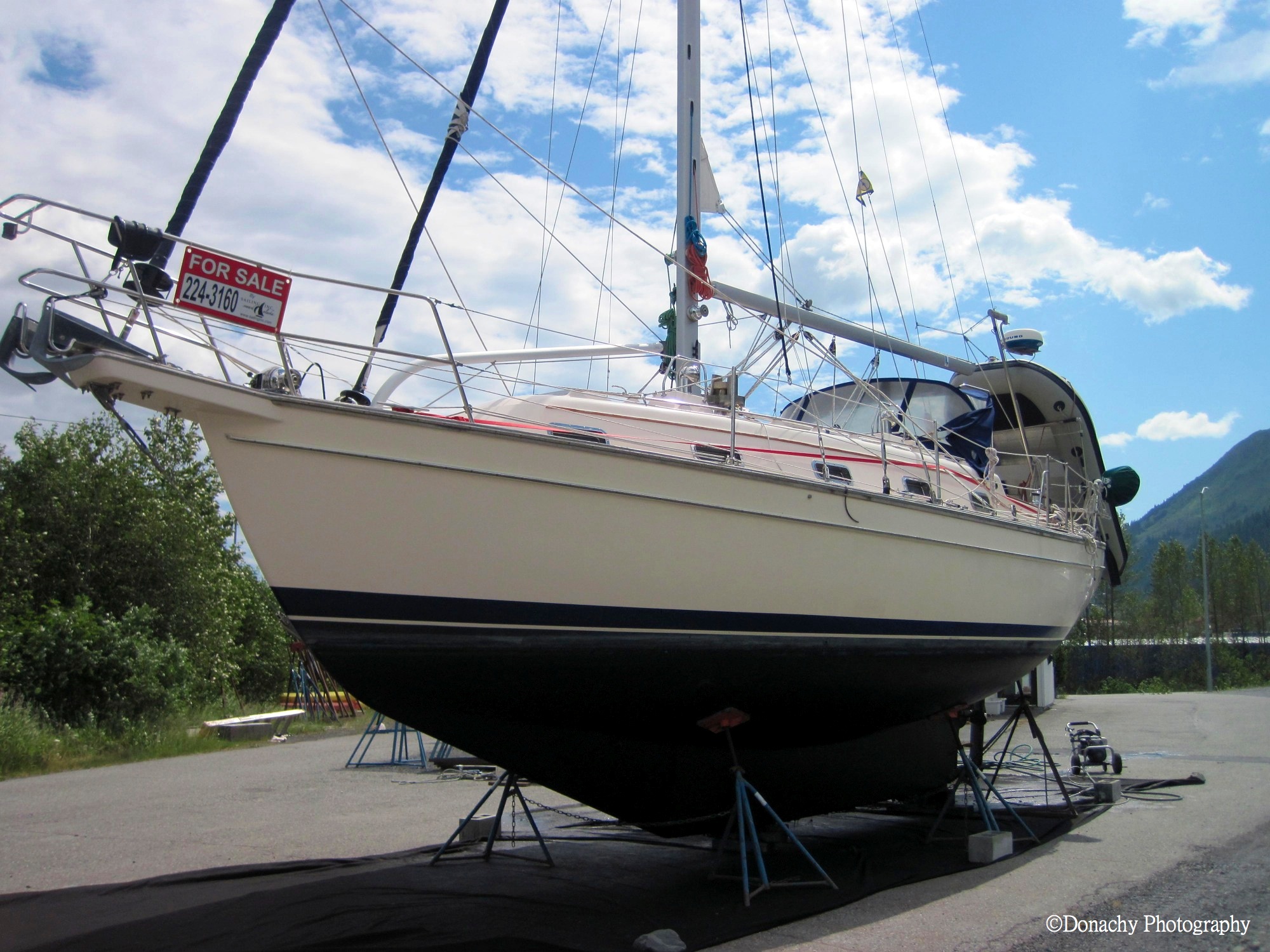
Here she is this past summer with a fresh coat of bottom paint. She sure put a song in our hearts! (Click photo for larger view.)


Florentines – Chocolate or Plain?

These crispy yet chewy cookies can be made as a sandwich with a layer of chocolate to hold them together, chocolate dipped, or with a drizzle of chocolate. And they are wonderful without any chocolate at all.

When I was young my family sometimes went to a deli in San Francisco where, out of an assortment of scrumptious confections, I was allowed to pick out a cookie after our meal. Often, I chose a chocolate dipped florentine, a delicious almond cookie flavored with the essence of orange zest, one of my favorite combinations.

We are trying to keep our kitchen as simple as possible in order to ready ourselves for life on a boat with only a relatively small galley kitchen. So it was only after serious contemplation that we recently added a new gadget to our galley – a Miallegro stick blender. Our manual nut chopper has worked well for most duties, but would have been tough to chop almonds fine and consistent enough to meet the needs of this recipe. The stick blender is much smaller than our counter top blender and much more versatile. With 550 watts of power and a dedicated nut chopper attachment, I had finely ground, perfectly uniform coarse almond flour in less than one minute!

Even with the help of the chopper, this recipe was time consuming, but our cookie taste testers all agreed: the result was fabulous. The first step was blanching and skinning the almonds. After some trial and error, I figured out that the easiest way to skin the almonds was to boil them for two minutes and then pinch them out of their skins while they were soaking in cold water. After this step, the almonds had to dry. I let them sit out on a cookie sheet overnight. After the dough is made, it needs to sit for about a half an hour in order to cool enough to handle. I could only bake six cookies at a time, which also added to the time. Lastly, if you dip the cookies or drizzle them in chocolate, this has to be done after the cookies have cooled. Wait! You still can’t serve them until the chocolate sets up. This investment in time results in cookies that end up disappearing quickly! I don’t know which I like better… the chewy yet crunchy texture, or the combination of the orange, almond, and chocolate flavors.

Florentine Cookies

Yields 24 six-inch cookies

  • 1 3/4 cups blanched almonds, sliced (about 5 ounces)
  • 3 tablespoons all-purpose flour
  • Finely grated zest of 1 orange (about 2 tablespoons)
  • 1/4 teaspoon fine salt
  • 3/4 cup sugar
  • 2 tablespoons heavy cream
  • 2 tablespoons light corn syrup
  • 5 tablespoons unsalted butter
  • 1/2 teaspoon pure vanilla extract
Chocolate topping (optional):
  • 2 to 4 ounces semisweet chocolate, chopped
Directions
  1. Position a rack in the center of the oven and preheat to 350 degrees F. Line a baking sheet with a silicone baking mat or parchment paper.
  2. Pulse the almonds in a food processor until finely chopped, but not pasty. Stir together the nuts, flour, zest and salt in a large bowl.
  3. Put the sugar, cream, corn syrup and butter in a small saucepan. Cook over medium heat, stirring occasionally, until mixture comes to a rolling boil and sugar is completely dissolved. Continue to boil for 1 minute. Remove from heat and stir in the vanilla, then pour this mixture into almond mixture and stir just to combine. Set aside until cool enough to handle, about 30 minutes.
  4. Scoop rounded teaspoons (for 3-inch cookies) or rounded tablespoons (for 6-inch cookies) of batter and roll into balls. Place on prepared baking sheet, leaving about 3 to 4 inches between each cookie since they spread as they bake.
  5. Bake 1 pan at a time, until the cookies are thin and an evenly golden brown in color, rotating pans halfway through baking time, about 10 to 11 minutes. Cool on baking sheet for 5 minutes, then transfer to cooling racks. Repeat with remaining batter.
Optional chocolate topping
  1. Put the chocolate in a medium sized, heatproof bowl. Bring a saucepan filled with 1 inch of water to a very low simmer; set the bowl over the water, but not touching the water. Stir the chocolate occasionally until melted and smooth.
  • For sandwiches, drop about 1/2 teaspoon chocolate onto the flat side of half of the cookies and press remaining halves onto the chocolate covered halves. Return to rack and let chocolate set.
  • For chocolate decor, drizzle melted chocolate over florentines as desired. Set aside at room temperature until chocolate has set.
Recipe courtesy of http://www.foodnetwork.com/recipes/food-network-kitchens/florentines-italy-recipe/index.html

There is a Lake…

At a remote lake we discovered by chance, the trout are not as long as your leg. Lots and lots (and lots) of 14 to 18 inchers though.

Weighing in at about 15 pounds (including flippers), Super Cat pontoons inflate quickly, can be worn like backpacks, and fish comfortably.

The walk in to remote waters is part of the adventure. On this particular hike, there were wildflowers, game tracks, berries, and a well-camouflaged covey of grouse perched in spruce trees.

Each summer, Maia, Barbra and I make it a point to meet up somewhere to fish, cook together, catch up with each other’s lives, and enjoy good wine and beer and stories. The fishing is secondary, but catching is definitely more fun than not catching. This is the kind of lake where you lose count of the fish turned, hooked or landed and settle into a gentle rhythm of casting, kicking and intense line watching, vigilant for the slightest twitch.

It is a beautiful and rare thing these days to fish a lake – no matter how remote – free from even a solitary scrap of litter. Such was the case on this lake. There was a hiking trail, and part of it traversed a log and board walk over a marshy area, but it was clear that those who know about this lake care about it. Save for a few mountain goats high up on a slope overlooking the lake, a pair of ospreys occasionally circling overhead and a small family of loons, we had the pristine water to ourselves.

On many remote (and not so remote) lakes, a size 8 or 10 bead head nymph dressed in olive, brown or black and jazzed up with something that sparkles is a killing pattern, and such was the case on this day. Lush beds of weeks were visible in the clear water. That’s where the insects were, and of course, the trout.

With a healthy population of trout and several size classes represented, we kept four smaller fish for dinner back at our campsite on a different lake. Evidence of a diet rich with scuds (freshwater shrimp), their flesh was as red as sockeye salmon flesh.

It’s difficult to improve on salt, ground pepper, and glowing charcoal when cooking just-caught fish. Accompanied with freshly picked sweet corn, roasted potatoes and a bottle of Chardonnay enjoyed around a campfire as the evening sky grew dark, our conversation was punctuated by an occasional pop from the fire and loons calling back and forth across the lake. 

Point Hope in Winter from the Air

The village of Point Hope, Alaska, February 24, 2012, as seen from a nine-passenger Cessna Caravan.

Viewed from the air, a continuous sheet of ice and snow obscures the boundaries between land and sea in the Arctic north. We were happy to fly south to Anchorage for a few days, thereby escaping the steady string of days with temperatures hovering around negative 20 degrees Fahrenheit. Compared to Point Hope, the weather in Anchorage was downright balmy, with highs around 28 degrees. Intermittent snow showers filled the crisp air with big, soft snowflakes.

Six days later our plane touched down on the icy Point Hope runway. As we descended the ladder, a blast of icy wind crushed into our faces, momentarily taking our breath away. The previous week, the absence of wind made walking outside pleasant enough, but now the wind chill is frequently dipping to 50 or 60 below and even colder. Cases of frostbite are up, as are cases of frozen plumbing. Each day, we’re gaining eight minutes of daylight. Still cold. Still a lot of winter left.

Denali – The High One

Denali – meaning “The High One” in Koyukon Athabascan – is known by many as Mount McKinley. 

The day we toured Denali National Park the namesake mountain was shrouded in clouds, a situation so commonplace we weren’t disappointed at not being able to see more than its base sloping up into the shrouding mist. In fact, a small industry exists to fly people up through the clouds for a bird’s eye view of North America’s highest summit. But with prices for those flights running hundreds of dollars per passenger, we figured we’d take our chances and wait for happenstance to put us on a plane flying near the elusive peak.

This past Friday, a flight from Point Hope to Anchorage via Kotzebue finally gave us the view we’d been hoping for. Denali’s rugged shoulders seemed to float on a sea of thick clouds. Barbra and I looked out our window awestruck as we contemplated the tectonic forces capable of thrusting this much solid granite nearly four miles above sea level.

In 2010, our trip to Denali National Park took place on a foggy day in mid-summer. The hills and valleys were verdant, wildflowers were in bloom and animals seemed to be everywhere. Ptarmigan burst from roadside cover, golden eagles soared overhead, moose browsed the willows along creeks, and Dall sheep – some with thick, heavy, fully-curled racks – dotted the slopes like tufts of white cotton. We saw three different sets of female grizzlies and their cubs, and after having heard wolves on different occasions while camping in Yellowstone and Yukon Territory, we finally saw a pack of wolves, males, females and cubs, resting and playing on a grassy hill. That alone made the trip to Denali worth it for us.

Although there is a very brief window in which a limited number of lottery winners (literally) are permitted to drive their own vehicles deep into the park, the more typical approach is to sign up for one of the bus tours. These shuttle tours are no frills, economical, and worth every penny. While we camped on the park’s outskirts (our campground neighbor showed us a photo of a lynx he’d seen the previous day), camping – both tent and RV – is available in the park as well. A 91 mile road – almost all of it unpaved – cuts through the heart of the park, but only the first 15 miles are open to the public. That’s where the bus tours come in. Backpacking permits are available as well.

We took the bus all the way to the end of the road at Wonder Lake, hoping against hope for a photo of The High One reflected in the lake’s glassy waters. No mountain, but lots of wild blueberries!

Stuffed Alaskan Halibut

Wild Alaskan Halibut with bleu cheese, stuffed with mushroom-pine nut purée and Alaskan shrimp.

The other evening after making Salmon en Papillote I had a few tablespoons of mushroom-pine nut purée left over (see recipe here). I’d never made stuffed halibut but felt certain the purée would make an excellent stuffing. To enhance it further, I mixed in several Alaskan shrimp cut into smaller pieces. I made a slice in the halibut exactly as one would do with pita bread and spooned in the stuffing.

Next I rubbed salt and freshly ground pepper into the halibut fillet and set it aside. I then put about three tablespoons of olive oil and one tablespoon of butter in a casserole dish just large enough to hold the fillet, tossed in several cloves of garlic, and heated the dish in an oven set at 375 degrees F (190 C). Once the oil-butter mixture was heated through, I placed the halibut fillet skin side down and baked the fish covered for twenty minutes. Then I topped the fillet with bleu cheese and continued baking till the cheese was melted.

This recipe was as easy as it was delicious – one of the best halibut dishes we’ve had. A 3/4 to one pound fillet prepared this way will serve two.

Ten to 20 pound halibut like this one are perfect for the kitchen.

Four Bourbon Taste Test

The four bourbon blind taste test: Maker’s Mark, Basil Hayden’s (Jim Beam Distillery), Blanton’s (Buffalo Trace Distillery), Knob Creek (Jim Beam Distillery) 

Good alcohol is art. Whether the medium is an amber-hued craft ale, a smokey, peaty Isle Scotch, a complex and subtle Willamette Valley Pinot, a tasty Tanqueray and tonic or any of thousands of other choices, a good drink can be downright sublime. In recent years, Barbra and I have become fans of that quintessentially American spirit, bourbon. Although our favorite has been Knob Creek, a recent article on bourbons in Wine Spectator got us thinking that it would be fun to try other makes. And so, as this weekend finds us in Anchorage, last night we engaged ourselves in a blind taste test of four bourbons.

The Crow’s Nest in the Captain Cook Hotel offers commanding views – of a blazing orange sunset over Cook Inlet on one side, of city lights waking and twinkling against the enveloping dark on the other. The bar carries a nice selection of bourbons, and with plenty of empty seats when we arrived, our bartender was happy to indulge us. We were keen to do a side-by-side of two popular brands: Maker’s Mark and Knob Creek. Past that, we were open to anything. “I have a couple I think you’ll find interesting,” she offered. So while we took in the nighttime views out the floor to ceiling windows, she surreptitiously poured out four measures of bourbon in attractive tumblers, arranged them at the bar, and motioned to us that our taste test was ready.

After a round of sniffing, sipping, swirling and comparing impressions, we agreed on our order of preference. We repeated the test one more time, letting our noses and taste buds explore for anything we might have missed the first time around, after which we called our bartender over to reveal which bourbons were which. The results surprised us.

Maker’s Mark, it turned out, was, hands down, our favorite. We found it to be smooth, light on our tongues, and a little sweet in a very agreeable way. Hints of carmel apple reminded me of autumn days in the western Pennsylvania mountains of my youth. We also found notes of sweet cream and vanilla and a clean finish that invited the next sip.

Our second choice – again by a clear margin over the remaining bourbons – was Knob Creek. This whiskey has a rich amber-red color, and a nice nose. Although we both wanted it to have a fuller finish, like Maker’s Mark this drink has a light roasted sweetness that, for me, evokes autumn leaf festivals and cool evenings warmed by oakwood fires – the image of the oak fire no doubt prompted by the subtle oakiness of the whiskey itself.

Although we went back and forth on the next two drinks, in the end we settled on Blanton’s. We found this bourbon to be crisper – less sweet – than the previous two, drier and, perhaps, a bit lighter. Certainly very enjoyable.

Basil Hayden’s has a distinctive rye taste that, perhaps, with more experience with bourbons we might come to appreciate but, for now at least, comes off a bit fumy and and a little overwhelming. I can imagine that if one did develop a taste for Basil Hayden’s, the characteristics of the rye could be satisfying indeed. Perhaps an analogy could be made with single malt Scotch. In our view, there are no “bad” single malt Scotches, but often times there is nothing quite as satisfying as a couple fingers of Laphroaig with all its up front peatiness and smokiness and its sherry undertones.

I’m not sure what it says about us, that our preferences in bourbon were the exact inverse of the pricing. I guess we’re still a couple of cheap dates!

And we incidentally made another discovery. Bourbon is a fine compliment to oysters on the half-shell and would probably pair well with other seafood as well. We splashed a little Blanton’s on these delectable oysters and enjoyed them with a round of Maker’s Mark.

Waste Not Want Not OR Spiced Pear Butter

Pear butter and cream cheese slathered on fresh-baked bread and canning jars of just-made pear butter ready for the freezer.

Jack and I try not to waste, especially when it comes to food. When our school’s head cook brought me a box of pears that were too banged up and bruised to serve to students, I gladly took them with the promise of creating something tasty in return.

I bagged up what weighed in at eight pounds of what appeared to be d’Anjou pears. With our supply of maple syrup running low (pancakes and waffles are a weekly feature on our breakfast menu) I reckoned they’d cook down into a fair amount of sweet, lightly spiced pear butter.

Outside it was blowing a gale. I made the walk home in near white-out blizzard conditions only to find my front door knob frozen solid! A snow drift as high as the house had the other door completely buried! After trudging back to school to get help – and fortunately finding one of our maintenance crew who knew exactly what to do – I decided to forego a walk to the store to pick up orange juice, a key element in my most recent batch of pear butter. I did have plenty of lemon juice on hand. Time to experiment.

I have to say this pear butter came out even better than the last. If you picked this up in a cute jar in a boutique gourmet shoppe, you would be happy you spent the $8.

Making pear butter requires an investment of time and effort, but it’s worth it. We taste tested it on Challah bread with a smear of cream cheese. Delicious. We already can imagine filling all the nooks in our weekend waffles with warmed pear butter and chopped pecans. It would be equally tasty on broiled pork chops or grilled chicken.

Ingredients

  • 6 pounds of cored pears cut into cubes (D’Anjou or Bartlett)
  • 1 tbsp dry ground ginger
  • 2 cups water
  • 1 cup lemon juice
  • 4 – 5 cups of sugar
  • 1/2 tsp cardamom
  • 1 tsp orange zest (lemon would be good, too)

Directions

  1. Put cubed pears and ginger into a large pot – preferably one with a thick enough bottom to prevent scorching. Add 2 cups water and 1 cup lemon juice. Bring to a boil. Reduce heat to simmer and cook until pears are soft, 25 – 40 minutes, stirring occasionally. Remove from heat and allow to cool slightly.
  2.  Purée the mixture using food processor, stick or regular blender. Pour puréed pears back into large pot.
  3. Add sugar. Taste after adding 4 cups to see if more sugar is needed. Add cardamom and citrus zest. Taste and adjust seasonings if necessary.
  4. Cook on medium-low heat, stirring often to prevent the purée from sticking to the bottom of the pan and burning. Cook until the mixture is fairly thick. Test by placing a small dollop on a chilled plate: it should not be runny. The cooking-down time can take anywhere from 45 minutes to 2 hours, depending on the batch.
  5. Store in freezer containers or canning jars.
Recipe adapted from http://simplyrecipes.com/recipes/pear_butter/

If you like this post, you might also like:

White Chocolate Chip Pear Butter Bread