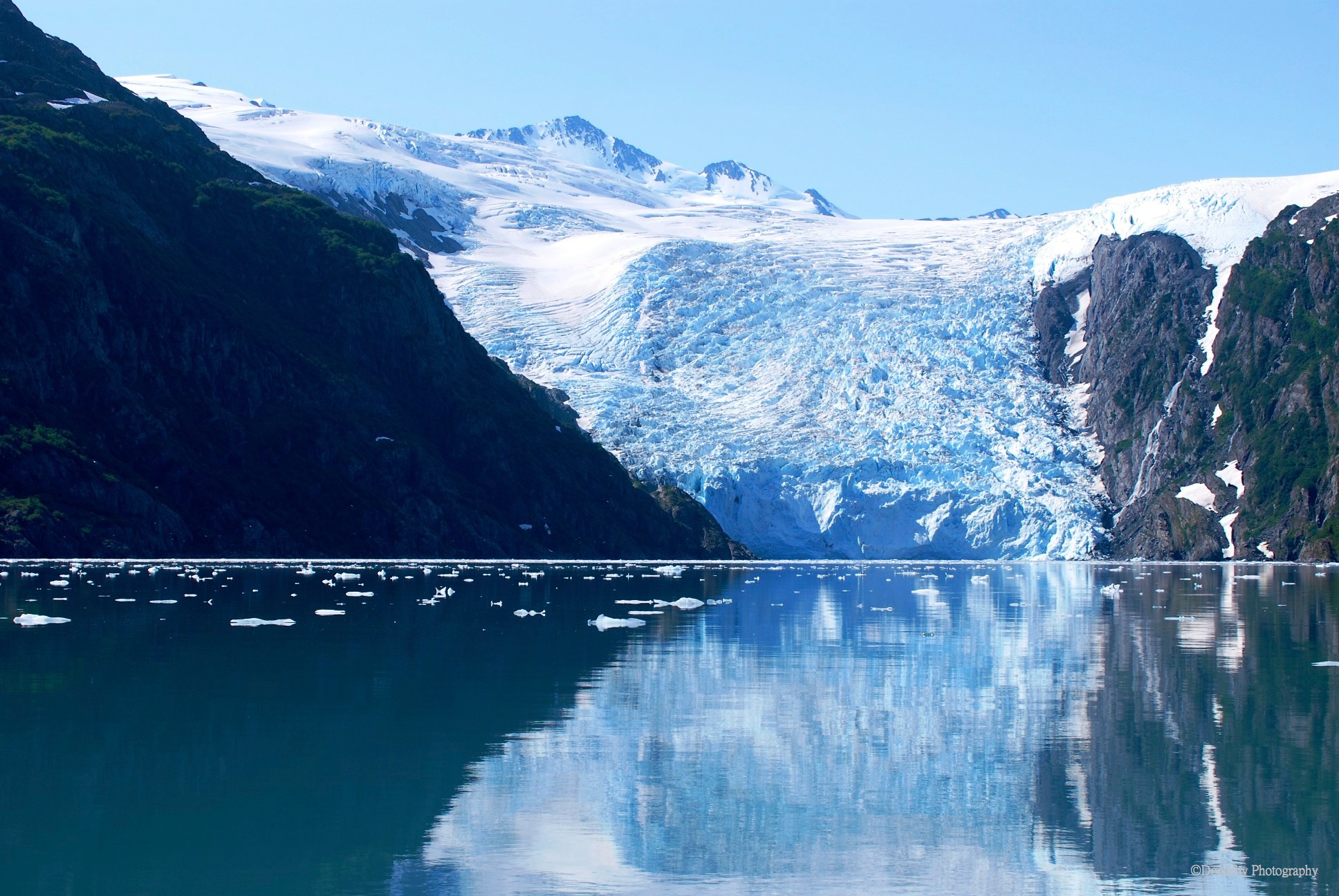
Childs Glacier: When Ice Falls

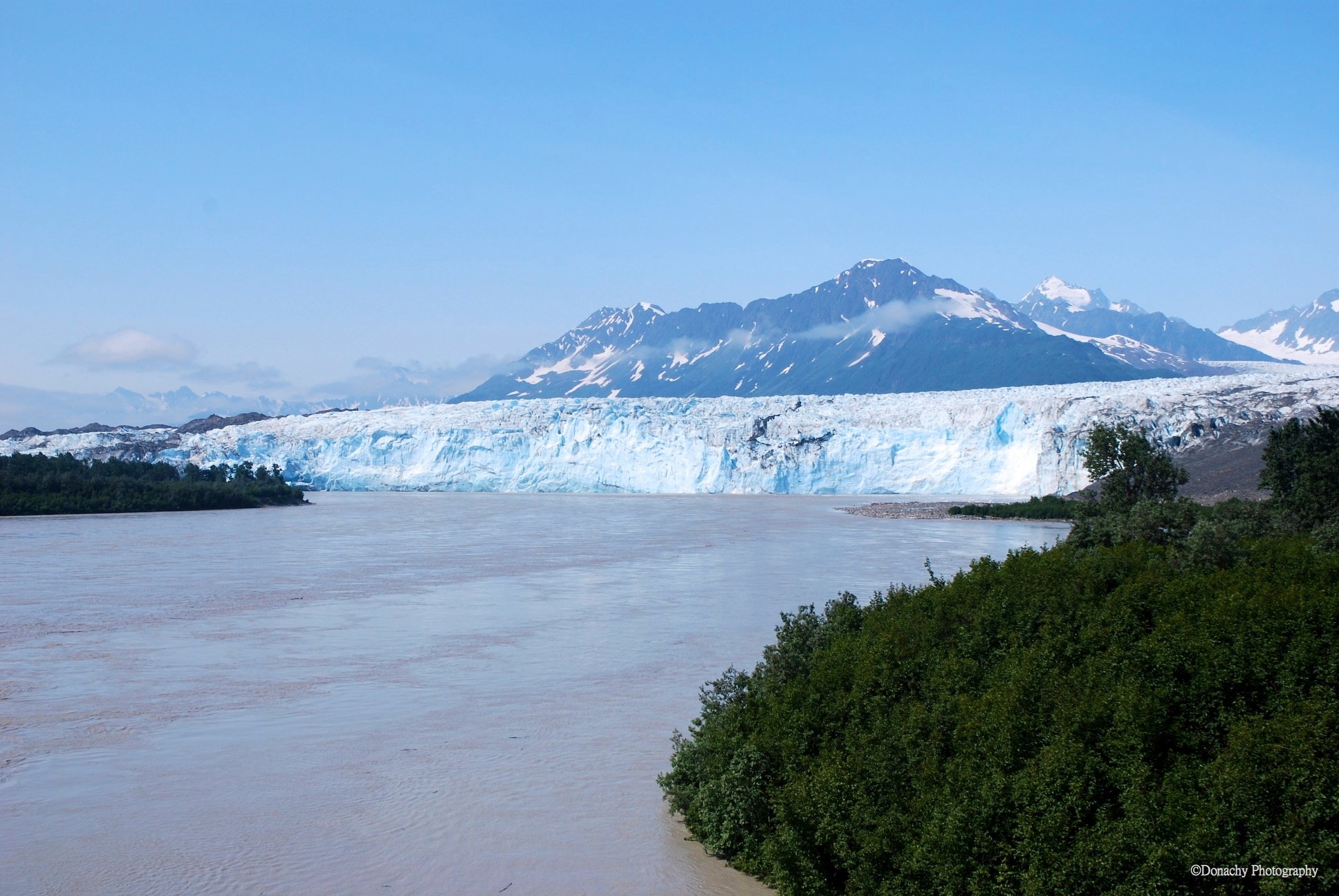
The face of Childs Glacier forms a bank on the Copper River near Cordova, Alaska. This is the same Copper River famed for its runs of wild salmon.

Two days prior, we’d launched our C-Dory in Valdez and made the 90-mile run across a section of Prince William Sound to Cordova – a fishing village accessible only by air or water. The livelihood of many of Cordova’s 2,000 or so inhabitants is connected to the massive runs of salmon that ascend the nearby Copper River. A running event, the Alaska Salmon Runs Marathon and Half-Marathon road races, had lured us to this idyllic village. We hadn’t even known about Childs Glacier when we first put together our travel plans.

Just 400 yards across the river is a picnic area offering excellent views of the glacier.

As often happens at running events, it wasn’t long after we’d finished the half-marathon that we fell into conversation with another couple. They were planning on renting a car and driving out to see the glacier the following day. When they asked if we’d be interested in splitting the rental car and joining them, we didn’t hesitate. This would be our first opportunity to get close to a glacier.

We figured we’d drive out, snap a few photos, have lunch at the picnic area, and drive back. If we were lucky, we might see a moose or a bear along the way. This was before we understood the dynamic nature of sea-level glaciers. We were completely unprepared for what we would experience.

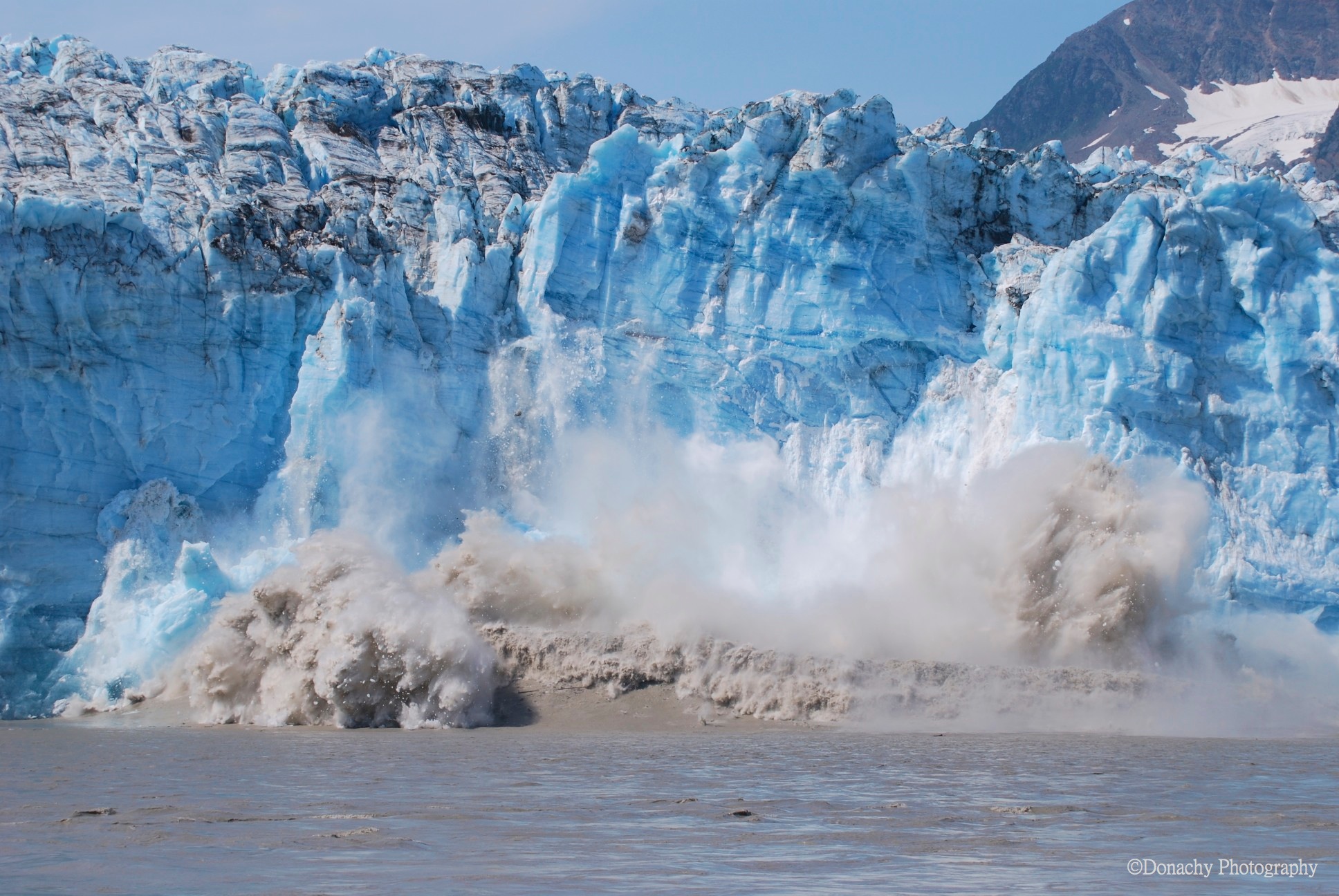
A shower of ice sloughs off the glacier’s face.

The width of the chalky-brown Copper River was all that separated the picnic area from this very active mass of slowly moving ice. Think of the cracking and popping sounds a couple of fresh ice cubes make in a glass of whisky. Now imagine those sounds magnified to amplitudes ranging from rifle fire to dynamite charges as ice almost continuously breaks away from the glacier’s face. We were mesmerized. The half-hour we’d planned on staying turned into an hour, then into two, and then into three.

We were witnessing yet another Alaskan phenomenon so large and full of energy that it is all but impossible to adequately capture on film or with words – an event you have to experience to comprehend, and we were here, experiencing it. Although neither Barbra nor I gave voice to the thought, it was probably on this day, watching and listening to this glacier, that the idea of moving up here began to root itself in us.

We sensed that something BIG was about to happen.

Suddenly, a massive section of ice below a seam we had been watching seemed to sag. A fraction of a second later a prolonged groaning, cracking explosion unlike any we’d heard before reached our ears as the face of the glacier fell away, collapsing into the water with a force that sent a small tidal wave curling toward us. The four of us looked at each other, eyes wide, jaws dropped, and quickly gathered our gear and scurried for higher ground. Seconds later, the wave hit the shore, inundating the area where we’d been standing only moments earlier. It was thrilling.

This large iceberg in Prince William Sound is the result of a glacier calving event in one of the sound’s fjords. Kittiwakes and gulls have claimed it as a roosting place.

Whaling: Two Miles Out on the Frozen Chukchi Sea

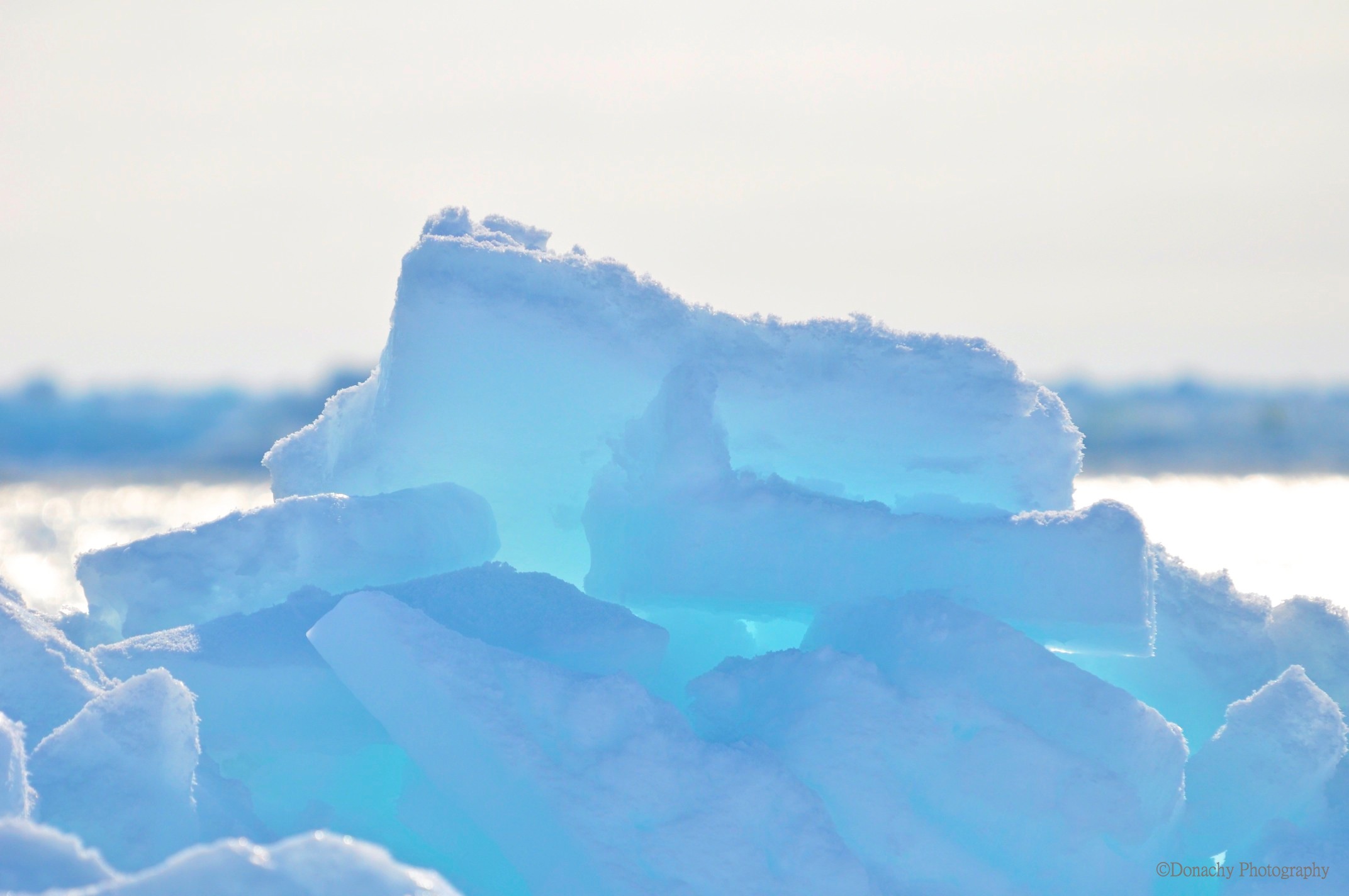
Two miles from land across the frozen Chukchi Sea, the ocean ice is constantly breaking up and reforming, creating ridges of fragmented ice. The blocks of ice in this photo weigh from hundreds to thousands of pounds, but are so clear they seem to be lit from within. 

We had heard that the bowhead whale was out near the point, three miles west of the village of Point Hope. But once out there, we saw few signs of activity. We found a trail leading out onto the ice and began following it in hopes of locating the lead – the place where currents and wind had caused a break in the ice and created open water. That’s where the whaling camp would be.

The ball and pyramid, above, were a familiar trail marker from a previous trek out onto the ice. (Click here to see “Whale Camp: Frozen Sees and Icescapes.” A frozen sea is not smooth. It is more like an otherworldly, windswept rock and sand desert with the rocks replaced by ice and snow replacing the sand. Note the faint snowmobile tracks curving along the right edge of the photo – that’s the trail. 

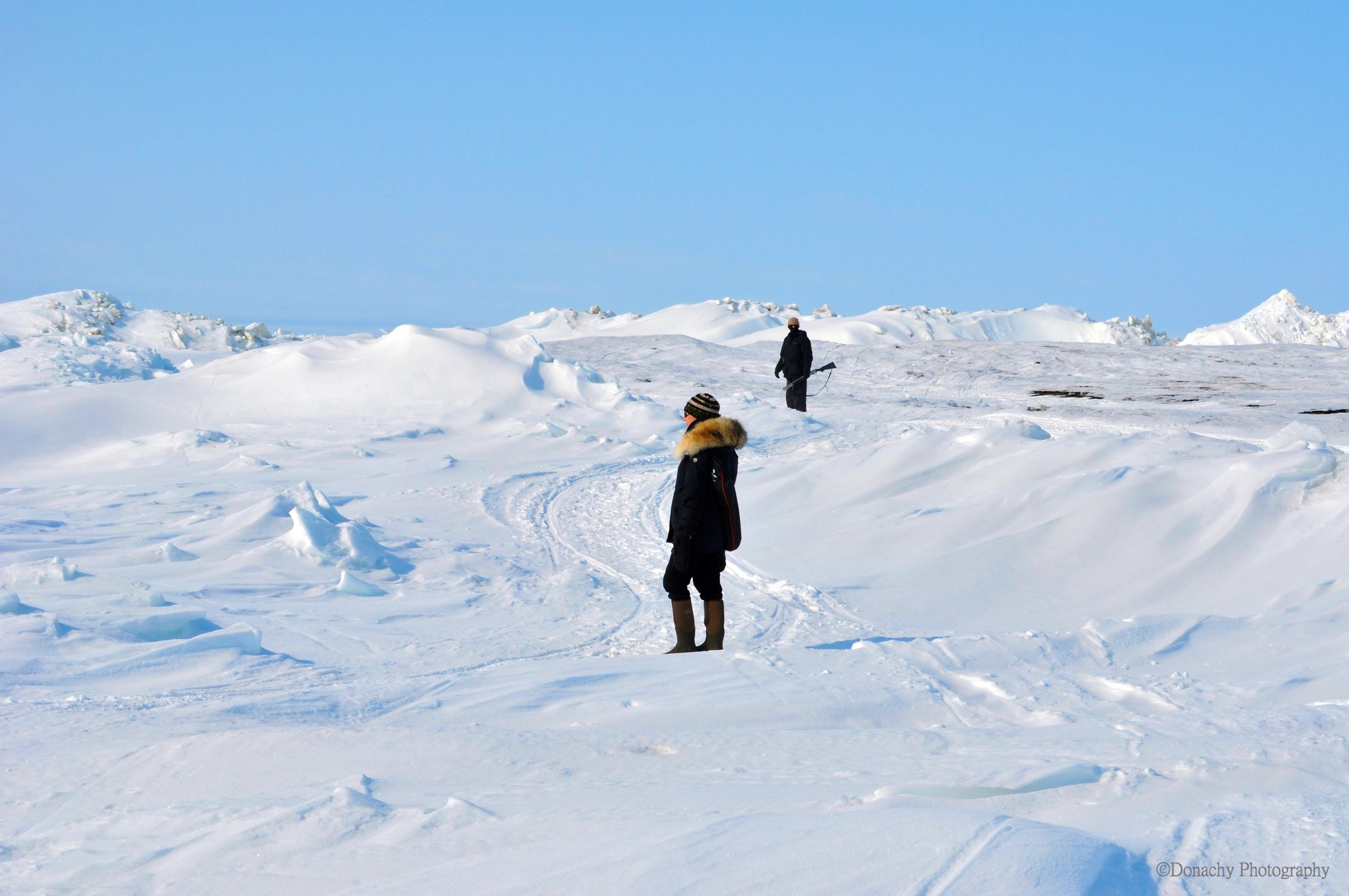
A mile or more out on the ice, Barbra and our friend, Bill, pause to scan for telltale seabirds that might give away the location of the lead. This is an area frequented by polar bears, hence the gun Bill is carrying. We saw no bears, but did cross a number of fox tracks.

Huge, luminescent fragmants of snow-dusted ice reminded me of the hardtack candy my grandmother used to keep in a crystal bowl. 

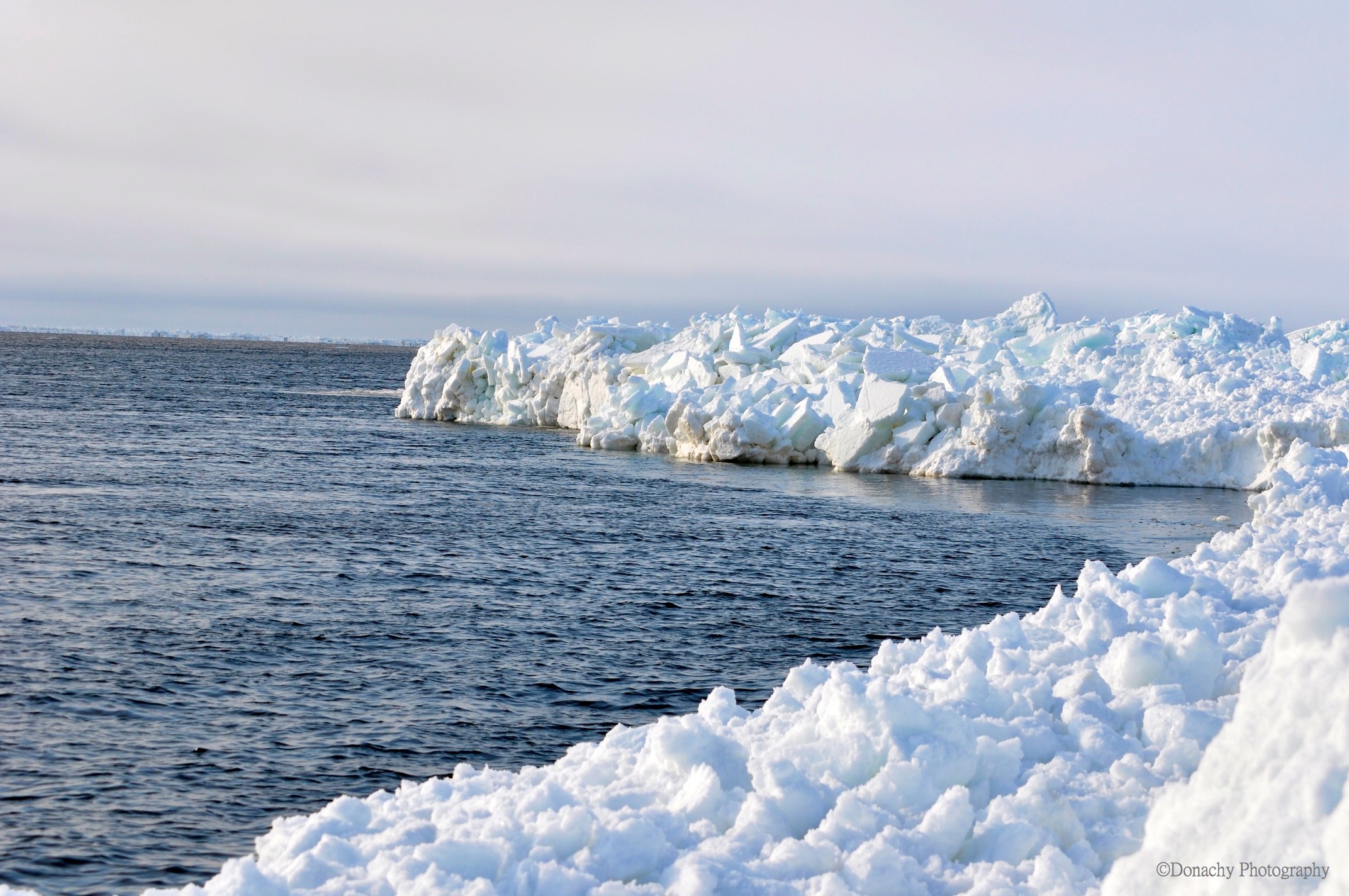
Leads can open and close in moments, leaving people stranded when a break-off occurs, or generating enough force to place this pickup-truck-sized block of ice precariously atop a mass of fragments. A walk across sea ice gives one a glimpse into the forces behind tectonic plates and events such as earthquakes and the formation of mountain ranges.

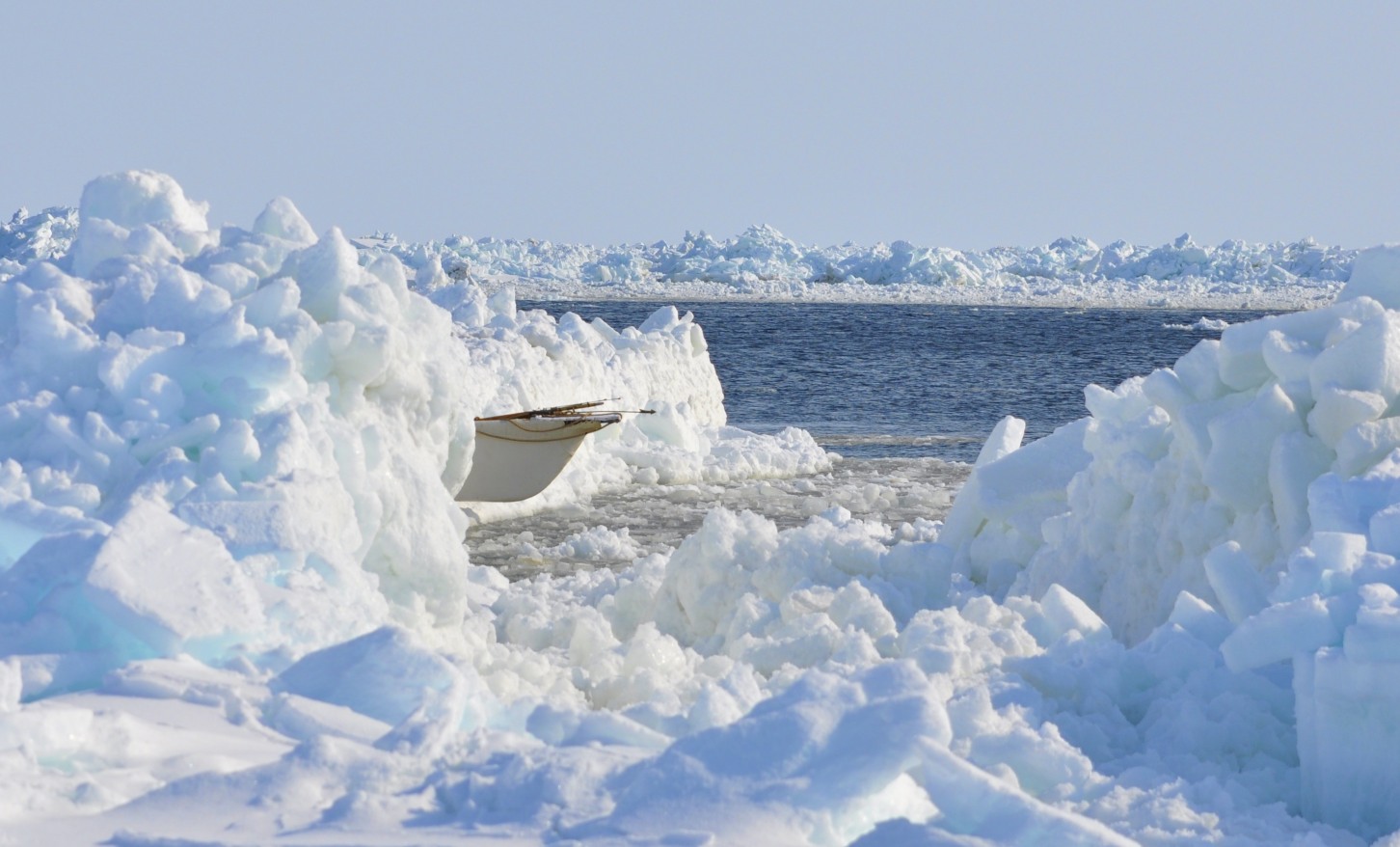
We’d walked over five miles by the time we finally found the lead – a fairly narrow band of water hemmed in between two ice sheets. The bow of a seal-skin boat was a sure sign we were nearing the main whaling site.

This is a typical whaling outpost. The seal-skin boat, which is about 17  feet long, is made from hand-stitched bearded seal hide. The boats are light, able to be moved on a moment’s notice. The jumble of ice at the edge of the lead was piled there by natural forces and serves as both wind shield and hunting blind. Note the mass of floating ice out on the water. 

At the edge of the lead, the ice does not taper. It is thick and strong, but susceptible to breaking off if the wind shifts. 

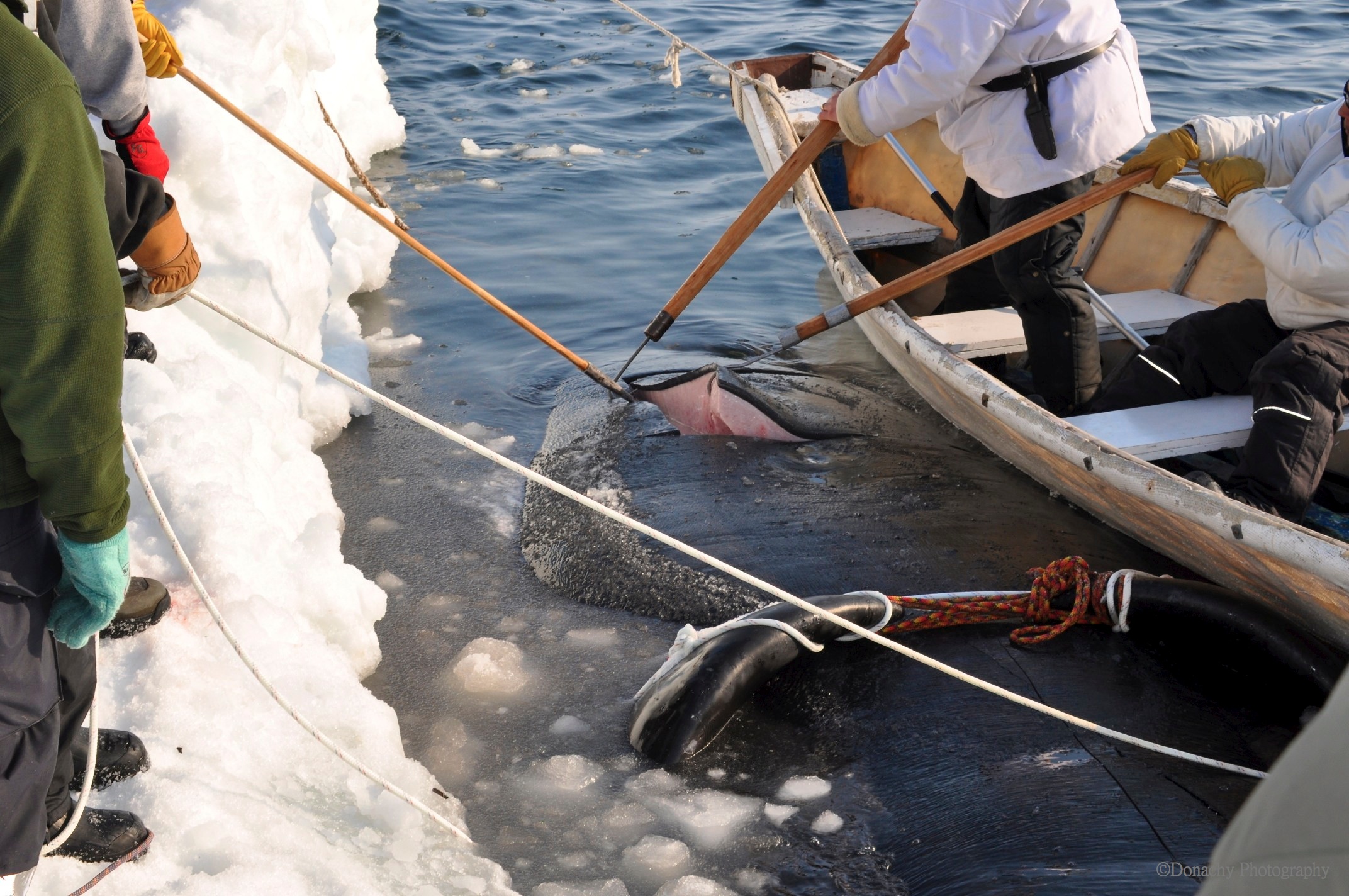
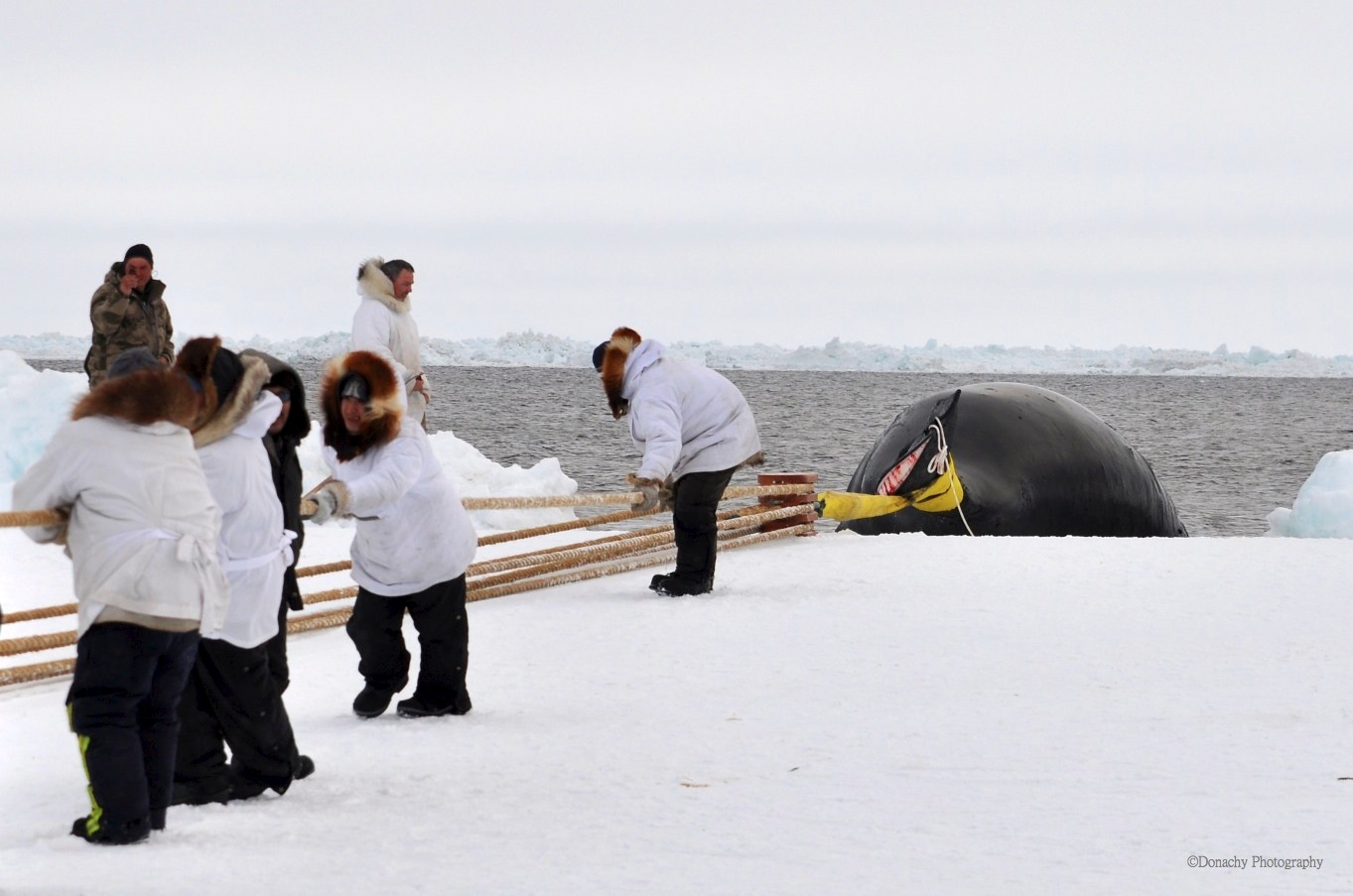
We had wondered how a whale weighing 10, 30 or even 50 tons is pulled from the water. Two heavy block and tackles are anchored to the ice. The one nearest open water is pegged with a thick metal spike. Fifty yards or so back a second block and tackle is anchored by drilling two holes through the ice and securing the it with a strong harness. Even with the modest mechanical advantage of pulleys, it takes dozens of people pulling for all they’re worth to bring the whale out of the water.

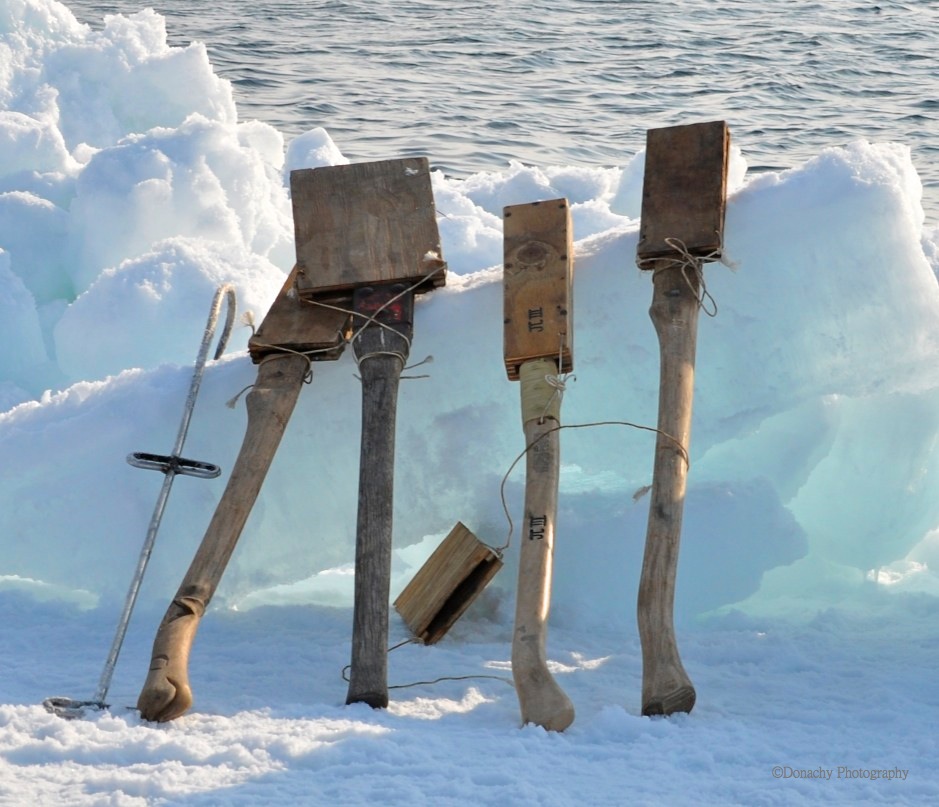
Most of the tools used are hand-crafted. The spade-like implements on the right are butchering tools.


We were very aware of this deep crack in the ice, as, no doubt, were the whaling captain and his crew. While the ice to the right of the crack was sturdy enough to support a house, a shift in the wind could have caused it to suddenly break off. 

The whale was small, a young one. Here a ceremonial first piece weighing 30 pounds or more is cut for soup in which the only ingredients are melted snow and fresh whale – a welcome celebratory meal against the cold.

When the pull began, I handed my camera to Barbra and found a place on the rope. The pull started with grunts and chanting, but as the whale begin to emerge from the sea onto the ice, the chanting gave way to whoops of joy and cheers.

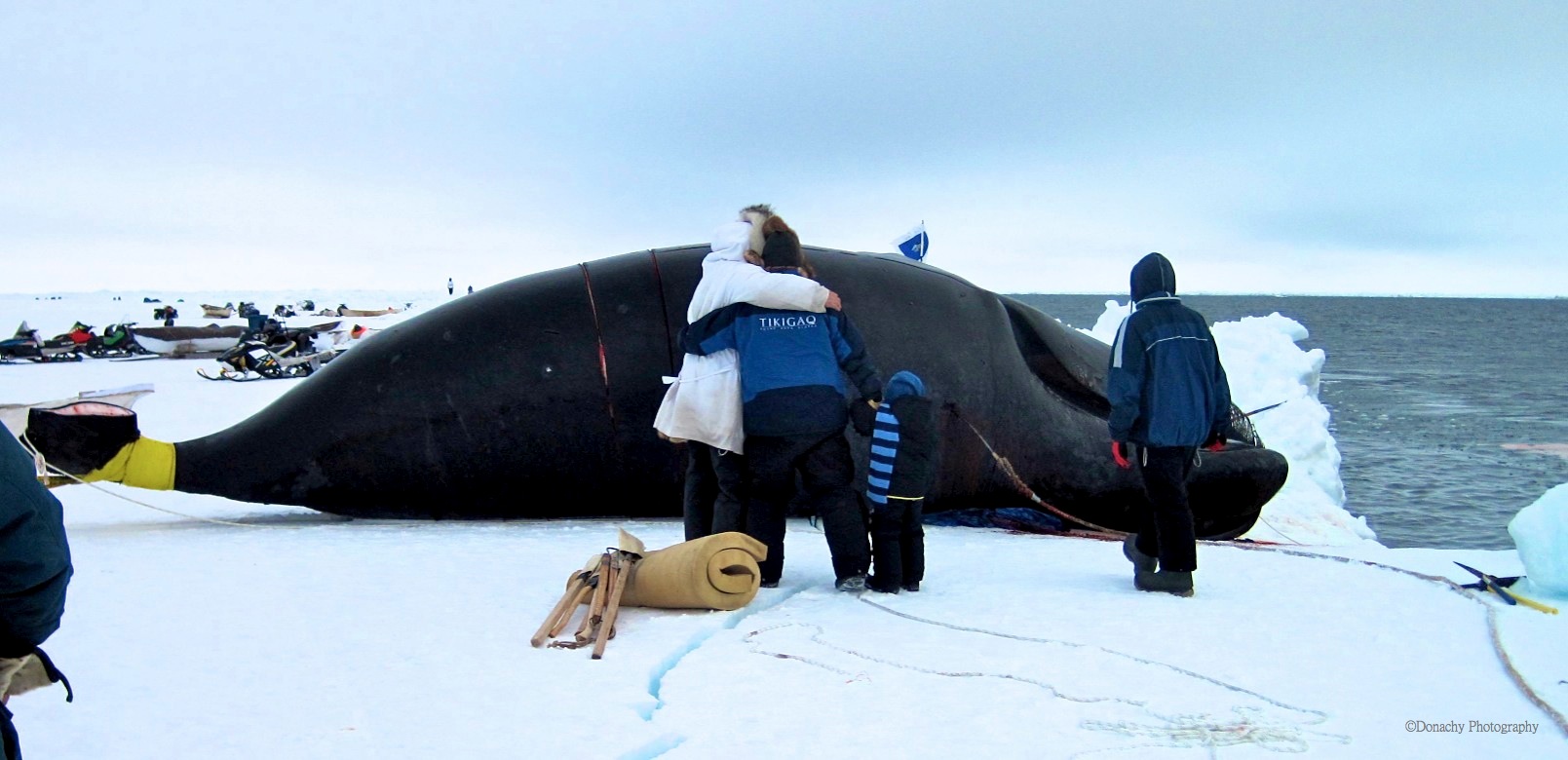
The captain (in the blue coat) shared a celebratory hug (above)…

…and then his crew member headed off with a friend for a bowl of hot whale soup. By this time, Bill, Barbra and I had been out on the ice for nearly five hours and we had a two-mile hike back over the sea to land. We were thrilled to have witnessed and taken part in a tradition that goes back to the roots of this Inupiat village.

Whaling Camp: Frozen Seas and Icescapes

Ball and Pyramid, Chukchi Sea, Alaska: This icescape, photographed with a Nikon D90 and a Sigma Bigma 50 – 500 mm lens, has been slightly processed to increase contrasts. The operative word here is “slightly.” Even to the naked eye, these frozen-sea icescapes are other-worldly.

Evocative, perhaps, of a scene from Star Trek, winter hikers venture across the frozen ocean out to a whaling camp. The gun the lead person is carrying is for protection. Although we saw no sign of polar bears on this day, friends of ours who took a slightly different path encountered fresh tracks.

Seal-skin boat at the ready, these men stand vigile for bowhead and beluga whales. Note the light blue block of ice they’ve cut out and positioned near their gear as a shield. These men are standing on sea ice just a few feet from the open sea. Last year was a good year for whaling in Point Hope, with three bowhead whales harvested. The hunt is dependent on the right ice conditions, which can be elusive. So far this year, no whales have been taken.

A well-equipped wall tent, complete with a supply of propane, serves as one of several whaling camps near the village. These camps are set up on sea ice, and may be anywhere from a few hundred yards to several miles offshore. The hunters travel out to leads – areas where the ice is open. Winds and currents can open and close leads quickly, underscoring the need for whaling crews to be constantly alert.

Sea ice seem to be lit from within by blue light. Heaved up in pressure ridges and broken into fragments weighing several tons, it is easy to appreciate the arduous work “breaking trail” entails as hunters go out onto the ice to set up camps. 

A black and white composition heightens the contrasts in these massive blocks of broken ice.

There’s a sense of being somewhere other than Earth…

And then a flock of common murres skims across a lead…

Rivers of Ice: Glaciers, Icefields and Floating Sculptures of Blue

Icebergs such as this ethereal blue sculpture are the culmination of a dynamic process eons in the making.

It’s easy to imagine glaciers as static – water interrupted, subject to thaw and melt, but otherwise frozen in space and time. In reality, they’re more like slow moving rivers, pulled down by gravity, pushed forward by the unimaginable tonnage of ice and snow in the icefields where the originate. A fast-moving glacier can travel at a rate of 20 meters a day or more.

Tidewater glaciers are among the most dynamic forms of ice in nature. Like the Blackstone Glacier (pictured below), they flow from icefields, much as a mountain stream might originate as the outflow from an alpine lake. What makes tidewater glaciers so fascinating is that they don’t gradually turn to water as they descend down a mountain valley, warming and thawing with the descent.

Instead, tidewater glaciers terminate when they reach the sea. The ice continues to flow, pushing the face of the glacier forward. If the face of the glacier is large enough, the combination of forward movement and warmer air and water temperatures can result in spectacular calving events, with massive pieces of ice sloughing off into the sea.

The Harding Ice Field, which gives birth to three dozen or more glaciers, stretches out like a vast, island-studed lake. 

As soon as the freshly calved ice hits the water, it become part of sea’s ecosystem. Harbor seals (above) and black-legged kittiwakes (members of the gull family, below) use the frozen islands to rest, feed and stage hunts. The seals also use the ice as nurseries.


Summer Blueberry Picking on the Arctic Tundra

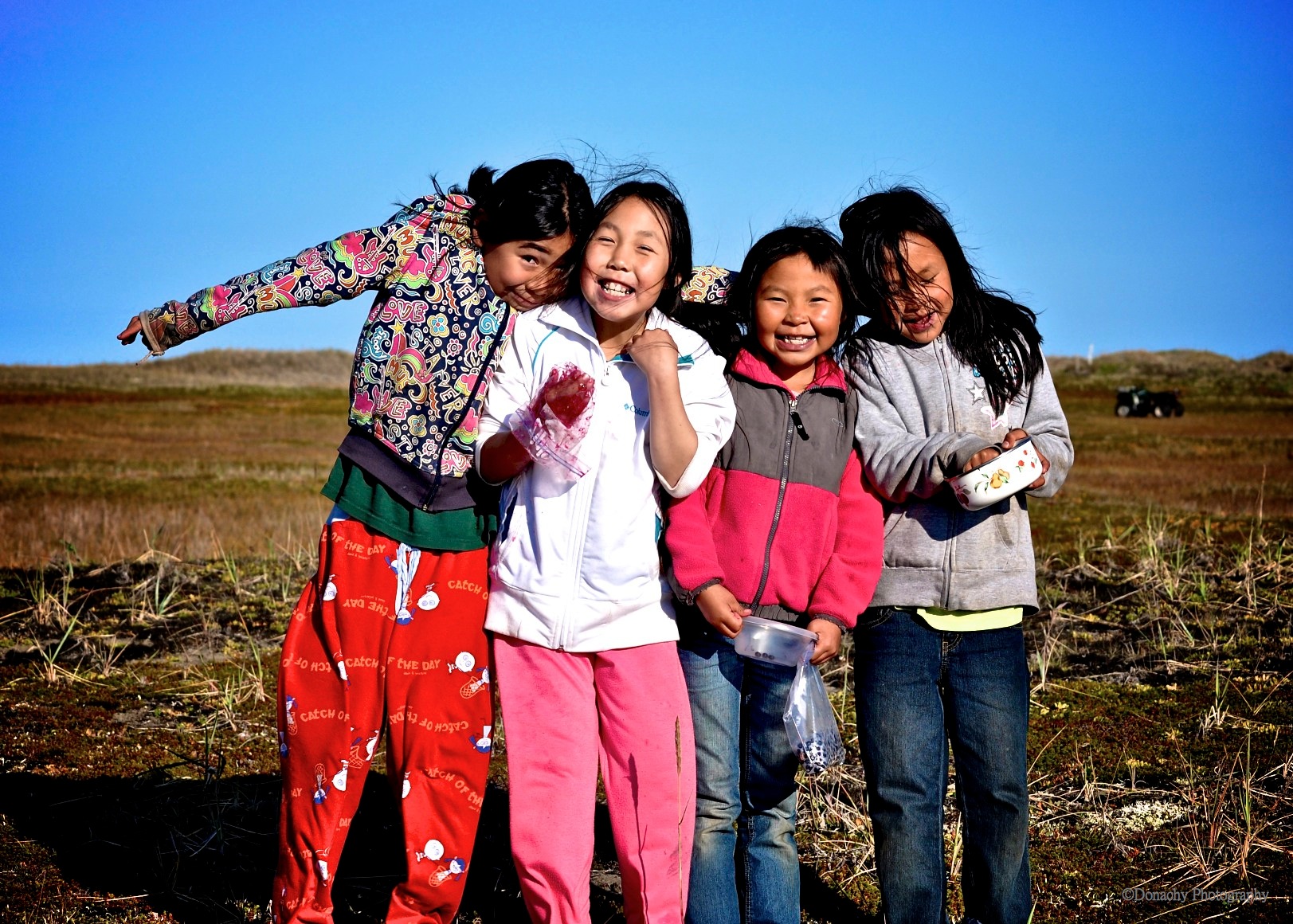
Friends from Shishmaref after an afternoon of blueberry picking. Gathering a cupful or two of these small, tart berries growing in scattered clumps across the tundra was work… the fun kind. The following morning, we celebrated with a stack of blueberry waffles.

Accustomed to the six and seven-foot tall blueberry bushes of Oregon where Barbra and I had picked berries by the bucketful when I lived in Astoria, we were surprised to learn that blueberries were growing right under our feet on our walks through the tundra near Shishmaref. “There’s lots,” one of my students told us. “We’re going to go tomorrow. You guys can follow.”

“Follow” is the village English way of saying “come along.” And sure enough, once we learned to key in on the unmistakable Autumn-red of the bushes (if ground-hugging plants that top out at six-inches can properly be called bushes), we began finding an abundance of small, perfectly ripe, deliciously tart berries. The comparatively thick, woody stems of some of these bushes suggested that they had weathered quite a few seasons near the Arctic Circle. Growing among the blueberries were crowberries (locally called blackberries) and low bush cranberries. Elsewhere in the far north, including in Europe, there are cloudberries, perhaps the most delicious berry on earth.

We walked along in the late summer sun, finding patches of berries here and there, crouching and kneeling to pick, and then moving on to find another patch of tell-tale red. Birds were out sharing the bounty – or maybe the insects associated wtih the fruit: lapland longspurs, white-crowned sparrows, savanah sparrows, and other small birds.

The pause that refreshes. A berry-picker gazes across the open tundra on Sarichef Island where Shishmaref is located, snacking on a bag of berries that probably aren’t going to make it all the way home. The red leaves near her feet? Yep. Blueberries!

The Birds are Back in Town!

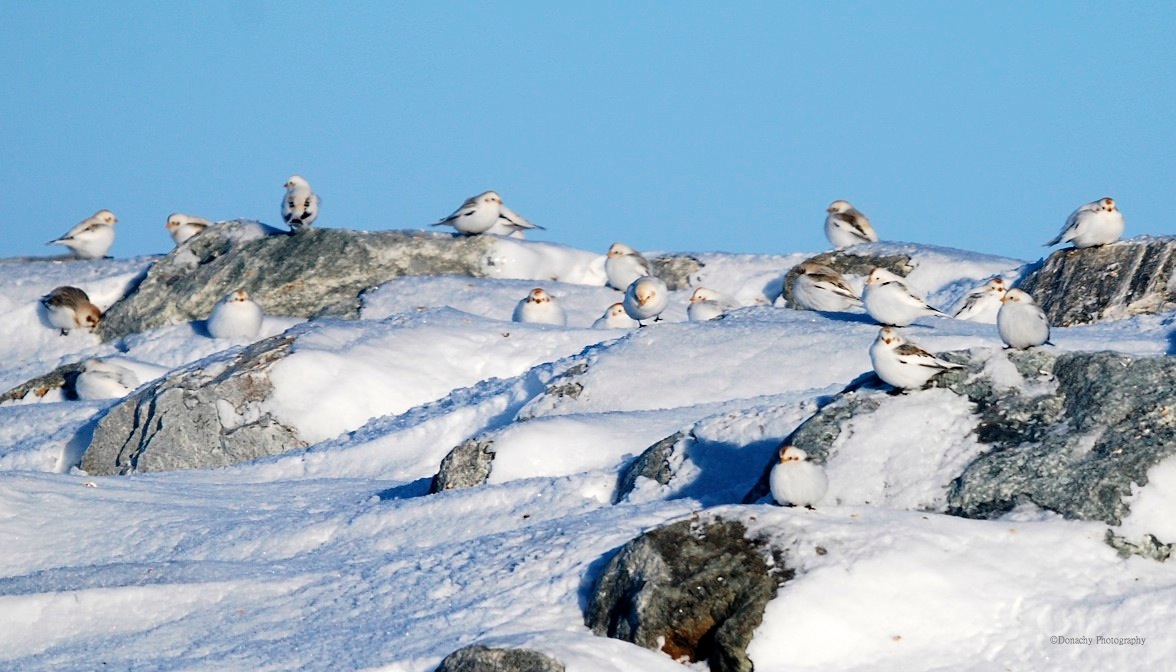
Feathers puffed against the cold, a female McKay’s bunting warms herself in the radiant heat from a rock. Daily highs are reaching the teens and even the twenties now, and today’s sunshine stretched from sunrise at 7:00 AM to sunset at 11:13 PM. The midnight sun is back, and so are the birds! 
Gripped in the heart of winter, an Arctic landscape can be one of the quietest places on earth. Save for a few hardy ravens that manage to make a living off dumpsters and the local garbage facility, most birds head for warmer climes. There are no tree branches for the wind to whistle through, no dry grass to rustle, and on the coldest nights, even the village dogs huddle up and stay mum. Dark settles in, and the waiting begins.
For the past couple of weeks, we’ve increasingly been hearing the welcome twitters and chirps of flocks of the snow birds of the north, snow buntings and McKay’s buntings. It’s been weeks since the last windstorm, and these days we can feel the warmth of the sun on our faces. It feels… wonderful.
I’ve always admired passerines – songbirds. These snow buntings have become some of my favorites.

Chiming Bells, Paintbrush & Bog Candles: Flowers of the AlCan Highway

Fireweed is as common as it is beautiful along the highways of western Canada and Alaska. It’s just one of dozens of wildflowers travelers can expect to encounter. Young fireweed leaves are a tasty addition to salads, and their petals can be used to make a beautifully colored ice cream.

Left: Prickly rose looks a lot like its domestic counterparts. This bud is within a day or two of bursting open. Right: I don’t know if one can properly talk about wildflowers growing in beds, but where we found a few chiming bells, there always seemed to be others peeking out from the shade where the soil was damp and the sunlight sparse.

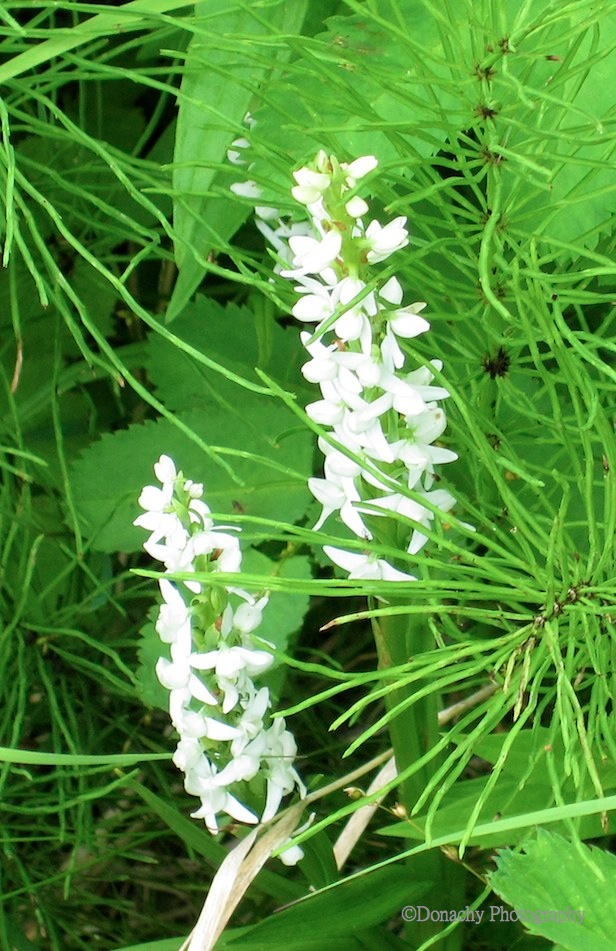
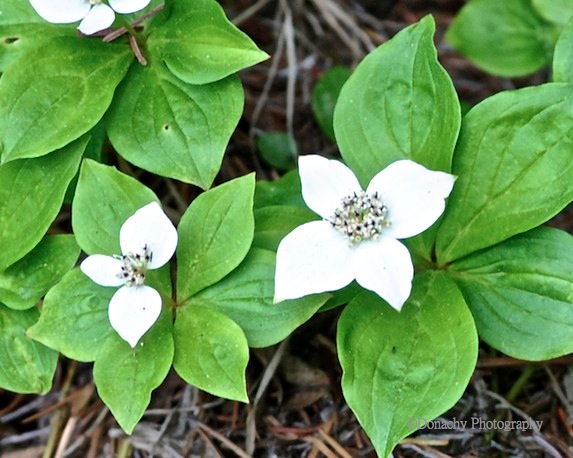
Appropriately named bog candle lights up the shaded places where it grows..Northern Yarrow is common throughout the region. Dwarf dogwood hugs the forest floor.

Fireweed leans toward the sun above a yellow sea of monkey flower.

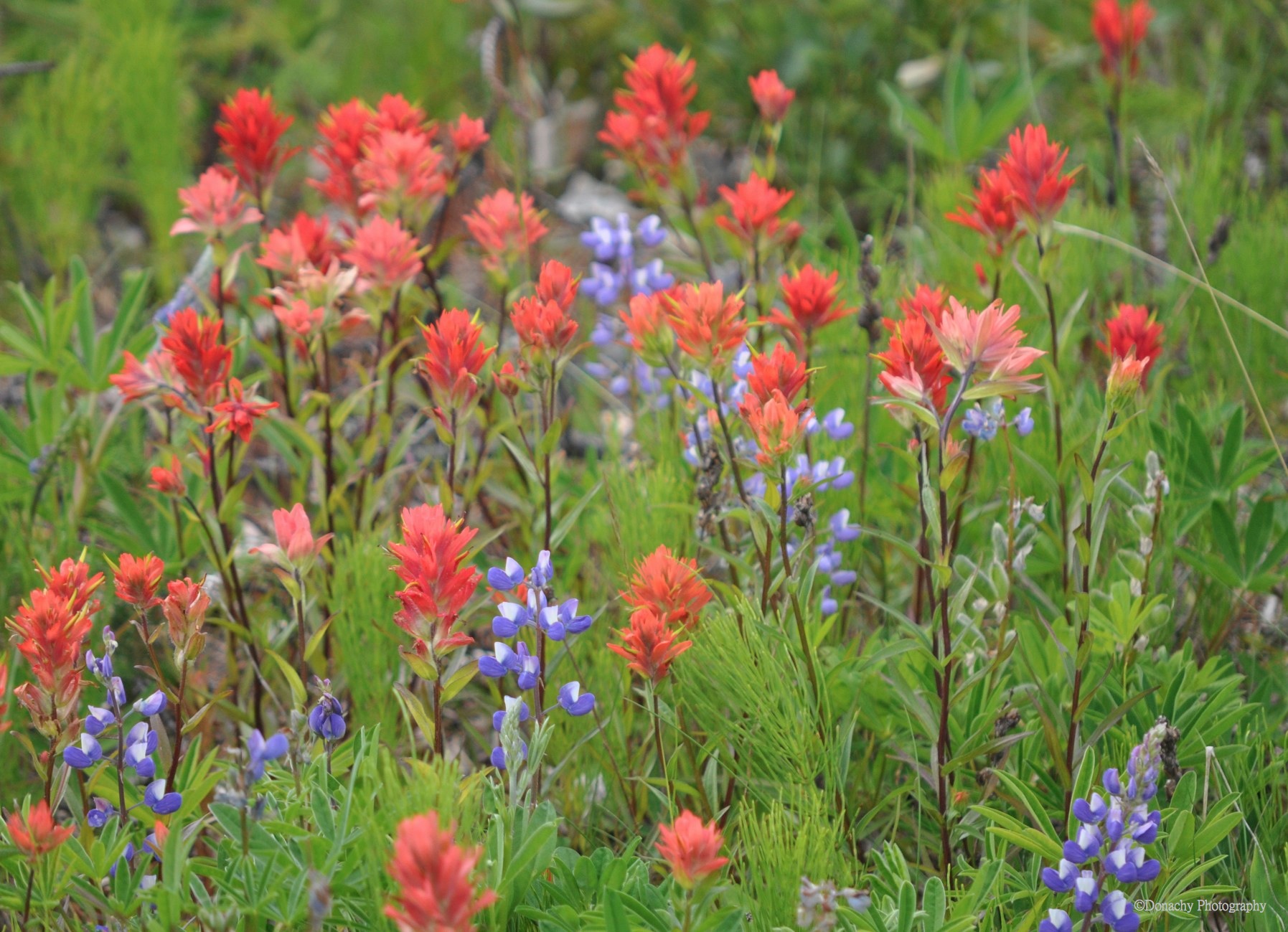
Indian paintbrush (red) and lupine (blue) are common throughout the Pacific Northwest.

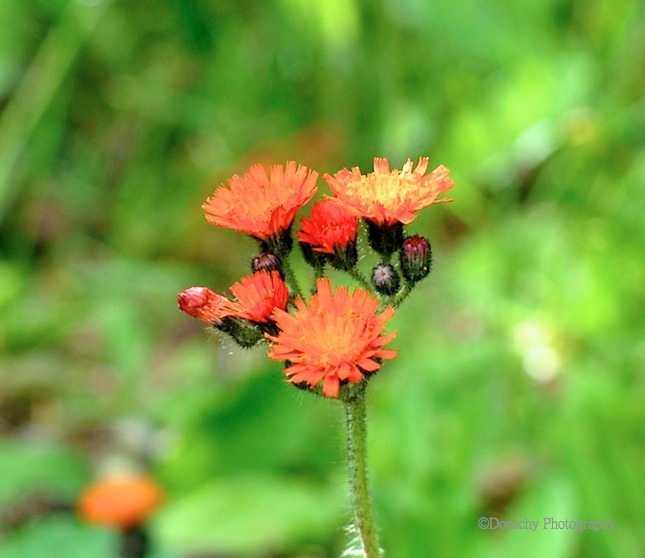
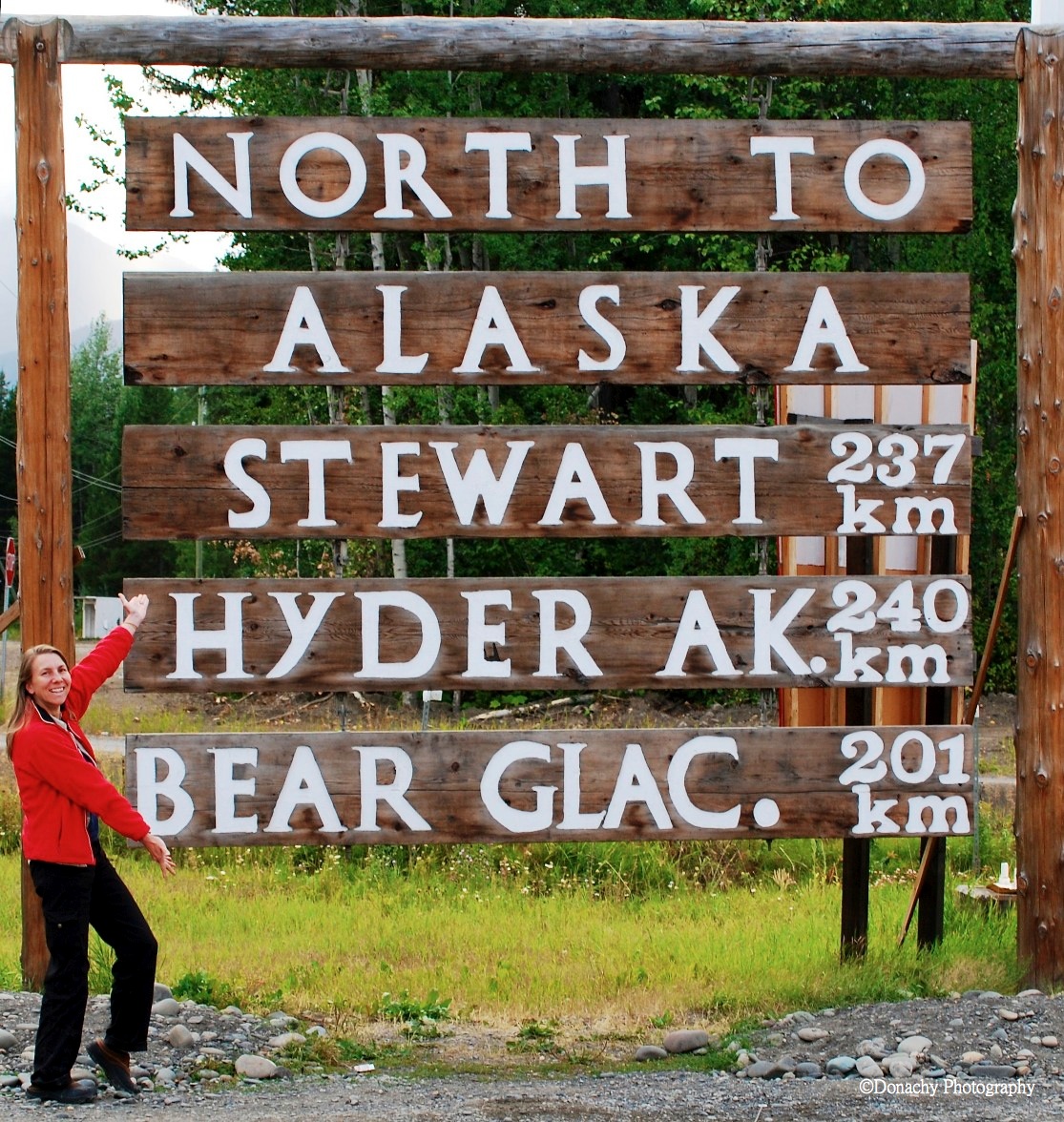
Orange hawkweed is sometimes mistaken for Indian paintbrush, but it’s an invasive species – albeit a pretty one. Wildflowers seem to be everywhere in western Canada. This black bear is framed in fireweed stalks as he takes a break from browsing a patch of sweet clover. A road trip up the West Coast through British Columbia, into Yukon Territory and on to Alaska had long been on our lifetime things-to-do list. This is one of the world’s great drives.

Totem Poles at Gitanyow

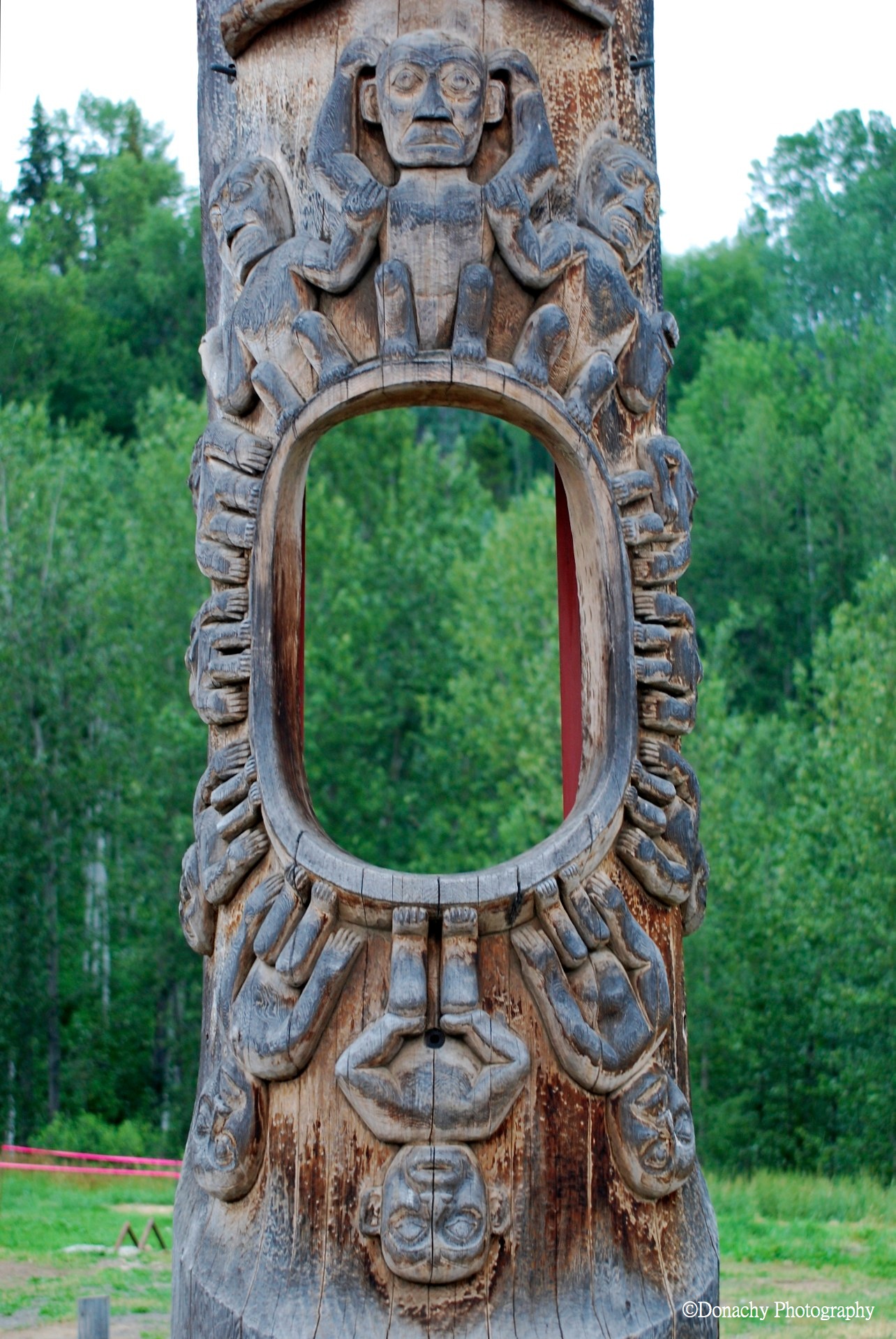
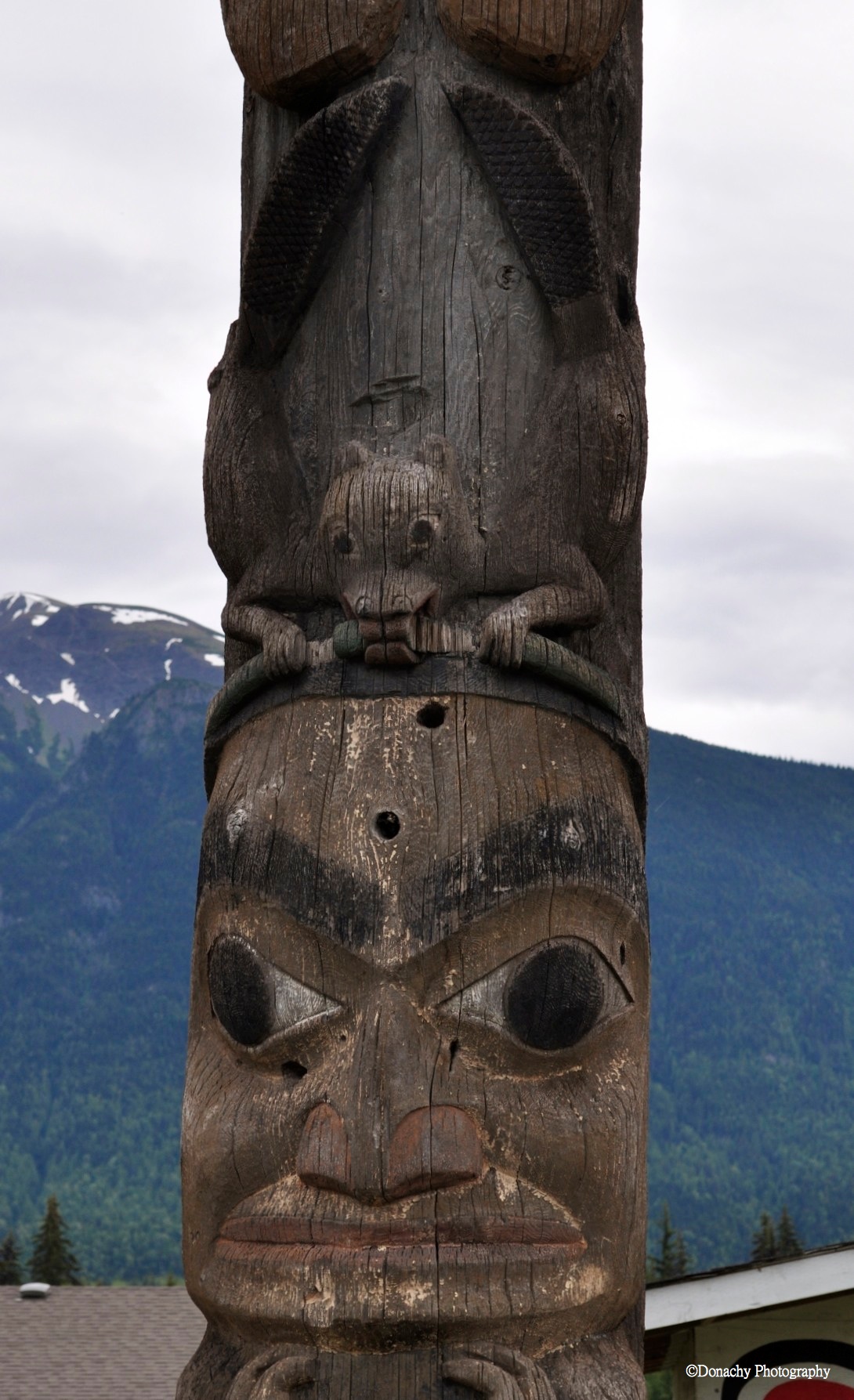
Above: Hole in the Ice totem pole at Gitanyow, British Columbia. The totem poles at this National Historical Site represent one of the largest collections in North America. Although many of the sculptures at Gitanyow are replicas (the originals were moved to museums), Hole in the Ice is an original.

Carved from cedar and imbued with symbolism, history and tradition, totem poles are an art from that fire the imagination. When we read that there was an authentic collection a short detour off the Stewart Cassiar Highway we were taking north through British Columbia, we had to make the trip. There are other places in the Northwest where you can see totem poles, but Gitanyow is compelling for sheer numbers (about 50) as well as for the detailed artistry in many of the poles.

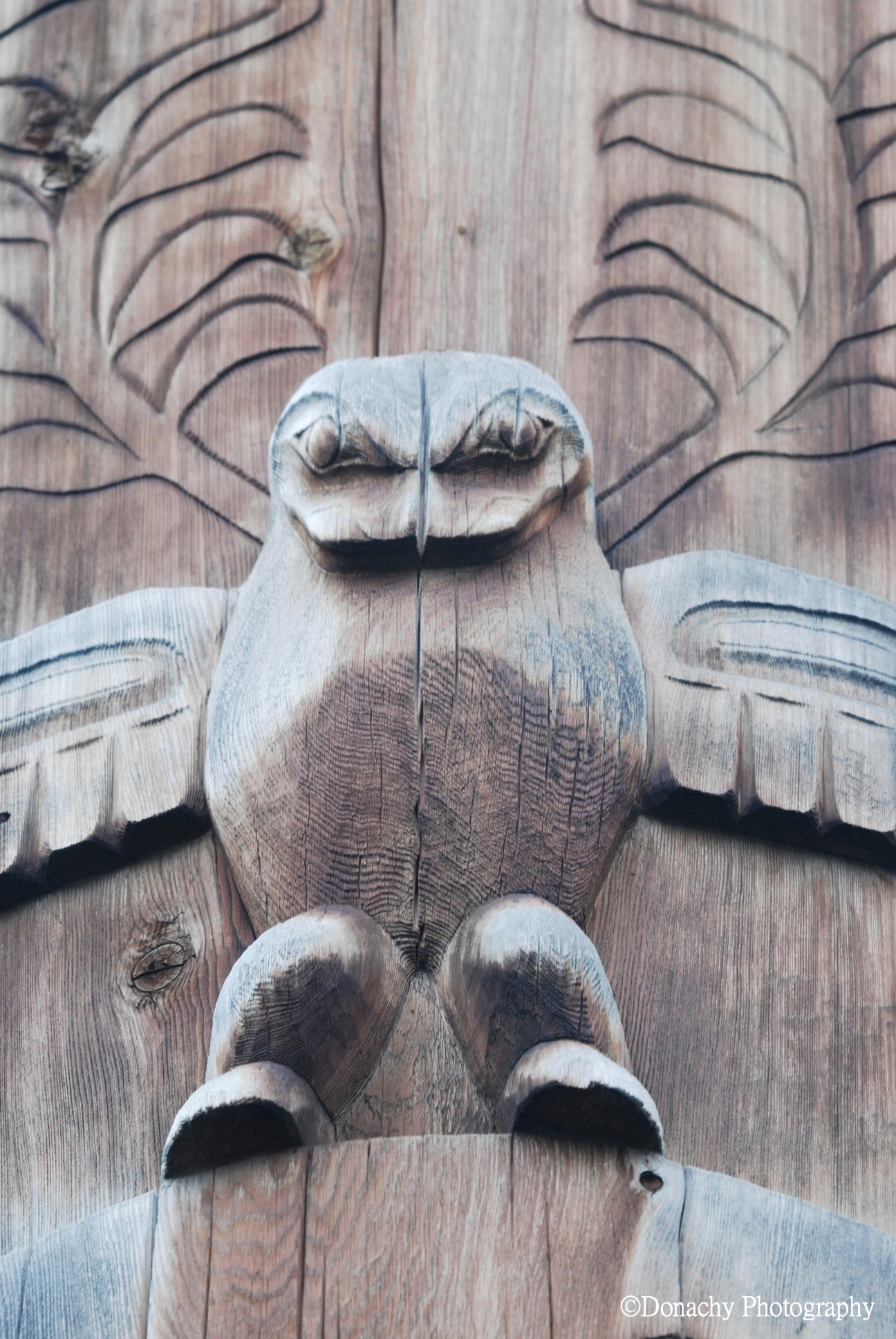
Figures such as this wolf may represent a clan, a specific person, or be part of a story.

Right: This friendly mixed breed  we nicknamed Bear adopted me and stayed by my side throughout our visit. The poles in this photo are smaller than the others pictured in this post.

There is a museum at this site, but it was closed on the day we visited. In fact, we didn’t see a single other person as we walked the grounds, and although explanations of what we were looking at would have been welcome, the solitude to contemplate these carvings through our own lenses was even more welcome.

The totem poles at Gitanyow are in various states of weathering, with some so worn their features are hard to make out.

As we walked the grounds on this grey, misty, sometimes rainy summer day, one word kept passing over our lips. “Cool.” Thinking back on that day and looking at these photos again, the same word comes to mind, pushing others aside. These sculptures are cool. Way cool.

Above: a beaver seems to be gnawing on a headband above this face. 

Bison and Bears (and a C-Dory) on the Al-Can Highway

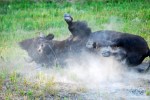
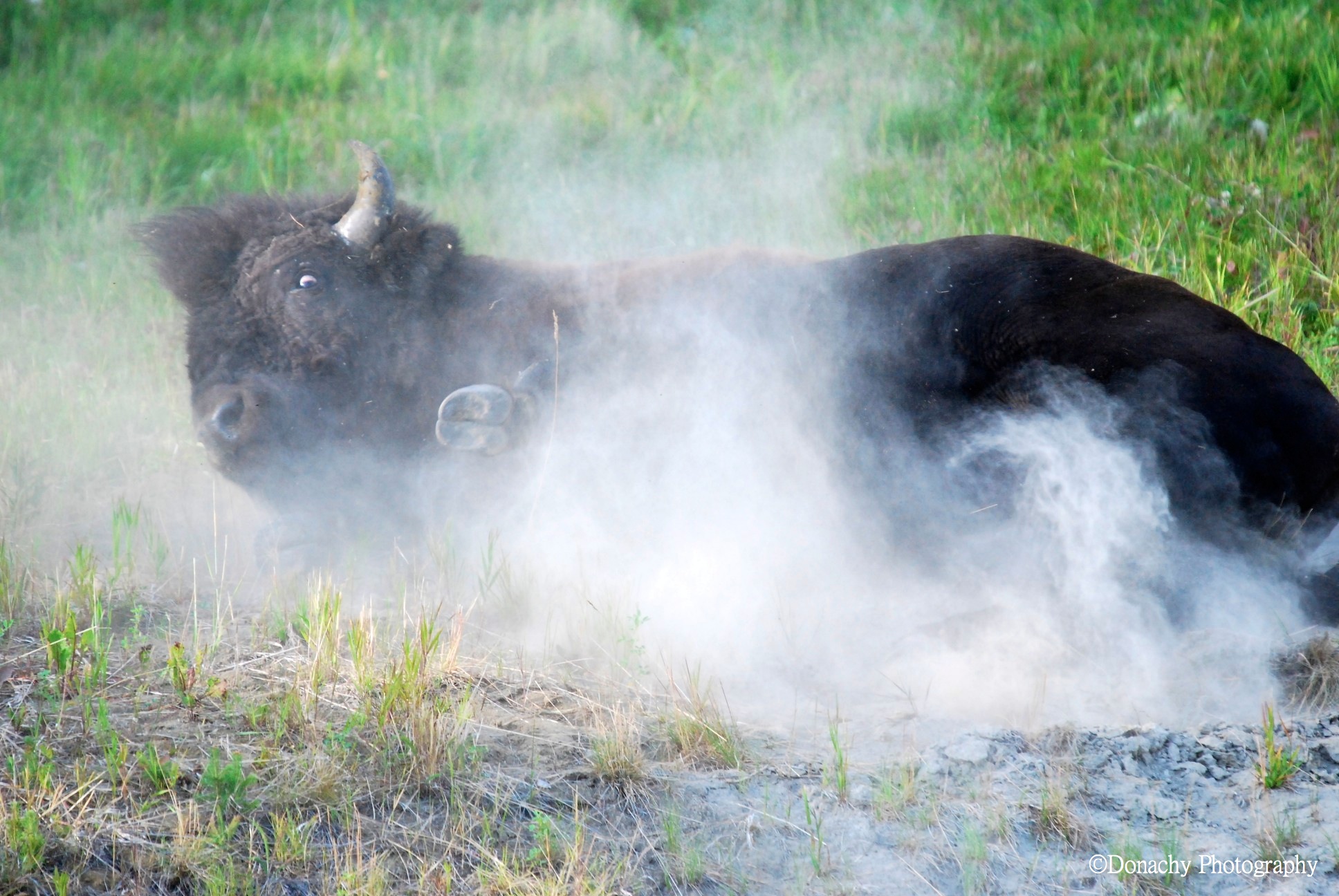
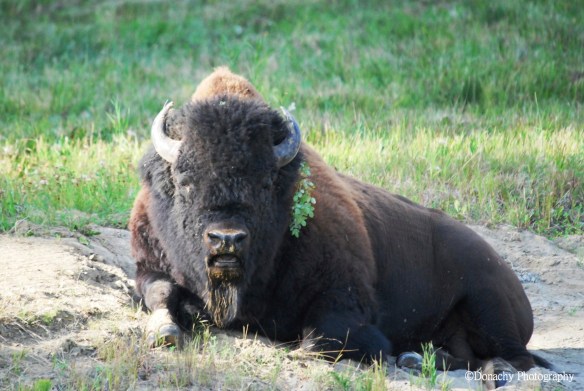
Ferdinand the Wood Bison kickin’ it in a dust wallow in Northern British Columbia. In addition to breathtaking views of the Canadian Rockies, vast forests, free-flowing rivers and an amazing array of wildflowers, a summer drive through western British Columbia and Yukon Territory on the way to Alaska provides one of the premier animal viewing opportunities in North America. (This is the first of several posts planned about the drive to Alaska and sights both along the way and in Alaska.)

In the fall of 2008 when Barbra and I purchased our C-Dory 22 Angler fishing boat, Gillie, we had no idea that 21 months later we’d be towing it 3,200 miles from Sacramento, California to Valdez, Alaska on a 43-day camping, exploring and fishing odyssey. With the exception of one night in an Anchorage hotel, we camped on Gillie – both at sea and on land – the entire trip. As Barbra and I fell into the daily rhythms of preparing meals and crawling into bed each night, our boat actually seemed to grow larger.

The trip north proved to be an ongoing revelation – one filled with far more grandeur than we’d anticipated.

I’d seen plains bison on trips to Yellowstone National Park, but we had no idea there was another subspecies of American bison, wood bison, roaming free in northern Canada and eastern Alaska. We encountered herds engaged in typical bison behavior including grunting males butting heads, females nursing spindly-legged young, and

individuals dust wallowing.

Our Tacoma had a feature we loved: a sun roof. By shooting photos from the open roof, we could safely get close to roadside animals, neither spooking them nor putting ourselves in danger. It was like having a photography blind.

At the beginning of the journey, we kept a list of the animals we encountered, dutifully tallying deer, elk, bison, stone sheep, moose, caribou, coyotes, hawk owls, and eagles. Eventually the numbers overwhelmed us. But there is one figure we still recall: thirty-two black bears. We also saw grizzlies, near Hyder, not to mention the sea mammals we encountered once we launched our boat in Alaska. And, of course, there were beavers and innumerable smaller animals and birds. But the group of animals we still most frequently talk about were the ones we didn’t see.

One evening, at the kind of typical roadside rest stop that served as our (free) campground most nights, we were walking after dinner and taking in an endless vista of taiga coniferous forest interspersed with aspen fringed lakes and swatches of magenta fireweed. It was around eleven o’clock at night, still light. With not a vehicle or building in sight, it felt like we had the whole world to ourselves.

And then we heard it. From a distant hill, a lone, high-pitched howl. Soon it was joined by other howls. Wolves! We listened in awe, our hearts singing.

Cow moose and their calves, such as this one, often hang out close to the highway in bear and wolf country. This helps them avoid predators, but vehicle fatalities run high.
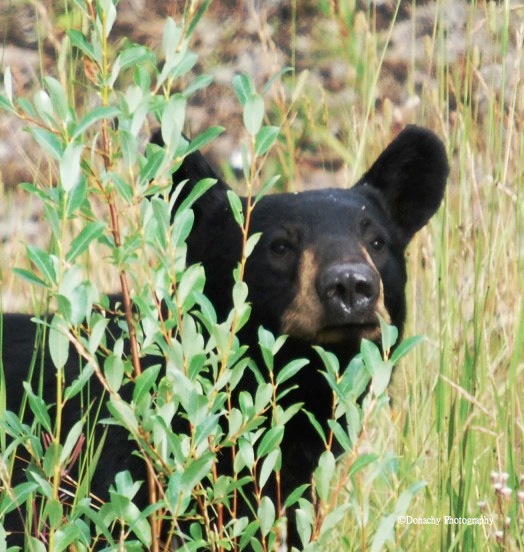
Travelers are bound to see bears – boars, sows and cubs – as they travel along the Al-Can.

Stone Sheep ewes take in salt or other minerals near Muncho Lake, British Columbia. Notice the lamb with the third ewe. Meanwhile, other lambs watch their mothers from the safety of a nearby slope.

For us, the drive to Alaska was the fulfillment of lifelong dreams. I used to pore over my grandfather’s back issues of Field and Stream and Outdoor Life, devouring anything and everything written about the Canadian and Alaskan wilderness. For both of us, the experiences we had on this trip exceeded our imaginations.

Less than a year later, we would be saying goodbye to friends in Sacramento and leaving behind our beloved E Street craftsman bungalow, a yard full of orange, lemon, grapefruit, lime, apple, cherry, peach and pear trees, and our long runs along the beautiful American River. We’d be trading our patch of raspberries for wild cloudberries, our fresh tomatoes for canned.

When we first got our C-Dory, we envisioned weekends to Bodega Bay and other ports along the California and Oregon Coast. We never imagined it would take us all the way to Alaska and a new life.

The C-Dory has a cuddy cabin that comfortably sleeps two, a small dinette in the cabin, and an amazing amount of storage. A dependable Coleman stove served as our gas range.

Arctic Spring

Hand stitched ugruk (bearded seal) skins cover the wooden ribs of this traditionally-crafted boat as it sits atop a rack in Point Hope, Alaska. With spring officially here (the Vernal Equinox was March 20), whaling season has begun. Whaling crews have been going out to break trail these past few days. This is rough going across the frozen, buckled landscape of the Arctic Ocean. 

Each Arctic day is lengthening by eight minutes, and the sun is shining with perceptible warmth as months of negative double digit cold gradually give way to highs approaching an even zero degrees Fahrenheit. Although the seas continue to be locked up tight, that is how it should be this time of year. Once the trail is broken, the village’s two whaling crews will set up their camps far out on the ice near open water, where, with boats stitched together from the skins of bearded seals at the ready, men dressed in warm, white parkas will wait and watch.

A small skiff seems to await the Chukchi Sea’s thaw.

Last year, three whales gave themselves to the village. That is the way people here say it. Animals are not “killed.” They give themselves, and for a whale to give itself, the hunters’ skill, preparation and worthiness must all come together. Point Hope is one of the oldest continuously inhabited settlements in the Americas. Perhaps the oldest. Here, the unique interplay of sea and river, hills and tundra bring salmon, char, seabirds, caribou, whales and even berries to the inhabitants. Compared to many other villages, the people of Tikigaq (Crooked Finger – so named for a narrow thrust of land at the tip of the peninsula that long since eroded away) have seldom had to go far for food.

The whales are bowheads, a right whale. These baleen whales may weigh 30 tons or more. Occasionally ivory, slate and jade harpoon heads of old are discovered buried deep in a whale’s blubber, indicating that they have a lifespan of at least 150 years. Although commercial whaling in the 1800’s pushed populations to near extinction, they have gradually recovered and numbers in the Chukchi Sea continue to grow by about 3% each year to over 10,000 currently.
Inuit artist Kenojuak Ashevak’s painting (above) depicts the circle of Arctic seasons. Her painting shows open water for less than half of the year.

When we leave the village in mid-May to spend our summer further south in Alaska, much of the tundra and the Chukchi Sea will still be locked in ice. When we return in mid-August, the tundra will be carpeted in shades of green, some of it already giving way to Autumn’s gold. In high summer, flowers bloom in profusion, but by August, most will be done. Berries – cloudberries, cranberries and crowberries near the village, joined by blueberries further out – will follow. Waves will tumble on the shore as though the ice never existed, and salmon and char will be swimming in the clear-green water.