Eureka!

Japanese Glass Fishing Floats
Hokkaido, Japan, July 16, 2018

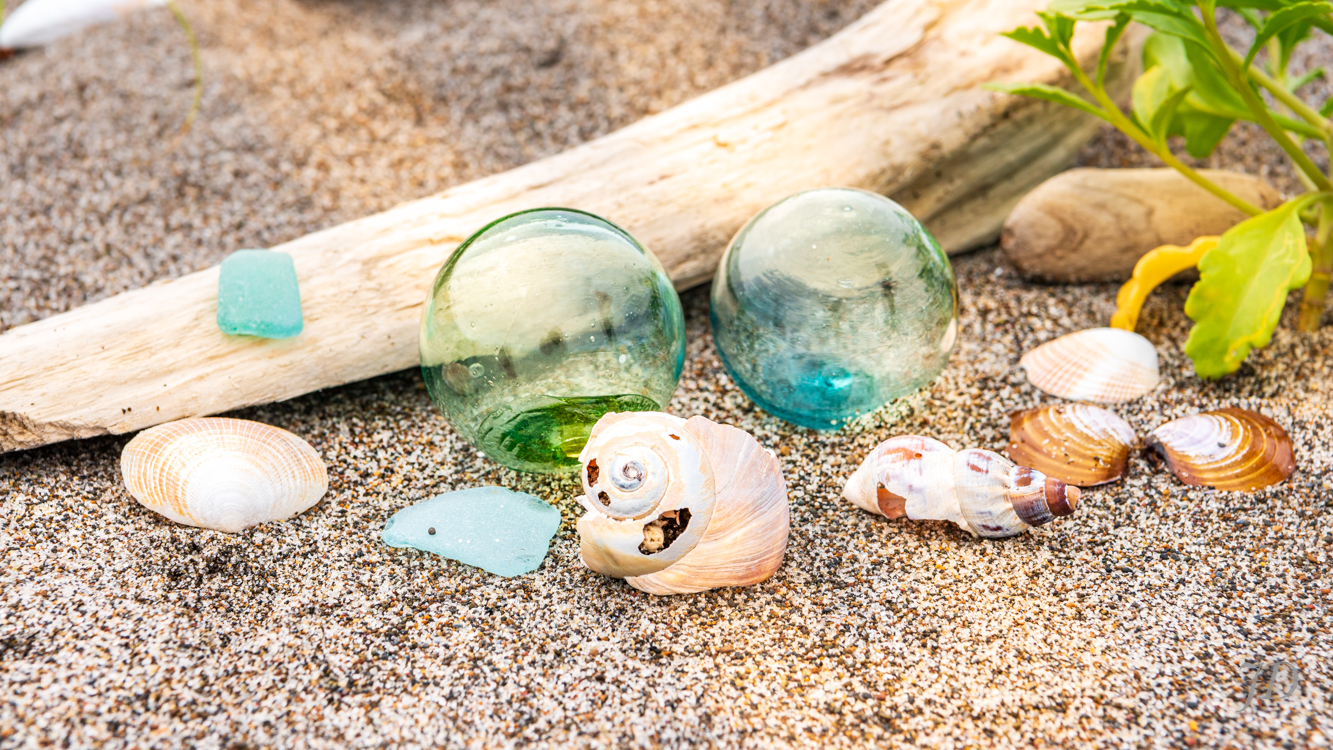
The summer I turned nine I encountered my very first Japanese glass fishing floats. I was in Oregon, and in addition to populating gift shops and restaurant decor, back then these mystical treasures still occasionally washed up on Oregon’s beaches, particularly after big winter storms. That summer I concluded my 13th consecutive reading of Call of the Wild, and Treasure Island and Robinson Crusoe were still fresh. My mind was filled with dreams of faraway lands. The floats, hand blown by craftsmen, fragile, beautiful, traveling across the vast Pacific over decades and thus providing a link not only with the exotic country of Japan but also with ships and fishermen and a culture of yore were utterly captivating.

Over the years, we’ve been gifted a collection of these floats from friends lucky enough to have lived along one of the few beaches where they still wash up. The gifts are appreciated… but it’s not the same as finding one myself. From California to Alaska, in all the years since that Oregon summer I’ve never visited a beach without harboring vague hopes of finding one.

Somewhere past the town of Shari (斜里町) as we approached the Shiretoko Peninsula, we stopped at a beach to have our breakfast and watch sport fishermen cast into the surf for Cherry Salmon.

Barbra found the first one. My stomach turned a little… conflicted. Happy for her find, but disappointed that it hadn’t been me. But where there’s one… maybe… Planting my feet where she found that first float, I scanned every inch of the beach through binoculars. And then, without a word, I handed the binoculars to Barbra and took off, running with all the joy of a young boy turning nine.

He Ain’t Comin’

He Ain’t Comin’

I made this image from a picture I took at Mokoto Train Station in Hokkaido when I looked up into a mirror above the waiting platform and saw Barbra there looking at her phone. There’s something about the scene – populated with houses and rail, and yet eerily empty – and Barbra, alone, looking at her phone -, that seemed to imply something universal about loneliness and the fine line between expectation and disappointment. Compositionally, the frame within the frame here appeals to me… as do… exotic elements such as Barbra’s bright red hair, Japanese writing and the ambiguity suggested by rail that appears to be rusted and perhaps no longer in use.

I am happy to acknowledge the influences of others… here a nod to Stefanie Schneider and her Instant Dreams series, which I invite readers to check out on Instagram or elsewhere. I’m not sure that there isn’t a hint of the old Twilight Zone TV series in this image as well… I think virtually all of us of a certain generation carry within our psyches some lingering effect of Rod Serling’s creation.

Speaking of which… as I attempt to build more exposure for my own work, I’ve been regularly posting on instagram. At some point, I intend to build a website dedicated to photography. Until then, Instagram is a good place to see photographs in one place without needing to click around a lot. If you’re interested, here’s the link: jackdonachy. Be sure to leave a “like” if you like what you see. Thanks!

Teuri Campground… and a note on AI Lens Blur

Thursday Morning Coffee Bar, Teuri Island Campground
Teuri Island, Hokkaido Japan, June 21, 2018

Clean restrooms close by (to answer the first question on the minds of most casual campers), good clean drinking water, quiet, and the entire grounds to ourselves. I don’t imagine that the camping situation has changed much since we visited Hokkaido in 2018. Traveling to Teuri with our bicycles was easy via the ferry from Haboro on Hokkaido’s west coast. We only spent two days on Teuri, but agreed we could easily have enjoyed a week on this small, bird-rich island.

Scrolling down panels in lightroom as I brought up the above photograph, I decided to give a relatively new feature a try: Lens Blur. With a single click, this AI-driven feature isolated what it interpreted to be the subject and foreground and then blurred (decreased the clarity) of the background. It worked well – which is to say, I liked the result.

To be sure, a more competent photographer equipped with the right lens could easily have achieved similar results in-camera. But six years ago when I captured this image, I was a less competent photographer. Less competent not only from a technical standpoint, but also my eye was less well developed, and so I didn’t always appreciate the pleasing effect a bokehed background could add to a photograph.

While I could have used masks and clarity sliders to isolate the subject and achieve the same effect, this Lens Blur feature significantly speeded up the process. So…

I might have more to say about AI technology in future posts. It’s here, part of our world now. Lots to think about. JD

Teuri Island: The Place to be for Rhinoceros Auklets

Rhinoceros Auklet Breeding Grounds, Teuri Island
Hokkaido, Japan, June 18, 2018

Not a lot appears to be going on in the above daytime photograph taken on Teuri Island’s cliff-lined northwest. The 2.1 square mile island (5.5 square km) hosts the breeding grounds for several species of birds, most notably seabirds. The holes in the above photograph are the burrows of Rhinoceros Auklets, a species for which Teuri serves as the world’s largest breeding ground.

While it doesn’t appear that much is going on in the photograph – a few gulls milling around notwithstanding – at the end of each burrow, which may be up to six meters (20 feet) in length, a Rhinoceros Auklet chick is waiting for twilight when parents will return from the sea, stomachs, gullets and bills crammed with catches of sand lances and squid. Gulls – primarily Slaty-backed which also breed on the island – will intercept some of the returning adults, but most will make it past the parasitic phalanx. Recent estimates put the auklet population at around 400,000 breeding pairs. Add in the chicks and the species count rises to over a million. Perhaps you can imagine the sight and the cacophony as night gathers and hundreds of thousands of adult auklets return, evading squawking gulls, somehow locating the specific burrow each parent calls home.

Teuri is also an excellent place to see Spectacled Guillemots, Common Guillemots and other seabirds as well as passerines such as Blue Rock Thrushes and Siberian Rubythroats. Regular, bicycle-friendly ferries from Haboro make it easy to get out to the island, and if you don’t choose to stay at the lovely campground (which you’re likely to have to yourself) there are wonderful inns offering comfortable accomodations and truly some of the world’s best fresh seafood.

Along the Herring Highway

Herring House (Nishin Goten)
West Coast of Hokkaido near HaboroJune 17, 2018

Somewhat paralleling the boom and bust of America’s west coast sardine/herring fishery (see Cannery Row), in the late 1800’s through the early 1900’s, fortunes were made and lost on the back of Hokkaido’s west coast herring fishery. The building in the above image is a Nishin Goten, a communal house for the herring fishermen of that era. Inside are the captain’s quarters, other areas where fishermen and other employees (I’m assuming the fishermen’s wives who were vital in processing the catch) could roll out their futons. Such houses featured a kitchen, a place to store slippers (in those days woven from grass) and a bit of furniture. These days, several Nishin Goten are preserved and open to visitors – well worth a stop if you’re traveling Hokkaido’s west coast along the famed Herring Highway.

Toya-ko Campground

Lake Toya Campground
Hokkaido, June 7, 2018

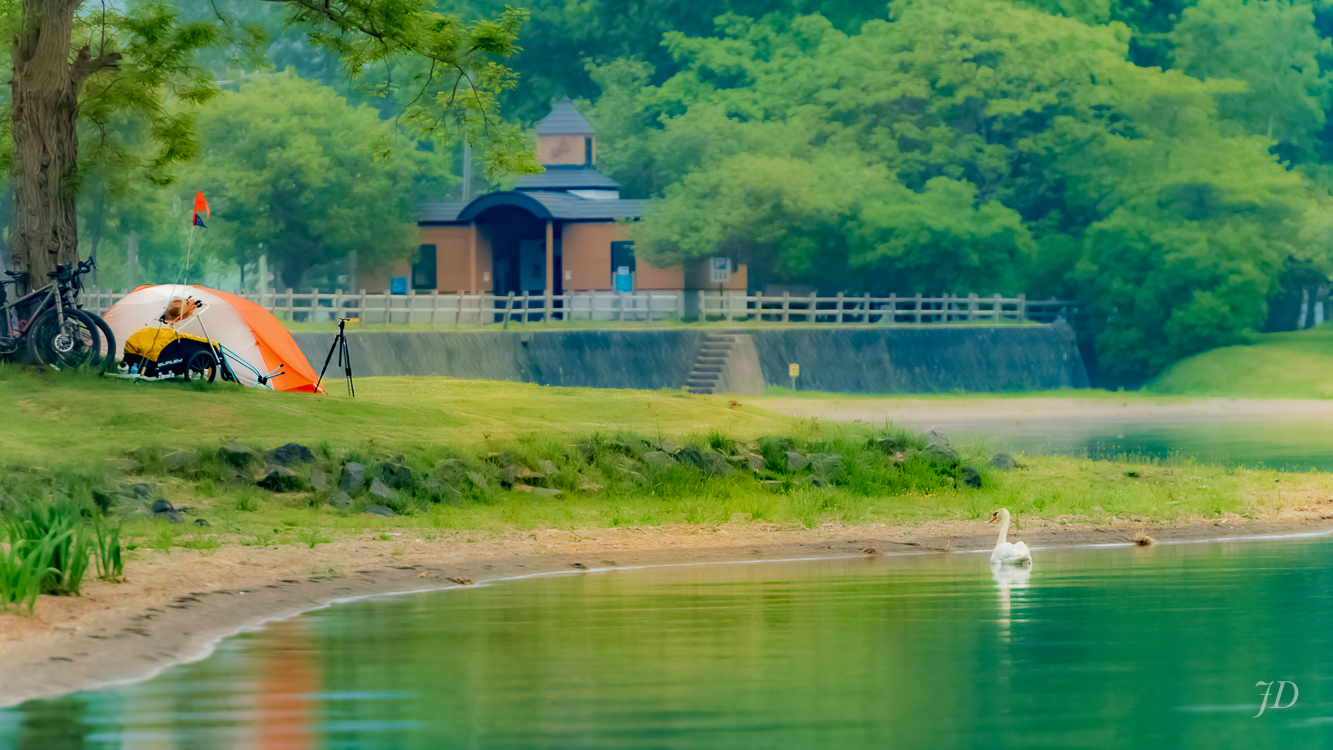
We found one terrific (often idyllic) campsite after another during our Hokkaido trek. Above is Nakatoya Campground on the shores of Toya-ko (Lake Toya). The lake formed in an ancient volcano caldera, complete with an island near the center – similar to Oregon’s Crater Lake. Overall, Hokkaido’s campgrounds were quiet, clean, and inexpensive. In fact, several were free and if memory serves even the most expensive site was only about $20 (in 2018). Most ranged from five to 10 dollars per camper per night.

In the past, language might have been a barrier to traveling in Japan. I speak some Japanese, which was immensely helpful, but these days with language apps right there on your phone, most locals eager to assist well-mannered visitors, and a lot of printed material such as highway signs, menus, national park information and so on written in English, even language differences need not impeded a tour of this wonderful, lightly-visited island. On a latitude approximating that of Oregon and Massachusetts, summertime biking in Hokkaido is pleasant, particularly along the coast.

I had forgotten that I’d softened so many of these Hokkaido images… Dreamy summertime bike trek.

Seawall Foggy Morning with Fishermen, Hokkaido

Seawall Foggy Morning with Fishermen
Hokkaido, Japan, June 4, 2018

This photo is an early experiment with softening rather than sharpening an image… taken before I appreciated how important careful note-taking is… I think this is in the harbor of Hagino.

We arrived in Japan on May 28, spent three days in the Crown Prince Hotel in Chitose, Hokkaido getting acclimated – figuring out where we might purchase fuel for our camp stove, re-assembling our bicycles and so forth -, and then on June 1 we embarked on a 67-day, 1,300 mile bicycle-camping trek circumnavigating most of coastal Hokkaido. For both of us, the trek was a fulfillment of childhood dreams of a self-guided bicycle trek in a foreign country. It was quite possibly The Most exhilarating adventure either of us had ever undertaken.

I paid for a significant part of the trip when I published an article in Adventure Cycling Magazine, which if you’re interested you can find here. We also published several articles about this trip right here on Cutterlight. The easiest way to access those is to simply type Hokkaido in the search box in the upper right of any Cutterlight page.

As I go through the 1,342 photographs from this trip (that’s after the initial culling), I’m not sure how many new images I’ll have to post. But I will underscore the feeling Barbra and I came away with after the trip. Go! If you’ve ever thought that a bicycle trek is something you might want to experience – think back to when you were 12 or 13 or 8 or 58 and riding in a car passed a couple or a small group of bike trekkers and wondered what it was like… wondered if you could do something like that – our answer is Why not?

Bicycle Trekking in Hokkaido, Japan – Vlog 1: Coasting into Shiraoi

In keeping with my goals for 2019, in addition to putting in time toward 500 hours of guitar practice in hopes of finally learning to play, I have just completed the second of five articles for magazine publication. The first article was a salmon-centric piece about life here in Chignik Lake. The second article was an introduction to our 65-day, 1,300 mile bicycle trek in Hokkaido, Japan last summer. While putting the article together I came across a few GoPro videos I’d nearly forgotten. One of those videos is below.

So what makes Japan’s northernmost island a nearly perfect bicycle trekking destination? Great food, clean inexpensive campgrounds, courteous motorists, abundant wildlife, rolling farmland, beautiful seascapes, terrific people, opportunities for hiking, fishing and even hot-air ballooning. The icing on the cake is bike rides like this! Leave a “like” and a comment or question. We’ll be posting additional video material from our Hokkaido Trek, so hit “follow” to make sure you don’t miss the next one!


xx

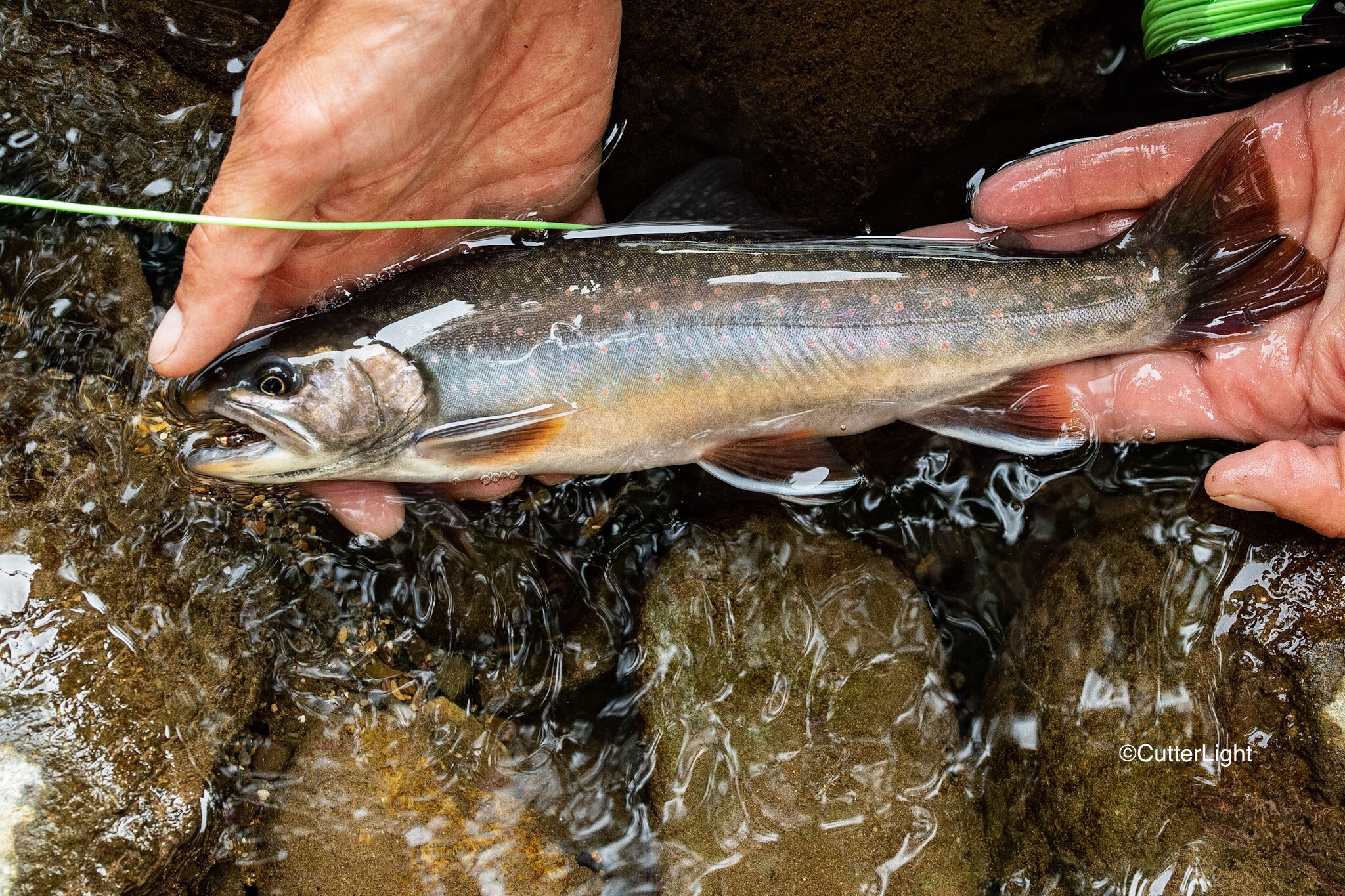
Knee Deep in Trout and Char (somewhere in Hokkaido)

Iwana (Dolly Varden Char) are one of Hokkaido’s most celebrated cold-water fish.

I have an incurable habit of looking into water for fish. It doesn’t matter what kind of water. At the beach I check the translucent prisms of waves for whatever might be cruising the surf. Coming upon pools on rivers during hikes I make efforts to position myself so that I’m looking into shade rather than glare so that I can maybe catch a glimpse of something with fins. I’ll even check out coin fountains in the off chance that a carp or even a goldfish might be swimming around. But bridges on quiet country roads crossing pretty little trout streams are especially inviting. There’s almost always a pool below the bridge, and if the water has a population of trout, there are often a few of them hanging out right there. No matter how hard-fished the water might be, it’s worth a look.

Yamame could literally be translated as “Mountain Girl” – a lovely name for a lovely fish. More commonly the stream-dwelling form of this species is called “Cherry Trout.” Similar to Cutthroat and Rainbow Trout of the Pacific Northwest, (to which yamame are related), some go to sea where they attain sizes measured in pounds and return to their natal rivers to spawn bright as polished chrome – Cherry Salmon.

And so there we were, mid-afternoon, straddling our bikes and leaning over the the concrete side of a bridge on a quiet road running through a mix of forest and farmland somewhere in Hokkaido. The water was perfectly clear, but the trout and char are so adeptly camouflaged to match the stony bottoms of these streams that unless one moves they are all but impossible to pick out. 

One moved. As it rose to take something off the surface I could even see its spots. A char of some type. I hadn’t done any fishing yet in Hokkaido. This fish was telling me it was time I did.

I didn’t expect the fish to be large and they weren’t. But in the space of about two hours I covered a couple hundred yards of this silvery mountain stream and caught two dozen or so fish  About half of them were iwana. The others were yamame. A few came to a parachute Adams – my favorite dry fly searching pattern. A lot more came to a pheasant tail nymph – my favorite nymph. A couple of overly eager types tried to eat the pea-sized orange strike indicator I was using. 

A younger version of myself would have kept a few of these fish for the frying pan. But these days I fish for trout in part to simply confirm that they are present, and I wanted these fish to remain present. So Barbra took a couple of photos and I released everything to continue living out their lives in this silvery piece of water and light somewhere in Hokkaido.

There wasn’t a single human footprint along the banks, much less a path. Knee deep in a cold mountain stream full of trout and char – sitting on top of the world, legs hanging free.

First Stop in Hokkaido – Don’t Miss Beautiful Chitose!

A mosaic of farmlands on the flight into Chitose evoked visions of fresh melons, strawberries, cherries, wines, cheese, and Hokkaido’s famous beef.

Although the city of Chitose, which lies just south of Sapporo, is generally seen as merely an airport stop, it’s a charming city in its own right. We found it to be the perfect place to stage and prepare for our trek around Hokkaido. The local Homac store sells butane camping stove fuel, there’s a beautiful green belt, and – as just about everywhere in Hokkaido – excellent restaurants.

A depiction of the Sapporo Beer Brewery paves the sidewalk outside the Chitose airport.

We quickly discovered that convenience stores such as 7/11 and Lawson are not only convenient (they all have restrooms… clean restrooms), but they feature very good coffee and a variety of tasty prepared foods to quickly fuel up hungry bicyclists. 
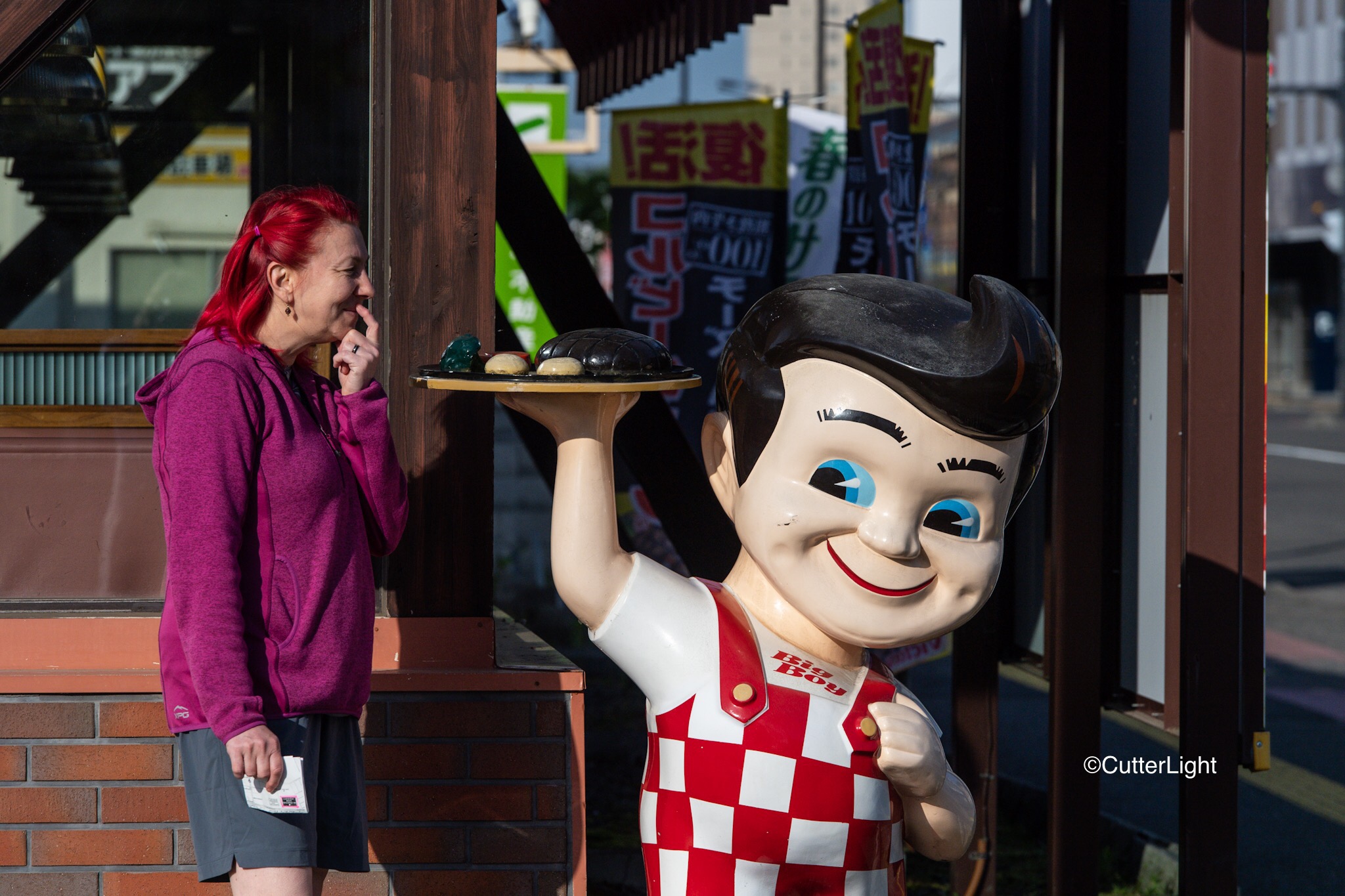
Bob!? Is that you? We hadn’t seen this character since we were kids… Either we were a lot smaller or he was a lot bigger back then. American-style hamburgers have not been on our menu… and I really didn’t care for the way he was looking at Barbra.

A passerby who works with one of the international airlines that frequents Chitose stopped to talk with us as we assembled our bicycles outside the hotel. He recommended the restaurant Ramai, which specializes in curry soup. Chock full of chicken and vegetables and exceptionally flavorful, we enthusiastically pass along the recommendation.

Keen to check out Hokkaido’s young and growing wine industry, we found Grace Winery open for tasting…

…in addition to haskap berry wine (also known as honeysuckle berry), the winery features whites and reds of German origin as well as Pinot Noir. The grapes at this winery were grown in the Yoichi area, which provided all the incentive we needed to make sure that Yoichi would be a stop on our trek!

At the the Chitose Aquarium (well worth a visit) we had our first encounter with Ainu culture. The Ainu are indigenous to Hokkaido and northern Japan, sharing many traditions in common with the indigenous people of the Pacific Northwest. Here salmon skin footwear is displayed. 

Rare and endangered, Itou (Japanese Huchen) are a close relative of taimen – the world’s largest salmonid species. Growing to over a meter in length, there are still fishable populations in some of Hokkaido’s waters, though catch and release is strongly encouraged if not the law of the land. 
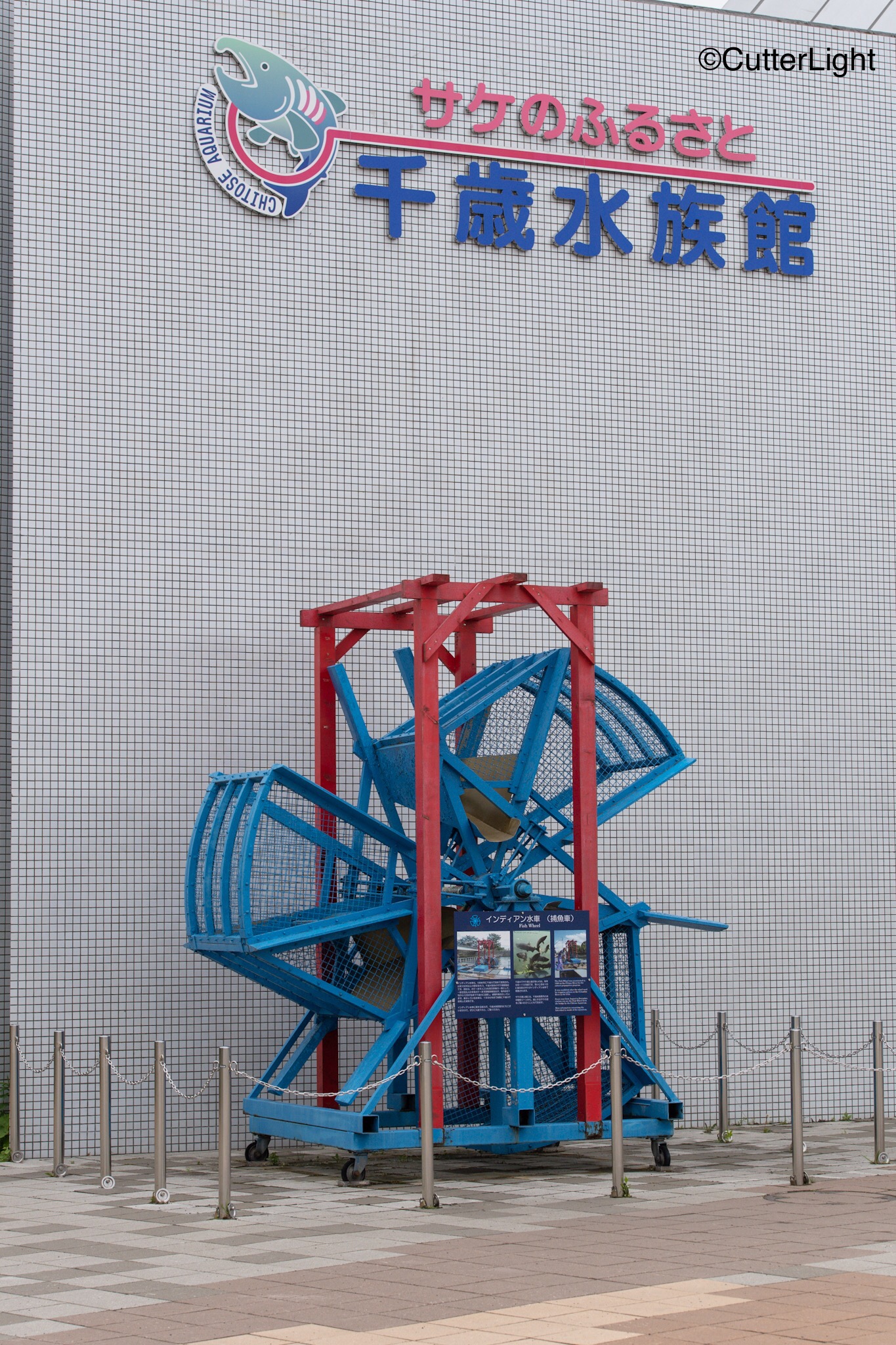
The Chitose River is remarkably clean and clear despite running through an urban area. It receives a strong run of Chum Salmon, which each fall are caprtured by this Pacific Northwest style fish wheel for the local hatchery. In late spring and early summer, visitors to the aquarium can participate by releasing a cup’s worth of salmon fry into the Chitose River, giving them a bit of ownership in maintaining healthy populations of salmon and a healthy river.

Caddisflies and May Flies were coming off the river the morning we walked its banks.

These angles caught a brown trout – right in the heart of the city!

While this colorful finch sang his heart out.

Although the cherry blossom were finished, Azeleas were still in glorious bloom – including colors we’d never before seen. Across the river, an aosagi (gray heron) is perched on a rock, no doubt anticipating making a meal of the many Japanese Dace that populate the river.
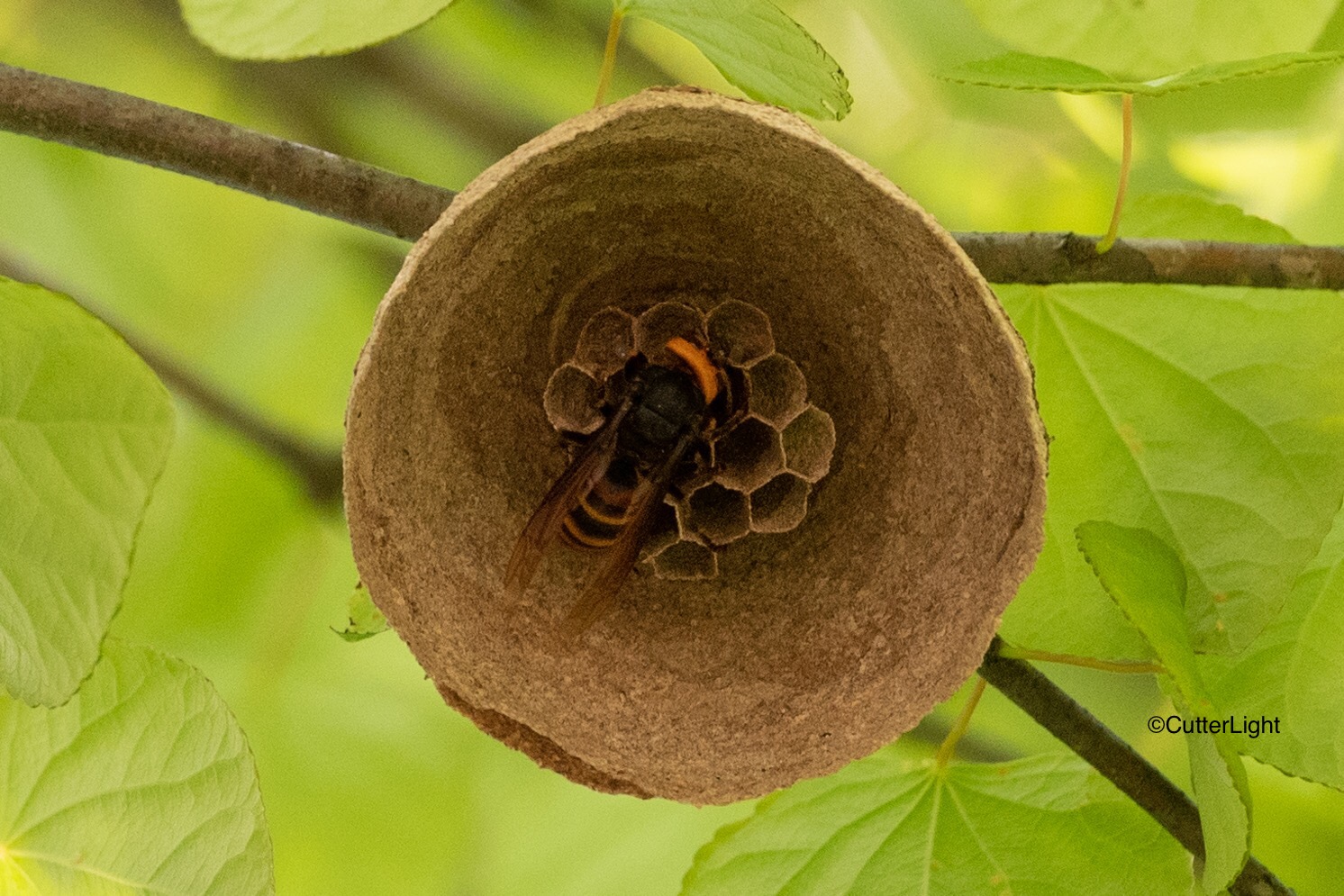
Although the Japanese express great concern regarding the several hundred higuma (brown bears) that inhabit the island, of far greater danger are the huge suzumebachi (Japanese Giant Hornet) which account for a number of deaths each year in Japan. We found this one beginning a nest and uneasily got this capture before backing off.

We enjoyed a wonderful, stress-free stay at the Ana Crowne Hotel in Chitose. Hotel staff were extremely accommodating to our unusual needs – even allowing us to store our large bicycle boxes with them until our return in August.