Birds of Chignik Lake: Ring-necked Duck – a Species Moving Northward?

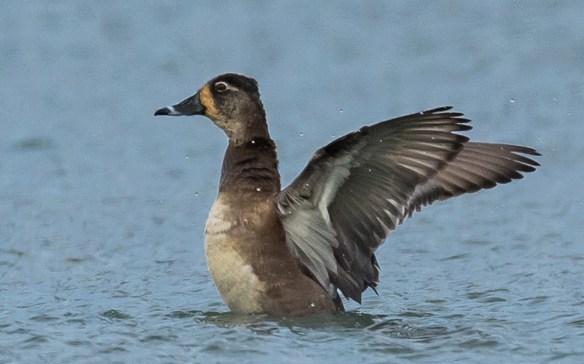
A female Ring-necked Duck stretches her wings on Chignik Lake. (January 8, 2016)

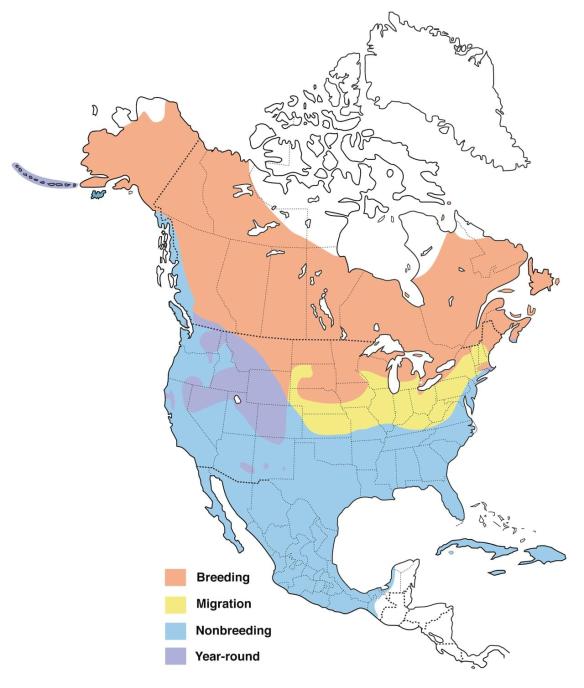
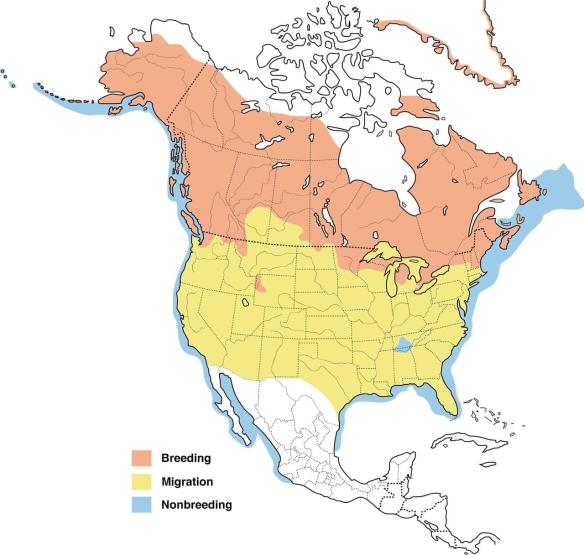
This is a species that may well be expanding its range north. According the several range maps I consulted, including the Birds of the World map below, Ring-neckeds shouldn’t be here with any regularity. It is true that they’re fairly rare on the Alaska Peninsula, but they’re definitely here, and the appearance of pairs in resplendent plumage in late winter and early spring suggests that they’re breeding on the peninsula – or perhaps at points even further north.

The “ringed neck” of the Ring-necked is generally not visible in the field. Apparently it shows better on dead specimens, which were the referents early scientists used when naming this species. Look instead for a distinctively black-tipped bill, a tall head (often showing purple) and a neck that appears rather long compared with most other ducks. In a bit different light, the white ring at the base of this drake’s bill would show plainly, hence one of the alternate local names for this duck, “Ring-billed.” (Chignik Lake, January 7, 2016)

The overall appearance of both male and female Ring-neckeds is similar to male and female scaup. We found that it often paid to carefully glass flocks of scaup when looking for this species. Their bills give them away.

Mousy-gray winter light generally isn’t what I’m hoping for, but here it helps show the distinctive ring at the base of this drake’s bill. Note the peaked head and the scaup-like side.

Although we sometimes saw Ring-neckeds come up from a dive with a billful of aquatic vegetation, it was difficult to determine what they were eating. The weeds, certainly, but very likely whatever invertebrates and small fish that might be mixed in with those weeds as well. Opportunistic feeders, it is reported that Ring-billeds gather in the hundreds of thousands to feed on wild rice in certain Minnesota lakes.
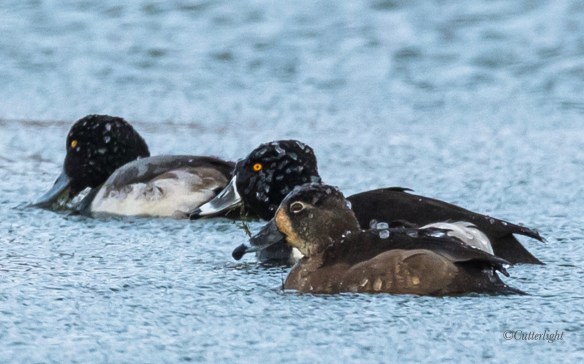
You’ve got to tip your hat to ducks for their hardiness. From front to back: A female Ring-billed, male Ring-billed, and a male Greater Scaup dive for aquatic weeds while ice accumulates on their feathers. (Chignik Lake, January 8, 2016)
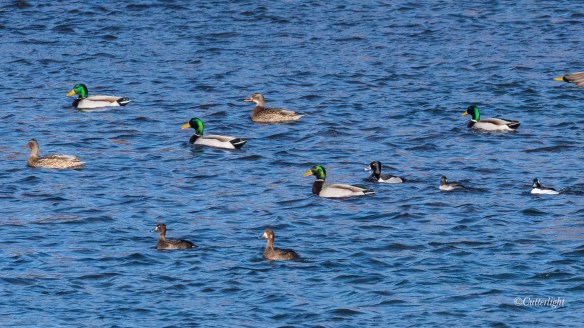
This photo offers size comparisons among various ducks: male and female Mallards, male and female Buffleheads, male and female Ring-billeds and a female scaup. (Chignik River, March 14, 2017)

This is a species to watch in terms of range. Maps may look different in the not-too-distant future as conditions on our planet continue to change.

Ring-billed Duck Range Map: with permission from The Cornell Lab of Ornithology, Birds of the World

Ring-necked Duck Aythya collaris
Order: Anseriformes
Family: Anatidae
Aythya: from Ancient Greek, a term used by Aristotle believed to describe a duck or seabird
collaris: from Latin for neck or collar

Status at Chignik Lake, 2016-19: Occasional to Regular late Fall, Wintertime and Spring Visitor, but rarely more than two at any one time. Often in flocks of Scaup.

David Narver, Birds of the Chignik River Drainage, summers 1960-63: Not Reported

Alaska Peninsula and Becharof National Wildlife Refuge Bird List, 2010Rare in Spring, Summer and Fall; Absent in Winter

Aniakchak National Monument and Preserve Bird List: Not Reported
loon silhouette

Previous Article: Greater Scaup

Next Article: Tufted Duck – Rare Eurasian Visitor 

*For a clickable list of bird species and additional information about this project, click here: Birds of Chignik Lake

© Photographs, images and text by Jack Donachy unless otherwise noted.
Ice Changes Everything – Wintertime Life on the Frozen Chignik

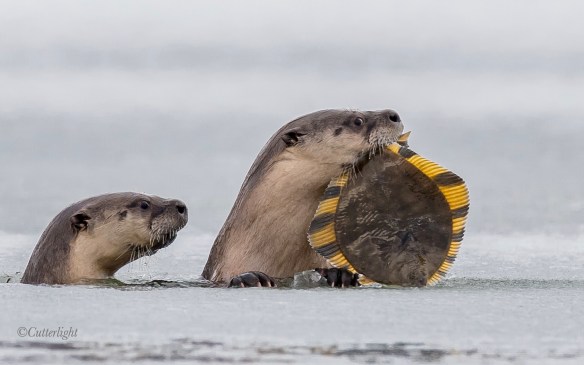
While River Otters are generally gregarious, playful sorts that get along beautifully, it’s hard not to project a twinge of envy on the otter to the left. Starry Flounder travel from the saltwater lagoon miles up The Chignik. Winter ice provides a lucky fisherman with a dining table. (Chignik Lake, February 2, 2017)

Clad in a 600-fill down parka, camouflage snow pants, insulated Muck Boots, a warm hat and heavy-duty mittens stuffed with hand warmers, I continue bellying forward on slick, solid ice toward a patch of open water near the lake’s outflow. With nearly effortless nudges from me, the tripod where my camera with its great, big wildlife lens is mounted slides before me. I’ve been at this since first light, moving slow and low. As careful as I’ve been, the otters have already taken notice. An assemblage of Greater Scaup, Common Goldeneyes, two species of mergansers, Canvasbacks and other waterfowl are either hauled out and resting on the edge of the ice or diving the frigid water for fish, clams and aquatic weeds. A pair of Bald Eagles perched on utility poles are taking in the scene, and I’m sure there are foxes – and maybe even a wolf or two – on patrol somewhere in the vicinity. Now I’m close enough to hear the otters snorting, breathing and crunching the bones of the fish they’ve caught. A pair of harbor seals pop their heads above water, survey the goings on, and quietly resubmerge.

Ice creates both new opportunities and new perils for the various species of the Chignik System. Here Skit, one of several Red Foxes we saw frequently enough to name, barely misses out on a sumptuous repast of Common Goldeneye. (Chignik Lake, February 3, 2017)

In early January of 2017, something happened to Chignik Lake that by local accounts used to happen nearly every winter but hadn’t happened in the past five years: save for a a couple of surface acres near the outflow, it froze solid. Over the ensuing days and weeks, while upwelling subsurface springs continued to keep the water near the outflow open, the lake ice grew thicker and the river itself froze in most places. For humans, foxes and wolves, the effect was to create an ice highway. The impact on waterfowl was to concentrate whatever birds remained in the system into the few patches of open water.

The more or less official book on the Chignik System is that Red-breasted Mergansers are common, and that Common Mergansers are uncommon or rare. While that tends to be true during summertime, we found that during wintertime, particularly during icy winters, Commons (above photo) greatly outnumber Red-breasteds and were in fact, common. Aside from research pertaining to salmon (and to a certain extent, Dolly Varden Char), the Chignik Drainage has been only lightly studied. Each new puzzle piece adds to a fuller picture of this complex ecosystem. (Chignik Lake, March 14, 2017)

As wintery conditions set in, scaup begin to show up on the lake, at times in flocks counted in the dozens. In the 2016-2017 winter, when the lake froze, scaup were fairly abundant. During the relatively mild 2018-2019 winter, scaup occurred less frequently and in smaller numbers. (Chignik Lake, January 3, 2017)

Icy conditions tend to concentrate any remaining waterfowl, making it a good time to look for less common or even rare birds. In a pocket of open water on the Chignik River, three female scaup (facing away from the camera), mill about with a fairly uncommon drake Ring-necked Duck (right) and, in the lower left, a somewhat rare visitor from Asia, a female Tufted Duck. 

Ice changes relationships among animals and creates new theater. I watched for several minutes as this River Otter used his catch (a flounder) to taunt a pair of eagles. The drama ended when one of the eagles took wing and made a half-hearted attempt to catch the otter, a maneuver the sleek fellow easily avoided by slipping back into the water. Resigned, the eagles flew off and the otter gnawed away at his catch. (Chignik Lake, January 25, 2017)

There always seem to be at least a few Harbor Seals somewhere in the freshwater lakes and river of the Chignik System. Here, a group haul out on ice to catch some rays. Events such as this are no doubt of great interest to the area’s wolves, as occasionally the pinnipeds get trapped on solid ice with no escape route. The foreground birds are male Common Goldeneyes – menaces in their own right to local sculpin and stickleback populations. (February 3, 2017)

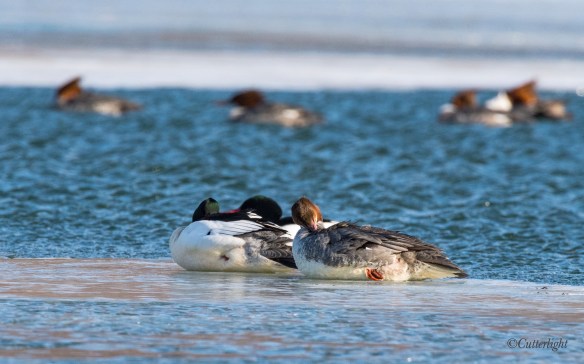
Some of the preceding photos might give one a less than accurate picture of wintertime at The Lake. Chignik is an Alutiiq word meaning “Big Winds,” a suiting epithet. Weather bullying its way from one side of the Alaska Peninsula to the other can be formidable. Here a group of female Common Mergansers hunker down on an ice point to wait out fierce winds and snow. (January 6, 2016)

A Pacific Loon shakes of snow out on The Lake. (January 13, 2018)

As wintertime conditions change in coming years, those of us interested in wildlife of all kinds will want to keep our eyes sharp for commensurate changes in flora and fauna. In this global study, the role of citizen scientist has never been more important. Every well-documented backyard feeder, walk along local trails, and note of what is – and isn’t – nesting in hedgerows and elsewhere is a unique, vital data point.

loon silhouette

Previous Article: Birds of Chignik: Green-winged Teal – Bantam-weight Duck

Next Article: Greater Scaup

*For a clickable list of bird species and additional information about this project, click here: Birds of Chignik Lake

© Photographs, images and text by Jack Donachy unless otherwise noted.

Birds of Chignik Lake: Green-winged Teal – Bantam-weight Duck

The Chignik watershed’s smallest and wariest duck, a flock of Green-winged Teal take flight near a group of islands where in fall they can often be found – but not easily approached. It is likely that they are in the same location in early spring as well. (September 22, 2018)

I never got more than a distant look at the Chignik’s Green-winged Teal. There is a group of gravel islands, some carpeted with willows and other vegetation, where they could reliably be found in fall. But they typically hung out on the downriver side of the islands. Approaching them, Mallards, mergansers and other upriver birds invariably flushed first, sending a rippling alarm downriver to the teal. A passing eagle had the same effect. The behavior always surprised me, as in other locations I’ve found teal to be fairly approachable.

The only occasion when I got even remotely close to these little ducks was one day when I was photographing bears and not paying much attention to the birds. Out on one of the islands, when I turned around these two Green-wingeds were there. I got the above shot, but they did not permit even one step closer. It is no doubt their reputation as a gourmet’s delight that prompts their wariness. (September 24, 2018)

Measuring just 14 inches from tip to tail and weighing an average of only ¾ pound, North America’s smallest duck is astonishingly quick to take wing. Herbert K. Job asserts that “From the culinary standpoint, surely there is nothing more luscious in the realm of waterfowl…,”1 which may explain the celerity with which they become airborne at any sign of danger. At parks and reserves where they aren’t hunted, teal can be considerably more approachable.

Green-Winged Teal, Birding Center, Port Aransas, Texas. Photo posted in Wikipedia by Alan D. Wilson – NaturesPicsOnline

1Birds of America, T. Gilbert Pearson, ed., Garden City Books, Garden City, New York, 1917

Green-winged Teal Range Map: with permission from The Cornell Lab of Ornithology, Birds of the World

Green-winged Teal Anas crecca
Order: Anseriformes
Family: Anatidae
Anas: from Latin for duck
crecca: from Swedish kricka = a local name for teal

Status at Chignik Lake, 2016-19: Common in Fall; Probable Spring & Summer

David Narver, Birds of the Chignik River Drainage, summers 1960-63: Common on Black River and most streams; rare on the lakes

Alaska Peninsula and Becharof National Wildlife Refuge Bird List, 2010Common in Spring, Summer & Fall. Absent in Winter

Aniakchak National Monument and Preserve Bird List: Presence Documented

loon silhouette

Previous Article: American Wigeon – America’s Most Vegetarian Duck

Next Article: Life on the Frozen Chignik

*For a clickable list of bird species and additional information about this project, click here: Birds of Chignik Lake

Birds of Chignik Lake: American Wigeon – America’s Most Vegetarian Duck

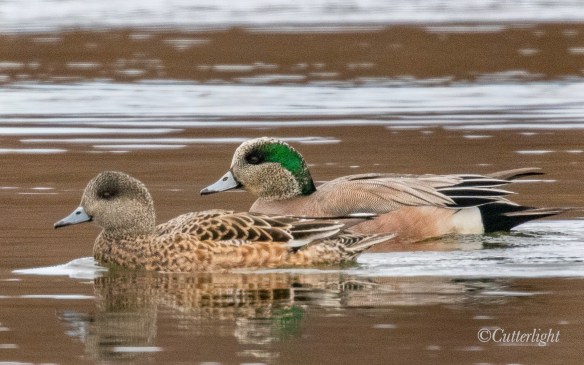
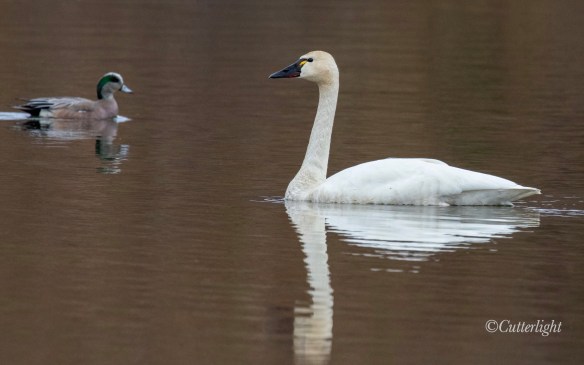
American Wigeons are a typical part of the the spring duck mix on The Chignik. This pair, along with another male, were hanging tight with a pair of Tundra Swans as they fed at an eddy favored by waterfowl. (May 4, 2019)

The first wigeons I ever encountered were of the Eurasian variety – back when I lived in Japan. On my way fishing, I’d often stop my bike on a bridge above Hiratsuka’s Hanamizu River. I wasn’t much of a birder back then, but the teal, wigeons, shovelers, mallards, pintails, egrets, and herons that gathered in the pools and riffles below the bridge fascinated me. At times, a shrike would put in an appearance as well. But sea bass, fluke and other species swimming the nearby coastal waters beckoned, and so I seldom lingered long. These days my priorities have shifted and I carry with me the small regret that I neglected to photograph the river’s kawasemi – glimmering aqua-and-orange plumaged Eurasian Kingfishers.

American Wigeon drake, Chignik River, Alaska. Wigeons are well-known food thieves, mixing in with other ducks and stealing food right from their bills. (May 4, 2019)

I don’t recall seeing American Wigeons until I lived at The Lake, but during breeding the male’s white crown-stripe framed in iridescent green makes this species unlikely to be mistaken for anything else. “Baldpate,” they are named in my copy of Birds of America1an unfortunate epithet for this handsome fellow. The same text gives an alternative common name as “American Widgeon” (with the added d) and the genus name Mareca which later became Anas and has since reverted back to Mareca, so nomenclature for this species has changed since that book’s 1917 publication.

Female wigeon, Chignik River. The most vegetarian duck, wigeons’ blue-gray bills are short compared with other ducks – an adaptation for pulling and breaking off tough vegetation. However, particularly during the breeding season, females take in more insects and other invertebrates. (May 12, 2019)

We generally encountered wigeons in pairs on the lake, on the river and on nearby ponds. As with other dabbling ducks, it is likely that breeding occurs at remote places in the drainage. It pays to listen for the male’s soft, whistling call when approaching likely habitat.

On the one hand, this drake in profile nicely shows the male wigeon’s cinnamon-brown flanks. On the other hand, he illustrates a point common to bird plumage: In this light, although photographed from several angles, his head showed none of the green wigeons in breeding plumage are known for. In different light, the shimmering green likely would have been obvious. In still different light, the stripe might take on a coppery-bronze iridescence. (May 12, 2019)

1Birds of North America, T. Gilbert Pearson, ed., Garden City Books, Garden City, New York, 1917

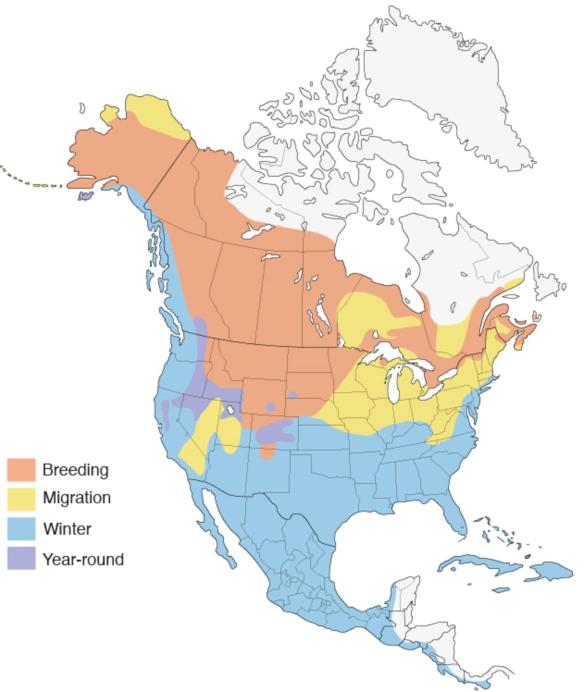
American Wigeon Range Map: with permission from The Cornell Lab of Ornithology, Birds of the World

American Wigeon Mareca americana
Order: Anseriformes
Family: Anatidae
Mareca: from Brazilian-Portuguese marréco = small duck
americana: of America

Status at Chignik Lake, 2016-19: Occurs regularly in Spring

David Narver, Birds of the Chignik River Drainage, summers 1960-63: Not Reported

Alaska Peninsula and Becharof National Wildlife Refuge Bird List, 2010: Common in Spring, Summer & Fall. Absent in Winter

Aniakchak National Monument and Preserve Bird List: Presence Documented

loon silhouette

Previous Article: Northern Pintail – The Dapper Dabbler

Next Article: Green-winged Teal – Bantam-weight Duck

*For a clickable list of bird species and additional information about this project, click here: Birds of Chignik Lake

Birds of Chignik Lake: Northern Pintail – the Dapper Dabbler

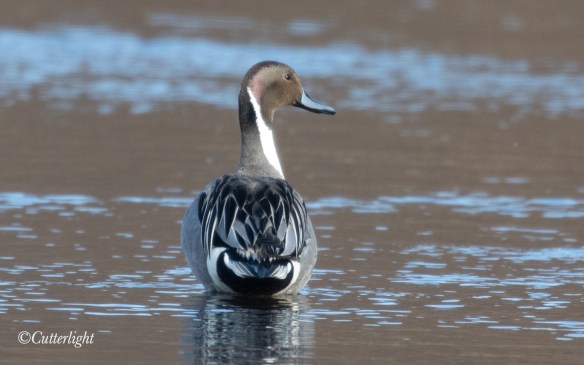
With glossy hints of purple and green highlighting a chocolate-brown neck and head, male pintails are downright regal. (Chignik River, May 2, 2019)

From the first time I encountered Northern Pintails, they became my favorite among the duck tribe. Perhaps it is that their slender, elongated features somewhat resemble my own. Or maybe I’m just plain envious of the drake’s handsome jacket and eye-catching head plumage. In any regard, while there certainly are more brightly-colored birds, it is hard to argue that any are more handsome.

This female and male arrived on The Chignik in late April and hung around for a few days. They appeared intent on nesting. Alas, it seemed that daily boat traffic eventually prompted them to look elsewhere. (May 2, 2019)

The case of the mated pair of pintails in the above photo gives one pause to wonder: In addition to deforestation, draining wetlands, depleting food sources, hunting, poaching, light pollution, pollution in general, and the various hazards presented by windowed buildings,  windmills and other structures, how much negative impact does human traffic in all its forms have on bird populations? The Chignik is relatively lightly traveled, and yet the impact motorized boats have on bird populations (and most likely, on Chinook Salmon populations as well) is readily apparent. The noise and commotion interrupts feeding, mating, nesting, and brood rearing as cruising boats set nervous birds to wing. Every burst into flight constitutes wasted calories. A nest left unguarded for even moments leaves eggs and chicks vulnerable to predation. Waves created by boats contribute to the siltation of weed beds and salmon redds and might even inundate nests along shorelines or situated on small islands. It has long puzzled me that in many locales, wildlife managers seem to take little to no account of this type of traffic.

Portrait of a Lady: With scalloped patterns in shades of gray and brown, female pintails are a beautiful bird in their own right. (May 2, 2019.)

The Chignik’s pintails can be observed in more or less the same seasons as other migrant dabbling ducks – from late spring through early fall. Anytime you see ducks standing or walking along the shore in these seasons it’s worth glassing for pintails as they often come off the water to rest or to look for insects, seeds and land plants.

In profile, the drake pintail’s long, almost gun-metal blue bill only further accentuates his sharp plumage. (May 2, 2019)

Although the upper river and Black Lake are beyond the scope of this study, we’ve seen pintails at those locations. It is almost certain that they nest along the shores of those quieter waters.

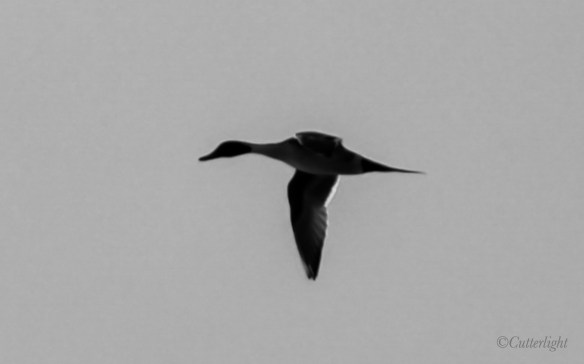
The long bill and eponymous tail make pintails one of the easiest birds to identify in flight – even in silhouette at considerable distance. (Shishmaref, Alaska, May 15, 2011)

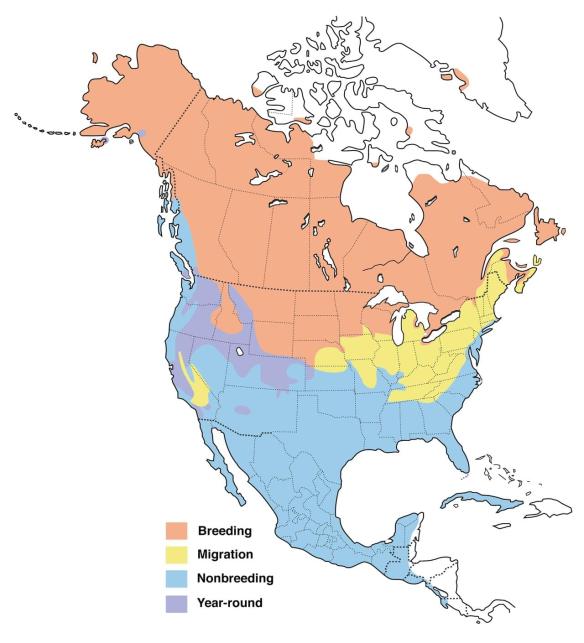
Northern Pintail Range Map: with permission from The Cornell Lab of Ornithology, Birds of the World

Northern Pintail Anas acuta
Order: Anseriformes
Family: Anatidae
Anas: Latin for duck
acuta: from Latin for “to sharpen” – a reference to the Pintail’s tail

Status at Chignik Lake, 2016-19: Common Spring and Fall migrant; Occasional on Chignik Lake. Occasional throughout the system in Summer.

David Narver, Birds of the Chignik River Drainage, summers 1960-63: Common in early and late Summer throughout the watershed; occasional in midsummer

Alaska Peninsula and Becharof National Wildlife Refuge Bird List, 2010:
Common in Spring, Summer & Fall; Absent in Winter

Aniakchak National Monument and Preserve Bird List: Presence Documented

Previous Article: Mallard – “Wary, Wise, Handsome”

Next Article: American Wigeon – America’s Most Vegetarian Duck

*For a clickable list of bird species and additional information about this project, click here: Birds of Chignik Lake

Birds of Chignik Lake – Emperor Goose: Alaska’s Painted Beauty

Emporer Gesse in Flight

Part of a flock of over 200 Emperor Geese overwintering at Chignik Lagoon. An almost strictly Alaskan and Siberian species, Emperors winter along the Alaska Peninsula and Aleutians and breed still further north. (March 9, 2019)

Although not strictly a species associated with the Chignik Lake study area, I include Emperor Geese in this report as they are a spectacular, unique bird that is special to The Chigniks. They are not likely to be encountered outside of Alaska and far eastern Siberia. In recent years their numbers in Alaska have been rebounding following a precipitous decline which saw their population plummet from 139,000 birds in 1964 to just 42,000 in 1986.

Formerly referred to as Beach Geese and still sometimes called Painted Geese, these surely are, as Edward W. Nelson who made a special study of them declared, the “least known and the most beautiful” of North America’s Geese. (March 9, 2019)

As our planet continues to change, it will be interesting to note what effects this has on Emperors. Hopefully they will part of the Chignik wintertime seascape for a very long time to come.

Emperor Goose Range Map: with permission from The Cornell Lab of Ornithology, Birds of the World

Emperor Goose Anser canagicus
Order: Anseriformes
Anser: Latinized Greek for swan
canagicus: for Kanaga Island in the Aleutian Island chain.

Status at Chignik Lake, 2016-19: Possibly Occasional on Chignik River; Common on Chignik Lagoon in late Winter

David Narver, Birds of the Chignik River Drainage, summers 1960-63Rare on Black River

Alaska Peninsula and Becharof National Wildlife Refuge Bird List, 2010:
Common Spring & Fall; Absent Summer; Uncommon Winter

Aniakchak National Monument and Preserve Bird List: Presence Documented

Previous Article: Tundra Swan – Harbinger of Spring at The Lake

Next Article: Cackling Goose

*For a clickable list of bird species and additional information about this project, click here: Birds of Chignik Lake

© Photographs, images and text by Jack Donachy unless otherwise noted.
 

Birds of Chignik Lake – Tundra Swan: Harbinger of Springtime at The Lake

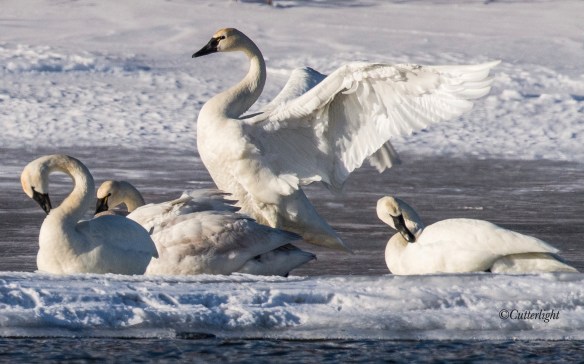
There may be snow on the ground and ice in the river, but when Tundra Swans begin showing up on the Chignik you know spring can’t be far behind. (March 16, 2017)

We were told that when swans show up on the river below the old dump, it’s a sure sign spring is on the way. While it seems possible to encounter Tundra Swans somewhere in the Chignik system in virtually any season (provided there’s open water), in early spring they’re still traveling in flocks, making it a good time to look for them. Prior to breeding, they’re often found with newly arrived ducks – Mallards, Northern Pintails, Buffleheads and other species.

This Tundra Swan was part of a pair we found feeding with a small group of American Wigeons on the Chignik River. The yellow lores and a very white back are diagnostic. (May 4, 2019)

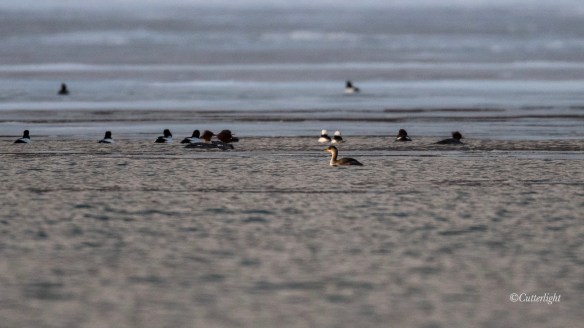
Swans and Ducks gather on The Chignik in Spring. In addition to the scaup, Mallards, Common Goldeneyes, and Buffleheads in this frame, Northern Pintails, and Red-breasted and Common Mergansers are often mixed in among the swans. (March 14, 2017)

A thin white line of several dozen swans underscores the Chignik Mountains at Black Lake. The shallow, weedy waters are important to waterfowl anytime the lake is ice-free. (January 3, 2018)

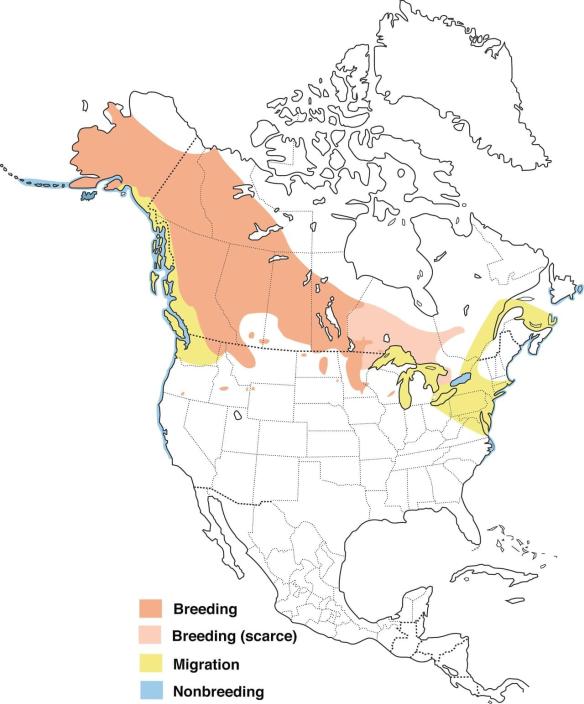
 Tundra Swan Range Map: with permission from The Cornell Lab of Ornithology, Birds of the World

Tundra Swan Cygnus columbianus
Order: Anseriformes
Cygnus: Latinized Greek for swan
columbianus: after the Columbia River (Meriweather Lewis of Lewis & Clark first named this species during their exploration across Northwest America)

Status at Chignik Lake 2016-19: 

David Narver, Birds of the Chignik River Drainage, summers 1960-63Uncommon on Black Lake

Alaska Peninsula and Becharof National Wildlife Refuge Bird List, 2010:
Uncommon in Spring & Fall; Common in Summer; Rare in Winter

Aniakchak National Monument and Preserve Bird List: Presence Documented

Previous Article: Pelagic Cormorant

Next Article: Emperor Goose – Alaska’s Painted Beauty

*For a clickable list of bird species and additional information about this project, click here: Birds of Chignik Lake

© Photographs, images and text by Jack Donachy unless otherwise noted.


Birds of Chignik Lake: Pelagic Cormorant

A hint of iridescent gloss in its plumage, a Pelagic Cormorants skims above Chignik Lagoon on a blue-sky day in late winter. Pelagics are common in The Lagoon where the fish they feed on are plentiful. Only very occasionally do they stray inland to the river and lake. (Chignik Lagoon, May 9, 2019)

My first close encounter with cormorants came at a pool I was fishing on Japan’s upper Tama River some years ago. I was in the midst of a fruitless morning when a cormorant of some sort showed up and elbowed its way into my pool. In no more than a few minutes it dove six times and caught six fish. Impressive.

Pelagic Cormorants are common all along the rocky, fish-rich Pacific side of the Alaska Peninsula. Red-faced and Double-crested Cormorants can be found along this coast as well. As for Pelagics, most of the very few we saw in the study area of this project were in flight as they headed up or down the Chignik System – perhaps from one side of the peninsula to the other.

Although their feet are webbed, cormorants’ middle toes are hooked – an aid in preening. 

Belying their common name, (and their binomial specific name, pelagicus), Pelagics rarely venture far out to sea, preferring rocky nearshore ocean waters.

This first-year Pelagic was encountered feeding below the salmon weir on Chignik River. (October 24, 2018)

Pelagic Cormorant Range Map: with permission from The Cornell Lab of Ornithology, Birds of the World

Pelagic Cormorant Phalacrocorax pelagicus
Order: Suliformes
Phalacrocorax: from ancient Greek name for cormorants – literally “bald raven”
pelagicus: of the open ocean

Status at Chignik Lake 2016-19: Uncommon/Occasional: At times are regular summertime visitors near the mouth of Clarks River on Chignik Lake

David Narver, Birds of the Chignik River Drainage, summers 1960-63Occasional on Chignik Lake after storms

Alaska Peninsula and Becharof National Wildlife Refuge Bird List, 2010:
Uncommon in Spring & Fall; Common in Summer; Rare in Winter

Aniakchak National Monument and Preserve Bird List: Presence Documented

Previous Article: Pied-billed Grebe

Next Article: Tundra Swan

*For a clickable list of bird species and additional information about this project, click here: Birds of Chignik Lake

© Photographs, images and text by Jack Donachy unless otherwise noted.

Birds of Chignik Lake: Red-necked Grebe

What a beauty. The face striping marks this specimen as a juvenile. The Bend on the upper Chignik (just below the lake) proved to be a consistently reliable place to get close enough to waterfowl to score good photographs. (October 23, 2017)

Red-necked Grebes are another among the Chignik’s several fish-hunting birds. We didn’t see them often, but when they were on the lake or river we always grabbed our binoculars for a closer look. It’s a good bet that they breed on Black Lake or nearby tundra ponds.

Buffleheads, goldeneyes, mergansers… and center stage an adult Red-necked Grebe in nonbreeding plumage. (Chignik Lake, January 24, 2017)

These were two of three juveniles that visited the lake in the fall of 2017. (Chignik Lake, October 20, 2017)

Example of a Red-necked Grebe in breeding plumage. (Potter’s Marsh, Anchorage, Alaska. June 24, 2017)

Red-necked Grebe Range Map: with permission from The Cornell Lab of Ornithology, Birds of the World

Red-necked Grebe Podiceps grisegena
Order: Podicipediformes
Podiceps: from the Greek
podicis = rump – refers to the posterior positioning of the grebe’s feet
grisegena: from the Latin
griseus = gray & gena = cheek 

Status at Chignik Lake 2016-19: Occasional in Fall & Winter

David Narver, Birds of the Chignik River Drainage, summers 1960-63: Common on Black Lake; Rare on Chignik Lake

Alaska Peninsula and Becharof National Wildlife Refuge Bird List, 2010:
Uncommon in Spring, Summer & Fall; Rare in Winter

Aniakchak National Monument and Preserve Bird List: Presence Documented

Previous Article: Yellow-billed Loon

Next Article: Pied-billed Grebe – An Alaska Peninsula First

*For a clickable list of bird species and additional information about this project, click here: Birds of Chignik Lake

© Photographs, images and text by Jack Donachy unless otherwise noted.


Birds of Chignik Lake: Common Loon

Common Loon – Chignik Lake, August 17, 2018

Words such as “common,” “uncommon” and “rare” can be vexingly imprecise. So, what are the chances of seeing a Common Loon on Chignik Lake? Generally pretty good, which prompts the question: Have Common Loons – which David Narver recorded us “uncommon” back in the early ’60’s – become more common on The Lake in recent years? And if so, does that explain the relative absence of the smaller Red-throated Loon – which Narver reported as “common?” I love questions like this, even if the answers are tough to know.

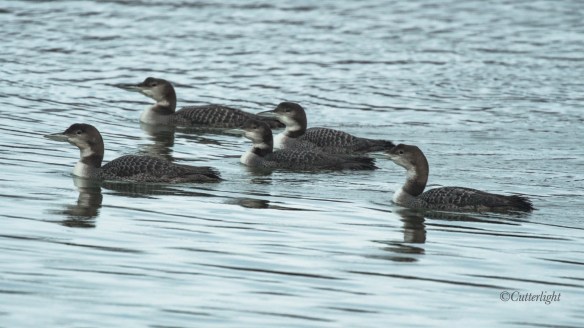
These Commons appeared to be cooperatively feeding as they worked their way along the shoreline. (Chignik Lake, January 14, 2018)

We encountered Common Loons with some frequency – as individuals, in pairs, and at times in what appeared to be family groups of four or five. Commons’ diets are comprised mainly of small fish – lots and lots of them. According the Cornell Lab of Ornithology, a pair with two chicks can consume about half a ton over a 15-week period. Unlike River Otters, mergansers and goldeneyes, Commons usually swallow their prey underwater. I was therefore unable to observe what species of fish they might be targeting. Sticklebacks, small char and juvenile salmon are all likely candidates. The system also holds populations of smelt and sculpins.

Right down to it’s gem-like eye and armed with a serious bill, Common Loons surely rank as one of North America’s most striking birds. (Chignik Lake, August 17, 2018)

Even in silhouette, there’s no mistaking a loon. (Common Loon, Chignik Lake, August 20, 2016)

Common Loon Range Map: with permission from The Cornell Lab of Ornithology, Birds of the World

Common Loon Gavia Immer
Order: Gaviiformes
Gavia: sea mew
immer: perhaps from the Latin immergo – to immerse; or from the Swedish immer – which refers to the ashes of a fire and suggesting the loon’s coloration

Status at Chignik Lake 2016-19: Common to Uncommon

David Narver, Birds of the Chignik River Drainage, summers 1960-63Uncommon

Alaska Peninsula and Becharof National Wildlife Refuge Bird List, 2010:
Common in Spring and Summer; Uncommon in Fall; Rare in Winter

Aniakchak National Monument and Preserve Bird List: Presence Documented

Previous Article: Pacific Loon

Next Article: Yellow-billed Loon

*For a clickable list of bird species and additional information about this project, click here: Birds of Chignik Lake

© Photographs, images and text by Jack Donachy unless otherwise noted.