A Study of Upper Summit Lake, Alaska

One of the most frequently photographed lakes in Alaska, Upper Summit Lake lies along the Seward Highway between Anchorage and Seward.

We recently got a wide-angle landscape lens and were eager to try it out. A broken sky over breaking up ice on Upper Summit Lake created a visually arresting set of contrasts and similarities.

We’d never been on the Kenai Peninsula early enough to see this much ice and snow. Only a few days prior, the lake was completely covered in ice, although it was apparent it was beginning to thin.

Notice the dandelions blooming in the foreground. Tough little flowers, pushing up through asphalt in the city, almost pushing away the ice and snow up here.

The upper end of Upper Summit Lake is the kind of place where we slow down and scan for moose.

Morning Song

This little guy, a fox sparrow (Passerella iliaca) has been bringing in our days every morning here in Seward with the loveliest song. Day by day, he’s grown a bit tamer. Today he was gracious enough to allow us to get these photos. 

“LBB’s,” my undergraduate ornithology teacher called them. Little brown birds. You see one, and even if you get a really good look at it, when you go to Peterson’s or some other bird guide, what you see quickly becomes a blur of what you think you saw mixed in with a handful of similar-looking birds. But the songs are compelling and unique, and so you keep going back and forth from binoculars to field guides, and if you do this often enough over enough years, distinct species begin to take form.

Here he is, singing his heart out. No doubt some avian version of something clear and strong about being in the right time and place, eager and ready. We humans hear that in birdsong, and it lifts us. 

There are four subspecies of fox sparrows, each geographically unique, except when they overlap. Which they do. And when they do, the birds interbreed. More LBB’s. More scrutiny through binoculars. More head scratching over pictures in bird books.

When I approached too close, he went for a familiar place: the ground. Fox sparrows love underbrush and are often heard rustling through leaves or glimpsed flitting from one low willow to another. 

We’re lucky. We who live in North America. These migratory passerines breed up here. Which means they sing. In the places they head to during the winter, they don’t breed, and they typically don’t sing.

Before he flew off, he perched atop a wooden sign and gave a backward glance. The early morning sky was gray. I returned to the camper to make a blueberry pancake and fry some bacon while Barbra cut a grapefruit in half and made us big mugs of coffee.

Dungeness Crab in Beer and Miso

Whether fresh or previously frozen, Dungeness crabs and blue crabs are a great meal to linger over.

Flip a coin. Heads its Dungeness, tails its blue. We’re in either way. Some of the most memorable meals we’ve enjoyed were centered around freshly steamed or boiled crabs, good beer or wine, and a long, leisurely meal with just the two of us or with friends cracking and picking crabs.

We prefer fresh crabs whenever we can get them. In South Carolina, there was a private dock on a saltwater cut through the marsh that could be counted on to produce blue crabs on incoming tides. And when I lived in Oregon, throwing out a couple of crab pots was a matter of course on salmon fishing trips. Because Dungeness populations are depressed in the parts of Alaska we frequent, their harvest isn’t currently permitted in those locales. So most of the crabs we’ve been getting are purchased already cooked, but we still heat them before serving.

Our favorite way to boil-steam crabs is fairly simple. We start with about a half-bottle (6 – 8 ounces) of beer and 1 tablespoon of miso per Dungeness crab. Since more liquid than this is necessary, we add a cup of water or two. The idea is to ensure that there is enough liquid so that it doesn’t all boil off in the 12 minutes or so required to heat through a previously frozen Dungeness. For two crabs, add a 12-ounce bottle of beer, a little more miso, and, if necessary, a little more water.

I usually don’t immerse the entire crab. This is because I’m frugal (cheap) and hate wasting beer. I boil-steam the crab on one side for a few minutes, then flip it and continue cooking it for a few minutes more. If I’m doing multiple crabs, I arrange them in the pot as best I can and rotate them once during the cooking – although this really may not be necessary.

Previously cooked crabs are inevitably already plenty salty. The beer and miso bath gives them a mild sweetness. If you’re starting with fresh crabs, you might want to add some salt to the broth. A good rule of thumb is to steam fresh crabs for about 7 – 8 minutes per pound – which means a two-and-one-half pound crab needs about 20 minutes in the pot. One crab this side is usually plenty for the two of us, served with, say, a salad, fresh corn on the cob, and a loaf of crusty bread.

Our favorite dipping sauce? Melted butter, olive oil, garlic, lemon and soy sauce. For two people, melt about 6 tablespoons of butter. Add a clove of minced garlic and sauté  it for a minute or so. Then add 1 tablespoon of olive oil, the juice from half a lemon, and 1 tablespoon of soy sauce. A slice or two from a really great loaf of bread can be used to sop up any remaining sauce.

Crab goes great with a wide range of beers or a buttery Chardonnay.

Stanley and the Lance

Our home on wheels the past three summers – a Lance camper perched on a 3/4 ton Chevy Silverado, here parked for lunch with a gorgeous view of Resurrection Bay near Seward, Alaska. Note the hitch for towing our C-Dory 22 Angler. This photo was taken on May 21, 2012.

Our first summer in Alaska, we lived aboard our C-Dory 22 Angler, GillieGillie’s pilot house and cuddy cabin made for a cozy nest, and the spirited little Toyota Tacoma that did the pulling over the 8,000 plus miles we drove that summer was, simply, the most enjoyable vehicle either one of us has ever driven. The 43 days we spent traveling in that rig made for a summer for the books. In fact, we talked for some time about traveling all across North America in this rig: exploring blue highways both on land and on water, envisioning jaunts down to the Florida Keys, out to Martha’s Vineyard, across the country to Catalina Island and everywhere in between. We even talked about launching the C-Dory at Pittsburgh, Pennsylvania and cruising all the way down the Ohio and the Mississippi to New Orleans.

But when we made the decision to move to Alaska, rent out our home in Sacramento, and spend our summers on the Kenai Peninsula…

A carved wooden hummingbird given to us by our daughter, Maia, on a trip that passed through a First Nations village in British Columbia greets us each time we open the door. Framed artwork and other personal touches make our camper a home.

After months of comparative shopping and researching campers and trucks, we still felt like we didn’t know as much as we would have liked. On the other hand, we knew enough to be comfortable making a decision. We’ve been very happy with both the Lance Camper and the Chevy Silverado 2500 it sits on.

The camper has a queen-size bed, lots of windows and skylights providing natural lighting, a three-burner propane stove with oven, an air conditioner and heater, a good shower and flush toilet, a TV and sound system, a great refrigerator/freezer, lots of storage space and enough room overhead to be comfortable for a person of my height (I’m 6′ 1″). We added a solar panel, which we highly recommend; even on cloudy days the battery charges. We also have a generator which, although rarely used, has been much appreciated the couple of times we’ve needed it.

A pair of Xtratuff boots – iconic of Alaska anglers and boaters – is ready at the entrance. 

Stanley is a name conferring strength and dependability – like Stanley tools. Fitted with airbags (extra shock absorbers), our three-quarter ton Silverado has performed superbly carrying the camper and towing our 4,500 pound boat. Given a steep mountain grade, Stanley shifts down as if to say, “All right.” Nothing more. No groaning and straining, no needless extra shifting, just a simple, straightforward, “All right” and up the mountain we go. And kicked into four-wheel drive, this truck has the grit to power through even loose beach sand with the camper – a test we didn’t intend to put the truck through and won’t be repeating.

We went back and forth regarding two options: gas or diesel, and dual rear wheels or single. We opted for a gas engine and single wheels, and after three summers of putting this rig to the test we can say without hesitation that with the right tires, single wheels are fine. And we’re happy we don’t have to deal with the noise of a diesel engine (or impose that noise on our neighbors). That being said, the fact is we don’t put a lot of miles on our rig. A diesel engine offers some real advantages to campers engaged in extensive traveling.

To anyone contemplating a rig like this, we have one firm recommendation: Start by choosing the camper you want, then match it to the right truck. 

This watercolor by Homer, Alaska artist Leslie Klaar depicts a boat much like our C-Dory heading off for a day of fishing in the great Northwest. It hangs near the door of of our camper.

Livin’ in a Van down by the River

Seward Harbor, May 21: This is the view from the back widows of our pickup truck camper, our summer home while we work to get Bandon ready to live on and to sail. Mornings start early up here, the first sunlight slanting into the camper a little after 5:00 AM – and getting earlier each day. Warblers and other songbirds are the first to wake. Too early for us. By the time we roll out of bed, gulls are calling and scolding and the high chirps of eagles have taken over. The fishing season hasn’t come into full swing yet, though a few engines can be heard making ready for a morning or a day on the water. Blueberry pancakes with maple syrup and strips of bacon on the side some days, fried eggs others, cold cereal when we’re really eager to get moving, but always with a ruby red grapefruit, a glass of orange juice and a big mug of coffee made from freshly ground beans. Then the walk to the end of the dock and a full day of work. In the photo above, as you look down the open water between the docks, Bandon is the last mast on the left.

We’ve submitted the paperwork to the coast guard in order to change the name of our Island Packet 350 from Tarsus to Bandon.

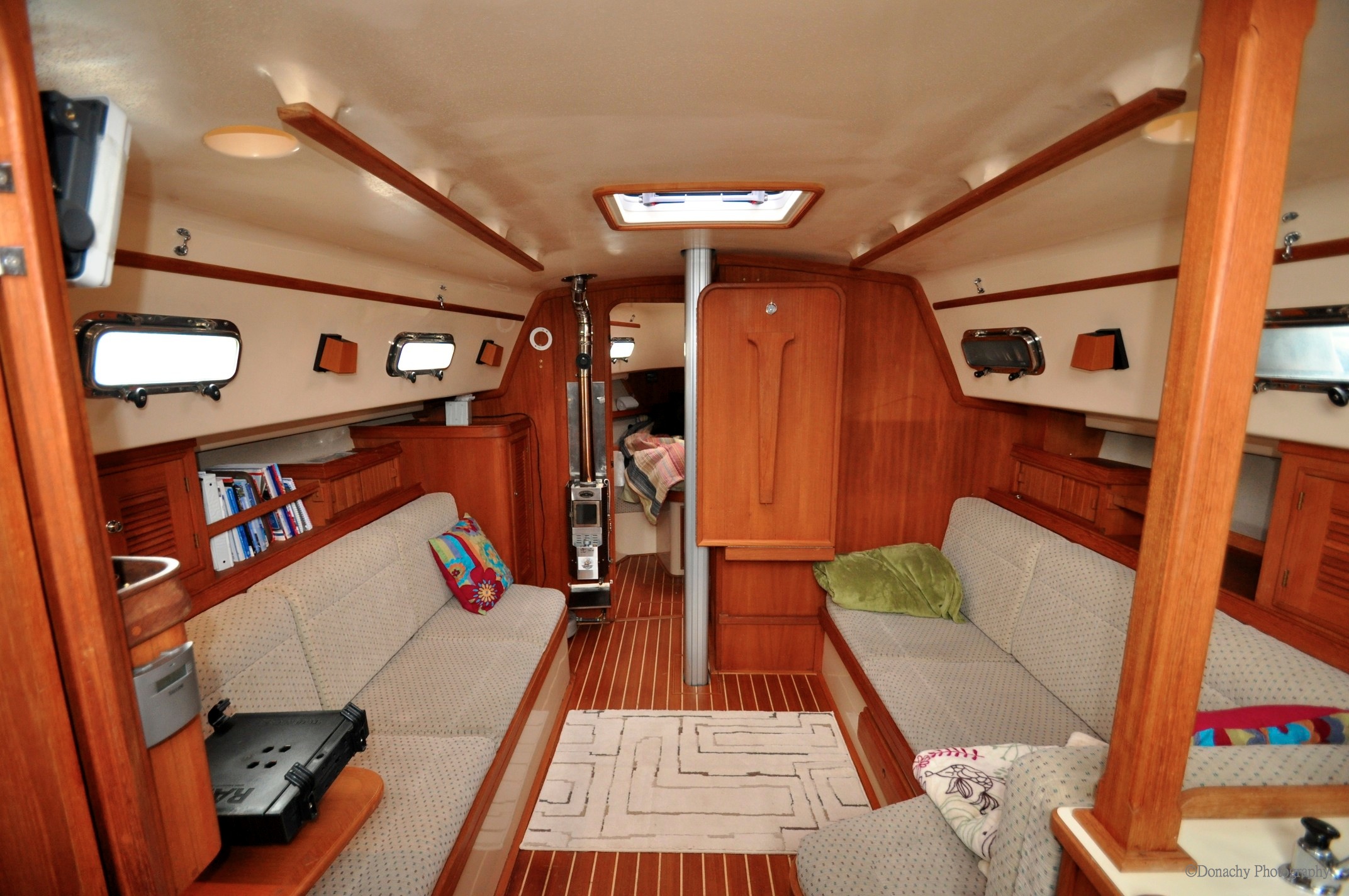
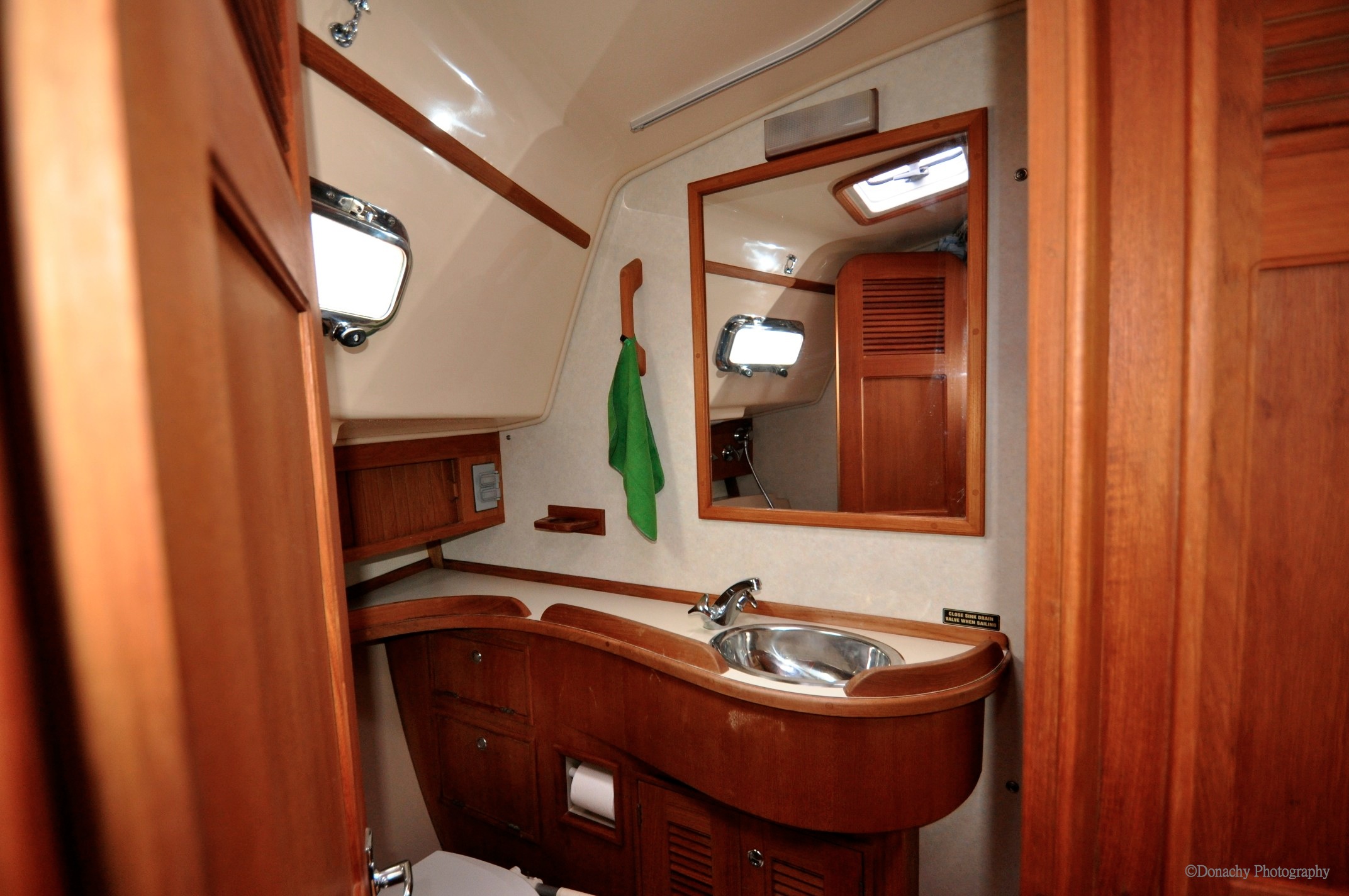
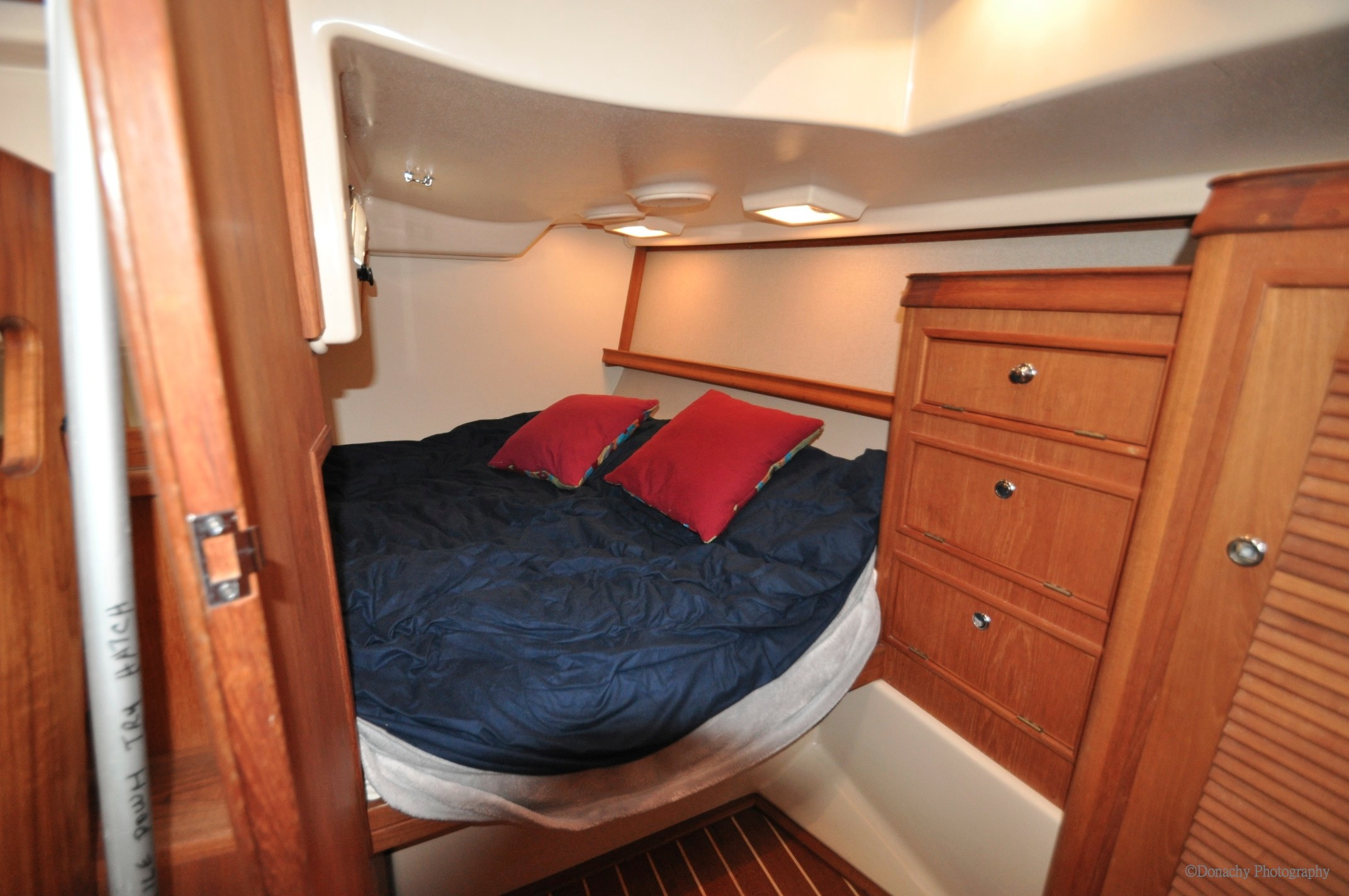
This is a sound vessel, and she surveyed well, but there is always work. The first of it has begun with giving every square inch of her interior – from her beautiful teak-wood sole to her overhead – a good cleaning. Meanwhile, there’s sorting through all the items previous owners left behind. From can openers to canvas, much of it is useful, and much of it is not. All of it requires a decision: toss out, donate to the  local thrift shop, or clean and restow.

Everything we touch, clean, move off or bring aboard makes this boat that much more ours. Bandon will be our home. In the near-term, that means about three months out of the year. And so we are outfitting it as such. This means furnishing it with good dinnerware (we went with Denby for our plates, bowls and pasta bowls), stemware (we found Schott Zweisel Tritan crystal wine glasses that look and feel luxurious but are exceptionally break resistant), and quality bourbon/Scotch glasses.

We anticipate that Bandon will be a full-on sailing vessel in every sense, but we recognize that even the most serious sailing vessels spend most of their days at anchor or in port. We want those days to be comfortable and inviting.

Scones and Lemon Curd – The Last Egg

How to use  up the last of the pear butter, lemon curd, orange marmalade and the lone remaining egg in the fridge? Whip up a batch of scones, set out the spreads, and watch it all disappear!

These scones were amazingly quick and easy and had just the right texture and flavor. When I set out a large glass baking dish filled with them in the school office, they were gone almost before I turned around.

To shape them, I used a circular cookie cutter and then cut those circles in half. For larger scones, you could roll the dough into a circle and cut it into eight wedges.

Scones

Ingredients

  • 3 cups all-purpose flour
  • 1/2 cup granulated sugar
  • 5 tsp baking powder
  • 1/2 tsp salt
  • 3/4 cup unsalted butter, softened
  • 1 egg, beaten
  • a little less than 1 cup milk
  • cinnamon/sugar mixture to dust the tops (optional)

Directions

  1. Preheat oven to 400 degrees F. Cover baking sheets with parchment paper.
  2. In a large mixing bowl, combine flour, sugar, baking powder, and salt. I used a stand mixer.
  3. Mix in butter.
  4. Put egg in a large measuring cup. Fill measuring cup to 1 cup line with milk. Mix well.
  5. Pour some of the egg mixture slowly into flour while mixing on low until mixture forms a dough ball. Set aside extra egg mixture.
  6. Turn the dough out onto lightly floured surface and knead briefly.
  7. Roll dough out to 1/2 inch thickness. Cut into the shape of your choice.
  8. Place scones on parchment-covered baking sheets. Brush with remaining egg mixture. Dust with cinnamon/sugar if desired.
  9. Bake 15 minutes in preheated oven, or until golden brown.

Coconut Butter Cookies – One Egg to Go

Chewy, sweet coconut butter cookies.

Some people count down by crossing off days. Up here in the village, the days are often counted in “sleeps.” This week, we’ve been counting in eggs. These cookies contain the second to last egg remaining in our refrigerator before we leave for the summer.

One egg, three days, two sleeps to go…

My mom cooked with fresh ingredients whenever she could, and so I have many memories of cracking coconuts and drinking the milk. Afterwards, we’d use fresh coconut shavings in various recipes.

Out here in bush Alaska, we’ve been using powdered coconut milk (obtained from our favorite Asian grocery store, New Sagaya, in Anchorage). Shredded coconut is also on our annual shopping list.

A few weeks ago, I made chocolate dipped macaroons. The coconut lovers around here gave them high marks. Others (those who couldn’t handle the coconut – you know who you are) diplomatically rated them “a-little-too-coconutty.” In an attempt to mellow out the coconut in this cookie, I mixed it into a tried and true butter cookie recipe. The coconut flavor and chewiness of these cookies goes perfectly with the butter-cookie sweetness. I was tempted to dip them in chocolate but resisted, thinking that might have made them too sweet. These cookies are already perfectly sweet!

Coconut Butter Cookies

Ingredients

  • 1 1/4 cups all-purpose flour
  • 1/2 tsp baking soda
  • dash salt
  • 1/2 cup unsalted butter
  • 3/4 cup granulated sugar
  • 1 egg
  • 1/2 tsp vanilla extract
  • 1 1/3 cups sweetened coconut

Directions

  1. Preheat oven to 350 degrees F.
  2. Mix together flour, baking soda and salt in a medium bowl. Set aside.
  3. In a separate mixing bowl, mix sugar and butter until smooth and pale colored.
  4. Mix egg into sugar mixture.
  5. Mix vanilla into sugar mixture.
  6. Blend in flour mixture to create a dough.
  7. Incorporate coconut into dough mixture.
  8. Drop dough by tablespoons onto parchment-lined baking sheets leaving 2 inches between cookies.
  9. Bake for 10 minutes or until cookies are toasted lightly on the top and golden brown on the bottom.
  10. Cool on wire racks.

Sandhill Cranes: Up Close and Personal

Driving into Homer, Alaska one summer we encountered this beautiful pair of gray and rust colored sandhill cranes (Grus canadensis) foraging on an expansive lawn. Cranes are opportunists, and although they are mainly herbivores seeking grains and seeds, they supplement their diet with insects, small mammals and other animals they encounter.

Bird weights can be deceptive due to their hollow bones. Even though adults have wingspans of six to seven feet (1.8 to 2.1 meters) and stand four to five feet tall (1 to 1.2 meters), they typically weigh less than 10 pounds (4 kilograms).

Since cranes are hunted in Alaska and can be quite wary, we felt lucky to find a pair that wasn’t too skittish. 

Other times we’d seen cranes, they were flying overhead, or, as was the case one summer in Yellowstone, far out on a plain. 

We stalked them for awhile, snapping photos, gauging our distance without spooking them into flight, and then we left the couple to continue their hunting. 

Of course, this being Alaska, when we looked up from the field where we’d been intently watching the cranes, this is what we saw – the Kachemak Glacier, which flows out of the Harding Icefield.

Razor Clam Fritters & Wasabi Slaw: Fusion Comfort

Something tried-and-true, something new: clam fritters and wasabi slaw – fusion comfort food.

My dad gave me two pieces of advice which have stood the test of time – 1) Take the stairs whenever you can, and take them two-at-a-time, and 2) eat as much fried food as you can when you’re young, because at some point you won’t be able to.

Clam fritters are so easy, I’m not sure why I don’t make them more often. Although I made these with razor clams, in South Carolina I made them out of the whelks I’d find, and at other times I’ve made them out of canned clams. The slaw is comprised of fairly standard ingredients – mayonnaise (homemade), pickle juice, vinegar, sugar, salt, pepper, carrots and cabbage – and given a kick with two teaspoons of powdered wasabi.

The fritters are adapted from Craig Claiborne’s recipe as it appears in The New York Times Cook Book, with the only difference being my substitution of dried tarragon and basil, which I have, for fresh parsley, which I do not have.

Clam Fritters: serves 4

Ingredients

  • 1 cup chopped clams
  • 1 egg, lightly beaten
  • 1 tsp lemon juice
  • 1 tbsp chopped tarragon (or substitute dry tarragon or marjoram)
  • 1 tsp baking soda
  • 1 cup flour
  • 1/4 cup clam juice
  • 1/4 cup milk
  • 1 1/2 tbsp melted butter
  • couple dashes cayenne pepper (to taste)
  • freshly ground black pepper to taste
  • oil for frying

Directions

  1. Chop clams on a cutting board. Not too fine. Place them in a mixing bowl.
  2. Add the egg, lemon juice, tarragon, baking soda and flour and stir.
  3. Blend the clam juice and milk. Add gradually to the clam mixture, stirring continuously. Do not make the batter too runny.
  4. Stir in the butter, cayenne and black pepper.
  5. Heat about 1/8 inch of oil in a frying pan.
  6. Drop batter in the hot oil – about 2 tablespoons per fritter. (They’ll cook better if they’re fairly small.)
  7. Turn when the bottom is browned, as you would for pancakes.

We served these with salmon sauce. Tarter sauce, shrimp sauce, or a squeeze of lemon works well, too. These seemed to beg for an amber ale. (Or maybe it’s Barbra and me doing the begging after nine months of living in a dry village!) Enjoy!

Lemon Brioche Croissants

Flaky and buttery croissants made from scratch using brioche dough. Stuff them with anything you like – I chose homemade lemon curd.

We leave for the summer in six days. After surveying the pantry for what will not survive three months, we determined the lemon juice, coconut and salsa are on the “must finish” list. Obviously, no recipe is going to take care of all three ingredients in one fell swoop — not one I’d want to eat, anyway! Salsa chicken and rice will be on this week’s menu. Coconut butter cookies for the staff potluck. And lemon curd stuffed croissants for breakfast.

From a culinary and baking standpoint, this summer should be interesting. We’ve cooked for weeks at a time in our camper. We’ve also cooked for weeks on a Coleman stove while tent and boat camping. This summer, it will be all galley cooking on our sailboat, Bandon. We’re both eager to outfit her galley with the least amount of quality tools that will help us with the most culinary tasks. We are also excited to fish the south central waters of Alaska and cook up the freshest and tastiest seafood for ourselves and our guests. Stay tuned to see what will be created from the galley of Bandon!

Lemon Brioche Croissants

makes 8 croissants

Ingredients

  • 1/2 cup whole milk
  • 1/8 cup granulated sugar
  • 2 eggs
  • 1 1/2 – 2 cups all-purpose flour
  • 1/2 tbsp instant yeast
  • 1/2 tsp salt
  • 3/4 cup soft unsalted butter
  • 3/4 cup lemon curd or other filling (see below for separate lemon curd recipe)

Directions

  1. Pour milk in saucepan and heat until lukewarm.
  2. Pour milk in mixing bowl. Add sugar. Mix until incorporated.
  3. Beat eggs. Pour eggs into milk mixture. Mix until incorporated.
  4. Add 1/2 cup of flour. Mix until incorporated.
  5. Add yeast and a second 1/2 cup of flour. Mix until incorporated. I switched to a dough hook on the mixer at this point.
  6. Add salt and last 1/2 cup of flour. Mix again until incorporated. Dough should be sticky.
  7. Mix butter into dough in increments of about 2 tbsp at a time.
  8. Once the butter is completed incorporated, cover dough with plastic wrap and refrigerate for at least 4 hours, or overnight.
  9. After at least 4 hours, place the dough on a lightly floured surface.
  10. Roll the dough out to form a circle with about a 15-inch diameter.
  11. Cut dough into 8 pieces (pizza style) using a pizza wheel, forming 8 triangles.
  12. Place a heaping tbsp of lemon curd near the base of the triangle.
  13. Roll dough from base of triangle toward point.
  14. Curve into a crescent shape and pinch ends closed.
  15. Place croissants on parchment-lined baking sheet and cover sheet with plastic wrap. Let rest for 45 minutes.
  16. Preheat oven to 350 degrees F while dough is resting. Bake croissants for 15 – 20 minutes until lightly browned.
  17. Cool on a wire rack.

Lemon Curd

Ingredients

  • 1/2 cup lemon juice
  • 3/4 cup granulated sugar
  • 2 eggs
  • 1/2 cup (1 stick) softened unsalted butter
  • zest of one orange (about a tablespoon)

Directions

  1. Mix together lemon juice, sugar, eggs, and zest. Mix in butter 1/4 cup at a time.
  2. Place bowl on simmering pot of water (double boiler). Stirring constantly, cook until mixture reaches 160 degrees F (about 10 minutes).
  3. Store covered in refrigerator. I used a mason jar.

The above recipe used about half of the lemon curd. Enjoy the extra on scones, with yogurt, or to replace jam in any other recipe.

Croissant recipe adapted from http://www.cookingbread.com/classes/class_lemon_brioche_croissants.html

Lemon curd recipe adapted from http://www.recipegirl.com/2008/11/10/meyer-lemon-curd/