Looking for Love

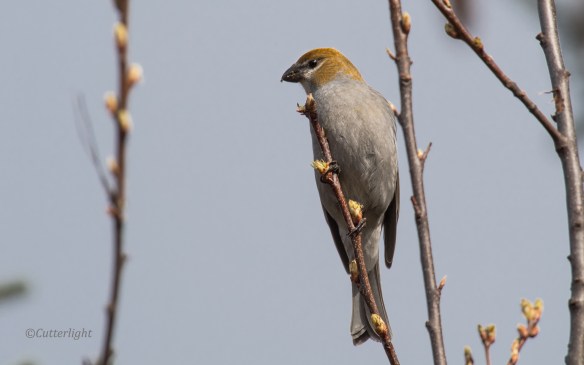
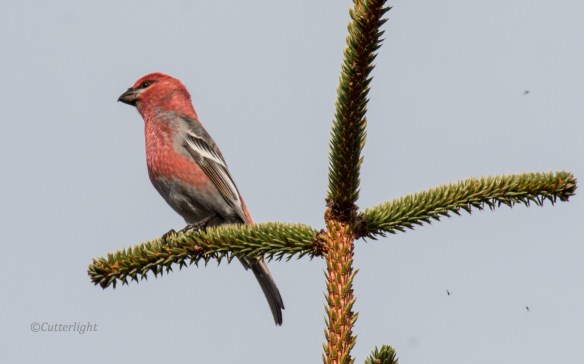
His colors will never be brighter than they are right now, nor his call more cheerful. Pine Grosbeaks tend to be irregular in their presence, but for the past two years in Chignik Lake they’ve been regular residents. For a look at a nearby female, which is very differently colored, see below. (Note the midges flying around to the right in the above photo. With big insect hatches coming off the lake and river, our swallows should be here any day!) 

Most days in the village the optimistic Peee-Peeet! of Pine Grosbeaks can be heard as they fly overhead or perch atop the tallest spruce trees. Always striking, the males are particularly colorful during springtime. Like their crossbill cousins, Pine Grosbeaks can be remarkably unwary. Move slowly around them, sit quietly, and they may forage on the ground practically at your feet. I’ve even had one perch on my head!

Female Pine Grosbeaks feature a rich olive-gold on their head, upper back, rump and often on their upper breast. This time of year, the leaf buds of deciduous trees figure heavily in Pine Grosbeaks’ diets. During wintertime they can be attracted to feeders featuring black oil sunflower seeds, suet or (I’m guessing) peanuts. They also love small fruit and during warmer months will include insects in their diet.

The “gros” of grosbeak is from the French gros, which means large. This is a species we’ll be looking for this summer in Hokkaido, Japan – part of their ranged across the Northern Hemisphere.

Chignik Lake Bald Eagle

Waiting for Salmon, Chignik Lake, Alaska

May 1, Tuesday Morning, frost: Eagles are once again daily encounters as they take up familiar roosts and join the village in watching for salmon. A few fish have trickled in, but usually it’s June before the run really gets going. A couple of nice char have been caught. Catkins on the willows, leaf buds everywhere ready to burst. A small flock of Pine Grosbeaks was in the village yesterday, the males as brilliant pinkish-red as they’ll ever be.

Point Hope Aerial, 2013

Point Hope, Alaska, February 22, 2013

One of the great privileges in our life was to live for three years in the Inupiat village of Point Hope, Alaska. Lying 200 miles north of the Arctic Circle and still deeply connected to a whaling-based subsistence culture, it is said that the Tikigaq Peninsula has been inhabited for some 9,000 years, making it one of the oldest continuously inhabited sites in North America. It is a place of aqpik berries and caribou, snowy owls and arctic foxes, fierce winds and frozen seas, a full month of darkness and the most magically soft pink, gold and orange morning and evening light we’ve ever seen. One day in early fall we hiked out to the end of the peninsula, stood on the beach, and watched in wonder as thousands upon thousands of murres, puffins, auklets and other seabirds streamed by on their way to the open ocean to spend the winter, their nesting season complete – surely one of the planet’s greatest migratory events. We endured a mid-winter three-day blow of hurricane force winds that forced most of the village to huddle together in the school which had its own generating system and could offer warm shelter and hot meals. Polar bears sauntered through the village right past our house and there were nights when the Northern lights danced above our heads in electric greens, pinks, purples and reds.  And it was a place of friends, some of the toughest, most generous people we’ve ever known. Tikiġaġmiut – the people of this peninsula in the Chukchi sea.

The Real Breakfast of Champions


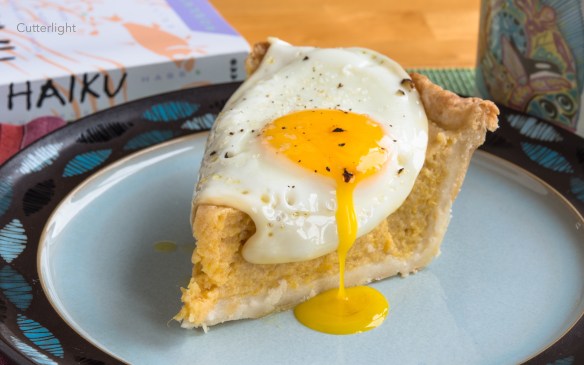
Creamy roasted butternut squash filling on a flakey, buttery crust – top it off with a lightly salted & peppered sunny-side up egg and serve a cup of French Roast on the side. Good morning, Chignik Lake.

Pumpkin pie for breakfast – it’s either just after Thanksgiving or Christmas, or we’re nearing the end of another year in the bush. In fact, we’re almost having to pinch ourselves to get our heads around the fact that there are just four days till the end of Barbra’s school year. With a very early summer vacation in sight, we’ve been in the process of clearing out our freezer. Several months ago we roasted and freezer-packed  a couple of butternut squashes. When we rediscovered them last weekend, they were still in excellent condition thanks to our manual defrost freezer.

Having never perfected crusts, I got out of the pie baking business when I married Barbra, but she still uses my pumpkin pie filling recipe – an adaptation from Craig Claiborne’s The New York Times Cookbook. She put a bush twist on the recipe this time, substituting Hoosier Hill Farm Premium Heavy Cream Powder for real heavy cream, which can be notoriously difficult to get out to the bush. The pie came out just fine.

And so this past week we’ve been starting our mornings right with one of our favorite breakfasts: Pumpkin Pie with a Fried Egg and a cup of joe. Our sparrows have begun returning, Cranes are starting to nest up on Black Lake, the bears are up and about and this morning I think I saw a salmon jump down at the bend. C’mon summer!

For our favorite pumpkin pie/squash pie recipe, see: A Cookbook for the Ages: Pumpkin and Pecan Pies from Craig Claiborne

Migration

Migration

April 18, early morning

The big picture window with a view across the lake was open just enough when the first group came through. Honking, chattering, noisy, at first distant then growing closer and then distant again till a silence was left where they had been. When the next group came through, I scrambled from behind my desk and dashed out the door, searching the morning’s gray sky till their thin, fluid lines came into view, sentences of sorts arcing northwest toward the big bays on the other side of the peninsula – Mud, Henderson, Nelson’s Lagoon – waters far from any town or village, remote even by standards up here.

All morning it was like that, wave upon wave of Canada Geese having decided that this was the day. When Barbra and I went for an evening walk, they were still coming, clamorous, easy to identify in the good light with their clean black heads and necks and bright white chins against the blue sky.

That night I opened the bedroom window a little, lay on my back not wanting to sleep, listening as the geese continued to write their way home even in the dark.

3 Easy Steps & 16 Minutes to Perfection: Pork Chops Cooked “Just Right” Every Time

Consistency is a key to turning out a perfectly cooked cut of meat. We’ve been following this straightforward recipe to turn out “just right” pork chops on stovetops, grills and even countertop toaster-ovens for years

Time tested and true, there are three keys to this recipe:

1. Start with a thick pork chop. Costco offers an excellent value on a package of exactly the kind of boneless pork loin chops this recipe calls for. If Costco quantities are too much, visit your local butcher. You want a two-inch thick (5 cm) chop, preferably one with a bit of fat.

2. Pick a great rub. Our favorites feature a balance of powdered chilis such as ancho, cayenne, Aleppo and chipotle as well as other seasonings such as mesquite, black pepper and paprika. Penzeys Southwest Seasoning or their Northwest Fire are good examples.

3. Use a sufficiently thick frying pan (one with a lid) to ensure even heating and to avoid burning the meat. Nonstick Swiss Diamond and Scanpan cookware handle heat well and make clean-up a breeze. Good stainless steel or well-seasoned cast iron pans are also good choices.

Once you’ve got the pork chop, the rub and the pan ready, the rest is a breeze. We find that one Costco-sized chop served with rice is plenty for two diners. In fact, we often have enough left over for a killer omelet the following morning.

I should add a note here: Stoves and pans vary. You may have to fine tune the heat, but once you’ve got it, you’ve got it. The same approach works for perfecting your favorite cut of steak, chicken breasts or thighs, or fish fillets.

Click here for an easy raspberry chipotle sauce.

16-minute Perfect Pork Chop

Ingredients

1 pork chop, 2 inches thick, rinsed and patted dry

chili based rub such as Penzeys Southwest Seasoning

soy sauce (or substitute sea salt)

1 or 2 tablespoons olive oil

Directions

Gently rub in a generous amount of seasoning on all sides

Meanwhile, in a frying pan, heat olive oil at a little higher than medium heat till it’s sizzling hot. Don’t allow it to smoke.

Set timer to 16 minutes and place chop in pan. Cover and cook for 1 minute to sear. Use tongs to turn the cutlet to the other side, lower temperature to medium-low, cover and allow to cook for 8 minutes.

Turn chop back to the side you first seared, drizzle with soy sauce, cover and cook for the remaining 7 minutes.

Remove chop and place on a wooden cutting board. Cover with a bowl or tent loosely with aluminum foil and allow to rest for 5 minutes.

Cut into two pieces. Top with raspberry chipotle sauce and serve with rice, couscous or potatoes.

A Chignik River Springtime Float

We began the float by paddling our Alpacka Gnu to the north shore of Chignik Lake opposite of Chignik Lake village, which looks as tiny as it actually is tucked up against the Chignik Mountains. Chignik means “big winds.” Not on the morning of April 14. (For a look at this same float in December, 2017, see: Early December in Paradise – a Float down the Chignik River.)

It was one of those days when we woke with no plans, and now the day was making a plan for us. The sun slid through a few thin clouds hovering above snowcapped mountains downriver to the east, casting a silvery light across the glassy lake. From our dining room window we could see fish rising, leaving little rings on the lake’s surface.

“We should do a float,” Barbra said. “It’s beautiful.”

“I’ll get breakfast going if you’ll start putting our gear together,” I replied.

Within an hour we were on the water, our inflatable canoe gliding down the lake to the narrows where the water quickens to become Chignik River. Magpies and chickadees called from the banks and as we slipped past the White Spruce Grove we could hear a cacophony rising from the 30 or so Pine Siskins that have spent the winter here. Salmon fry, fingerlings and parr dimpled the river surface all round us, occasionally leaping clear to add a shimmer of silver to the morning light. A kingfisher rattled as it flew overhead. With the shoreline suddenly teaming with small salmon and sticklebacks, our kingfishers will soon be back in numbers. Maybe this will be the year I find a nest.

Behind polarized sunglasses we let our eyes to adjust to the water’s clear-green depths, searching the cobblestone riverbed for the year’s first Sockeyes, a big Dolly Varden or a rare steelhead. No luck, but a neighbor has already found two ocean-bright salmon in his net, the year’s first. A million more are on their way, and with them eagles, harbor seals and bears.

With the wind down and as much time as we cared to take to float the two miles to the barge landing, we let the easy current do most of the work, dipping in our paddles mainly to keep a true course. Being the first boat on the water, we had a good chance to encounter any ducks or swans that might be around. And you never know: bears are just beginning to wake up, and the shores are frequently patrolled by foxes, otters and mink and less frequently by wolves, lynxes and wolverines. We spoke softly, scanned the banks, and listened.

Long before we came around a bend and saw them, we could hear Tundra Swans and mallards honking and quacking in one of their favorite stretches of water. There were just two swans, stately, regal, gracefully gliding along the shoreline to our left. The mallards were a bit of a surprise. There must’ve been 20 or more drakes and hens paired up, feeding on vegetation in the shallows, warily bursting into fight as our raft drifted close.

Further down the river, we came upon a pair of Barrow’s Goldeneyes, a rare species in the Chigniks. We sometimes get Common Goldeneyes in the dozens, but years go by between reports of Barrow’s. It’s possible that they might nest here if they can find the right sort of rocky crevice or opening in an abandoned structure of some sort.

On the North side of the river there’s a feeder stream we’d been talking about exploring. So when we came to it, we beached the raft, tied it down and began hiking. The stream is just eight to 15 feet wide on average and shallow enough in places to cross in Muck boots. But the water runs cold and fast and clear over clean rocks and gravel, pooling and eddying in ways that are attractive to salmon. Peering into a riffle, I noticed what appeared to be one long, continuous set of redds – salmon nests – before I thought to give the banks a closer look.
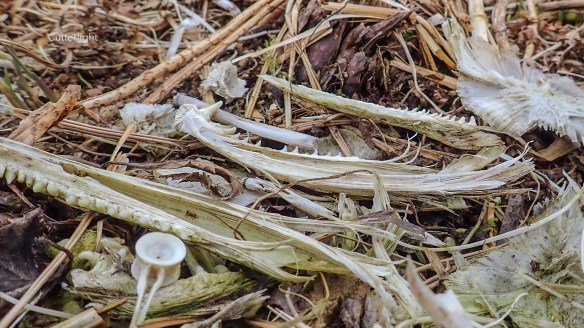
Above are the remains of a couple of salmon that became a brown bear banquet. Last fall, the Chignik system filled with the highest number of Pink and Silver Salmon anyone had seen in a long time. Fat autumn bears make for fat spring cubs. 

On both sides of the creek, the vegetation had been trampled down in broad swaths, a sure sign that bears heavily use this stream. Sure enough, when we looked down we found the area littered with the winter-bleached spines, gill plates, and tooth-filled jaws of Pink Salmon. We agreed that we’d have to make sure to fish the stream this fall when sea-run char marked in spectacular greens, reds and oranges would follow Pinks into the stream to pick off eggs that aren’t successfully buried in the redds. In places where stands of alder choked down foot traffic, the narrow trails had been worn inches deep into the soil, the work of centuries or perhaps millennia of brown bear comings and goings. Along the shoreline, every patch of sand held a carpet of fox tracks, some old, some fresh.

By the time we returned to our raft, the morning sun was high and temperatures had climbed into the 40s. Millions of tiny black midges were hatching, skittering across the water as they struggled to free themselves from the husks of their pupal stage – activity that was eliciting slashing rises from pinky-sized salmon as well as a few larger char. Mixed in with the midge hatch were a few dark stoneflies as well as big, creamy-brown caddisflies. With days warming and insects hatching, our swallows should be on their way.
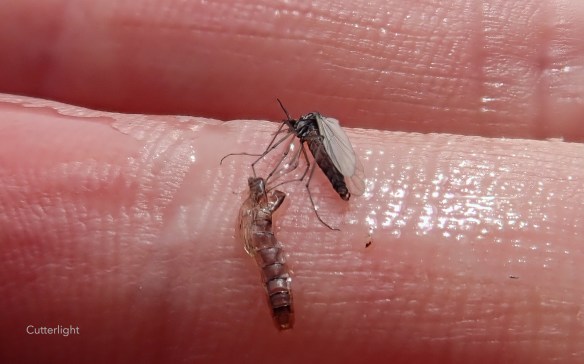
They’re small, but to some of our favorite fish and bird species (trout, char, salmon and swallows) they are indispensable food items. They’re midges, order Diptera from the Greek indicating that they use two wings to fly. During a hatch such as the one we found ourself in the midst of, midge pupae trap gas in their thorax, ascend to the water’s surface, shake off their pupal exoskeleton and emerge as winged adults – as this one on my ring finger has just done.

Drifting along the rocky bluff across from the salmon-counting weir that the Department of Fish & Game operates from June through September, we came across two large piles of sticks in the still leafless alders – active magpie nests, egg-shaped and roughly the size of a couple of basketballs. Our chickadees, too, seem to be establishing territory and selecting mates, and everywhere new green shoots are pushing up through winter-browned grass.
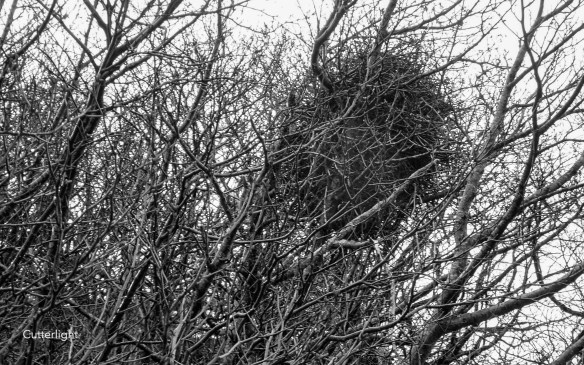
Chignik’s magpies began nesting about two weeks ago, giving away locations as they ferry large sticks into thick, brush growth along banks or into spruce trees. Somewhere in that jumble there very likely are half-a-dozen or so lightly speckled gray-green eggs. 

We beached the boat at the barge landing, deflated it, rolled it up, stuffed it in a backpack and began the three-mile hike home. Along the way we took note of bright green salmonberry shoots, the beginnings of wild irises, an unfamiliar warmth in the air. Earlier in the week it had snowed. But winter’s fighting a losing battle at this point. And every living thing knows it.

Another $8 Cookie, Please

The best chocolate chip cookie on the planet? There’s one way to find out!

Break out all the best ingredients you’ve been hoarding and make yourself a batch of these…now!

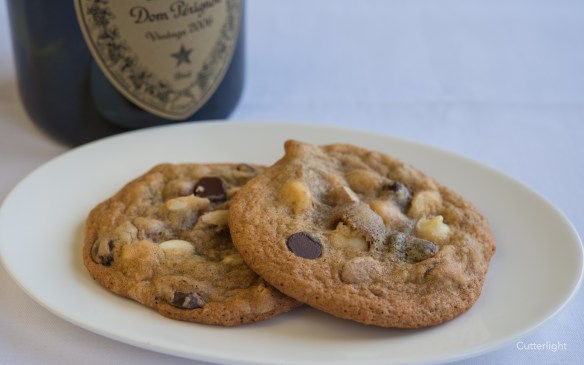
A couple of years ago, I read about a cookie that really sells for $8. Could I create a cookie worth such a price? Oh boy, yes! The secret to this cookie is not gold flecks or a butler to serve it, but fine ingredients and an investment of some time. The recipe demands high quality chocolates, browned butter, toasted almonds, and vanilla paste. Serving them slightly cooled from the oven is a key to the experience. I make a batch of dough, cookie scoop out portions and freeze them. When we are in the mood for these decadent beauties, I pop a couple in the oven while we are eating dinner in order to serve them as a perfectly warm $8 dessert.

The $8 Cookie

Ingredients

  • 1 large egg
  • 1/3 cup dark brown sugar
  • 3 tbsp granulated sugar
  • 1/3 cup unsalted butter, browned
  • 2 tsp vanilla paste
  • 1/2 tsp almond extract
  • 3/4 cup plus 2 tbsp all-purpose flour
  • 1/2 tsp baking soda
  • pinch salt
  • 1/3 cup toasted almonds, chopped
  • 1/3 cup good quality milk chocolate chips
  • 1/3 cup good quality white chocolate, chopped

Directions

  1. Mix the sugars and the egg well.
  2. Add in the browned butter.
  3. Mix in vanilla paste and almond extract.
  4. Stir flour, baking soda and salt into the mixture.
  5. Fold in the almonds and chocolate pieces.
  6. Chill the dough for at least 1 hour.
  7. Line a baking sheet with parchment paper.
  8. Preheat oven to 325 degrees F (160 degrees C).
  9. Scoop tablespoon-sized balls using a small ice cream scoop onto the baking sheet. Bake for 8 – 10 minutes.
  10. Let the cookies set on the baking sheet for about 3 minutes before removing them to a wire cooling rack.
  11. Continue to cool for another two minutes on the wire rack.
  12. Serve cookies while still warm.

Makes 12 cookies.

Move Over Bacon – Smoked Wild Salmon Fried Rice

A dollop of homemade ikura adds a tasty finishing touch to a bowl of Alaskan soul.

You know it’s a good day when a recipe for bacon fried rice shows up in your inbox. That’s just what happened a few days ago when our blog friend Chef Mimi posted a recipe for this very dish. Who doesn’t love fried rice? The slightly nutty flavor of sautéed day-old rice tossed with scrambled eggs and onions is a regular on menus from Kodiak to Kyoto. Add bacon, and a favorite truism comes into play: anything is better with bacon. Right?

Well, we actually didn’t ship out any bacon in our annual shopping this past year. Don’t worry, we’re hardly turning vegan. 😉 We just decided that as much as we love the flavor, the texture, the – well, everything – about bacon, it really isn’t good for our health. We’ve discovered that we can substitute smoked salmon in most recipes that call for bacon and be very satisfied.

Enter Chef Mimi’s recipe for bacon fried rice. A quick check of our pantry revealed that we had on hand most of the ingredients she uses and delicious substitutions for those we didn’t. A swap of smoked salmon for bacon, a switch of snow peas for petite peas, a few extra splashes of flavors we have around and, voila, we came up with an Alaska twist which came out beautiful and delicious. We give you Smoked Wild Salmon Fried Rice.

Smoked Wild Salmon Fried Rice

Ingredients

  • 4 cups cooked rice, leftover rice works great
  • 1 tbsp fish sauce
  • 1 tbsp soy sauce
  • 1 tbsp lime juice
  • 1 tbsp mirin
  • 2 tbsp extra virgin olive oil
  • 1 1/2 cups diced sweet onion such as Walla Walla
  • 1/4 cup chopped garlic
  • 1/2 cup diced carrots
  • 1 cup chopped snow peas
  • 3/4 cup canned corn
  • 2 large eggs, lightly beaten
  • 8 oz. smoked salmon

Directions

  1. Set out cooked rice to bring to room temperature.
  2. In a small bowl, mix together fish sauce, lime juice, soy sauce, and mirin. Set aside.
  3. In a large pan, heat oil over medium-high heat.
  4. Sauté onions for about 2 minutes.
  5. Add garlic and continue to cook for about 2 additional minutes.
  6. Add carrots and sauté for another 2 minutes.
  7. Mix in snow peas and corn. Cook for an additional minute.
  8. Gently stir in rice. Let mixture heat thoroughly.
  9. Make a well in center of pan.
  10. Add eggs and scramble them in the well.
  11. When eggs are just cooked through, add in salmon.
  12. Stir entire mixture so that all ingredients are evenly distributed.
  13. Toss the rice mixture with fish sauce mixture.
  14. Optionally, garnish with green onions, or salmon roe.
  15. Serve immediately.


Two Thumbs Up – Meet the Alula

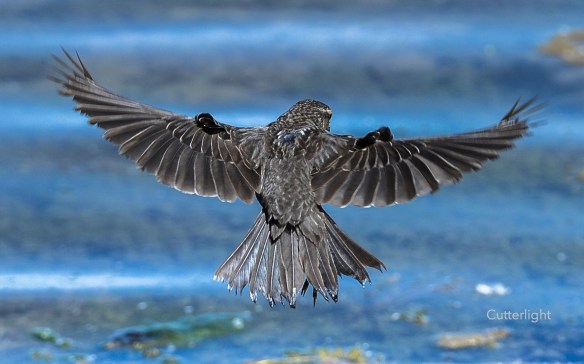
Hovering as she hunted for flying insects at a Montana pond, this female Red-winged Blackbird was able to keep from “stalling out” by redirecting air flow over her wings with her alulae, the tufts sticking up on the fore edge of her wings.

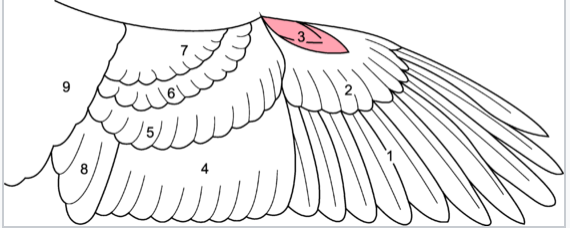
It’s easy to find oneself marveling at the ease and grace with which a raptor or songbird flies – the seamless changes of direction, the steep climbs, the ability to hover, the smooth landings. Aiding in these intricate maneuvers is a small tuft of tiny feathers that the bird can manipulate to create a pocket of whirling air – a vortex – which helps it finesse some of its most amazing moves.

It appears that the alula evolved approximately 130 million years ago during the Cretaceous Period, first in genus Protopteryx and a few million years later in Eoalulavis, or Dawn Bird. Earlier species such as the bird-like dinosaur Archaeopteryx, Old Wing, lacked alulae, indicating that while they probably were capable of gliding, they most likely did not fly in the sense that modern birds fly.


Bearing 3 to 5 small, asymmetrical flight feathers, the alula is found on modern bird species as well as on some pre-avian dinosaurs that were capable of flight. It’s the bird’s first digit, analogous to the human thumb. Illustrations courtesy of: Muriel Gottrop – https://commons.wikimedia.org/wiki/File:BirdWingFeatherSketch.png