Ikura: Curing Salmon Eggs

Ikura, transluscent, close_n

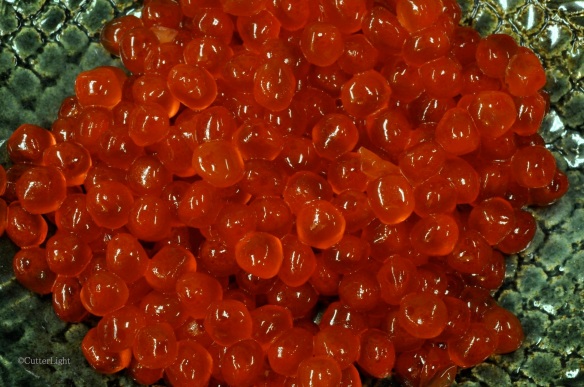
Like fire opals lit from within, freshly cured salmon eggs are ready to be served as ikura sushi, sprinkled on a bowl of rice (ikuradon), as a seafood garnish, with cream cheese and rice crackers, or simply gobbled by the spoonful!

At $40 to $50 a pound wholesale (and more expensive than that at the grocery store, when you can find it), cured salmon roe is not a regularly featured food in most kitchens. But if you catch your own salmon – or are friends with someone who does – it can be. Although the process of curing fresh salmon roe is somewhat time consuming, it is not difficult, and with patience almost anyone can turn out a sushi-grade batch of this delicacy.

Salmon eggs, King, in sacs_n

These two matching skeins of eggs, or roe sacs, from a Chinook salmon were frozen this past summer and went into one of our ice chests when we flew to our home in Point Hope, Alaska this fall. Japanese chefs typically prefer the eggs of chum salmon (they’re big), but the eggs from any salmon species are fine. In fact, very attractive cured roe can be made from the smaller eggs of large char, too.

Whether you use fresh or fresh-frozen eggs, the first step (once the roe is completely thawed) is to separate the individual eggs from the skein. The riper the eggs, the easier this process will be. There’s a trick that makes this process much easier than it might otherwise be. Bring a pot of water to a temperature of about 120 degrees Fahrenheit and plunge the whole skein into the hot water. Remove the pot from heat and gently swirl the eggs around. You’ll probably want a pair of nitrile or plastic gloves for this. As you do this, you’ll notice the eggs becoming opaque – cream colored. They’ll look as though you’ve ruined the batch. You haven’t.

Ikura after soaking in hot water_n

Hot water temporarily colors the roe and makes it easier to remove from the membranous roe sac. Provided you have kept the water temperature below 140° F, do not be concerned if your eggs become whiter and more opaque than those in the above photograph.

Next, pour the eggs and the water into a strainer. Plastic colanders, with their smooth surfaces, work well for this step. A lot of the extraneous tissue will drain off at this point. Place the strainer with the eggs in a large pot, fill with cold water, and continue to swirl the eggs around. The fat and other unwanted tissue will tend to rise above the eggs and can be skimmed off with a wire mesh skimmer. Some of the eggs will still have tissue attached. These can be cleaned by hand.

Ikura before and after being cured_n

Left: Salmon roe separated and cleaned and ready to be cured. Right: the finished product – fresh, salty ikura.

The next step is magical. For each cup of salmon roe, add just less than a teaspoon of salt. Finely ground sea salt or kosher salt works best for this step. Gently but thoroughly mix the salt into the eggs with your hands. The eggs will immediately begin to turn bright and translucent. Taste and roe and, if desired, add additional salt.

Finally, place the eggs in a strainer one more time to allow excess liquid to drain off. The cured roe will keep for several days in the refrigerator. It can also be kept in the freezer in tightly sealed jars.
Ikura on plaice plate_n

One you get the basic method down, you can substitute soy sauce for some of the salt or add a splash or two of sake (酒) to create subtly different flavors.

We serve ikura on everything from scrambled eggs to seafood pizza, as well as on traditional Japanese dishes such as chawan-mushi and zaru soba. Below, they add a splash of color and flavor to crepes wrapped around smoked Alaskan salmon and herbed cream cheese.
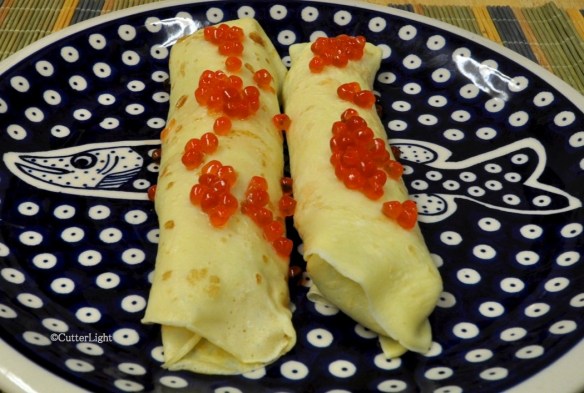
Crepes w smoked salmon & herbed cheese_n

Moose and Spinach Cannelloni with Homemade Ricotta and Homemade Pasta

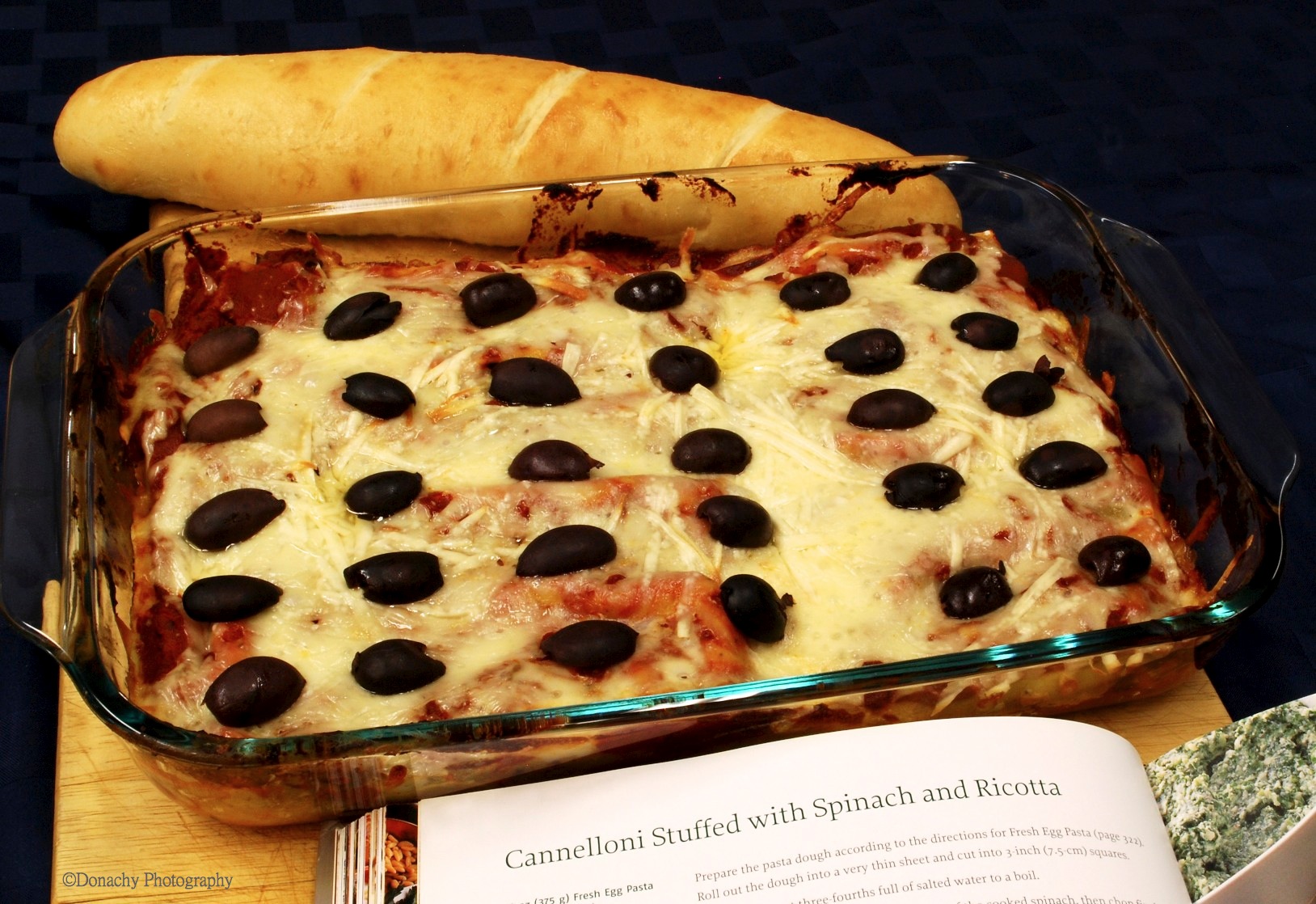
New Traditions. Smothered in mozzarella and parmesan and topped with Kalamata olives, 10 individual cannelloni pastas stuffed with homemade ricotta cheese, ground moose, and spinach await dinner guests.

Cooking in bush Alaska requires a certain amount of ingenuity and flexibility. Last year when I made a couple of pans of moose lasagna, with no ricotta cheese on hand I substituted mozzarella and called it lasagna anyway. It was excellent. The hot, stringy mozzarella was reminiscent of a deep dish Margherita pizza.

When a friend gave me a few pounds of moose again this year, Barbra said, “I’ll make you ricotta cheese for your lasagna.” She also made the pasta – 20 five-inch-by five-inch squares, ready to be rolled around ricotta cheese, spinach, sautéed  moose burger and tomato sauce. This is not traditional cannelloni, but, like last year’s lasagna, has twin roots in Italy and Alaska.

A serving of two moose, spinach and ricotta cannelloni fresh out of the oven. Each cannelloni (literal translation, “big reed”) is a five-inch-long cylinder of fresh pasta wrapped around ricotta cheese and other ingredients. 

Moose and Spinach Cannelloni

Ingredients for one 13 x 9 inch baking dish:

  • 1/2 pound ground moose, sautéed in olive oil till browned
  • pasta to make ten 5 x 5 inch tubes (cannelloni). (Or substitute store-bought manicotti.)
  • three 6-oz. cans tomato paste with enough water to thin the sauce to the thickness of marinara sauce
  • fresh spinach, cut so that the leaves will easily fit into cannelloni tubes (or substitute frozen spinach)
  • 1 1/2 cups ricotta cheese
  • 1/4 pound mozzarella cheese grated (about 1 cup)
  • 1/4 cup parmesan cheese grated fine
  • 1 1/2 tablespoons Italian herbs, separated into 2 equal parts
  • 1 tsp ground fennel (optional)
  • 2 or 3 cloves garlic, minced
  • several grinds of black pepper
  • 2 tbsp olive oil
  • salt (optional)
  • additional mozzarella and parmesan cheese to top cannelloni before baking (optional)
  • Kalamata olives, sliced in half lengthwise (optional)

Directions:

  1. Preheat oven to 350 degrees F.
  2. Place tomato paste, garlic, olive oil, black pepper, half the Italian herbs, fennel (and salt, if desired) in a nonreactive bowl and mix together, adding water to thin till sauce is just pourable.
  3. Cover a 9 x 13 inch baking dish with a layer of tomato sauce. Set aside remaining sauce.
  4. Place ricotta, mozzarella and parmesan into a large bowl. Add remaining Italian seasoning, a few grinds of pepper and mix together well by hand.
  5. Shape a piece of ricotta blend so that it lays end-to-end across one of the pasta squares. Position a few pieces of spinach leaves next to the ricotta. Use a spoon to lay down a thin bed of tomato sauce Add moose meat. Roll the pasta into a tube, pinch/press closed and position the tube seam side down atop the tomato sauce in the baking dish.
  6. Repeat till all the pasta squares have been filled and placed in the baking dish. Cover the cannelloni with the remaining sauce.
  7. (Optional). If desired, sprinkle grated mozzarella and parmesan atop the sauce-covered cannelloni. Top with Kalamata olives.
  8. Cover baking dish with aluminum foil and place on center rack of oven. Bake for 30 minutes.
  9. Remove foil and finish baking for an additional 5 to 10 minutes – to melt and lightly brown the cheese.

Homemade “Ricotta” – A Successful Experiment with Powdered Milk and Powdered Cream

Simple, delicious cheese you can make at home without any additives or preservatives. What a revelation! Perfect for cannelloni, lasagna, cannoli, ravioli, calzone or the Indian dessert Ras Malai.

A culinary goal for my Arctic kitchen this year was to experiment with cheese-making. I’m all for anything we can make at home in order to reduce our consumption of chemicals, stabilizers, and other weird junk. In addition to the drawbacks of processed foods, our Native Store here in Point Hope isn’t much larger than a typical quick-shop convenience store, and often doesn’t have items we need. Last year, a friend brought up ricotta cheese for us. This year, I decided to make my own.

Our store does not sell cream or whole milk, so my experiment with homemade cheese had one unusual ingredient – dried milk and cream. The only powdered milk I could find during our annual summer shopping in Anchorage was non-fat. Yuck. Thank goodness for the Internet! And especially thank goodness for Amazon’s free shipping. I bought two large cans of powdered whole milk (apparently abundant in Mexico!) and a can of powdered 72% butterfat cream. These would be the main ingredients for my “ricotta.” And by the way, the end product – made with powdered ingredients – was delicious.

The cheese that resulted is not a true ricotta, but is more like an unpressed paneer – with a slightly tangy, lighter taste than ricotta. In any case, it’s going into Jack’s moose cannelloni later today, rolled into homemade cannelloni tubes. Yum!

Homemade “Ricotta” – Perfect for Sweet or Savory Dishes

Ingredients

  • 2 cups whole milk powder
  • 1 cup powdered cream
  • 8 cups of water
  • 4 tbsp distilled white vinegar
  • 1/2 tsp salt

Directions

  1. Place powdered milk and cream into a large pot. Add water. Whisk until incorporated.
  2. Heat mixture until it steams but doesn’t boil (between 165 and 180 degrees F using an instant read or candy thermometer).
  3. Remove from heat.
  4. Slowly stir in vinegar. Milk should curdle.
  5. Stir in salt.
  6. Cover pot with clean cloth and let sit for 2 hours.
  7. Line colander with cheesecloth. I read paper towels or a kitchen towel will also work.
  8. Scoop curds out of pot and into lined colander.
  9. Let whey (watery substance) drain out of curds. I let it drain overnight in the refrigerator because I wanted a less watery product for the lasagna.

Baked Lingcod with Lobster Sauce: Celebrating The Rough, Tough King of Northern Pacific Reefs

Seasoned breadcrumbs, lobster sauce with Alaskan shrimp, and a couple dabs of lumpfish roe are fitting accompaniment for one of the sea’s most prized fish – lingcod. This fillet is served on a bed of couscous and is surrounded by thin slices of Coho salmon sashimi. Recipes can be found at the end of this article.

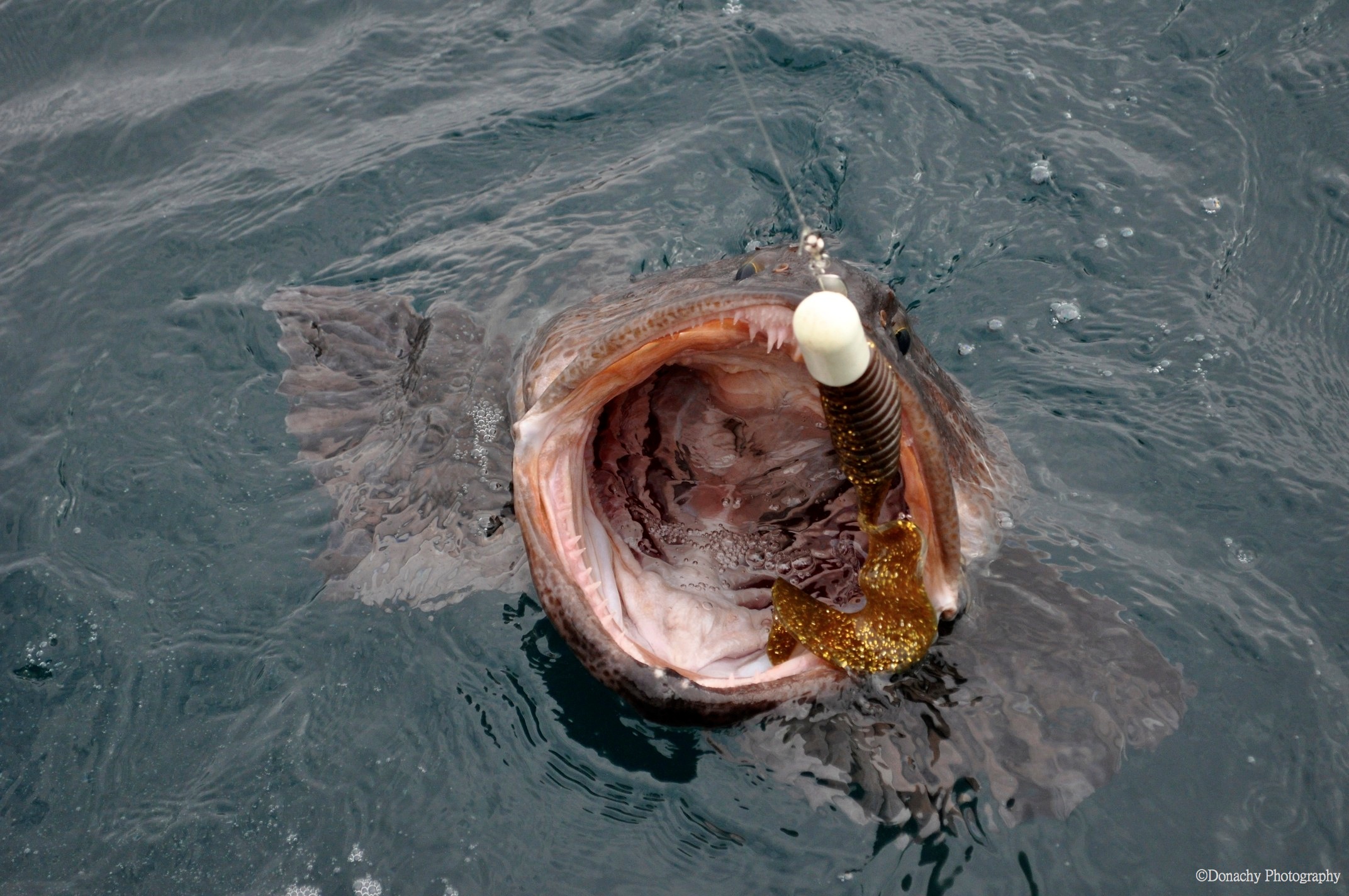
Lingcod (Ophiodon elongatus – long tooth) are a special fish. Their leopard-like spotting marks them for what they are: aggressive predators that, save for other, bigger lingcod, are at the top of the food chain among the fish with which they share rocky Northern Pacific reefs. They lie in ambush, waiting for unsuspecting greenling, rockfish, octopuses or whatever else might happen by, and then spring into action with massive jaws encircling 18 needle-sharp teeth. In the heart of their range – from British Columbia through Southcentral Alaska – 20 to 40-pound lingcod are common, with fish over 50 pounds showing up each year. The all-tackle IGFA record stands at 82 lb 9 0z and came from the Gulf of Alaska. Larger fish have been reported in commercial catches.

Welcoming a nice ling aboard our C-Dory 22 Angler. Note the two-pound rockfish hanging from the lower end of the metal jig.

A few of the usual customers you can expect to run into dropping a metal jig off a deep, rocky point in Alaska: salmon, rockfish, and a lingcod. 

Lings thump a jig like few other fish, and although pound-for-pound the smaller eight to 20-pounders seem to fight harder than the big cows, all lings generally give a good account of themselves, typically peeling line from reels as they dive for the rocks after being hooked. Many an angler has hooked a two or three pound

A 10″ twister tail grub on a 1 pound jighead is dwarfed in the maw of a 40-pounder. Root beer is a favorite color among lingcod fishermen. Here the color is paired with a glow-in-the-dark jig.

rockfish and while reeling in the catch had it violently intercepted by a lingcod. Frequently in these cases, the ling isn’t even hooked, but will hang onto its catch as tenaciously as a bulldog, fighting all the way to the boat where, if the angler is quick-witted enough, it can be gaffed or scooped up in a net. A moment’s hesitation, slack line, or lifting of the hitch-hiking ling’s head above water, however, can cause the predator to release its prey and nonchalantly swim back to the bottom.

If I had just one type of lure to fish rocky reefs, there’d be no contest as to what I’d choose: metal jigs in the right hands are deadly. 

On the table, it is our view that lingcod is unsurpassed among white-meated fish. It compares favorably with grouper, halibut, snapper, and similar fish whether baked, broiled, pan-fried or deep-fried. Interestingly, the meat of fresh lingcod is sometimes blue. This does not affect the flavor or texture at all, and when cooked, the meat comes out in big, white, flakey chunks.

Lingcod are susceptible to overfishing. Most of the ones we catch go back to keep growing and to sustain the population.

Baked Lingcod with Breadcrumbs

Ingredients (serves 4)

  • 24 ounce lingcod fillet cut into 4 separate pieces, skin removed
  • 1/2 cup olive oil, placed in a bowl
  • 2 cups seasoned breadcrumbs (We make our own breadcrumbs and season them with an Italian seasoning blend of our own making, but any good commercial blend is fine.)
  • salt
  • freshly ground pepper
  • Additional olive oil for baking

Directions

  1. Place a baking sheet on the center rack of an oven and preheat to 425 degrees F.
  2. Place breadcrumbs in a bowl and season with Italian seasoning, salt and pepper to taste. Then transfer 1 1/2 cups of breadcrumbs to a plate where you will roll the fillets, and spread the remaining 1/2 cup of breadcrumbs on a cutting board where you will rest the fillets once they’re coated with breadcrumbs.
  3. Dip fillets one at a time in olive oil and completely cover with oil. Then roll the fillet in the breadcrumbs, covering all sides. Place atop breadcrumbs on cutting board.
  4. Coat baking sheet with olive oil. When oil is sizzling hot, place fillets on baking sheet and bake for about 10 minutes (for fillets that are 1 inch thick). Breadcrumbs should be golden brown when fillet is done.
  5. Remove fillets from oven and place on a bed of couscous, rice or farfalle pasta.
  6. Spoon lobster sauce on fillets. Garnish with caviar, lumpfish roe or ikura (cured salmon eggs) and serve piping hot.

Lobster Sauce with Alaskan Shrimp

Ingredients

  • 1 tablespoon Better than Bouillon lobster base or similar lobster base
  • 1/4 pound peeled shrimp. Small shrimp are preferable; larger shrimp can but cut into smaller pieces.
  • 1/2 cup water
  • 1 cup heavy cream
  • 1 1/2 tablespoons rice flour (or substitute all-purpouse flour), as a thickener
  • 1 tablespoon butter
  • 1 tablespoon olive oil
  • 1/4 cup finely chopped sweet onion
  • 1/4 tsp paprika
  • 1 teaspoon dried tarragon
  • Freshly ground pepper
  • Salt, if needed

Directions

  1. In a small pot over medium-low heat, place olive oil and onions. Stir occasionally till onions begin to turn translucent.
  2. Lower heat and add water and lobster bouillon, stirring until mixed together.
  3. Add rice flour, tarragon, pepper, paprika and butter, stirring constantly until flour is completely mixed in and mixture begins to thicken. Cover and lower heat (use a flame tamer if necessary).
  4. Add cream a little at a time, stirring constantly, until desired consistency is achieved.
  5. Add shrimp. Continue to stir until shrimp is cooked through (about 2 to 3 minutes).
  6. Remove pan from heat, but keep warm until sauce is needed.

Matcha Green Tea Ice Cream

A Japanese ramekin heaped with a couple of scoops of matcha ice cream is the perfect dessert after a sushi dinner.

A few years ago after a lovely meal at a Japanese restaurant in San Francisco, I enjoyed a scoop of creamy green tea ice cream. Inspired by that memory and an abundance of matcha tea powder in our pantry, I attempted to recreate that delicious dessert. The intense flavor of the matcha powder gave this ice cream a rich, complex flavor. Keeping with Japanese preferences, this recipe calls for only about half the sugar American palettes might prefer, but is still satisfyingly sweet.

Matcha Green Tea Ice Cream

Ingredients

  • 3 cups heavy cream
  • 1 cup whole milk
  • 3 egg yolks
  • 1/4 cup sugar
  • 2 tbsp matcha green tea powder
  • 1 tsp vanilla bean paste

Directions

  1. Heat cream and milk in a medium saucepan over medium heat.
  2. Add vanilla paste and green tea powder and heat until mixture almost boils, about 5 – 8 minutes.
  3. Reduce heat to low.
  4. Meanwhile, beat yolks and sugar until the mixture is light yellow and smooth.
  5. Add 4 tbsp on hot cream mixture to egg mixture and stir until combined. This will temper the eggs.
  6. Slowly add warmed yolk mixture to warm cream. Stir continuously in order to not cook/curdle eggs.
  7. Cook entire mixture over low heat until slightly thickened and mixture coats the back of a spoon.
  8.  Cool completely. I put the mixture in the refrigerator overnight before I use it.
  9. Pour into freezer bowl of ice cream machine. Turn machine on and mix until mixture thickens, about 20 minutes.
  10. Transfer to airtight container and place in freezer until firm, about 2 hours.

If you liked this post, you might like to read about matcha green tea cookies.

Smoked Salmon Quiche and Butternut Squash Pie: Savory and Sweet Breakfast (or Dinner)

Savory smoked salmon quiche, sweet butternut squash tarts, a strip of smoked salmon and a mug of black French roast coffee make for a hearty Fisherman’s Breakfast. 

Whether served as breakfast, lunch or dinner, we’re big fans of quiche. It’s easy to make, and since it’s delicious either hot or cold, there are no complaints about leftovers. In making this particular quiche, I set out to resolve two questions. First, would smoked salmon that has been frozen and then thawed work well, and second would the Penzeys dried shallots I’d recently gotten live up to their billing. I’m happy to report that the smoked salmon seemed to suffer not at all from freezing, and the dried shallots were flavorful enough to merit making them a standard part of our kitchen here in the Alaskan bush.

For the squash pie, I used a modification of Craig Claiborne’s pumpkin pie recipe that has long served well. Since the baking times and temperatures for these two pies was similar, I baked them together. We had a bit of squash purée and pie crust dough left over, so Barbra used a muffin pan to make a few squash tarts.

Smoked Salmon Quiche

Ingredients:

  • 1 pie crust
  • 4 large eggs
  • 3/4 cup heavy cream
  • 1/2 cup milk
  • 1 cup shredded Swiss or Gruyère cheese
  • 1/4 cup shallots chopped fine (I used Penzeys dried shallots,which were excellent)
  • 1/2 cup mushrooms, cut into less-than-bite-sized pieces
  • 1/3 to 1/2 pound smoked salmon, cut into less-than-bite-sized pieces
  • 1/3 cup sun dried tomatoes, cut into small pieces
  • 1 tsp dried majoram
  • sea salt to taste
  • freshly ground pepper to taste

Directions:

  1. Preheat oven to 350 degrees F. Bake pie crust for 20 minutes. Halfway through baking, cover edges with aluminum foil or a pie ring to prevent edge of crust from burning.
  2. Remove the pie crust from the oven and set aside.
  3. Turn oven up to 400 degrees F.
  4. Whisk eggs until blended. Add cream, milk, shallots, marjoram, salt and pepper and mix together.
  5. Add mushrooms, sun-dried tomatoes and smoked salmon, mixing together gently so as not to break up the salmon.
  6. Pour and scrape ingredients into the baked pie crust and place on oven’s center rack. You do not need to place on a baking sheet.
  7. Bake quiche at 400 degrees F. for 15 minutes. Turn down oven to 350 degrees F. and continue baking for 25 – 35 minutes – until a wooden toothpick poked into the center comes out clean.
  8. Serve hot or cold.

Butternut Squash Pie

Ingredients:

  • 1 pie crust
  • 3 cups butternut squash (or pumpkin) purée
  • 1/2 cup sugar
  • 1/2 tsp salt
  • 1/2 tsp grated nutmeg
  • 1/2 tsp cinnamon
  • 1/2 tsp powdered ginger
  • 3 large eggs, lightly whisked
  • 2 tablespoons Bourbon (optional, but very tasty)
  • 1 cup heavy cream

Directions:

  1. Preheat oven to 425 degrees F.
  2. Have a chilled, unbaked pie crust ready.
  3. Squash purée: Cut away the stem of the squash and discard. Then slice squash into into round discs approximately 1 inch thick. Cut the disks into 4 to 6 parts. When you get to the bulb, remove the seeds and fibrous part and slice into 6 strips as you would a pumpkin or melon. Steam, oven roast or grill the squash until a fork passes easily through the flesh. Let cool and cut off the skin. Use a stick blender, regular blender or food processor to purée the squash.
  4. Combine the purée with all the other ingredients in a large mixing bowl, blend together, and pour into the chilled pie crust.
  5. Place on oven’s center rack. Bake for 15 minutes, then reduce heat to 350 degrees F. and continue baking for 30 or 40 minutes, until the filling is set. Cracks will begin to appear on the surface of the pie when the filling is set.
  6. Serve warm or chilled, with or without whipped cream.

For a great recipe for making smoked salmon, see Smoked Salmon with Soy Sauce and Brown Sugar Brine.

Portabella Cap Stuffed with Yelloweye Rockfish

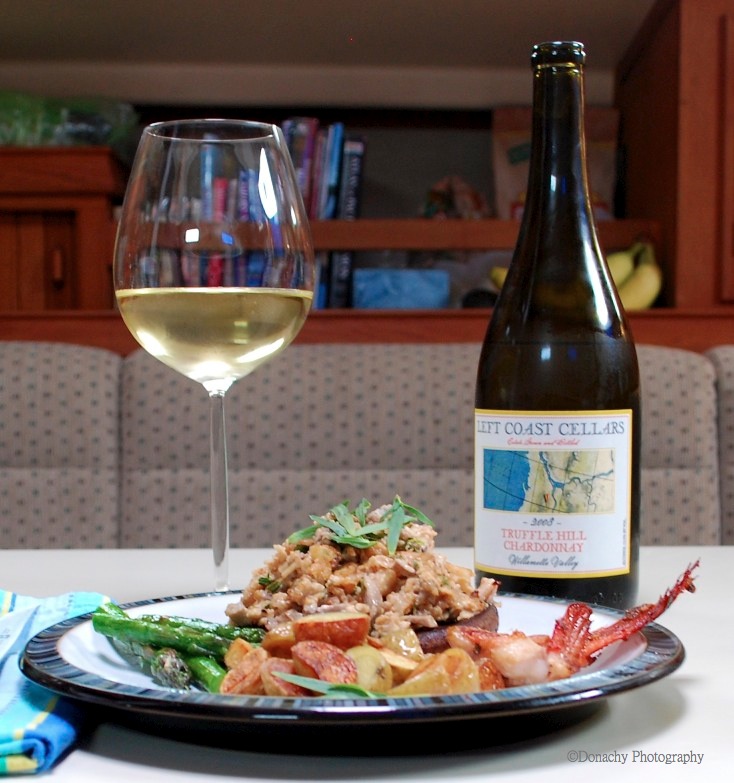
This summer’s fishing has brought us riches of our one of our favorite species, Sebastes ruberrimus, yelloweye rockfish. The collar meat of yelloweye, especially the smaller two to five pound fish, has a lobster-like texture and taste that we’ve enjoyed experimenting with and have even served as one would lobster with drawn butter. In this creation, we combined yelloweye with another favorite, Portabella mushroom caps, and paired it with a Willamette Valley Chardonnay for one of the easiest and best meals of the summer.

Ingredients for two servings:

  • ½ pound collar meat from yelloweye rockfish, chopped into small pieces. (Substitute similar fish such as red snapper, red porgy, striped bass or walleye)
  • 2 portabella mushroom caps, stems removed
  • 2 portabella mushroom stems (from above), chopped coarse
  • egg whites from 2 eggs
  • 2 or 3 cloves garlic, chopped fine, divided into equal parts
  • ½ cup rice crackers (sesame flavor is good) crumbled fairly fine
  • 2 tsp soy sauce, separated into 1 tsp each
  • 1 tbsp grated parmesan cheese
  • 2 tsp finely chopped tarragon
  • freshly ground black pepper
  • 2 tablespoons sherry
  • olive oil

Directions:

  1. Add enough olive oil to cover the bottom of a frying pan large enough to hold the 2 mushroom caps and heat over medium low heat.
  2. Add the mushrooms, gill side up, and cook for about 5 minutes.
  3. Add 1 tsp soy sauce and half the garlic. Turn the caps and move around so the gills absorb the soy sauce. Cook until mushroom is tender.
  4. Meanwhile, combine yelloweye meat, crackers, parmesan, tarragon, egg whites, chopped portabella stems, a healthy dollop of olive oil, a few grinds of pepper and the remaining garlic and soy sauce in a bowl, mixing ingredients together.
  5. Heat a frying pan over medium-high to high heat (you want enough heat to drive off moisture), add olive oil to cover the bottom, and add the yelloweye mixture, stirring frequently for about two minutes. Add sherry and continue cooking until browned, stirring frequently. Avoid overcooking.
  6. Place cooked yelloweye mixture on sautéed mushroom caps, garnish with a few tarragon leaves, (or, nori, or, better still, a shiso leaf, if available)

We served this dish with home fried potatoes, asparagus sautéed in butter and lemon, and a creamy Chardonnay with touch of oak, toasted almonds, and hints of fall fruit.

Rockfish Meunière on Whole Wheat Pasta

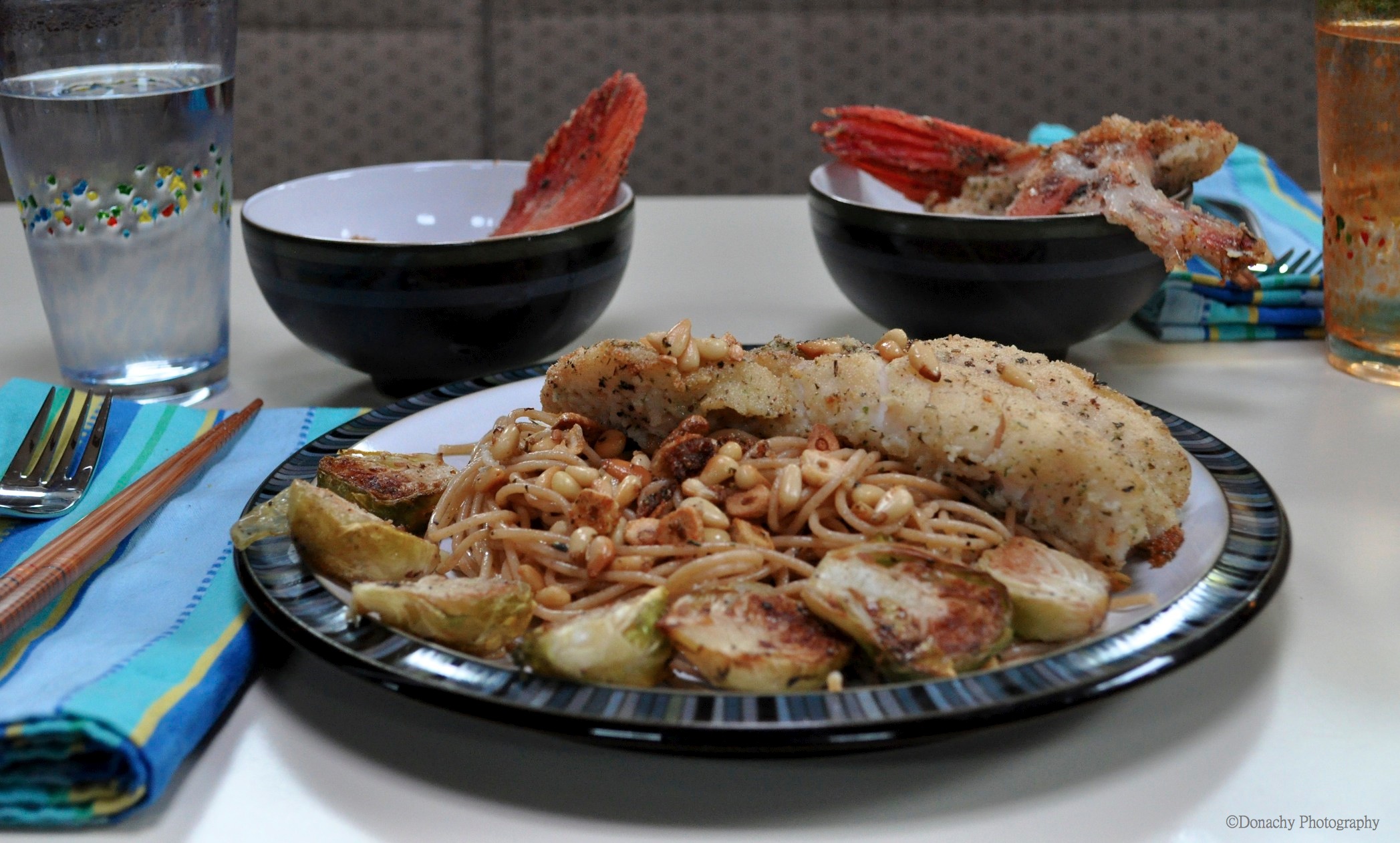
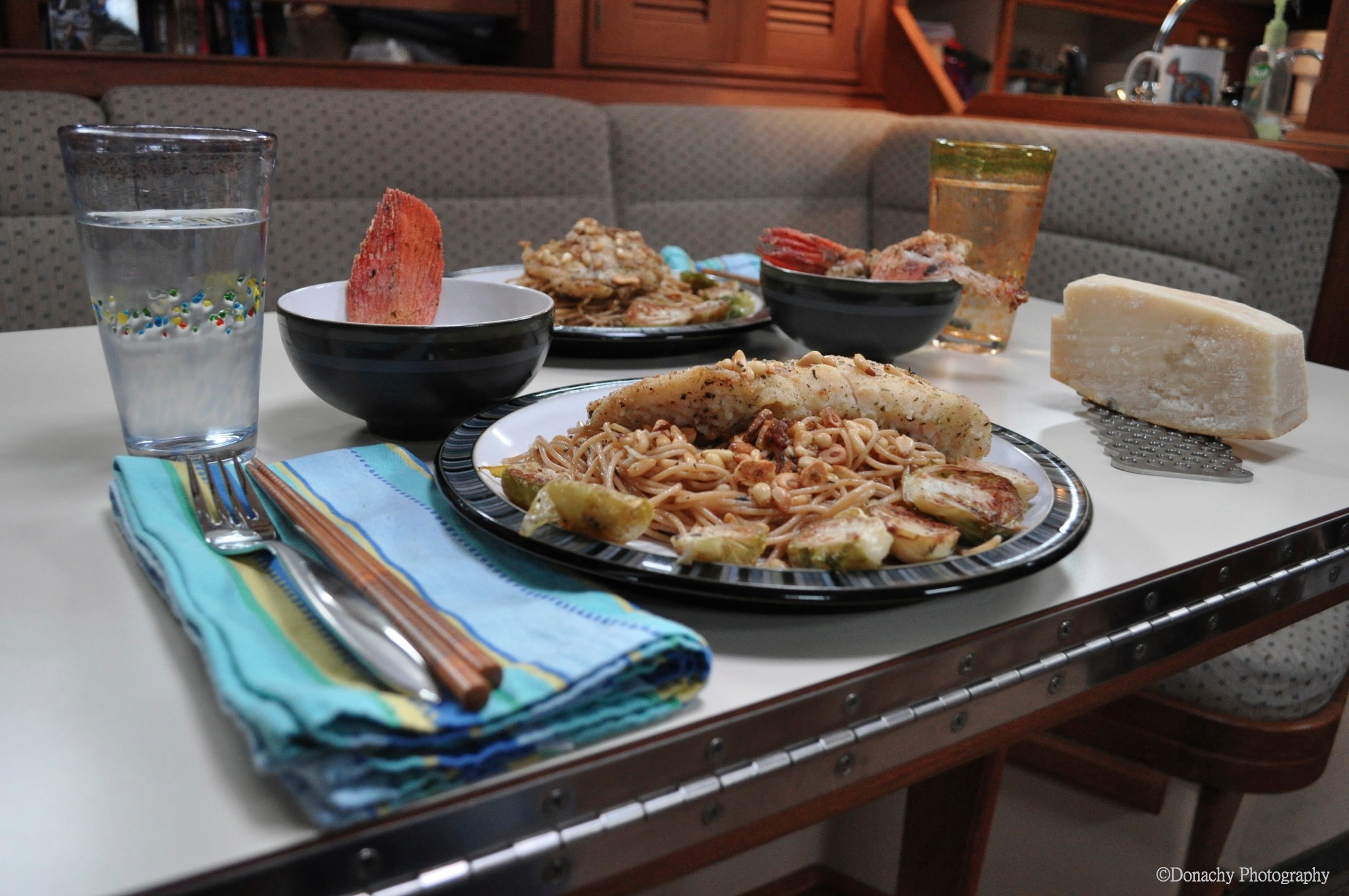
A fillet prepared à la meunière and served on pasta is one of our favorites when cooking with firm, delicately flavored white fish. We modify the traditional recipe, which means “miller’s wife” (descriptive of the flour this method employs) by using olive oil instead of butter and by skipping the lemon and butter finishing sauce.

Our three favorite methods for preparing fish, in no particular order, are as follows: sashimi – raw, thinly sliced fish dipped in a soy sauce and wasabi mixture; shioyaki – fish salted and then broiled or grilled; and à la meunière – dredged in seasoned flour and pan fried. These three preparation methods are the epitome of simplicity, emphasizing the freshness of the fish rather than sauces or seasonings, and can be accomplished in even the most bare-bones of kitchens. While they won’t adequately cover every species of fish (some species do well only when poached, and a few others shine best when deep fried), they are good methods to have in one’s repertoire.

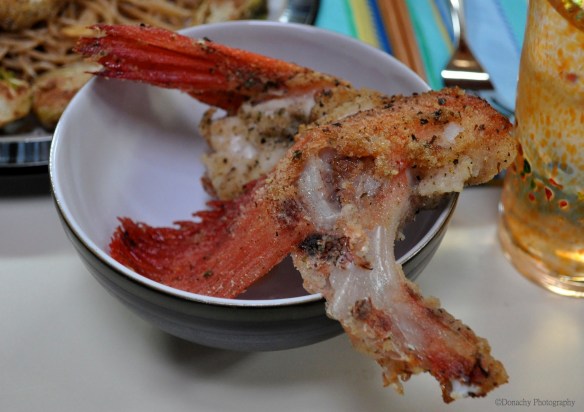
A collar – the meat just behind the fish’s head, including the pectoral and ventral fins – is a good candidate for meunière. Pictured is the collar from a two to three pound yelloweye rockfish.

Each cooking method works particularly well with certain species of fish. Chinook salmon, for example, is a superb fish for shioyaki and a much underutilized sashimi fish. Yellowtail and other tuna are excellent served as sashimi. When you think of meunière, think of fish that is white, firm but not dense, and mildly or even delicately flavored. Some of the best candidates are sole, flounder, greenling and Pacific rockfish in the genus Sebastes such as black rockfish, copper rockfish, yelloweye and so forth.

Rockfish à la Meunière on Pasta for Two

Ingredients:

  • two fish fillets 1/4 to 1/2 pounds each (110 to 230 grams), cleaned, skin removed, rinsed and patted dry with paper towels. Do not use a thick cut of fish for this. The fillets should be fairly thin – less than an inch thick (2.5 cm) as opposed to using part of a fillet from a large fish.
  • 1/3 cup semolina flour. (All-purpose or other flour is fine, but semolina will result in a very pleasant additional crunch and fuller texture to the finished fillet.)
  • 1/2 tablespoon herbs de Provence, plus 1 teaspoon herbs de Provence, separate
  • 1/8 teaspoon sea salt
  • 1/2 teaspoon freshly cracked pepper
  • 3 to 6 cloves of garlic, sliced thin
  • 2 tablespoons pine nuts (optional)
  • 1 tablespoon extra virgin olive oil
  • olive oil for frying
  • enough pasta for two servings
Directions:
  1. Cook pasta according to directions. Drain off water, return to pot and toss with about 1 tablespoon of extra virgin olive oil and 1 teaspoon herbs de Provence. Set aside. (Or do this simultaneously while cooking the fish.)
  2. In a plastic Ziplock bag, or in a mixing bowl or on a plate, mix together the flour, 1/2 tablespoons herbs de Provence, salt and freshly ground pepper.
  3. Thoroughly dredge the fillets in the flour mixture and set aside on a plate or cutting board. Left over flour can be used as a bed for the fillets.
  4. In a frying pan large enough to hold both fillets, add olive oil to about 1/8 inch depth. Heat over medium to medium-low until oil causes a pinch of flour to sizzle.
  5. Position fillets in pan making sure they do not touch. Cook uncovered over medium to medium-low heat for about 3 to 5 minutes.
  6. Carefully turn the fillets over. Add garlic slices and pine nuts and continue cooking for 3 to 5 minutes. The first few times you cook fish this way, you may have to break the fillets apart to check for doneness as it will vary depending on thickness, type of fish and cooking temperature.
  7. Place pasta on dinner plates. Remove fillets from pan and place on pasta. Use a slotted spoon to separate garlic and pine nuts from oil and sprinkle on fish and pasta.
  8. Serve hot with freshly grated Parmesan cheese.

We served the pasta and fillet with a side of fish collars, also prepared à la meunière, and brussels sprouts sliced in half, seasoned with salt and pepper, and pan roasted. This is a simple yet elegant meal that can be prepared in a galley, on a camp stove, or in virtually any kitchen.

Don’t Bogart that Collar, My Friend: Yelloweye Rockfish Melts

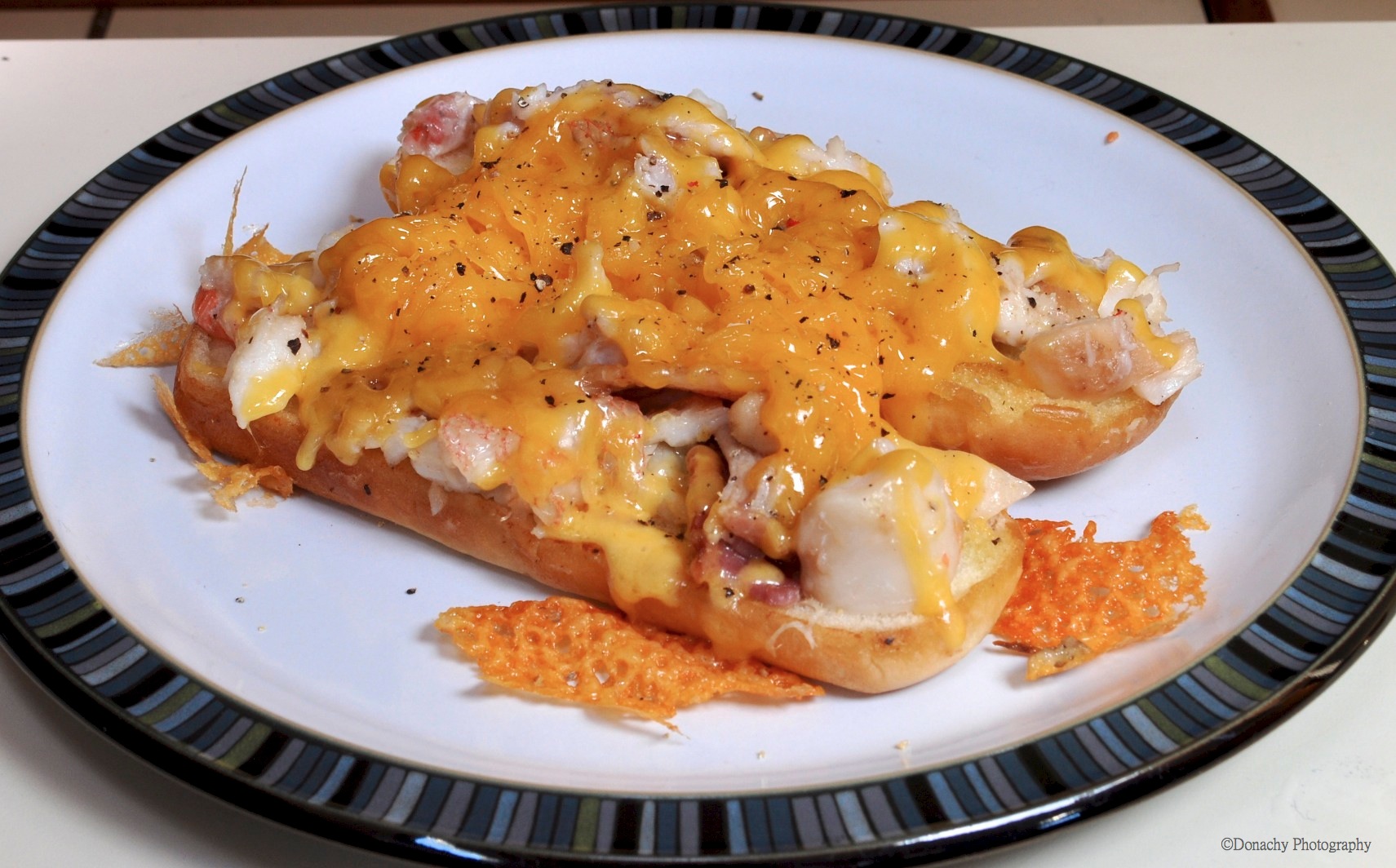
A pan-toasted sourdough bun, a chunky heap of yelloweye rockfish, and Tillamook cheddar cheese along with a couple of grinds each of sea salt and pepper are all you need for a gourmet lunch. The collar meat of yelloweye has a texture and flavor reminiscent of lobster and in similar fashion puffs up when you cook it.

While crab or shrimp are the classic seafoods in a melt, firm, white-meated fish is every bit as good. Enter yelloweye rockfish (Sebastes ruberrimus) collar meat. The large, firm chunks of meat are perfect on melts. Lingcod, halibut, grouper, snapper and freshwater walleye are good candidates for this dish as well, and while collar meat is an excellent choice, any boneless portion of fish works fine.

I like to start with pan-toasted sourdough bread. Heat some olive oil in a frying pan, place in the bread and move the down side around so it become coated with the oil. Cook over medium-lowor low heat till it’s toasted golden brown. Sometimes I add a little butter or some garlic to the olive oil.

Meanwhile, in a separate pan where you’ve also heated a little olive oil, place the fish and cook it over medium-low heat.

If you’ve timed things right, the first side of the bread is toasted and ready to flip at about the same time the seafood is cooked through.

Flip the bread to toast the other side, place the hot, cooked seafood on the toasted side of the bread, cover with shredded cheddar cheese, add a few grinds of pepper and some sea salt, then cover the pan with a lid and continue cooking over low heat till the cheddar is melted.

A few slices of avocado or fresh fruit on the side, a cold lager, iced tea or freshly-squeezed lemon-ade, and you’ve got a quick and easy lunch that will be relished as much by most kids as by gourmets.

Rockfish in Sweet & Spicy Beans with Miso

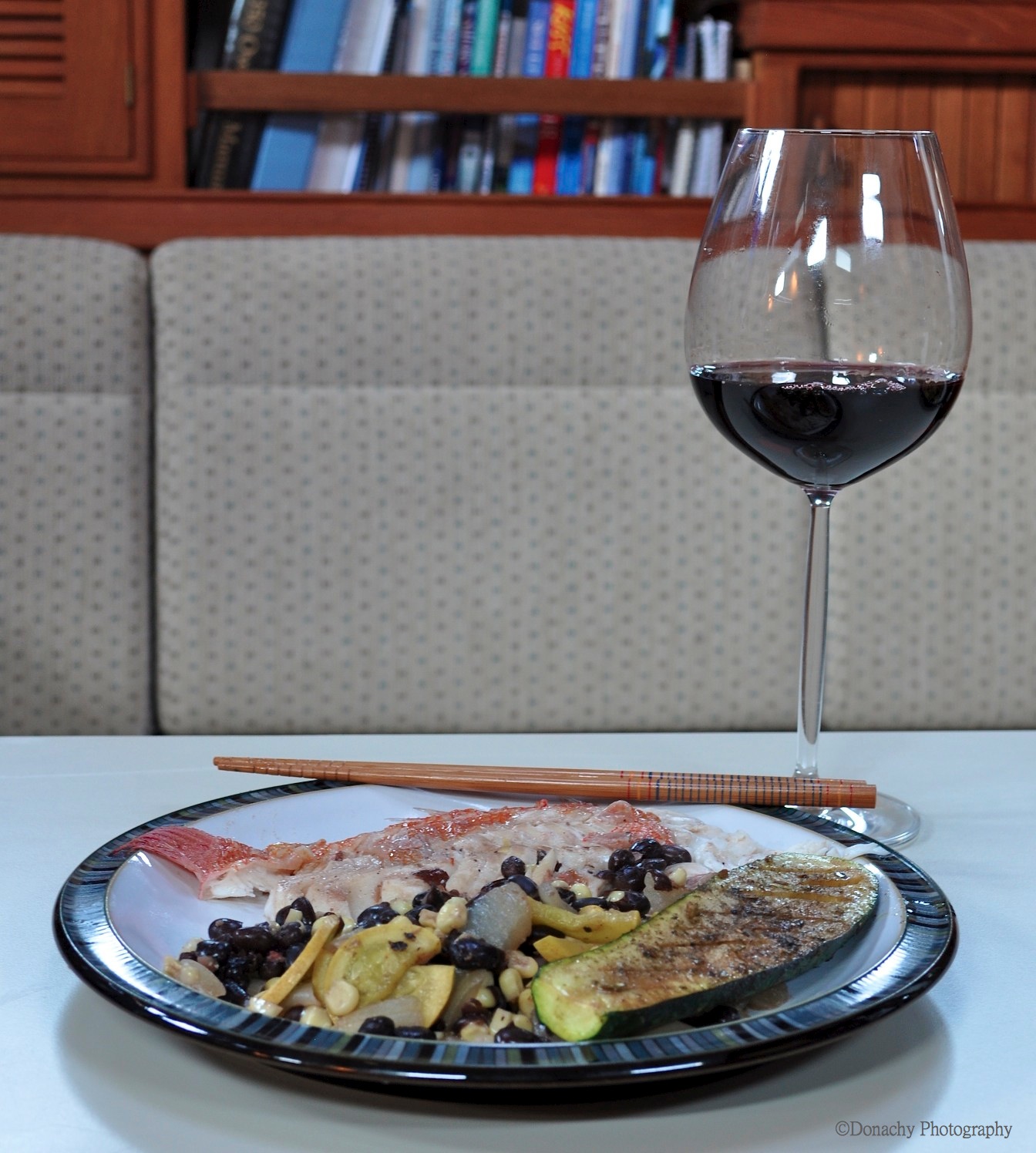
Yelloweye rockfish poached in miso soup with black beens, sweet corn and summer squash. The broth is sweetened with honey and spiced with a Jamaican-style rub for a little heat to balance out the sweet.

In Japan, I was served a dish featuring carp cooked in sweetened beans. It was good, though a bit sweet to my tastes. Later, I began catching kurosoi, a black rockfish (genus Sebastes) common in northern Japan. After broiling a couple of them, I knew I had a good candidate to try in a spicier bean dish.

Two pound rockfish such as this yelloweye are perfect for a whole-fish-for-two dinner. A small zucchini, cut in half, scored, drizzled with olive oil and seasoned with herbs de provence, makes a nice side dish. 

A variety of firm, white-meated fish work well in this dish. Any of the rockfishes in genus Sebastes, black seabass, small stripers, snappers and porgy (sea bream) would be good choices. Any leftover broth from this dish can be served the following day as an excellent soup.

Rockfish in Sweet and Spicy Beans with Miso

For two diners…

Ingredients:

  • One rockfish (or other fish with firm, white meat) weighing about 1 1/2 to 2  pounds with scales, gills and entrails removed.
  • 1 pound of black beans
  • 1 cup of red miso soup broth (make it a little stronger than usual)
  • 1/2 tbsp Jamaican rub or other spicy seasoning featuring hot peppers. Cumin and oregano may be included in the seasoning, or may be added separately.
  • Several cloves of garlic, chopped coarse
  • 1/2 sweet onion, chopped coarse
  • sweet corn (one ear’s worth – about 1 cup)
  • 1 yellow squash (summer squash), sliced into circles, circles cut in half (optional)
  • sea salt to taste (the miso will add quite a bit of salt)
  • freshly ground black pepper, to taste
  • hot chili pepper, sliced thin or chopped fine – just a little for additional heat (optional)
  • two tablespoons honey
  • two tablespoons olive oil
Directions:
  1. Thoroughly clean the fish, pat dry with paper towels, and set aside.
  2. Over medium-low heat, prepare the miso broth in a pan large enough to hold the whole fish (an oblong poacher works best for this, but any large, round pan that has a lid will do).
  3. Stir in the honey until dissolved.
  4. Add the beans, onions, corn, spices (including slices of chili pepper), olive oil and freshly ground pepper. Taste. Add salt and more spices, if desired. Cover with a lid and bring to a simmer.
  5. Add the fish, working it down into the broth.
  6. Cover with a lid and maintain a simmer, reducing heat if necessary, and cook for about 7 minutes. Using two spatulas, carefully turn the fish so that both sides are cooked in the broth. Add the summer squash at this time. Continue simmering on low heat for another 10 to 13 minutes. The fish will be all but falling apart when done. (Cooking the first side for a shorter time before turning the fish will mean that the fish is firmer and therefore easier to turn over.)
  7. Carefully remove the fish to a serving platter. Arrange beans and vegetables around the fish and serve piping hot.
We enjoyed this fish with a red table wine from the state of Washington. Syrah, Malbec, or Merlot would pair well with this dish.

And don’t forget a colorful seasonal salad!