Tikigaq School 5th Graders Perform Point Hope Eskimo Dances

The rhythms are played on traditionally-crafted drums; the dances have been passed down from generation to generation. These fifth graders demonstrate that Inupiat traditions are alive and well in Point Hope, Alaska.

With the help of village elder Aaka Irma, my fifth graders and I learned an old Point Hope Eskimo dance that hadn’t been performed in some time. Under the guidance of our Inupiat language teacher, Aana Lane, the students also practiced popular traditional Point Hope dances. The students performed these dances for the Christmas presentation last month to an enthusiastic crowd.

The group of students I have this year is very connected to their culture and heritage, particularly when it comes to dancing. It’s amazing to see every student in the class become so completely engaged in a cultural tradition. During their performance in December, the students captivated the entire audience. The performance culminated with the students inviting one and all to join them on the gym floor in the closing Common Dance – a dance familiar to virtually everyone in our village.

Winter Light and Polar Bear Prints, Point Hope, Alaska

Sun, 3 PM Dec 22, Point Hope_n

This photo was taken on December 22, 2012, a day in the midst of the month during which the sun does not rise above the horizon in Point Hope, Alaska. 

The sun dipped below the horizon 31 days ago on December 6 and did not rise again till yesterday, January 6. And yet, there was light each day, dim, brief, often breath taking.

We walked to the beach on one of those days when the sun didn’t rise. It was about 3:00 pm, and the sky was filled with shades of red, violet, amber and gold. The sea, which lies just 300 meters or so from our doorstep, is locked in ice. This time of year, polar bears are always a possibility as they roam the ice, searching for food.

Maia's hand in Polar Bear Track, Dec 22, 2012_n

Maia’s hand is dwarfed by a fresh polar bear paw print. 

Edging the beach where ice met land was a fresh set of polar bear tracks. The evidence that we share this environment with these magnificent animals was thrilling – but also a reminder that caution is in order. We scanned in every direction as far as our eyes would take us. No movement. The bear had probably passed through in the dark of early morning.

Polar Bear Tracks on South Beach Dec 22, 2012_n

Arctic foxes often follow polar bears in hopes of dining on scraps of the bear’s kill. Above, you can see the small paw prints of a fox near the bear’s tracks. Notice the tell-tale scrape marks in the snow on the forward edge of some of the bear tracks. Their long claws leave these scrapes as the bears amble along.

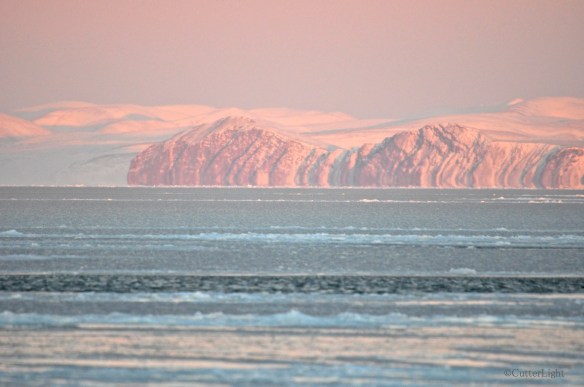
We waited and watched and listened. The wind moving over the seemingly endless frozen sea was all we could hear. In the distance to the east, we could see Cape Thompson’s snowy cliffs bathed in light etched against the pink horizon. As we walked along the edge of the sea, we found a murre, apparently exhausted, tucked into a snowy alcove against a bank of ice. The bird was lucky the fox had already passed by. Although the murre found the strength to take flight as we drew near, it is doubtful it went far. The Arctic winter is unforgiving.

Maia walking to ocean Dec 22 Point Hope II_n

Walking west, toward the sea, on a December day in Point Hope…

Daughter Maia was in the village for a two-week visit over winter break from college. Unfortunately, the Northern Lights didn’t cooperate, but the sky still put on some amazing displays.

Point Hope South Beach Dec 22 3 pm Nikon D90

Ikura: Curing Salmon Eggs

Ikura, transluscent, close_n

Like fire opals lit from within, freshly cured salmon eggs are ready to be served as ikura sushi, sprinkled on a bowl of rice (ikuradon), as a seafood garnish, with cream cheese and rice crackers, or simply gobbled by the spoonful!

At $40 to $50 a pound wholesale (and more expensive than that at the grocery store, when you can find it), cured salmon roe is not a regularly featured food in most kitchens. But if you catch your own salmon – or are friends with someone who does – it can be. Although the process of curing fresh salmon roe is somewhat time consuming, it is not difficult, and with patience almost anyone can turn out a sushi-grade batch of this delicacy.

Salmon eggs, King, in sacs_n

These two matching skeins of eggs, or roe sacs, from a Chinook salmon were frozen this past summer and went into one of our ice chests when we flew to our home in Point Hope, Alaska this fall. Japanese chefs typically prefer the eggs of chum salmon (they’re big), but the eggs from any salmon species are fine. In fact, very attractive cured roe can be made from the smaller eggs of large char, too.

Whether you use fresh or fresh-frozen eggs, the first step (once the roe is completely thawed) is to separate the individual eggs from the skein. The riper the eggs, the easier this process will be. There’s a trick that makes this process much easier than it might otherwise be. Bring a pot of water to a temperature of about 120 degrees Fahrenheit and plunge the whole skein into the hot water. Remove the pot from heat and gently swirl the eggs around. You’ll probably want a pair of nitrile or plastic gloves for this. As you do this, you’ll notice the eggs becoming opaque – cream colored. They’ll look as though you’ve ruined the batch. You haven’t.

Ikura after soaking in hot water_n

Hot water temporarily colors the roe and makes it easier to remove from the membranous roe sac. Provided you have kept the water temperature below 140° F, do not be concerned if your eggs become whiter and more opaque than those in the above photograph.

Next, pour the eggs and the water into a strainer. Plastic colanders, with their smooth surfaces, work well for this step. A lot of the extraneous tissue will drain off at this point. Place the strainer with the eggs in a large pot, fill with cold water, and continue to swirl the eggs around. The fat and other unwanted tissue will tend to rise above the eggs and can be skimmed off with a wire mesh skimmer. Some of the eggs will still have tissue attached. These can be cleaned by hand.

Ikura before and after being cured_n

Left: Salmon roe separated and cleaned and ready to be cured. Right: the finished product – fresh, salty ikura.

The next step is magical. For each cup of salmon roe, add just less than a teaspoon of salt. Finely ground sea salt or kosher salt works best for this step. Gently but thoroughly mix the salt into the eggs with your hands. The eggs will immediately begin to turn bright and translucent. Taste and roe and, if desired, add additional salt.

Finally, place the eggs in a strainer one more time to allow excess liquid to drain off. The cured roe will keep for several days in the refrigerator. It can also be kept in the freezer in tightly sealed jars.
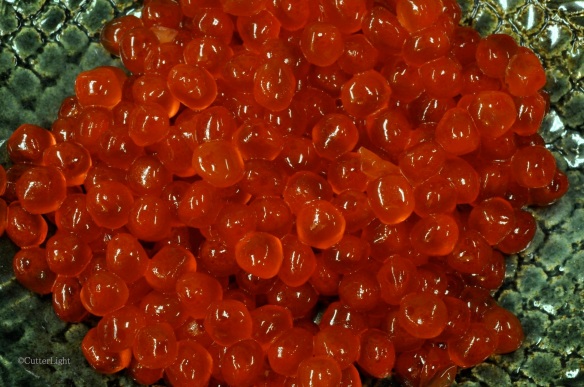
Ikura on plaice plate_n

One you get the basic method down, you can substitute soy sauce for some of the salt or add a splash or two of sake (酒) to create subtly different flavors.

We serve ikura on everything from scrambled eggs to seafood pizza, as well as on traditional Japanese dishes such as chawan-mushi and zaru soba. Below, they add a splash of color and flavor to crepes wrapped around smoked Alaskan salmon and herbed cream cheese.
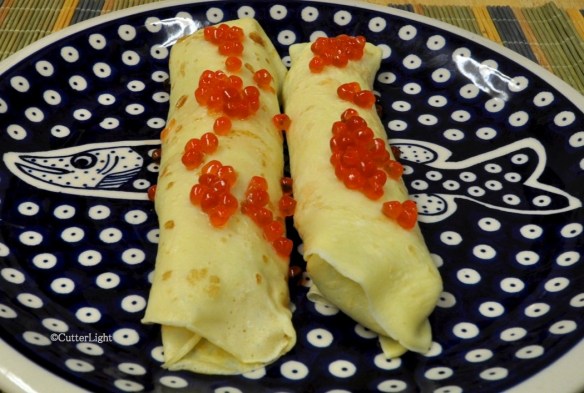
Crepes w smoked salmon & herbed cheese_n

Tufted Puffins, a Name Change and Best Wishes for 2013

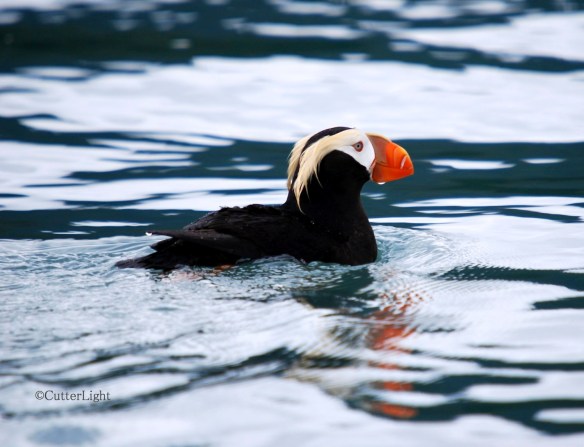
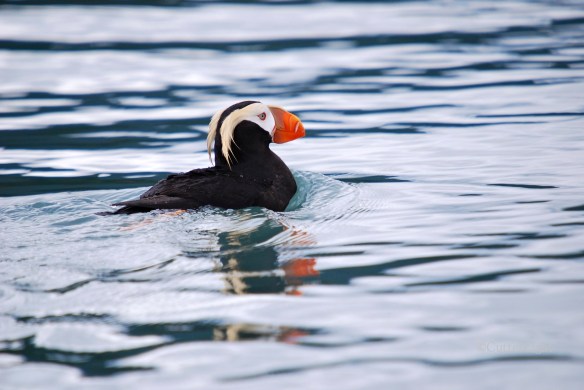
Tufted puffin near Homer I_nUnmistakable with their toucan-like bright orange beaks and combed back white tufts of head feathers, tufted puffins (Fratercula cirrhata) are among Alaska’s most familiar ambassadors.

When we began this blog a little over two years ago, it was for ourselves. The blog was to be a place to catalogue our recipes and keep a photographic record of our travels and adventures. And so we named it Frozen Moments and didn’t think too much about it. It seemed an appropriate name for a blog where photographs are highlighted (frozen moments) and especially so since our home nine months of the year is in Arctic Alaska (frozen months).

Tufted puffin near Homer II_nBut as we got more into it, we discovered that Frozen Moments was a little too obvious. Others were already using the name. We realized we’d eventually want to make a change. CutterLight has its origins in two sources. Cutter derives from our summer home in Seward – our cutter-rigged sailboat. To us, the term evokes images not just of sailing, but of travel and adventure in general, as well as a spirit of being willing to learn and experience new things.

Tufted puffin near Homer III_nLight, too, holds multiple meanings for us. There is of course the “light” which all photographers are concerned with. As our skills and interest in photography grow, we are finding that we are becoming, inevitably perhaps, obsessed with light. It permeates our world now in ways it never did before, and this newfound awareness affects everything from the way we watch movies to how we perceive the world around us to how we deal with the deceptively elusive basic elements of photography.

Tufted puffin near Homer IV_nBut Light holds a second meaning – one which is perhaps even more central to our lives. As we move forward toward fulfilling our goals as writers, photographers and sailors, we have pared away much of what we once considered necessary. Not much fits on a 35-foot sailboat. A succession of yard sales and donations to thrift shops allowed us to part with most of our possessions before we moved to Alaska three years ago. Since then, every new item we add to our lives is carefully evaluated for the value it brings in terms of utility and pleasure. Few items make the cut. We are moving forward with a life that feels lighter yet stronger. It is a wonderful feeling.

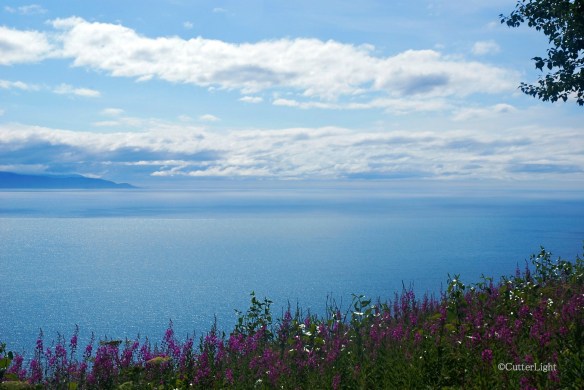
Lower Cook Inlet near Homer_nLooking out over lower Cook Inlet from the bluffs above Homer, Alaska.

As we look back on 2012, it is with a deep sense of appreciation. Many new friends came into our lives this year, and we also were fortunate to have had some really special reconnections with people from our former lives. We are happy, too, that our blog is finding an appreciative audience. We wish one and all fair winds and following seas in the coming year.

Jack and Barbra Donachy

How Have Long Life: Life Philosophy from Alaska’s Longest Reindeer Herder

winter sky_n

The sun doesn’t rise now. In its absence, there is darkness and dusk. And there is beauty in the pink hues and  blue silhouettes of midday.

Words to live by from the longest reindeer herder, Chester Asakak Seveck.

For long live and joy life,

I believe these things –

Keep busy and do good work.

Have much good exercise.

Eat good food,

no waste anything

and every day enjoy what it gives

and do not spoil this day with much worry of tomorrow.

Be happy.

I know this way

how I be “Longest Reindeer Herder.”

Start 1908, finish 1954,

altogether 46 years herd reindeer.

From Longest Reindeer Herder: A true life story of an Alaskan Eskimo covering the period from 1890 to 1973, by Chester Asakak Seveck

The Light before the Fire (First Sea Ice, Point Hope)

There’s not much sun now –

three hours or so from dawn to dusk

and in those three hours, the sun doesn’t climb very high

so that on clear days the world is bathed 

in soft pink and lavender and gold

the horizon rimmed in turquoise

beneath a pale sky

until one day the wind shifts,

and gathers sheets of ice

already formed at sea,

and pushes the ice to shore

where it gathers the light,

and you forget about the things you thought you missed…

the life you left behind

in that moment

before the sun sinks to the ice-covered sea

and everything turns to fire

Alaska: Northern Lights in the Big Point Hope Sky

Named for the Roman Goddess of dawn, Aurora, and the Greek word for north wind, Boreas, Aurora Borealis events originate with the sun and are carried to Earth on solar winds.

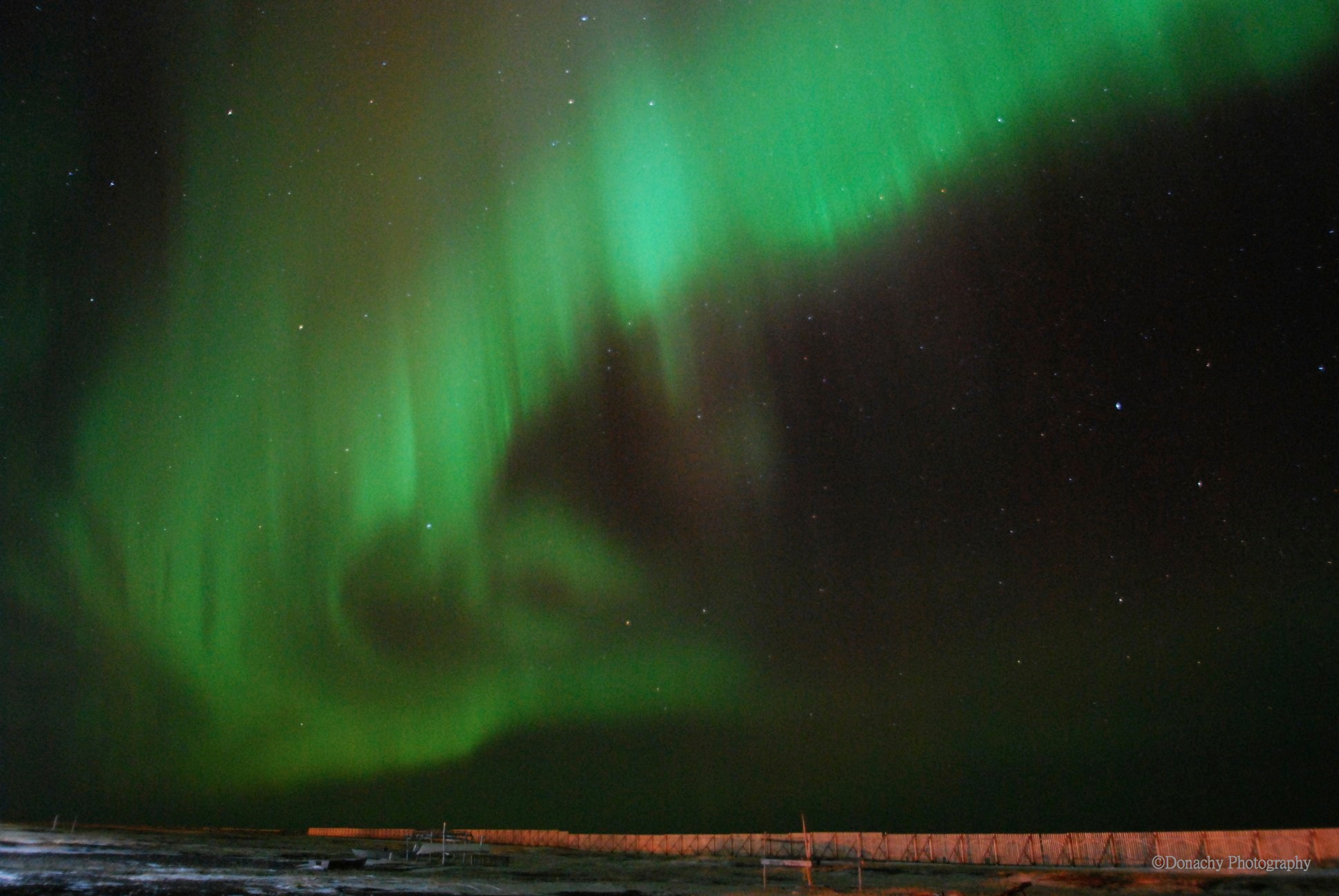
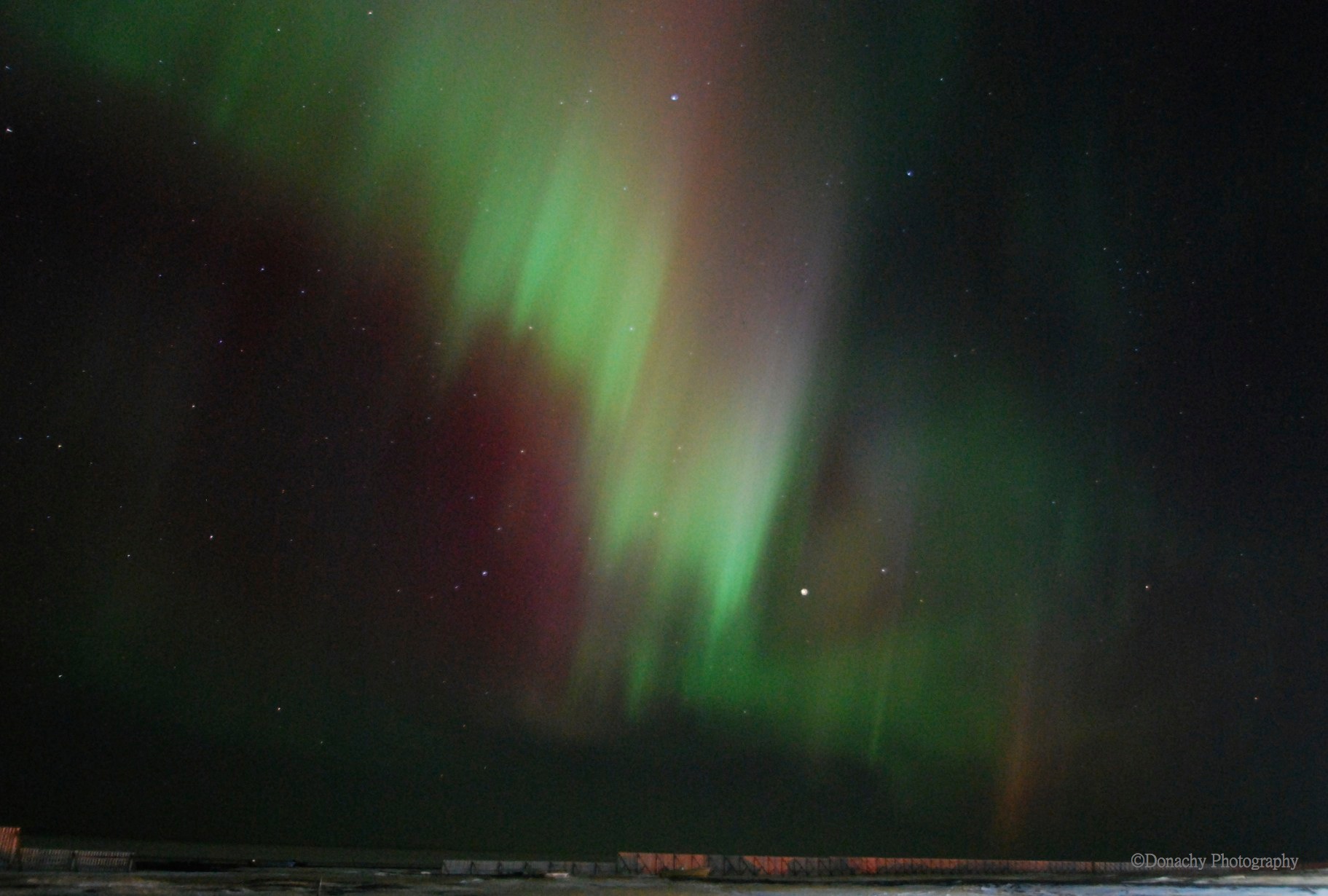
Notice the seal skin boats in front of the snow fence in this photo looking northwest along the lagoon at Point Hope. The most common color for  Northern Lights is green – whitish green on nights of weak activity. Yellows, pinks, reds and purples are less common. Any color in the night sky is a thrill.

We have a phone tree set up so we can let each other know when the lights are out in force. When our phone woke us just after five AM this morning, we didn’t even pick up. We threw on warm clothes and coats (the windchill was below zero degrees Fahrenheit) put together the camera and tripod, and headed out the door. 

We walked away from the town’s lights, to the darkness near the lagoon, and set up. We took these shots with a 15 second exposure. When the lights are active, they move, constantly changing shape and color. 


The Arctic Foxes at Tikigaq Cemetery

Stunning in their soft, white coats, Arctic foxes (Vulpes lagopus) are common in this part of Alaska. The size of a small dog and as soft on their feet as a cat, these omnivores forage on whatever is available, from berries to insects to small mammals and birds – and it appears, big, fat marine worms!

In the past few weeks, there have been spawning events on our beaches near Point Hope. A couple of weeks ago, we were hearing about small fish – probably capelin (smelt) – coming ashore with the surf. More recently, we’ve been finding large marine worms on the beach. The size of Ball Park Franks, the appearance of these worms has coincided with egg cases in areas of coarse sand and gravel. In turn, these spawning events have drawn numbers of snowy owls and Arctic foxes looking for easy meals to the point of land west of town.

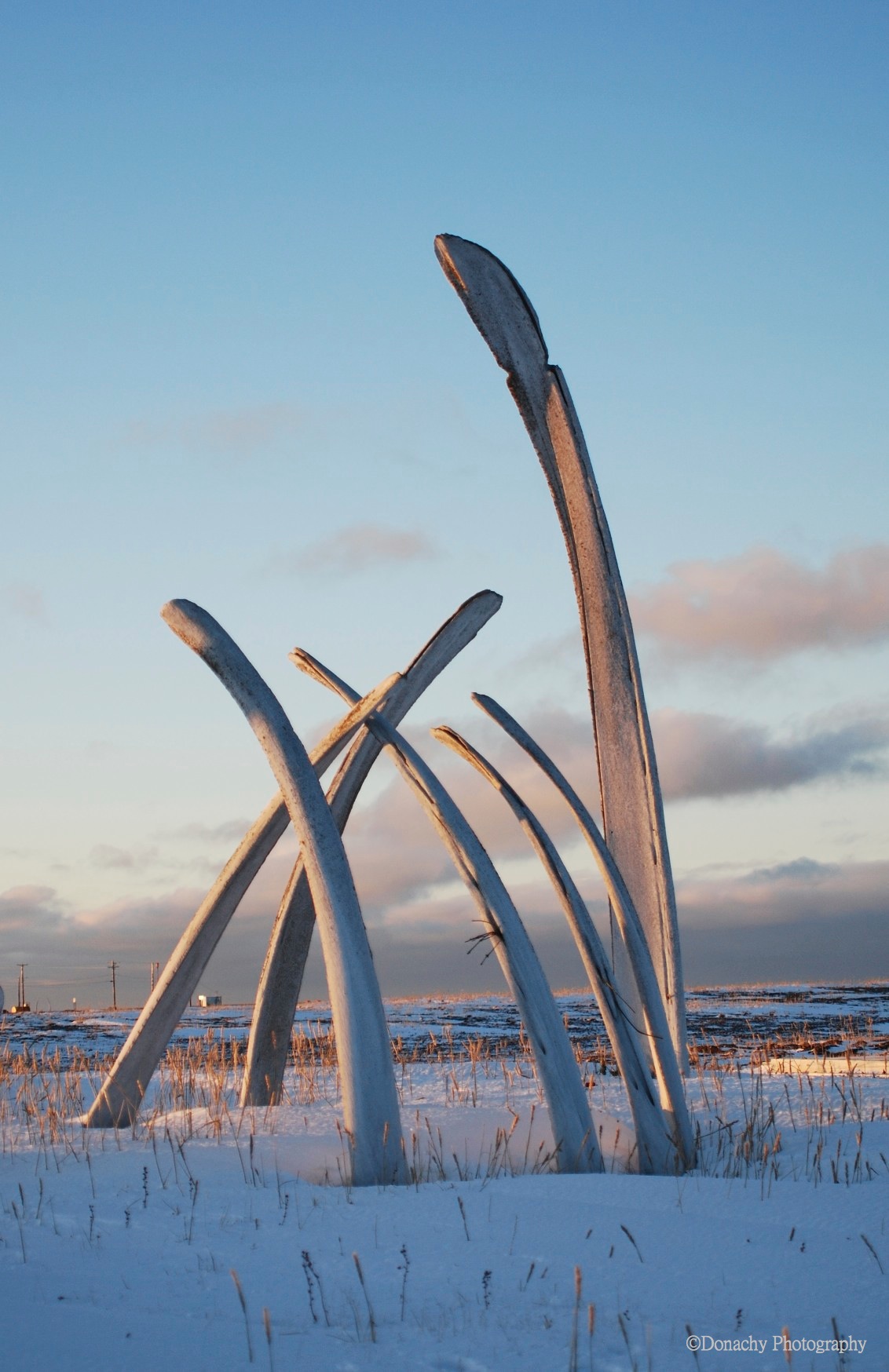
Morning sunlight slants through the jawbones of bowhead whales commingled with crosses at the Tikigaq cemetery in Point Hope, Alaska.

Not so long ago, National Geographic Magazine ran an article about domesticating foxes. Apparently there’s been some success, as breeders in Russia select the most gentle, friendly, trainable and inquisitive offspring generation upon generation. At an average size of six to eight pounds, Arctic foxes would be just the right size to curl up on the sofa for an evening of popcorn and a movie.

Like ribs pushing up from the tundra, these bowhead jawbones mark the resting place of one of Tikigaq’s last shamans.

The diversity – and sheer number – of animals and plants that manage to hack a living out of this cold land amazes us. Far from being the vast, frozen desert the Arctic has often been described as, each season brings with it an astounding number and variety of flora and fauna to the land and sea around Point Hope. Tracks in the snow near our house reveal that we have a weasel or two living beneath our porch!

A Ghost Town, Grizzlies, and the Best Fish and Chips Anywhere

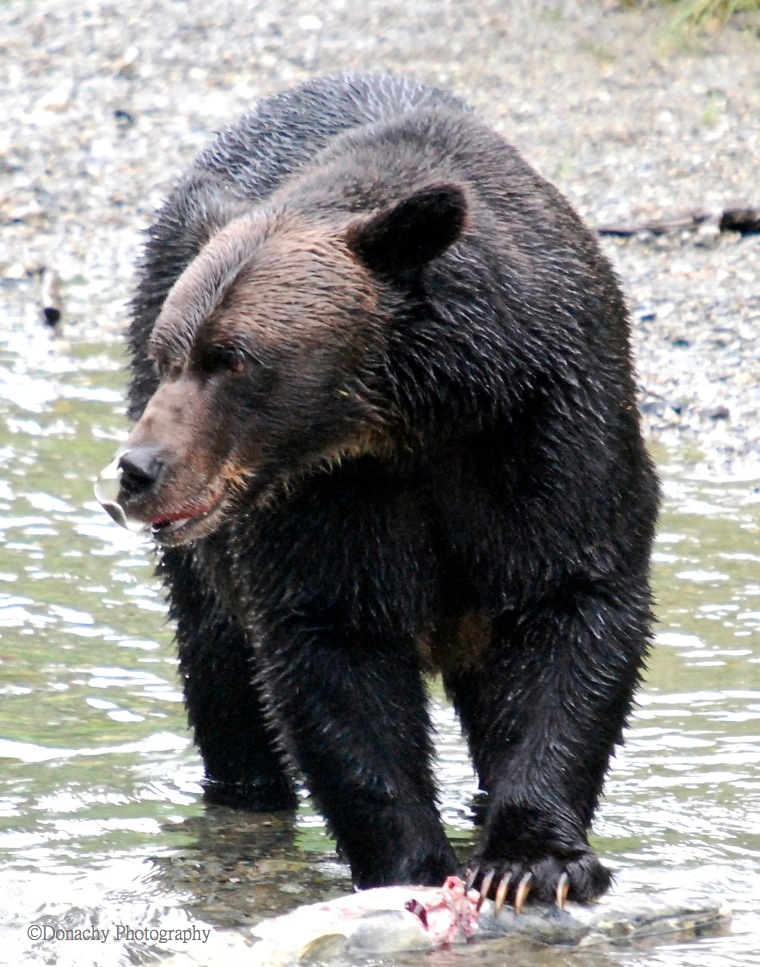
Patrolling Hyder, Alaska’s Fish Creek like she owns it, 600-pound Monica fattens up on a freshly subdued chum salmon.

With a population of fewer than 100 residents, Hyder, Alaska, bills itself as “The Friendliest Ghost Town in Alaska.” The town is one of those gems that is far enough off the beaten path to still be something of a secret, known mainly to the relatively few people who travel the Cassiar Highway in western British Columbia. Many of these travelers are on their way to or from Alaska, and not even all of these travelers are aware of what Hyder offers.

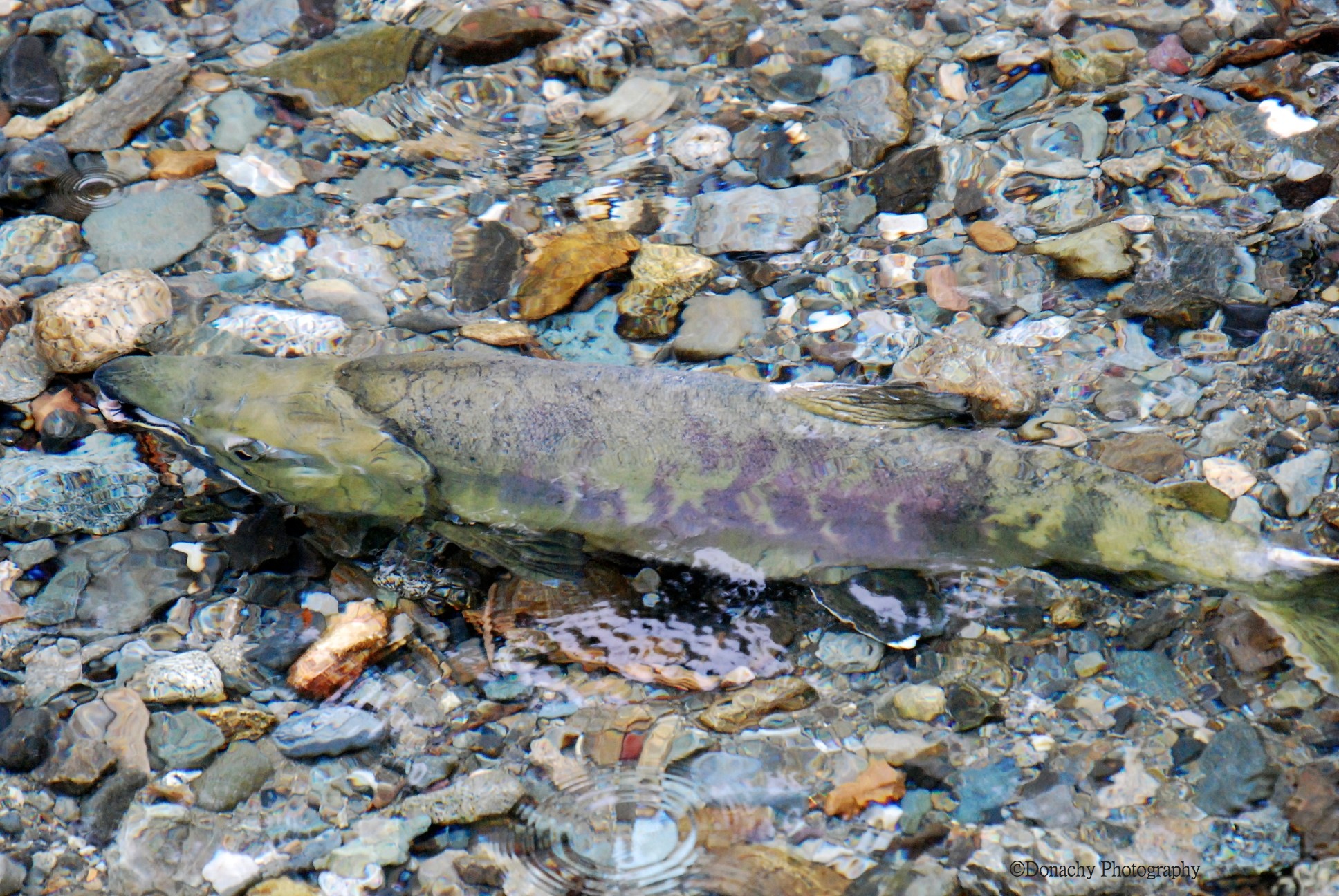
A prize for any grizzly, this beautifully marked chum salmon makes its way up the air-clear water of Fish Creek. 

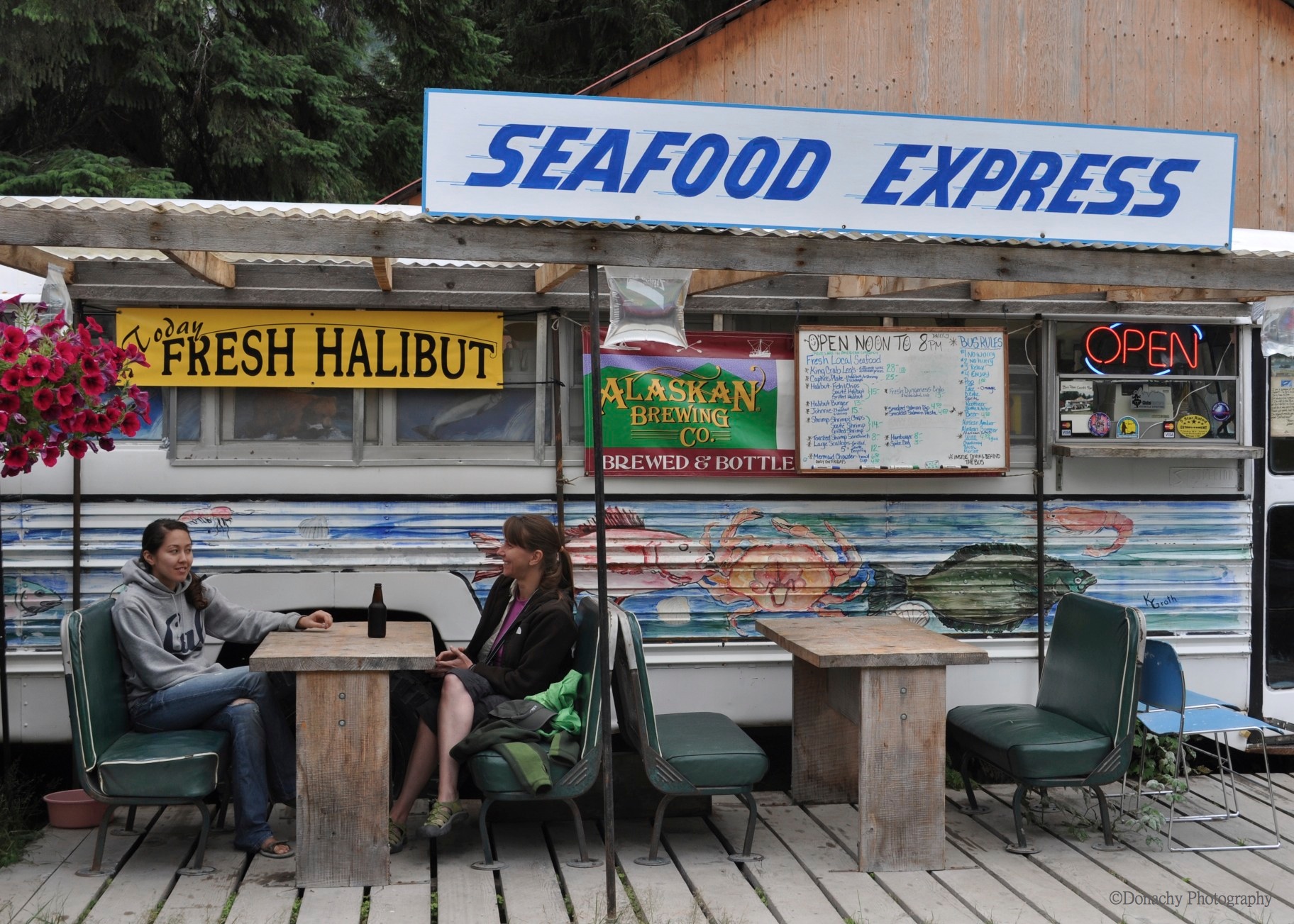
In addition to rare opportunities to watch and photograph grizzlies up close from a safe vantage point (an elevated viewing deck runs along a short portion of Fish Creek), Hyder boasts what is surely one of the world’s most unusual destination restaurants. We’ve written about the Seafood Express in a previous post. Established in 1998, the school bus Jim and Diana Simpson converted into a restaurant continues to turn out the very best fish and chips we’ve ever had. Even when the salmon and bears aren’t in, the restaurant alone makes taking the turnoff to Hyder worthwhile. Jim, a fisherman by trade, supplies the fresh salmon, halibut, shrimp and prawns Diana magically transforms into perfectly crispy, golden-brown, airily light creations that seem to disappear in one’s mouth. Complimented by a bottle of Alaskan Amber Ale, lingering over a meal there is the perfect way to relax after a morning of nature watching while Rufous Hummingbirds trill musically from the nearby spruce and fir forest.

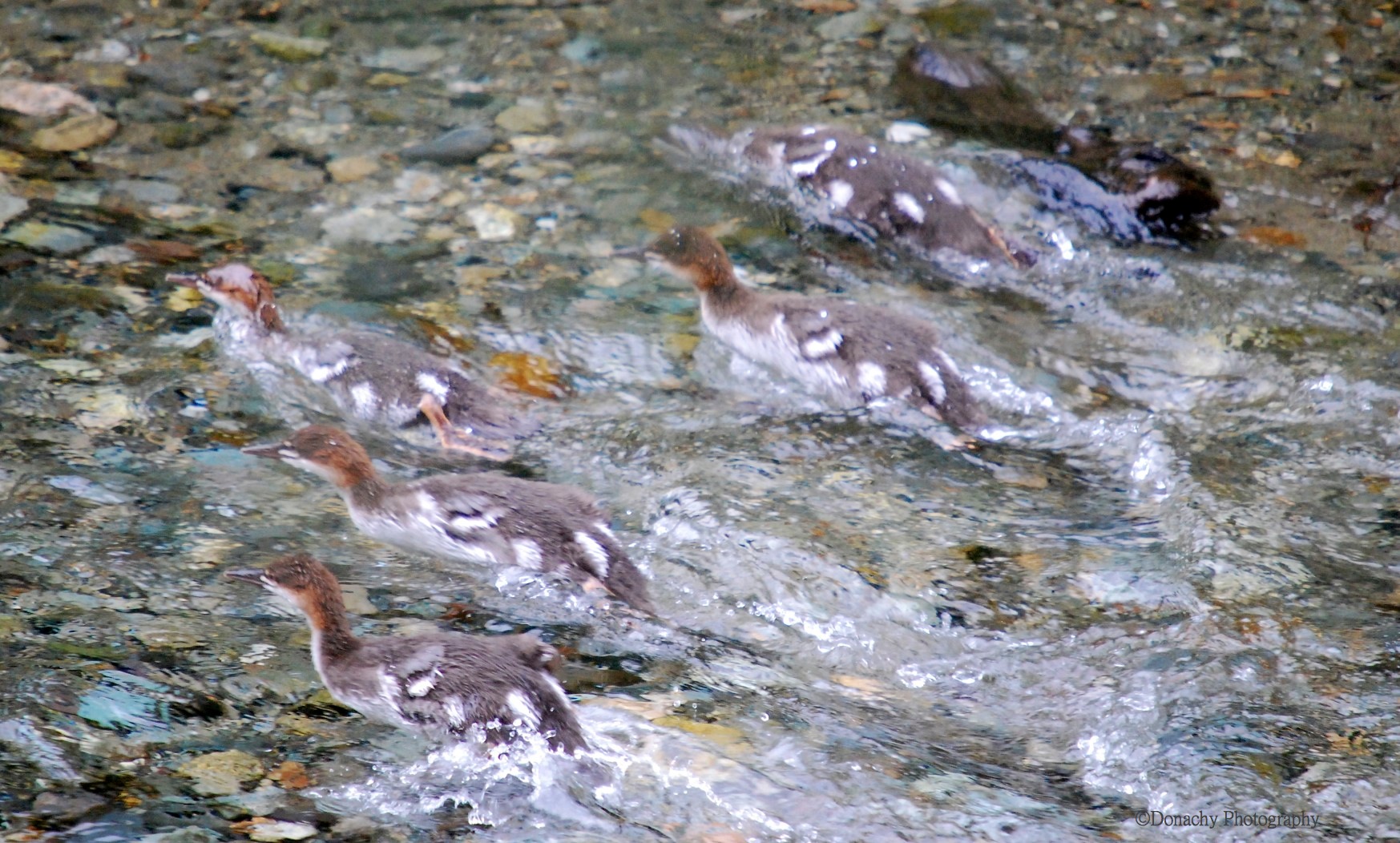
A female common merganser (Mergus merganser) leads her brood of chicks (next photo) down Fish Creek’s crystalline currents.

Merganser chicks scurry to keep up with their mother. This type of duck typically nests in tree cavities near water. They feed on small fish, insects and (I’m guessing) salmon eggs when they can find them.

Since 1998, the Seafood Express has been serving up gourmet-quality fish and chips

The viewing platform on Fish Creek provides one of the very few places in North America where people can routinely and safely view wild grizzlies from a fairly close distance. The platform is manned by knowledgable U. S. Forest Service Rangers. The best viewing is from late July through September.

A trip to Alaska through British Columbia by car, camper or motorhome is a trip of a lifetime. If your route takes you along the Cassiar Highway, Hyder should be a “must visit” destination!

For more, click here to see our iReport on CNN.

Homemade “Ricotta” – A Successful Experiment with Powdered Milk and Powdered Cream

Simple, delicious cheese you can make at home without any additives or preservatives. What a revelation! Perfect for cannelloni, lasagna, cannoli, ravioli, calzone or the Indian dessert Ras Malai.

A culinary goal for my Arctic kitchen this year was to experiment with cheese-making. I’m all for anything we can make at home in order to reduce our consumption of chemicals, stabilizers, and other weird junk. In addition to the drawbacks of processed foods, our Native Store here in Point Hope isn’t much larger than a typical quick-shop convenience store, and often doesn’t have items we need. Last year, a friend brought up ricotta cheese for us. This year, I decided to make my own.

Our store does not sell cream or whole milk, so my experiment with homemade cheese had one unusual ingredient – dried milk and cream. The only powdered milk I could find during our annual summer shopping in Anchorage was non-fat. Yuck. Thank goodness for the Internet! And especially thank goodness for Amazon’s free shipping. I bought two large cans of powdered whole milk (apparently abundant in Mexico!) and a can of powdered 72% butterfat cream. These would be the main ingredients for my “ricotta.” And by the way, the end product – made with powdered ingredients – was delicious.

The cheese that resulted is not a true ricotta, but is more like an unpressed paneer – with a slightly tangy, lighter taste than ricotta. In any case, it’s going into Jack’s moose cannelloni later today, rolled into homemade cannelloni tubes. Yum!

Homemade “Ricotta” – Perfect for Sweet or Savory Dishes

Ingredients

  • 2 cups whole milk powder
  • 1 cup powdered cream
  • 8 cups of water
  • 4 tbsp distilled white vinegar
  • 1/2 tsp salt

Directions

  1. Place powdered milk and cream into a large pot. Add water. Whisk until incorporated.
  2. Heat mixture until it steams but doesn’t boil (between 165 and 180 degrees F using an instant read or candy thermometer).
  3. Remove from heat.
  4. Slowly stir in vinegar. Milk should curdle.
  5. Stir in salt.
  6. Cover pot with clean cloth and let sit for 2 hours.
  7. Line colander with cheesecloth. I read paper towels or a kitchen towel will also work.
  8. Scoop curds out of pot and into lined colander.
  9. Let whey (watery substance) drain out of curds. I let it drain overnight in the refrigerator because I wanted a less watery product for the lasagna.