
DIY Small Batch Purple Sauerkraut

sauerkraut diy_n

To make this beautiful purple kraut, you need only a few days of fermenting time and items you already have in your kitchen.

Every year I pick one thing I want to learn to make and force the issue by removing it from our annual shopping list. Last summer, a friend had us taste her homemade kraut infused with locally picked highbush cranberries, which grow in Alaska. It was delicious. Her quick directions gave me confidence that I could easily make sauerkraut, too.

The purpose of lacto-fermenting vegetables is to store the summer harvest so that vegetables can be enjoyed throughout the year. Since I had only one head of cabbage which weighed a pound-and-a-half,  I turned to small batch food preservation methods. Credit for the following directions goes to a blog called The Kitchn where the author posts all sorts of information about lacto-fermentation, photos, and step-by-step directions.

Our first menu with the finished kraut was a knock-your-socks-off reuben. We’ll post that  recipe in an upcoming article.

DIY Small Batch Purple Sauerkraut

Ingredients

  • 1 small head purple cabbage (about 1.5 lbs.)
  • 1 tbsp kosher salt
  • 1 tbsp caraway seeds
  • 1 tbsp dried juniper berries

Directions

  1. Gather materials you will need to process kraut: 2 quart container, cutting board, chef’s knife, gallon Ziploc bag, large mixing bowl, and lidded quart container for final product.
  2. Slice cabbage into ribbons. Discard core.
  3. Place cabbage ribbons into large mixing bowl. Sprinkle salt all over cabbage.
  4. Knead, massage, and squeeze salt into cabbage, until cabbage begins to become shiny and loses liquid. This will take about 10 minutes.
  5. Mix in caraway seeds and juniper berries.
  6. Pack mixture into 2 quart container. Pour any liquid from mixing bowl into container, too.
  7. Fill Ziploc bag with water and set inside 2 quart container to weigh down and cover cabbage.
  8. Press down cabbage every few hours. This will cause air to come to the surface.
  9. If there is not enough liquid to cover the cabbage in 24 hours, add 1 cup water mixed with 1 tsp salt.
  10. Keep the container out of light and at a temperature of 65 – 75 degrees F.
  11. Allow to ferment from 3 – 10 days. Begin tasting at 3 days. Mine tasted just right at 3 days. The longer you leave it, the more sour it will be.
  12. Put finished sauerkraut in a 1 quart container and store in the refrigerator. It should keep for several months.

Vanilla Flan with Traditional Caramel Sauce

flan_n

Enjoy this vanilla custard, caramel-topped dish with a freshly brewed cup of coffee or tea to complete a memorable dinner with friends.

Crème caramel (flan) and crème brûlée are classic oven-baked custards. We’ve both loved flan from the first taste. The soft, custardy texture is very satisfying and the way the caramel sauce  drizzles down the side of this dessert when you invert it is just plain fun. When I was in my twenties, I made flan the instant way – squeeze the packet of caramel on the bottom of a dish and pour in the custard. Jack discovered flan in Japan, where it is commonly sold in convenience stores as a complete, packaged snack and less frequently in coffee shops.

After learning to make flan authentically – preparing stovetop caramel from scratch and baking the dessert in a water bath – there is no turning back. The vanilla flavor in this recipe is intense, thanks to the addition of vanilla paste, and the caramel was sweet with just a hint of bitterness just as my Culinary Institute of America teacher said it should. Many flavors could be substituted for the vanilla; try orange, chocolate, cinnamon, or chai for an equally excellent dessert.

Vanilla Flan with Caramel Sauce

Ingredients

  • 1 cup and 1/3 cup granulated sugar, separated
  • 1/4 cup water
  • 1 1/4 cup whole milk
  • 3/4 cup heavy whipping cream
  • 1 tbsp vanilla paste, or 1 vanilla bean, split
  • 3 eggs

Instructions

  1. Place 1 cup granulated sugar and 1/4 cup water in a pot. Gently stir to blend.
  2. Bring mixture to a boil without stirring, putting a lid on pan so that moisture from boiling syrup will wash down sides.
  3. Let mixture continue to boil until it starts to turn a light brown color.
  4. Take pan off heat and allow mixture to cool until it has a honey-like consistency.
  5. Pour caramel into 4 small ramekins. Swirl caramel around so it covers the bottoms of the ramekins. Set aside.
  6. Preheat oven to 300 degrees F.
  7. Warm milk, 1/3 cup sugar and vanilla on stovetop.
  8. Whisk eggs in a medium bowl. Pour warm milk mixture into eggs, whisking continuously. Add cream and continue to whisk until thoroughly mixed.
  9. Pour milk mixture into prepared ramekins.
  10. Place ramekins in a larger pan, for example a roasting pan, and fill the roasting pan until water reaches halfway up the ramekins.
  11. Bake custards in oven for 30 – 40 minutes.
  12. Custards will be done when there is a small wiggle in the custard. Allow ramekins to cool off and wipe them dry. Refrigerate for a couple of hours, or overnight.
  13. To present the dessert, run a small knife around the edges of the ramekins. Place a serving plate on top of the ramekin. Flip the dish and give it a quick jerk in order to remove the flan from the ramekin. The caramel should now be on top and will drizzle over sides to plate.

Really Righteous Rye for Reubens

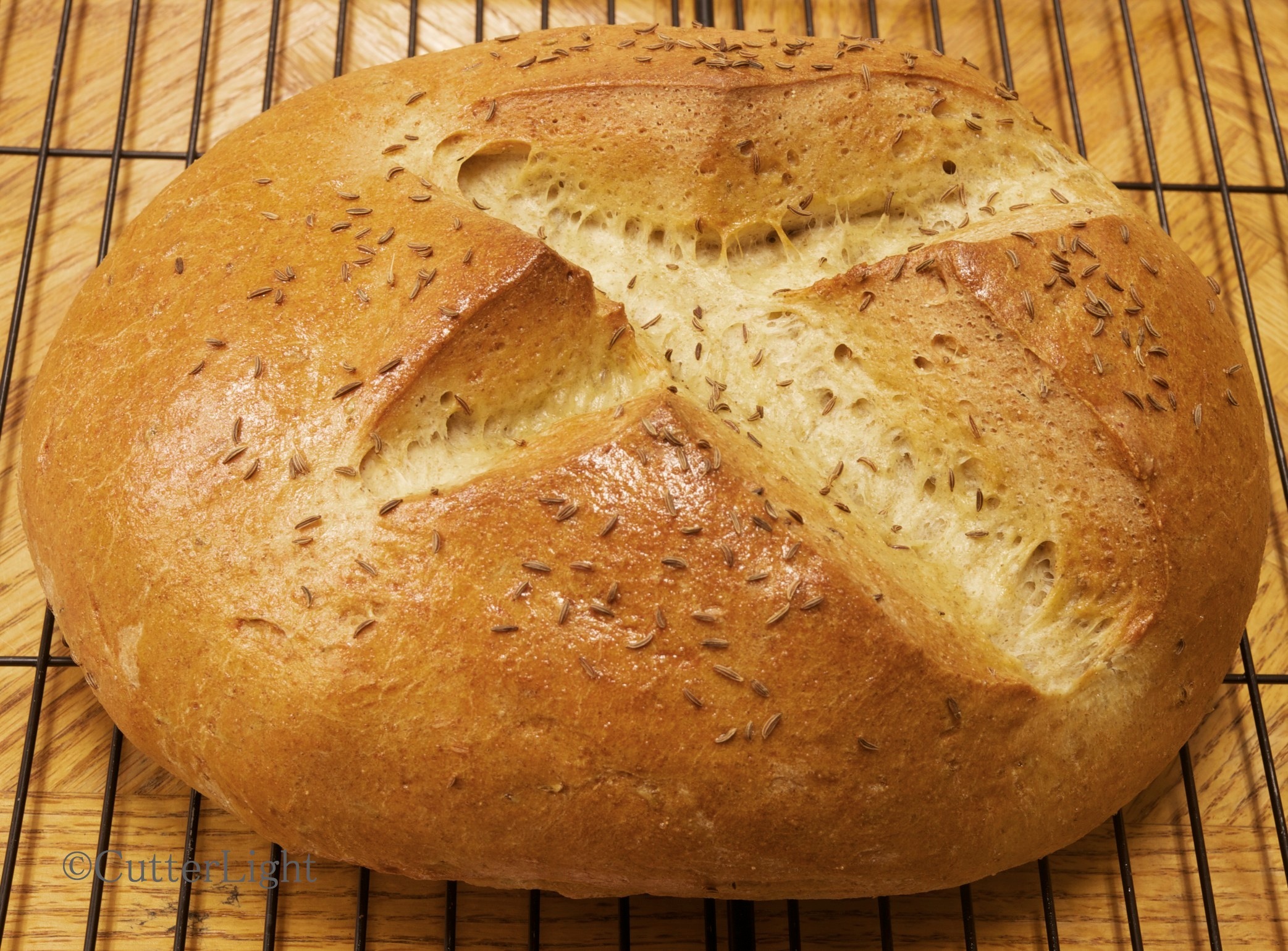
Rye bread_nWith a golden-brown crust and a soft inside, this flavorful combination of rye flour and caraway seeds is the perfect loaf to be sliced thick for home-made reuben sandwiches. 

One of our favorite sandwiches is an East Coast style reuben with the rye sliced thick and everything piled high. Up here in the Arctic, the only way to get a sandwich like that is to make it ourselves. So, based on several recipes and my own calculations, I created a rye bread recipe for my Zojirushi “dough machine.” After four years of fairly heavy use (we bake all our own breads), this built-like-a-tank bread machine is still going strong. After it had done its magic, I kneaded the dough once more by hand and shaped it into an oval for one last rise.

I gave the dough two quick slashes, brushed it with egg, popped it in the oven and 35 minutes later our kitchen was filled with the delicious aroma of freshly baked rye bread – the final ingredient for our “up-town” Arctic lunch of hot tomato soup and reubens! Our recipe for DIY sauerkraut to follow.

Bread Machine Rye Bread

Ingredients

  • 3 tbsp melted unsalted butter
  • 1 egg
  • 1 cup whole milk
  • 1 tsp extra virgin olive oil
  • 1 1/2 cups all-purpose flour
  • 1 cup rye flour
  • 1 tbsp caraway seeds (a few more for the top)
  • 1 envelope active dry yeast
  • 1 tbsp granulated sugar
  • 1  1/2 tsp salt
  • 1 egg (to brush the top of the loaf)

Directions

  1. Place all items except the last egg in the bread machine in the order recommended by the manufacturer.
  2. Set machine to dough setting.
  3. Start machine.
  4. Remove dough from machine and place onto lightly floured board. Knead dough a few times and shape into ball.
  5. Place dough ball on a parchment-lined baking sheet and cover with a damp cloth. Let rise until almost doubled in size.
  6. Preheat oven to 350 degrees F.
  7. Slash a big X on top of loaf.
  8. Brush loaf with egg and sprinkle a few more caraway seeds on top of loaf.
  9. Bake for 35 minutes. Finished loaf should should have a golden brown crust and sound hollow when tapped.

Lighter than Air: Cream Puffs and Eclairs

cream puffs_n

Friends who share a love of baking and cream-filled pastries dipped in chocolate ganache warmed up a rainy afternoon in our kitchen north of the Arctic Circle.

Perfectly turned out pastry puffs filled with delectable cream and dipped in chocolate ganache are the the stuff of home bakers’ dreams. Cream puffs and eclairs require a special dough called pâte à choux. Worked to exactly the right consistency, this dough bakes up light and flaky and leaves a hollow space in the center of the confection. Although we used traditional vanilla-flavored pastry cream, we also imagined filling these airy profiteroles with fresh whipped cream, homemade ice cream and even savories such as smoked salmon cream.

Making cream puffs and eclairs can’t be rushed. The pâte à choux dough requires time and attention in order to get it to the correct consistency as it cooks on the stove top. Next, it must be carefully piped onto a baking sheet and placed in the oven where it will finish. Creating the pastry cream is fairly easy, and making chocolate ganache is magical.

All that work, and between three bakers, three tasters and steaming mugs of of rooibos almond tea, our eclairs and puffs disappeared in short order.

Pâte à Choux

Ingredients

  • 1/2 cup water
  • 1/2 cup whole milk
  • 1/2 tsp salt
  • 1/2 tsp sugar
  • 4 oz. unsalted butter, softened
  • 1 cup all-purpose flour
  • up to 4 eggs

Directions

  1. Line two baking sheets with parchment paper. Preheat oven to 400 degrees F.
  2. Pour milk and water into medium pan.
  3. Stir in salt and sugar.
  4. Add butter.
  5. Bring mixture to a boil over medium heat.
  6. Take mixture off heat and stir in all the flour. Mixture should look like mashed potatoes.
  7. Return pan to low heat and stir continuously. This will dry out the dough a little.
  8. Dough should come together to form a ball.
  9. Starchy residue at the bottom of the pan is an indicator that the dough is dried out enough.
  10. Take dough off stove and place it in the mixing bowl of a stand mixer. Turn it to low to allow the dough to be cooled off by the mixer.
  11. Mix in eggs one at a time, watching that the dough does not become too thin. The dough should be soft, creamy, and shiny.
  12. Transfer the dough to a piping bag with a large tip.
  13. Pipe ball shapes onto parchment-lined baking sheets, leaving plenty of room for these puffs to double in size.
  14. Bake puffs for 10 minutes.
  15. Turn oven down to 325 degrees F and continue to bake for 15 minutes.
  16. Fill with chilled whipping cream or pastry cream – savory or sweet.

These will freeze nicely.

Lattice Top Apple Pie with Baked-On Cinnamon Sauce

apple pie lattice top n

Cinnamon sauce baked into the lattice-top crust makes this apple pie irresistible. The only debate was whether to enjoy it with a slice of sharp cheddar cheese or a scoop of homemade vanilla bean ice cream. 

Last week’s baking lesson was all about baking with butter: buttery cranberry scones, fluffy butter biscuits, and two kinds of pie – lemon meringue and a lattice-topped apple. After learning how to create the lattice top, which was surprisingly easy, we took a basic apple filling and poured the liquid you would normally mix into the apples over the top of the pie, allowing the flavors to bake into the lattice and surround the apples inside. This apple pie was served hot out of the oven to friends with cinnamon vanilla ice cream as fortification against a chilly day north of the Arctic Circle.

Apple Pie with Baked-on Cinnamon Sauce

Ingredients

  • 5 Granny Smith apples, cored, peeled, and sliced
  • 2 tbsp lemon juice
  • 1/2 cup unsalted butter
  • 3 tbsp all-purpose flour
  • 1/4 cup water
  • 1/2 cup granulated sugar
  • 1/2 cup brown sugar
  • 1 tsp ground cinnamon
  • pastry crust for 9-inch double crust pie

Directions

  1. Preheat oven to 425 degrees F (220 degrees C).
  2. Toss apples in lemon juice. Set aside.
  3. Melt the butter in a saucepan.
  4. Stir in flour to form a paste.
  5. Add water, granulated sugar, brown sugar and cinnamon, and bring to a boil. Reduce temperature and let simmer.
  6. Place the bottom crust in your pan.
  7. Fill with apples, mounded slightly.
  8. Cover with a lattice work crust.
  9. Gently pour the sugar and butter mixture over the crust. Pour slowly so that it does not run off.
  10. Bake 15 minutes in the preheated oven. Reduce the temperature to 350 degrees F (175 degrees C). Continue baking for 35 to 45 minutes, until apples are soft.
  11. Let cool slightly. Serve warm with vanilla ice cream or a slice of sharp cheddar cheese.

Salmon Cheddar Soup with Lobster Mushrooms

salmon cheddar soup n

With or without lobster mushrooms (see photo below), this quick, easy seafood soup is one of our wintertime favorites.

The inspiration for this recipe comes from A. J. McClane’s excellent cookbook, North American Fish Cookery. McClane’s original recipe is sans mushrooms and calls for lobster, but the basic stock – milk and cheddar cheese seasoned with nutmeg – lends itself to a variety of innovations. The first time we created this dish we substituted grilled steelhead for the lobster. Other iterations have featured broiled or grilled salmon, smoked salmon, and Alaska shrimp. In fact, we’ve never used lobster, and although freshly ground nutmeg remains a must in our soup, we usually spice it up with the addition of ground smoked chipotles or other peppers and smoked sea salt. Most recently we made this soup with our own canned smoked red salmon, lobster mushrooms and red bell pepper.

lobster mushroom salmon cheddar soup n

Ready for soup: a lobster mushroom, nutmeg, our own blend of smoked chipotles and other seasoning, and a jar of smoked Copper River red salmon.

Salmon Cheddar Soup

Ingredients

  • ¼ to ½ pound smoked salmon, grilled salmon, raw salmon, lobster or shrimp cut into ½-inch chunks. (If using raw seafood, allow for a few minutes cooking time in soup till done.)
  • 1¼ cups lobster mushrooms cut into chunks slightly smaller than the seafood. (Optional) These particularly mushrooms work well because they have a firm texture, nice color, and mild flavor.
  • Part of a red bell pepper cut into thin strips – 4 to 5 strips per serving. Sauté until tender and set aside.
  • 1/4 cup olive oil or butter
  • 3 tbsp flour, as a thickening agent. Rice flour works especially well, but all-purpose flour is fine.
  • 3 cups milk
  • 1¾ cups shredded cheddar cheese
  • 1/8 tsp ground nutmeg
  • 1/2 tsp ground smoked chipotle (optional)
  • freshly ground black pepper
  • sea salt or smoked sea salt
  • paprika (finishing garnish – a dash or 2 per serving)

Directions

  1. Place olive oil or butter in a large pot over medium heat.
  2. Add lobster mushrooms, a little salt, a couple grinds of pepper and sauté for about two minutes.
  3. Lower heat and vigorously stir in flour. Then add milk and seasonings, stirring until mixture begins to thicken and becomes hot. Do not allow to boil.
  4. Stir in seafood and cheddar cheese. Give the soup a taste and adjust seasonings as necessary.
  5. Serve piping hot, garnished with a few strips of bell pepper and a dash or two of paprika.

We enjoyed this soup with homemade biscuits.

Chai Crème Brûlée for Two

chai creme brulee_n

Easy to create, this crème brûlée features a rich custard flavored with vanilla and chai tea and is sealed with a crunchy caramelized top.

We give careful thought before adding any new item to our kitchen. Does the tool merit the space it will take up in Bandon’s galley or in the kitchen of our Arctic home? Will it be durable? Is it practical?

For the past few years, both of us have been eyeing a butane torch – the perfect niche tool for toasting a couple of  homemade marshmallows, singeing  meringue pie tips, and of course, for creating the perfect crème brûlée.

For most people, the addition of an item such as a kitchen torch means driving to a local store and picking one out along with the necessary fuel. For us, getting a canister of butane out to bush Alaska means purchasing a haz-mat certificate and having the item sent by cargo flight out here because the post office doesn’t ship hazardous materials via airplane.

Last night, the torch came out of the box, was fueled up, and put into service to finish a dessert that we and our guests couldn’t get enough of – chai crème brûlée. For this recipe, we began with a traditional crème brûlée custard recipe and infused it with the mildly spicy, sweet flavors of loose leaf chai tea and vanilla paste.  The resulting dessert was more complex and flavorful than typical crème brûlées. Using our new torch so that our guests and we could caramelize the tops of the custard just before serving, this turned out to be the best crème brûlée we and our guests had ever had.

Chai Creme Brulee for Two

Ingredients

  • 1/4 cup whole milk
  • 3/4 cup heavy whipping cream
  • 1/3 cup granulated sugar
  • tiny pinch salt
  • 1/2 tsp vanilla paste
  • 1 tbsp loose chai tea
  • 3 large egg yolks
  • 2 tsp granulated sugar for topping

Directions

  1. Preheat oven to 325 degrees F. Place an oven rack in the slightly lower than center position.
  2. Whisk milk, heavy whipping cream, sugar, salt, vanilla paste and chai tea in a medium pot over medium heat. Whisk until mixture steams and almost boils. Set aside to cool for 10 minutes.
  3. Strain cream mixture to remove tea leaves.
  4. Whisk eggs in a medium bowl. Stir in cream mixture to eggs one tablespoon at a time until the egg mixture is warmed. Once mixture is warmed, increase addition of cream mixture to 1/4 cup at a time. This will prevent eggs from cooking and scrambling.
  5. Pour mixture into two 4-ounce ramekins.
  6. Set ramekins in a baking dish. Pour enough hot water to reach halfway up the ramekins.
  7. Bake uncovered in preheated oven until desserts are softly set, about 45 minutes. The centers will jiggle.
  8. Remove baking dish with ramekins from oven and let desserts come to room temperature while in water bath on counter.
  9. Chill ramekins in refrigerator for at least 2 hours before serving.
  10. Right before serving, sprinkle 1 teaspoon granulated sugar evenly on each dessert.
  11. Use a kitchen torch to slightly brown and caramelize the granulated sugar. Let cool for ten minutes and serve.

Waste Not Want Not Potato Bread

potato bread b n

We don’t normally buy instant mashed potatoes, but when friends offered us a couple packets at the end of their Alaska camping trip last summer, we came up with a good use for them.

The packets of instant mashed red potatoes remained in our pantry for over a year – until the other day when I was thumbing through a friend’s bread machine recipe book and saw that potato bread could be easily made with instant mashed potatoes. Let the experimenting begin!

The potato bread recipes I came across included lard, butter, milk and salt. Since the pre-mixed potato packet already had many of these ingredients, I adjusted the recipe to fit packet at hand. If you make this recipe with plain instant potatoes, I’d recommend the addition of more butter and salt.

Mashed Potato Bread

Ingredients

  • 1 cup instant mashed potatoes
  • 1 tbsp unsalted butter
  • 1 cup milk
  • 1/2 cup water
  • 5 cups all-purpose flour
  • 1 tbsp granulated sugar
  • 1 tbsp yeast

Directions

  1. Rehydrate instant potatoes according to directions.
  2. Mix in butter.
  3. Place potato mixture, milk, water, flour, sugar and yeast into bread machine in the order recommended by the manufacturer. Turn on dough setting.
  4. Turn out dough onto floured surface.
  5. Split dough into two pieces and knead into loaf shapes that will fit into loaf pans.
  6. Bake in oven preheated to 350 degrees F for 30 minutes. Loaves will sound hollow when tapped.

Coconut Chocolate Chip Scones – Yes, Please!

coconut chocolate chip scones_nFry an egg, brew a cup of coffee and serve with these icing-laced coconut scones chock-full of mini chocolate chips. Fuel for a hike on the tundra, a morning downtown or whatever the weekend brings.

Shelf stable items are a staple in our Arctic pantry. Recently we have been experimenting with powdered coconut milk and are finding it to be easily reconstituted and packed with flavor. Friends recommended we add extra virgin coconut oil to our pantry, which ups the coconut flavor.

Armed with the coconut flavors I needed and an intriguing recipe I came across on MyBakingAddiction.com, I was ready to bake.

These scones have the essence of a chocolate dipped macaroon without being overly sweet. Using whole wheat for half the flour makes them more hearty than a traditional scone, while the baking powder helps them rise to epic scone proportions. The recipe is a perfect candidate for making dough the night before and popping in the oven the next morning for an impress-your-friends brunch.

Coconut Chocolate Chip Scones

Ingredients

  • 3/4 cup coconut milk
  • 1 egg
  • 1/4 cup granulated sugar
  • 2 tsp vanilla extract
  • 1 cup all-purpose flour
  • 1 cup whole wheat flour
  • 1 tbsp baking powder
  • 1/2 tsp salt
  • 3 tbsp unsalted butter, cold, cut into small pieces
  • 1 tbsp extra virgin coconut oil
  • 3/4 cup semi-sweet mini chocolate chips
  • 1/2 cup unsweetened coconut flakes
  • 2 tbsp coconut milk (to brush on top)

For the drizzle

  • 1 cup powdered sugar
  • 2 tbsp coconut milk

Directions

  1. Preheat oven to 375 degrees F. Line a baking sheet with parchment paper. Set aside.
  2. In a medium bowl, mix coconut milk, egg, sugar and vanilla. Set aside.
  3. In a large bowl, mix together flours, baking powder and salt.
  4. Mix butter and coconut oil into flour mixture using a pastry blender or your hands. Do this quickly to avoid melting the butter. Mixture should have pea-sized butter lumps that are evenly distributed in the flour.
  5. Mix wet ingredients into dry ingredients.
  6. Fold in chocolate chips and coconut flakes.
  7. Turn out dough onto lightly floured surface and knead 4 or 5 times.
  8. Shape dough into a 9-inch disk. Disk should be about 3/4 inch thick.
  9. Place disk on parchment-lined baking sheet.
  10. Slice disk into 12 wedges, pizza-style, leaving the dough in place.
  11. Brush disk with 2 tbsp of coconut milk.
  12. Bake for 18 – 20  minutes, till scones are slightly golden brown on edges.
  13. Cool scones in pan.
  14. While scones are cooling, create drizzle by mixing powdered sugar and coconut milk. Drizzle should be consistency of molasses.
  15. Place drizzle in a Ziploc bag. Snip a tiny bit off of one corner.
  16. With a sweeping motion, squeeze out drizzle over scones until you are satisfied with the amount of coverage.

Whole Fish Salted and Broiled: Easy, Elegant, Delicious!

dolly varden shioyaki_n

This Chukchi Sea Dolly Varden Char was liberally salted, broiled and served with roasted Peruvian potatoes and garlic cloves. Salt grilling or broiling brings out the natural sweetness of species ranging from porgy and snapper to trout, char and salmon. 

When a friend recently presented us with two harvested-from-the-ocean-this-morning char, we knew immediately what we wanted to do with one of them: shioyaki. Although Japanese cuisine is better known for sushi and sashimi, far more fresh fish on Japanese tables is served well salted and then broiled or grilled.

The Japanese eat a lot of fish, and it is for good reason that shioyaki fish is weekly fare in most households. It’s quick, it’s easy, and fish prepared this way are deliciously savory and sweet. This is also an excellent method for preparing freshly caught trout while camping. Simply clean the catch, skewer it lengthwise, cut a few shallow slashes into the skin, rub salt on the fish and roast it on an open fire or over a grill. Brook trout served this way make for memorable camp fare, as do Japanese iwana (char).

dolly varden side by side_n

This pair of sea run Dolly Varden char have all the characteristics of fresh fish: bright, clear eyes, firm, nicely colored flesh, and no evidence of bruising. 

Because the fish are seasoned only with salt (and perhaps the smoke from a grill or fire), it is imperative that it be absolutely fresh. When you’re purchasing fish, look for a healthy shine, bright colors and clear, bright eyes. The scales should be intact and the gills, if any remain, should be bright red. Don’t be shy about giving a fish you’re considering purchasing a whiff. It should smell clean. Fish does not smell fishy; it is bacteria growing on poorly cared for or old fish that carries the unpleasant smell often called “fishy.”

Salt-Broiled Whole Fish

  1. Start with a clean, fresh fish. If it is a salmon, trout or char, it need not be scaled, but all traces of gill and viscera should be removed. Rinse the fish in cold water and pat dry inside and out. (Fish, such as porgy, snapper and rockfish should be scaled.)
  2. Preheat broiler to high and position a broiling pan a few inches from the heating element. (You may have to experiment to find the right position in your oven.)
  3. Use a very sharp knife to cut shallow diagonal slashes about an inch apart down the length of the fish.
  4. Rub a generous amount of salt into the fish. Let rest for a few minutes up to half an hour. Coarse grey sea salt from France (Celtic sea salt) is perfect for this recipe.
  5. When the broiler is hot, coat the broiling pan with oil by either brushing on or spraying with a pump spray. Canola oil or light olive oil work well.
  6. Place the fish on the pan. It should sizzle. If it doesn’t, it will stick to the pan.
  7. Cook for approximately 8 to 10 minutes per inch of thickness. Do not move fish during cooking. (On a grill, you will want to turn the fish once to ensure even cooking.) The fish is done when the tail and fins are crisp, the eyes are opaque and clear juice is no longer bubbling up through the slashes. With a fat fish, you will see some white fat in the slashes. This is good.

This dish requires no further adornment and is delicious with a glass of cold sparkling water, a craft ale, or a fine daiginjyo sake.