Seawall Foggy Morning with Fishermen Hokkaido, Japan, June 4, 2018
This photo is an early experiment with softening rather than sharpening an image… taken before I appreciated how important careful note-taking is… I think this is in the harbor of Hagino.
We arrived in Japan on May 28, spent three days in the Crown Prince Hotel in Chitose, Hokkaido getting acclimated – figuring out where we might purchase fuel for our camp stove, re-assembling our bicycles and so forth -, and then on June 1 we embarked on a 67-day, 1,300 mile bicycle-camping trek circumnavigating most of coastal Hokkaido. For both of us, the trek was a fulfillment of childhood dreams of a self-guided bicycle trek in a foreign country. It was quite possibly The Most exhilarating adventure either of us had ever undertaken.
I paid for a significant part of the trip when I published an article in Adventure Cycling Magazine, which if you’re interested you can find here. We also published several articles about this trip right here on Cutterlight. The easiest way to access those is to simply type Hokkaido in the search box in the upper right of any Cutterlight page.
As I go through the 1,342 photographs from this trip (that’s after the initial culling), I’m not sure how many new images I’ll have to post. But I will underscore the feeling Barbra and I came away with after the trip. Go! If you’ve ever thought that a bicycle trek is something you might want to experience – think back to when you were 12 or 13 or 8 or 58 and riding in a car passed a couple or a small group of bike trekkers and wondered what it was like… wondered if you could do something like that – our answer is Why not?
Paradise Sunrise – Salmon water on the Chignik River
It wasn’t so long ago that I was at the stage in life where a number of iconic figures in the art and entertainment world had begun to pass out of this life. I am far from being a celebrity hound, but as I scanned the news headlines each morning, it was always a sad and somewhat mildly shocking thing to see that an actor, singer or other icon I’d long admired had been admitted to a hospital for the kinds of illnesses that portend the end, or that indeed the end had come. The mild shock in such moments stems no doubt from the reminder that in fact we are all, all of us, “in the queue.”
More recently, feathered in among these iconic entertainment artists, the mentor-friends of my boyhood have been departing. The deaths that have hit closest have been among the men with whom I had the honor of hunting and fishing, men who I studied closely and learned from. The lessons included the proper handling of firearms, where to look in a pool for trout, various forms of woodcraft and the like, of course, but more importantly my association with these men provided vital guideposts along my own path toward – and into – adulthood.
Bill Kodrich 1933-2024
I doubt that there was anyone who had a greater influence on my young life than did Bill Kodrich. The winter when I was 12, he taught me to tie flies, the very first of which was a white-winged Coachman… I can still remember my clumsy fingers fumbling to tie in matched sections of Mallard wing. That spring at the small pond on his property, Bill let me borrow one of his fly rods as he showed me how to cast a fly line. Later, he brought me into the fold of Trout Unlimited, an organization in which my wife and I are proud to be life-time members. (Bill, who was a biology professor at Clarion State College/University, served as Pennsylvania’s TU President and in 1991 received TU’s Distinguished Service Award.
As important as those early lessons were, it has been Bill’s example that has had the greater impact. Were one to glance at my various tools, fly boxes, cookware and so forth, one might notice every drill bit accounted for and in its proper place, flies arranged in tidy rows, cookware stored thoughtfully, clean and cared for. “This is the way Bill would do it,” I’ve said to Barbra or thought to myself countless times – and will continue to do so, a fly rod wiped clean and returned to its proper place on wall pegs after a day’s fishing bringing back fond memories of Clarion and of hunting and fishing with Bill and studying his example. In fact, I find that as I pass by vegetable gardens here and there, compared with the impeccably well-ordered rows Bill attended to, all are somewhat wanting. And it’s seldom that I have a really good piece of pie and he doesn’t come to mind. “We’ve got to fuel up if we’re going to be spending the day…” hunting or fishing.
The testament of Bill’s life – of the lives of all of these mentors from my youth – is that even a little attention cast to a young person can have an impact that lasts a lifetime. It is a legacy grander and more meaningful than the largest mansion, a pile of money to the sky, or fame in any measure.
Under a Broken Sky – Barbra swinging a Rocket Man streamer for Silvers at Paradise Bend, October 7, 2018
During the several years we fished the water at Paradise Bend (our name for an expansive area of tidally influenced braided runs and gravelled, vegetated islands), we only encountered other anglers on one occasion. Their guide had them casting in the wrong places – unproductive water unlikely to hold salmon. In due time their casts became listless, eventually gave way to billed caps lifted and head-scratching, and then to searching glances at each and beseeching looks toward the guide. They left fishless, and that was the only time we encountered anglers on “our” pool.
Paradise is a very special place, often beautifully lit by morning light, frequented by some of the world’s largest Brown Bears, traversed by moose, mink, fox, otter and wolf, shorelines decorated in season by magenta fireweed, sunflower-like arnica, marsh marigold and a dozen other showy blooms. At any time of year the water is free of ice you might hear the ratchety call of a kingfisher, and all summer long there are the songs of thrushes, sparrows and warblers to cheer the day. Gulls and eagles scavenge the islands when the fish are in, and in spring the wide, weedy shallows load up with Tundra Swans and hundreds of ducks. The ducks, particularly Mallards and Green-winged Teal, return en force in fall, and it was near Paradise that I encountered a brilliantly marked male Spotted Redshanks – a rare stray from Asia.
Tucked back in a bend off the main channel where boats never ran, it was easy to lose oneself during a morning at Paradise. Schools of newly arriving Coho pushing up tidal-bore-like bulges of smooth water as they arrived in the main pool were a thrill, and the fishing could be agreeably challenging in the clear, shallow water where we could watch the fish come to our flies. At the take, we would strip-set and then brace for long runs punctuated by cartwheeling acrobatics. There were more productive pools on the river, but none more enjoyable to fish.
Maybe even more satisfying than these periods of activity were the times in between, the water temporarily empty of salmon, the big sky, the vast landscape, bird song, rushing water and quiet… a place to let thoughts find their own way and perhaps to visit with a friend or love from the past who, for whatever reason, is now absent. There are a lot of reasons to take down a fly rod from its wall pegs and go to the water. There is the fishing, of course… but there are times when the promise of uninterrupted thought is the more compelling motivation.
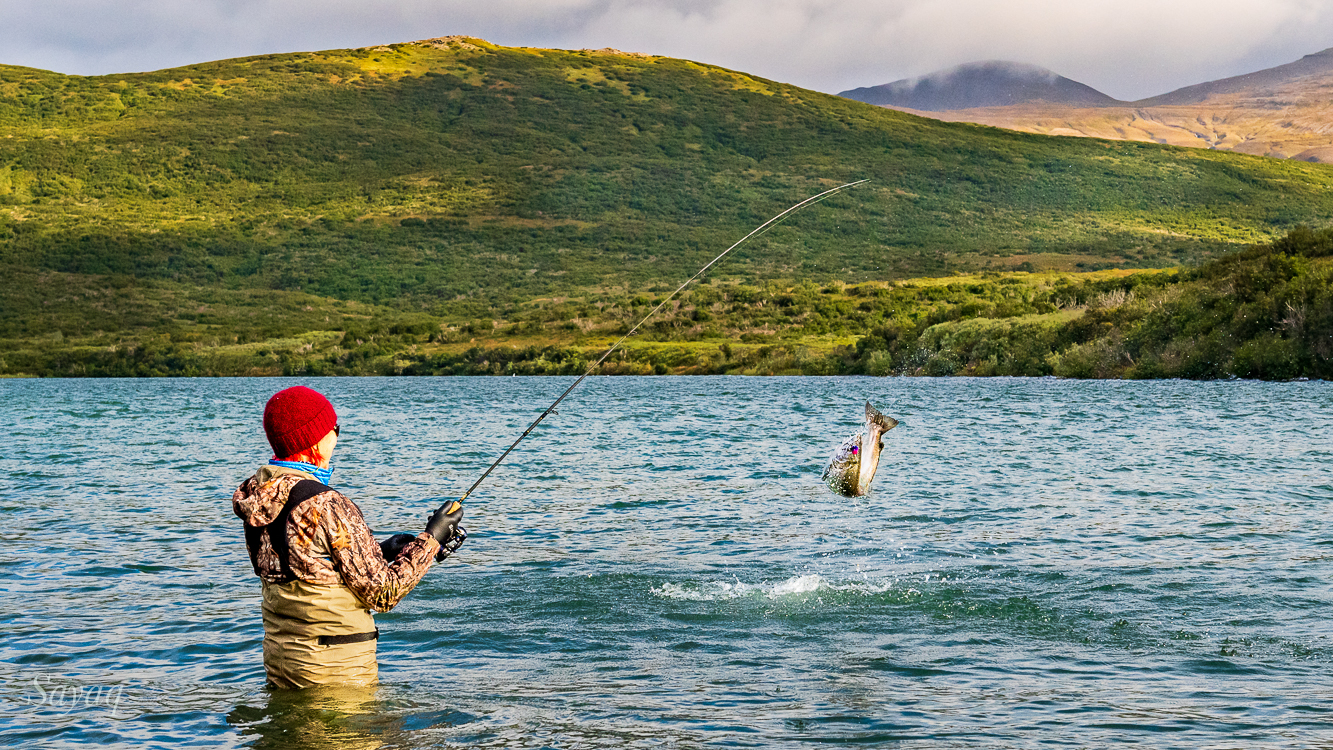
Leaper at The Bend – Ten Pounds of Silver two feet in the air at the juncture where Chignik Lake, to Barbra’s left, necks down and becomes Chignik River, to Barbra’s right. The village of Chignik Lake is on this near shore, less than half a mile up the lake. Approximately six miles from this spot, the river enters the salt waters ofthe estuary at Chignik Lagoon. Here at the early peak of the Coho Salmon run in early September, though most of the flowers are finished and summertime nesting birds are gone, low along the water alders are still wearing summer green; higher up the slopes, vegetation is autumn gold.
Sam Stepanoff preparing to get in a few casts for the Chignik’s elusive Steelhead. A fellow birder, Sam helped confirm Juncos as new to The Lake and certain finches as previously uncommon or rare. The 13-apartment nesting box he made was often filled to capacity with Tree Swallows. As a subsistence angler, Sam was surely responsible for one of the greatest non-commercial distributions of salmon in North America – beach seining, smoking and canning the Chignik’s wonderful Sockeyes and sending the jarred product off to friends and family not lucky enough to live along the banks of a great salmon river. He is missed. (February 3, 2017)
Sawbill: Red-breasted Merganser with salmon parr catch, Chignik Lake, Alaska, 12/31/16. One of my first photos of this species. Note the formidable serrations on the bill, hence the colloquial “Sawbill” sobriquet. The image, as it pertains to The Lake, is somewhat misleading as a piece of documentation. In my observation, our diving ducks were far more likely to make a meal of sticklebacks than of salmon parr.
It has been a daunting task, going through not merely thousands, but tens of thousands of photographs Barbra and I have taken during the 16 years of our marriage. In the early days, I did not shoot. It took Barbra’s coaching to instill in me the confidence to pursue a photography dreams I had set aside long before I met her.
Recollections grow blurry with time. Add to that the fact that we often didn’t see what we may think we saw; that frequently we didn’t experience what we thought we experienced. Anyone who has ever faithfully kept a journal and then gone back later to reread events recorded there will invariably think to themself, “Huh… that’s not the way I remember it,” a firmly held memory tripped up by one’s own written record. No one can accurately write about their own life and pretend that it is some sort of self-biography.
All memoir is fiction, and rightly belongs in that section of the bookshop or library next to other novels. It is folly to call memoir “autobiography” and tuck up next to the truer stuff of biography. With that understanding, we proceed.
Four months into my 12th year, the fall of 1971, I discovered on my father’s bookshelves A. J. McClane’s McClane’s Standard Fishing Encyclopedia and International Angling Guide a 1,057-page tome that changed my life and in retrospect provided a vital stepping stone along a path that led to The Chignik. Filled with angling lore, photographs, fish recipes, fly patterns, fly-rod theory, and species by species, state by state, country by country descriptive synopses it was, from the time it was published in 1965 on through the 1970’s, the one volume virtually every serious student of angling had on their shelves. The color plates featuring dozens of flies, accompanied by recipes for their patterns, made the book a must all by themselves. It was from that book, at the age of 11, that I learned to tie an Alaska Mary Ann, a fly of no meaningful application on the Brook Trout and stocked Rainbows and Browns of my Pennsylvania youth, but which I kept in my fly box as a kind of talisman holding within its wisp of white calf tail wing, jungle cock eye and silver tinsel ribbing a life I dreamed of.
I wasn’t permitted to be in the small library where McClane’s was shelved, but arriving home from school each day well before my parents returned from their teaching jobs at the local state college gave me an hour or so of privacy with this wonderful book before the sound of the kitchen door opening signaled me to spring up from the oriental carpet where I’d been kneeling over the book, return it to its place, quietly ease the den door shut, slip out of the room and sprint up the stairs to my bedroom. Minutes later, I would come back down the stairs and find my parents in the kitchen. All the while my younger sisters would have been in the downstair TV room, glued to and hypnotized by reruns of Gilligan’s Island and similar fare.
Anyway, at some point it came to me that 1) angling connected the world as did virtually no other pastime, far more widely and passionately practiced than anything else I could think of and that 2) A. J. McClane, editor-author of this massive compendium of angling expertise, angling editor of Field and Stream magazine, regarded as the foremost angling journalist of his time, would not live forever. Someone would become the next A. J. McClane.
Why not me?
My first mistake in attempting to embark on this journey was to share this dream with my parents. She put a needle in the balloon of my hopes with a single syllable laugh. He dismissed my aspirations with the same two-word opinion he voiced anytime I expressed a hope or goal. You’re delusional.
Nonetheless, when I mentioned to him the book I’d found and asked to borrow it, he allowed me to take it to my room. I doubt he had ever read more than a few pages out of it and probably hadn’t touched it in years. So the book became mine, and I pored over it. That Christmas, I once again engaged in the annual futility of asking for a for Christmas present. I wasn’t allowed to cook in her kitchen, so for the immediate future I had no means of beginning to acquire McClane’s culinary skills, but a friend of my father’s had recently taught me to tie flies and to cast a fly line and I was getting the hang of all that. I needed a camera. The little bit of money I’d made painting my godfather’s garage that summer had already been spent on clothing for school. So I asked my college educated, college teaching parents for a camera. “That’s all I want,” I told them. “I need a good camera. Don’t get me anything else. Just a good camera.” I supplied them with a specific model that was popular at the time. I suppose the term for what I was hoping for would be an “enthusiast’s” camera – something of sufficient quality to learn with.
I should have know better, having been through this charade with them every Christmas of my sentient life. That year, in addition to the usual packages of underwear (for Christmas… sigh… I should have given her a dusting cloth and a can of Pledge), there was the usual assortment of stuff I had no use for – enough of it that, added together, it would easily have paid for the camera I had pleaded for along with many rolls of film.
There was a camera… a Kodak Hawkeye Instamatic II… a ridiculous “all plastic” model from which it was impossible to coax a decent image. The camera was a promotional gimmick available for free at department stores. Purchase a couple rolls of film and a couple more of “magic cubes” flashcubes, and Kodak made money off of it. I have an image in my head of showing the camera to an uncle who was a skilled amateur photographer and the way he silently turned it over in his hand as though trying to make sense of it while searching for something positive to say, finally concluding that there was nothing to say before simply saying “Here you go,” as he handed it back to me and turning a quizzical look toward his sister. That spring, on a trip to Washington, D.C., I saw seven and eight year olds with the camera. It was of no use to me.
Lacking the means to pursue McClane-esque dreams on my own and with no support to be had from my parents, I honed my expertise in one of the great gifts I learned living with them: the art of turning my attention elsewhere. Along any path, on any journey, one is likely to encounter obstacles. The ability to find a path around those obstacles, to continue moving forward in life, cannot be overestimated in its value. Resilience. Head up, looking for an open window when a door is closed. My parents did not mean to teach me this art; I’ll never know exactly what their intent was. But the art of moving forward is the finest thing I learned while negotiating my way through life with them.
Years passed. Decades. I never completely got the idea of photography out of my head… but it seemed that the older I got, the more trepidation I had about picking up a camera and beginning to learn. When a friend invited me to attend a photography exhibit during a visit to L.A., the art I was looking at seemed so far beyond anything I might be capable of that, then in my 40’s, I concluded I would never by a photographer.
Enter Barbra.
When I began seeing her, she was shooting with digital bodies matched with an assortment of lenses. She’d taken classes at the college level, and in the pre-digital era had converted a closet into her own darkroom. It was all way beyond me, but I couldn’t conceal my curiosity. Cueing off my obvious interest, she repeatedly encouraged me to give it a go. With feelings tugging me in contradictory directions, initially I demurred. Months passed before I worked up the courage to finally ask her to show me how her D90 worked.
That seems like a lifetime ago. Year by year, new skills, new knowledge and growing enthusiasm have led to acquiring ever more sophisticated gear – and, in this digital age – an ever growing body of images. Using Lightroom (think of it as a digital darkroom with a searchable database and library) to retouch and catalog these images, I’d been doing a steady job of keeping up with our pictures till a disaster of the most fortuitous kind struck.
While transferring Lightroom files to a new computer, we wiped out all the key-working and all the edits. Countless hours of work vanished.
Turns out, that was a good thing.
Because my original key-wording was a mess. I didn’t initially understand that “key word” is best thought of as a, single, word. So I had photos tagged with long phrases, and hence a long list of keyword phrases which resulted in a headache of cluster and a difficult to search data base.
The photo retouching I had done in those days was subpar as well. Practice makes better. The more retouching I performed, the better I became at it. Not only that, my eye developed. Even before we lost all those edits, looking back on my files I was beginning to see that my early edits needed work – that in many cases, I would be better off resetting the photo to its original state and starting over.
So…
At this point, I’ve gone through our scanned photos, wedding photos, Sacramento Days, Alaska-Canada Highway, Seward Summers, Shishmaref, Point Hope, Mongolia, San Francisco. Along the way, I eliminated thousands of pictures, key-worded and retouched the keepers… and continued learning.
At last, I have reached the tens of thousands of images we created at The Lake. My view is that if a picture is worth keeping, it’s worth cataloging so that it can readily be located, and it’s worth retouching (cropping, adjusting exposure, hue, vibrance, contrast, sharpness) to bring out its best qualities. I have a friend whose father left behind, at death, thousands of photographic slides. “What am I supposed to do with this?” he said, mild exasperation in his voice as he motioned towards cabinet drawers jammed full of uncatalogued slides.
Either hire someone to go through and curate them or make a bonfire, I suggested.
I can’t bring myself to add up how many photos are yet to be finished. When climbing a mountain, a glance at the summit should be enough; after that, it is best to keep one’s eyes on the path just ahead.
Seven year’s of images from the Alaska peninsula, plus our bicycle trek in Hokkaido and other summertime adventures during those years. But it’s good work, the kind that puts a smile on my face as I revisit happy memories. I confess that I teared up when I opened the first image from our Lake years – an aerial landscape of endless, jagged, snow-capped peaks as we flew down the Alaska Peninsula for the first time to live among Alutiiq Native Americans in a tiny wilderness village along one of the world’s last, great, seldom-touched salmon rivers. The extraordinary fly-fishing that followed; the bird project; the flowers and wildlife and landscapes and people.
I’ll continue to post a photo each day or so from this massive library – a sample of those that I really like. My hope is to finish sometime this spring, at which point I’ll be ready to move forward with the next project.
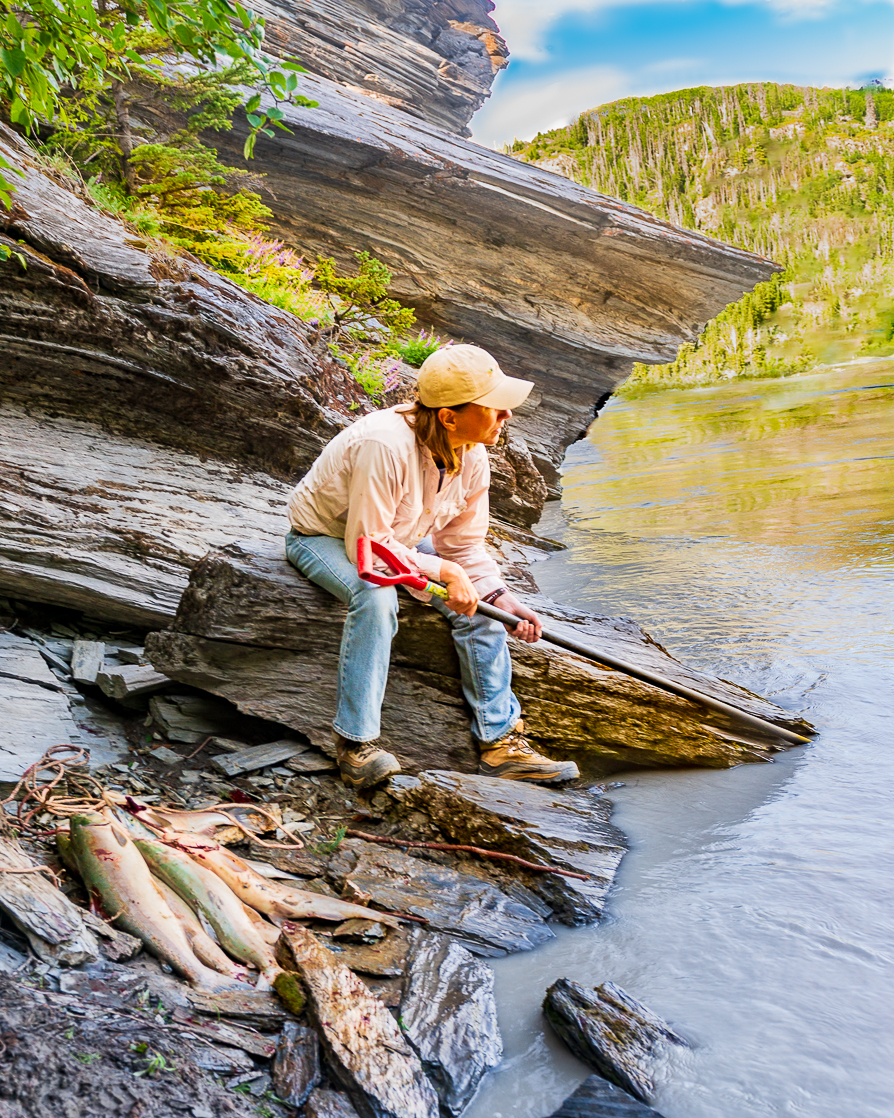
Barbra waiting for Sockeye Salmon to hit her net on the mighty Copper River near Chitina, June 22, 2012.
Iconic Alaska. Hike in along a canyon trail, then down a steep, more narrow trail to water’s edge. The river’s chalky, clay-colored glacial till reveals nothing. But the fish are there. Upwards of a million Sockeyes will ascend the Copper, and that’s after the commercial fishing fleet has taken a similar number from the sea near the river’s mouth. Armed with a net on a big hoop attached to a 15-foot pole, you find a fishable perch along the canyon wall and ease the net into an eddy. If you’ve timed it right, huge schools of fish are passing in front of you within feet of the shoreline. It doesn’t take long till you feel the morning’s first solid thump as a Red hits the net. If you’ve got the patience and don’t pull in right away, you might feel another thump, and then another – three fish in one scoop. And you feel a connection with people who have been fishing for salmon this way for thousands of years… grateful that there’s a place where it can still be done, not another person in sight except for the companion you’ve hiked in with. You get the feeling this isn’t going to last… which makes you appreciate it all the more. Iconic Alaska.
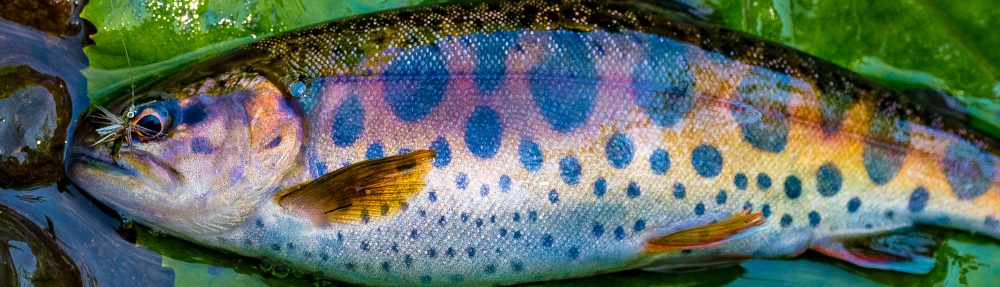
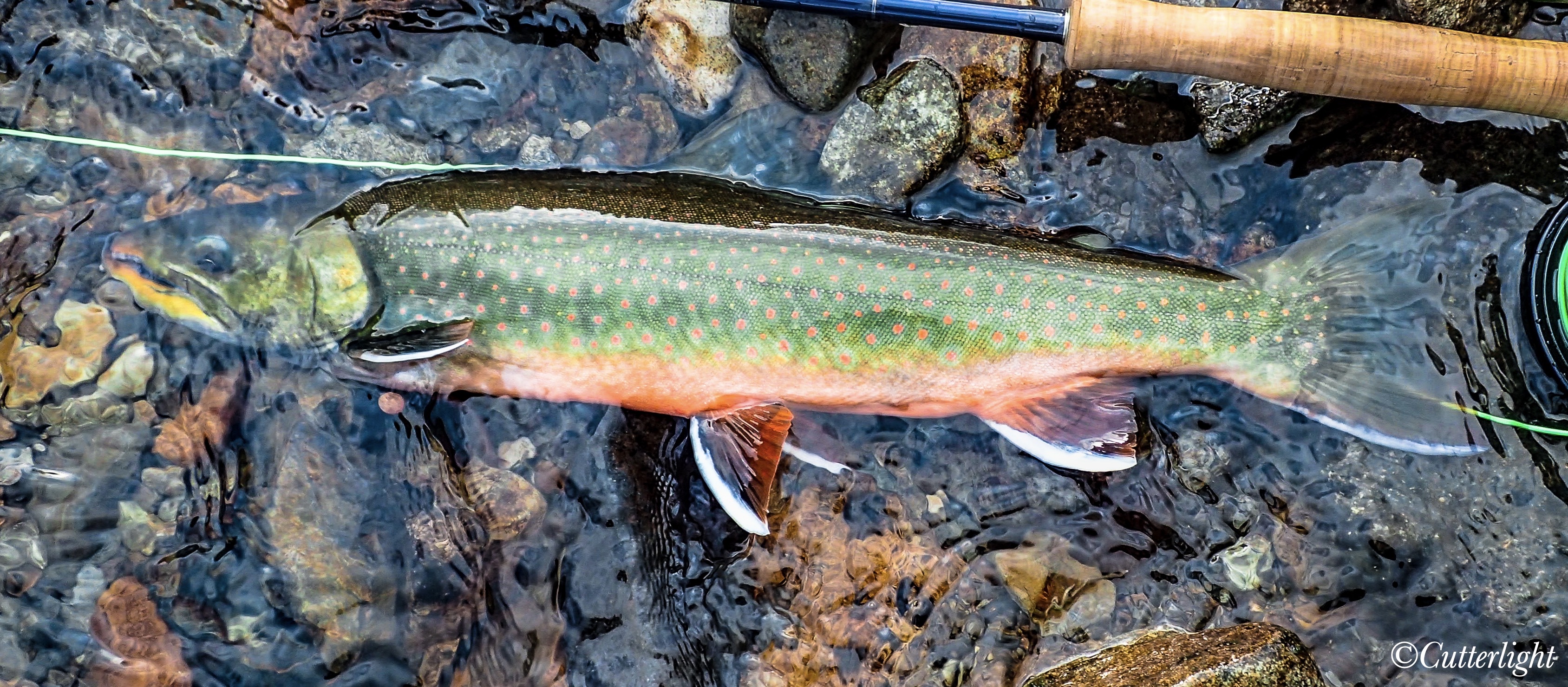
Perhaps there is no species of fish more stunningly marked than a char in spawning colors. Regardless of their size or the particular species (there are dozens scattered across the Northern Hemisphere), the beauty of a fall char offers a special reward for a fly-fishing outing to the cold, clean rivers, streams and brooks they inhabit. The term char is thought to derive from the old Irish ceara or cera, which refers to the blood red coloration sported by some char.
The specimen in the above photo is of the species Salvelinus malma, Dolly Varden, caught on September 25, 2016 on a local creek. While many char inhabit only fresh water, others, such as the 18-inch male in this picture, spend part of their lifecycle at sea. This fish had migrated to a small stream where he was fattening up on salmon eggs prior to his own spawning event. While the char of the Chigniks don’t attain the massive size of certain populations elsewhere (30 pounders have been recorded), their spirit as a game fish when taken on a light fly or tenkara outfit and their striking coloration make char of any species among our favorites. And by the way, if you’ve never treated yourself to a meal of char, check for farmed Arctic Char where you purchase fish. Unlike farmed salmon, which we strongly advise avoiding, farmed char are a sustainable, ecologically smart choice. Served whole or filleted, the meat is sumptuous. (Olympus Tough TG-3, 1/320 at f/32, ISO 100)
If you’d like to read more about cooking and fishing for char…
Wild Alaska Salmon on pan toasted homemade English muffins, wild Alaska blueberries and a big mug of coffee – a wild way to start the weekend.
This is easy. Take a wild salmon fillet, remove the skin, chop up the fillet and put it in a bowl. Add equal parts grated mozzarella and crumbled goat cheese. Sprinkle in a spicy seasoning – something with smoked chipotle is especially nice. No salt needed as the cheese should be salty enough. That’s it. Now shape the mixture into burgers and fry in olive oil, flipping once.
Served on English muffins that have been pan toasted in olive oil, these make for a terrific weekend brunch. Or put the burgers in traditional hamburger buns. Try them with a little Dijon mustard. Bon appétit!
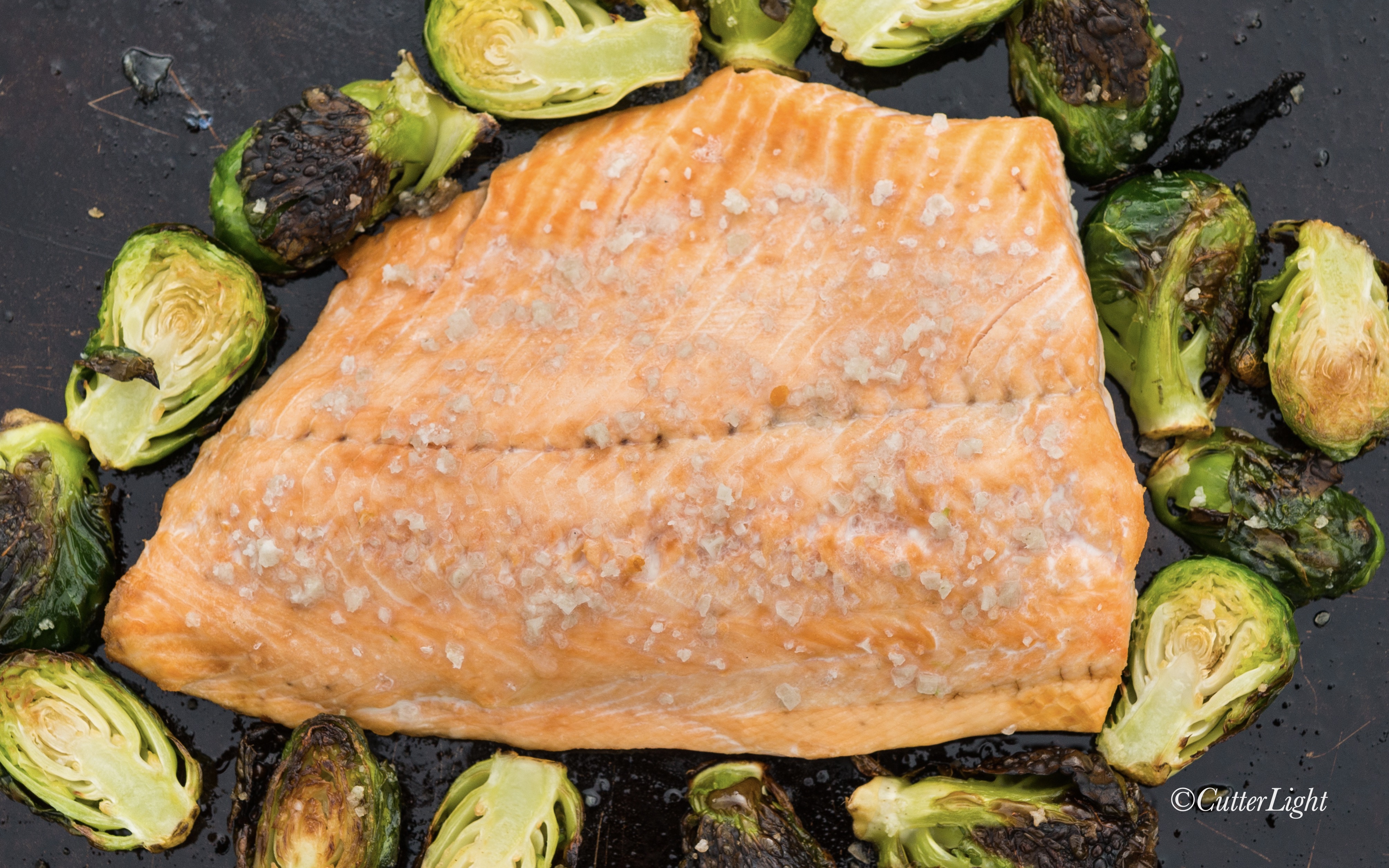
Sea salt, olive oil and heat are the only ingredients you need to turn out great salmon every time. Particularly if you’re just getting into cooking and you try this recipe, we’d love to hear from you with any comments or questions and of course a report on how your salmon came out!
Over the years, one question has repeatedly come our way: “I really don’t do much cooking, but I’d like to be able to make salmon. Is there an easy recipe you know of?”
Not only is the answer to this question a resounding “Yes,” the recipe happens to be our favorite. I learned about shioyaki (salting and cooking) when I lived in Japan where shioyaki can refer either to charcoal grilled fish or, more commonly in home kitchens, broiling.
In addition to being the definition of simplicity, the genius of this recipe is that, unlike more elaborate recipes, the salt brings out rather than masks the flavor of the fish. This is exactly what you want when dealing with a fresh, wild-caught salmon. On the other hand, because the flavors are simple, the finished dish is easily enhanced with toppings. Try it with raspberry chipotle sauce (easily made at home) or with Mae Ploy Sweet Chili Sauce. Here’s how it’s done.
Ingredients & Preparation
You’ll need a broiling sheet. A standard cookie sheet works fine, but a heavier sheet is even better.
Salmon fillets – any species of wild-caught salmon
A favorite kosher salt or sea salt. We’ve found coarse Grey Sea Salt to work especially well.
Extra virgin olive oil
Directions
Place oven rack in center or one position below center. (This is the one “trick” you might need to experiment with. Ovens vary. So don’t be discouraged if your first attempt doesn’t work out as you expected. Adjust the rack position and go for it again! Once you have this dialed in, the rest is a snap.)
Place the broiling sheet in the oven and preheat on Broil. (10 minutes is generally the right amount of time.)
Meanwhile, rinse salmon fillet(s) in cold water. Pat dry with paper towel and place skin side down on cutting board.
Sprinkle salt on fillet.
Put a little olive oil on the hot broiling sheet – enough to cover the area where you’ll place the fillet.
Place salmon fillet skin side down on prepared sheet and place in oven. It should vigorously sizzle when it touches the sheet. If it doesn’t, simply place the sheet back in the oven and continue preheating.
Cooking time will vary depending on fillet thickness. 8 to 10 minutes is usually about right. An oil-like liquid will begin to emerge from the top of the fillet when it is done. Again, if your first attempt produces an undercooked or overcooked fillet, make a note, stick it on your fridge, and adjust the cooking time. If the fillet comes out overly dry on top or burnt, you probably need to lower the rack. Keep simple notes till you get it dialed in.
Fillets prepared this way are superb served on rice, on pasta, served along with tartar sauce or avocado spread as a sandwich or broken into pieces to top a superb Alaska-style pizza. Going for an added touch with a glass of wine? It’s tough to beat a lightly chilled Chardonnay.





 CutterLight