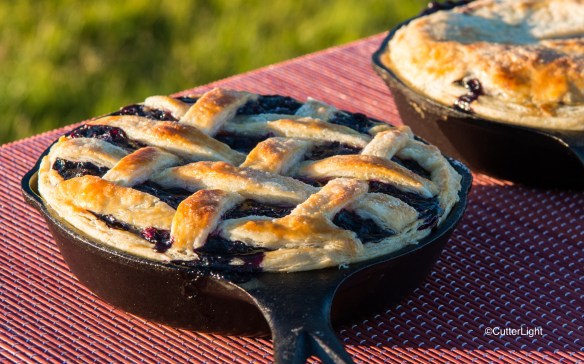
Alaska Wild Blueberry Skillet Pies

For us, late summer in Alaska means harvest time. This is the time of year for berry picking and fishing for Sockeyes and Silver Salmon in the Chignik River system. Only a short walk away from our home, there is a lovely patch of feral raspberries with plenty of ripe berries. And not so far away in the other direction is a place we call the blueberry bog, where, as you’ve already guessed, we can pick low bush blueberries to our hearts’ content. 

Now that I’ve finally mastered the Buttery Flaky Pie Crust (a culinary goal checked off last winter), I am confident when Jack requests pie for dessert. Today’s request – Alaskan Wild Blueberry Pie.  Jack and our houseguest Isabel knew what they had to do while I was busy teaching my students. Armed with bear spray and berry collecting containers, they hiked the mile or so to the bog. Their efforts were rewarded with fresh slices of pie topped with scoops of extra rich homemade vanilla ice cream.

Alaska Wild Blueberry Skillet Pies

(Makes 2 6-inch skillet pies)

Ingredients

  • 1 double pie crust
  • 3/4 cup sugar
  • 3 tablespoons cornstarch
  • 1/8 teaspoon salt
  • 1/4 cup cold water
  • 5 cups fresh blueberries, divided
  • 1 tablespoon butter
  • 1 tablespoon lemon juice

Directions

  1. In a saucepan over medium heat, combine sugar, cornstarch, salt and water until smooth. Add 3 cups blueberries. Bring to a boil; cook and stir for 2 minutes or until thickened and bubbly.
  2. Remove from the heat. Add butter, lemon juice and remaining berries; stir until butter is melted. Cool. 
  3. Preheat your oven to 350 degrees F.
  4. Cut four circles out of of pie dough. Each dough circle should be about 1/2 inch larger than the mini skillet you’re using as your guide. Place the dough circle into the skillet, being careful not to stretch the dough. With a knife trim off any excess dough.
  5. Ball up all of the extra dough and roll it out on a lightly floured surface. Cut out four more circles large enough to cover the top of a mini skillet.
  6. Next, evenly divide the blueberry filling among the skillets. Top each with approximately 1/2 tablespoon of cubed, cold butter.
  7. Cover each skillet with a piece of dough. Using your fingers, crimp the edge of dough all the way around to seal. Brush with egg wash and sprinkle lightly with sugar. Place skillets onto a cookie sheet for baking.
  8. Bake for 35-40 minutes or until crust is golden and the filling is bubbly. (If the top crust starts to get brown before the inside is hot, cover with aluminum foil.)
  9. Cool before serving. Top with ice cream.


First Silver of 2018

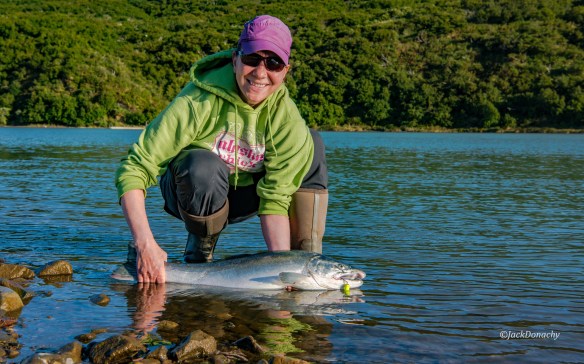
Ocean-bright and full of fight, Barbra’s 12-pound Coho today is the first and only salmon we’ve put on the bank this year… so far.

In each our previous six years in Alaska, our fish for the coming months were long ago caught, cleaned, freezer-packed or smoked and canned and put away.

Not this year.

Like a lot of salmon runs around Alaska, here on the Chignik River its been a mere trickle of fish compared to other years. In fact, for a few weeks in July fishing was closed altogether. Still, we were confident upon returning from our bike trek in Hokkaido that we’d be able to get the couple of dozen or so fish we need.

That was nearly a month ago. Admittedly, it’s not like we’ve been hitting the water every day. But the few times we’ve been out, it’s been discouraging. When lots of salmon are around, so are bears, eagles and seals, and we can generally see lots of jumpers – salmon fresh from the sea and full of energy spontaneously leaping for whatever reasons salmon spontaneously leap. But it’s been eerily quiet; the usual eagle roosts have been empty.

Even in this down year, hundreds of thousands of Sockeyes ascended the river, and there will undoubtedly be thousands of Coho as well. It felt great to finally get one. Pasta with fresh salmon is on the menu tonight.

Raspberry Vanilla Custard Tart in a Swanky Almond Crust

Sixty-six days on a bike, 1,300 miles pedaled, more miles walked, hiked, climbed, and canoed. Before we knew it, we were back home with thousands of photos and a lifetime of stories to prepare for publication. What better way to transition back from the world of bicycle trekking to our home in Chignik Lake than baking? I can’t think of one.

I arrived back home to my patiently waiting, full, lovely pantry. Translucent jars of raspberry jam caught my eye on from the shelf where they’d been stored. With this year’s fruit quickly ripening, it’s time to use up last year’s stores. What a great excuse to bake with one of my favorite flavors – raspberry. Jack “I-don’t-have-a-sweet-tooth” Donachy’s secret weakness is custard desserts. For no better reason than pure love (of custard and raspberry), this little baby was created. Wait… I’m not saying that little baby Jack was created just to eat custard. I’m saying that this dessert… never mind.

A crust infused with almonds. Then a creamy vanilla custard topped with a smooth, delicious layer of homemade jam – I prefer raspberry. I set it out to photograph, and it was gone in a flash.

For those of you following along, we will have plenty of photos and stories coming from our bicycle trek around Hokkaido. Jack is up to is elbows in the sorting and editing process as well as catching the last of Chignik Lake’s migratory birds before they head south. Stay tuned. For now, sit back and enjoy a slice, or two, of this delicious tart.

Raspberry Vanilla Custard Tart

Crust

Ingredients

  • 1 cup all purpose flour
  • 1/2 cup finely chopped almonds
  • 3 tbsp granulated sugar
  • 2 large egg yolks
  • 1 tbsp cold water
  • generous pinch salt
  • 1/4 cup cold unsalted butter

Directions

  1. In a large bowl, whisk together flour, almonds, and sugar.
  2. In a medium bowl, whisk egg yolks and water.
  3. Grate butter into flour mixture. Toss butter so that it is fully coated. Use two sharp knives (I used steak knives) to chop the butter into smaller pea-sized pieces.
  4. Pour egg mixture into flour mixture. Stir with fork until dough comes together. It should be shaggy looking. If it’s too dry add tiny amounts of cold water until it comes together.
  5. Turn dough out into a 9-inch springform pan or tart pan with removable bottom.
  6. Press dough into bottom of pan and up the sides of pan (about 1 inch) with fingertips.
  7. Prick dough with fork. Freeze for 20 – 30 minutes.
  8. Preheat oven to 350°F.
  9. Bake crust for 35 minutes. It will be golden brown when finished.
  10. Let cool completely. You can store the crust at room temperature if it’s tightly wrapped in plastic.

Vanilla Custard Filling and Raspberry Topping

Ingredients

  • 2 cups whole milk
  • 1 tsp vanilla paste
  • 4 large egg yolks
  • 1/3 cup granulated sugar
  • 4 tbsp cornstarch
  • pinch salt
  • 3 tbsp unsalted butter
  • 1/2 cup homemade raspberry jam (here’s a good recipe for quick jam)

Directions

  1. Bring milk and vanilla to a simmer in a medium pot. Remove from heat.
  2. While heating milk mixture, thoroughly whisk together egg, sugar, cornstarch and salt in a medium bowl.
  3. Slowly, while whisking, pour milk mixture into egg mixture.
  4. Pour custard back into the medium pot.
  5. Continue whisking mixture over medium heat. Mixture should begin to bubble and become thick. Remove from heat.
  6. Whisk in butter, one tablespoon at a time.
  7. Transfer back to medium bowl. Cover with plastic wrap so that wrap is against surface of custard.
  8. Cool completely in refrigerator.
  9. To assemble, whisk cooled custard until smooth.
  10. Pour custard into cooled crust.
  11. Spread jam evenly on top of custard.
  12. Serve immediately.

Recipe adapted from Bon Appétit  Magazine.

Gray Heron, Hokkaido – wildlife notes

Gray Heron, (aosagi), Abishiri campground, Hokkaido, Japan.

One of the reasons we chose Hokkaido for our first bicycle trek were the reports that wildlife viewing on this northern Japanese island can be quite good. We’ve not been disappointed. Almost every morning we’ve woken to the songs and calls of birds, and our rides this summer have taken us through mile upon mile of gently rolling farmland, forested hills, river valleys and along coastlines. To date we’ve identified over 60 species of birds and have encountered bears, deer, foxes, mink, seals, porpoises and small whales. Some of the highlights have included:

  • 9 Brown Bears
  • over 20 Red Foxes
  • Dozens of Ezo Deer
  • 32 Red-crowned Cranes
  • Over 20 White-tailed Eagles
  • 2 Blakiston’s Fish Owls (and nighttime voices of other species of owls)
  • the world’s largest breeding colony of Rhinoceros Auklets
  • 3 species of cuckoo
  • 4 species of woodpecker
  • 2 species of snakes
  • Ezo Red Squirrels (and Siberian Chipmunks)
  • Peregrine Falcons
  • Dall’s Porpoises
  • over 100 seals
  • more butterflies and moths – and more different kinds of butterflies and moths – than we’ve ever before seen anywhere

Wildflower viewing as well has been fantastic. When we return to Alaska, we’ll post more detailed articles about Hokkaido wildlife.

Thick-billed Crow’s Lucky Day

Got ‘em!

A few days ago we were in Rausu, Hokkaido at a bed and breakfast where Blakiston’s Fish Owls can be seen. From head to toe and wing tip to wing tip, these are the world’s largest owls – and one of the rarest. We had hoped to get a look and maybe some photographs. 

In the stream that flows in front of the property, the minshiku owners have created a small pool which they keep stocked with trout. Most nights this time of year a breeding pair of fish owls take turns showing up at the pool to forage for themselves and their chicks. We got some nice photos of both the female and the male owl which we’ll include in an article at a later date.

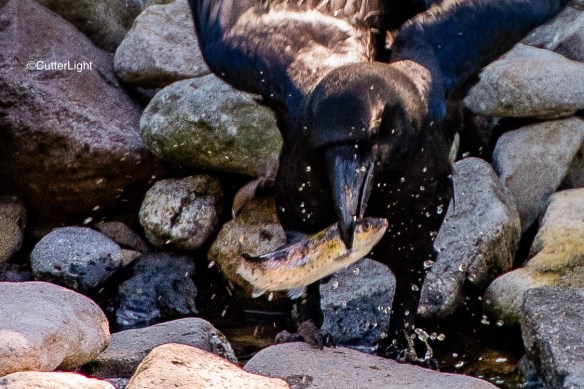
In addition to the owls, minks – a species introduced from America – are occasional nighttime visitors to the pool. In wintertime, bears follow spawning salmon up the stream. One afternoon I was watching the pool, camera in lap, when a Thick-billed Crow landed in a nearby tree. I knew right away what he had in mind, so I focused on the pool and waited. What I wasn’t prepared for was the short work he made of catching this trout. 

Knee Deep in Trout and Char (somewhere in Hokkaido)

Iwana (Dolly Varden Char) are one of Hokkaido’s most celebrated cold-water fish.

I have an incurable habit of looking into water for fish. It doesn’t matter what kind of water. At the beach I check the translucent prisms of waves for whatever might be cruising the surf. Coming upon pools on rivers during hikes I make efforts to position myself so that I’m looking into shade rather than glare so that I can maybe catch a glimpse of something with fins. I’ll even check out coin fountains in the off chance that a carp or even a goldfish might be swimming around. But bridges on quiet country roads crossing pretty little trout streams are especially inviting. There’s almost always a pool below the bridge, and if the water has a population of trout, there are often a few of them hanging out right there. No matter how hard-fished the water might be, it’s worth a look.

Yamame could literally be translated as “Mountain Girl” – a lovely name for a lovely fish. More commonly the stream-dwelling form of this species is called “Cherry Trout.” Similar to Cutthroat and Rainbow Trout of the Pacific Northwest, (to which yamame are related), some go to sea where they attain sizes measured in pounds and return to their natal rivers to spawn bright as polished chrome – Cherry Salmon.

And so there we were, mid-afternoon, straddling our bikes and leaning over the the concrete side of a bridge on a quiet road running through a mix of forest and farmland somewhere in Hokkaido. The water was perfectly clear, but the trout and char are so adeptly camouflaged to match the stony bottoms of these streams that unless one moves they are all but impossible to pick out. 

One moved. As it rose to take something off the surface I could even see its spots. A char of some type. I hadn’t done any fishing yet in Hokkaido. This fish was telling me it was time I did.

I didn’t expect the fish to be large and they weren’t. But in the space of about two hours I covered a couple hundred yards of this silvery mountain stream and caught two dozen or so fish  About half of them were iwana. The others were yamame. A few came to a parachute Adams – my favorite dry fly searching pattern. A lot more came to a pheasant tail nymph – my favorite nymph. A couple of overly eager types tried to eat the pea-sized orange strike indicator I was using. 

A younger version of myself would have kept a few of these fish for the frying pan. But these days I fish for trout in part to simply confirm that they are present, and I wanted these fish to remain present. So Barbra took a couple of photos and I released everything to continue living out their lives in this silvery piece of water and light somewhere in Hokkaido.

There wasn’t a single human footprint along the banks, much less a path. Knee deep in a cold mountain stream full of trout and char – sitting on top of the world, legs hanging free.

Tunnels of Love – Light at the end of the Tunnel – Tunnel Vision: A Bicyclist’s Point of View

A kind snow tunnel – not too long, plenty of light, and just enough shoulder.

There is something about tunnels, sometimes dark and scary, sometimes magical and transformative.

When I was very young, my family drove around in a Volkswagen Beetle. I remember enjoying the magic of the immediate darkness of tunnels. The dark would be simultaneously met with the crackle of static on the radio as we lost reception. Then the heartbeat of yellow lights would blink into the windows from the dim tunnel lighting providing a rhythm to accompany the radio static. With a jolt from this world, the Beetle would be blasted back into the light and back into normal. It was fascinating to my young imagination.

Some welcome! Eighteen meters tall (almost 60 feet), the demon of Noboribetsu would be the perfect host to some of the tunnels we traversed.

Fast forward to our current bike trek in Hokkaido. Our ride has brought a whole new stream of consciousness to the tunnel. In recent years, hadn’t given much thought to these marvels of modern engineering, the exception being the time I drove our pickup while towing our fishing vessel Gillie through the unnervingly narrow tunnel that leads to the town of Whittier, Alaska. Steering wheel gripped tightly in my hands, I could feel the boat trailer sashaying back and forth on the slick railroad tracks that transversed the abyss. But that is another story.

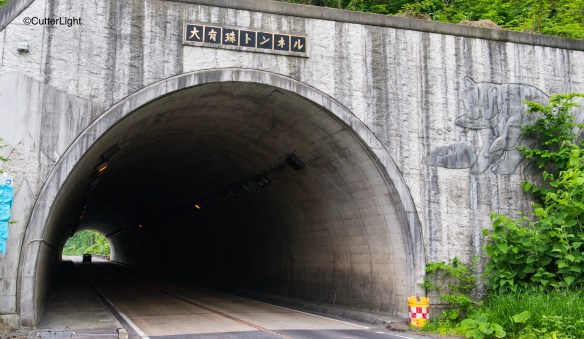
The first “real” tunnel seemed long, but at just over a mile, it turned out to be merely average.

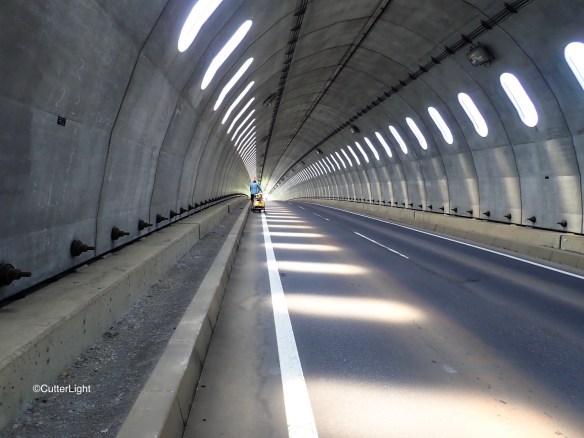
Our introduction to the tunnel by bicycle happened the very first day of our Hokkaido trek. It was a kind introduction as the tunnel was of the type designed to keep the heavy winter snowfalls off the road. Wrapped tight to a mountain pass, the tunnel’s outside wall featured a series of openings where sunlight poured in, giving the space a comfortable, open feeling. Moreover, there was a large enough shoulder to ensure safe passage even for our somewhat Rubinesque, trailer-towing bikes. Though several hundred meters in length, this first light-filled tunnel with its wide sidewalk was a breeze.

Our first “real” tunnel – dank, dark, cold, long and narrow – came later. We hugged the shoulder, our safety lights blinking, pedaling as fast as possible, worried that approaching vehicles wouldn’t see us in time. The amplified roar of oncoming traffic echoed and mixed with the odor of mold, grease, diesel and exhaust fumes and in that dark tube we experienced the paradox of simultaneously feeling that we we traveling very fast while making little progress. Jack found the energy in his legs to pull ahead, even while pulling the trailer. My nerves must have been apparent as a kind driver slowed behind me and escorted me to daylight.

At this point, I can’t believe how many tunnels we’ve gone through. The best tunnels have been the snow tunnels. They rank high because of the natural light and their relative brevity. On rare occasions, we’ve traveled through tunnels with a sidewalk separated by a safety railing. But even these tunnels can’t muffle the brain-rattling sounds of roaring trucks and screaming motorcycles, and there’s always the sense that you’ve got to concentrate on maintaining an unerringly straight course lest you pin yourself to some protrusion jutting out from the soot-stained tunnel wall.

One day, we had a relatively short ride from Yoichi to Otaru along Hokkaido’s southwest coast. The map showed tunnels…lots of tunnels…between the two towns and in fact the ride felt almost like a constant tunnel as even when we weren’t physically inside a tube we were psychologically preparing for one. This day featured our worst tunnel experience.

As usual, we were swallowed into the tunnel in question just as we had been swallowed into the semi-darkness and wet chill of previous tunnels. We rode on a sidewalk, which was just wide enough to handle our bike’s girth with panniers and the trailer. But perhaps a kilometer into the dimness and utterly without warning, the sidewalk shrunk to half its size. The next thing I knew, Jack’s front panniers hit the railings and he screeched to a stop. Escaping with a bloodied knuckle and a mouthful of expletives, we survived the tunnel by crowding into the flanks of our bikes and walking the remainder of the way, our shins absorbing a few pedal bites in the process, the experience bringing fresh gratitude for the light at the end of the tunnel!

After a wonderful two-days in the city of Otaru, we steeled our nerves for the ride up the coast. The ride would be beautiful. But there would be tunnels. Lots and some really long ones. Rattled from the most recent tunnel experience, at the first one we encountered we opted to push our bikes through on the very narrow sidewalk. Just wide enough to accommodate our bikes in this fashion, the sidewalk seemed to have been installed for maintenance workers rather than pedestrians. Our plan was for me to follow Jack closely and shout a warning if the outside trailer wheel got too close to the edge of the walk. Using this strategy was maybe safer, but it seemed like it took forever.

As we traveled up the coast, traffic grew lighter. We couldn’t stomach another long walk through another dark and deafening tunnel and the one we were now facing was truly a beast – two nearly adjoining tunnels spanning almost four miles. It was time to shore up our confidence and place some faith our fellow drivers. We strapped on headlamps and, as I was in the rear position, I added a couple of blinking lights to my rig and off we went.

Translation? Tunnel after tunnel after tunnel after tunnel!”

At some point, I had adopted a strategy of singing in the tunnels in order to drown out the deafening noises and to distract myself from my own nerves. I didn’t just sing. I sang at the top of my lungs. This turned out to work pretty well – once Jack didn’t take my singing noises as anguished cries for help. And so for most of four miles I belted out any song that came to mind.

Time to take in some sunshine, enjoy lunch, and scan for birds.

Once we had finally put the beast behind us, we pulled off the road for a rest and a celebratory lunch. Apparently you can burn some serious calories pedaling like a dervish while simultaneously singing at the top of your lungs!

Tinged with the unknown and eliciting perhaps mixed emotions of safety and danger, tunnels remain fascinating to me. For a little while, they take you out of the world in which you’ve been residing, close in around you, carry you along in a way that demands a kind of trust… and then deliver you to some newly lighted world on the other side.

A happy bear eating salmon at one end and light at the other. A perfect tunnel.

Agehachou – Asian Swallowtail Butterfly

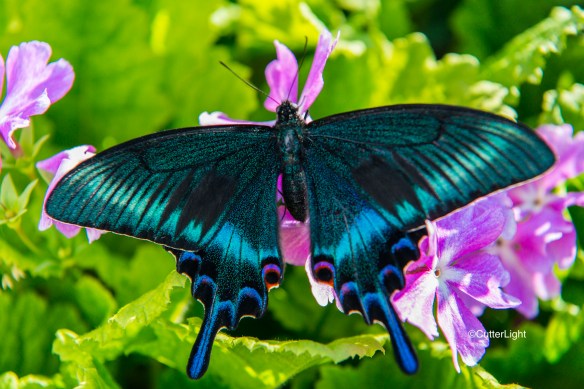
Almost surreal in it irredescence, this agehachou is one of the many stunning butterflies we’ve encountered on our Hokkaido bike trek.

We’re not lepidopterists, but it would be all but impossible not to notice the incredible beauty and diversity of the moths and butterflies – not to mention the amazing variety of caterpillars – we’ve been encountering on our bike trek around Hokkaido, Japan. If you find them early enough in the morning when they’re still warming up, you can sometimes sneak a decent photo. This agehachou (Asian swallowtail) is among the more stunning butterflies we’ve found, but it seems that all butterflies are beautiful. As the summer progresses and flowers change, different species are emerging. Today the paths were filled with nearly iridescent black caterpillars, leaving us wondering what form they’ll take as adults.

The Many Tastes of Hokkaido – Kita no Lamp-tei Restaurant in Shiraoi

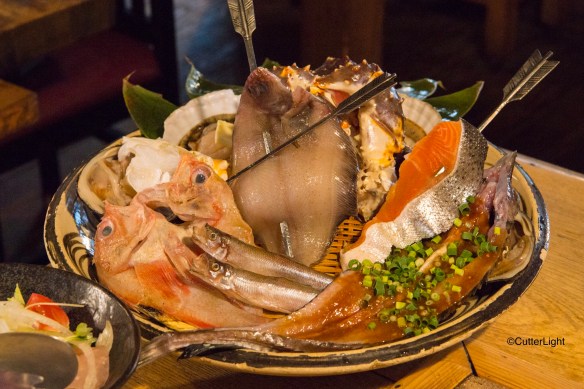
Our waiter’s recommendation: a platter of seafood ready for the tabletop grill featuring some of Shiraoi’s regional summertime specialties. From 12:00: King Crab legs, ocean-fresh salmon, Sailfin Poacher, Willow Leaf Smelt, Thornyhead Rockfish, Surf Clam, Sea Scallop, center, flounder. (Viewer discretion is advised regarding the food photographs that follow.)

When the only two people in Shiraoi we asked for an evening restaurant recommendation immediately suggested the same place even while in the same breath acknowledging that it was too far to reach in a bike trip, our interest was definitely piqued. The first person we asked was our server at Shiraoi’s Kinpen Cafe where we were having a delicious casual seafood lunch and the other was a guide at the local tourist information agency – people who were likely to know where the best food was being served. We lamented the fact that we probably wouldn’t connect with the Kita no Rampu-tei (Northern Lamp) restaurant and resigned ourselves to our standard “Plan B” – ride until we come upon something. That particular night, we grabbed an assortment of sushi and other items at a local supermarket and took them back to our campground for dinner. (And by the way, if you’ve never had supermarket sushi in Japan, don’t be tempted to compare it to the generally not-very-good fare offered in American supermarkets. Supermarket sushi in Japan is superb.)

An excellent choice for casual dining – and a good place to get additional dining recommendations – Kinpen Cafe, Shiraoi.

We broke camp late the following morning at Poroto Campground, hopped on our bikes and headed southwest along the coast toward the city of Noboribetsu.

Frogs, woodpeckers, deer and other wildlife added a nice touch to the quiet, well-maintained campground at Poroto Lake in Shiraoi.

Taking an especially leisurely pace even by our standards, we paused for a while to talk with fishermen trying their luck for flounder and greenling along a harbor wall, had a picnic lunch along another sea wall and stopped frequently to check out African Stonechats and other songbirds which seemed to be everywhere. By the time we’d covered a few miles, the sun was coming down and we were ready for dinner. 

There were some nice fish being caught along this harbor wall. The main target was greenling with flounder showing up in good numbers as well.

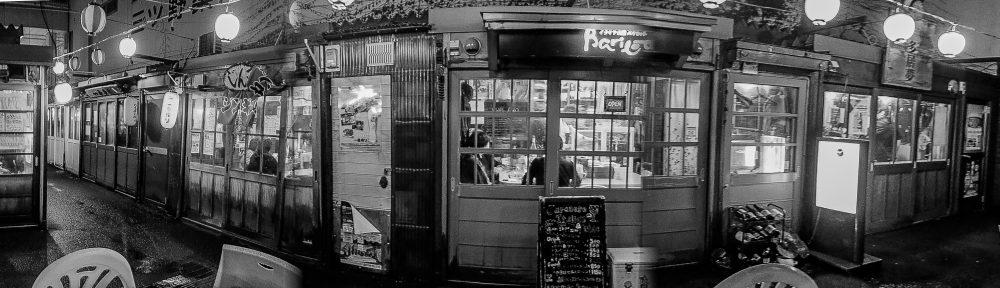
Longtime admirers of the beautiful, hand-blown glass floats Japanese fishermen used to buoy their nets in the pre-plastic era, an attractive display of large floats hanging from a building drew our attention. We spent a good bit of time photographing the floats before we realized that the building they were attached to was a restaurant, and a bit of time after that before I stepped back and attempted to decipher the name of the place.

 北のランプ亭. 

“Hey! Kita no Lamp!” I called out to Barbra. “This is the place those people recommended!”

“Oh, wow! What are the odds? Let’s see if we can get a table!” She replied.
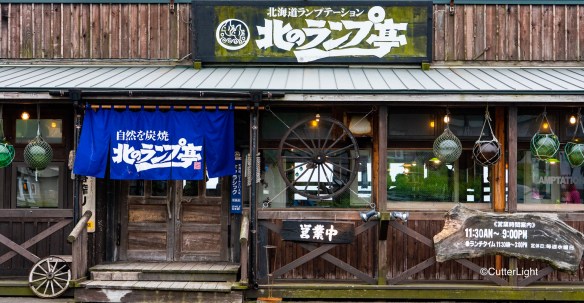
We found out later that Kita no Lamp is the top rated of the area’s 80-some restaurants and that it can be tough to get into without a reservation. Still early in the tourist season and late on a mid-week night to boost, luckily we were able to get a table. I don’t know the bar an establishment has to clear to earn Michelin recognition, but what followed was easily one of the best restaurant experiences either one of us have ever had. 
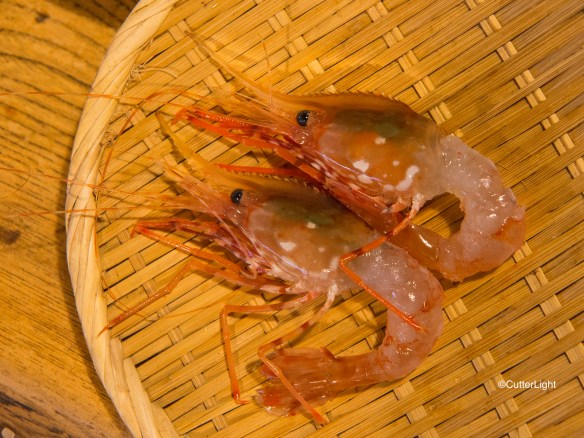
Our waiter first presented this pair of ama-ebi (Northern Deepwater Prawn) live, then took them to the kitchen where they were prepared for the table.

Many years ago as a student of things Japanese, I read several dismissive accounts of Japanese cuisine. “Bland” was a term that cropped up more than once. This was before the sushi revolution swept the world, a revolution that was followed by a growing appreciation of the seasonality of foods, the subtleties of different types of noodles, and before terms such as “umami” had become part of the world-wide culinary lexicon. In fact, when I found myself stationed in Japan as a United States Navy sailor, I couldn’t understand what those writers were talking about. Japanese food is amazing. 

Ikura (salmon roe) served with slivers of nori and a smidgeon of wasabi atop a bowl of steaming hot rice kept the meal moving forward.

Hokkaido in particular merits food destination status, and while seafood reigns supreme on this island surrounded by cold, clean Pacific seas, there is tender, flavorful beef, pork, lamb and fresh fruits and vegetables that rival the best to be found anywhere. Indeed, much of the food will be minimally seasoned. With the very best ingredients served fresh and at their peak, a light hand with seasoning is ideal.

We had been told that we absolutely must try Shiraoi beef. In fact, a fellow camper at Poroto shared a couple of expertly grilled pieces with us, leaving us wanting more of this incredibly flavorful, fatty, soft beef. Here a steak shares a plate with local pork belly, sausages, marinated chicken, pumpkin, mushrooms and asparagus which was at the peak of perfection during our time in Shiraoi.

And so, relatively early in our summer in Hokkaido and comfortably seated at one the island’s top restaurants, we followed our waiter’s recommendations, ordered too much food, savored every last bit of it, and, with the owner’s permission, ended up pitching our tent on the restaurant’s property and spending the night there.
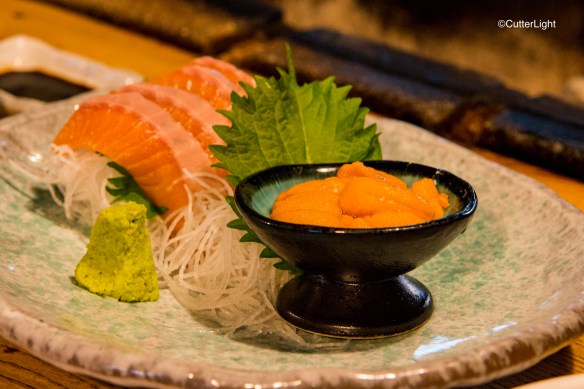
At this time of year, virtually all of Hokkaido features creamy, fresh-from the ocean Sea Urchin. Here a bowl is served along with salmon sashimi.
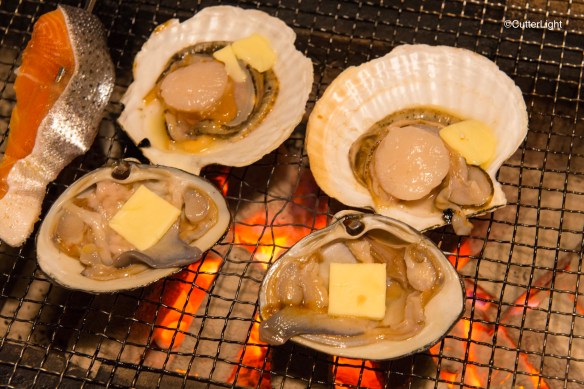
While researching this trip, we kept coming across photos of grilled scallops. Our first encounter with this delicacy was served with a thick pat of rich Hokkaido butter. It was fun grilling these shellfish right at our table. When the butter is melted and not a second longer, the clams and scallops are ready. Add a splash of soy sauce… or not.

Northern Lamp’s decor harkened back to earlier times – classic posters, vintage sake jugs, period lamps and lanterns, and seafaring themed relics.

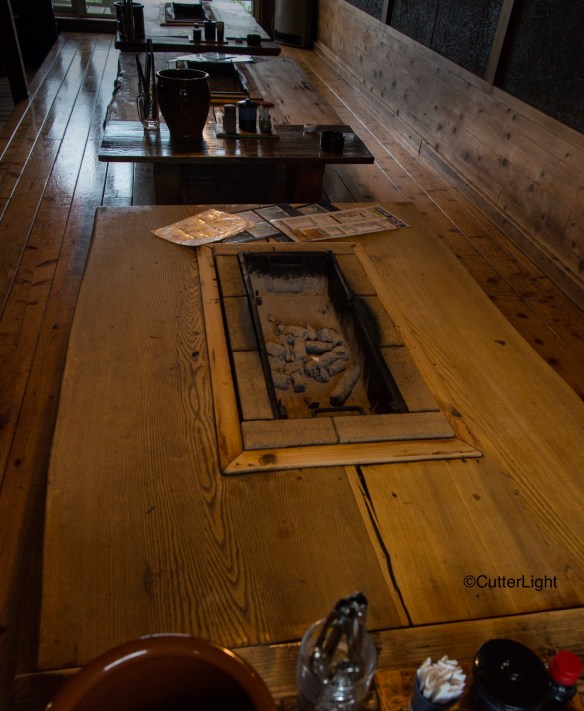
Each table featured a grill which the wait staff filled with hot wood coals when customers were seated. 

These sailors may have been assigned to guard the sake jugs behind them, but they seemed to be more interested in the feast we were working on.

We finished the meal with a small scoop of lemon sorbet – and with some effort got up from the table and set up camp. The following morning we woke to the sun rising over the back deck of Kita no Lamp Restaurant. 
Yagishiri Island Hokkaido – Power of a Storm

Barbra and a young friend cheese it up for the camera at Yagishiri’s ferry port.

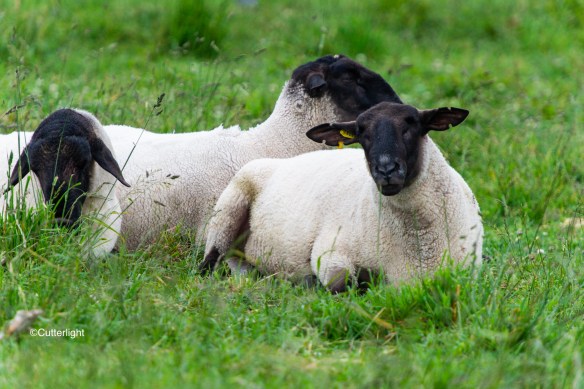
A cool ocean breeze drifted in across the Sea of Japan and the sun was shining brightly as we set up our tent on Yagishiri Island. Brilliant orange-yellow Day Lillies speckled the green, gently rolling countryside around us. It was easy to imagine the Suffolk sheep the island is known for tucking their black faces into tufts of rich grass and quietly grazing a few hillsides away.

Yagishiri is home to Suffolk Sheep. Brought over from Scotland, they grow cute and tasty on the island’s lush grass.

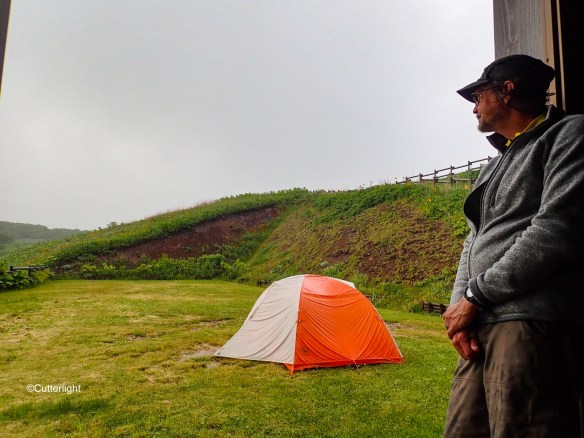
The campsite was ideal. Our tent was nestled into a flat between hills and protected from coastal gusts by a small building. The campsite featured cold running water, an immaculate restroom, and even an outdoor shower.

We stowed our bike bags beneath the tent’s fly and headed down an inviting pathway to what the map boasted as a swimming beach. Although the sun was high in the sky, I wasn’t prepared to take a chilly Sea of Japan swim. I noticed that the beach was covered with countless tiny treasures – blue, green and amber beach glass polished smooth, crab husks, miniature clam shells, dried sea urchin shells- some with their spines still attached, and colorful small rocks with interesting patterns. Larger flat rocks offered perfect surfaces on which to create found art displays with favorite finds from the beach. What a lovely, relaxing way to spend part of an afternoon.

Yagishiri-to (Yagishiri Island) is a short ferry ride from the town of Haboro on Hokkaido. There is one main road that follows the island’s perimeter which is only 12 kilometers (just over seven miles). After exploring the beach and with our bike bags stowed at the campsite, we hopped onto our now feather-light bikes and went out to discover the rest of the island. 

As the sun moved in and out from behind a few gathering clouds, I couldn’t help but smile. When I was young, my family traveled a good bit. During those trips, I fantasized about having my bike with me so I could explore those places at a bike’s pace – slow enough to catch all the details around me but fast enough to actually get somewhere. It’s exercise up the hills, the coast back down a pleasantly earned reward.

Off in the distance we began to hear the rumble of thunder. We had nearly reached the opposite side of the island from our camp. Looking out to sea, we tried to discern which way the thunder was coming from. Toward the sea, the clouds were thin and light. Looking toward Hokkaido’s mainland, the clouds were thick with rain.

Rather than turn back, we decided to continue around the island. We guessed the lighter clouds were coming our way. However, a few minutes later, big splats of rain hit us. Seems we are not meteorologists! Near the top of a hill, we spied a path leading into a small forest which, according to our map, would lead to a shrine. We decided a quick side trip there might give us shelter from a burst of rain. We found the shrine in a state of some disrepair. Tall grass grew around the gate-keeping statues and stone lanterns, and scattered ladders and work tools gave the site the look of a place that was on someone’s to-do list. 

Suddenly the clouds ripped open as a torrent of rain poured down. We sat on the dry steps of the shrine enjoying the sounds of rain drumming on the forest canopy while birds chittered complaints in the forest and tree frogs sang in celebration. It was lovely to wait out a squall with no appointments to attend to and no plans for the afternoon. As squalls do, it passed. We got back on our bikes and continued our tour of the island.

A treasure trove of glass floats filled this small fishing boat to the gunwhales.

As we neared the highest elevation on the road, lightning flashed in the distance. This time, it seemed clear the angry cloud mass was heading straight for us. There was no more leisure in this ride; it was time to get back to camp. The flashes and booms were still over ten miles away according to our primitive counting measurement system – one one thousand, two one thousand, three one thousand… The race was on.

As we neared our campsite, the clouds opened up and once again began to unleash sheets of rain. We hurriedly parked our bikes, grabbed our water bottles and rushed to the tent. As we did, we noticed something strange: the side of the building we were camped by was now open. It seemed magical. We hadn’t noticed any type of opening when we set up the tent. It turns out there was a rolling door, like a garage door. While we were gone exploring, some kind person had come along and opened the building for us. The opening revealed a friendly space with a dry concrete floor, kitchen sinks and stainless steel countertops – a perfect place to duck in out of the rain and cook our dinner!

We positioned our camp chairs near the opening and watched our poor tent get pounded by rain. Soon the thunder and lightening passed directly over us. I’ve always loved watching lightening storms. It was exciting and wild to have the strikes pass close by. We counted them as close as two miles away! Eventually the storm faded across the hills, across the sea and into the distance.

Rain, rain and more rain – waiting for a lull in a series of squalls on Yagishiri-to.

By now it was getting late. Our bellies were full of a hot soba concoction Jack had whipped up and our bodies were warmed by the last sips of peaty, smoky whiskey from a purchase at the Nikka Whiskey distillery. With the rain waning, I t was time for bed.

Our little tent is amazing. It had been thoroughly doused. Yet the fly had held out through the worst of it and our sleeping bags and all of the gear inside the tent was snug and dry. Nestled inside our cocoon, we both quickly drifted to sleep.

Then –

Flash! Crack! Boom! The lightning and thunder came in nearly simultaneous sequence, jolting us awake.

While we had been soundly asleep, another intense squall had crept upon the island. This time the lightning strikes were practically on top of us. Two in a row where there wasn’t time to count to one thousand-one between the nearly blinding flash and the earth-shaking boom had our eyes wide open. A tent previously described as “tough” and “sturdy” now seemed to be but a flimsy piece of nylon separating us from the elements. “Give me your hand!” I demanded of Jack. I grabbed his hand as another Flash! Crack! Boom! pounded down from the heavens. I squeezed my eyes shut but couldn’t keep out the blinding flashes. I plugged my ears to muffle the thunder’s roar. I wondered about people who’d been struck by lightening and had survived. What did that feel like? Were we going to be one of those stories?

“We’re in a low place,” Jack assured me. “We’ll be fine.”

The next blinding flash lit up the tent. This time the roar of thunder came after “one one thousand.” Maybe it was moving away? I still clung to Jack’s hand. Another blinding flash. I buried my head in my sleeping bag and counted – one one thousand. Then, right away, another flash – one one thousand, two one thousand. My heart was still racing. While this squall seemed to be passing, I wondered if another set of storm clouds would move in.

A few minutes passed and another flash came – one one thousand, two one thousand, three one thousand, four one thousand. 

As the thunder and lightning slowly drifted further away, I finally released my grip on Jack’s hand. My heart slowly returned to its normal rate as the drumming of rain on our tent softened. For the remainder of the night it rained and rained, but the thunder and lightning had ceased. The next morning, I woke up wondering where exactly the lightening had struck. A moment later, I felt grateful that I didn’t know.