30 Minute Raspberry Jam!? Yes, Way!

raspberry-jam-n

Fresh raspberry freezer jam. 30 minutes from ripe berries on a bush to yummy jam.

Chignik Lake is a magical place. Maybe I shouldn’t gleefully announce this. One of the things that make this place magical is the small population. 😉

Jack and I really enjoyed living in Mongolia. The stint there certainly scratched a life-long itch of living overseas. We enjoyed trips our to the countryside and we certainly miss our Mongolian friends. But while we were away from Alaska, we longed for the pristine forests, tundra, mountains and seascapes and outdoor activities that have forever become part of our desired reality. At the top of our list? Foraging for wild food.

Part of the magic of Chignik Bay is the blueberries, crowberries (also known as blackberries in Alaska), and cranberries that grow in wild abundance. Additionally, currants and raspberries have been planted here and are thriving. We may try to grow our own in the spring. We’ve found many mushrooms and still need to figure out which ones are edible. There will be fireweed shoots to harvest in the spring, too. Needless to say, our freezer is stocked with the Sockeye and Silver salmon we’ve caught.

After a few trips out to nearby muskeg areas (berries love this type of environment), our freezer was stocked for the coming winter. It was time to start processing some of the berries into jams, jellies, sauces and syrups. I grabbed my container of pectin and noticed a recipe for “jam in 30 minutes” – no cooking required. Freezer jam!

It turned out fantastic. Since I used perfectly ripe raspberries for my experiment, the jam looks and tastes exceptionally bright and flavorful, like the fresh fruit I used. I do like cooked jams, but this fresh jam is a quick and easy way to make something a little different than the usual. It is delicious spread on bread or spooned into yogurt or hot cereal. The jam will keep for about three weeks in the refrigerator and will keep in the freezer for about a year.

Raspberry Freezer Jam

Ingredients

  • 1 2/3 cups of cleaned, ripe raspberries
  • 2/3 cup granulated sugar
  • 2 tbsp instant pectin

Directions

  1. Stir sugar and pectin into a bowl.
  2. Mix in berries.
  3. Stir for 3 minutes.
  4. Ladle mixture into freezer safe containers, jam jars work well.

Makes 2 cups of jam.

Purple Martins: The Highest-Flying Swallow

purple martins w draggonfly n

The Catch: Purple Martins, Kimiwan Lake Bird Walk, Alberta, Canada

Swallows are a favorite bird wherever they fly, and among them North America’s largest and most universally appreciated species is without a doubt the Purple Martin (Progne subis). Before Europeans ever came to North America, Native Americans in the South were known to hang hollow gourds as nesting boxes to attract these birds. The beneficial nature of Martins is well known: not only do they consume enormous quantities of insects that humans consider pests – among them horseflies, beetles, termites and grasshoppers -, they also aggressively drive away birds of prey as well as crows and thus were traditionally welcomed by farmers. Often soaring at altitudes of several hundred feet, Martins capture their prey exclusively on the wing; they quench their thirst on the wing as well, skimming the surface of ponds, lakes and rivers.

purple martin male gun metal n

Iridescent purples and gun metal blues mark the plumage of the male Martin.

Although the range of the three subspecies of Martins covers most of the U. S. and sections of southern Canada, they tend to be rather uncommon. This is due in part to their very specific nesting requirements and to the fact that invasive species – European starlings and house sparrows – frequently outcompete Martins for preferred sites. Formerly found in hollow trees, Eastern Martins have almost exclusively shifted their nests to human created housing: apartment-like complexes on poles, rows of houses side-by-side, or, particularly in the South, hollow gourds. Like Chimney Swifts and Barn Swallows, Eastern Purple Martins have become dependent upon humans for nesting sites.

purple martin female n

The plumage of females is lighter in color, predominated by shades of brown.

Writing in the early 1800’s, John Audubon observed the ubiquitous nature of Martin nesting boxes in America:

The… Indian is also fond of the Martin’s company. He frequently hangs up a calabash on some twig near his camp, and in this cradle the bird keeps watch, and sallies forth to drive off the Vulture that might otherwise commit depredations on the deer-skins or pieces of venison exposed to the air to be dried. The slaves in the Southern States take more pains to accommodate this favourite bird. The calabash is neatly scooped out, and attached to the flexible top of a cane, brought from the swamp, where that plant usually grows, and placed close to their huts. Almost every country tavern has a Martin box on the upper part of its sign-board; and I have observed that the handsomer the box, the better does the inn generally prove to be. 

All our cities are furnished with houses for the reception of these birds; and it is seldom that even lads bent upon mischief disturb the favoured Martin. He sweeps along the streets, here and there seizing a fly, bangs to the eaves of the houses, or peeps into them, as he poises himself in the air in front of the windows, or mounts high above the city, soaring into the clear sky, plays with the string of the child’s kite, snapping at it, as he swiftly passes, with unerring precision, or suddenly sweeps along the roofs, chasing off grimalkin, who is probably prowling in quest of his young. Birds of America, John J. Audubon, printed 1827 – 1838.

Purple Martin male wings n

Healthy Martin colonies indicate a healthy environment.

The next time you see a large flock of dark birds, look closely. Although often starlings, Martins, too, come together in the thousands and even hundreds of thousands, particularly in late summer as they prepare to migrate to South America.

For more information about Purple Martins, or to learn more about building a nesting complex of your own to attract them, visit www.purplemartin.org

For more information on the wonderful Kimiwan Nature Walk and Interpretive Center in McLennan, Alberta, please visit www.kimiwanbirdwalk.ca.


C’mere and give us a kiss

mountain sheep give us a kiss n

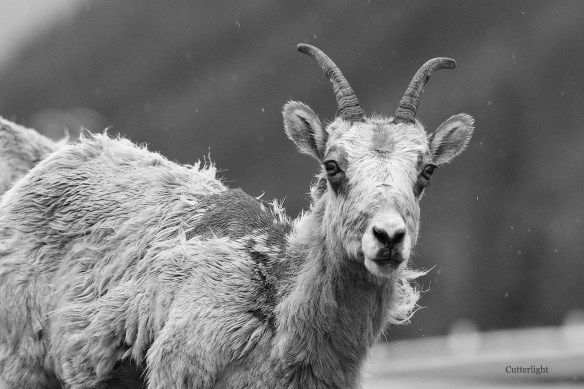
We’ve all been there – mornings when you’re out of cigarettes and reduced to digging through an overflowing ashtray; mornings when you can’t find your Scotch glass… or the sash for your robe. Your lipstick’s smeared from the night before, your head is pounding, you can’t even look at food and you just want to know that you’re still loved. (Stone Sheep Ewe on a rainy day in Alberta, Canada)

Bull Fight on the Al-Can

Bison Bull Fight n

Nearly a ton each, when wood bison decide to take over a piece of the Alaska-Canada highway, they do. Shooting from the deck of our C-Dory, we found ourselves surrounded by leathery thuds of muscle smacking muscle, the crack of horn on horn, hooves pounding pavement and turf as animals the size of small trucks worked themselves into sprints, snorts, grunts, bellows and the thick odor of bison. We’d been photographing more placid scenes in a herd of about 100 animals – cows and nursing calves, young bulls, grandpa bulls and The Kings – the taut-muscled mature males that stood hands higher than the other members of the herd. Aside from a few younger males occasionally testing each other with head-butts, all was tranquil. The older bulls, hump-shouldered, muscle-ripped massive beasts, grazed peacefully along with the cows and calves or rolled in dust wallows.

The dynamics changed in the blink of an eye. A couple of the big boys started snorting at each other, then locking horns hard and kicking up dust. Suddenly every big bull in the herd, including the largest bull, was on high alert, tails held high, heads lowered as they zeroed in on the point of conflict. Kicking up grass, shrubs, sand and dust, these muscle-sculpted kings moved with impressive speed in their attacks which were aimed at bellies and buttocks as well as heads and shoulders.

Vehicles on the road cautiously edged backwards to give the sparring bison sufficient berth. The motorcyclist seen on the left side of this photo turned around and headed in the opposite direction as the fight edged closer to him.

Still Life with Woodpecker

pileated woodpecker n

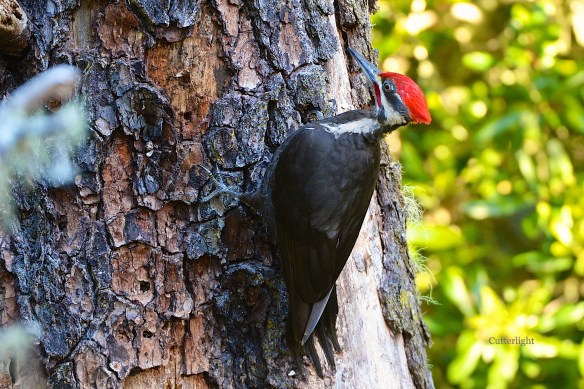
Traveling up Highway 1 through Oregon, heading back home to Alaska, reading Tom Robbins’ Still Life with Woodpecker along the way. Saw this pileated woodpecker in Bullards Beach State Park.

Lots of wildflowers and butterflies, too, and a herd of Roosevelt elk.

Still Life with Woodpecker

Horse Skull, Springtime in Mongolia

horse head black n white n

Terelj National Park, May 2016. It was a hard, cold winter.


Long-tailed Rosefinch: Tuul River, Ulaanbaatar

Pallas Rosefinch male n

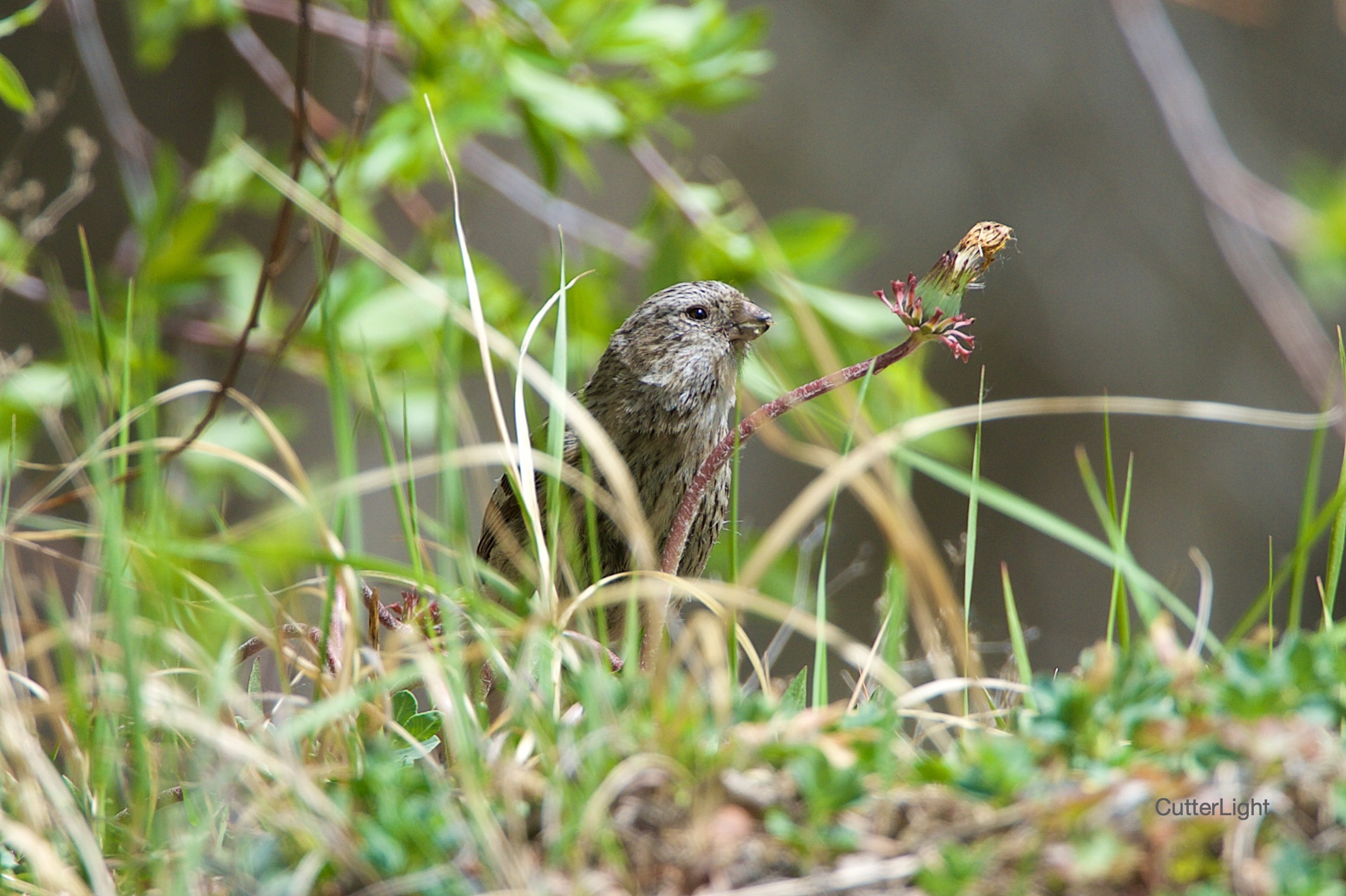
After a long winter, this striking male long-tailed rosefinch (Carpodacus sibiricus) was fattening up on fresh willow seeds near the Tuul River. 

pallas rosefinch female n

And here’s the female. Although residents of Mongolia, these birds were likely passing through Ulaanbaatar on their way to higher elevations to the north. Rosefinches are mainly seed eaters. There are several species throughout the Northern Hemisphere. 

Snow and a Memory of Snow: 10 Photographs during a Spring Snowfall in Ulaanbaatar

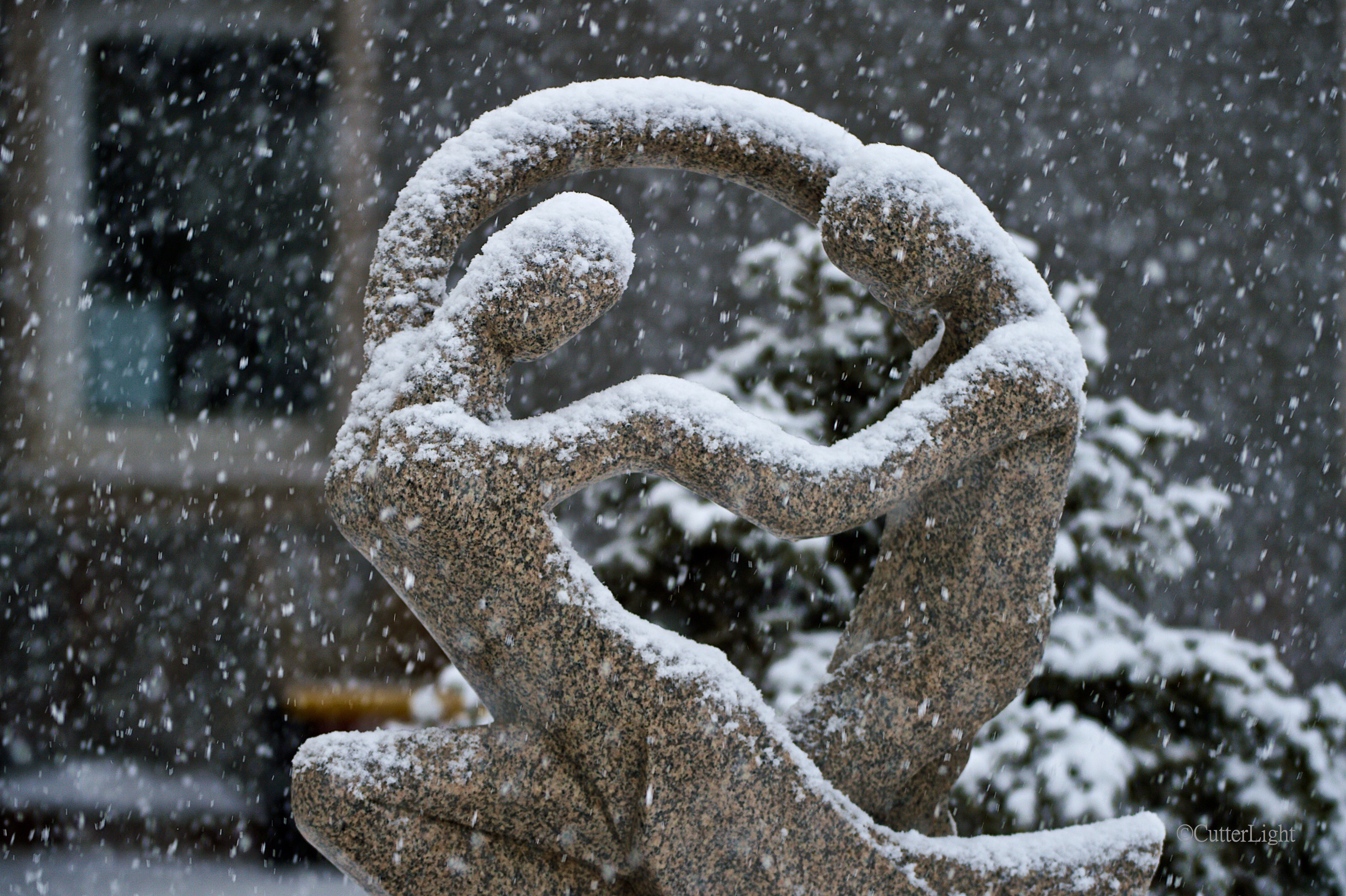
granite dancers in snow soft n

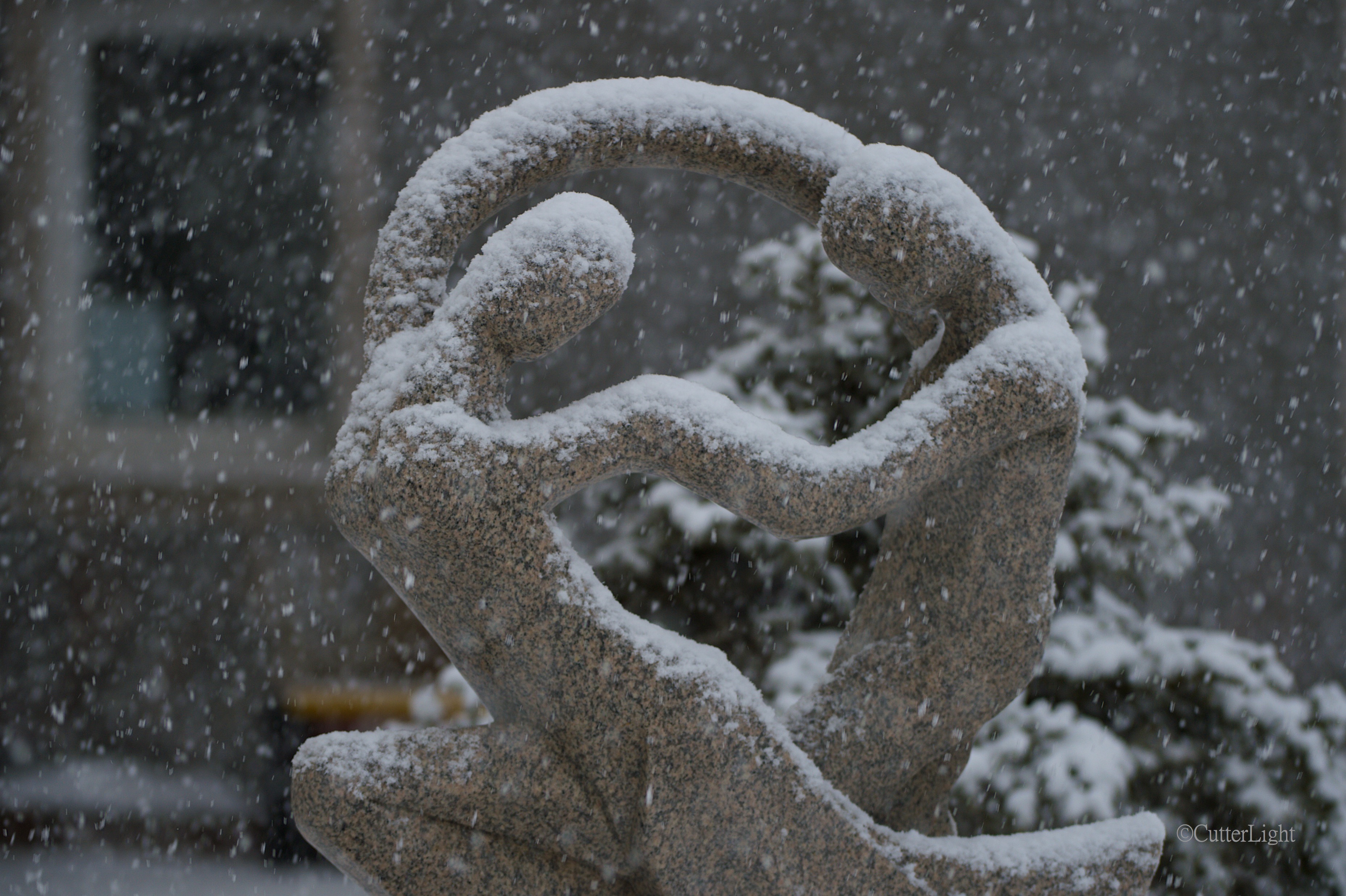
Granite Dancers in Spring Snow  I walk passed this sculpture at least two times a day, every day, but this was the first time I photographed it. On this day, I knew before I left the apartment that I wanted to record it in the particular light that was falling. The snow was a bonus, adding depth and additional movement. Nikon D4, Nikkor 200-400mm f/4G IF-ED II, 200mm, ISO 100, f/4, 1/200

Watching the snow fall from inside our apartment building, I was reminded of a favorite haiku by Basho. Come! Let’s go snow-viewing/till we’re buried!

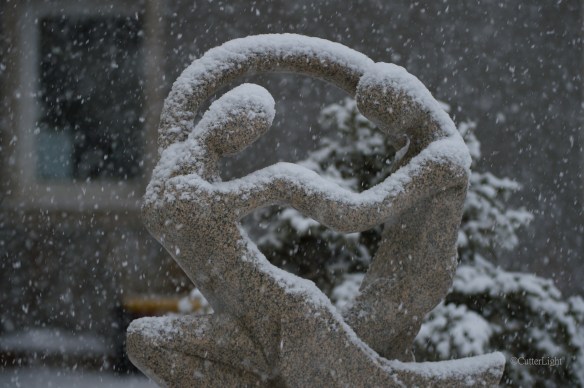
granite dancers in snow sharp n

Granite Dancers in Spring Snow, high contrast This is the same exposure as above. I brought up the contrast and saturation and sharpened the edges. This image might be more marketable as a postcard, but I prefer the softer, previous image, which, to me, feels more intimate.

Which do you like?
UB apt building snowy day enhanced a n

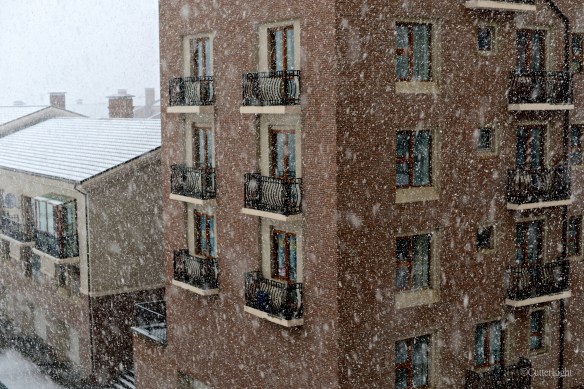
Brick Apartment Building in Snowfall, Ulaanbaatar  This is the view out the window of my apartment in Ulaanbaatar, Mongolia. On most days, it is uninteresting to me, the occasional pigeon roosting on our windowsill notwithstanding. But on this day, the scene was transformed into something magical. I set the ISO low to preserve as much contrast as possible. Then, in processing, I brought up the contrast even more, exaggerating the blue in the window panes and the black of the railings. Nikon D800, Nikkor 50mm f1.4G, ISO 100, f/3.5, 1/125
UB apt row snowy day b n

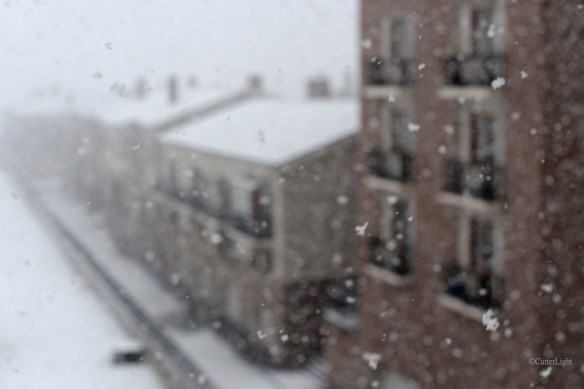
It’s Snowing in UB  I’m not entirely sure why, but this photo and the next one tug at my gut in the way really good writing does. For me, there’s something lonesome… longing… in these shots where the focus is almost on the nearest snowflakes but not quite on anything. I imagine someone far from home, perhaps recently moved from the Mongolian steppe, or any place in the world, looking out on a city… no people, no traffic, nothing… focusing on nothing, longing for home. Nikon D800, Nikkor 50mm f/1.4G, ISO 1250, f/5, 1/1000
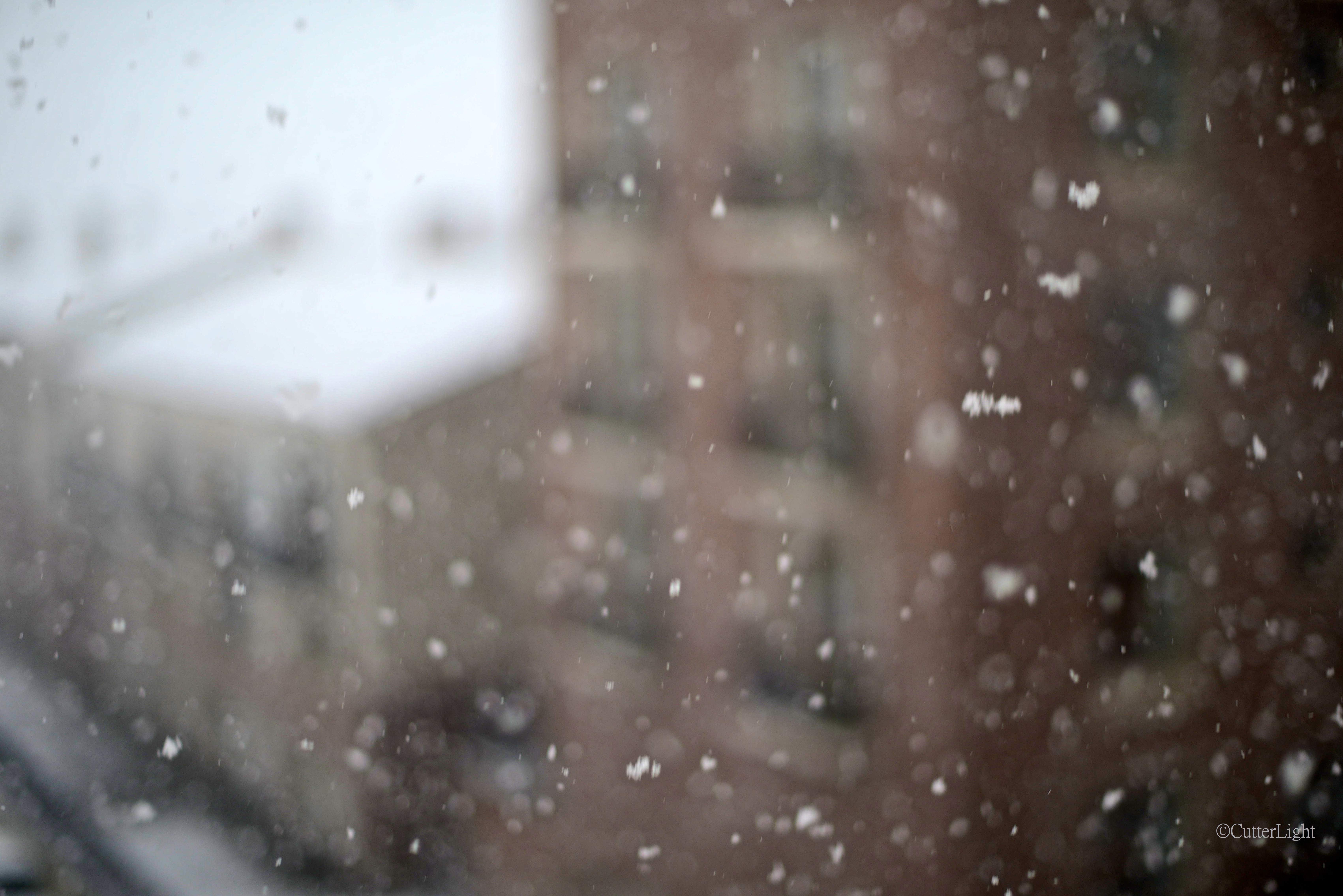
Snow and a Memory of Snow n

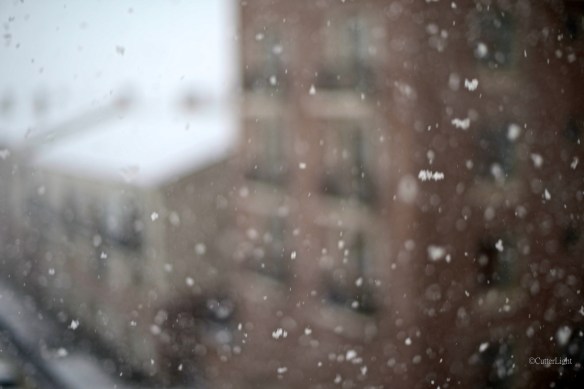
Snow and a Memory of Snow  As in the above photo, the focus is close to the viewer, yet indistinct. For me, these shots evoke a sense of thoughts being elsewhere. A person from snow country could look out the window on snowfall in any city in the world and in a moment be taken back to a memory in a small town or city, a ger out on the steppe, a woodland cabin, or anywhere. Anyway, that’s what I was going for in this image. This is probably the most purposeful, intended image I’ve taken so far. I applied a small technique to get the focal point where I wanted it to be. The image was inspired by the song It’s Snowin in Brooklyn by Ferron, a song I heard just one time on a snowy night in Boulder, Colorado back in 1985 and which has been stuck in my head all these many years till I recently rediscovered it thanks to an Internet search based on a single line from the song. Nikon D800, Nikkor 50mm f/1.4G, ISO 100, f/1.4, 1/800

UB apt snowy day streak d n

Snow Streaks on Brick  For a brief few moments, a breeze kicked up, gently driving the snow diagonally. I used settings one might employ to capture rushing streams and waterfalls to capture the faint, oblique lines the driven snow was painting on the brick. In processing, by bringing up the contrast and increasing color saturation, I was able to accentuate the blackness of the railings and the blueness in the windowpanes. The splash of light and the yellow pot in the window on the right add a place for the eye to wander to in this photo. Nikon D800, Nikkor 24-70 f.2.8G ED, ISO 640, Focal Length 70mm, f/22, 1/5

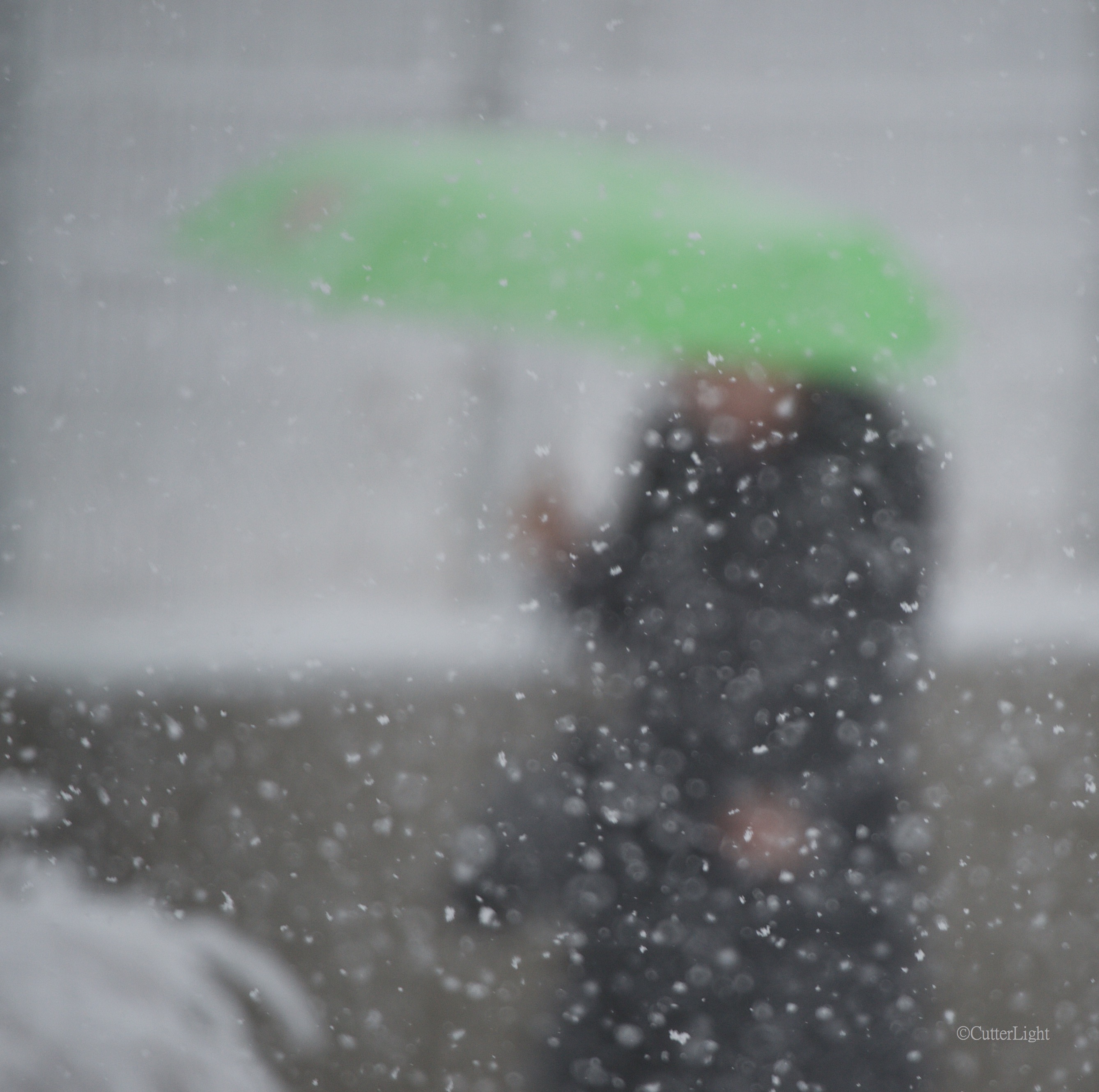
woman w green umbrella snowy day n

Woman with Green Umbrella, Snowy Day, Ulaanbaatar  I saw her walking down the street toward our apartment when she was in the distance and began thinking about how I would compose the shot. I wanted to create a watery blur, reminiscent of an impressionist painting – evocative perhaps, of Andre Kohl’s studies of women carrying umbrellas. I’m not sure how well the green works, and even as I was framing this shot I was imagining processing it in black and white. Were I to shoot this again, I think I would decrease the shutter speed. (See next picture.) Nikon D4, Nikkor 200-400mm f/4g IF-ED II, ISO400, Focal Length 200mm, f/4, 1/640
woman w umbrella b n w snowy day n

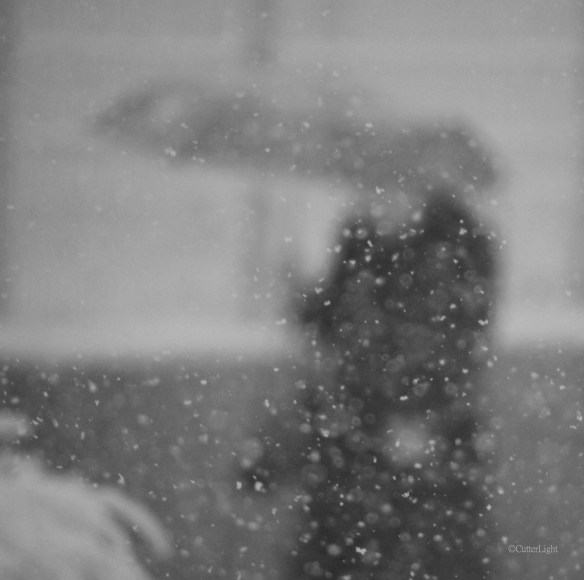
Impression of a Woman with Umbrella This is the above photo processed as a black and white shot. What do you think? I prefer this one, partly for the way the umbrella and the woman’s features are only suggested. Again, a slower shutter speed might have further enhanced the image I was striving for.

house sparrows snowy day n

House Sparrows Framed in Spring Snow, Ulaanbaatar We pass by flocks of these friendly little guys each day on our walk to and from school. These are birds of the city – ubiquitous in northern temperate climates the world over. In fact, even in the trees along the river that runs through Ulaanbaatar, this species becomes less common, and by the time one has hiked up the forested mountain on the edge of town, they disappear altogether, so specifically adapted to co-habitation with humans have they become. But on this day, they presented themselves in fresh light, framed in falling snow. I wanted a shallow depth of field because the background could have been a distraction, and so I focused on the female and let the three males blur out a little.  Nikon D4, Nikkor 200-400mm f/4g IF-ED II, ISO400, Focal Length 400mm, f/4, 1/640

kestrel snowy day n

First Kestrel of Spring, Snowy Morning, Ulaanbaatar, March 26, 2015  Mongolia is home to many birds of prey, most of which fly south in late fall. I first spotted this kestrel – a type of small falcon – earlier in the week when it and a harrier were circling above our apartment building. The harrier has since moved on, but I continue to see this or other kestrels in the city. An abundance of sparrows (above photo) and plenty of buildings to use as perches make this a good place for small birds of prey to get something to eat as they migrate to their nesting sites in the mountains.

            The snow was falling heavily when I heard the kestrel’s chirp from high above. I swung my lens skyward knowing I’d only get a shot or two before the glass was covered with snow. Autofocus was useless, so I did my best to manually focus while panning with the bird with a two-pound camera attached to a seven-pound lens. This image is significantly cropped and not very clear. I value it for the documentation of the year’s first kestrel, one of our favorite birds. Nikon D4, Nikkor 200-400mm f/4g IF-ED II, ISO400, Focal Length 400mm, f/4, 1/640

So what do you think?

When it was time to come back in, we were, in fact, buried in heavy, wet snow and a little worried about our cameras. But they held up fine. The next day we hiked down to the river to check the willows, poplars and pines for newly arriving songbirds. I still have to go through those photos. Next time!


Fire and Ice Needles: Dawn, Hustai National Park, Mongolia

ice needles at dawn n

Stalked a group of stag red deer

up a draw to the top of a rise 

where the sun broke fiery and cold

lighting feather grass and ice needles

suspended in the negative something air.

Along the ridge, winter-hard antlers

lit with sunlight

scattered into the dawn.

– Hustai National Park, Mongolia, 2014

Jack Donachy


Off The Beaten Path – In Remote, Wild, Spectacular Mongolia!

Thanks to Lesley Carter for publishing this post on Bucket List Publications!

Off the Beaten Path – In Remote, Wild, Spectacular Mongolia!