The Hike to Clarks River: An Alaska-Sized Landscape on the Remote Southwest Peninsula

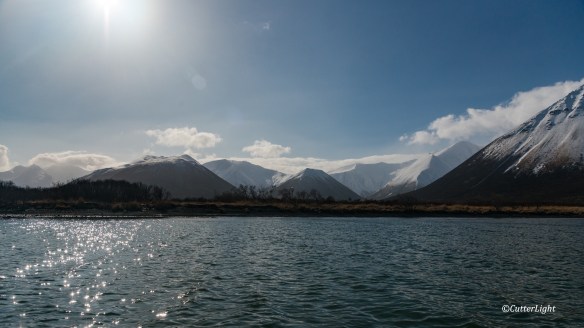
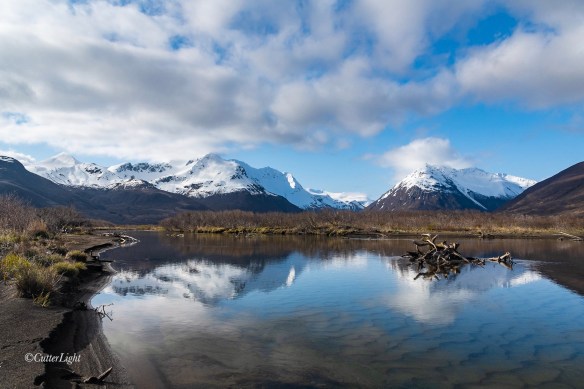
Like a vast infinity pool, Chignik Lake pulls in the mountains and sky and seems to go on forever. 

We woke before dawn to clear skies, still air and frost. With noon temperatures projected to reach a nearly summer-like high of 50° F, it was the perfect day for the three-mile hike from Chignik Lake up to Clarks River. By the time we downed hot bowls of steel cut oats and slabs of energy-rich, thick-cut bacon, the sun had cleared the snow-capped mountaintops across the lake from our house. Outside the air was still brisk from the nighttime freeze, but American Robins, Golden-crowned Sparrows, Sooty Fox Sparrows, Pine Grosbeaks and Redpolls were already filling the sleepy village with song. We didn’t know it yet, but Violet-green Swallows would arrive later in the day to add to the chorus.
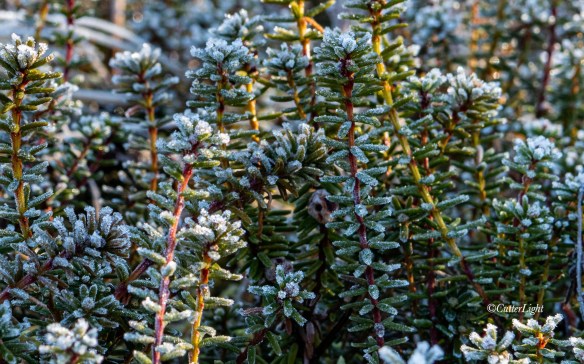
By the time we hit the trail, soft sunlight was beginning to brush the frost off crowberry plants and other vegetation.

Skim ice covered puddles and everything about the morning felt crisp and full of promise. Savannah Sparrows sang from brushy perches. Somewhere down by the lake a Sandhill Crane trumpeted in brassy notes. On a morning like this, there was no telling what we might see. I tapped the bear spray in my coat pocket. We stopped often to listen and to glass patches of open tundra and hillsides.
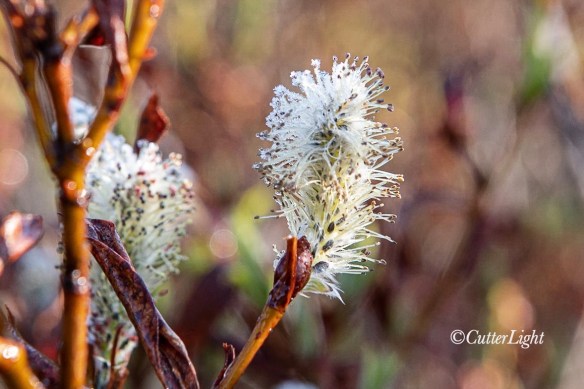
Most of the catkins were finished. In places bathed in light during these 18-hour spring days willows were leafed out in brilliant green.

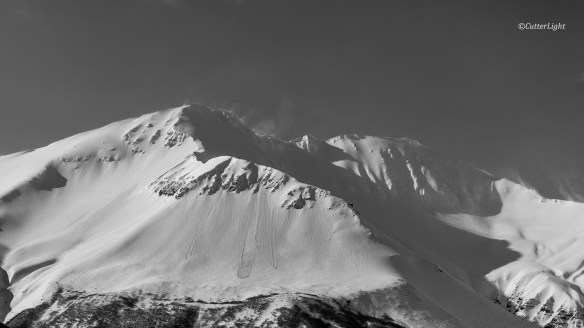
As we approached Lower Pond, a pair of Black-capped Chickadees emerged from a tangle of still bare alders to look us over. A crane soared low over the path and landed somewhere out of sight. Fresh avalanche runs tongued the steep Chignik Mountain slopes, still buried in snow. When we hit the Blueberry Bog, a snipe exploded from an edge that often seems to have one of these wary, secretive birds. Mindful of not bothering a possible nest, we kept moving.

Barbra hikes into a landscape traversed by fewer than 100 living people. Clarks River lies straight ahead. The lake is to the right. 

As we hiked we noted that Fireweed shoots were at the perfect stage for picking. We’d brought along a small bag to gather some on the way back to add to the evening’s teriyaki salmon stir-fry.
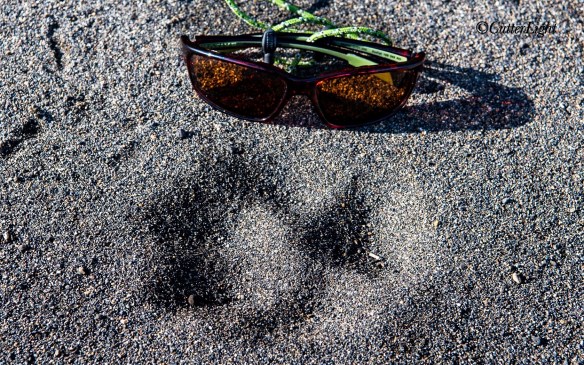
Wildlife tracks ran all along the beach, their number and variety increasing the closer we got to the river. Seldom seen, wolves are always around, as this track attests.

One for the books, this is the largest Brown Bear track we’ve ever come across. With males routinely topping 1,000 pounds and sometimes exceeding a standing height of 9 feet, Chignik’s bears are among the world’s largest, rivaling those of Kodiak Island in size. An abundance of salmon makes for a healthy bear population – and a healthy ecosystem in general. Barbra’s sunglasses measure 5¾ inches from temple to temple.

In addition to lots of fox tracks, two sets of wolf tracks and several sets of bear tracks, it was evident that a troupe of River Otters had recently been through the area. Though it was mostly quiet under the mid-morning sun, a Red-throated Grebe rested out on the lake, and along the far shore we could just make out Scaup, a Red-breasted Merganser and a few Common Goldeneyes. Savannah Sparrows sang and flitted from bush to bush and as we approached the mouth of Clarks, a yellowlegs or perhaps a Wandering Tattler took off up the river.

The remains of a feast, this bleached piece of Red Salmon jaw was a reminder of last fall when the banks of Clarks were trampled down into a bear highway and the shores and shallows were carpeted with spawned-out Sockeyes and Silvers.

We paused to let our eyes search a pool below a beaver dam in a small tributary before Clarks, recalling a fall when we’d seen it stacked with maybe a thousand Coho Salmon. The beavers, like those salmon, are long gone. Tiny salmon fry and parr darted through the pool in tight schools, the parr occasionally rising to take a midge off the water’s surface. Around the pool’s edge, the first light pink salmonberry blossoms were opening.
Clarks River forks just before it debauches into the lake. This is the lower, quieter piece of water. In late summer and fall, tens of thousands of salmon ascend this cold, snow-fed river.

We found a warm spot in the sun on the sandy beach, made a makeshift picnic blanket of my coat amidst otter tracks, and had lunch. Magpies chattered from a distance as we scarfed down trail mix and reminisced about the fine fly-fishing we’d had at the mouth of this river for bright Silvers. You never stop scanning for bears when you’re out here, and of course there are the wolves. The salmon will return soon, new birds are steadily filling the landscape and there’s the prospect of getting that gargantuan Brown Bear in the view finder of one of our cameras – so many incentives to get out into this country to look around.

Philosophies for Learning to Play the Guitar at 60: The Final Philosophy

Sunrise April 6, 2019. A golden new day in Chignik Lake.

Philosophy #21

Express Gratitude. Growing up, I had a difficult time imagining what 60 would be like for me. The people in my life who were around that age seemed old. I think, looking back on it, that in truth most of them were old. I wasn’t exposed to many (any?) models of older people who were physically fit, active, still exploring new ideas, and welcoming into their lives new music, new passions or fresh perspectives. A few of the older people I knew sometimes got into a car or boarded a plane and went somewhere – to go see, more than to go do.

Sitting. What I remember most about the older people I knew back then was the sitting. Lots and lots of sitting.

In 1974 my family took a spring vacation trip from our home in Clarion, Pennsylvania to Washington, D.C. I was 14. The ostensible reason for the trip was my father’s interest in an international wrestling tournament in which one of Clarion State’s wrestlers, Wade Shallas, was participating. But to my young mind, the wrestling tournament was almost irrelevant. In the spring of 1974, Washington was electrified. 

Further south than Clarion, everything was already bright spring green. Magnolia trees covered with big, showy blooms seemed to be everywhere. Attired in the kind of post-Haight Ashbury garb I’d only seen on TV and in magazines, people were busking, selling art and hand-made pot holders, giving soap box speeches or loosely milling around signs, tight in their own earnest discussions. The Watergate Scandal was exploding. Then President Richard Nixon had fired special prosecutor Archibald Cox the previous November, senior Whitehouse aides J. R. Haldeman and John Ehrlichman had just resigned and Whitehouse Counsel John Dean’s head was about to roll. Impeach the Cox-sucker! one of those signs shouted. Coming from the tiny mountain town of Clarion it was like leaving a world of somnambulance for one wide awake.

But amidst the flowers and buskers, the street hawkers and protestors, the wrestling and the (in my then very limited experience) fancy hotel where we were staying, over the years my mind has continually returned to one image.

Tennis was hugely popular in the ’70’s, and as we strolled the streets we came upon a park of lovely, tree-shaded courts. With heads of impeccably coiffed white hair and crisp, white tennis attire, the couple volleying a ball back and forth must’ve been in their sixties. Yet both the man and the woman hit with real power, and the way they dashed around the court gave them the impression of being half their chronological ages.

In that moment, watching them play, I formulated what was to become a salient life goal. I could be like those two.

The image that couple modeled, and the goal I set for myself back then have stayed with me for 46 years.

And so, in my 50’s, I learned to sail, guided myself to fishing firsts including fly-caught salmon, backpacked remote country in Denali National Park, found my own dinosaur fossil on a trip to the Gobi Desert while living in Mongolia, helped a group of Eskimo friends haul a whale up onto the ice, took up photography, got into birding, kept my cool when charged by a thousand pound bear and at 59 went off on my first-ever bike trek, a self-guided 1,300 miles through Hokkaido, Japan.

I wake up every day grateful for every day. I go to bed every night thankful for the day that transpired and looking forward to the next. And between those two times, I strive to keep myself fit, active and growing. I don’t do this merely for myself. If my own interests were the only motivation, I’m sure I’d have lost momentum and replaced it with the TV remote control years ago. My hope, every day, is that in some way I might help or even inspire someone else. I’m lucky, and I know I’m lucky. Maybe a young person who saw us on our bike trek will one day herself embark on a similar adventure. Maybe a fisherman who has always dreamed of catching a salmon will make this the year they go out and give it a try. Maybe someone who had given up the idea that they could learn to play the guitar will revisit that dream.

None of us knows what tomorrow or even the next moment will bring. It’s good to be alive.


The Lake – for a Moment

The Lake – for a Moment
Chignik Lake, Alaska, Dawn March 26, 2019


Singing His Heart Out: A Pleasant Morning at White Spruce Grove

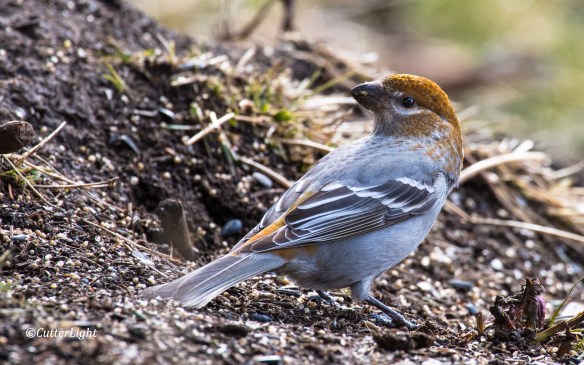
Resplendent! This male Pine Grosbeak came down from a tree crown to forage beneath one of the feeders at White Spruce Grove.

When we stepped out the door yesterday morning, the first thing we noticed was a new song in the air. A spring song. Returning Fox Sparrows have been the first to begin this each year we’ve been in Chignik Lake, but the warbling melody didn’t sound like a Fox Sparrow’s riff. We could see the bird, a plump silhouette atop a spruce tree near the church and since we were on the way to the White Spruce Grove to top off bird feeders anyway, the obvious choice of walking path was the one that would bring us nearer to the singer.

The female grosbeak briefly joined her mate.

Pine Grosbeak, brilliant red and singing for all he was worth. Quite a change from the brief but distinctive Peek Peek! we hear from this species throughout fall and winter. It wasn’t a new bird, but it was new behavior. We continued on the half-mile to the spruce grove with anticipation.

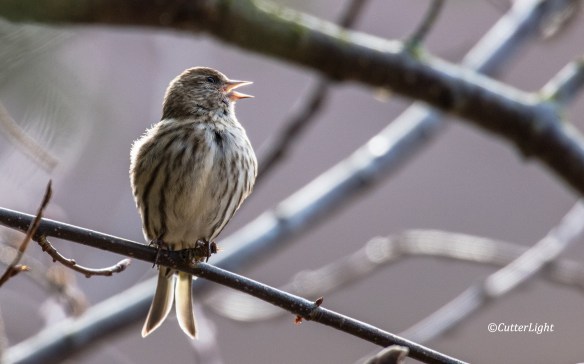
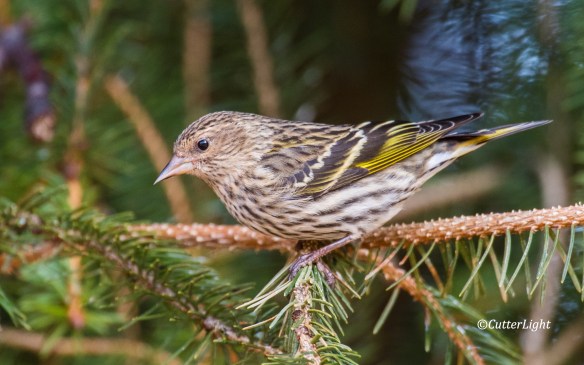
Our Pine Siskins were their usual raucous selves, singing, squabbling, gorging on seeds, darting from tree to tree.

Along the way scattered flocks of Pine Siskins buzzed and called from the sky and from a neighbors’ house where they sometimes take refuge in a few spruce trees while visiting the feeder there. Magpies, common here at The Lake, made their presence known, as did a woodpecker, almost certainly a Downy though we couldn’t find it. Further along a pair of Black-capped Chickadees gave a couple of their various calls from willows, the branches of the scrubby trees suddenly having turned bright yellow-green and beginning to bud.

My guess is that when the time comes, the siskins will head up the peninsula to the denser spruce forests around Lake Iliamna and similar places to nest, but they’ve been welcome winter visitors the past two years.

At the White Spruce Grove the usual Siskins, which showed up last fall and have spent the winter, were busy at the feeders as well as prying the last seeds from cones. But there were a few larger, rounder shapes foraging on the ground as well. We didn’t get our binoculars up in time to have a look, but as we were filling the feeders we heard the unmistakable plaintive song of Golden-crowned Sparrows.

There’s just a touch more gold in this Golden-crowned Sparrow’s crown than there may have been a month ago. He’s still a ways off from full breeding plumage though.

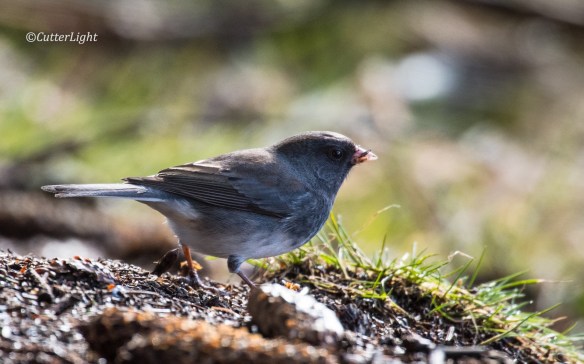
Sure enough, once we scattered a little seed along the brushy edge where they like to feed, they began to show up, and they brought a Dark-eyed Junco with them. Seldom observed out on the Alaska Peninsula – and absent altogether or marked with a question on most of the region’s birding lists – Juncos have shown up in small numbers each of the three winters we’ve spent here. In fact, we think we have the only documentation on the peninsula of Oregon race juncos.

While there have been fewer Juncos at the Lake than there were last year, every so often we see one or two or three.

The Golden-crowned Sparrows appear to have just begun growing in their breeding plumage. Some of the male Siskins though are already there, showing off brilliant canary yellow in their primaries. At one point a Belted Kingfisher rattled by, most likely a male getting things ready for the females that will soon return. Ravens called in throaty croaks from a far hill. No ducks on the water and no eagles on their usual perches, which is a little unusual. Perhaps the ducks are already up at Black Lake where most of the nesting occurs. Gulls will begin returning any day.

Sleepy but looking well fed, she lost both of her fully-fledged chicks last year, one to an electrical box on a utility pole and the other to some other cause. We’re hoping she nests again this year with much better luck.

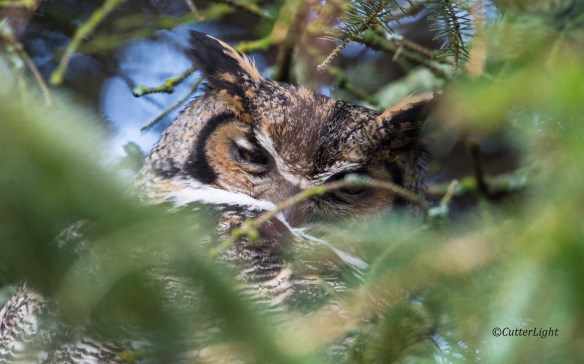
We aren’t always lucky enough to see one and we rarely see both of them, but this was a red letter day as both of our Great Horned Owls – the female and the slightly smaller, more lightly colored male – were perched where we were able to find them. As is usually the case, they were buried in shadows behind thick evergreen boughs, aware of our presence but seemingly unconcerned. The ground beneath their favorite roosts is littered with bits of hair, feather, bone and beaks and oblong balls the size of two thumbs placed together packed tight with the remains of the various voles, Magpies, ermine, lemmings or whatever else constitutes one of their meals. Last year the female spent several days perched atop a winter-white Snowshoe Hare – several meals.

Discernibly smaller and with brighter plumage, we feel fairly certain that this is the male. The Ainu – Japan’s indigenous people – believed that owls protected their villages. They are certainly regal animals.

Frost on the ground this morning, but if you look closely at the photos, you can see other signs that spring is coming to Chignik Lake. Hopefully I’ll be posting a video of a Fox Sparrow singing in the near future.

With their uplifting songs and stunning plumage, if birds didn’t actually exist I don’t think we’d believe that they even could exist. They certainly brighten our world.

Skiffin’ – A Chignik Version of the Sunday Drive: Sunshine, Sea Birds, Seals and Snow-covered Mountains)

The view at Hatchery Beach, a wind-swept shore on Chignik Lake where sufficient upwelling and pea-sized gravel create ideal conditions for Sockeye Salmon to spawn. The stream-fed pond behind the strip of land is a feasting area for our huge brown bears from summer through fall.

It was a perfect day for skiffin’ – full-on sunshine, light breezes and a mid-day high tide pushing far enough up the river for The Shallows to be passable. The tide meant access to the Lagoon, the saltwater estuary where Chignik River debouches into the Alaska Gulf and an opportunity to photograph Emperor Geese. So when a friend called with an invitation to go out in his 18-foot Lund, we made quick work of lunch and pulled our camera gear together. Oh, and we bundled up; highs are only reaching 40° or so (4 or 5 degrees C) and it’s always colder on the water.

The Chignik Mountains surrounding the lake were shouldered in fresh, powdery snow. Kudos to Barbra on the landscape photographs in this article. It can be tough getting good shots from a bouncing boat.

Every plane coming into the village prompts two questions: Mail? Freight? Other than this plane and one other skiff, we had the lake, the river, the lagoon and the day to ourselves. 

Check out those talons… and that beak! Although we see eagles nearly every day, we always pause to admire these magnificent birds. I surprised myself a little with this shot. Even with a light breeze there was enough chop on the water to have the skiff (Chignik for what Pennsylvanians would call a boat) bouncing like crazy – a problem magnified several times over with a long wildlife lens and a teleconverter attached to my camera. Most of the time I couldn’t even find the bird in my viewfinder, and when I did I had less than a second to shoot before the boat rocked and the bird wildly bounced out of the frame. But he (or she) was patient with me and I had plenty of light to shoot fast when the chance came. They’ll be nesting soon, I imagine.

Here’s Hatchery Beach looking back toward the Clarks River watershed – a significant spawning tributary and with its nearly clear-as-air flow a magical place to fly-fish.

And a third shot moving up the lake along the Hatchery Beach shoreline. We’ve often thought that a lot of these mountains, which top out at just over 3,000 feet (1,000 meters), would make for a good climb. The main feat might be getting through the jungle-thick alders at the base.

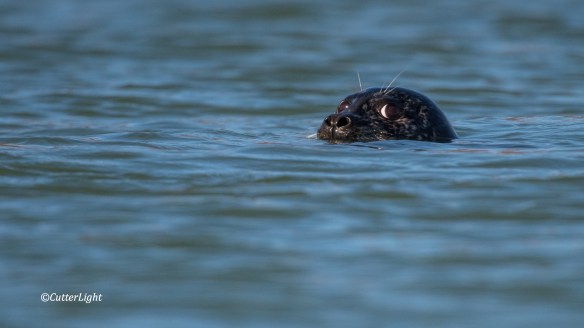
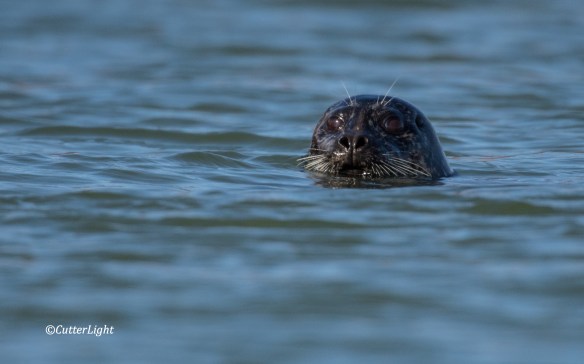
Cute, right? There always seem to be a few Harbor Seals in Chignik Lake and, I’m told, further up in the headwaters at Black Lake.

Here in Alaska, the population of Harbor Seals in Lake Iliamna gets a fair amount of attention. Yet we’ve never read a single word about the year-round seals in the Chignik System. One year I got a photo of nine seals hauled out together on lake ice across from our house. On this day, we saw this one and another that was sunning itself on a rock. I’d love to know more about what they eat once the salmon runs are finished.

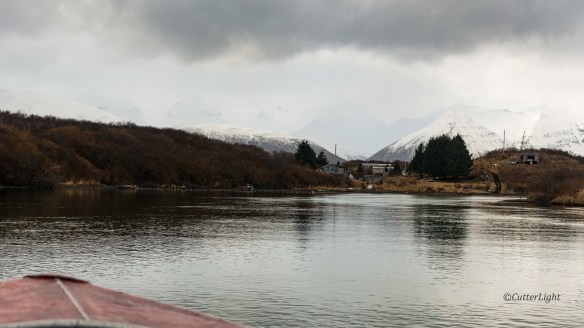
Heading back down the lake toward the lagoon we passed our village on the right. Our house is the white duplex closest to the water toward the right of the photo. The large building to the left and behind our house is the school, and just to the left of that, almost center, you can see the golden steeple on the Russian Orthodox Church. Just 30 yards from the lake, our living room/dining room windows are ideal for wildlife viewing. From these windows we’ve seen a wolf, a wolverine, a beaver, moose, ermine, voles, lemmings and a number of brown bears, otters and harbor seals. Eagles, kingfishers, several species of ducks, common loons, magpies, ravens and a number of passerines are common along with our resident Great Horned Owls. Falcons are less common but Merlins nest here, and during summer we frequently hear and occasionally see sandhill cranes.

This photo was taken at the head of the Chignik River on the return upriver to the village. I include it because it shows the copse of 20 trees we call White Spruce Grove – a small but important piece of bird habitat. This is where we see most of the black-capped chickadees, juncoes and other sparrows, redpolls, Pacific wrens, golden-crowned kinglets, pine siskins and white-winged and red crossbills we’ve written about in other articles. Thus far, we’ve documented over 70 species of birds in or near Chignik Village, a few of which had, to our knowledge, never before been reported on the Alaska Peninsula. Predators such as sharp-shinned hawks, merlins, owls and shrikes use these trees as well. Note the net, marked by a line of white floats on the water, extending from a skiff out into the river. A neighbor has been catching Sockeyes of about 22 to 23 inches, most probably a resident strain of fish that never go out to sea.

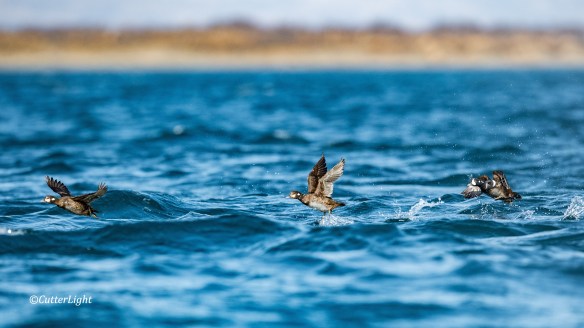
Although they occasionally visit the river during summers, and rarely are seen on the lake, we found lots and lots of harlequin ducks at the lagoon, the males (far right) already beginning to come into breeding plumage.

As with the harlequins, pelagic cormorants are uncommon visitors to the lake and river but abundant in the lagoon. And as with the photo of the eagle, some of these shots surprised me when I got them on the computer. This was a point, swing, hope and click effort with a pelagic heading in the opposite direction as our skiff cruised by.

I can count on one hand the number of times long-tailed ducks have shown up on the lake. Usually mixed in with other species, their distinctive coloration (a little like a scoop of strawberry, chocolate and vanilla Neapolitan ice cream) always makes me do a double-take. But they proved to be probably the most common bird on the estuarine lagoon on this outing, rivaled only by harlequins. The center bird is displaying his eponymous tail. Like harlequins, long-tailed ducks are fairly catholic in their dining habits and there’s simply a broader smorgasbord in the lagoon than in nearby freshwater. We foolishly left our binoculars behind, but there were a number of other species on the lagoon including what appeared to be a football-shaped phalarope so stuffed with whatever it was eating it could barely fly. From June through September the lagoon and nearby waters are a staging area for millions of returning salmon – in good years nearly two million reds (sockeyes) along with tens of thousands of silvers (coho) as well as pinks, chums and kings. 

Our friend had mentioned the lagoon’s flocks of Emperor Geese and I was hopeful of getting some photos. Unfortunately, as a hunted species, they proved to be fairly wary. Here a group of 200 or so birds take flight while we’re still well off their sand spit roost. (Thanks for the hero shot, Barbra!)

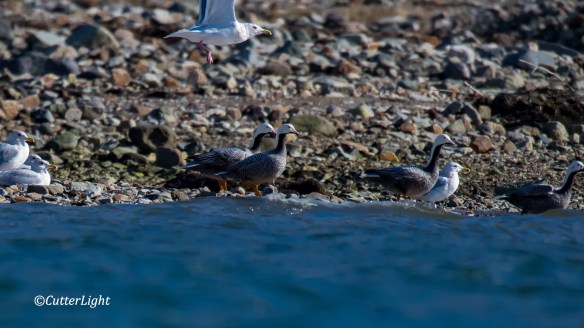
At the one place where we were able to get reasonably close to a few geese, colliding current and wind caused the skiff to bounce like crazy. But these handsome birds with white heads and napes, pink bills and yellow-orange legs are emperors – the first I’d photographed and a new bird for my Chignik List.

There’s little as stirring as wildlife abundance. I estimated close to 200 geese crowded together along with a few gulls on this last significant spit before the lagoon opens into the Alaska Gulf.

And there they go. I hate spooking wildlife. Just prior to this shot, birds were still dropping in to join the roost – but often it only takes one bird with antsy wings to get the rest up and going. The day was a lot of fun though and we got a few shots. Hopefully we’ll do another episode of skiffin’ in a few weeks to inventory the bird population again!

If you enjoyed this article, try typing “birds” into the search bar near the top of the page. You can find additional reading about our tiny bush village of Chignik Lake by typing those words into the search bar as well.

All Quiet at The Lake

Dawn, late February, Chignik Lake, Alaska

It has been a winter unlike our previous two at Chignik Lake – quiet, even by the quiet standards we’ve become accustomed to. Pine Siskins, dozens of them, have taken over the White Spruce Grove. A raucous lot, it may be that they’ve driven off most other birds. In any event, the Dark-eyed Juncos and other sparrows of past years have been all but absent, and we’ve not seen a sign of Golden-crowned Kinglets, Redpolls or wrens. There’ve been fewer, far fewer, ducks on the lake this year as well. Perhaps this unusually warm Alaskan winter has given waterfowl other open water to choose from. And while we did spot our first ever winter-white Short-tailed Ermine as well as a pure white Collared Lemming awhile back, otherwise wildlife has been scarce, a very occasional fox, otter or seal notwithstanding.

A friend has been setting a net and catching a few Sockeyes. Mirror bright, free of sea lice and small at just 22 inches or so, they are almost undoubtedly representatives of a resident lacustrine population – kokanees that never migrate out to sea but spend their lifecycle in the lake. One such fish is on the dinner menu for this evening. I will poach it whole in a broth of clam juice, lemon and saffron. The broth in turn will serve as the base for a salmon bisque.

As quiet as it has been, Barbra and I remain as busy as ever. There are unending lists of new recipes and baking, many thousands of photographs from previous adventures to edit, Barbra’s duties as a teacher to attend to, literature to read and study and future adventures to plan for. We’re looking forward to slightly warmer weather when we can more comfortably work on our fly-casting. We’re both on pace to be in shape to run a half-marathon this summer – our first in 10 years. Meanwhile, I’ve been putting in full days and then some between putting together articles for magazines and my new interest, learning to play an acoustic steel string guitar. The quiet provides a pleasant backdrop for these activities.

Only three months till Sockeyes begin returning to the Chignik River. Biologists are forecasting a strong run. It’s raining on the Lake this morning, but there’s new snow on the mountains. A neighbor reports hearing our owls make “strange noises” lately. Spring is coming.


Gray Heron, Hokkaido – wildlife notes

Gray Heron, (aosagi), Abishiri campground, Hokkaido, Japan.

One of the reasons we chose Hokkaido for our first bicycle trek were the reports that wildlife viewing on this northern Japanese island can be quite good. We’ve not been disappointed. Almost every morning we’ve woken to the songs and calls of birds, and our rides this summer have taken us through mile upon mile of gently rolling farmland, forested hills, river valleys and along coastlines. To date we’ve identified over 60 species of birds and have encountered bears, deer, foxes, mink, seals, porpoises and small whales. Some of the highlights have included:

  • 9 Brown Bears
  • over 20 Red Foxes
  • Dozens of Ezo Deer
  • 32 Red-crowned Cranes
  • Over 20 White-tailed Eagles
  • 2 Blakiston’s Fish Owls (and nighttime voices of other species of owls)
  • the world’s largest breeding colony of Rhinoceros Auklets
  • 3 species of cuckoo
  • 4 species of woodpecker
  • 2 species of snakes
  • Ezo Red Squirrels (and Siberian Chipmunks)
  • Peregrine Falcons
  • Dall’s Porpoises
  • over 100 seals
  • more butterflies and moths – and more different kinds of butterflies and moths – than we’ve ever before seen anywhere

Wildflower viewing as well has been fantastic. When we return to Alaska, we’ll post more detailed articles about Hokkaido wildlife.

Whale Bones and Crosses, the Cemetery at Point Hope

Whale Bones & Crosses, Point Hope, Alaska

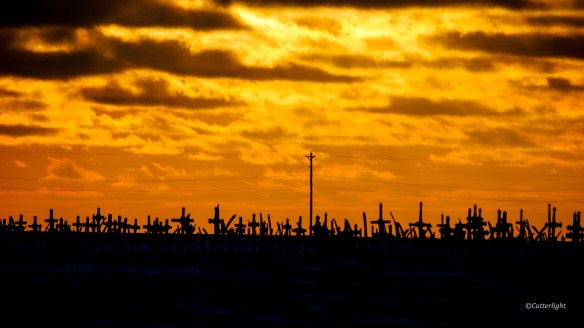
Perhaps its most iconic landmark, the cemetery at Point Hope, Alaska, is enclosed in Bowhead Whale ribs positioned as one would a picket fence. The above image was made at 2:25 PM, November 7. At that time of year, there are slightly less than six hours between sunrise and sunset. By early December, the sun sinks completely below the horizon and will not show itself again for 32 days.

In 1890, three years after a commercial whaling base called Jabbertown had been established near the village, the first Christian missionary arrived in Point Hope. A doctor by profession, it is reported that John Driggs performed “heroic” medical work, but his attempts at converting the village’s inhabitants to his religious beliefs were unsuccessful. In fact, the Episcopal Church that sponsored him reported that Driggs had become “eccentric and absent” in his duties to proselytize. Nonetheless, by 1910 Christianity had become predominant throughout Arctic Alaska. By this point the new religion had been spread from village to village by converts among the Inupiat themselves.*

*See: The Inupiat and the christianization of Arctic Alaska, Ernest S. Burch, Jr., Etudes/Inuit/Studies,1994

Full Moon over Frozen Lake: Chignik Lake, Alaska

Full Moon over Frozen Lake – Chignik Lake,6:56 PM January 30, 2018

Twilight, that sliver of light between the day’s last direct sunlight and darkness, is often the prettiest light of the day. I was happy that Fred has his lights on. This shot was taken from the beach in front of our house. (Snowing here this morning, May 6.)

Chignik Lake Bald Eagle

Waiting for Salmon, Chignik Lake, Alaska

May 1, Tuesday Morning, frost: Eagles are once again daily encounters as they take up familiar roosts and join the village in watching for salmon. A few fish have trickled in, but usually it’s June before the run really gets going. A couple of nice char have been caught. Catkins on the willows, leaf buds everywhere ready to burst. A small flock of Pine Grosbeaks was in the village yesterday, the males as brilliant pinkish-red as they’ll ever be.