
Wood Hex
Reply


You might encounter this puffin relative just about anywhere along North America’s Pacific coastline, and in fact there are breeding populations scattered from Canada through Alaska’s Aleutian Islands. But perhaps the best place to see Rhinoceros Auklets is on Terui Island off the west coast of Hokkaido where they gather in the hundreds of thousands to nest – the largest Rhinoceros Auklet breeding colony in the world.
The northwest cliffs of Teuri are pockmarked with burrows which the auklets have dug deep into the sandy soil to keep their eggs and chicks safe from gulls and other predators. During the day, the parents leave their chicks behind as they venture out to sea where they dive for food – primarily Sand Lances and squid. As twilight gathers, the adult auklets return to home, somehow sorting out their burrows from among the tens of thousands of similar tunnels. Gulls await the returning auklets, keen on stealing an easy meal. This is an example of why for many species it is so important that their numbers remain vast. Were only a few auklets to return, they’d each make an easy target for the waiting gulls. But with hundreds of thousands flying in, the relatively few gulls are overwhelmed, and although the gulls manage to take a few meals, most of the auklets make it safely to their burrows where hungry chicks are waiting.
On Terui Island, guides are available to take birders out to the nesting site to observe the spectacle of returning auklets. Along a pathway, a few low lights allow for a good view of the birds as they scurry through low, dense vegetation. Some of the auklets will be quite close, but in order to get good photographs a fast lens and a camera capable of handling high ISO values is necessary as using additional lighting is not permitted (and would be wrong, even it were). You’ll be hand-holding and so you have to hope you catch one standing still to momentarily collect its thoughts, as in the above photograph. JD

Not a lot appears to be going on in the above daytime photograph taken on Teuri Island’s cliff-lined northwest. The 2.1 square mile island (5.5 square km) hosts the breeding grounds for several species of birds, most notably seabirds. The holes in the above photograph are the burrows of Rhinoceros Auklets, a species for which Teuri serves as the world’s largest breeding ground.
While it doesn’t appear that much is going on in the photograph – a few gulls milling around notwithstanding – at the end of each burrow, which may be up to six meters (20 feet) in length, a Rhinoceros Auklet chick is waiting for twilight when parents will return from the sea, stomachs, gullets and bills crammed with catches of sand lances and squid. Gulls – primarily Slaty-backed which also breed on the island – will intercept some of the returning adults, but most will make it past the parasitic phalanx. Recent estimates put the auklet population at around 400,000 breeding pairs. Add in the chicks and the species count rises to over a million. Perhaps you can imagine the sight and the cacophony as night gathers and hundreds of thousands of adult auklets return, evading squawking gulls, somehow locating the specific burrow each parent calls home.
Teuri is also an excellent place to see Spectacled Guillemots, Common Guillemots and other seabirds as well as passerines such as Blue Rock Thrushes and Siberian Rubythroats. Regular, bicycle-friendly ferries from Haboro make it easy to get out to the island, and if you don’t choose to stay at the lovely campground (which you’re likely to have to yourself) there are wonderful inns offering comfortable accomodations and truly some of the world’s best fresh seafood.
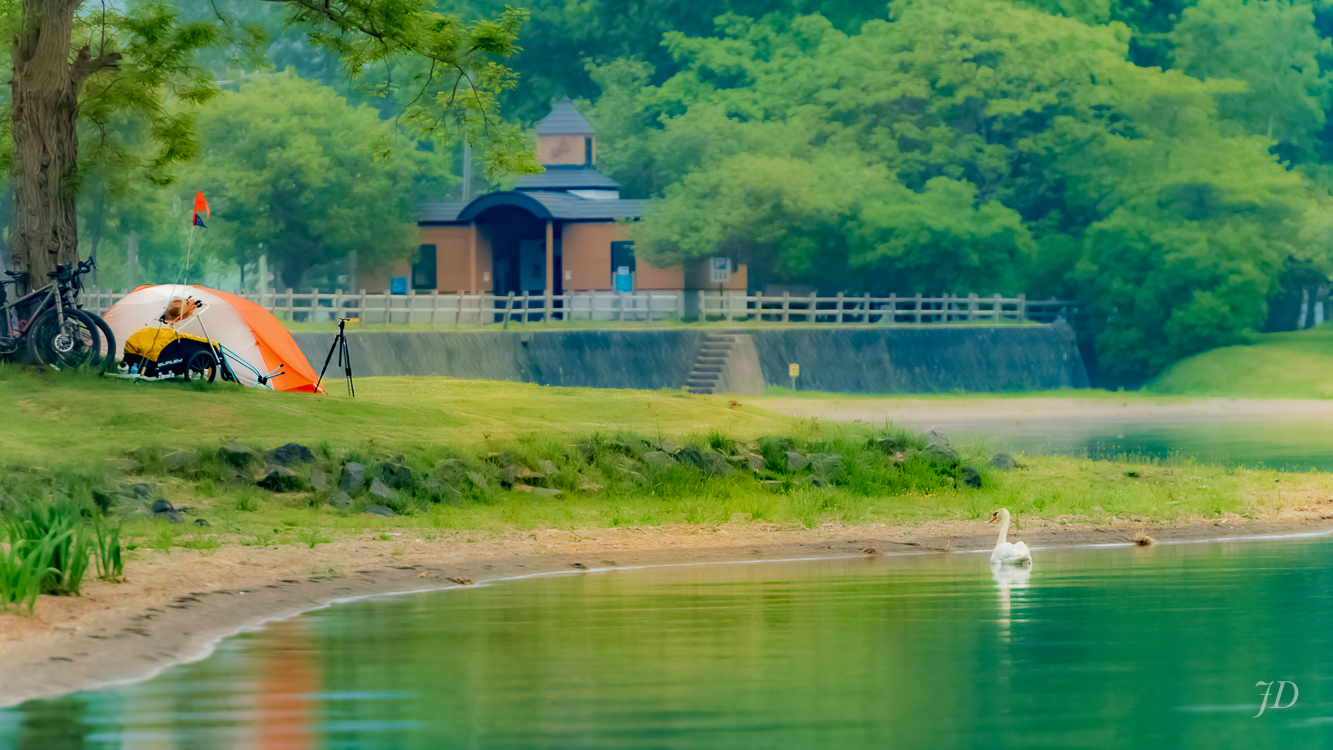
We found one terrific (often idyllic) campsite after another during our Hokkaido trek. Above is Nakatoya Campground on the shores of Toya-ko (Lake Toya). The lake formed in an ancient volcano caldera, complete with an island near the center – similar to Oregon’s Crater Lake. Overall, Hokkaido’s campgrounds were quiet, clean, and inexpensive. In fact, several were free and if memory serves even the most expensive site was only about $20 (in 2018). Most ranged from five to 10 dollars per camper per night.
In the past, language might have been a barrier to traveling in Japan. I speak some Japanese, which was immensely helpful, but these days with language apps right there on your phone, most locals eager to assist well-mannered visitors, and a lot of printed material such as highway signs, menus, national park information and so on written in English, even language differences need not impeded a tour of this wonderful, lightly-visited island. On a latitude approximating that of Oregon and Massachusetts, summertime biking in Hokkaido is pleasant, particularly along the coast.
I had forgotten that I’d softened so many of these Hokkaido images… Dreamy summertime bike trek.

Veniaminof was active on and off in the years we lived at The Lake. There were times when, while out fly-fishing the river, we could hear it rumbling, it’s smoking cone just over 20 miles to the west. In this photograph from a remote cabin on Black Lake near the headwaters of the Chignik, the volcano is even closer – perhaps just 20 miles distance. The forecast during our stay on Black Lake had been for fair weather, but shortly after sunset the evening one of us took the above photo we were hit with a huge out-of-nowhere storm packing freezing temperatures and winds in excess of 100 miles per hour. The little cabin rattled and rocked and we dug deep under a pile of blankets and sleeping bags, hoping the shelter would hold together. It did. That morning we woke to calm and a lake locked in thick ice. Our way out – back to the village, was by boat – a mile down the lake, seven miles down Black River and then seven more miles down Chignik Lake. No cell service. We were locked in, solid.

We procured a backcountry permit at the park office, took a shuttle bus a ways into the park, debarked and backpacked into the landscape in this photo to spend a couple of nights. The only sign of people we came across was a plastic lens cap from a camera – something accidentally lost, not littered. Caribou and Dall Sheep, Wolf prints and Wolverine tracks… A Grizzly Bear caused us to change our course… Short-eared Owls cruising low, nesting Willow Ptarmigan hens – the males waking us at first light with their call of Potato! Potato! Potato. Tree Sparrows flushing from tiny ground nests where clutches of blue-green & brown eggs were crowded together. We came across Caribou antler sheds; a moose rack attached to a skull suggested a successful hunt by wolves. In 1846, Thoreau needed only to travel from Concord, Massachusetts to Maine’s Mt. Katahdin* to immerse in the vital contact with wilderness he sought. During the 2022-2023 season, 105,000 tourists traveled to Antarctica – up from just 5,000 only a few years prior… which was up from somewhere near zero not so long before that. Even Alaska’s remote, far-north rivers are typically floated by multiple parties each year. Not long ago I came across a recent piece of video depicting an unimproved campsite I overnighted at on youthful floats down my native Clarion River. The site was seldom used in those days, nearly pristine, and you could nice-sized large trout in the pool and the riffle water that flowed by. The contemporary video showed trampled vegetation, fire pit scars, bags of trash…
There are no doubt as many definitions of wilderness as there are human expectations of what might be present or absent in such a place. The one certainty is that wilderness is becoming more difficult to find, to immerse in, to discover and explore. My recollection of reading Thoreau’s account of his attempt to ascend Katahdin is that at some point the climb (or was it the descent?) was terrifying. Perhaps therein lies a piece of what wilderness means… a place cut off from civilization, where things could go wrong, and if they do, you’re on your own. There’s something liberating in it.

The one pancake to a pan pancake: Half of one makes for a hearty breakfast. Perfectly crispy on the outside, light and fluffy and jammed full of fruit on the inside, served with a couple strips of thick bacon and maple syrup, who needs the other food groups? Well, coffee…
I’ve been messing around with pancakes for a long time. Here’s what I now think I know about making the perfect pancake.
First, while one can make them from scratch, there is no reason to. Krusteaz has come up with a mix that nails it. We buy Krusteaz mix in bulk at Costco and enjoy waffles or pancakes – or both – once or twice a week.
Second, put the butter in the pan, not on the pancake. Pancakes fry up crispier, turn a lovely golden brown, and taste more decadent when fried in roughly equal parts light olive oil and butter.
Third, the right pan makes a big difference. Barbra and I have become big fans of Swiss Diamond nonstick cookware. The pans are thick and heavy, so food scorch is avoided, and once they heat up, they cook with incredible evenness.
Fourth, do your best to get away with as little water and as little mixing as possible. The result is a fluffier pancake.
Fifth, forget medium heat. Low and long is the way to go. I start on medium-low, and then go a little lower than that, giving the cake time to rise without burning.
Sixth, one big pancake cooks up better – in every regard – than several small ones. Think 11 1/2″ pan and enough batter to cover most of it. Big pancakes can hold more fruit per volume and rise up higher and fluffier than smaller pancakes. (Get a big spatula, and be ready for a little splatter when you flip the cake.)
And finally… Fruit. Adding a generous amount of fruit to the batter lends more than just the added flavor and texture of the fruit itself to the cake; it also adds a creaminess that a fruitless pancake cannot match. Whole blueberries are great, and as this is Alaska, we use them frequently. Chopped bananas are superb. But our favorite? Strawberries. There is something about fresh strawberries, diced, that takes a pancake to another world.
Honey, jam, preserves or maple syrup – they all do a good pancake justice. Crispy around the edges, creamy in the middle, the maple syrup getting on the bacon, a hot cup of coffee to cut through the sweetness… It’s good morning food.
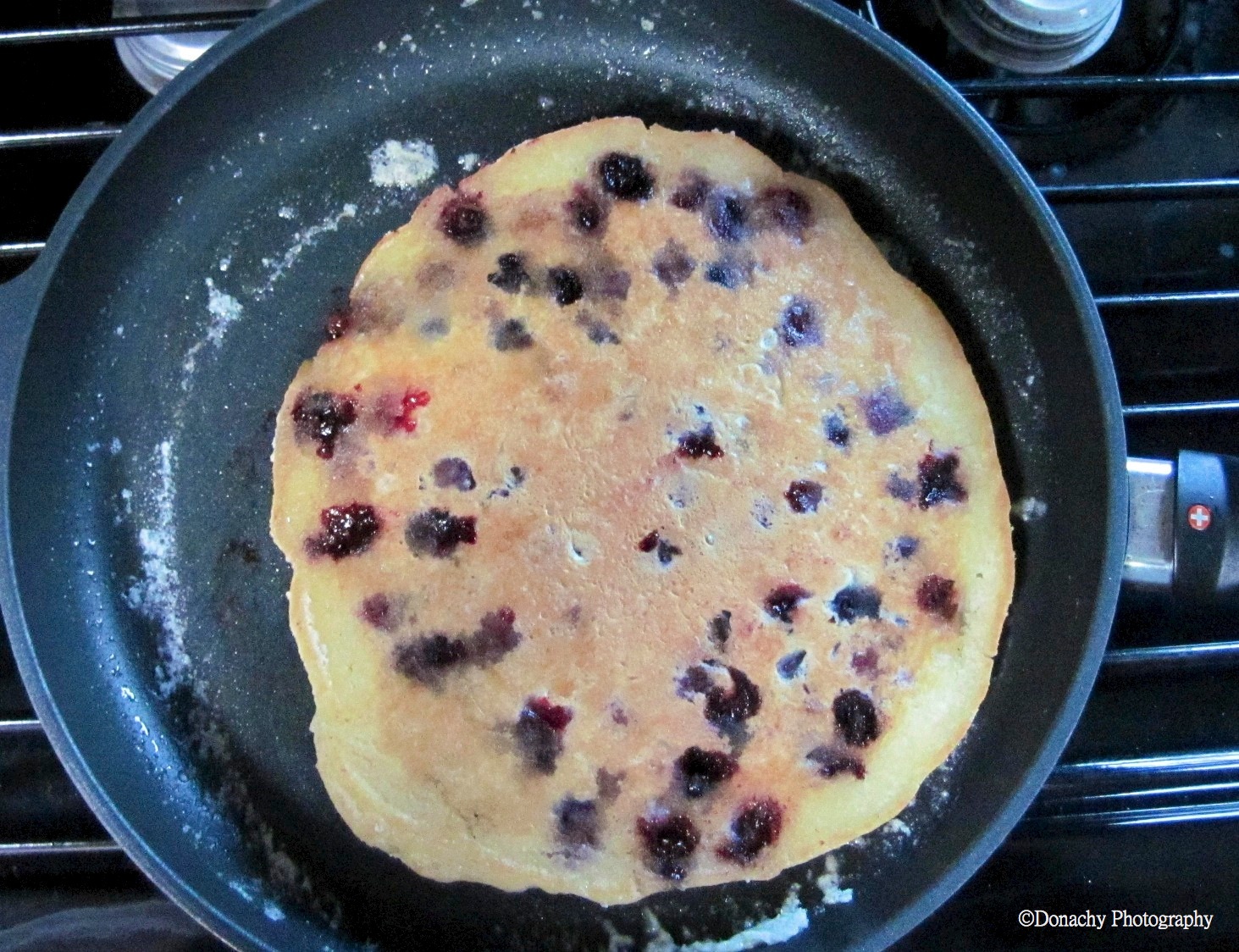
A big blueberry pancake, just about ready to be cut in half and served for breakfast.
 CutterLight