Unknown's avatar

About Jack & Barbra Donachy

Writers, photographers, food lovers, anglers, travelers and students of poetry

A Snack That Can’t be Beet – Bright Magenta Beet Hummus

beet hummus n

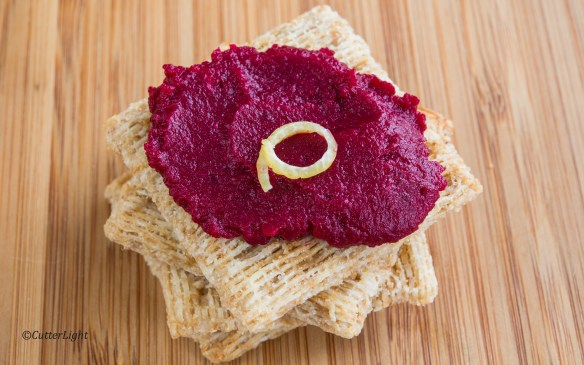
Healthy? Yes, but more importantly beautiful and delicious! Imagine this wine-colored spread on crispy crackers or as part of a vibrant plate of garden-fresh crudités.

This hummus is just as creamy and smooth as my white bean hummus recipe. My favorite thing about hummus is the flavorful marriage of garlic, lemon, and cumin. Inspired by a couple of beets in the fridge, I decided to do what beets like best – roast them. Roasting brings out the sweetness in this beautiful root vegetable. I substituted beets for the white beans in my original recipe and was really happy that the main garlic, lemon, and cumin flavors still shine through. The beets add a subtle earthy, sweet flavor. Best of all, they take the presentation through the roof with their color.

Roasted Beet Hummus

Ingredients

  • 2 medium beets
  • 1 15 oz. can garbanzo beans
  • 3 tbsp lemon juice
  • 2 tsp cumin
  • 2 cloves garlic, chopped
  • a few dashes hot sauce. We like Cholula.
  • 1 tsp salt
  • 1/2 cup olive oil
  • pepper

Directions

  1. Preheat oven to 375° F (190 C. Remove the stem from the beets. Scrub and wash them with cold water.
  2. Place beets in foil, drizzle with olive oil, wrap tightly and roast for one hour or until the tines of a fork pass through without resistance. They should be tender. Let cool slightly.
  3. You should be able to rub the skin off of the beets. Otherwise, use a paring knife to peel off the roasted skin.
  4. Cut beets into chunks. Place in deep bowl.
  5. Rinse and drain beans. Add to bowl.
  6. Combine lemon, cumin, garlic, hot sauce, salt and half of the olive oil with beet mixture. Use a stick blender to mix and purée hummus. This can also be done in a food processor.
  7. Process mixture until smooth, adding more olive oil to reach desired consistency.
  8. Serve with a drizzle of olive oil and a crack of black pepper.


Pretzel Dogs – or Finally, a Food Post!

Chewy, soft pretzels with a not-so subtle just-right hit of salt, stuffed with your favorite hot dog – a recipe for a delicious lunch easy to take with or one to stay in with on a snowy spring day.

Many years ago, actually just approaching ten, we decided to move to Alaska. There are many different Alaskas within this beautiful state. The one we chose to move to was the Alaska Bush, a place we knew would be challenging, fascinating and exciting and a place where we knew we would need indoors hobbies to entertain us during cold and dark winters. One of my first goals was to become a baker. To set myself up for success, I sent out hundreds of pounds of different flours, sugars, flavorings, pans, cutters, and a beautiful tapered rolling pin with inlaid bamboo for inspiration (a lovely gift from Jack).

As my baking skills improved, I graduated from bread-in-a-rice-cooker to a a bonafide bread machine. As I continued to improve my baking, I ditched the machines and really dug into the whole process of baking. During my initial education, I enlisted the help of The Great Courses and chef Stephen Durfee from the Culinary Institute of America (via the online class). For six Sundays in a row, the three of us dutifully watched these classes and then baked – with feedback from countless taste-testers. We learned how to create lattice-crusted pies, ganache-topped éclairs, and mousse-filled many layered chocolate cakes. That was just the start. By the way, if you’ve ever wanted to really learn how to bake, I highly recommend the Baking Pastries & Desserts class from the Great Courses. I also highly recommend sharing the experience with friends. It was a lovely introduction into serious baking.

Of course, spending this much quality time with friends can only make friendships grow. After completing our class, my friend Reba and I continued to bake together, share recipes and swap tastes of new creations. Pretzel dogs always remind me of Reba and those baking days in Point Hope. This recipe produces an agreeably light, airy roll and is part of my permanent rotation. Thanks to Reba for the spiral wrapping style!

Pretzel Dogs

Ingredients

  • 1 3/4 cups milk
  • 2 tsp instant yeast
  • 2 tbsp olive oil
  • 1 1/2 tsp salt
  • 4 cups all purpose flour
  • 10 good quality hot dogs
  • coarse sea salt
  • 1/2 cup baking soda
  • 16 cups water

Directions

  1. Whisk milk and yeast together in a large bowl. Let stand for a few minutes until yeast starts to foam.
  2. Stir in oil.
  3. Stir in 1 cup flour and mix until well combined.
  4. Stir in salt.
  5. Mix in remaining 3 cups of flour.
  6. Turn dough out onto floured surface.
  7. Knead until smooth and elastic, about 10 minutes.
  8. Place dough in an oiled bowl, covered with plastic wrap. Let rise until doubled, about 1 ½ to 2 hours.
  9. Line a baking sheet with parchment paper.
  10. Cut dough into 10 equal pieces.
  11. Roll dough pieces into long snakes. Coil dough around each hot dog, pinching the end pieces of the dough to secure it.
  12. Let pretzel dogs rest while you prepare pretzel bath.
  13. Preheat oven to 400° F.
  14. In a large pot, boil 16 cups water and salt.
  15. When water is boiling, stir in baking soda.
  16. Place 2 pretzel dogs in boiling water for 30 seconds. Flip and continue to boil for 30 more seconds. Remove from water with slotted spoon and place on parchment-lined baking sheet.
  17. Repeat with remaining pretzel dogs.
  18. Sprinkle each pretzel dog with coarse salt.
  19. Bake for 20 minutes. Pretzel dogs are finished when they are a rich dark brown.
  20. Let cool for a couple of minutes on baking sheet. 
  21. Serve warm with Dijon or another good quality deli mustard and a delicious red ale.

Philosophies for Learning to Play the Guitar at 60: Metronome

Philosophy #8

Use a metronome. Both to keep steady time and to challenge yourself to play with increased speed.

As a high school student, I ran middle distances for my track team and was introduced to a world carefully measured in minutes and fractions of seconds. Our coach, Bob Bowersox, kept meticulous records. He recorded our race times, of course, but he also kept records of our workout times as we ran repeated intervals of 440 and 880 yards and he encouraged us to do the same. Thus, over the course of a season, we had proof of our individual progress as race times and practice times got faster and faster.

It’s a strategy that applies to guitar work as well – one my daughter, Maia, used as she became an accomplished violinist and later a pianist and guitar player. I occasionally give myself “time trials” and record the results in metronome-measured beats per minute in my music book. It’s a confidence boost to document that songs and scale exercises I initially struggled with are becoming faster and smoother. At the same time, using a metronome helps me push myself toward these kinds of improvements.

The main reason to use a metronome, though, is to help develop a sense of steady rhythm. Set the metronome for a beat you can handle and play along with it. The metronome will remind you not to rush easy passages, and it will also help you identify places where you stumble and need more work.

Philosophies for Learning to Play the Guitar at 60: Scales

Image courtesy Wiki Commons

Philosophy #7

7. Practice and memorize scales. Scales are the key to chords and melodies.
In his book about the Brooklyn Dodgers baseball team, The Boys of Summer, author Roger Kahn provides insight into George “Shotgun” Shuba’s bat swing which was famous for producing hard line drives and was said to be “…as natural as a smile.” The backstory on that “natural” swing, according to Shuba, was that for a time in his life, each night before he went to bed he performed hundreds of swings with a 44 ounce bat. Many thousands of swings later he had developed that “natural” swing.

Think of scales like that as you work on them to develop your ear, your finger and hand speed and your knowledge of the fretboard.

Philosophies for Learning to Play the Guitar at 60: Warm Up

Philosophy #6

Warm up. Ever walk the halls of a college campus or music conservatory where students are in individual rooms singing or playing instruments? What strikes many experiencing this for the first time is that rather than songs, a lot of what is heard are scales and other musical drills.

Just as a chef prepares with mise en place (everything in place), and just as an athlete limbers up, begin every exercise session with warm-ups such as scales, moving up, down and across the fretboard, repeating chord changes and so forth. It’s tempting to skip this. Don’t. Warm-ups gently bring your mind and hands back into the world of the guitar, and they provide a good time to check mechanics such as good posture, proper hand positioning, and striving to hit notes so that each one rings true. Mindful warm-ups are vital to making playing the guitar second nature. It’s helpful to write down routines.

Philosophies for Learning to Play the Guitar at 60: Study Systematically

Philosophy #5

Study systematically. Virtually everyone who loves rock, blues, jazz or other music featuring guitars has formed in their minds an image of a teenager cloistered in a bedroom or garage working tirelessly with a cheap guitar to pick out riffs and chords by ear from a favorite song and then going on to guitar hero status. Although the great majority of people who embark on this route probably end up quitting before they get very far, it works for some…

Who begin as teenagers…

…with all the time in the world before them.

But if the peak of your capacity to acquire new skills lies some decades in your rearview mirror…

You’ll make better progress with a more systematic approach.

Work with a good teacher and a proven text of spiraled skill acquisition. Spiraled… as in beginning with an introduction regarding nomenclature, proper posture, correct hand positioning, and the names of the strings. Page by page and lesson by lesson you’ll add to your knowledge until you’ve formed a solid base that includes the ability to read music, proficiency with scales and chords, and foundational skills that include efficient shifting, flat picking and finger-style playing. Along the way, you’ll probably learn some guitar music history, too, and that can be very enjoyable – especially as your circle of friends begins to include others who are interested in such things.

For what it might be worth, I’m very happy with the sources I’ve chosen for learning the guitar. Here they are, in order of importance to my learning thus far.

The Great Courses
Learning to Play Guitar: Chords, Scales and Solos
Instructor: Collin McCallister
Don’t be put off by the somewhat low 4 out of 5 stars rating this course is receiving on The Great Courses site. Most of the complaints are over the fact that McCallister spends time discussing the historical roots of guitar music and examples of learning. Personally, I wanted to learn more about guitar history, and I find his insights into learning to play the guitar to be quite valuable. As to the guitar lessons: McCallister is a masterful musician and an energetic, engaging, sometimes humorous university professor who has taken the time to put together a carefully spiraled approach to gradual skill acquisition. He’s also more candid than over 90% of instructors out there who will happily accept your money on the subject of “how long” it takes to achieve something like Advanced Beginner status: “Hundreds of hours of practice.” I couldn’t be happier with this course.

Mel Bay’s Modern Guitar Method Grade 1
First published in 1948, this slim, 48-page book has outlived the man who wrote it. (Bay died in 1997). The longevity this book has enjoyed – along with its outright popularity (millions of copies have been sold and it’s still widely regarded as the best beginner text) – are a testimony to the intelligence and accessibility of its carefully spiraled approach to learning chords, scales and familiar songs.

Uncle Tim’s First Year: A Beginner’s Guide to the Guitar
Tim Gillespie takes a unique approach in laying out the foundation for learning the guitar. His 82-page book is filled with text rather than with songs. Interspersed are illustrations of chords, scales, flat-picking and finger-style patterns, and… hmm. That’s pretty much it. If you want to understand guitar music theory (and as an older learner, you should – this knowledge will boost your learning curve), this is a terrific resource. Do you understand The Circle of Fifths? How scales work (and therefore how lead solos are put together?) Neither did I. This book goes nicely with Collin McCallister’s class, above.

Youtube Videos and other Internet Resources
I’ve been Googling videos to listen to how songs in Mel Bay’s book are supposed to sound, to see demonstrations of finger-style patterns, for general inspiration and to expand on subjects Collin McCallister introduces in his lessons. Check out this video of Mississippi John Hurt picking John Henry.

And if you’ve started playing, keep playing!

Got a tip from your own experience learning a skill late in life? I’d love to hear about it.

Philosophies for Learning the Guitar at 60: Don’t Set Expectations

Philosophy #4

Don’t set expectations. As a wise person once observed to me, “It’s amazing what you can accomplish when you don’t have expectations.” Goals set too early in an endeavor can be worse than useless. They may lead to disappointment if timelines aren’t met, to imagined competition with others, and to frustration with progress perceived to be too slow. None of this is helpful. Even if you meet some arbitrary goal, so what? You would have gotten there just the same simply by putting in practice time.

As an older learner taking up the guitar, there’s simply no way to know what you’ll accomplish. So don’t worry about it. In fact, try not to even think about it. Enjoy the journey and what you discover about music, the guitar, and yourself.

Skiffin’ – A Chignik Version of the Sunday Drive: Sunshine, Sea Birds, Seals and Snow-covered Mountains)

The view at Hatchery Beach, a wind-swept shore on Chignik Lake where sufficient upwelling and pea-sized gravel create ideal conditions for Sockeye Salmon to spawn. The stream-fed pond behind the strip of land is a feasting area for our huge brown bears from summer through fall.

It was a perfect day for skiffin’ – full-on sunshine, light breezes and a mid-day high tide pushing far enough up the river for The Shallows to be passable. The tide meant access to the Lagoon, the saltwater estuary where Chignik River debouches into the Alaska Gulf and an opportunity to photograph Emperor Geese. So when a friend called with an invitation to go out in his 18-foot Lund, we made quick work of lunch and pulled our camera gear together. Oh, and we bundled up; highs are only reaching 40° or so (4 or 5 degrees C) and it’s always colder on the water.

The Chignik Mountains surrounding the lake were shouldered in fresh, powdery snow. Kudos to Barbra on the landscape photographs in this article. It can be tough getting good shots from a bouncing boat.

Every plane coming into the village prompts two questions: Mail? Freight? Other than this plane and one other skiff, we had the lake, the river, the lagoon and the day to ourselves. 

Check out those talons… and that beak! Although we see eagles nearly every day, we always pause to admire these magnificent birds. I surprised myself a little with this shot. Even with a light breeze there was enough chop on the water to have the skiff (Chignik for what Pennsylvanians would call a boat) bouncing like crazy – a problem magnified several times over with a long wildlife lens and a teleconverter attached to my camera. Most of the time I couldn’t even find the bird in my viewfinder, and when I did I had less than a second to shoot before the boat rocked and the bird wildly bounced out of the frame. But he (or she) was patient with me and I had plenty of light to shoot fast when the chance came. They’ll be nesting soon, I imagine.

Here’s Hatchery Beach looking back toward the Clarks River watershed – a significant spawning tributary and with its nearly clear-as-air flow a magical place to fly-fish.

And a third shot moving up the lake along the Hatchery Beach shoreline. We’ve often thought that a lot of these mountains, which top out at just over 3,000 feet (1,000 meters), would make for a good climb. The main feat might be getting through the jungle-thick alders at the base.

Cute, right? There always seem to be a few Harbor Seals in Chignik Lake and, I’m told, further up in the headwaters at Black Lake.

Here in Alaska, the population of Harbor Seals in Lake Iliamna gets a fair amount of attention. Yet we’ve never read a single word about the year-round seals in the Chignik System. One year I got a photo of nine seals hauled out together on lake ice across from our house. On this day, we saw this one and another that was sunning itself on a rock. I’d love to know more about what they eat once the salmon runs are finished.

Heading back down the lake toward the lagoon we passed our village on the right. Our house is the white duplex closest to the water toward the right of the photo. The large building to the left and behind our house is the school, and just to the left of that, almost center, you can see the golden steeple on the Russian Orthodox Church. Just 30 yards from the lake, our living room/dining room windows are ideal for wildlife viewing. From these windows we’ve seen a wolf, a wolverine, a beaver, moose, ermine, voles, lemmings and a number of brown bears, otters and harbor seals. Eagles, kingfishers, several species of ducks, common loons, magpies, ravens and a number of passerines are common along with our resident Great Horned Owls. Falcons are less common but Merlins nest here, and during summer we frequently hear and occasionally see sandhill cranes.

This photo was taken at the head of the Chignik River on the return upriver to the village. I include it because it shows the copse of 20 trees we call White Spruce Grove – a small but important piece of bird habitat. This is where we see most of the black-capped chickadees, juncoes and other sparrows, redpolls, Pacific wrens, golden-crowned kinglets, pine siskins and white-winged and red crossbills we’ve written about in other articles. Thus far, we’ve documented over 70 species of birds in or near Chignik Village, a few of which had, to our knowledge, never before been reported on the Alaska Peninsula. Predators such as sharp-shinned hawks, merlins, owls and shrikes use these trees as well. Note the net, marked by a line of white floats on the water, extending from a skiff out into the river. A neighbor has been catching Sockeyes of about 22 to 23 inches, most probably a resident strain of fish that never go out to sea.

Although they occasionally visit the river during summers, and rarely are seen on the lake, we found lots and lots of harlequin ducks at the lagoon, the males (far right) already beginning to come into breeding plumage.

As with the harlequins, pelagic cormorants are uncommon visitors to the lake and river but abundant in the lagoon. And as with the photo of the eagle, some of these shots surprised me when I got them on the computer. This was a point, swing, hope and click effort with a pelagic heading in the opposite direction as our skiff cruised by.

I can count on one hand the number of times long-tailed ducks have shown up on the lake. Usually mixed in with other species, their distinctive coloration (a little like a scoop of strawberry, chocolate and vanilla Neapolitan ice cream) always makes me do a double-take. But they proved to be probably the most common bird on the estuarine lagoon on this outing, rivaled only by harlequins. The center bird is displaying his eponymous tail. Like harlequins, long-tailed ducks are fairly catholic in their dining habits and there’s simply a broader smorgasbord in the lagoon than in nearby freshwater. We foolishly left our binoculars behind, but there were a number of other species on the lagoon including what appeared to be a football-shaped phalarope so stuffed with whatever it was eating it could barely fly. From June through September the lagoon and nearby waters are a staging area for millions of returning salmon – in good years nearly two million reds (sockeyes) along with tens of thousands of silvers (coho) as well as pinks, chums and kings. 

Our friend had mentioned the lagoon’s flocks of Emperor Geese and I was hopeful of getting some photos. Unfortunately, as a hunted species, they proved to be fairly wary. Here a group of 200 or so birds take flight while we’re still well off their sand spit roost. (Thanks for the hero shot, Barbra!)

At the one place where we were able to get reasonably close to a few geese, colliding current and wind caused the skiff to bounce like crazy. But these handsome birds with white heads and napes, pink bills and yellow-orange legs are emperors – the first I’d photographed and a new bird for my Chignik List.

There’s little as stirring as wildlife abundance. I estimated close to 200 geese crowded together along with a few gulls on this last significant spit before the lagoon opens into the Alaska Gulf.

And there they go. I hate spooking wildlife. Just prior to this shot, birds were still dropping in to join the roost – but often it only takes one bird with antsy wings to get the rest up and going. The day was a lot of fun though and we got a few shots. Hopefully we’ll do another episode of skiffin’ in a few weeks to inventory the bird population again!

If you enjoyed this article, try typing “birds” into the search bar near the top of the page. You can find additional reading about our tiny bush village of Chignik Lake by typing those words into the search bar as well.

Philosophies for Learning the Guitar at 60: 500 Hours

Philosophy 3

Humble yourself to 500 hours. How long does it take to be able to play the guitar with basic proficiency? The answer depends on innate ability, prior experience, the quality and consistency of practice sessions, and how the term “basic proficiency” is defined. So any number we might choose will be somewhat arbitrary. That being said…

I’m using 500 hours as a benchmark. That’s about how much classroom, practice and study time I estimate I’d need to really get down all the material in a two-semester college level beginning guitar course. It’s also roughly the amount of work it appears it will take to thoroughly complete the 24 lessons in Collin McCallister’s Learning to Play the Guitar: Chords, Scales and Solos at The Great Courses along with the supplemental material I’m using.

This 500 hours does not include the time it takes to pick up and tune your guitar, locate your music, repeatedly check the clock or take a phone call. This is 500 hours of purpose-driven practice.

Let’s take a moment to consider what this means in terms of skill acquisition.

  • Committing to daily practice of 30 minutes, it will be 1,000 days before 500 hours of meaningful practice have been invested. That’s 2 years and 9 months. With these relatively short practice sessions, a high percentage of time will be spent warming up. Days will go by between circling back to practice certain skills and there often won’t be sufficient time to work through problems. Thus, even with 500 hours (2 years and 9 months) under your belt, you will likely not have attained the same skill level as someone got to 500 hours through longer practice sessions over a shorter period of time.

As a young person, you or someone you know may have been instructed to practice half-an-hour a day on the piano, violin or another instrument. It’s a fairly common prescription. But with time off during summer, missed weekends and holidays, inevitable illnesses, visits with friends and relatives, school projects and other commitments intervening, and (let’s be honest) a certain amount of wasted time during those practice sessions, it is often the case that practice only occurred on about 200 days in a given year. That’s only 100 hours of practice. At this pace – which is a fairly typical one – a person could take lessons for 5 years before hitting the 500 hour benchmark. Meanwhile, with all the interruptions, much of that 500 hours would have been devoted to review. This is one reason so many people who attempt to learn a musical instrument (or a foreign language) come away from the experience believing they have “no talent” for it. In reality, they never gave themselves an opportunity to develop the talent that they probably do have.

  • With 1 hour a day, the time to 500 hours is cut to 1 year, 4-and-a-half months. Because a higher percentage of practice time will have been devoted to skills beyond warm-ups, and because you can both practice a broader range of skills in each session (thus avoiding forgetting and other forms of skill deterioration) and because you’ll have more time to work through challenging areas and to experiment, at the conclusion of 500 hours you’re likely to be well ahead compared with had you committed to shorter sessions.

Still with days off here and there, you’re looking at close to a year-and-a-half before you’ve got 500 hours under your belt. That’s a fairly long time.

  • Two hours a day will get you to 500 hours in just over 8 months. In other words, within a year of first picking up a guitar, you could be playing it fairly well.
  • And so on. A schedule in which one begins with an hour a day in the first month, progresses to two hours in the second month as hands become stronger, and then ups practice time to three hours per day thereafter will get the guitarist to 500 hours in just over 5½ months. Consider the path any accomplished musician – or cook, fly-fishing master, athlete, educator, artist, or writer – took to reaching proficiency. They got there with lots of purpose-driven practice.

From 1960 to 1962 The Beatles worked bar gigs in Hamburg, Germany where they played five hours a night seven nights a week. That’s thousands of hours of meaningful, purpose-driven practice before their first #1 single in October 1962, Love Me Do.  

Keep in mind that the annals of achievement are filled with stories of people who weren’t very good (or who were actually quite awful) when they started, but by sticking with it and putting in the time went on to accomplish great things. Conversely, there are at least as many stories of people who began with great promise but who didn’t invest in the time and who subsequently fizzled out.

I offer the above as grist for thought rather than advice; each person must determine their own schedule and the pace of their own journey. But here’s a further observation. We all know people who have practiced a given skill “for years” and who still aren’t particularly accomplished at it. That’s because, as the above example with piano lessons illustrates, skill acquisition cannot meaningfully be measured in years. Dabbing at or dabbling in a complex skill in short practice sessions interrupted by distractions and further chopped up with lengthy periods when the thing is not practiced at all is a slow, long path and one most likely to end in discouragement.

As to 500 hours… It’s a lot of time. Think of it as a journey, enjoy it, and when you arrive you’ll be able to look back at that time when it (guitar or whatever else “it” is) was just a dream to a present time when you have acquired enough skills to make yourself say “Wow! I’m doing this!”

Philosophies for Learning the Guitar at 60: Purpose-driven Practice

Philosophy 2

A skill is built hour by hour engaged in focused practice guided by a purpose. There is no other way.