Unknown's avatar

About Jack & Barbra Donachy

Writers, photographers, food lovers, anglers, travelers and students of poetry

A Moment of Bliss: Hand-feeding Wild Finches (a short video)

Their hard little feet feel cool on one’s fingers, and despite sharp bills they are gentle feeders. The large red bird is a male Pine Grosbeak. The golden-yellow one is a female. The smaller birds are Pine Siskins. Both species are finches and at times are abundant in the village of Chignik Lake.

This past summer we placed skepticism aside and purchased a couple of clear plastic window feeders – the kind that attach to a window by means of suction cups. We didn’t know whether our resident seed-eating passerines would take to the feeders. Our main source of reservation, though, was doubt that they’d stay up. We get some fierce winds here at The Lake as well as hard freezes, and UV rays can make short work of plastic that is constantly exposed to the sun.

plastic window bird feeder

The feeders drew customers within a few days of installation.

But here it is, the New Year on a windy, snowy, freezing January afternoon and our two feeders remain firmly in place. With occasional soap and water cleanings, they’re as good as new. As many as 60 or so finches come around at a time, impatiently waiting for a turn at the feeders. This has prompted us to order a third.

Thus far, the feeders have attracted 12 species of birds. In the feeders:

  • Pine Siskins
  • Common Redpolls
  • Pine Grosbeaks
  • Black-capped Chickadees
  • Golden-crowned Sparrows
  • Black-billed Magpies (which we generally shoo away)
  • A lone European Starling (the first – and last – of this species to be documented this far down the Alaska Peninsula)
  • Downy Woodpeckers

Taking advantage of seeds on the ground below:

  • Dark-eyed Juncos (both Slate-colored and Oregon races)
  • One or two White-crowned Sparrows
  • a Tree Sparrow
  • and one lonely Snow Bunting

Oh! And Red-backed Voles and a lemming!

red-backed vole chignik lake

Shy little fellow, we often find voles – or signs of voles – where birds are being fed.

Window box bird feeders

That’s my computer on the left side of this photo. While writing and editing photographs, I now not only have a view of Chignik Lake, I sit a mere three feet from constant avian activity. It has been fascinating to have such an up close and personal view of the birds and to witness behaviors and characteristics I’d never before noticed. For example, one could make a study of the various hues of Redpoll caps and beak shapes.

Our dining table – a three-foot tall, window-heigh pub table – sits just to the right of the photo. It’s been a pleasant part of our day, dining along with the birds and the birds dining along with us.

Notice the translucent maple leaf affixed to the window. All of our windows are adorned with similar leaves and bird silhouettes in order to help birds be aware of the panes of glass, thereby avoiding deadly collisions. We encourage everyone to install similar decals on any clear window – home, school and place of business.

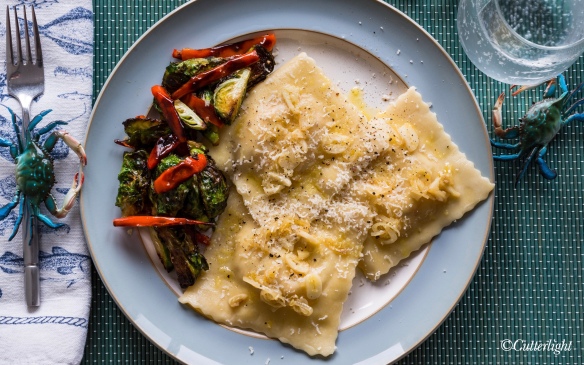
Three Cheese Dungeness Crab Ravioli

Dungeness Crab RavioliGiant ravioli stuffed with creamy cheese and sweet Dungeness Crab. Happy 2021 from The Lake!

“Jack?” It was Donny on the phone. “Come down to the beach and get some crab! Bring a tote. There’s lots!”

I’d been photographing kinglets in a copse of spruce trees a two-minute walk from my house when I got the call. Crab?! I didn’t waste any time retracing my steps. Back home I went straight to the living room window. Sure enough, there was Donny talking with a man and a woman I didn’t recognize who had nosed an unfamiliar skiff into the lakeshore. On the beach near Donny were three or four large tubs. I set my camera gear aside, grabbed a bright pink plastic tote, slipped my feet into boots and made my way down to the scene.

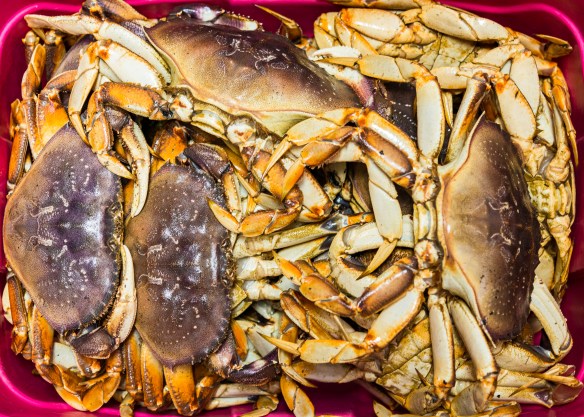
The skiff and its occupants were with the Alaska Department of Fish and Game. Apparently, they’d been sampling the Dungeness Crab population in the Chignik estuary and nearby waters and with a good haul of the tasty crustaceans had made the six-mile run up the river to share the bounty. I greeted Donny, introduced myself to the ADFG crew, and surveyed the tubs heaped with crab. There were indeed “lots.”

“Go ahead and fill that tote,” Donny advised. “And make sure you get some big ones.”

They were good-looking crabs. Legal males. Clean, shells filled out, two-pounds on average, still kickin’, sea-scented.

That night, quite literally everyone in the village of Chignik Lake feasted on fresh Dungeness Crab. All 50-something of us.

Barbra and I spent a good bit of that evening steaming Dungies three at a time in our big soup kettle. We picked two that night for dinner, complimented  with a bottle of Chard. The rest were frozen for later use. We did this by first freezing the crabs in regular zip-seal plastic bags. Similar to berries and other fragile items, once the crabs are frozen hard they can be vacuum-packed without being crushed. Frozen this way, the crabs are perfect and keep a long time. Which is a good thing; we ended up with a lot of crab.

The ravioli? Once you’ve got the pasta made, there’s really nothing to it.

I combined equal amounts of mozzarella, goat and feta cheeses along with a blend of Italian herbs. To this mixture, I added an equal amount of Dungeness Crab and hand-tossed the ingredients together.

Meanwhile, Barbra rolled out the pasta and cut it into nice, big three-and-a-half inch squares, filled them with the crab and cheese mixture and crimped them closed with a pastry roller. It is important to use a sharp tool for the crimping. It helps to ensure that the ravioli remains sealed.

To avoid crowding these large raviolis, I used two pots, each with a good amount of water. Once the water came to a boil, I added the ravioli. After three minutes, I gently flipped them to ensure even cooking of the pasta and the filling – a total of six minutes.

Meanwhile, in a small skillet on a back burner, I heated extra virgin olive oil over medium heat. When it was hot, I added shallots and garlic sliced as thin as I could manage along with a tablespoon of butter and a couple of healthy pinches of sea salt. This is a wonderfully simple accompaniment for delicately flavored pasta. I finished the dish with a grind of black pepper and a bit of grated Parmigiano-Reggiano.

By the way, these raviolis freeze well. Simply lay them out on a cookie sheet, freeze them solid, and then pack them in plastic bags. Cook them frozen, adding a minute to the overall boiling time.

With a surfeit of tasty Dungies in the freezer, expect more crab recipes in the coming weeks!

No Bananas! Our Project with B&H Photo is Up and Running!

Who knew that getting a minute and 29 seconds of film could be so much work!? But thanks to our friends at B&H Photo (the world’s largest camera store) it was a terrific experience. Initially (back in pre-Covid times) they were going to send a crew out to Chignik Lake. Well, as the epidemic took hold, that plan got nixed. Technology to the rescue!  The B&H team remotely coached us through the interview and getting the on-location footage they needed back in New York City.

In a skinny 1:29, we think the team did an excellent job of capturing some of the unique challenges (and very cool opportunities) that are part of our lives as photographers in this remote, spectacular part of the world.

Birds of Chignik Lake: Arctic Tern – World’s Migration Champion… and Vomerine Serrations?*

Arctic Tern Chignik Lake

With some Arctic Terns traveling nearly from pole to pole, no bird migrates further than representatives of this species. An interesting consequence of their affinity for spending summers at the poles is that it is also the case that no bird lives in more hours of daylight. (Chignik Lake, July 27, 2020)

“They’re pretty amazing.” We were watching a group of terns diving for small fish when one of us turned to the other and made the comment. Commanding the air with a combination of graceful soaring, swallow-like directional changes, Kestrel-esque hovering and pelagic seabird-style dives, as they called back and forth among themselves the terns almost seemed to be announcing, Watch! This is flying! There were few misses as they dramatically crashed the water and emerged with small, silvery fish in their bright red bills.

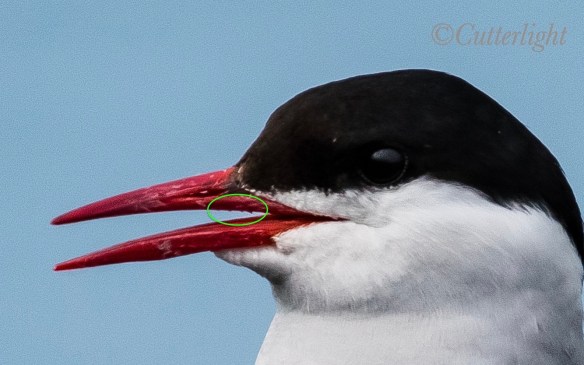
Arctic Tern bill serrations

As is the case with many dedicated piscivores, the bills of Arctic Terns feature serrations. But unlike the tomial serrations found on some ducks, in Arctic Terns they appear to be confined to the inside of the upper bill. They are thus analogous to vomerine teeth on the roof of a trout’s upper jaw.* These serrations aid in grasping and holding onto prey. (Chignik Lake, July 27, 2020)

For my own part, I no longer speculate as to whether or not birds experience feelings akin to human enjoyment in these successes. I’m certain they do.1 And the cries and calls of gregarious species such as terns seem to be at least partly aimed at sharing the good feelings that come with easy feeding on bountiful prey.

World-wide distribution, range and migration routes of the Arctic Tern: Map by Andreas Trepte, commons, Wikimedia

It depends on exactly where one is departing from and where one will end up, but a tern feeding along the Antarctic ice shelf in summertime down there and later migrating to Arctic Alaska to breed during summertime up there has to cover some 10,000 miles, making for a round trip of 20,000 miles. But that’s nothing. Arctic Terns don’t often take the most direct flight path; there are records of individuals traveling as much as 57,000 miles in a single year.

Arctic Tern feeding chick Alaska

Arctic Terns typically lay one to three buff-colored eggs in nests constructed on the ground. We found this devoted parent and its chick at Potter’s Marsh, a well-known birding sanctuary in Anchorage, Alaska. (June 21, 2017)

Given the context of their long flights over vast, open seas and their need to feed along the way, it is easy to understand how a bird such as a tern might mistake the glimmer of a small piece of plastic floating on the ocean for the flash of a fish. We can all help these birds by making certain that every bit of the plastic we use – every cigarette butt, candy wrapper and the rest of it – is disposed of properly. Arctic Terns are among the truly amazing beings we share this planet with, deserving of our admiration and respect.

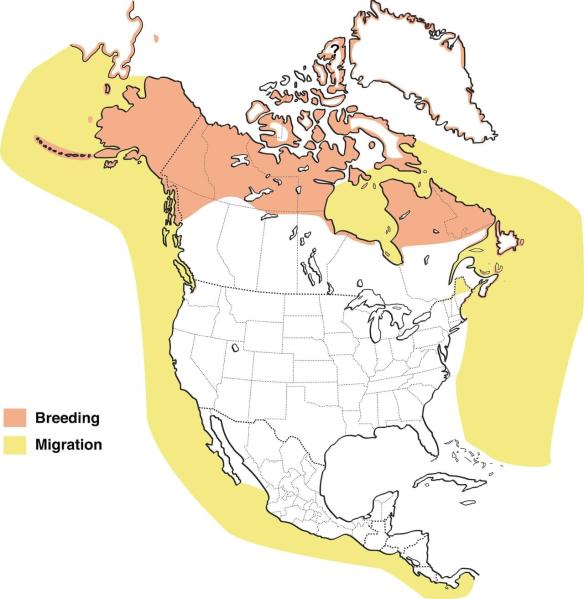
Arctic Tern Range Map: with permission from The Cornell Lab of Ornithology, Birds of the World

Arctic Tern Sterna paradisaea
Order: Charadriiformes
Family: Laridae
Genus: Sterna – Old English stearn = tern
Species: paradisaea – Latin: paradisus = paradise

Status at Chignik Lake: Common in Summer on Black Lake and Chignik Lake

David Narver, Birds of the Chignik River Drainage, summers 1960-63: Abundant on Black Lake; Common on Chignik Lake

Alaska Peninsula and Becharof National Wildlife Refuge Bird List, 2010:
Common in Spring and Summer; Uncommon in Fall; Absent in Winter

Aniakchak National Monument and Preserve Bird List: Present

*Birds do have a vomer. However, although I checked several references I could find few mentions of this avian structure and no mention of “vomerine serrations.” I’d be interested to learn more about this fascinating anatomical feature.

1For further exploration of this subject, see: Emory & Clayton, Do Birds have the Capacity for Fun? Current Biology Volume 25 Issue 1. January 5, 2015

Table of Contents and Complete List of Birds of Chignik Lake

© Photographs, images and text by Jack Donachy unless otherwise noted.

For a list of reference materials used in this project, see: Birds of Chignik Lake

Birds of Chignik Lake: Bonaparte’s Gull

Chignik Bonaparte's Gull

If you encounter a “masked” or “hooded” gull in The Chigniks, it is most probably a Bonaparte’s. Note the red legs, black bill and white eye ring of a bird in breeding plumage. Non-breeding adults have paler legs and either a broken up hood or just a smudge of darkness on their heads. These small, almost tern-like gulls can be found in summertime at the braided outflow of Black River on upper Chignik Lake. (Chignik Lake, July 27, 2020)

Only the Northern European Little Gull and East Asia’s Saunders’s Gull are smaller than our Bonaparte’s. Averaging just 13.5 inches in length, they are agile, acrobatic flyers, able to stop in mid-air, sweep backwards and dip to the water to snatch small fish and other food from the water. In addition to consuming fish and an array of aquatic invertebrates, Bonaparte’s are well-known insectivores. Ever the opportunists, it is likely that they feed heavily on the Chignik’s robust midge population.

Chignik Bonaparte's gull juvenile

As is the case with many gulls, the plumage of juvenile’s differs from that of adults. These colors and markings are typical of a mid to late summer Bonaparte’s shortly after fledging. (Chignik Lake, July 27, 2020)

Although they will nest on the ground in some locales, Bonaparte’s are primarily tree nesters, a trait that makes them unique among gulls. As they prefer taiga spruce trees – which the Alaska Peninsula in the vicinity of Chignik Lake lacks – their breeding status in the Chigniks is doubtful. However, in summertime Bonaparte’s and their fledged young can be found at the head of Chignik Lake where Black River enters. There they can be found in association with Arctic Terns, Greater Yellowlegs, Semipalmated Plovers and occasionally other gulls and shorebirds.

Chignik Bonaparte's Gull first year

Bonaparte’s in their first summer typically lack the striking black hoods more mature breeding birds wear. (Chignik Lake, July 27, 2020)

So… Bonaparte’s? The bird is not named after that Bonaparte, but rather one of Napoleon’s nephews, a French ornithologist who visited America in the 1820’s.

Bonaparte’s Gull Range Map: with permission from The Cornell Lab of Ornithology, Birds of the World

Bonaparte’s Gull Chroicocephalus philadelphia
Order: Charadriiformes
Family: Laridae
Genus: Chroicocephalus – Ancient Greek khroizo = to color + kephale head
Species: philadelphia Latinized version of Philadelphia, the location where the first specimen was collected for study

Status at Chignik Lake: Common Summertime Gull on Chignik Lake near the mouth of Black River

David Narver, Birds of the Chignik River Drainage, summers 1960-63: Common

Alaska Peninsula and Becharof National Wildlife Refuge Bird List, 2010:
Uncommon in Spring; Common in Summer and Fall; Absent in Winter

Aniakchak National Monument and Preserve Bird List: Present

Table of Contents and Complete List of Birds of Chignik Lake

© Photographs, images and text by Jack Donachy unless otherwise noted.

For a list of reference materials used in this project, see: Birds of Chignik Lake

Birds of Chignik: Black-Legged Kittiwake

Black-legged Kittiwake nesting

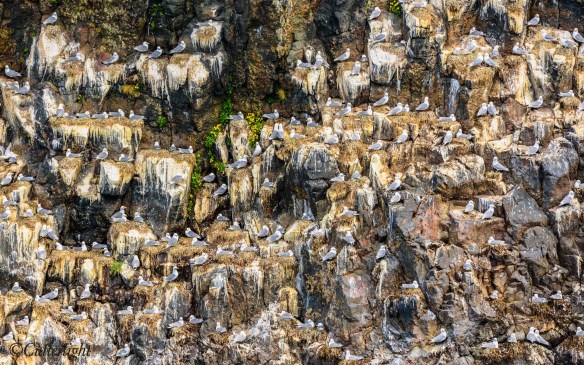
You can imagine the high-pitched clamor as a boat draws near a colony of nesting kittiwakes. The gregarious gulls cram into every available ledge, adding their own beds of mud, grass and seaweed. There the females will lay one to three eggs in hues that might range from blue to olive to brown. (Resurrection Bay, Alaska, June 22, 2013)

Fancifully named for a cry that resembles kit-ti-wake, Black-legged Kittiwakes are generally the most common gull – and at times the most common seabird – along the Chignik Coast. At an average size of 17 inches, the relatively slender kittiwake is a graceful master of the salt air, soaring and coasting effortlessly until it spies a herring or other small fish at which point it dives tern-like into the water. Because they snatch fish from near the surface, kittiwakes are the friends of fishermen and whale watchers alike; flocks of these smallish gulls crashing the ocean surface for baitfish are reliable indicators that cod, salmon, halibut or other gamefish – or whales – are pushing the small fish to the surface. Kittiwakes have an uncanny capacity for somehow knowing when whales are about to surface – cueing photographers as to where to focus.

Black-legged Kittiwake with herring

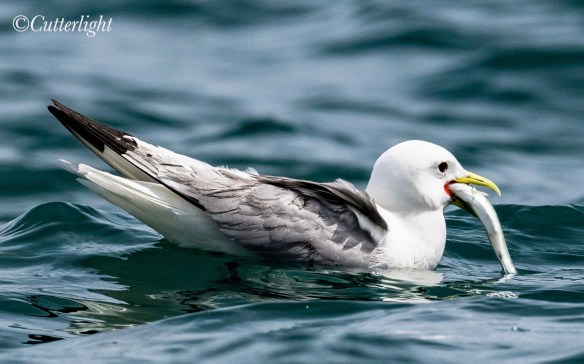
Some have described the kittiwake as a “dainty” gull, but there’s nothing dainty about that bill. Note the bright red mouth of this bird in breeding plumage. It will cram as many of these herring as it reasonably is able to into its stomach and regurgitate a good portion of them to feed its young. (Chignik Bay, Alaska, June 28, 2020)

With the exception of breeding season, these are birds of the ocean, seldom venturing inland. While they may follow fishing boats and other vessels in search of fish that might be disoriented in the wake, kittiwakes will not be found at garbage dumps as are some other gulls. In addition to diving from the air to catch fish, kittiwakes sometimes sit on the surface and catch prey.

Black-legged Kittiwakes Chignik Bay

Following a morning of feeding, a flock of kittiwakes rests on Eagle Rock in Chignik Bay. (July 28, 2020).

Black-legged Kittiwake flight

Look for distinctive black wingtips, a dark eye, an all yellow bill, angular, somewhat tern-like wings, and a more slender profile than that of most other gulls.

Black-legged Kittiwake nonbreeding plumage Kenai Fjords

The dark splotch on the back of the head is indicative of a nonbreeding kittiwake. Juveniles will also have this splotch as well as a dark collar, a distinctive dark pattern on their wings, and a dark bill. (Kenai Fjords National Park, Alaska, August 2, 2009)

As the climate continues to warm and overfishing throughout the world persists, kittiwakes are a species to keep a a concerned eye on. Although their populations worldwide are in the millions, steep declines have been observed in recent years.

Black-legged Kittiwake Range Map: with permission from The Cornell Lab of Ornithology, Birds of the World

Black-legged Kittiwake Rissa tridactyla
Order: Charadriiformes
Rissa: From Rita, the Icelandic name for this bird
tridactyla: Ancient Greek tridaktulos – three-toed. The kittiwake’s rear toe is reduced in size, giving the appearance of just three toes.

Status at Chignik Lake: Abundant in Chignik Lagoon and Chignik Bay, particularly in summer

David Narver, Birds of the Chignik River Drainage, summers 1960-63: Occasional in Chignik Lagoon

Alaska Peninsula and Becharof National Wildlife Refuge Bird List, 2010:
Common in Spring & Summer; Uncommon in Fall; Rare in Winter

Aniakchak National Monument and Preserve Bird List: Present

Table of Contents and Complete List of Birds of Chignik Lake

© Photographs, images and text by Jack Donachy unless otherwise noted.

For a list of reference materials used in this project, see: Birds of Chignik Lake

Birds of Chignik Lake: Willow Ptarmigan – Once Abundant at The Lake; Now Nearly a Cryptid

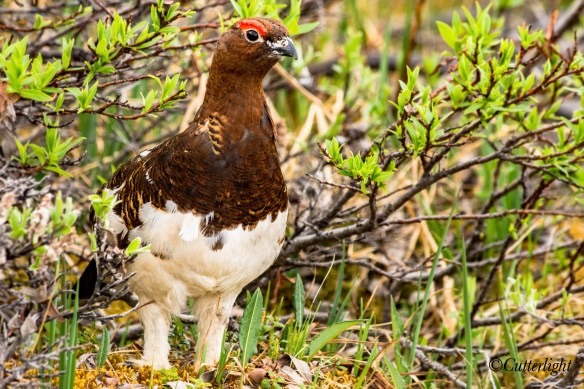
Willow Ptarmigan male

Hmm… I wore white slacks something like these to my high school senior prom. I think they are better suited to this dapper male Willow Ptarmigan. While on a backcountry backpacking excursion in Denali National Park a few years ago, we had an opportunity to observe and photograph Willows in frame-filling portraits like this. The male’s “potato! potato! potato!” call woke us each morning in a breathtaking landscape we shared with carpets of wildflowers, rushing glacial rivers, Grizzlies, Dall’s Sheep, Caribou, Moose, Wolves and Wolverines. (Denali National Park, June 9, 2017)

In choosing photographs for this project, I try to use pictures taken of local birds and, to the extent possible, to use my own captures. At the same time, I strive to select at least one photo for the article that clearly depicts characteristic markings and coloration of that species. Sometimes that’s not possible. I have yet to get any photograph at all of the Gyrfalcons that occasionally cruise through our valley. Clear captures of a few other species I’ve positively ID’d have eluded me as well – Northern Harriers gliding in an unphotographable distance, a Saw-whet Owl who evaded being photographed through high winds and rainstorms and his own secretive habits during a brief visit to our village being among examples.
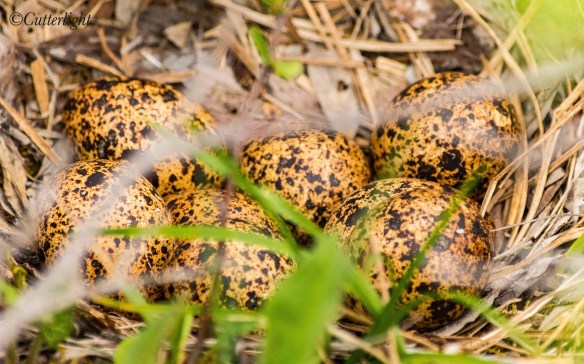
Willow Ptarmigan nest eggs

We startled ptarmigan from their nests several times while hiking through willow thickets in Denali. The best procedure is to give the nest a respectable berth and continue hiking, but on this occasion I took the opportunity to snap a quick photo – with a telephoto lens and not disturbing the vegetation surrounding the well-concealed eggs. The hen soon returned. Willows may lay as few as four or as many as 14 inch-and-a-half to two-inch eggs. (Denali National Park, June 7, 2017)

The Willow Ptarmigan presents a somewhat different challenge.

We’ve never seen one here at The Lake. Or anywhere near The Lake.

Nor heard one, though we are familiar with their calls.

Nor found their scat, though we know what that looks like and have searched likely places for it.
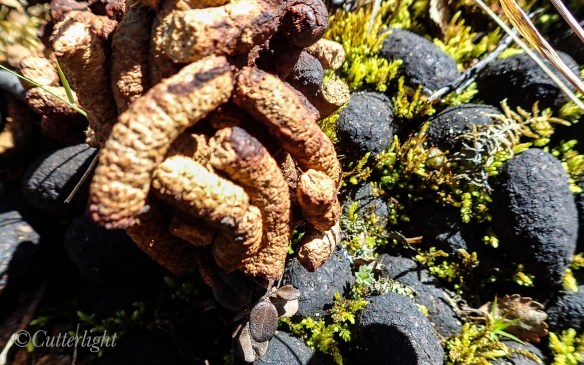
willow ptarmigan scat

Willow Ptarmigan scat… in case you were wondering… (Denali National Park, June 14, 2017)

No one else has seen a clue of this species around here in recent years either, though everyone agrees that they were once abundant. “We used to sometimes find them in the swamp (marsh) right in the center of the village,” a guy my age told me. “Yeah, they used to be everywhere,” another friend observed. “Especially around Black River and Upper Lake.”

Not anymore. Whether they were locally shot out (they are famously unwary), overcome by  disease or simply no longer find the habitat here suitable is uncertain. In recent years they have been absent, and there are enough eyes looking out for them that if any were around, it would be known.

Willow Ptarmigan unwary

They’re not guarding nests. They’re not tame. They haven’t been baited. They’re just Willow Ptarmigan being Willow Ptarmigan, and as Barbra could as easily be approaching with a 20 gauge shotgun as with a camera, they’re illustrating a susceptibility to being locally extirpated by hunters. They aren’t merely “dumb.” Ptarmigan have been known to exhibit playful behavior with each other and they’re well adapted to the harsh environments they thrive in. But perhaps they trust the camouflaging qualities of their plumage – which becomes white during wintertime – a little too much. (Point Hope, Alaska, September 2, 2013)

And then, just a few weeks ago one morning while Barbra and I were out exploring after a fresh carpet of snow had been lain down, there they were. Not the birds themselves, but tracks. Unmistakable. Miniature three-toed snowshoes gently pressed into the powdery snow. Ptarmigan. No cryptozoologist on the trail of Bigfoot could have felt their heart soar higher than did ours at the finding. We stood rock still and listened. We watched, our eyes peering as far up the trail as we could see and into every little pocket and open space along the way searching for movement, a dark eyeball, anything. We quietly followed the tracks, not even daring to whisper till they abruptly disappeared. We continued our hunt in ever broadening circles, eyes sharp for a bird we knew would be as white as the snow itself this time of year.

No birds.

Yet.

But maybe they’re coming back. Oh, happy day!*
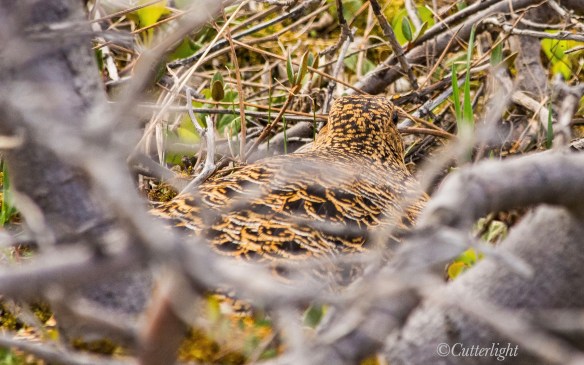
Willow Ptarmigan hen on nest

The portent of good things to come – and a scene we’d like to find near The Lake: a Willow hen brooding her eggs. Members of the grouse family, Willows are the only grouse species in which the males regularly assist in raising the young. (Denali National Park, June 8, 2017)

Willow Ptarmigan Range Map: with permission from The Cornell Lab of Ornithology, Birds of the World

Willow Ptarmigan Lagopus lagopus
Order: Galliformes
Lagopus: Ancient Greek Lagos = hare + pous = foot: hare foot, for its heavily feathered feet which, as with hares, allows the ptarmigan to more easily walk on snow
lagopus: as per genus definition above

Status at Chignik Lake: Now rare, but as Willow Ptarmigan are seen elsewhere on the Alaska Peninsula, could repopulate in the future

David Narver, Birds of the Chignik River Drainage, summers 1960-63: Common around Chignik Lake; Abundant around Black Lake

Alaska Peninsula and Becharof National Wildlife Refuge Bird List, 2010:
Common in Spring, Summer & Fall; Uncommon in Winter

Aniakchak National Monument and Preserve Bird List: Present

*From Shakespeare’s Henry IV, Part 2. Bardolph: “Oh Happy Day! I wouldn’t even trade a knighthood for my new, good fortune.”

Table of Contents and Complete List of Birds of Chignik Lake

© Photographs, images and text by Jack Donachy unless otherwise noted.

For a list of reference materials used in this project, see: Birds of Chignik Lake

Birds of Chignik Lake: Least Sandpiper – the Tiniest Peep… And Why the Serrated Bill?

Least Sandpiper Chignik River

Although he’s got some bulk to him, at a mere five to six inches from bill tip to toenail, this ball of white and russet feathers would have to look up to make eye contact with a House Sparrow. But to the tiny crustaceans and other small invertebrates that make up most of his diet, the Least Sandpiper is undoubtedly viewed as a formidable predator. (Chignik River, July 24, 2020)

The Least is our smallest sandpiper, which makes it, I believe, our smallest shorebird. In fact, until a flock of them takes flight, they can easily be overlooked on pebbled shorelines where their size and plumage allow them to blend in almost perfectly. On the other hand, they’re numerous and widely distributed, making them one of the more frequently encountered peeps. In addition to their tiny size, look for yellowish legs. This characteristic distinguishes them from Western Sandpipers and most other similar birds which generally have dark legs. They use their long, slightly down-curved bills to probe mud, sand and silt or to glean suspended minutia from the water surface. Often found among flocks of other waders, it is reported that Least Sandpipers tend to feed a little higher up the flat or shoreline in slightly drier habitat, probably to avoid competition from larger birds. Alongside the Semipalmated Plovers and Western Sandpipers we saw them feeding among, they seemed to mix right in though, often wading up to their downy chests along the edge of the river.

It wasn’t until we returned home and uploaded the photos that the Least’s most interesting characteristic – to me – became evident.

least sandpiper serrated bill

Avian adaptations make for fascinating study in their own right. Questions beginning with “Why,” and “How” immediately pop into one’s mind when examining the unique characteristics birds have evolved to ensure success in their environments, though no degree of explanation can diminish one’s amazement at these adaptations. 

From the time when at a young age I first noticed the sharp, undulating teeth on a steak knife, serrations have fascinated me. I can’t resist running the pad of my thumb along the edge of a fossilized Megalodon tooth, and I have spent hours contemplating the fearsome saw-toothed edges of Atlantic Stingray tail spines. Although they no longer possess the dentition of the dinosaurs that preceded them, several species of birds – today’s dinos – have evolved serrated bills. Apparently Least Sandpipers are among those species. Why? 

Serrations make sense in dedicated piscivores such as Red-breasted and Common Mergansers, but how are they useful to these little peeps? The serrations don’t seem long enough to serve as filters; perhaps they aid in grasping any of the larger invertebrates that might be encountered as the birds probe beneath rocks and sift through silt.

least sandpiper feeding

This little gal or guy has some sort of tiny morsel in its bill. It can use water tension to transport small items such as this from its bill to its mouth.

The range map, below, indicates that this species might nest in the Chigniks, yet another reason to man the skiff early this coming year and resume exploring.

Least Sandpiper Range Map: with permission from The Cornell Lab of Ornithology, Birds of the World

Least Sandpiper Calidris minutilla
Order: Charadriiformes
Calidrisfrom Ancient Greek kalidris or skalidris, a term Aristotle used for some gray-colored shorebirds1
minutilla: Medieval Latin minutilla = very small

Status at Chignik Lake: Common on Chignik River gravel shorelines and bars for a few weeks in summer

David Narver, Birds of the Chignik River Drainage, summers 1960-63: Common

Alaska Peninsula and Becharof National Wildlife Refuge Bird List, 2010:
Common in Spring & Summer; Uncommon in Fall; Not reported in Winter

Aniakchak National Monument and Preserve Bird List: Present

Click here for the: Table of Contents and Complete List of Birds of Chignik Lake

© Photographs, images and text by Jack Donachy unless otherwise noted.

For a list of reference materials used in this project, see: Birds of Chignik Lake

Birds of Chignik: Western Sandpiper – Elegance in a Tiny Being

Rufous scapulars and golden-brown highlights make the Western Sandpiper among our prettiest little shorebirds. Check out the tiny spoon at the tip of this little sandpiper’s down-curved bill. Such elegant detail in a tiny being. (Chignik River, July 24, 2020)

We had irregularly been encountering flocks of anywhere from dozens to perhaps a couple hundred small shorebirds on fishing trips to Devil’s Flats. Obsessed with putting flies in front of salmon and char, I had difficulty breaking away to attempt photographs of the little peeps. But as days passed and July headed toward August, I knew I’d better get with it before the visitors migrated out.

Chignik River Western Sandpiper

I am occasionally taken aback with photographic evidence of just how modest some of my field estimations of numbers in flocks can be. I’d been saying “dozens” when we encountered these sandpipers, but there are well over 100 birds spilling out of this frame and there are still more birds in a separate flock nearby. If you’ve got a screen large enough to not result in eyestrain, it might be interesting to see how many birds you come up with in the above picture. (Photo by Barbra Donachy, Chignik River, July 24, 2020)

Yet, even equipped with the right photographic equipment and good intentions, it wasn’t until the evening of a day late in July that Barbra and I finally got our shots. The fishing had been good, but the birds had been no-shows. We’d called it a day and were heading back to the skiff when the peeps finally arrived. Suddenly 200 or so birds were winging their way up the river, heading straight for the gravel shores of the island where we’d beached Buster. We immediately dropped our fishing gear into a loose pile and began setting up to shoot as the birds lit down along the rocky shoreline.

western sandpipers chignik river

At an average length of just 6½ inches – only a quarter of an inch larger than a junco – these birds presented us with the usual challenges in photographing, wary, tiny, ever-moving wild birds. We found that by crawling slowly and keeping vegetation between ourselves and the feeding sandpipers – tufts of tall grass, burdock, willows – we could approach fairly close without disturbing them. For a short while, they scurried through the river shallows and rocks bobbing their heads and feeding frenetically. At times they appeared to be using their bills to pick something minute from the water’s surface; at other times they jabbed and probed between rocks; and at still other times they seemed to use their bills as a small plows, pushing them forward to stir up the silty bottom, chirping and cheeping with enthusiasm at the smorgasbord they were finding. For a little while, there was quite a lot of busy activity.

And then they did something that astonished us. Almost as one, the feeding stopped, the chattering quieted, and the little birds seemed to disappear. Before we knew it, most of them had nestled into comfortable places among the rocks, tucked their bills beneath a wing, and closed their eyes. I’d never considered shorebirds roosting after a meal as do other birds, but of course they must. Had we not known the birds were there, I doubt we’d have noticed them. Suddenly, the many times I’d been walking along a shoreline and was startled by a flock of peeps exploding into flight practically under my feet came into focus. Even a falcon passing overhead might miss these birds at rest. It is their movement that gives them away.

western sandpiper sleeping Chignik River

Of course, not all of the birds slept at once. Always a few remained vigilant, continuing to feed and looking about them as they did. However, we’d learned something that day, and on subsequent outings we tested ourselves by carefully looking over the ground near any actively feeding birds. At times we were able to find additional birds that were roosting, birds that in the past we would have missed.

Western Sandpipers flight Chignik River

We stayed with the shoot as long as we could, but by the end the sunlight had gone from this part of the river and a chill was seeping into the air. Who knows what prompts avian decisions? At some point the sandpipers lifted into the air and flew back downriver. I read a short essay on how it is that they manage to fly together, banking and turning in unison without colliding into each other. But I still don’t really understand it, which is well enough.

All things come to an end, and so it was with this day. Our Sockeyes for the year had already been caught, cleaned, filleted and freezer-packed, so on this day we had successfully cast to the river’s Dolly Varden Char and Pink Salmon, and whether foul-hooked or fair, a few Reds had found our flies as well. It was early still for Silvers, but we searched anyway and in so doing took note of a few King Salmon which we failed to entice. Jacob’s Ladder, Yellow Monkeyflower and River Beauty were near their peak, signs of active bears were everywhere, and on the way home I got nice photos of our fledgling Rough-legged Hawks.

The range map indicates that these sandpipers are migrants, on their way south after nesting further north. As we’ll be able to begin skiffing the river as early as we want to this coming year, an objective will be to keep a keen eye out for when these birds arrive on The Chignik.

Western Sandpiper Range Map: with permission from The Cornell Lab of Ornithology, Birds of the World

Western Sandpiper Calidris mauri
Order: Charadriiformes
Calidris: from Ancient Greek kalidris or skalidris, a term Aristotle used for some gray-colored shorebirds1
mauri: for the Italian botanist Ernesto Mauri

Status at Chignik Lake: Common on Chignik River gravel shorelines and bars for a few weeks in summer

David Narver, Birds of the Chignik River Drainage, summers 1960-63: Not Reported

Alaska Peninsula and Becharof National Wildlife Refuge Bird List, 2010:
Common in Spring & Fall; Uncommon in Summer; Not reported in Winter

Aniakchak National Monument and Preserve Bird List: Present

Click here for the: Table of Contents and Complete List of Birds of Chignik Lake

© Photographs, images and text by Jack Donachy unless otherwise noted.

1From the article “Calidris” in Wikipedia, which sites Jobling, James A (2010). The Helm Dictionary of Scientific Bird Names. London: Christopher Helm. p. 84. ISBN 978-1-4081-2501-4.

For a list of reference materials used in this project, see: Birds of Chignik Lake

Birds of Chignik: Black Turnstone

black turnstone Chignik Lagoon

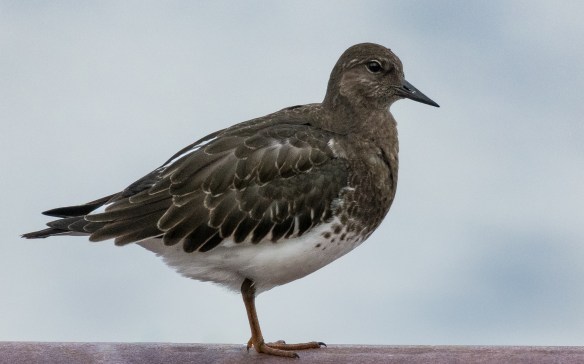
Note the sharp, well-defined toenails on this Black Turnstone. It shares this adaptive characteristic in common with Ruddy Turnstones, enabling the two species to easily walk on the slick, seaweed covered rocks they frequent. (Chignik Lagoon, July 27, 2020)

On the same day I photographed Ruddy Turnstones at Chignik Lagoon, I encountered their somewhat chubbier cousins, Black Turnstones. When we first arrived, there appeared to be a small flock of the Blacks, but they took wing as we beached our scow. I found the lone specimen in the above photo hanging out near a pair of Wandering Tattlers.

These stout, robin-sized birds get their name from the manner in which they use their chisel-like bill to turn over kelp, stones and other debris in search of invertebrates and fish eggs. They even use their bill as a plow, moving through washed up seaweed and dining on whatever is stirred up or uncovered. Black Turnstones also use their bills to hammer at and pry open barnacles and bivalves.

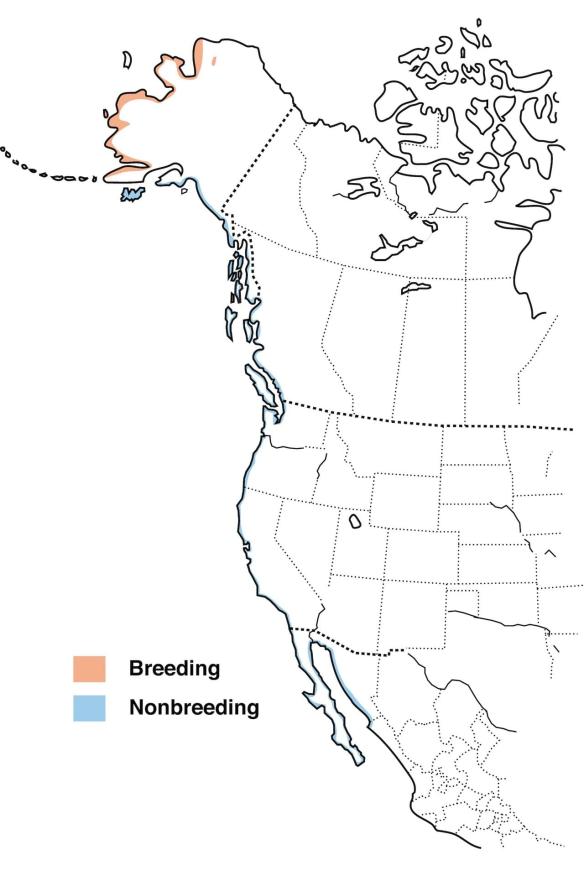
Because they are Pacific Coast residents rather than the long-distance migrants their Ruddy relatives are, they can be seen throughout the year on rocky coasts from the more southerly  parts of Alaska as far south as Mexico’s Baja Peninsula.

Black Turnstone Range Map: with permission from The Cornell Lab of Ornithology, Birds of the World

Black Turnstone Arenaria melanocephala
Order: Charadriiformes
ArenariaLatin arenarius. arena = sand; inhabiting sand
melanocephala: Ancient Greek melas = black +  kephale = head; black headed

Status at Chignik Lake: Occasional as a post-breeding migrant along the shorelines of Chignik Lagoon and Chignik Bay

David Narver, Birds of the Chignik River Drainage, summers 1960-63: Occasional at Black Lake

Alaska Peninsula and Becharof National Wildlife Refuge Bird List, 2010:
Uncommon in Spring & Fall; Rare in Summer; Not reported in Winter

Aniakchak National Monument and Preserve Bird List: Present

Click here for the: Table of Contents and Complete List of Birds of Chignik Lake

© Photographs, images and text by Jack Donachy unless otherwise noted.

For a list of reference materials used in this project, see: Birds of Chignik Lake