Corrupting a Child into the Art of Angling: a Journey from Granny Knots to 8-Weights

The 2018 cover of the Southwest Alaska Fishing Regulations featuring my photography: I was out on the ice last winter when I happened upon these two cuties (Barbra’s students) trying their luck for Dolly Varden Char and smelt on Chignik Lake. Teaching a young person to fish is an action that can have long legs and far-reaching positive consequences.

My father started my little sister and me with granny knots, #6 hooks, 10 lb test line, wine cork bobbers and solid fiberglass poles sans reels. Hers had a red handle. Mine was green. Half-a-mile below our house down the winding Route 322 hill lay Piney Dam Reservoir, an impoundment on western Pennsylvania’s Clarion River which, back in those days, was fairly fishless thanks primarily to acid runoff from coal strip mines and effluent from a paper mill 60 miles upstream. This was in the days before President Nixon’s executive order establishing the Environmental Protection Agency. The river looked clean – but the acid runoff left it relatively sterile, bereft of the web of aquatic weeds, tiny crustaceans and insect that make up a healthy ecosystem. These days, the coal mines are mostly gone, grown over with mixed forests of white pine and oak and other hardwoods that have reclaimed the landscape from the war-zone look I remember from childhood. Thanks to EPA regulations, the mining operations that remain are much more responsibly operated. Meanwhile, the paper mill modernized, also guided by EPA regulations. Now trout, bass, muskellunge, decent-sized panfish and, I’m told, even walleyes swim in waters that back in my day held little more than a few stunted sunfish, perch, shiners and bullheads.

Given time, if the Earth isn’t damaged too much, it can heal.

On the sunny side of the valley at the foot of the old 322 bridge was a small, wooden, long-abandoned dock. The steps leading down the steep embankment were rotting and coming apart. The dock itself wasn’t in much better shape. But unclaimed, we called it ours, as in “Let’s go fishing at our dock.”

Even digging up a coffee can’s worth of worms in preparation for those trips was an adventure, and with my dad being a biologist, something of a science lesson as well. For starters, we discovered that there were different kinds of worms; the little red ones worked best. And turned up by Dad’s spade would be other creatures: beetles and beetle larvae, centipedes and millipedes and alien-looking chrysalises. Sometimes garter snakes and little green snakes would glide out of the weeds ahead of us, and a rock turned over might reveal mice tunnels, big black crickets or shy red-backed salamanders with their protruding, otherworldly eyes.

There are four indispensable characteristics an adult must possess if he or she expects to successfully corrupt a child into the art of angling:

  1. The adult must know where there are fish an inexperienced child would be able to catch…
  2. …and he or she must know how to catch those fish in the easiest manner conceivable.
  3. Once conditions one and two have been met, the adult must possess the abundance of patience necessary to allow the young person to figure out how to catch those fish.

To his credit, although my dad took along his own outfit, after casting far from the cover of the dock out into featureless water where there would be no fish, he would set his rod down, ignore it, and focus on my sister and me. That way, if one of us might say, “Dad, you should fish too,” he could truthfully reply, “I am fishing.”

There were always a few panfish hanging out in the dock’s shade – diminutive bluegills and pumpkinseeds, a shiner or two, and our favorites for their combination of size, brilliant orange fins and qualities on the table, yellow perch. The shiners, too bony to deal with, went back into the water. As for the rest of the fish, five-inches was enough to make a “keeper,” and those went on a hand-made stringer. As long as we didn’t fish it too often, the dock could be counted on for a meal’s worth of fish.

The fourth characteristic necessary to develop an enthusiastic young fisherman is probably the most important. The adult must know when enough is enough. My sister and I were diligent in our attention to our wine-cork bobbers, staying with them as they rocked in the wake of ski boats, not moving our eyes from them for long minutes when they just sat there on placid water doing nothing. We didn’t miss many bites. But as time went by and we thinned the dock’s population of fish, bites became fewer and further between. The sun climbed higher and grew hotter. Small stomachs started to growl.

My father seemed to have a sixth sense for impeccably timing the question, Are you ready to call it a day?

No! Not yet! Let’s stay! Just one more? We’d plead.

Well, my dad would wisely say while enthusiasm was still running high, We’ve got enough for a meal. Your mother’s going to be wondering where we are. It’s time to go.

Aw-ww! That’s the response you hope to hear from someone you’re trying to teach anything to when it’s time to call it a day. Aw-ww, in at least two syllables.

Weeks went by between our trips to the dock, but my sister and I never lost track of whose turn it was to carry the stringer back to the car and triumphantly in through the kitchen door. Down in the basement, Dad would spread out yesterday’s Pittsburgh Press and we’d get to watch as he cleaned the catch. Too small to bother filleting, he’d scale the fish and gut them and remove their heads, so that by the age of six I knew enough about fish anatomy to pass a biology exam. We’d even open their stomachs to examine the dragonfly larvae, midge pupae and other tiny animals they fed on.

Upstairs in the kitchen, Mom made them Appalachian style – rolled in cornmeal seasoned with salt and pepper and fried golden brown and so crisp their tails were like potato chips. The three of us unerringly remembering whose plate the catch-of-the-day belonged on – usually a nice perch. Bread and butter and a big salad of lettuce, tomatoes and cucumbers from my dad’s garden rounded out the meal. Those summertime meals of fresh fish and garden salad are far and away my favorite childhood food memory.
Intrepid Trepidations

Staring at my readied bike loaded with gear for this summer’s epic adventure, I am filled with… fear, excitement, anxiety, worry, nerves…

I’ve read so many articles and blogs and books about traveling. The common theme in these stories is excitement. The stories often have a dramatic edge. In the spirit of excitement, there is often reckless abandonment of caution and unplanned success. The stories are invigorating and inspiring – always with a happy ending. As my bike stares back at me, daring me … I find myself thinking that I’ve never read the version of the story that started with a daunting case of nerves. This seems to be my story.

The inspiration for this summer’s adventure began a few lifetimes ago. When I was young, my family used to camp. I remember watching bicyclists loaded with camping gear trekking along California blue roads from the window of our VW Camper. I loved to ride my bike. And I was instantly in love with the idea of being self-sufficient on two-wheels trekking anywhere I wanted to go.

Anyone who has known me over the past few decades could testify that I am an adventurous person. I have been known to get up and go do something based on very little information, sometimes on just an idea that something would be fun. I have had many happy endings to those stories, just like those I have read. So why worry now?

I stare at my bike. Its panniers and fork bags puffy with camping gear. As if in answer to my question, the front fork bag of my bike falls off and spills.

It’s the logistics of this trip that make it like no other. I’ve always been able to fill a backpack or a suitcase and go. But this summer, the adventure includes more than what can be packed in a backpack. We’ve planned a trip that involves bicycling around a foreign country for three months. The activities on the trip are to include sightseeing, culinary adventures, fishing, photography, backpacking and maybe even pack rafting. Aside from test packing and other activities we can do to get ready while in Alaska, the additional logistics are mind boggling. In order to get this trip started, there is the first leg – which seems to be the most daunting of the logistics – we need to maneuver all of our gear from our tiny village of Chignik Lake, through the city of Anchorage and all the way to the north island of Hokkaido, Japan. The other part of the logistics is planning for daily mileage and making sure we are in good enough shape to pull off this physical adventure.

All this planning is, of course, in theory. I have so many questions… How many miles can we realistically bike? Can we carry all the gear we want to carry? Are we over packing? Are we forgetting something critical? Will our gear be safe from thieves? Will we be able to find campgrounds as easily as we hope? Will the roads be safe to ride on? Are we going to have trouble transporting our gear with the airlines? Is this too big an undertaking?

So, Jack and I sat down to tackle, not the questions, but the psychology behind the questions. Our discussion centered around the question, “Do we really want to take on a trip so far outside of our comfort zone?” The answer, it turned out, was a resounding Yes!

So, plane tickets have been purchased. The first test packing has been completed. Our trip itinerary is coming together. The bike and treadmill workouts are underway. And the faith that we are resourceful people is the response to those questions that really can’t be answered until we begin the journey.

And now I propose a toast: Here’s to another summer of epic proportions living well off the beaten path. Cheers!

Progressivism Always Prevails. Reasons for Optimism in the Aftermath of 17 Preventable Deaths

Above: The future. Below: I wrote the following letter to my daughter, Maia, and share it here. Have faith. Our side always wins in the long-run. Always.

Dear Maia,

I spent a good bit of the latter part of this past week looking at the images and listening to the voices out of Douglas High School in Parkland, Florida. It is incomprehensible to me that a teenager who can’t legally purchase a beer, or drive a car without a license, is able to legally purchase an assault weapon with the capacity to fire dozens of deadly rounds in a single minute. In fact, it’s incomprehensible that any civilian is able to legally own such a weapon.

Incomprehensible, that is, until one considers that the single most powerful political lobby in Washington is the NRA and that they own nearly every single Republican politician – politicians who, apparently, value NRA campaign contributions (and promises of post-retirement speaking fees) more than they value the safety of American citizens including our children and young people. The top 10 recipients of NRA money in both the U. S. Senate and the U. S. Congress are all Republicans. (Rather than provide a link to verify this, I encourage readers to do their own research in order to get a real sense of just how deeply the NRA has its claws into our Republican politicians. )

And so it should be no surprise that in his role as House Speaker, Congressman Paul Ryan, (Republican, Wisconsin) will permit neither meaningful floor debate nor a meaningful vote on anything that would curb the lucrative sale of guns in this country. Or that in the aftermath of one mass shooting after another, the only pleas he makes are pleas for non-action.

In the past election, Donald Trump received over $30 million in direct and indirect campaign money from the NRA. And so, again, it should come as no surprise that Trump has promised the NRA he will never sign legislation undermining gun sales. “You have a true friend in the White House,” Trump told the NRA.

Who, in Parkland, Florida, among the 14 dead young people and the three teachers and coaches who loved these kids and laid down their lives to protect them, and their families, and their friends , have a “true friend” anywhere in the Republican Party? Or the next 17 dead? Or the next 17? Or the 17 after that?

Even the majority of gun owners do not want these current lax laws to exist. (Anything you suspect I’m making, up, you should research.) It’s an NRA thing. It’s a Republican thing. It’s a $32 billion dollar a year gun industry thing.

Money over lives in the GOP party of coal, tax breaks for the rich, opposition to national health care, hostility toward education, unending wars on our environment and indifference toward the DACA young people who came to the United States with their parents. Build a wall, like they did 2,000 years ago in China. Have a military parade, like they do in North Korea. And keep taking NRA money.

With fellow Americans voting for Republican majorities in the House, the Senate and (by a minority vote only possible in America) giving the presidency to Trump, how can I be optimistic?

Maia, remember what I told you about ISIL? That this terror-war waged by a minority of Muslims was the predictable outcome of a variety of international policies and that over time it would subside? You can Google maps of ISIL’s gains and losses; they began steadily losing ground a few years ago. This is one of the few areas where Trump has kept Obama-era policies in place, and ISIL’s demise is continuing.

At the same time, countries inviting people from war-torn nations to enter their borders and to experience life in free, Democratic societies – to benefit from higher education, to make friends, to see the world through a more progressive lens, to reduce fears and misunderstandings on all sides – are doing more to defeat terror than all the bullets and bombs combined. The people of Sweden, Germany, France and other countries accepting émigrés have taken risks in opening their borders. They are heroic for doing so.

And they are on the right side of history.

Over the long haul of history, progressivism always win. Always. As a species, we periodically subject ourselves to bloody crusades, anti-science/anti-legal-system dark ages, tribal holocausts, authoritarian reigns of terror and the predictable aftermath of colonialism/neocolonialism and slavery. But along the longer arc, we slough off these primitive instincts, allow our better angels to guide us…

…and we keep moving forward.

And now we are here – at a day and age when, despite pockets of evil, on a scale never before even imagined in human history more people than ever are enjoying freedom, prosperity, access to education, health care, self-expression and art. If we can begin to address population growth, it will only get better.

Out of every darkness, there has come a time when a new generation has wrested leadership from their elders and demanded a new course. The overwhelming majority among the current generation now coming of age are rejecting the Republican Party’s backward push to coal, bigotry, misogyny, unsustainable growth, and Feudal era solutions to 21st century challenges (the wall).

And senseless access to guns that serve no purpose other than to kill fellow human beings.

I’ve been listening to the voices out of Douglas High… Emma Gonzalez’s being one of the strongest (do Google her)… And my heart is full. I’m optimistic that change is coming. Maybe not tomorrow… but it’s coming.

Because over the long haul, we always move forward. Progressivism prevails. And in the pursuit of optimism, patience is a virtue.

Love, Dad

JD, Chignik Lake, Alaska

Four Days of Quiet Solitude (Except for the Hurricane-force Winds): The Cabin on Black Lake

Fire Mountain: Barbra got this beautiful photo of sunset rimming a mountain – possibly 8,200 foot Veniaminof Volcano, its top missing. That’s me left of center, shooting a closer perspective. During our stay at a nearby cabin, the forecast had been for temperatures in the mid 30’s (low single digits Celsius) and the usual 10 to 20 knot breezes. The subfreezing temperatures, heavy sleet and snowfall, and hurricane-force winds we experienced seemed to come out of nowhere.

Every night before we go to bed and every morning upon waking, I slide the dining room/living room window open and scan the lakeshore with a small, powerful spotlight. You never know what you’ll see. Though not necessarily at night, from these very windows we’ve seen brown bears, moose, foxes, owls, weasels, otters, eagles, falcons, beavers, a wolverine and a wolf, not to mention an array of waterfowl including cranes, swans, loons and ducks.

“You oughta take that spotlight and stay in my cabin up on Black,” Fred texted one morning. “You’d like it up there.” Fred’s Chignik Lake home sits atop a high bluff, big picture windows overlooking a good bit of Chignik Lake and the beginning of Chignik River. He spends a fair amount of time doing the same thing we do – scanning for wildlife.

Snow Bunting, Black Lake, Alaska. We’re told that in years past, Snow Buntings were common winter visitors to Chignik Lake. Recently, they’ve been scarce. Although the flock of three birds we came upon only gave me a chance for a couple of quick shots, I was happy to get this record for a project I’m working on to document area birds. (Stay tuned for more on this.) In addition to waterfowl, Black-capped Chickadees, Common Redpolls, magpies, eagles and a Northern Shrike rounded out the avian life we encountered. 

Fred’s text came on the last day of December, a few days before Barbra’s winter break was over. The two of us were antsy from days-on-end rain we’d been enduring through most of autumn and early winter. Fred’s offer wouldn’t change the weather, but it would change the scenery. We were in.

That evening we packed up our gear: down sleeping bags, rain gear, extra rain gear for when the first rain gear was soaked, cameras and binoculars, pens and journals, cookware, four days worth of dehydrated backpacking food, four sweet onions and four Fuji apples…

…and awoke the next morning to find that the weather had taken a nasty turn. Rain we can work with, but when winds started blowing spray off the whitecaps on the lake, there was no way Fred would be launching his skiff. “We’ll try again tomorrow,” we agreed. In retrospect, this squall which hadn’t been forecast should have tipped us off that our local weather patterns were unstable.

The following morning we rose early, hoping for the best. During winter, the sun doesn’t break over the mountains rimming our valley till sometime after 10:00 AM, but a flashlight cutting into the pitch black indicated that Fred and his friend Nick were already down at the beach getting the skiff ready. The wind had settled and a mist was falling under a lightless sky that swallowed the lake in inky darkness.

By nine o’clock the first crepuscular twilight silhouetted the mountains to the south. With breakfast behind us and a hint of light on the water, we loaded up the skiff and began the 18-mile run north up the valley. Pockets of near-freezing drizzle appeared and disappeared, prompting us to pull our hoods tight. The forecast – which up here is usually spot on – was for similar weather over the coming days with a few sun breaks mixed in. Ahh, sun breaks. This year, we’ve been living for sun breaks.

As we cut across the lake and proceeded up Black River, a loon and a few mallards and pintails lifted from resting places in coves and a pair of eagles were startled from their riverside perches. Most of the bears are denned up by this time of year, though here and there a few late-run salmon still cling to life in feeder streams. There’s always a chance of seeing a wolf.

Fins, January 2, 2018: The Chignik System is known to receive the latest salmon runs in North America. Still, we were amazed to find a few Coho in a nearby feeder stream near the cabin. More remarkable still, some of these fish appeared to spawning.

 A rim of shore ice at the mouth of the stream provided a dining table for otters, who left plenty of salmon scraps for ravens. Although we didn’t see the otters, evidence of their presence was everywhere. We also found signs of moose, foxes, weasels, hares and wolves. In fact, we have reason to suspect that at one point a wolf was just around the bend from us.

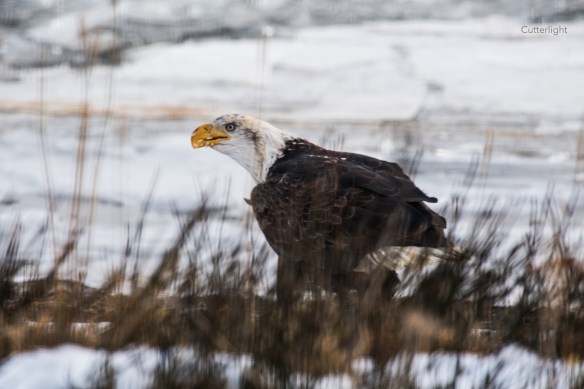
After the storm, a fully intact salmon carcass managed to find its way to the shore in front of our cabin – quite possibly plucked from a patch of open water and dropped by this very eagle. I grabbed this shot through a double-paned window – not ideal for a photograph, but what a handsome bird. The moment I opened the cabin door, she took off.

If you come across a single antler from a member of the deer family, it’s been shed, part of an annual process in which male deer, elk and moose grow antlers for the mating season and then lose them. If you come across an entire rack joined by skull bone, it’s the result of a kill. Some years ago, when Fred was scouting out the location for a cabin from his skiff, he came upon five wolves on a downed bull moose right on the beach where he hoped to one day build. Years later, someone found this rack in a nearby alder thicket – undoubtedly that same moose having been dragged there by the predators. 

Fred described the cabin he and a couple of friends had built as “sturdy, snug and cozy,” a spot-on description. Insulated from floor to roof and appointed with double-paned windows, the cabin’s 10 x 15 interior is just big enough to comfortably house a diesel heater, three-burner propane stove, hand-made wooden bed frames, small pantry, a table and three hand-made wooden stools. Snug and cozy. The lines looked square and sturdy, points that would soon be tested.

Once Nick got the heater going, the cabin was toasty warm in no time. Fred introduced us to the vagaries of the propane stove, pointed out the water catchment system (a bucket hanging near a roof gutter), and assured us once again that we were welcome to dip into any of the food in the pantry.

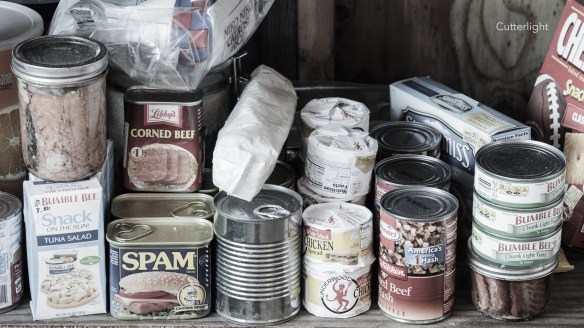
I muted the color in this pantry photo. The cabin’s door is never locked and the assortment of canned fish, deviled meat, rice and crackers could be a lifesaver for anyone caught in a sudden storm or out of luck with a dead engine. Although we brought plenty of our own food, I have to confess that the temptation of a skillet of fried Spam was more than I could resist, not having had this treat since childhood. It was, to my mild surprise, every bit as good as I remembered.

With winds pushing 100 miles per hour and sub-freezing temperatures, our water catchment system failed. Fortunately, the wind blew beautifully clear sheets of ice onto our shore.

Following two days of snow and sleet pushed by fierce, cabin-rattling winds, the sun rose serenely over a frozen lake Black Lake. Black River, which leads to Chignik Lake, begins in the gap between the mountains where the light is breaking through. If things didn’t warm up and melt the ice, there was doubt that Fred would be able to make across the lake in his skiff. Fortunately, by the next day the ice had thinned and lay in broken patches. We learned later that two of our neighbors in the village out on a different adventure had to be emergency rescued when the storm came up.

The view from the cabin shoreline after the storm passed: Although we didn’t get the waterfowl and wildlife encounters we’d hope for – and the weather certainly had our full attention for awhile – our four days on Black Lake were wonderfully memorable. And left us with this thought: Why aren’t we doing more landscape photography? New adventures lead to new thoughts, new studies, new goals. 

“Hope you guys get lucky and see some wildlife,” Fred said as he and Nick headed to the skiff. Motioning across the bay toward the far shore from where a racket of honking and quacking was issuing, he added, “Of course, those swans and ducks never stop chattering. They’ll keep it up all night.” I helped shove off the skiff, and as the last echoing hum of the boat was enveloped in the valley we’d just come up, we found ourselves wonderfully and utterly alone. Over the next four days, the only human-generated sound we would hear was the drone of a couple of bush planes flying into the village 18 miles to the south.

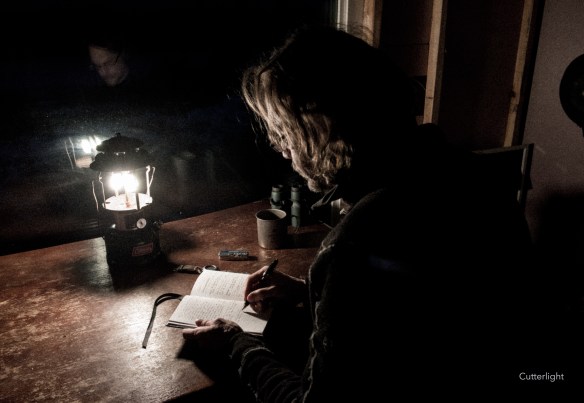
Sketching a novel outline at the cabin on Black Lake: Thirty-some years ago, aboard USS Blue Ridge, a friend and I made elaborate post-enlistment plans to go up into the Colorado Rockies, find a cabin, and live there for a year. We talked about the staples we’d need to lay in: flour, rice, coffee and so forth, the rifles and shotguns we’d take to hunt with, canning equipment, and the desirability of locating ourselves not overly far from a small town where we could reprovision as necessary. We would write. Fundamental to that objective would be pens and journals and a small, carefully selected library of literature. My friend got out a few months before I did… and disappeared. When I called the number he’d given me, his mother picked up the phone. She sounded distraught, with no idea where her son was. No one knew. I’m still not sure if we were kidding ourselves or if we’d really intended to go through with the plan, but either way I couldn’t see going it alone. When an acceptance packet came from the University of Colorado at Boulder, I took the door that was open. But I never completely let go of that idea… someplace quiet, off the grid, armed with books to read and journals to fill.

January 26, Chignik Lake, Alaska


Ink and Light: Chickadee Flamenco and thoughts on art and spring from Su Tung P’o

Chickadee Flamenco

What a wonderful talent – that can create an entire Spring
from a brush and a sheet of paper. If he would try poetry
I know he would be a master…
Su Tung P’o – On a Painting by Wang the Clerk of Yeng Ling, c. 1080

Also known as Su Shi, Su Tung P’o (1037-1101) was a Song Dynasty writer, calligrapher, painter, poet, statesman and noted gourmet. The dish “dungpo pork” is named for him.

Ink and Light: Spring Snow, a thought by C. S. Lewis… and how Do you pronounce that word that means “Artistic Blur” in photography?

Woman with Umbrella in Spring Snow: Ulaanbaatar, Mongolia

*Bokeh (暈け / ボケ) is a Japanese term meaning blur that began to gain popularity in American photography circles in the late 1990s. 

The only friend to walk with is one… who so exactly shares your taste
for each mood of the countryside that a glance, a halt, or at most a
nudge, is enough to assure that the pleasure is shared.
C. S. Lewis – from Surprised by Joy, 1955

Clive Staples Lewis (1898-1963), known as Jack, considered his last novel, Till We have Faces, to be his most mature and masterly work though it did not achieve commercial success.

*As is true of many Japanese words added to English, the pronunciation of “bokeh” is not always consistent with the original Japanese. This bothers some a lot, others a little and still others not at all. Many English speakers pronounce the word “boh-kuh” to rhyme with chocolate “mocha.” However, in Japanese the first syllable in bokeh  is pronounced with the “o” in hope and the second syllable is pronounced with a clipped (shortened) long “a” approximately between the ke in kettle and the kay in the name Kay. Almost like the word “bouquet:” long “o” and long “a,” but with the vowels clipped short and neither syllable accented. 

Ink and Light: The Gobi Desert’s Singing Dunes and Inspiration from Herman Melville

Khongoryn Els: The Singing Dunes, Gobi Desert, Mongolia

A trace of slate in the sand grains at Khongoryn Els results in vibrations that are not only easily audible, but which reverberate through one’s body.

…I am tormented
with an everlasting itch
for things remote.
Herman Melville – Moby-Dick; or, The Whale, 1851

Herman Melville (1819-1891) served aboard a whaling ship before deserting in the Marquesas. Although he knew his subject (the book draws from Melville’s own experience, The Bible, Shakespeare’s work, research into whaling, the actual account of a hard-to-catch white whale nicknamed Mocha Dick and the sinking of the American whaling ship Essex by a whale, Moby Dick received mixed reviews and was a commercial flop. Dedicated to Nathaniel Hawthorn “in token of my admiration for his genius,” the book sold just 3,200 copies in Melville’s lifetime and was out of print at his death. 

A year after Melville’s death, Moby Dick was reprinted by Harper and Brothers. Literati circles – mostly in New York – kept interest in the book (barely) alive over the next several years until it was rediscovered by larger audiences. Of the book, William Faulkner said that he wished he’d written it himself; D. H. Lawrence called it “the greatest book of the sea ever written,” and in time it found its place as an icon of American literature.

Ink and Light: Bohemian Waxwing and Lines from Robert Francis

Panache: Bohemian Waxwing, Ulaanbaatar, Mongolia

The red, waxy tips on the Bohemian Waxwings’ wings are actually flattened feather shafts. 

…beneath a silk-blue sky…
To sun, to feast, and to converse
and all together – for this I have abandoned
All my other lives.
Robert Francis – Waxwings, 1960

– Robert Francis (1901-1987) lived for 40 years in a two-room house he built in Amherst, Massachusetts. Of Francis, Robert Frost noted, “…of all the great, neglected poets, (he is) the best.”

Ink and Light: Double Limits! 120 Razor Clams & lines from Steve Kowit

Double Limits!* 120 Razor Clams near Whisky Gulch, Alaska

Big, tender and tasty, Razor Clams are avidly sought along Pacific Northwest beaches. The year these were dug, the limit in Alaska was 60 clams per person.

…drop to your knees now & again…
& kiss the earth & be joyful & make much of your time…
For although you may not believe it will happen,
you too will one day be gone.
I whose Levis ripped at the crotch for no reason,
assure you this is the case. Pass it on.
     Steve Kowit – Notice, 2000

– In 1966, Steve Kowit (1938-2015) sent the U. S. Army a letter: Were he drafted to fight, the letter stated, he would fight for the other side. He then married the love of his life and spent the next few years in Mexico and Central America before returning to the U.S. to live in California.

Ink and Light: Watching for Whales and a thought about roads less traveled (and places seldom fished)

Watching for Whales: Point Hope, Alaska

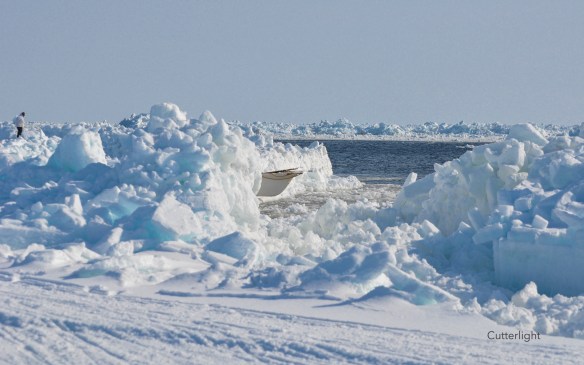
The Inupiat Eskimos of Point Hope, Alaska (population 750) harvest an average of five to 10 Bowhead Whales each spring as part of their subsistence traditions. The season begins in March as whaling crews begin making trails over the frozen sea – at times an arduous task as the sea ice has often buckled up into fairly tall, jagged ridges and it may be several miles over frozen ocean to reach the open leads where the Bowhead and Belugas migrate. Crews still use traditional umiaks, boats made by stretching the skin of Bearded Seals over handcrafted wooden frames. Managed for sustainability, the Chukchi Sea’s Bowhead Whale population is increasing.

When I recall places like this, I wish nothing more than for this to be he way it is for the rest of my life – pointing a pickup truck upstream, upriver, up tide, cutting through forests or along beaches, looking for fish in places only a few people know about, can get to… have time for.
Jack Donachy – from Gravel Lick, 1991

Barbra and I lived in Point Hope, Alaska, from 2011 – 2014.