Powering Through with Coconut Chocolate Chip Tahini Fudge

Fueling up with fudge. These tasty snacks helped us through today’s 3½ hour bicycle training ride. Sixteen days till we arrive in Hokkaido!

We are beginning to wrap up the preparation for our 3-month bicycle adventure in Hokkaido, Japan. Our home looks like an outdoor store that has barely survived a tornado attack. Bicycles with halfway-packed panniers are leaned up against walls, an assortment of bags are strewn about having either passed or failed packing tests, and there are a number of items that have not quite yet found a home in our portable summer transportation scheme. If anyone were to peek into on our home, they would surely worry for us. Will we really be ready to start sending our gear on this Wednesday’s flight out of Chignik Lake? In reality, this light-at-the-end-of-the-tunnel mess is absolutely normal for us right before everything comes together.

Along with the flurry of final packing, we still are relentlessly adhering to our fitness-training schedule. We both have a lot of experience with preparing for running events, but a bicycle adventure is new. It turns out that prepping is not as simple as setting up a beginner, intermediate or advanced program as we would for a running event. We’ve had to take into account that we need enough “seat time” to avoid sore rear ends. We also factored in our ages and an overall goal that emphasizes endurance over speed. Our Hokkaido schedule will be very flexible. Free from the pressure of reservations (we’ll be tent camping throughout the summer), we’ll be able to ride very short days if we want to stay in a particular location – but we also want to be in shape to put some serious mileage behind us when we want to get somewhere.

After doing quite a bit of research, we settled on a training program called “Sofa to 50k.” With an 8-week schedule culminating today with a 3½ ride, this program is set up similarly to a marathon running schedule. Yikes! Did I say 3½ hours? OK, saddle up!

We usually start our Sundays – the day of our long rides – with steel cut oatmeal. We like to add homemade yogurt and homemade jam for extra flavor and calories. As the long ride days grew longer, we’ve needed to add additional mid-ride calories. Trail mix, nuts, or Figgy-pops have been our go-to snacks. But with a 3½ hour ride looming, I wanted some kind of a nutrition-packed snack that we would look forward to. We couldn’t be more sick of Figgy-pops! With half a jar of tahini left over from a previous recipe, I had an idea for a fudge-like confection packed with protein and energy. After sharing an entire batch today on our longest ride, we both agreed these little treats were fantastic! One tip: You’ll want to keep these in the fridge till you’re ready to eat them. They get sticky at room temperature.

Coconut Chocolate Chip Tahini Fudge

Ingredients

  • ½ cup tahini
  • ½ cup unsweetened coconut flakes
  • ¼ cup honey
  • 2 tbsp coconut oil, melted
  • ½ tsp cinnamon
  • ½ tsp vanilla paste (or extract)
  • ¼ cup semi sweet chocolate chips, chopped
  • pinch salt

Directions

  1. Mix all ingredients thoroughly.
  2. Place tablespoon-sized scoops in a silicon ice cube tray.
  3. Freeze for at least 30 minutes.
  4. Pop frozen confections out of tray and store in an airtight container in the refrigerator.
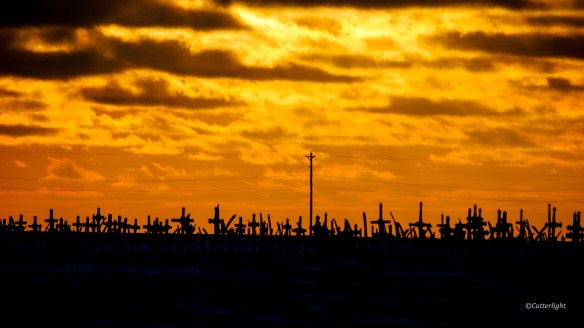
Whale Bones and Crosses, the Cemetery at Point Hope

Whale Bones & Crosses, Point Hope, Alaska

Perhaps its most iconic landmark, the cemetery at Point Hope, Alaska, is enclosed in Bowhead Whale ribs positioned as one would a picket fence. The above image was made at 2:25 PM, November 7. At that time of year, there are slightly less than six hours between sunrise and sunset. By early December, the sun sinks completely below the horizon and will not show itself again for 32 days.

In 1890, three years after a commercial whaling base called Jabbertown had been established near the village, the first Christian missionary arrived in Point Hope. A doctor by profession, it is reported that John Driggs performed “heroic” medical work, but his attempts at converting the village’s inhabitants to his religious beliefs were unsuccessful. In fact, the Episcopal Church that sponsored him reported that Driggs had become “eccentric and absent” in his duties to proselytize. Nonetheless, by 1910 Christianity had become predominant throughout Arctic Alaska. By this point the new religion had been spread from village to village by converts among the Inupiat themselves.*

*See: The Inupiat and the christianization of Arctic Alaska, Ernest S. Burch, Jr., Etudes/Inuit/Studies,1994

Full Moon over Frozen Lake: Chignik Lake, Alaska

Full Moon over Frozen Lake – Chignik Lake,6:56 PM January 30, 2018

Twilight, that sliver of light between the day’s last direct sunlight and darkness, is often the prettiest light of the day. I was happy that Fred has his lights on. This shot was taken from the beach in front of our house. (Snowing here this morning, May 6.)

Point Hope Red, Orange, Blue 2011

Chukchi Sea Red, Orange Blue 2011

This November 19, 2011 sunset looking out over a Chukchi Sea nearly frozen solid reminded us of a Mark Rothko painting. The quality of light in the far north is often breathtaking.

Looking for Love

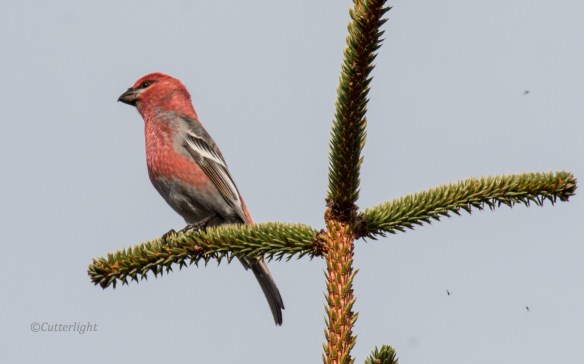
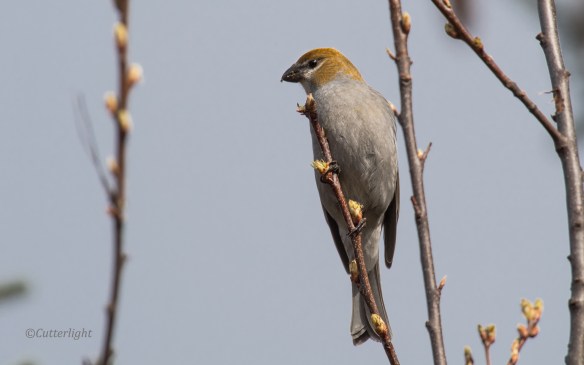
His colors will never be brighter than they are right now, nor his call more cheerful. Pine Grosbeaks tend to be irregular in their presence, but for the past two years in Chignik Lake they’ve been regular residents. For a look at a nearby female, which is very differently colored, see below. (Note the midges flying around to the right in the above photo. With big insect hatches coming off the lake and river, our swallows should be here any day!) 

Most days in the village the optimistic Peee-Peeet! of Pine Grosbeaks can be heard as they fly overhead or perch atop the tallest spruce trees. Always striking, the males are particularly colorful during springtime. Like their crossbill cousins, Pine Grosbeaks can be remarkably unwary. Move slowly around them, sit quietly, and they may forage on the ground practically at your feet. I’ve even had one perch on my head!

Female Pine Grosbeaks feature a rich olive-gold on their head, upper back, rump and often on their upper breast. This time of year, the leaf buds of deciduous trees figure heavily in Pine Grosbeaks’ diets. During wintertime they can be attracted to feeders featuring black oil sunflower seeds, suet or (I’m guessing) peanuts. They also love small fruit and during warmer months will include insects in their diet.

The “gros” of grosbeak is from the French gros, which means large. This is a species we’ll be looking for this summer in Hokkaido, Japan – part of their ranged across the Northern Hemisphere.

Chignik Lake Bald Eagle

Waiting for Salmon, Chignik Lake, Alaska

May 1, Tuesday Morning, frost: Eagles are once again daily encounters as they take up familiar roosts and join the village in watching for salmon. A few fish have trickled in, but usually it’s June before the run really gets going. A couple of nice char have been caught. Catkins on the willows, leaf buds everywhere ready to burst. A small flock of Pine Grosbeaks was in the village yesterday, the males as brilliant pinkish-red as they’ll ever be.

Point Hope Aerial, 2013

Point Hope, Alaska, February 22, 2013

One of the great privileges in our life was to live for three years in the Inupiat village of Point Hope, Alaska. Lying 200 miles north of the Arctic Circle and still deeply connected to a whaling-based subsistence culture, it is said that the Tikigaq Peninsula has been inhabited for some 9,000 years, making it one of the oldest continuously inhabited sites in North America. It is a place of aqpik berries and caribou, snowy owls and arctic foxes, fierce winds and frozen seas, a full month of darkness and the most magically soft pink, gold and orange morning and evening light we’ve ever seen. One day in early fall we hiked out to the end of the peninsula, stood on the beach, and watched in wonder as thousands upon thousands of murres, puffins, auklets and other seabirds streamed by on their way to the open ocean to spend the winter, their nesting season complete – surely one of the planet’s greatest migratory events. We endured a mid-winter three-day blow of hurricane force winds that forced most of the village to huddle together in the school which had its own generating system and could offer warm shelter and hot meals. Polar bears sauntered through the village right past our house and there were nights when the Northern lights danced above our heads in electric greens, pinks, purples and reds.  And it was a place of friends, some of the toughest, most generous people we’ve ever known. Tikiġaġmiut – the people of this peninsula in the Chukchi sea.

The Real Breakfast of Champions


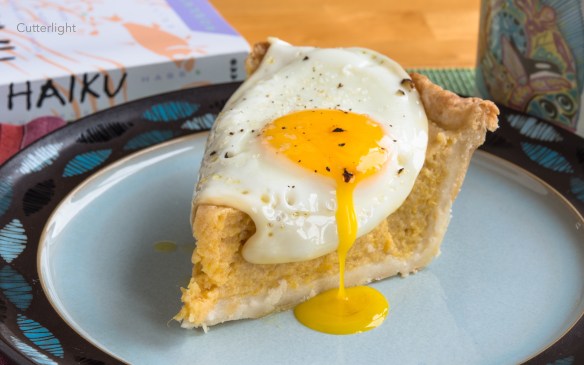
Creamy roasted butternut squash filling on a flakey, buttery crust – top it off with a lightly salted & peppered sunny-side up egg and serve a cup of French Roast on the side. Good morning, Chignik Lake.

Pumpkin pie for breakfast – it’s either just after Thanksgiving or Christmas, or we’re nearing the end of another year in the bush. In fact, we’re almost having to pinch ourselves to get our heads around the fact that there are just four days till the end of Barbra’s school year. With a very early summer vacation in sight, we’ve been in the process of clearing out our freezer. Several months ago we roasted and freezer-packed  a couple of butternut squashes. When we rediscovered them last weekend, they were still in excellent condition thanks to our manual defrost freezer.

Having never perfected crusts, I got out of the pie baking business when I married Barbra, but she still uses my pumpkin pie filling recipe – an adaptation from Craig Claiborne’s The New York Times Cookbook. She put a bush twist on the recipe this time, substituting Hoosier Hill Farm Premium Heavy Cream Powder for real heavy cream, which can be notoriously difficult to get out to the bush. The pie came out just fine.

And so this past week we’ve been starting our mornings right with one of our favorite breakfasts: Pumpkin Pie with a Fried Egg and a cup of joe. Our sparrows have begun returning, Cranes are starting to nest up on Black Lake, the bears are up and about and this morning I think I saw a salmon jump down at the bend. C’mon summer!

For our favorite pumpkin pie/squash pie recipe, see: A Cookbook for the Ages: Pumpkin and Pecan Pies from Craig Claiborne

Migration

Migration

April 18, early morning

The big picture window with a view across the lake was open just enough when the first group came through. Honking, chattering, noisy, at first distant then growing closer and then distant again till a silence was left where they had been. When the next group came through, I scrambled from behind my desk and dashed out the door, searching the morning’s gray sky till their thin, fluid lines came into view, sentences of sorts arcing northwest toward the big bays on the other side of the peninsula – Mud, Henderson, Nelson’s Lagoon – waters far from any town or village, remote even by standards up here.

All morning it was like that, wave upon wave of Canada Geese having decided that this was the day. When Barbra and I went for an evening walk, they were still coming, clamorous, easy to identify in the good light with their clean black heads and necks and bright white chins against the blue sky.

That night I opened the bedroom window a little, lay on my back not wanting to sleep, listening as the geese continued to write their way home even in the dark.

3 Easy Steps & 16 Minutes to Perfection: Pork Chops Cooked “Just Right” Every Time

Consistency is a key to turning out a perfectly cooked cut of meat. We’ve been following this straightforward recipe to turn out “just right” pork chops on stovetops, grills and even countertop toaster-ovens for years

Time tested and true, there are three keys to this recipe:

1. Start with a thick pork chop. Costco offers an excellent value on a package of exactly the kind of boneless pork loin chops this recipe calls for. If Costco quantities are too much, visit your local butcher. You want a two-inch thick (5 cm) chop, preferably one with a bit of fat.

2. Pick a great rub. Our favorites feature a balance of powdered chilis such as ancho, cayenne, Aleppo and chipotle as well as other seasonings such as mesquite, black pepper and paprika. Penzeys Southwest Seasoning or their Northwest Fire are good examples.

3. Use a sufficiently thick frying pan (one with a lid) to ensure even heating and to avoid burning the meat. Nonstick Swiss Diamond and Scanpan cookware handle heat well and make clean-up a breeze. Good stainless steel or well-seasoned cast iron pans are also good choices.

Once you’ve got the pork chop, the rub and the pan ready, the rest is a breeze. We find that one Costco-sized chop served with rice is plenty for two diners. In fact, we often have enough left over for a killer omelet the following morning.

I should add a note here: Stoves and pans vary. You may have to fine tune the heat, but once you’ve got it, you’ve got it. The same approach works for perfecting your favorite cut of steak, chicken breasts or thighs, or fish fillets.

Click here for an easy raspberry chipotle sauce.

16-minute Perfect Pork Chop

Ingredients

1 pork chop, 2 inches thick, rinsed and patted dry

chili based rub such as Penzeys Southwest Seasoning

soy sauce (or substitute sea salt)

1 or 2 tablespoons olive oil

Directions

Gently rub in a generous amount of seasoning on all sides

Meanwhile, in a frying pan, heat olive oil at a little higher than medium heat till it’s sizzling hot. Don’t allow it to smoke.

Set timer to 16 minutes and place chop in pan. Cover and cook for 1 minute to sear. Use tongs to turn the cutlet to the other side, lower temperature to medium-low, cover and allow to cook for 8 minutes.

Turn chop back to the side you first seared, drizzle with soy sauce, cover and cook for the remaining 7 minutes.

Remove chop and place on a wooden cutting board. Cover with a bowl or tent loosely with aluminum foil and allow to rest for 5 minutes.

Cut into two pieces. Top with raspberry chipotle sauce and serve with rice, couscous or potatoes.