Back on the Water: Upriver Grayling in Mongolia

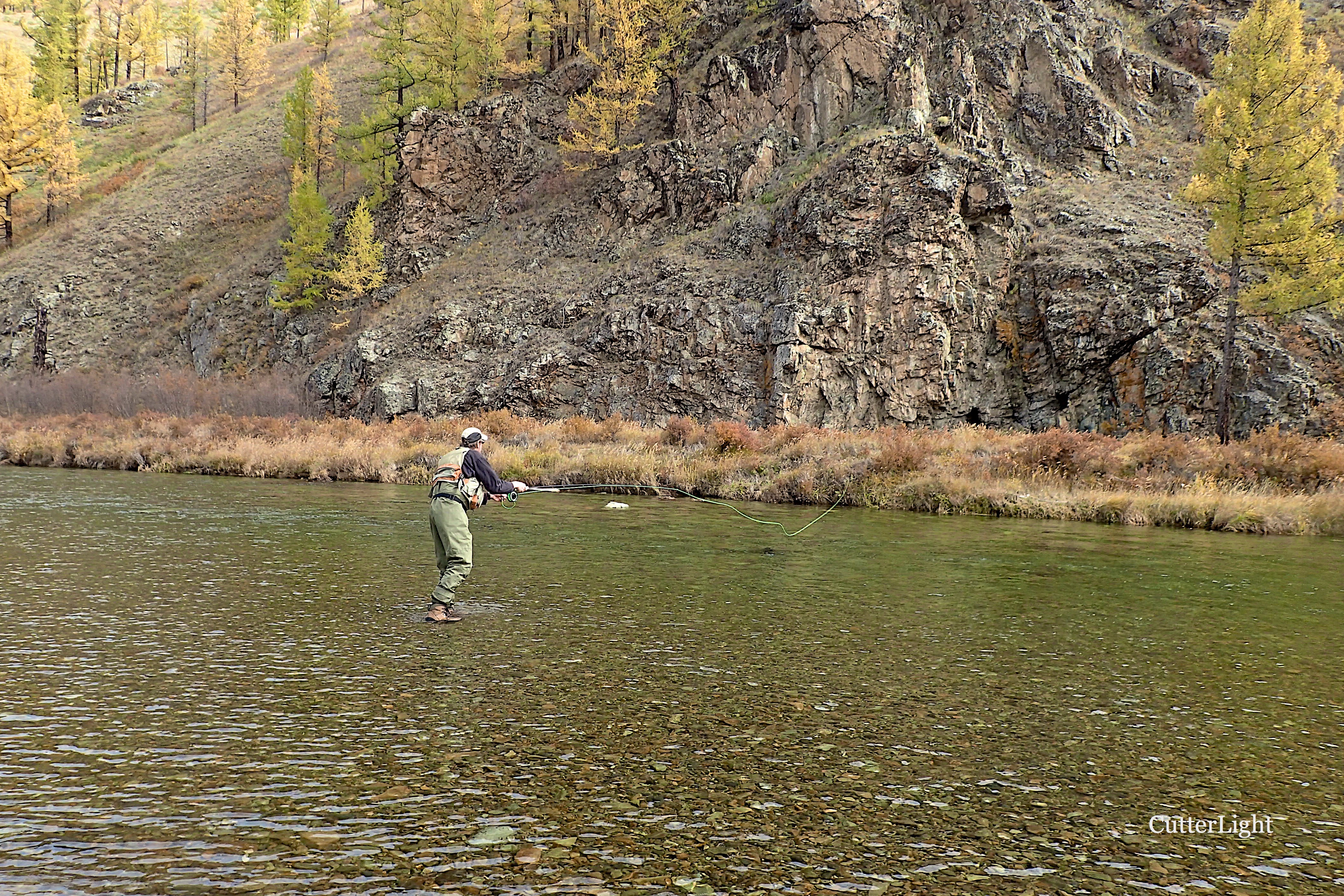
It felt good to finally get out on water. Prospecting for these handsomely marked grayling on a small river in Mongolia took us back to prospecting for trout in small waters in other places.

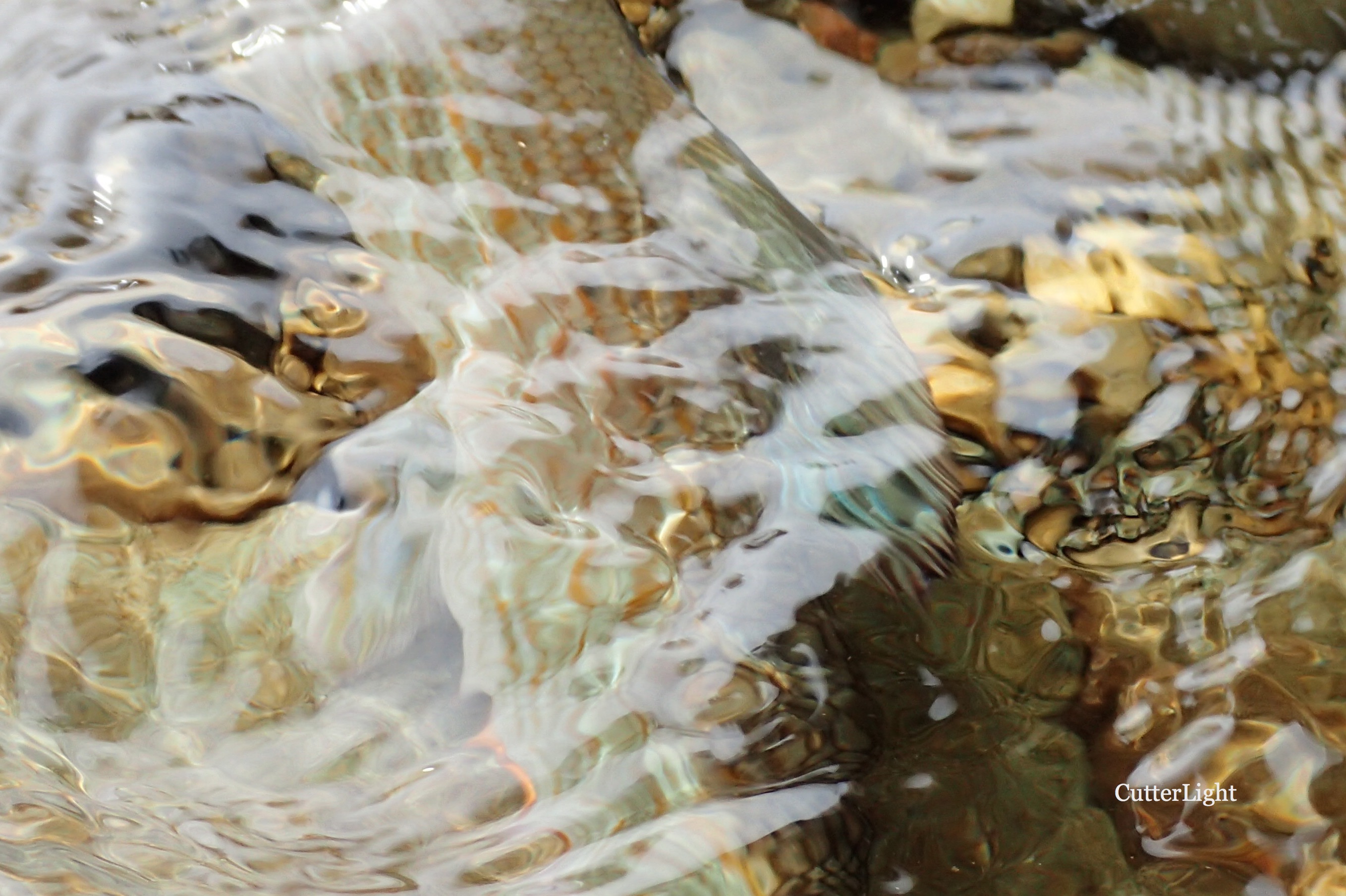
Nearly as translucent as water and marked like colored glass, the grayling’s dorsal fin…

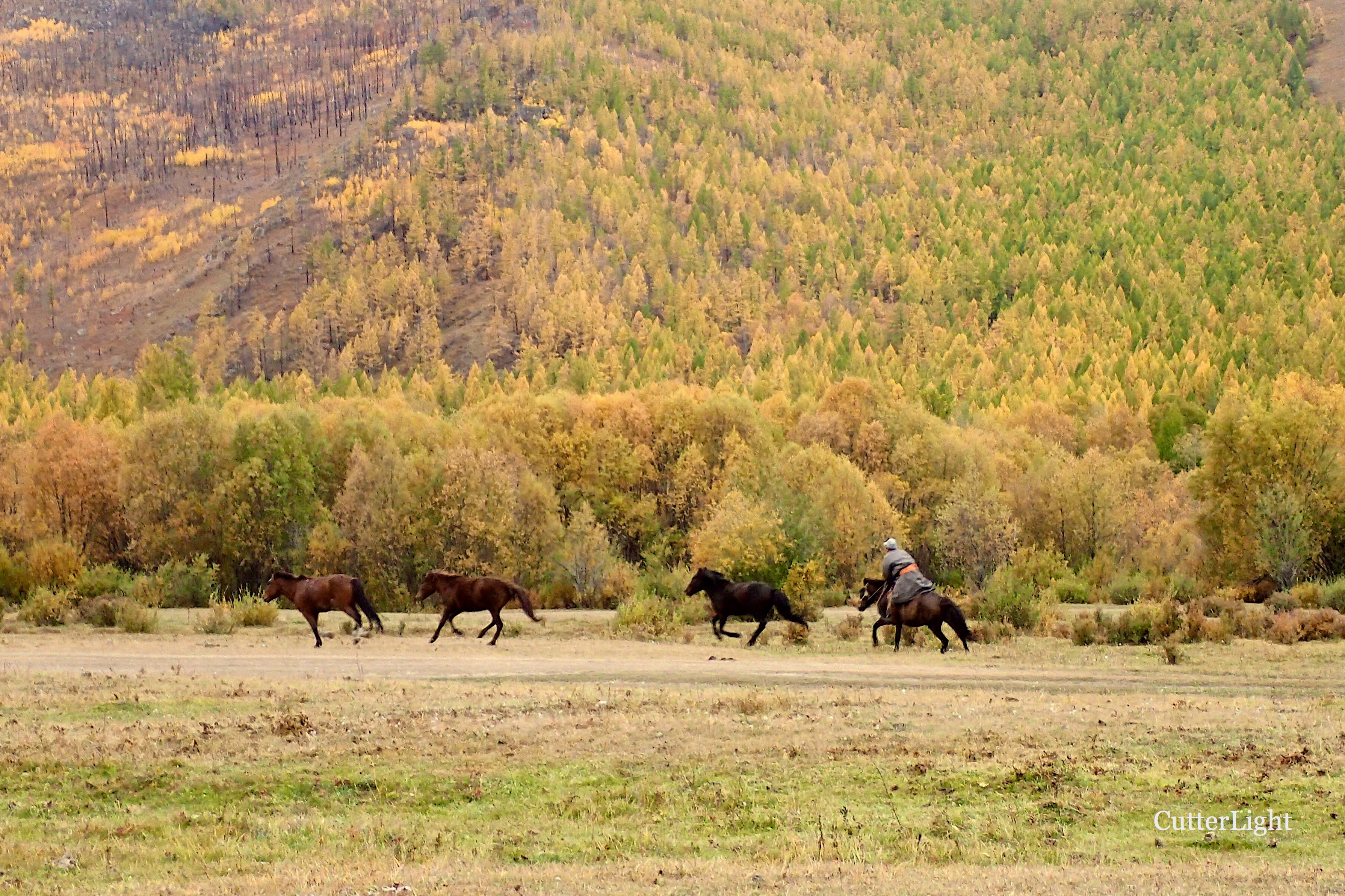
By mid-September, autumn has come to Mongolia’s steppes and mountains. By the end of September, we’ll have had our first snows.

Sluggish with cold and dark with Autumn, one of the year’s last grasshoppers. 

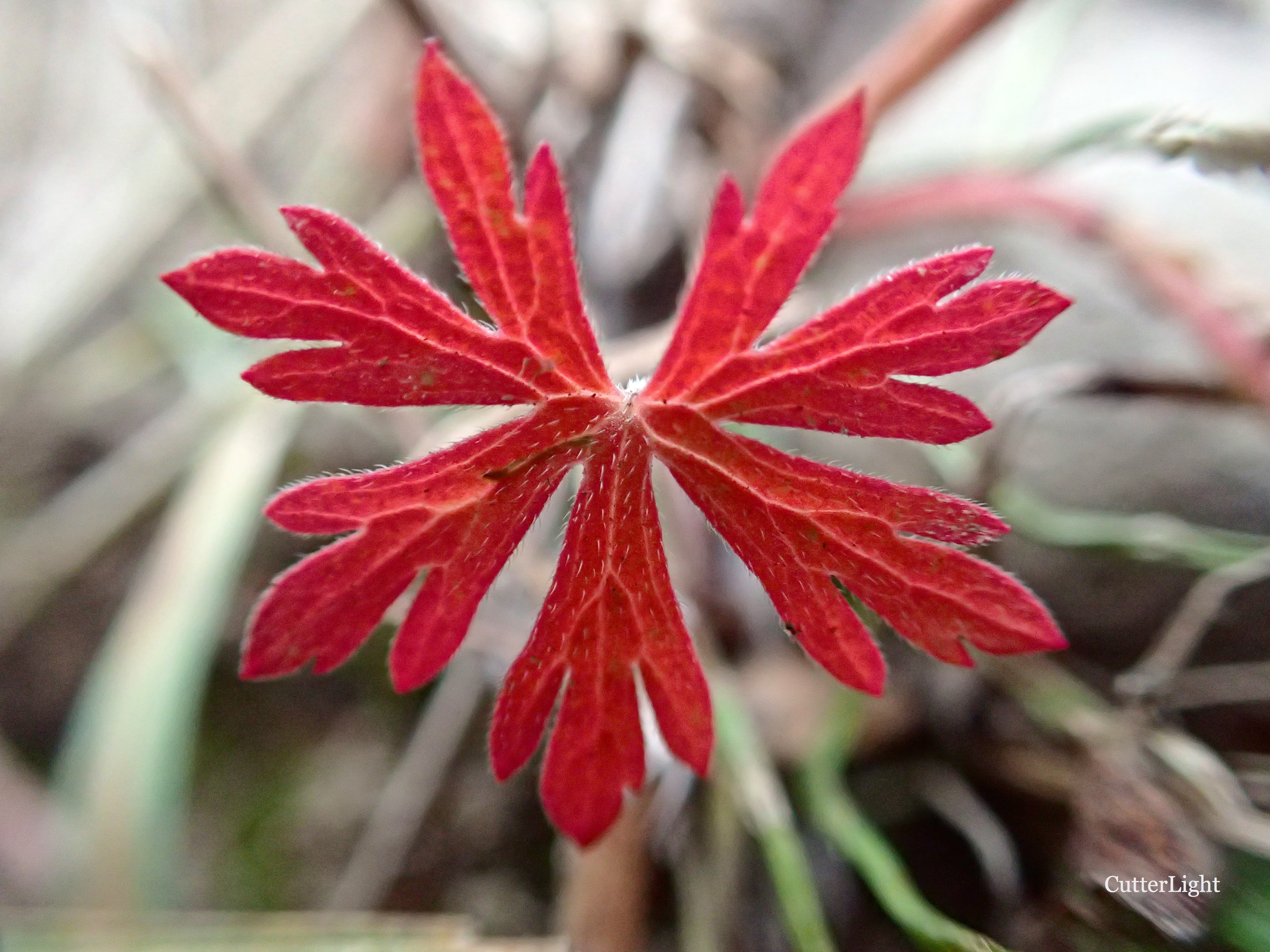
Yellows, golds and browns mixed with the blue-green of evergreens, predominant fall colors across this land. Here and there a touch of crimson. 

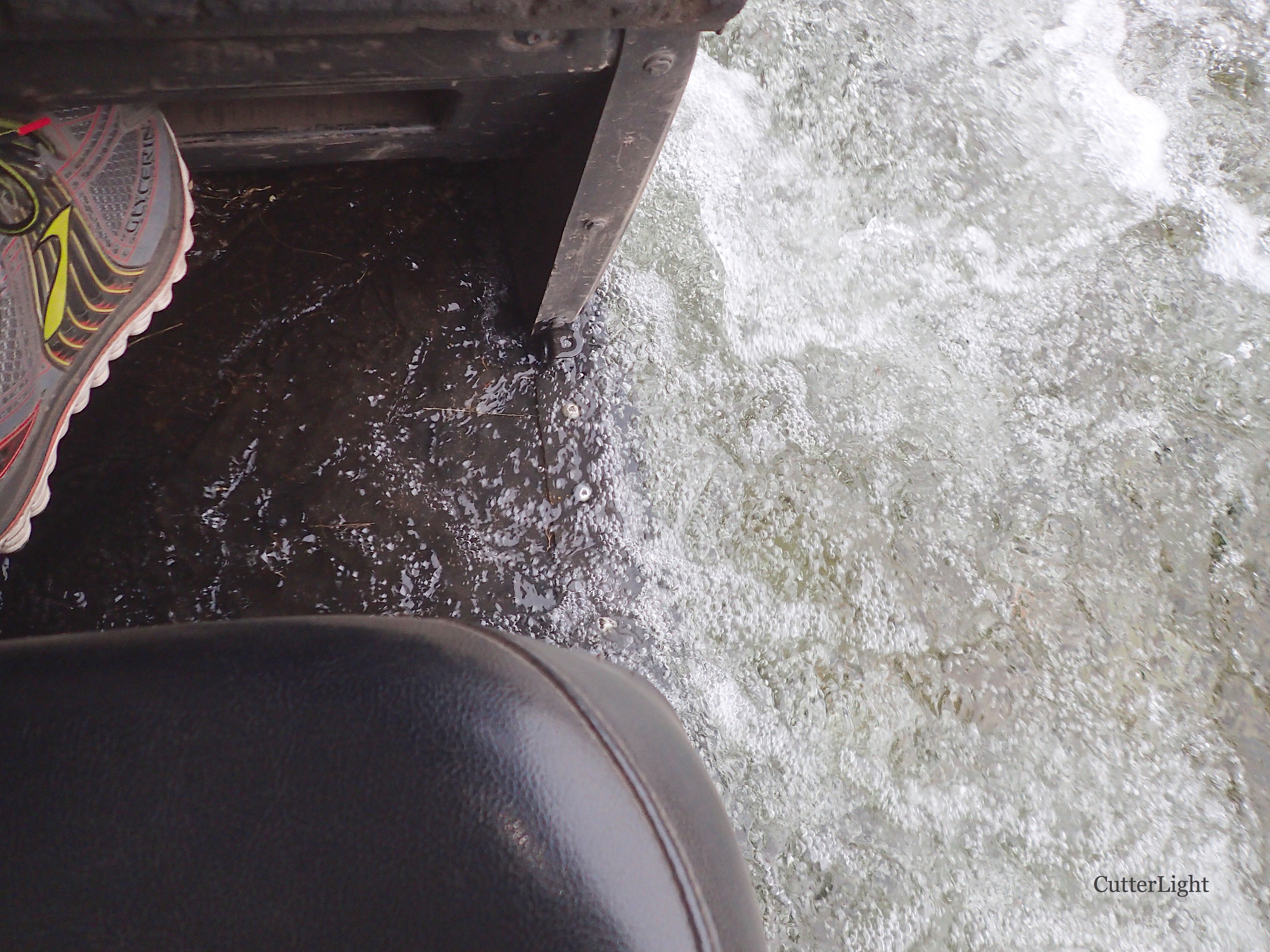
Feet up. Water pours across the floorboards of the doorless Polaris Ranger. One of several crossings.

Not everyone made it.

Stringing up. Something between rumor and someone’s good authority sent us up to these headwaters, prospecting.

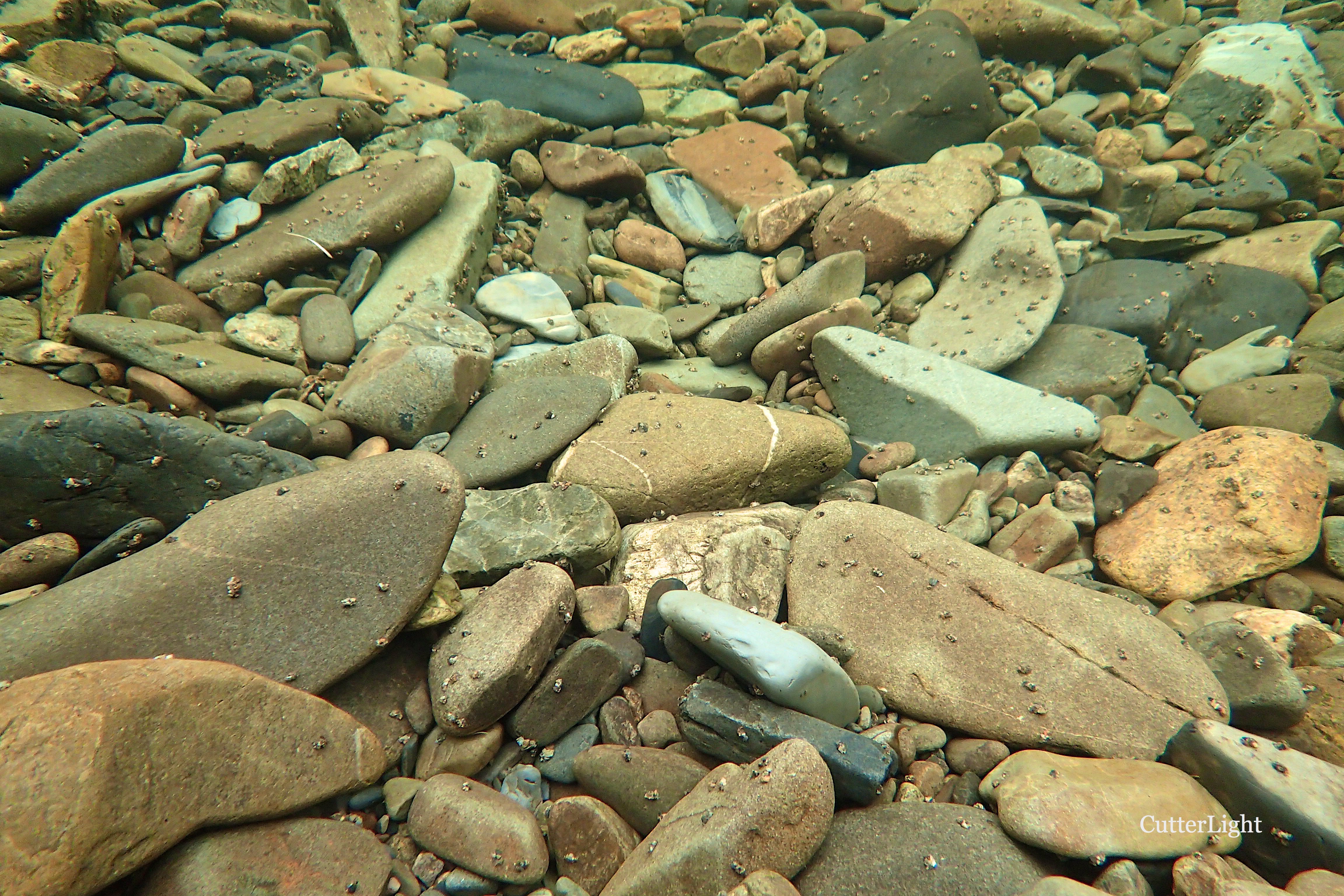
I stuck my camera into the icy water to get a photo of rocks speckled with caddis casings. 

OLYMPUS DIGITAL CAMERA

We encountered sporadic blue-winged olive mayflies. Rocks we flipped revealed caddis and stoneflies, a few loaches and this dragonfly nymph. 

Possible water, but not promising. Larch trees yellowed by frost-laced mornings, pools in shaded feeder streams iced over.

It feels like a lifetime ago that we were on our boat in Alaska, filling coolers with a years’ worth of ocean bright salmon, halibut and rockfish to sustain us through months in the Arctic Bush. Back to roots – a fly rod, a small river, drifting nymphs and dries. Bone satisfying to once again feel the weight of a fish. Could be a rainbow stream in Colorado, cutthroat water in Oregon, a brookie creek in Pennsylvania or a yamame stream in Japan. It all feels like home.

Barbra’s first grayling and her first fish in Mongolia.

We hiked and drove and hiked some more. At last we found the water I’d been looking for – the right depth, the right flow, the right-sized boulders breaking up the bottom at the right intervals. And there in front of us, tens of fish materialized out of nothing – out of water as clear as air – porpoising and splashing across a run maybe 60 feet long and half that width in pursuit of something tiny emerging from the water. Several times these grayling rocketed completely out of the water as they threw themselves at our mayfly patterns. A number of times we were both hooked up, simultaneously.

Eight inches or eighty pounds… It never gets old. The grayling were still feeding when we left, reluctantly, the sun low behind clouds.

OLYMPUS DIGITAL CAMERA

A backward look…

Grayling. Grayling water. Mongolia…

Red-billed Chough: Corvids are Cool

Red-billed chough

Striking a regal pose after a morning of catching grasshoppers: Close cousins of crows, ravens, jays and magpies and adaptable to both urban and wilderness environs, choughs are common around Ulaanbaatar.

chough convention n

The convention: On the crest of this rocky hill, there were dozens of choughs. A hundred. Maybe more. Many of them were gathered around a cluster of chough feathers near these rocks. A fox? A kite? An eagle or hawk? Some predator had diminished their numbers by one. The entire flock was concerned.

choghs flock of n

Choughs in dawn light, hanging together, winging their way across the mountains and steppe near Ulaanbaatar.

Wisconsin Wildlife Services Removes 100’s of Beaver Dams Each Year, Many by Explosives

beaver dam blown up

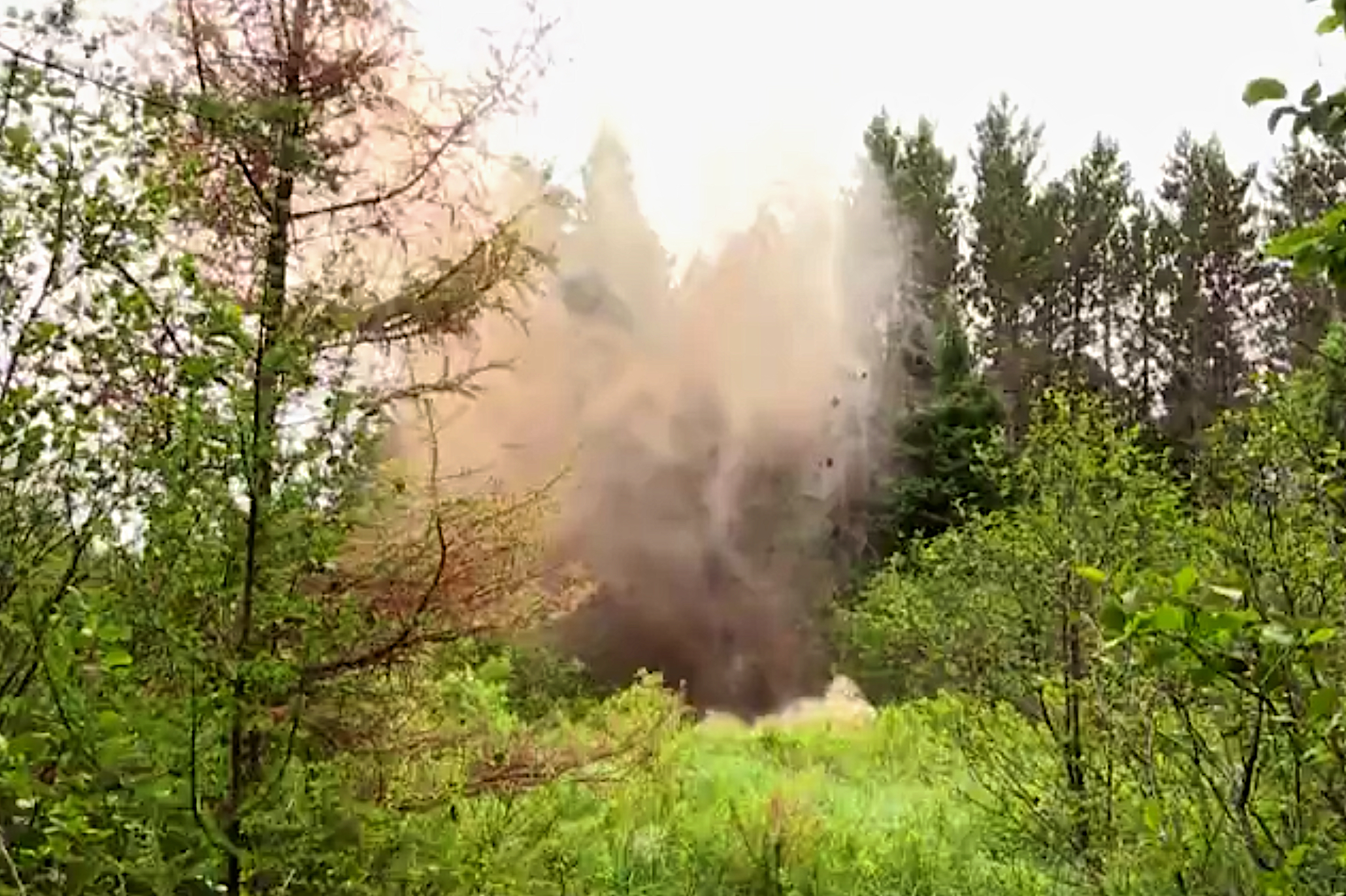
This video (see link below) showing a beaver dam being blasted sky high by Wisconsin Wildlife Services in the name of “improving habitat for trout” left us speechless. This particular detonation took place on the upper reaches of Wisconsin’s Wolf River, a National Scenic River. We’re interested to know what readers think of this strategy for managing wildlife and natural resources.
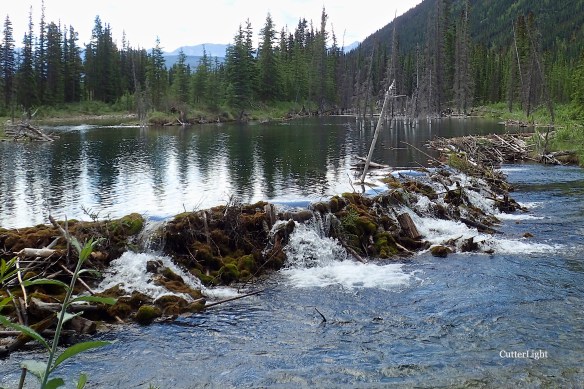
Beaver ponds such as this one in British Columbia represent biologically rich, exceptionally diverse, constantly changing micro-habitats within the larger forest.The many snags (dead trees) in this pond represent feeding opportunities for woodpeckers as well as potential cavity nesting sites for a variety pf species of birds and mammals. Eventually, this pond will become silted in, the beavers will leave, and a beaver meadow will replace the pond. These meadows, free from the shade of the forest canopy and with a bed of thick, fertile soil create places where unique species of flowers and other plants thrive. Black bears are among the many animals that visit these meadows to graze on the grasses and berries that may not exist elsewhere in the forest. The meadow itself will eventually be replaced by mature hardwood forest. So it has been in North America for thousands and thousands of years, with trout, beavers, bears and berries co-evolving.

The setting is a small stream in a Wisconsin forest. The water has been dammed by beavers. Because the pool of water created by the beavers may become too warm for healthy brook trout populations and because beaver dams can block the migration of these native trout, fishermen complained. Enter the Wisconsin Department of Natural Resources, the United States Forest Service, the Wisconsin Wildlife Services and several pounds of explosives. Although government officials occasionally remove beaver dams in order to prevent flooding of roads, make no mistake, most of these dam removals in Wisconsin are for one reason and one reason only: “The purpose of our work is to create a free-flowing stream for the benefit of the trout to be able to migrate up and down.”

See video at: http://www.nbcnews.com/video/government-blasts-away-beaver-dams-475081283719

In a recent three-year period, Wisconsin Wildlife Services removed over 2,000 beaver dams. According to the NBC News report cited above, government officials in Wisconsin use explosives on about 150 dams annually. The beavers are trapped and the dams are destroyed in order to …”(maintain)… one of the natural resources we’ve got for the public to enjoy, trout fishing…”

Barbra and I watched this video and listened to these comments with our jaws hanging open. Speechless. After about two minutes, the video came to an end.

“Wow,” was all we could manage to articulate at first. And then again, “Wow.”

For the past day, we’ve been researching this issue as thoroughly as we’re able to, reaching out to Trout Unlimited groups in Wisconsin and kicking our own thoughts around between each other. We haven’t reached any conclusions. But we do have a few observations.

If… if… the chief or only goal of environmental stewardship were to improve brook trout habitat, Wisconsin’s beaver management strategy might deserve a round of applause. Brook trout thrive in cold, free-flowing streams that feature clean, silt-free rock and gravel bottoms. Temperatures in beaver ponds can hit 70 degrees or more under the summer sun, near the upper limits of what these native char can tolerate and well above their preferred temperature range of 55 – 65 degrees Fahrenheit (12 – 18 degrees C). And because brook trout have very specific requirements for successful spawning – small, clean gravel where upwelling from springs occurs – it’s critical that they be able to access these areas during the fall spawning season.

So just blow up the beaver dams, right?

Not so fast.

moose in beaver pond n

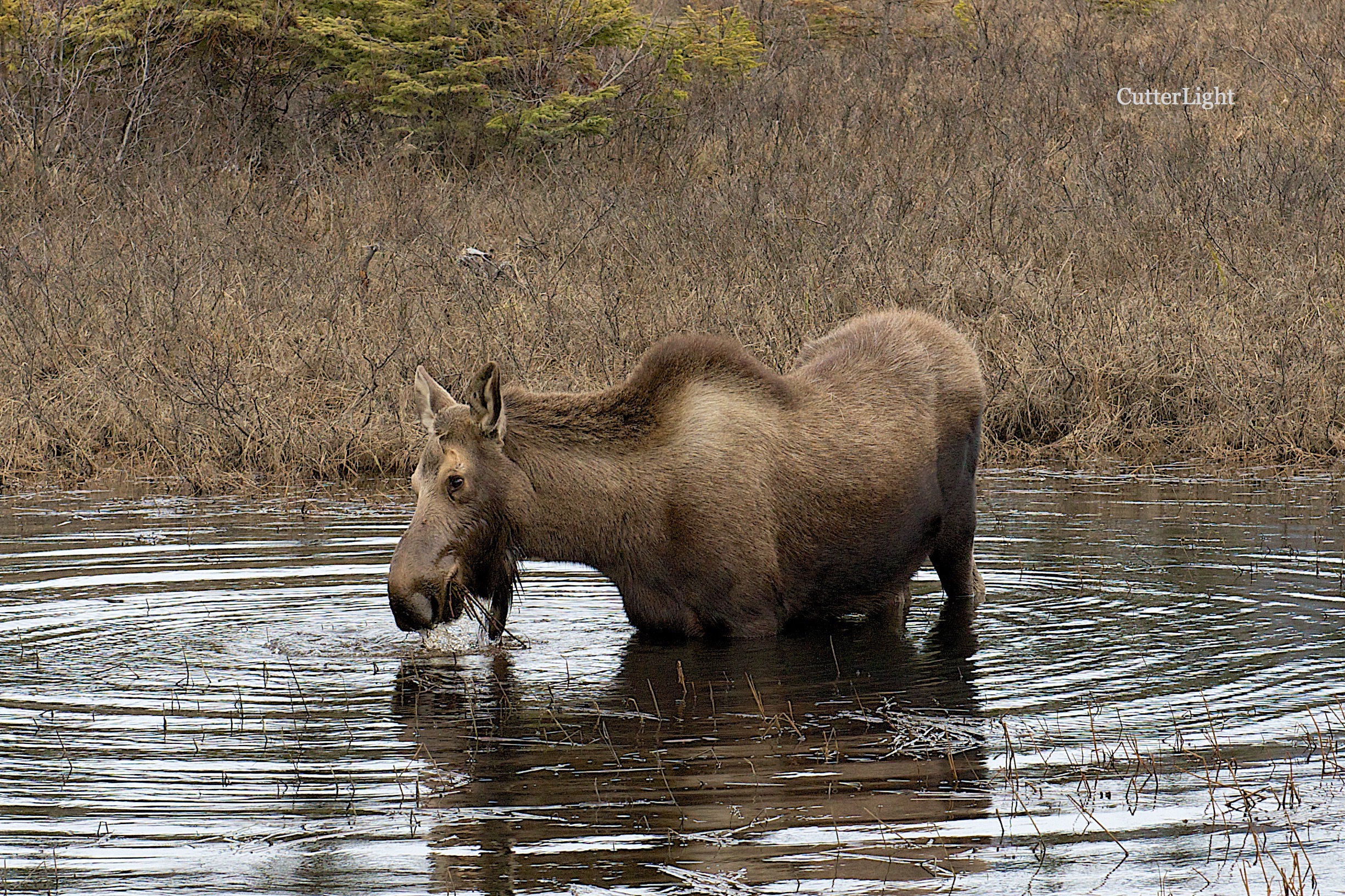
After a long winter in Alaska, this young moose finds a meal in the upper reaches of a north country beaver pond.

Beaver ponds represent dynamic, ever-changing micro-habitats that foster some of the greatest species diversity in the forests where they are found. We’re for biodiversity. As much as we enjoy trout fishing, we would never wish that our desire to catch a particular species of fish be placed above the overall health of an ecosystem.

During the life of the beaver pond, it can provide vital habitat for all kinds of animals. As trees are drowned, they become snags. (One Wisconsin DNR report stated simply that “beaver dams kill trees” – an example of how a statement can be both completely true and completely misleading. Dead trees are part of every healthy forest.) Pileated woodpeckers and other woodpeckers utilize these snags as forage bases and nesting sites. The cavities woodpeckers create in turn become nesting sites for flying squirrels, owls, wood ducks, and host of other mammals and birds. Meanwhile, these ponds become important stop-over or seasonal habitat for a variety of waterfowl and often attract shore nesting species. Tree swallows, flycatchers and similar passerines thrive in the edge habitat created by the beavers’ activity. Again, the snags provide nesting sites, and the cleared airspace above the insect-rich pond creates excellent feeding opportunities for insect eating birds as well as for bats.

The pond itself becomes one the most biologically rich systems in the forest – perhaps the most biologically rich. Everything from burrowing mayflies to dragonflies and damselflies to a variety of aquatic beetles inhabit these waters. Amphibians such as newts, salamanders, toads and frogs depend on these these ponds as well, which provide vital nurseries for their young. Aquatic and semi-aquatic snakes take advantage of the smorgasbord, and in turn may provide a meal for a hawk. Deer, moose, turkeys and grouse are among the frequent visitors to the edge habitat found along the shores of beaver ponds.

Silt prevented by the dam from moving downstream eventually creates a rich bed of mud which in turn fosters the growth of aquatic vegetation. This vegetation may provide a meal for a moose or a migrating duck, a nursery for the young of certain fish species, a place for a tiger salamander to attach its eggs, or an ambush post for a predacious diving beetle. What’s best for trout is not necessarily best for the countless other species that depend on the habitat created by beaver ponds. Healthy stream and forest systems feature a variety of habitats.
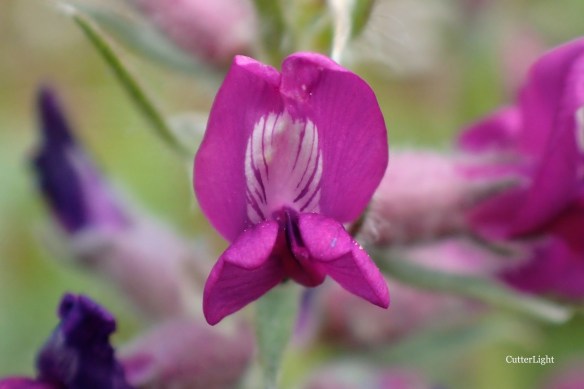
One of several stunning flowers we photographed last summer along the shores of a beaver pond.

Moreover, because these dams cause water to pool, some of that water percolates down into subterranean aquifers. This should be an important consideration in a state that is rapidly pumping its aquifers dry. The particular stream in question, the upper reaches of the Wolf River, becomes vital lake sturgeon spawning habitat further down river. As the underground aquifers beaver dams contribute to resurface in the form of springs further downstream, these springs cool the main river, which helps ensure that lake sturgeon spawn successfully. Take away the beaver dams upstream, and you take away a piece of a complex system which countless species have evolved to thrive in.

Eventually these ponds become overly silted, increasingly shallow and the beavers move on. Over time, the dams break up, the stream cuts a familiar channel, often finds a rock bed again. What’s left behind is a beaver meadow – a place with thick, rich soil capable of supporting an incredible variety of trees, flowers and grasses. For the overall health of the forest, it’s a good thing that these dams retain forest soil. Butterflies take advantage of the abundance of flowers, deer and bears come for the grass, and the snags – the trees that died when they became flooded – continue to provide nesting sites for a variety of animals till the day they fall to the earth and become nursery logs.

It’s important to keep one other fact in mind. Salvalinus fontinalis, the native char most fishermen refer to as the brook trout, has been co-evolving with beavers and beaver dams for longer than humans have been on the North American continent. This sudden need to “manage” wildlife is an outcome of an ongoing series of humankind’s mismanagement of this planet.

All this being said, it may appear that we’ve made up our minds on this issue.

We haven’t.

Between the absence of sufficient natural predation and insufficient economic incentive for more beavers to be trapped for their pelts, we understand that it is entirely possible that Wisconsin’s beaver population is out of balance. This would seem to present three options:

  1. Reintroduce predators and foster the growth of their numbers. Predators? That would be wolves. The problem with that strategy is that wolves historically have been more interested in ungulates such as deer and moose (and even in voles and mice) than in beavers. Prior to European settlement, the population of beavers in North America is estimated to have been between 60 and 400 million. There were lots of wolves back then, too. They apparently weren’t eating many beavers.
  2. Continue the present strategy. Where beaver dams appear to be negatively impacting brook trout habitat, kill the animals and tear out their dams. If the dams can’t be broken up by hand, employ explosives.
  3. Do nothing. Let it go. Enjoy the biodiversity beaver ponds foster. If the natural activity of beavers temporarily (or permanently) makes a stream unsuitable for brook trout, rest assured that the habitat is probably becoming just right for other species. Find another stream to fish, or tie up some Clousers and go bass fishing.
  4. And if anyone is really concerned about rising temperatures in streams, maybe consider getting rid of your air conditioner, installing double-paned windows in your house, and locating in a place where you can leave your car at home and walk to work, to the grocery store, and to your friends’ homes.

We’re sure there’s more to the beaver situation in Wisconsin than we currently realize. We’d love to hear what others think. Thanks for reading.

Sincerely,

Jack & Barbra

Black-Veined White Butterfly

Black-veined white (Aporia crataegi), Ulaanbaatar, Mongolia.
For a few days in late June, maybe a week, these black-veined whites (that’s their name) were everywhere. In the air, in the bills of birds, sipping on purple flowers. And then they were gone. In that one week, they were beautiful…

Spring! April in the World’s Coldest Capital

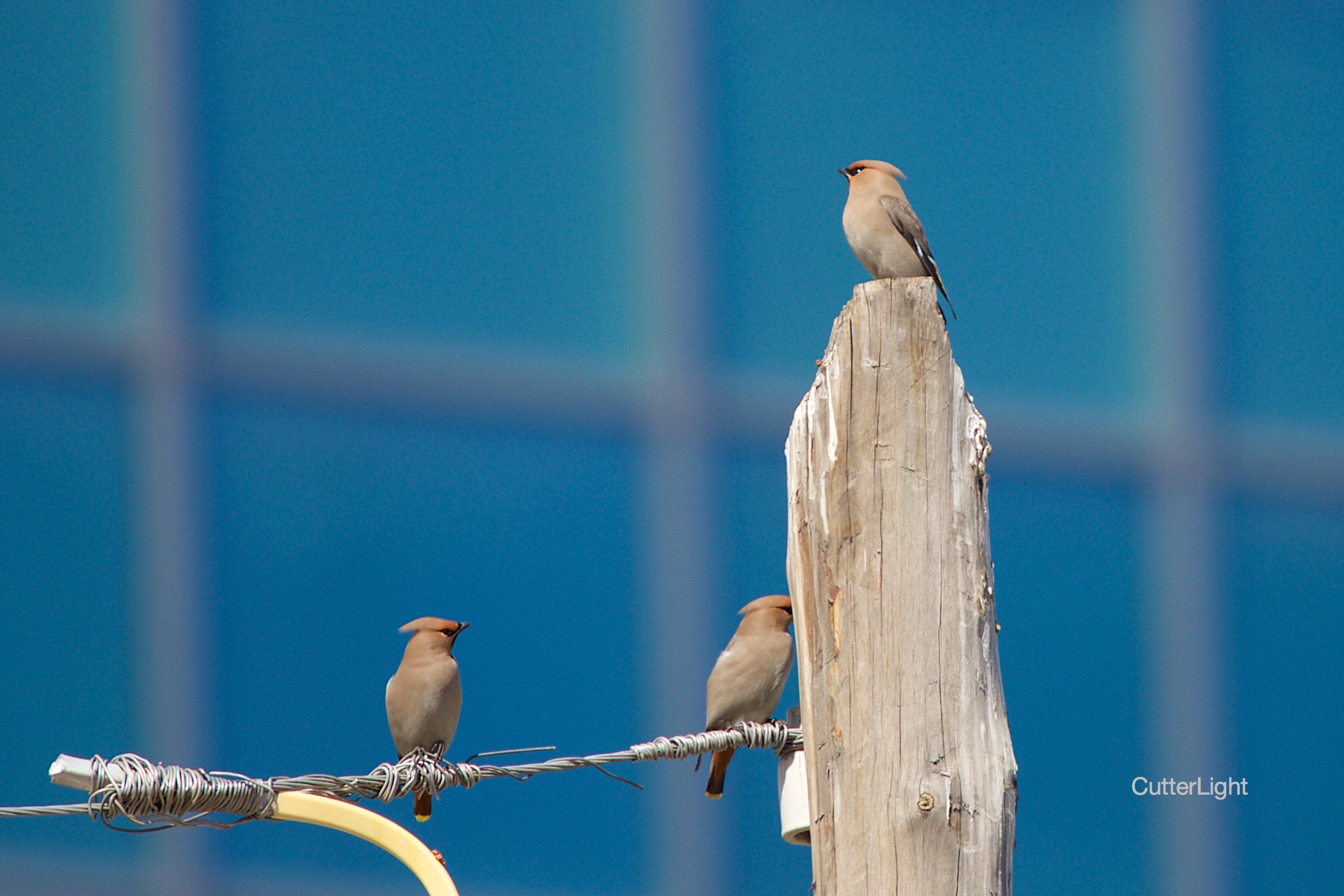
Bohemian waxwing april 2015 n

Warmer temperatures are bringing flocks of new birds to Ulaanbaatar. These Bohemian Waxwings won’t stick around long; they’re on their way to nesting grounds in Siberia.

One day temperatures are in the 50’s or 60’s (in the teens, Celsius). The next day it’s below freezing with snowfall. And so it has been for the past few weeks from late March through mid-April. Welcome to Ulaanbaatar, Mongolia – officially recognized as the world’s coldest capital city. As transplants from Alaska, it feels like home – albeit a little warmer than our former north-of-the-Arctic-Circle village of Point Hope.

pussy willows catkins n

Pussy Willows – flowers of willow trees – have begun pushing out of their buds along the banks of Ulaanbaatar’s Tuul River.

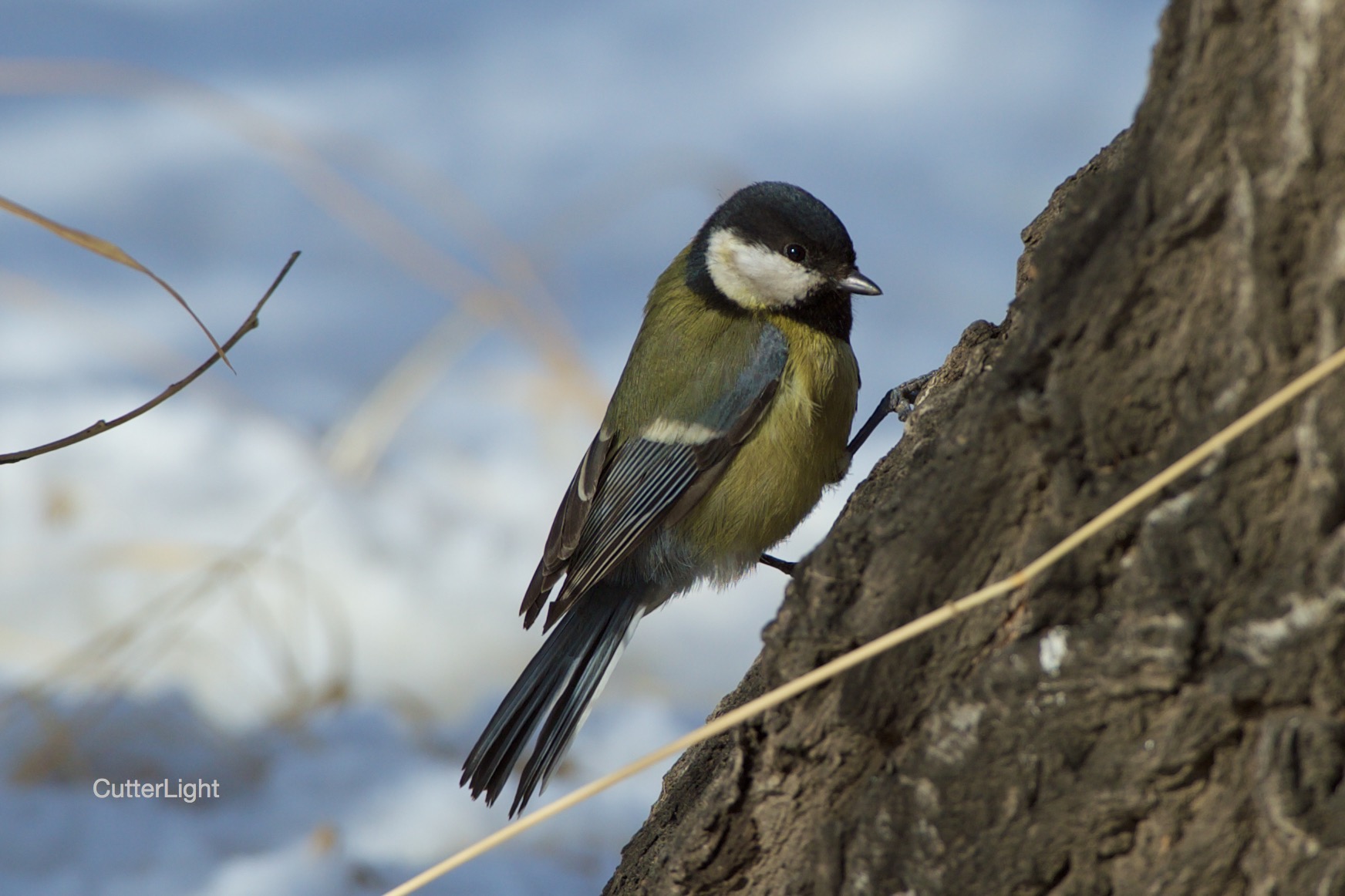
great tit profile tree n

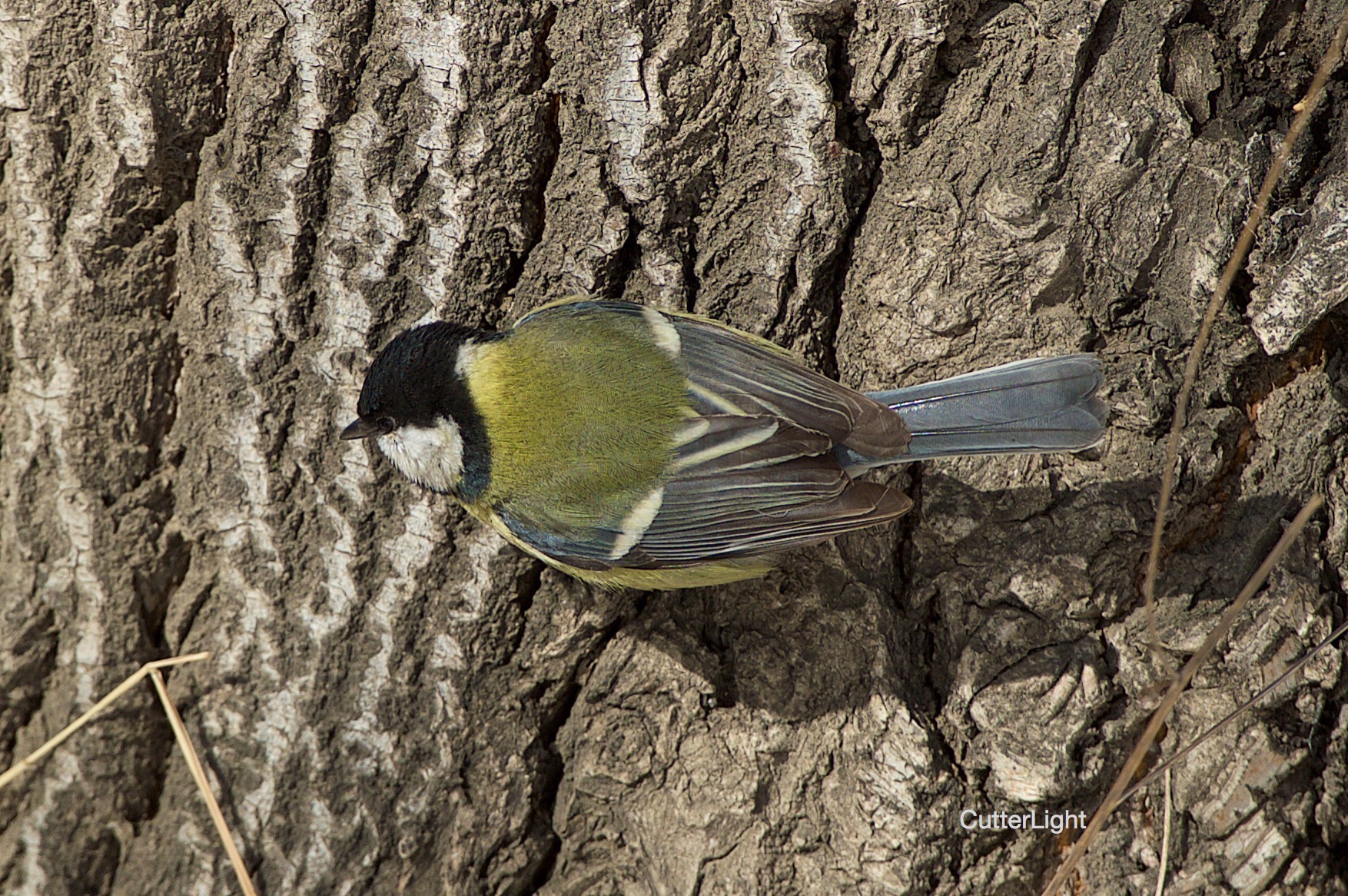
Great tits, above and below, are common residents along the Tuul River as well as in the nearby mountain forests.

great tit back tree n

Such interesting little birds, all camouflage and color from the head to the mid-back, an abrupt line, and then symmetry from the mid-back through the tail, which, in nature, is its own form of camouflage.

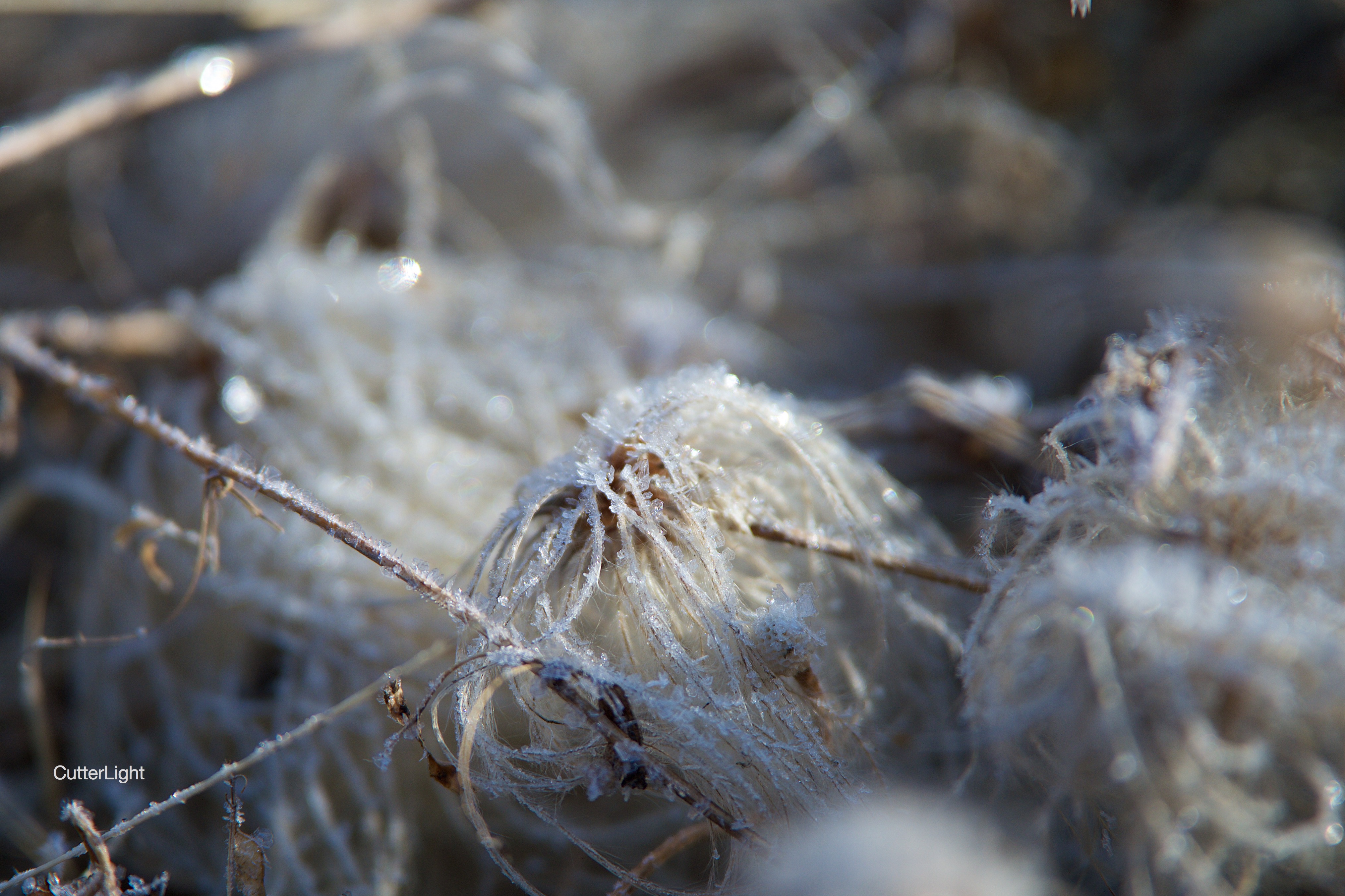
frost jellyfish weed april 2015 n

Early morning frost turned the withered remnant of last fall’s flowers into frozen jellyfish.

jellyfish weed april 2015 n

By late morning, the sun had melted most of the frost…

long-tailed rosefinch n

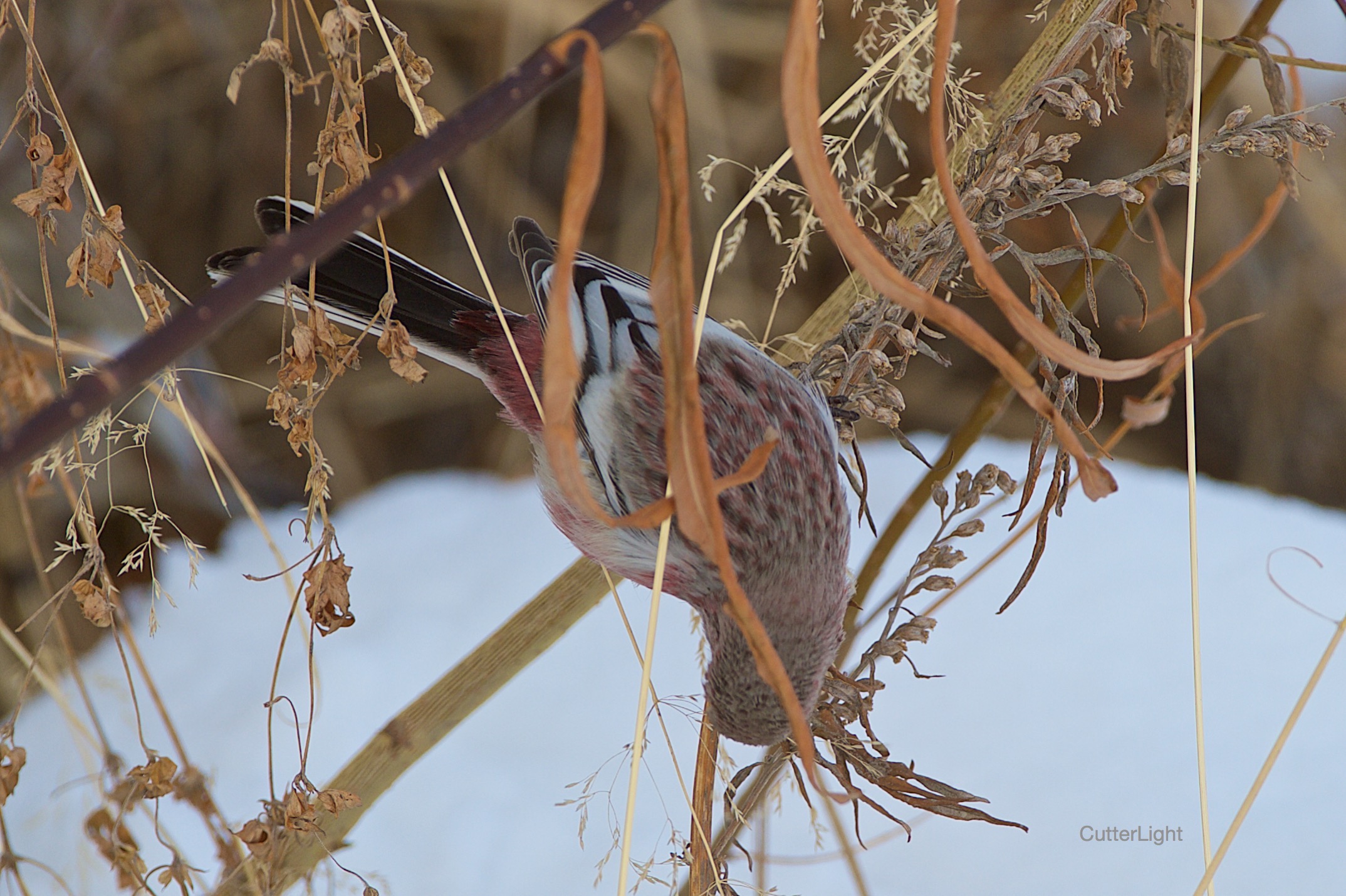
…while in shaded pockets where snow still lingered, newly arrived long-tailed rosefinches filled up on last year’s store of seeds. The willows and grasses along the Tuul provide the perfect habitat for many species of birds. And, judging by tracks in the snow, rabbits as well.

long-tailed rose finch upside down n

Finches become acrobats in pursuit of a good meal.

female long-tailed rose finch n

As is typically the case among passerines, the colors of the female long-tails are subdued compared to their male counterparts.

Magpie March 2015 n

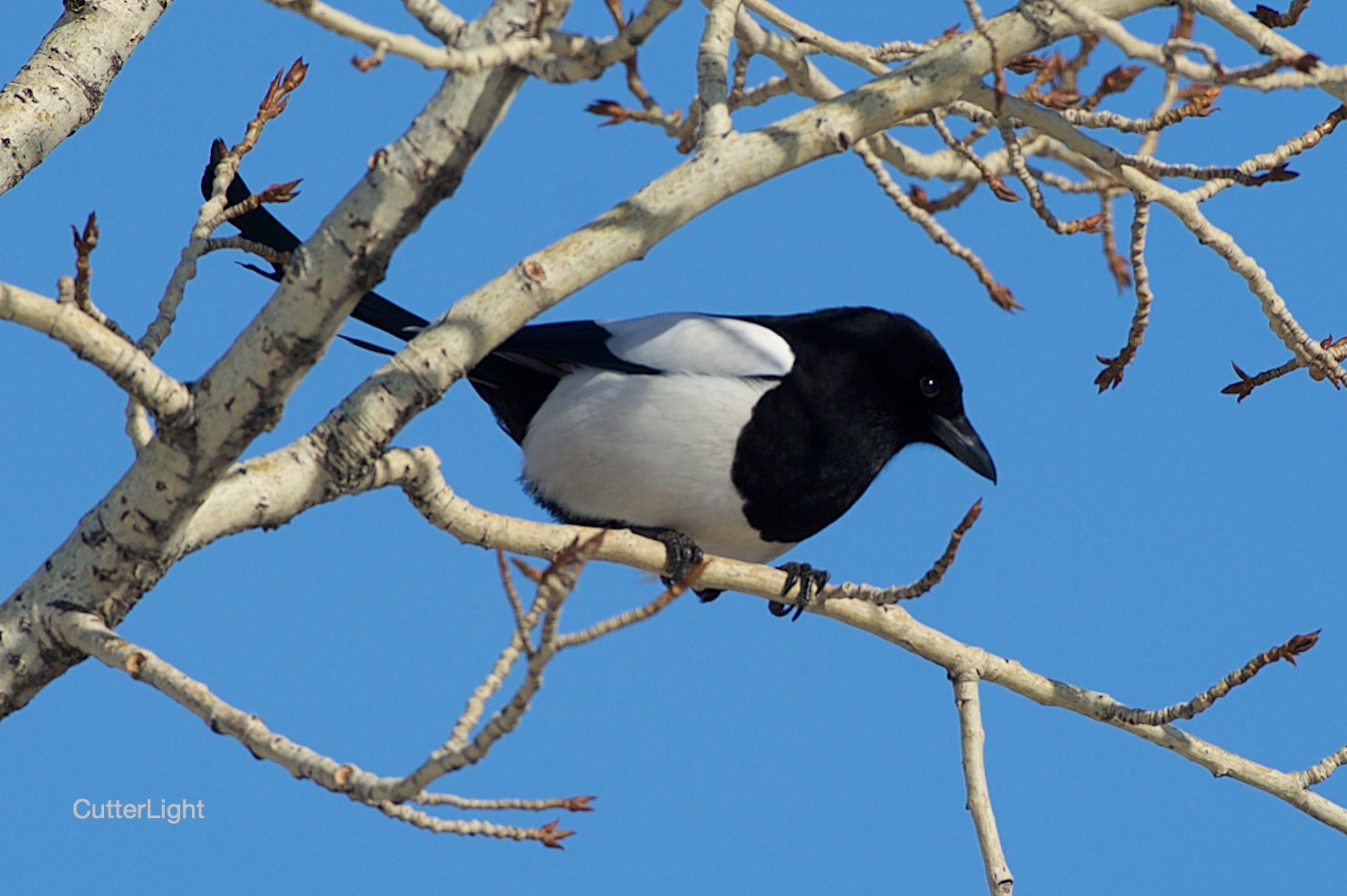
Magpies were out in force, searching for nesting material to add to the massive jumbles of sticks they build in trees. It must work. They return to the same nests year after year, building them ever higher. Note the hooked beak; passerines beware. Magpies are predators, and no mistake.

big tree w sun april Tuul n

The Tuul River green belt is our favorite place in Ulaanbaatar. In addition to providing habitat for year-round resident birds and summer nesters, the abundant seeds provide critical fuel for passerines migrating further north.  The belt is also important hunting grounds for kestrels and other birds of prey as they make their way to their own nesting grounds. The banks of the Tuul are what’s left of an increasingly fragmented ecosystem. We’ve even caught fleeting glimpses of some type of quail or partridge in the thick willow undergrowth!

Fire and Ice Needles: Dawn, Hustai National Park, Mongolia

ice needles at dawn n

Stalked a group of stag red deer

up a draw to the top of a rise 

where the sun broke fiery and cold

lighting feather grass and ice needles

suspended in the negative something air.

Along the ridge, winter-hard antlers

lit with sunlight

scattered into the dawn.

– Hustai National Park, Mongolia, 2014

Jack Donachy


Mongolia’s Impressive Red Deer

red deer stag pair n

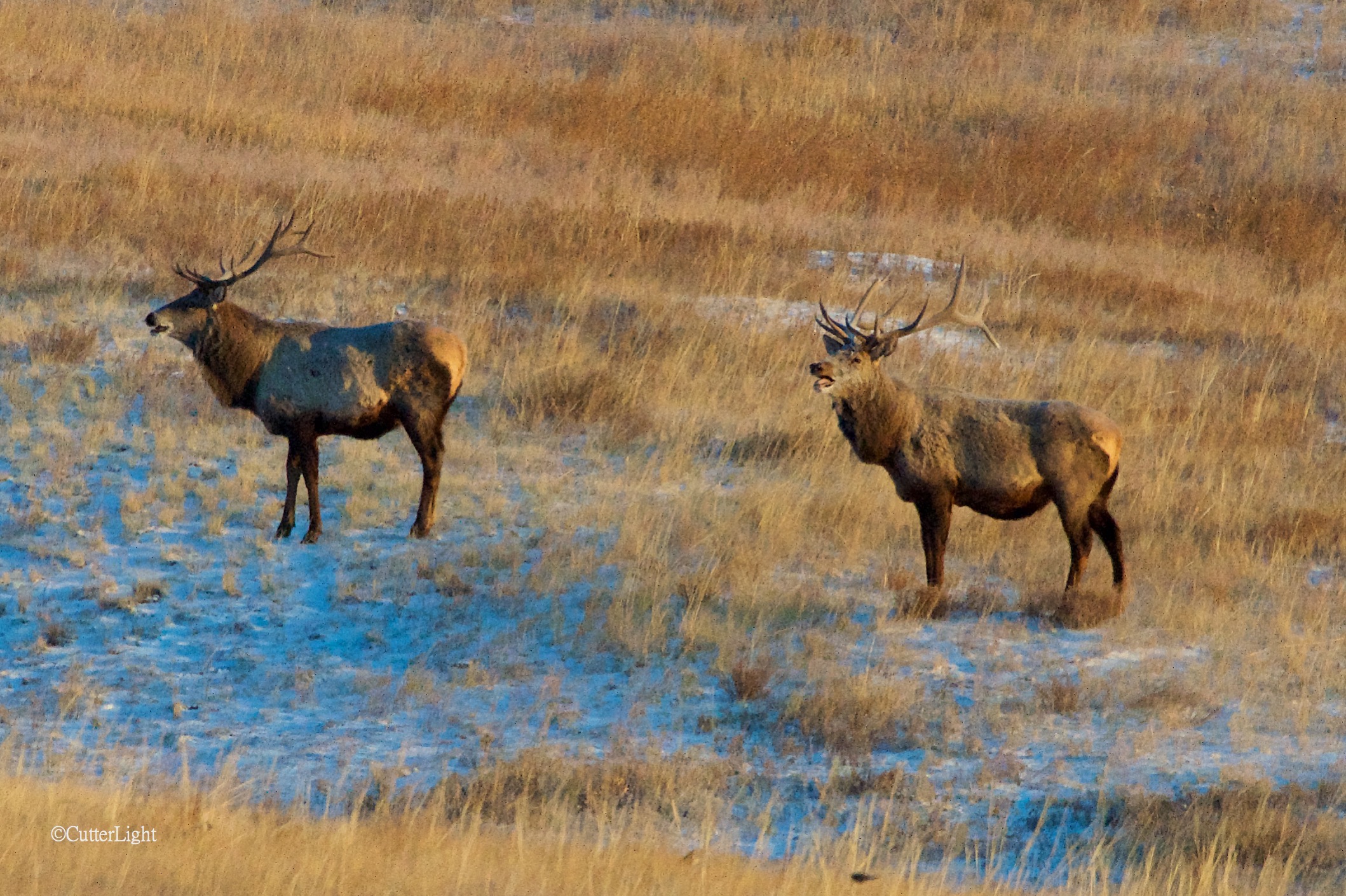
Red deer stags (Cervus elaphus) in early morning light. Among the world’s largest deer, this species shares an extinct ancestor in common with North American elk: Megaloceros, the massive Irish elk. 

Historically, red deer ranged from the British Isles east through Mongolia and other parts of Asia and south into northern Africa. Until about two decades ago, their numbers in Mongolia were strong with some 130,000 individuals taking advantage of forest, steppe and mountain habitat. In recent years, however, poaching has decimated red deer herds in this country as their antlers command increasingly high prices as an ingredient in traditional medicines in China and elsewhere. Even National Football League players in America have been implicated in purchasing these medicines. Elk and red deer grow new antlers each year. When the antlers are growing, they are covered in soft tissue and are said to be “in velvet.” This is when the antlers are valuable.

Here’s the problem for the elk and deer. Some studies indicate there may actually be health benefits gained from using medicinal antler and regardless of the science, a lot of people believe they derive benefit from the antler. The trade is annually running over 1.5 billion U.S. dollars, and it is destroying populations of these magnificent animals. Although no recent population surveys have been conducted, it is believed that there are now fewer than 10,000 red deer in Mongolia.

red deer males bedded down n

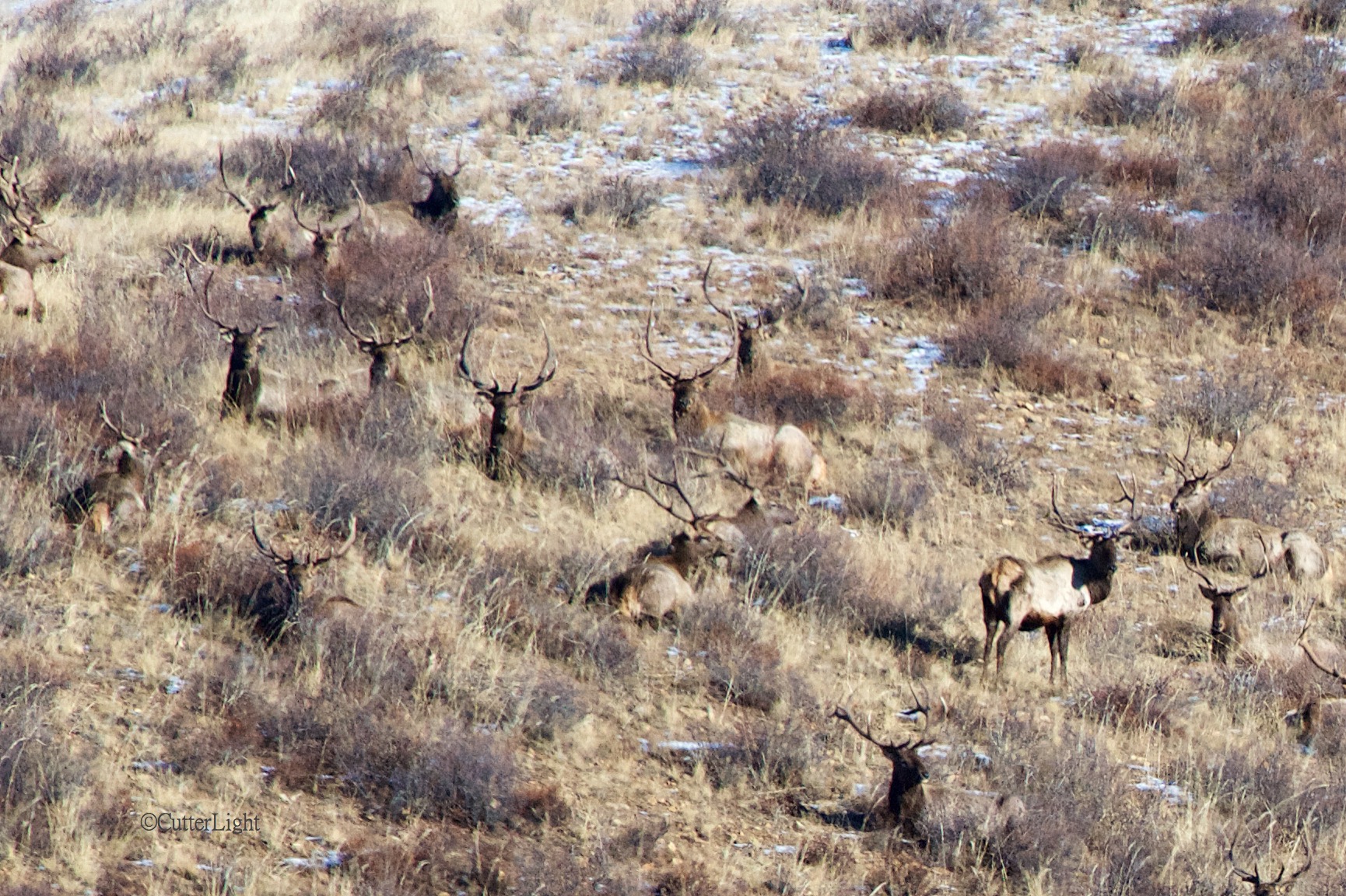
On a recent trip to Mongolia’s Hustai National Park, we encountered a herd of approximately 100 mature male red deer. Separated by sex during the winter months, females were miles away in a different part of the park. These stags will drop their anglers in early spring.

Among deer, only Alces alces – called moose in North America and Eurasian elk in Europe and Asia, North American elk (wapiti), and sambar deer are larger. Adult male red deer attain weights between 550 – 770 pounds (250 – 345 kg). Some subspecies grow even larger. The extinct Irish elk, Megaloceros, which occupied much of the same range as modern-day red deer, was believed to have attained a weight of 1,500 pounds (700 kg) and had truly massive, moose-like antlers – perhaps contributing to its demise. Because of their value as a food and game species (these are the “harts” and “stags” of European hunting lore), red deer have been introduced to New Zealand, Australia, Chili and Argentina.

red deer males on alert n

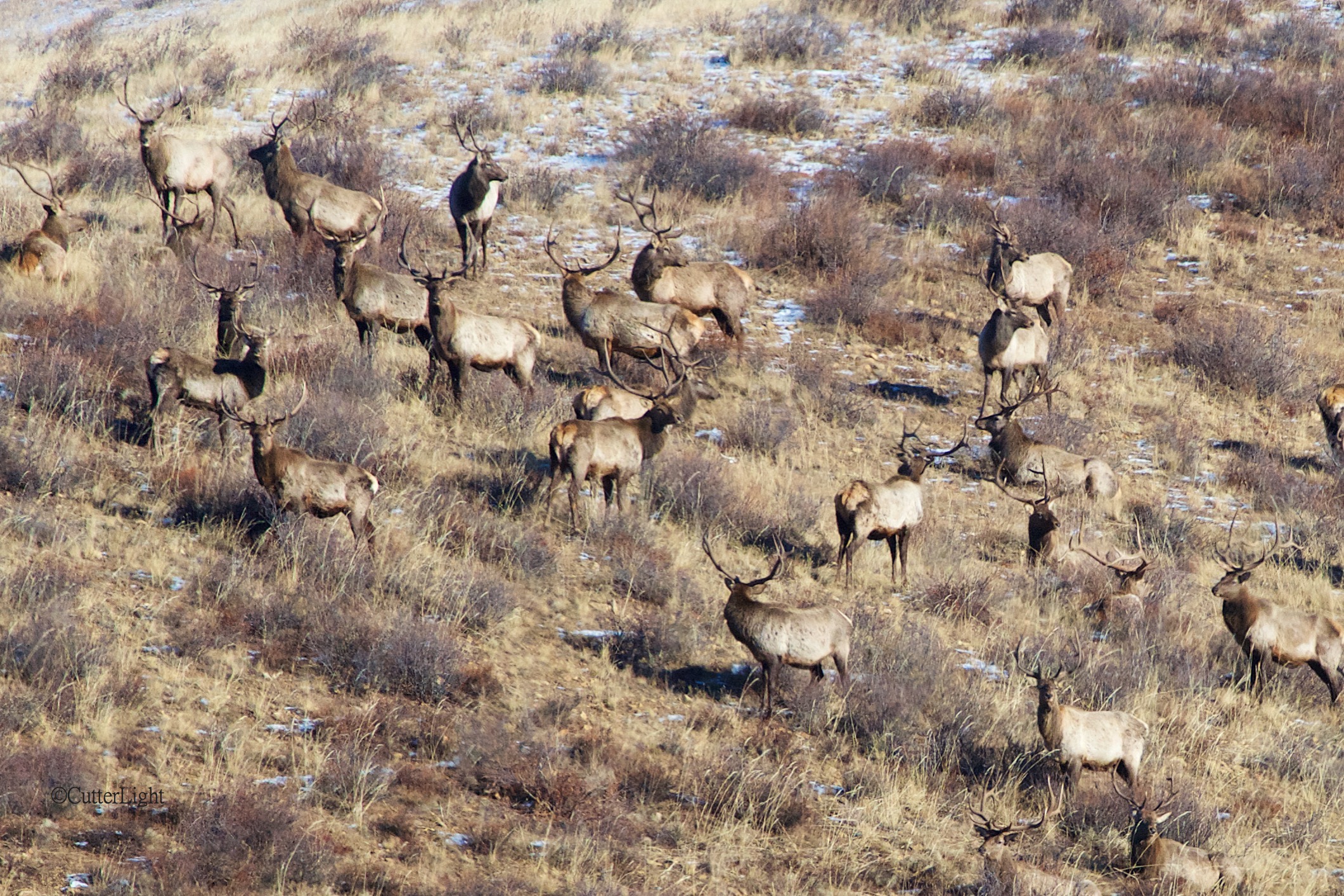
We stalked these deer stooping and crawling for about half a mile (1 kilometer). Suddenly nearly all of them stood up – 100 animals including the ones outside the frame of this photo -, made nervous by an approaching rider on a horse.

red deer femals on snow n

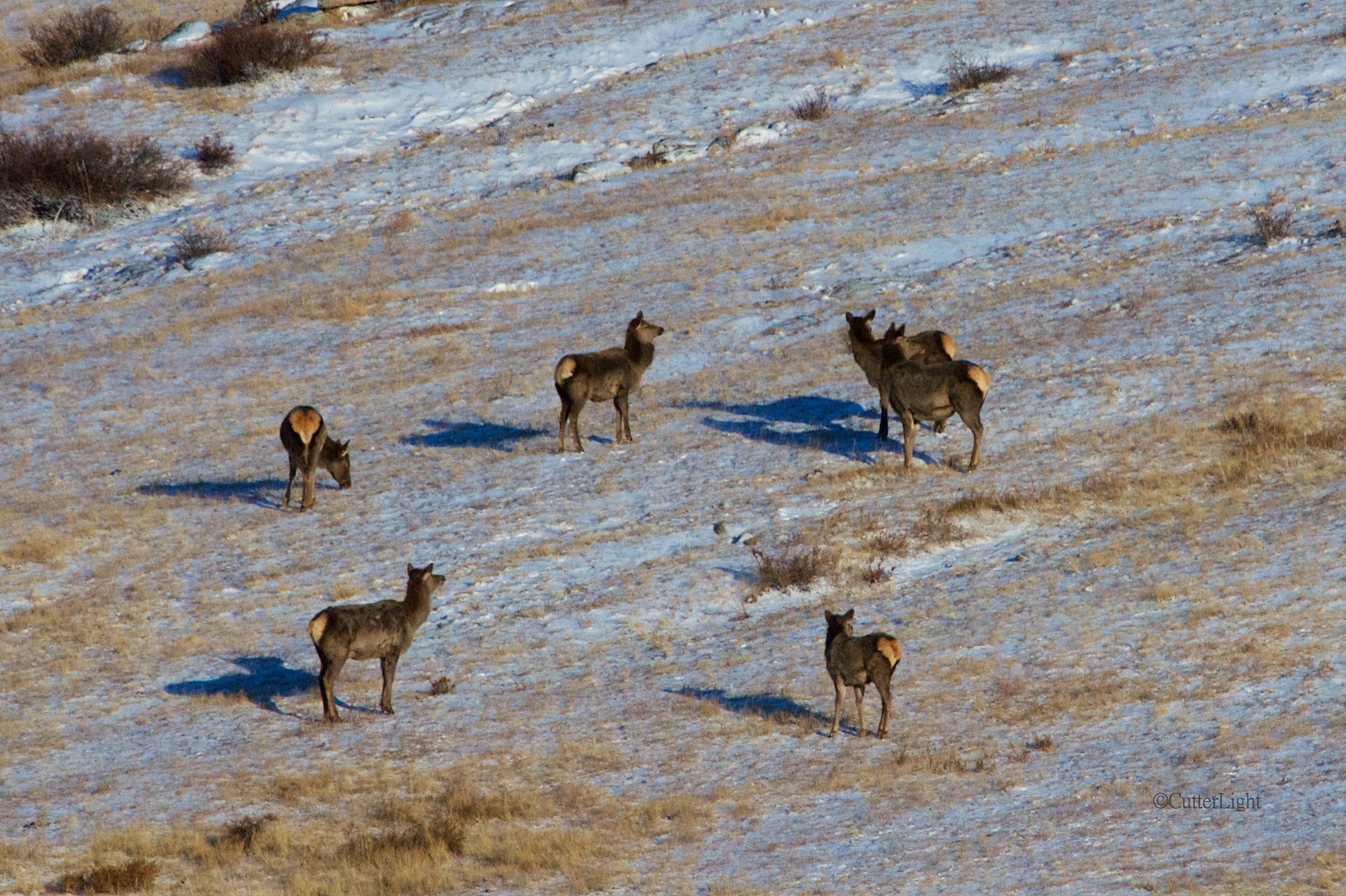
Rutting season occurs in autumn. The rest of the year females and young form distinct groups away from the mature males.

OLYMPUS DIGITAL CAMERA

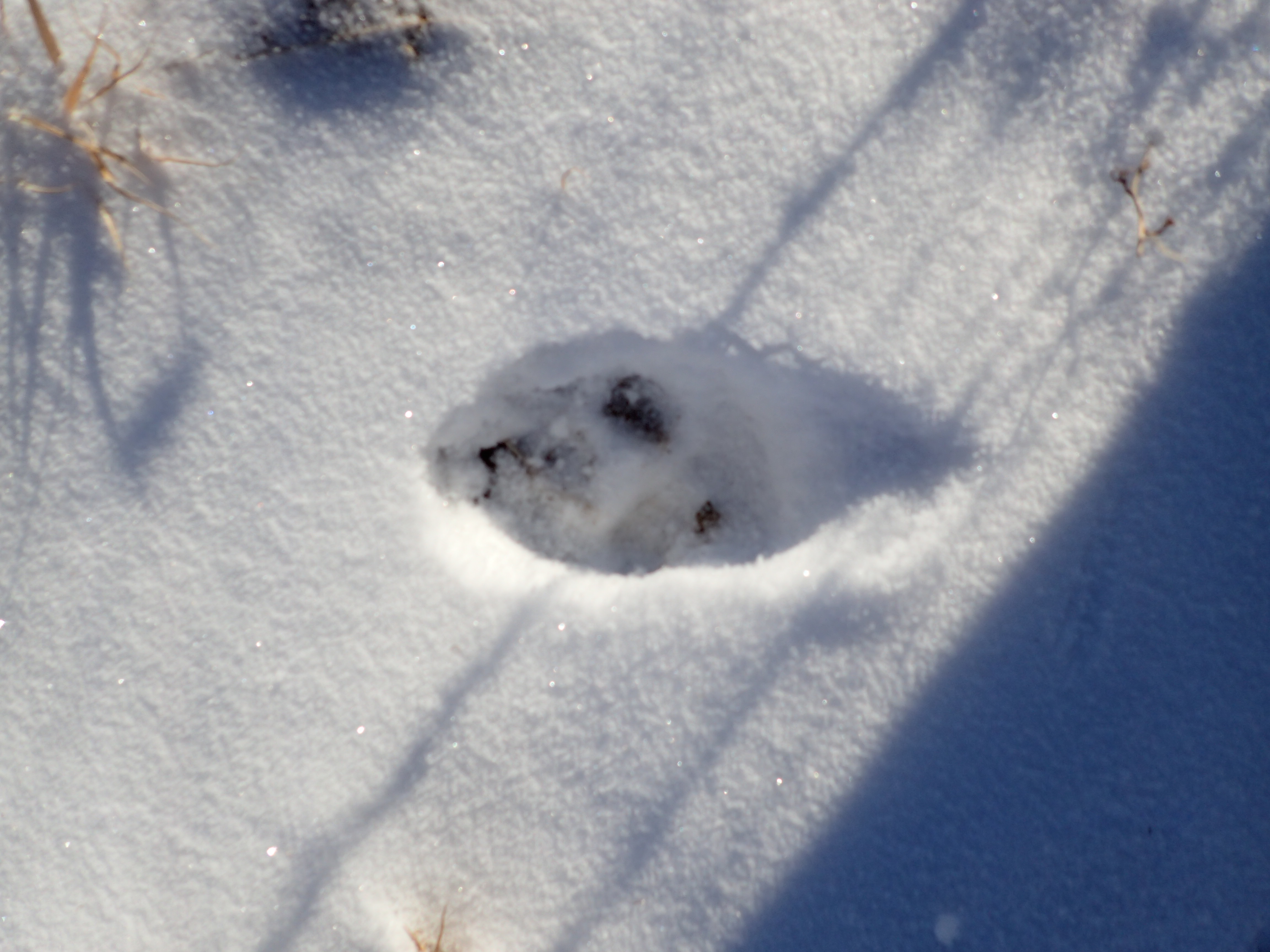
It’s not just poachers that prompt vigilance among red deer. This wolf track spotted near a herd of females and young was fresh.

red deer 3 males gathering scent n

Some scent on the air kept causing the largest of these three males to look back. 

red deer running over hill n

Dozens of stags stream over a break in the hillside. In a land where nomads and their herds have shared the landscape with wild animals for millennia, the countryside would seem empty without the red deer. As Mongolia’s human population continues to grow, it will become increasingly necessary that places such as Hustai National Park are protected if the deer are to continue to thrive.

Takhi – A Success Story in the Land of Chinggis Khan

Takhi w magpie full n

Magpie and takhi (Przewalski’s horse) – old friends reacquainted in a scene that has played out for many thousands of years but that was sadly interrupted in those decades during which the takhi were extinct in the wild. 

In 1967, somewhere on the arid steppe of Mongolia’s Western Gobi Dessert, the last small herd of wild takhi was seen. Two years later, only one horse remained. And then Equus przewalskii vanished completely from the wild. Although closely related to modern domestic horses, takhi were never tamed. This differentiates their status as “truly wild” from the ferrel mustangs of America which are descendants of domestic horses.

In their natural environment, wolves were their main predators, and the dry, harsh, cold conditions of the steppe would invariably claim victims each winter. But the main cause of the demise of the takhi was probably due to its being hunted for meat.

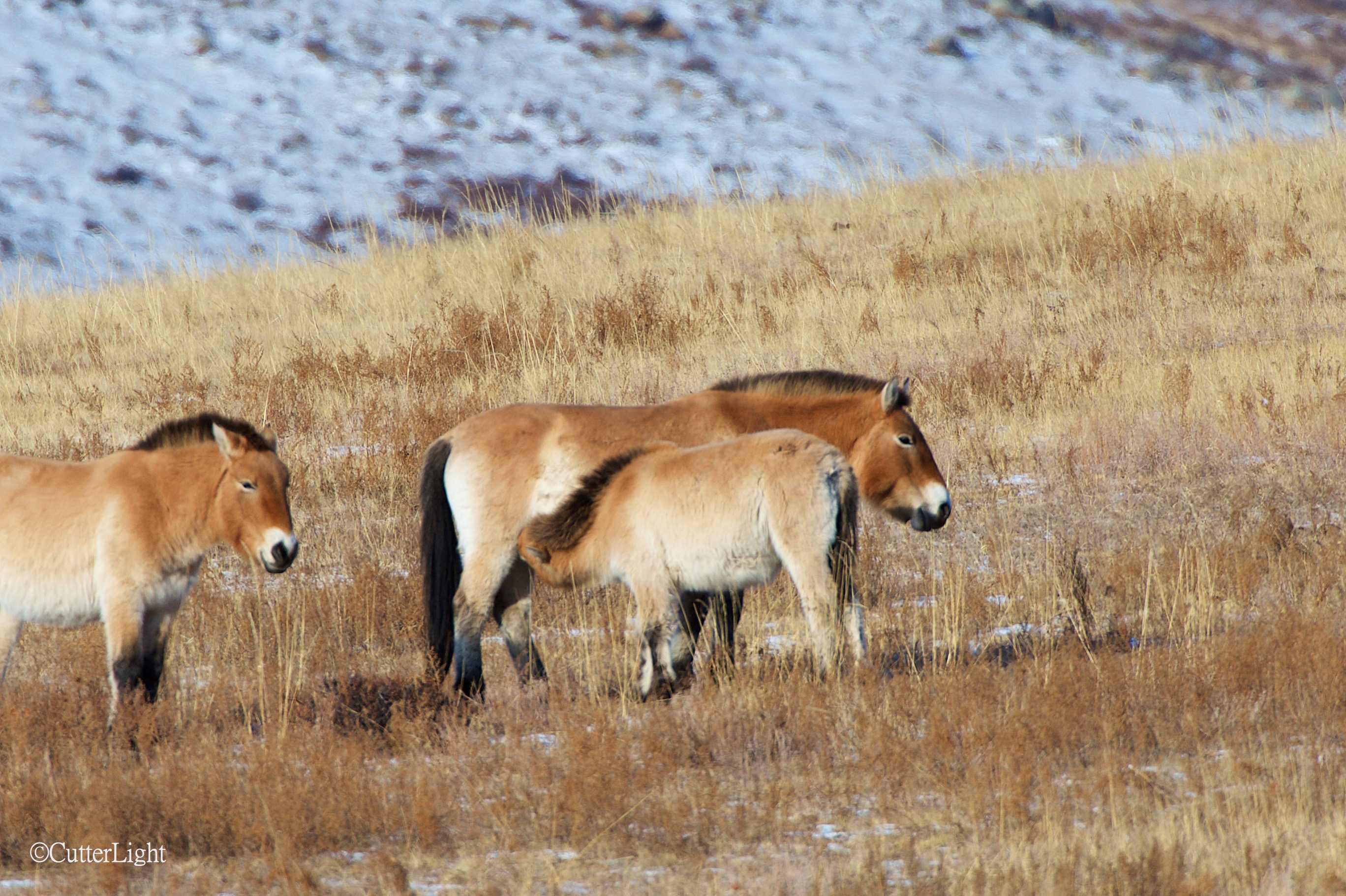
Takhi nursing winter n

Takhi form small family groups comprised of a lead stallion, two or three mares, and their offspring. These family groups loosely intermingle with other families as well as with bachelor stallions which often travel in pairs or groups of three. Stocky and with zebra-like manes, takhi are comparatively small, standing only about 48 – 56 inches tall at the shoulders. They have 66 chromosomes, two more than any other species of horse. 

By 1970, the only living specimens existed in a few zoos and private ranches. Extinct in the wild, it seemed only a matter of time till their official extinction from the planet would be announced.

Then something truly remarkable occurred. In a cooperative venture between the Zoological Society of London and Mongolian biologists, the horses were reintroduced to Mongolia’s Khustai (Hustai) National Park where they’ve been thriving even since.

takhi with red deer n

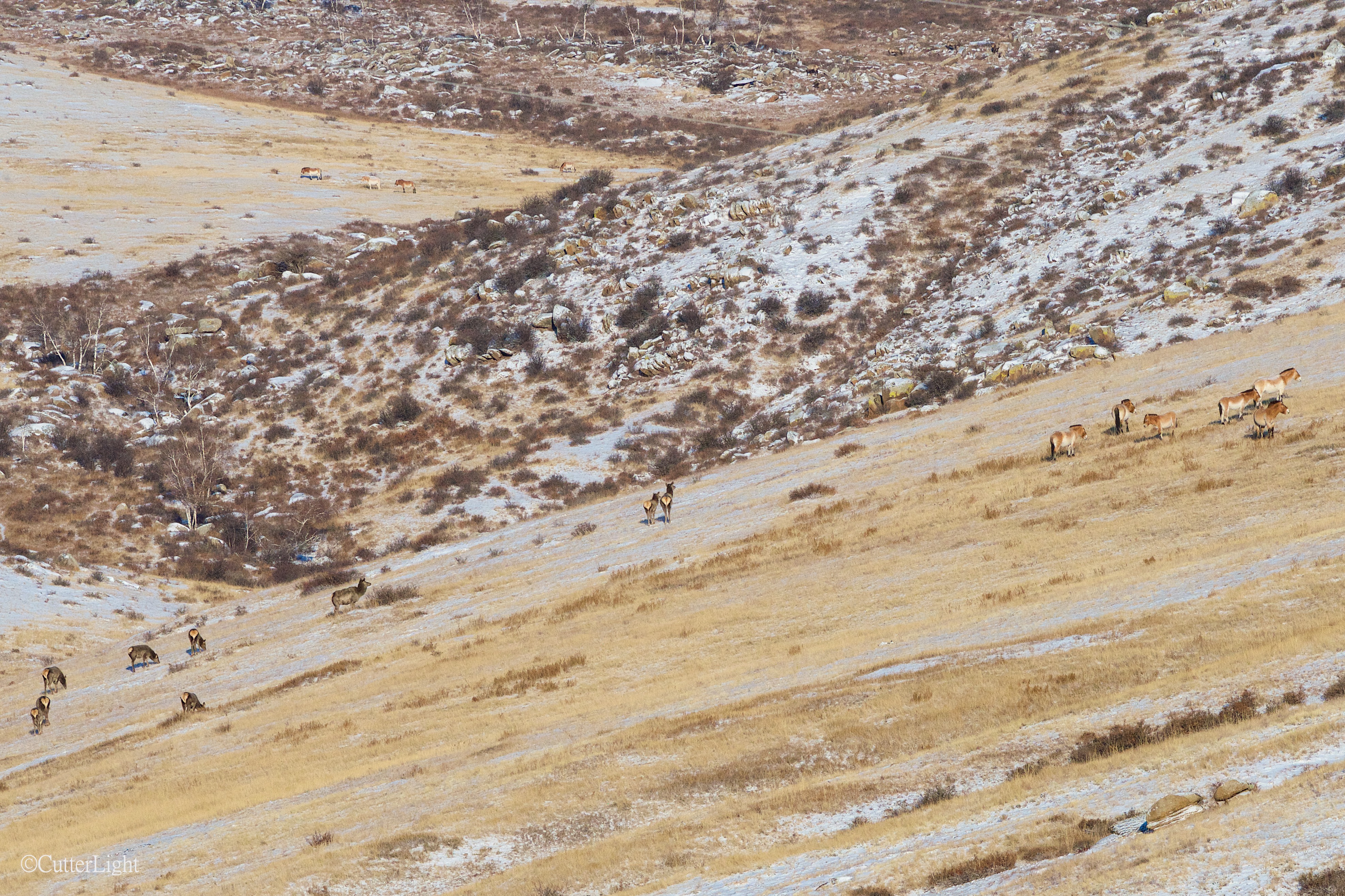
On a morning bright with ice needles in the air and a fresh dusting of snow on the ground, takhi and female red deer (Cervus elaphus) share a piece of rugged terrain in Mongolia’s Khustai National Park. 

takhi stallion pair n

In full winter coats, these wild takhi are as beautiful as they are tough.

We counted ourselves as lucky to have spent a few days in Khustai during some of the coldest stretches of winter. The deeply rutted dirt roads were quiet, wildlife was abundant, and the horses seemed only mildly curious regarding our presence.

takhi in summer field

Takhi can readily be viewed in summertime as well. We can’t say which season is more beautiful. There are wild horses in this world still. That is beautiful.

Big, Beautiful Grizz Chillin’ at the Edge of an Alaskan Forest

Grizzley admiring nails n

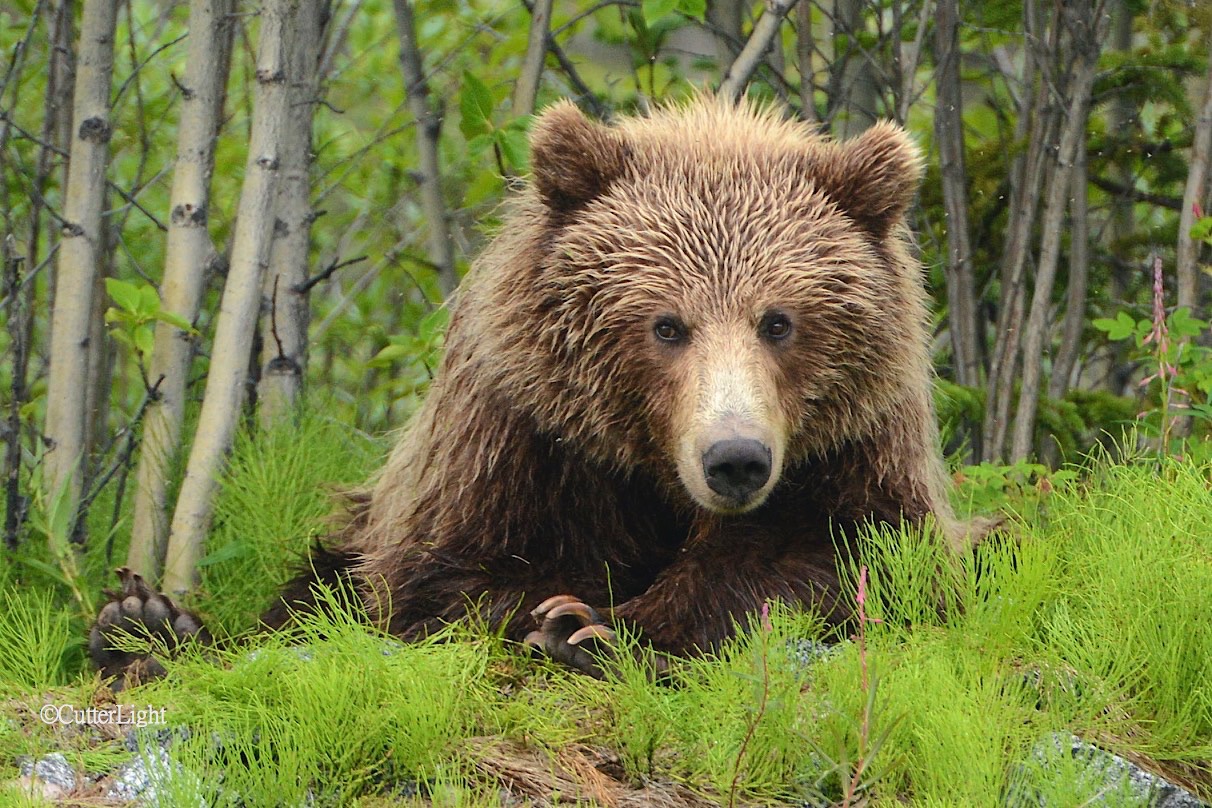
We caught this Alaskan grizzly bear chillin’ on the edge of a forest on a cool, overcast morning in mid-summer. With nails like that, who wouldn’t lie around admiring them? (Six more photos.)

Grizzley looking straight on n

The previous day, I (yours truly, Jack Donachy) managed to drop and break “the big lens.” But this sleepy guy barely paid us any attention as we photographed him from the safety of our Chevy, so the 70-200 mm with a 1.4 teleconverter got us close enough. Hard to say how many cars had driven by this big, blonde-brown hulk without noticing that morning. We stayed with him – and he with us – for about half an hour.

Grizzly the Thinker n

He’d doze off for a bit, wake up, think about whether or not to get up (or maybe he was trying to remember where he’d left his car keys last night), give a little sigh and then drop off to sleep again. 

grizzly sleeping  a n

Grizzly looking to his right n

And then he’d wake and take a look around.

Grizzly picking up scent n

Eventually a scent on the air caught his attention…

Grizzly ambling off diorama n

And he ambled off. Almost looks like he’s posed in a diorama. The overcast morning light really made the colors pop.

Crows Ice Fishing for Caddis Larvae: Tuul River, Mongolia

carion crow flock tuul  n mountains n

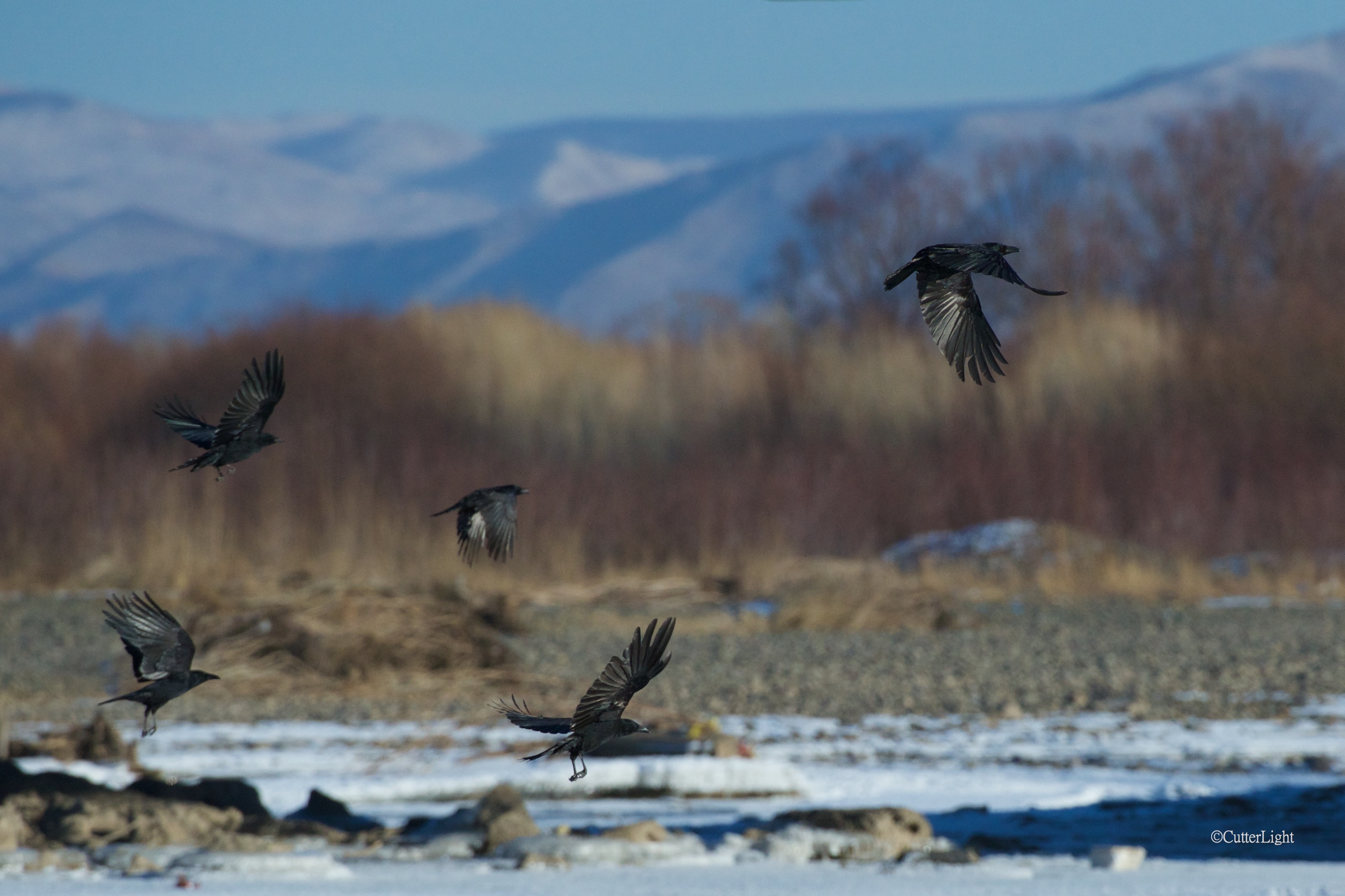
Corvids – a group which includes crows, ravens, rooks, jays, magpies and nutcrackers – fascinate. On a frigid December afternoon, we found them ice-fishing for caddis larvae in Mongolia’s Tuul River in the heart of Ulaanbaatar. (Click any of the photos for a larger view.)

The most intelligent of all birds, and with a brain-to-body-mass ratio rivaling that of the great apes and cetaceans, crows and their allies often exhibit remarkable behavior. Members of this family have been observed using and to some degree engineering purpose-specific tools – the only nonhuman animal other than the great apes to do so. There’s little doubt that certain feeding behaviors adopted by crows have been learned by watching other birds and animals.

carrion crows wings n cadis n

Note the object in the beak of the crow on the left. It’s a caddis larva casing.

The Tuul River flows through Ulaanbaatar, Mongolia’s capital city. Despite urbanization, the river’s water quality remains high – good enough to support species of trout as well as sensitive aquatic insects such as mayflies, stoneflies and caddisflies – species which spend the early part of their lives as larvae on the bottoms of clean rivers and streams. The Tuul is fast-flowing. Consequently, despite weeks on end of sub-freezing temperatures, here and there pockets of water remain open over shallow, stony, silt-free bottom.

OLYMPUS DIGITAL CAMERA

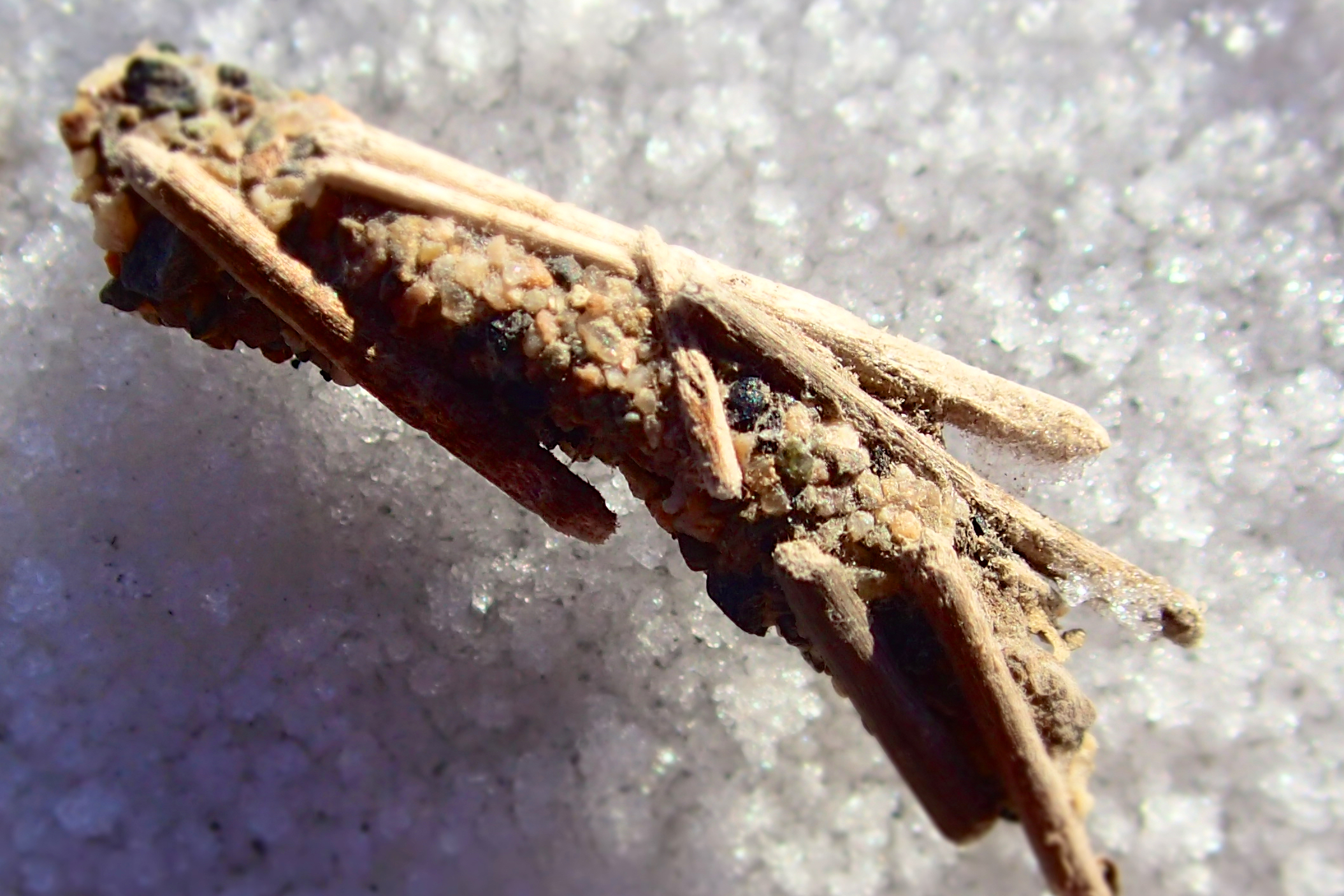
We took a cue from watching the crows and began scanning the ice for caddis larvae casings. As our eyes tuned into the proper size and shape, the empty husks appeared everywhere. This casing, constructed of tiny sticks and pebbles, is about 1.5 inches long (3.8 cm) and belonged to a member of the Northern case maker caddisfly family. 

Perhaps the crows learned of the abundance of wintertime food in these areas of open water by watching dippers – a robin-sized bird that happily plunges into pools and riffles in all seasons in search of aquatic insects and small fish. In fact, on this day we saw a white-throated dipper submerge itself in one of the riffles where the crows were feeding and come up with a small fish.

carion crow w caddis n

Here a carrion crow (Corvus corone) has his prize – a caddis larva pried from its pebble and stick casing.

Not adapted to plunge into water, the crows were fishing from the edge of the ice – thus gaining access to water not overly deep, but deep enough to provide habitat for slow-moving caddis larvae. Resourceful birds, are crows.