
The Lake – for a Moment
Chignik Lake, Alaska, Dawn March 26, 2019
The Lake – for a Moment
Chignik Lake, Alaska, Dawn March 26, 2019

Resplendent! This male Pine Grosbeak came down from a tree crown to forage beneath one of the feeders at White Spruce Grove.
When we stepped out the door yesterday morning, the first thing we noticed was a new song in the air. A spring song. Returning Fox Sparrows have been the first to begin this each year we’ve been in Chignik Lake, but the warbling melody didn’t sound like a Fox Sparrow’s riff. We could see the bird, a plump silhouette atop a spruce tree near the church and since we were on the way to the White Spruce Grove to top off bird feeders anyway, the obvious choice of walking path was the one that would bring us nearer to the singer.
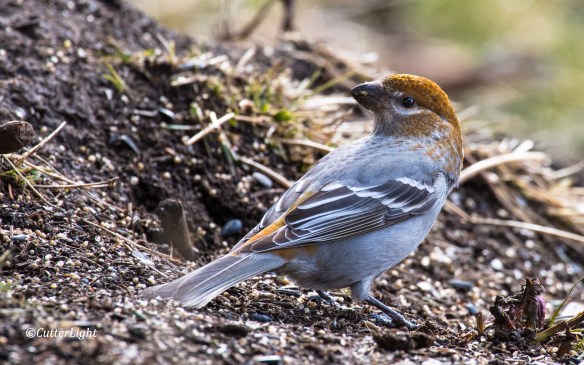
The female grosbeak briefly joined her mate.
Pine Grosbeak, brilliant red and singing for all he was worth. Quite a change from the brief but distinctive Peek Peek! we hear from this species throughout fall and winter. It wasn’t a new bird, but it was new behavior. We continued on the half-mile to the spruce grove with anticipation.
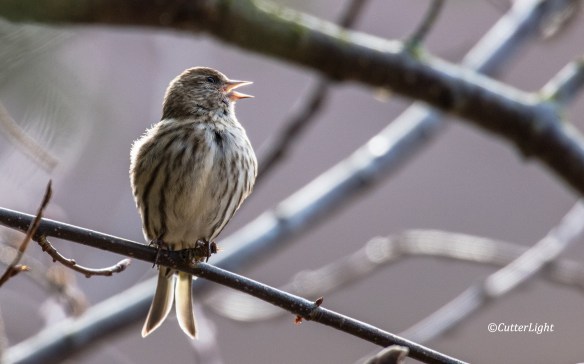
Our Pine Siskins were their usual raucous selves, singing, squabbling, gorging on seeds, darting from tree to tree.
Along the way scattered flocks of Pine Siskins buzzed and called from the sky and from a neighbors’ house where they sometimes take refuge in a few spruce trees while visiting the feeder there. Magpies, common here at The Lake, made their presence known, as did a woodpecker, almost certainly a Downy though we couldn’t find it. Further along a pair of Black-capped Chickadees gave a couple of their various calls from willows, the branches of the scrubby trees suddenly having turned bright yellow-green and beginning to bud.
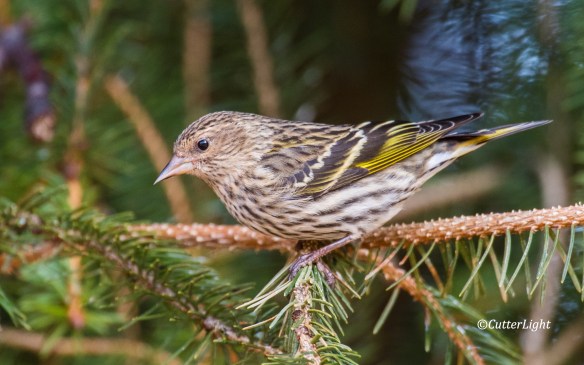
My guess is that when the time comes, the siskins will head up the peninsula to the denser spruce forests around Lake Iliamna and similar places to nest, but they’ve been welcome winter visitors the past two years.
At the White Spruce Grove the usual Siskins, which showed up last fall and have spent the winter, were busy at the feeders as well as prying the last seeds from cones. But there were a few larger, rounder shapes foraging on the ground as well. We didn’t get our binoculars up in time to have a look, but as we were filling the feeders we heard the unmistakable plaintive song of Golden-crowned Sparrows.

There’s just a touch more gold in this Golden-crowned Sparrow’s crown than there may have been a month ago. He’s still a ways off from full breeding plumage though.
Sure enough, once we scattered a little seed along the brushy edge where they like to feed, they began to show up, and they brought a Dark-eyed Junco with them. Seldom observed out on the Alaska Peninsula – and absent altogether or marked with a question on most of the region’s birding lists – Juncos have shown up in small numbers each of the three winters we’ve spent here. In fact, we think we have the only documentation on the peninsula of Oregon race juncos.
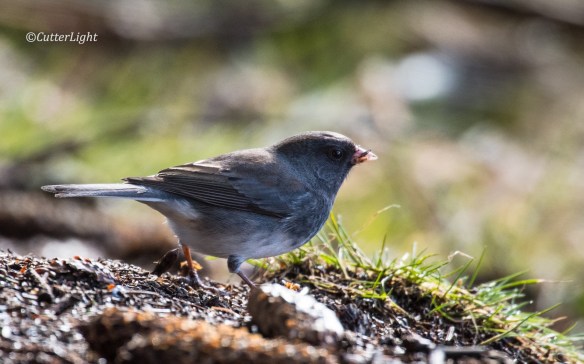
While there have been fewer Juncos at the Lake than there were last year, every so often we see one or two or three.
The Golden-crowned Sparrows appear to have just begun growing in their breeding plumage. Some of the male Siskins though are already there, showing off brilliant canary yellow in their primaries. At one point a Belted Kingfisher rattled by, most likely a male getting things ready for the females that will soon return. Ravens called in throaty croaks from a far hill. No ducks on the water and no eagles on their usual perches, which is a little unusual. Perhaps the ducks are already up at Black Lake where most of the nesting occurs. Gulls will begin returning any day.
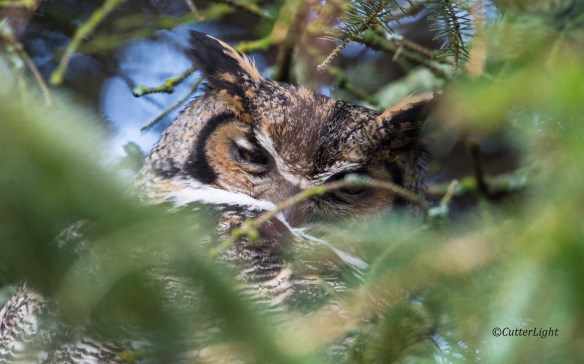
Sleepy but looking well fed, she lost both of her fully-fledged chicks last year, one to an electrical box on a utility pole and the other to some other cause. We’re hoping she nests again this year with much better luck.
We aren’t always lucky enough to see one and we rarely see both of them, but this was a red letter day as both of our Great Horned Owls – the female and the slightly smaller, more lightly colored male – were perched where we were able to find them. As is usually the case, they were buried in shadows behind thick evergreen boughs, aware of our presence but seemingly unconcerned. The ground beneath their favorite roosts is littered with bits of hair, feather, bone and beaks and oblong balls the size of two thumbs placed together packed tight with the remains of the various voles, Magpies, ermine, lemmings or whatever else constitutes one of their meals. Last year the female spent several days perched atop a winter-white Snowshoe Hare – several meals.

Discernibly smaller and with brighter plumage, we feel fairly certain that this is the male. The Ainu – Japan’s indigenous people – believed that owls protected their villages. They are certainly regal animals.
Frost on the ground this morning, but if you look closely at the photos, you can see other signs that spring is coming to Chignik Lake. Hopefully I’ll be posting a video of a Fox Sparrow singing in the near future.

With their uplifting songs and stunning plumage, if birds didn’t actually exist I don’t think we’d believe that they even could exist. They certainly brighten our world.
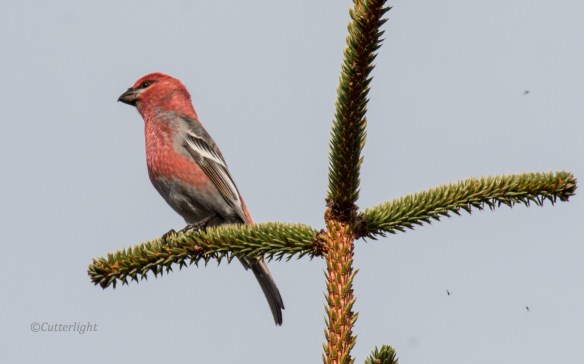
His colors will never be brighter than they are right now, nor his call more cheerful. Pine Grosbeaks tend to be irregular in their presence, but for the past two years in Chignik Lake they’ve been regular residents. For a look at a nearby female, which is very differently colored, see below. (Note the midges flying around to the right in the above photo. With big insect hatches coming off the lake and river, our swallows should be here any day!)
Most days in the village the optimistic Peee-Peeet! of Pine Grosbeaks can be heard as they fly overhead or perch atop the tallest spruce trees. Always striking, the males are particularly colorful during springtime. Like their crossbill cousins, Pine Grosbeaks can be remarkably unwary. Move slowly around them, sit quietly, and they may forage on the ground practically at your feet. I’ve even had one perch on my head!
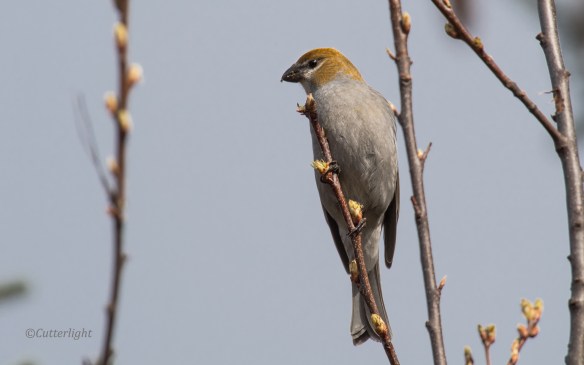
Female Pine Grosbeaks feature a rich olive-gold on their head, upper back, rump and often on their upper breast. This time of year, the leaf buds of deciduous trees figure heavily in Pine Grosbeaks’ diets. During wintertime they can be attracted to feeders featuring black oil sunflower seeds, suet or (I’m guessing) peanuts. They also love small fruit and during warmer months will include insects in their diet.
The “gros” of grosbeak is from the French gros, which means large. This is a species we’ll be looking for this summer in Hokkaido, Japan – part of their ranged across the Northern Hemisphere.
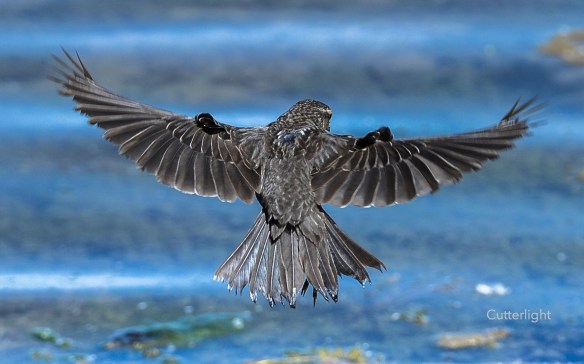
Hovering as she hunted for flying insects at a Montana pond, this female Red-winged Blackbird was able to keep from “stalling out” by redirecting air flow over her wings with her alulae, the tufts sticking up on the fore edge of her wings.
It’s easy to find oneself marveling at the ease and grace with which a raptor or songbird flies – the seamless changes of direction, the steep climbs, the ability to hover, the smooth landings. Aiding in these intricate maneuvers is a small tuft of tiny feathers that the bird can manipulate to create a pocket of whirling air – a vortex – which helps it finesse some of its most amazing moves.
It appears that the alula evolved approximately 130 million years ago during the Cretaceous Period, first in genus Protopteryx and a few million years later in Eoalulavis, or Dawn Bird. Earlier species such as the bird-like dinosaur Archaeopteryx, Old Wing, lacked alulae, indicating that while they probably were capable of gliding, they most likely did not fly in the sense that modern birds fly.
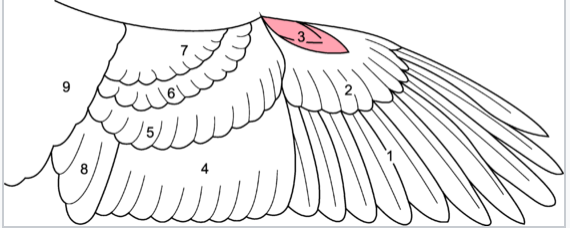
Bearing 3 to 5 small, asymmetrical flight feathers, the alula is found on modern bird species as well as on some pre-avian dinosaurs that were capable of flight. It’s the bird’s first digit, analogous to the human thumb. Illustrations courtesy of: Muriel Gottrop – https://commons.wikimedia.org/wiki/File:BirdWingFeatherSketch.png

Snow Birds: House Sparrows, Ulaanbaatar, Mongolia
Come!
Let’s go snow-viewing
till we’re buried!
Matsuo Basho, 1644 – 1694
House Sparrow males and females are dimorphic: a female is center in this photo, accompanied by three males. This species has adapted so well to life with people, they’ve become nearly ubiquitous in places of human habitation throughout the world – and nearly absent in more natural environments.
Basho suffered from severe bouts of depression, occasionally becoming recluse for long periods of time. A solitary nature took him on a number of journeys, alone, along routes that were often well off the beaten path. The Edo Five Routes which he followed on one of his earliest journeys were considered to be among Japan’s most dangerous roads; When he first embarked on this trek, he expected to be killed by thieves or to simply die along the way. Widely regarded as the world’s finest master of hokku (haiku), his poetic travel log Oku no Hosomichi (The Narrow Road to the Interior) is considered to be his finest work.

At First Sight: Sandhill Cranes, Northern British Columbia
Sandhill Cranes choose partners based on graceful mating dances and remain together for life.
…and our graves will be like two lovers washing
their clothes together
In a laundromat
If you will bring the soap
I will bring the bleach.
Richard Brautigan (from Romeo and Juliet, 1970)
– Raised in abject poverty, Richard Brautigan (1935-1984) was struggling to gain a foothold in San Francisco’s literary scene when, in 1967, he published Trout Fishing in America. The counter-culture novel catapulted him to international fame. A year later he solidified his reputation with In Watermelon Sugar.
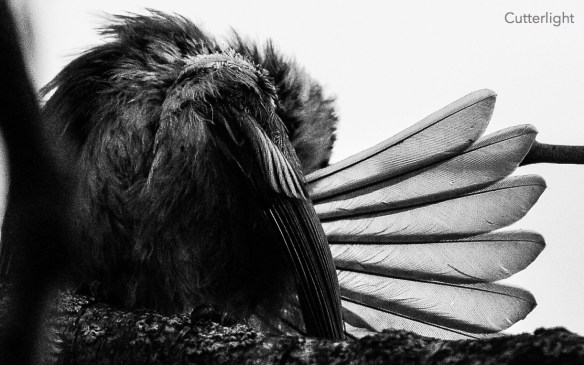
Feather Fan: Junco
To me the meanest flower that blows can give
Thoughts that do often lie too deep for tears.
William Wordsworth – Intimations of Immortality, 1807
Along with Samuel Coleridge, Wordsworth (1770-1850) is credited with founding English Literature’s Romantic Age. He was the country’s Poet Laureate from 1843 until his death.

Amber Eyes: Arctic Fox, Point Hope, Alaska
The thick, soft fur of the Arctic Fox is the most efficiently warm of any land mammal.
It seems to me that the natural world is the greatest source of excitement; the greatest source of visual beauty; the greatest source of intellectual interest. It is the greatest source of so much in life that makes life worth living.
David Attenborough – BBC Life documentary series, 2009
Knighted in 1985, Sir David Attenborough turned 90 in 2016. The world’s most recognized narrator of natural history films, he remains in possession of amazing vitality.

September 18: First snow in the mountains.
September 21: First frost along the lake.

Nearly a ton each, when wood bison decide to take over a piece of the Alaska-Canada highway, they do. Shooting from the deck of our C-Dory, we found ourselves surrounded by leathery thuds of muscle smacking muscle, the crack of horn on horn, hooves pounding pavement and turf as animals the size of small trucks worked themselves into sprints, snorts, grunts, bellows and the thick odor of bison. We’d been photographing more placid scenes in a herd of about 100 animals – cows and nursing calves, young bulls, grandpa bulls and The Kings – the taut-muscled mature males that stood hands higher than the other members of the herd. Aside from a few younger males occasionally testing each other with head-butts, all was tranquil. The older bulls, hump-shouldered, muscle-ripped massive beasts, grazed peacefully along with the cows and calves or rolled in dust wallows.
The dynamics changed in the blink of an eye. A couple of the big boys started snorting at each other, then locking horns hard and kicking up dust. Suddenly every big bull in the herd, including the largest bull, was on high alert, tails held high, heads lowered as they zeroed in on the point of conflict. Kicking up grass, shrubs, sand and dust, these muscle-sculpted kings moved with impressive speed in their attacks which were aimed at bellies and buttocks as well as heads and shoulders.
Vehicles on the road cautiously edged backwards to give the sparring bison sufficient berth. The motorcyclist seen on the left side of this photo turned around and headed in the opposite direction as the fight edged closer to him.


