Birds of Chignik: Black-Legged Kittiwake

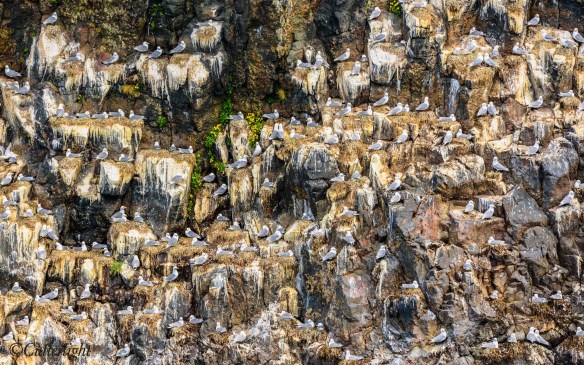
Black-legged Kittiwake nesting

You can imagine the high-pitched clamor as a boat draws near a colony of nesting kittiwakes. The gregarious gulls cram into every available ledge, adding their own beds of mud, grass and seaweed. There the females will lay one to three eggs in hues that might range from blue to olive to brown. (Resurrection Bay, Alaska, June 22, 2013)

Fancifully named for a cry that resembles kit-ti-wake, Black-legged Kittiwakes are generally the most common gull – and at times the most common seabird – along the Chignik Coast. At an average size of 17 inches, the relatively slender kittiwake is a graceful master of the salt air, soaring and coasting effortlessly until it spies a herring or other small fish at which point it dives tern-like into the water. Because they snatch fish from near the surface, kittiwakes are the friends of fishermen and whale watchers alike; flocks of these smallish gulls crashing the ocean surface for baitfish are reliable indicators that cod, salmon, halibut or other gamefish – or whales – are pushing the small fish to the surface. Kittiwakes have an uncanny capacity for somehow knowing when whales are about to surface – cueing photographers as to where to focus.

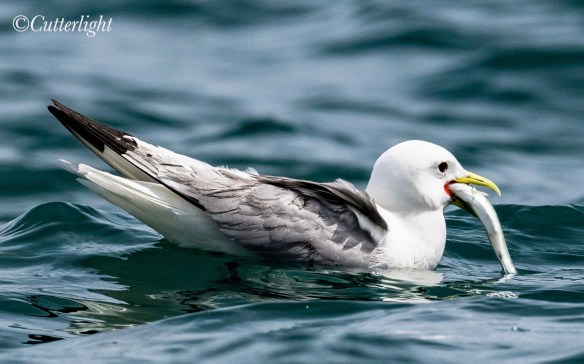
Black-legged Kittiwake with herring

Some have described the kittiwake as a “dainty” gull, but there’s nothing dainty about that bill. Note the bright red mouth of this bird in breeding plumage. It will cram as many of these herring as it reasonably is able to into its stomach and regurgitate a good portion of them to feed its young. (Chignik Bay, Alaska, June 28, 2020)

With the exception of breeding season, these are birds of the ocean, seldom venturing inland. While they may follow fishing boats and other vessels in search of fish that might be disoriented in the wake, kittiwakes will not be found at garbage dumps as are some other gulls. In addition to diving from the air to catch fish, kittiwakes sometimes sit on the surface and catch prey.

Black-legged Kittiwakes Chignik Bay

Following a morning of feeding, a flock of kittiwakes rests on Eagle Rock in Chignik Bay. (July 28, 2020).

Black-legged Kittiwake flight

Look for distinctive black wingtips, a dark eye, an all yellow bill, angular, somewhat tern-like wings, and a more slender profile than that of most other gulls.

Black-legged Kittiwake nonbreeding plumage Kenai Fjords

The dark splotch on the back of the head is indicative of a nonbreeding kittiwake. Juveniles will also have this splotch as well as a dark collar, a distinctive dark pattern on their wings, and a dark bill. (Kenai Fjords National Park, Alaska, August 2, 2009)

As the climate continues to warm and overfishing throughout the world persists, kittiwakes are a species to keep a a concerned eye on. Although their populations worldwide are in the millions, steep declines have been observed in recent years.

Black-legged Kittiwake Range Map: with permission from The Cornell Lab of Ornithology, Birds of the World

Black-legged Kittiwake Rissa tridactyla
Order: Charadriiformes
Rissa: From Rita, the Icelandic name for this bird
tridactyla: Ancient Greek tridaktulos – three-toed. The kittiwake’s rear toe is reduced in size, giving the appearance of just three toes.

Status at Chignik Lake: Abundant in Chignik Lagoon and Chignik Bay, particularly in summer

David Narver, Birds of the Chignik River Drainage, summers 1960-63: Occasional in Chignik Lagoon

Alaska Peninsula and Becharof National Wildlife Refuge Bird List, 2010:
Common in Spring & Summer; Uncommon in Fall; Rare in Winter

Aniakchak National Monument and Preserve Bird List: Present

Table of Contents and Complete List of Birds of Chignik Lake

© Photographs, images and text by Jack Donachy unless otherwise noted.

For a list of reference materials used in this project, see: Birds of Chignik Lake

Birds of Chignik Lake: Willow Ptarmigan – Once Abundant at The Lake; Now Nearly a Cryptid

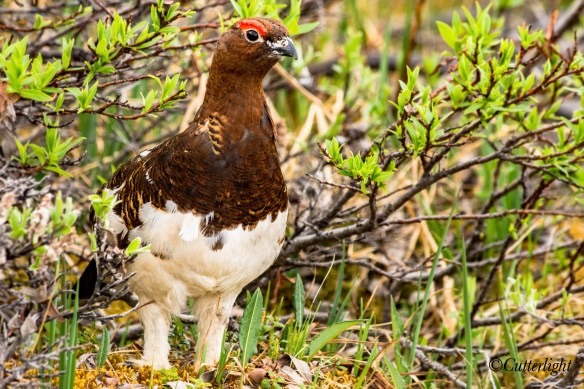
Willow Ptarmigan male

Hmm… I wore white slacks something like these to my high school senior prom. I think they are better suited to this dapper male Willow Ptarmigan. While on a backcountry backpacking excursion in Denali National Park a few years ago, we had an opportunity to observe and photograph Willows in frame-filling portraits like this. The male’s “potato! potato! potato!” call woke us each morning in a breathtaking landscape we shared with carpets of wildflowers, rushing glacial rivers, Grizzlies, Dall’s Sheep, Caribou, Moose, Wolves and Wolverines. (Denali National Park, June 9, 2017)

In choosing photographs for this project, I try to use pictures taken of local birds and, to the extent possible, to use my own captures. At the same time, I strive to select at least one photo for the article that clearly depicts characteristic markings and coloration of that species. Sometimes that’s not possible. I have yet to get any photograph at all of the Gyrfalcons that occasionally cruise through our valley. Clear captures of a few other species I’ve positively ID’d have eluded me as well – Northern Harriers gliding in an unphotographable distance, a Saw-whet Owl who evaded being photographed through high winds and rainstorms and his own secretive habits during a brief visit to our village being among examples.

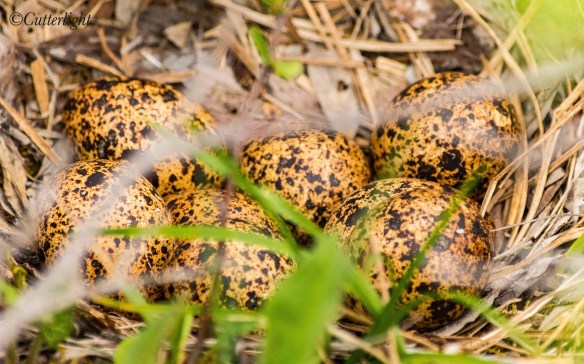
Willow Ptarmigan nest eggs

We startled ptarmigan from their nests several times while hiking through willow thickets in Denali. The best procedure is to give the nest a respectable berth and continue hiking, but on this occasion I took the opportunity to snap a quick photo – with a telephoto lens and not disturbing the vegetation surrounding the well-concealed eggs. The hen soon returned. Willows may lay as few as four or as many as 14 inch-and-a-half to two-inch eggs. (Denali National Park, June 7, 2017)

The Willow Ptarmigan presents a somewhat different challenge.

We’ve never seen one here at The Lake. Or anywhere near The Lake.

Nor heard one, though we are familiar with their calls.

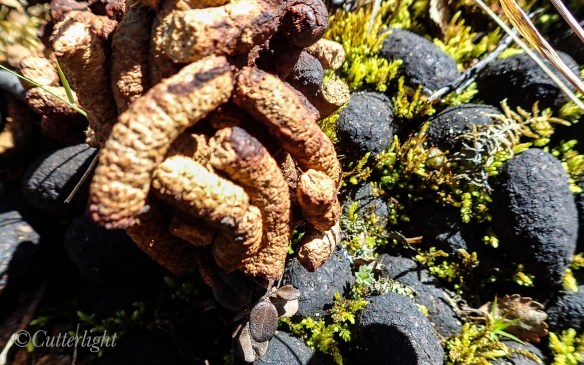
Nor found their scat, though we know what that looks like and have searched likely places for it.

willow ptarmigan scat

Willow Ptarmigan scat… in case you were wondering… (Denali National Park, June 14, 2017)

No one else has seen a clue of this species around here in recent years either, though everyone agrees that they were once abundant. “We used to sometimes find them in the swamp (marsh) right in the center of the village,” a guy my age told me. “Yeah, they used to be everywhere,” another friend observed. “Especially around Black River and Upper Lake.”

Not anymore. Whether they were locally shot out (they are famously unwary), overcome by  disease or simply no longer find the habitat here suitable is uncertain. In recent years they have been absent, and there are enough eyes looking out for them that if any were around, it would be known.

Willow Ptarmigan unwary

They’re not guarding nests. They’re not tame. They haven’t been baited. They’re just Willow Ptarmigan being Willow Ptarmigan, and as Barbra could as easily be approaching with a 20 gauge shotgun as with a camera, they’re illustrating a susceptibility to being locally extirpated by hunters. They aren’t merely “dumb.” Ptarmigan have been known to exhibit playful behavior with each other and they’re well adapted to the harsh environments they thrive in. But perhaps they trust the camouflaging qualities of their plumage – which becomes white during wintertime – a little too much. (Point Hope, Alaska, September 2, 2013)

And then, just a few weeks ago one morning while Barbra and I were out exploring after a fresh carpet of snow had been lain down, there they were. Not the birds themselves, but tracks. Unmistakable. Miniature three-toed snowshoes gently pressed into the powdery snow. Ptarmigan. No cryptozoologist on the trail of Bigfoot could have felt their heart soar higher than did ours at the finding. We stood rock still and listened. We watched, our eyes peering as far up the trail as we could see and into every little pocket and open space along the way searching for movement, a dark eyeball, anything. We quietly followed the tracks, not even daring to whisper till they abruptly disappeared. We continued our hunt in ever broadening circles, eyes sharp for a bird we knew would be as white as the snow itself this time of year.

No birds.

Yet.

But maybe they’re coming back. Oh, happy day!*

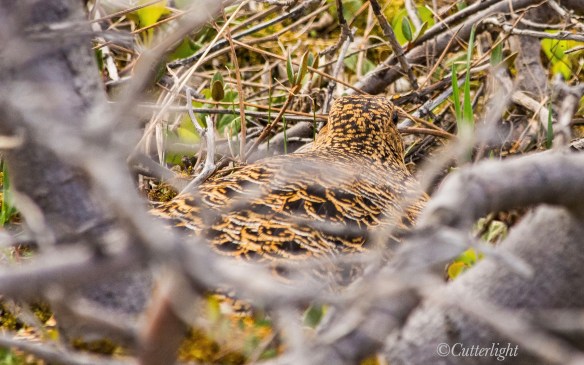
Willow Ptarmigan hen on nest

The portent of good things to come – and a scene we’d like to find near The Lake: a Willow hen brooding her eggs. Members of the grouse family, Willows are the only grouse species in which the males regularly assist in raising the young. (Denali National Park, June 8, 2017)

Willow Ptarmigan Range Map: with permission from The Cornell Lab of Ornithology, Birds of the World

Willow Ptarmigan Lagopus lagopus
Order: Galliformes
Lagopus: Ancient Greek Lagos = hare + pous = foot: hare foot, for its heavily feathered feet which, as with hares, allows the ptarmigan to more easily walk on snow
lagopus: as per genus definition above

Status at Chignik Lake: Now rare, but as Willow Ptarmigan are seen elsewhere on the Alaska Peninsula, could repopulate in the future

David Narver, Birds of the Chignik River Drainage, summers 1960-63: Common around Chignik Lake; Abundant around Black Lake

Alaska Peninsula and Becharof National Wildlife Refuge Bird List, 2010:
Common in Spring, Summer & Fall; Uncommon in Winter

Aniakchak National Monument and Preserve Bird List: Present

*From Shakespeare’s Henry IV, Part 2. Bardolph: “Oh Happy Day! I wouldn’t even trade a knighthood for my new, good fortune.”

Table of Contents and Complete List of Birds of Chignik Lake

© Photographs, images and text by Jack Donachy unless otherwise noted.

For a list of reference materials used in this project, see: Birds of Chignik Lake

Birds of Chignik: Western Sandpiper – Elegance in a Tiny Being

Rufous scapulars and golden-brown highlights make the Western Sandpiper among our prettiest little shorebirds. Check out the tiny spoon at the tip of this little sandpiper’s down-curved bill. Such elegant detail in a tiny being. (Chignik River, July 24, 2020)

We had irregularly been encountering flocks of anywhere from dozens to perhaps a couple hundred small shorebirds on fishing trips to Devil’s Flats. Obsessed with putting flies in front of salmon and char, I had difficulty breaking away to attempt photographs of the little peeps. But as days passed and July headed toward August, I knew I’d better get with it before the visitors migrated out.

Chignik River Western Sandpiper

I am occasionally taken aback with photographic evidence of just how modest some of my field estimations of numbers in flocks can be. I’d been saying “dozens” when we encountered these sandpipers, but there are well over 100 birds spilling out of this frame and there are still more birds in a separate flock nearby. If you’ve got a screen large enough to not result in eyestrain, it might be interesting to see how many birds you come up with in the above picture. (Photo by Barbra Donachy, Chignik River, July 24, 2020)

Yet, even equipped with the right photographic equipment and good intentions, it wasn’t until the evening of a day late in July that Barbra and I finally got our shots. The fishing had been good, but the birds had been no-shows. We’d called it a day and were heading back to the skiff when the peeps finally arrived. Suddenly 200 or so birds were winging their way up the river, heading straight for the gravel shores of the island where we’d beached Buster. We immediately dropped our fishing gear into a loose pile and began setting up to shoot as the birds lit down along the rocky shoreline.

western sandpipers chignik river

At an average length of just 6½ inches – only a quarter of an inch larger than a junco – these birds presented us with the usual challenges in photographing, wary, tiny, ever-moving wild birds. We found that by crawling slowly and keeping vegetation between ourselves and the feeding sandpipers – tufts of tall grass, burdock, willows – we could approach fairly close without disturbing them. For a short while, they scurried through the river shallows and rocks bobbing their heads and feeding frenetically. At times they appeared to be using their bills to pick something minute from the water’s surface; at other times they jabbed and probed between rocks; and at still other times they seemed to use their bills as a small plows, pushing them forward to stir up the silty bottom, chirping and cheeping with enthusiasm at the smorgasbord they were finding. For a little while, there was quite a lot of busy activity.

And then they did something that astonished us. Almost as one, the feeding stopped, the chattering quieted, and the little birds seemed to disappear. Before we knew it, most of them had nestled into comfortable places among the rocks, tucked their bills beneath a wing, and closed their eyes. I’d never considered shorebirds roosting after a meal as do other birds, but of course they must. Had we not known the birds were there, I doubt we’d have noticed them. Suddenly, the many times I’d been walking along a shoreline and was startled by a flock of peeps exploding into flight practically under my feet came into focus. Even a falcon passing overhead might miss these birds at rest. It is their movement that gives them away.

western sandpiper sleeping Chignik River

Of course, not all of the birds slept at once. Always a few remained vigilant, continuing to feed and looking about them as they did. However, we’d learned something that day, and on subsequent outings we tested ourselves by carefully looking over the ground near any actively feeding birds. At times we were able to find additional birds that were roosting, birds that in the past we would have missed.

Western Sandpipers flight Chignik River

We stayed with the shoot as long as we could, but by the end the sunlight had gone from this part of the river and a chill was seeping into the air. Who knows what prompts avian decisions? At some point the sandpipers lifted into the air and flew back downriver. I read a short essay on how it is that they manage to fly together, banking and turning in unison without colliding into each other. But I still don’t really understand it, which is well enough.

All things come to an end, and so it was with this day. Our Sockeyes for the year had already been caught, cleaned, filleted and freezer-packed, so on this day we had successfully cast to the river’s Dolly Varden Char and Pink Salmon, and whether foul-hooked or fair, a few Reds had found our flies as well. It was early still for Silvers, but we searched anyway and in so doing took note of a few King Salmon which we failed to entice. Jacob’s Ladder, Yellow Monkeyflower and River Beauty were near their peak, signs of active bears were everywhere, and on the way home I got nice photos of our fledgling Rough-legged Hawks.

The range map indicates that these sandpipers are migrants, on their way south after nesting further north. As we’ll be able to begin skiffing the river as early as we want to this coming year, an objective will be to keep a keen eye out for when these birds arrive on The Chignik.

Western Sandpiper Range Map: with permission from The Cornell Lab of Ornithology, Birds of the World

Western Sandpiper Calidris mauri
Order: Charadriiformes
Calidris: from Ancient Greek kalidris or skalidris, a term Aristotle used for some gray-colored shorebirds1
mauri: for the Italian botanist Ernesto Mauri

Status at Chignik Lake: Common on Chignik River gravel shorelines and bars for a few weeks in summer

David Narver, Birds of the Chignik River Drainage, summers 1960-63: Not Reported

Alaska Peninsula and Becharof National Wildlife Refuge Bird List, 2010:
Common in Spring & Fall; Uncommon in Summer; Not reported in Winter

Aniakchak National Monument and Preserve Bird List: Present

Click here for the: Table of Contents and Complete List of Birds of Chignik Lake

© Photographs, images and text by Jack Donachy unless otherwise noted.

1From the article “Calidris” in Wikipedia, which sites Jobling, James A (2010). The Helm Dictionary of Scientific Bird Names. London: Christopher Helm. p. 84. ISBN 978-1-4081-2501-4.

For a list of reference materials used in this project, see: Birds of Chignik Lake

Birds of Chignik: Black Oystercatcher – the Bill that Fits the Bill

black oystercatcher chignik bay

A Black Oystercatcher works an intertidal mussel shoal at the base of Eagle Rock in Chignik Bay. 

A sharp eye is likely to pick out the crimson of a Black Oystercatcher’s bill before the entire bird can be made out. Although, as can be seen in the above photo, their plumage has more brown that black in it, they tend to blend in well with the rocky, mussel-strewn habitat they prefer. There seldom seem to be many of these birds in any one place, but from the Aleutian Islands to Baja Mexico they are frequently seen in pairs, as single birds or as small family groups.  I’ve read that at times flocks of these striking birds can number in the dozens or even hundreds – no doubt an amazing sight. Look for oystercatchers especially on small rocky islands or sloping shorelines, especially at low tide when barnacle and shellfish colonies are exposed.

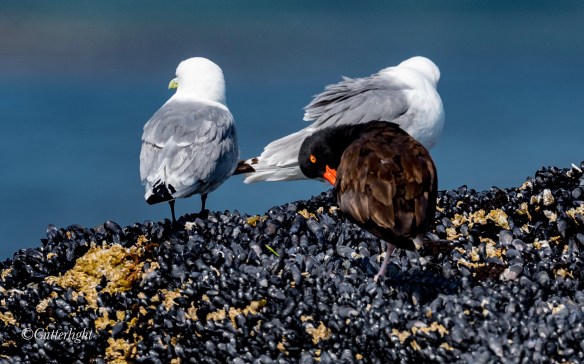
black oystercatcher with kittiwakes

At 17.5 inches from bill to toe, the oystercatcher’s overall size compares with that of these Black-legged Kittiwakes, which measure about 17 inches.

Oystercatchers tend to be wary, taking flight with shrill yelps and piping whistles, so it pays to have a long lens or a good pair of binoculars when watching them forage. Contrary to what their name implies, their diet is fairly eclectic and includes a variety of bivalves, chitons, crabs, sea urchins, worms and other invertebrates. At times they may also feed on sandy beaches and mudflats.

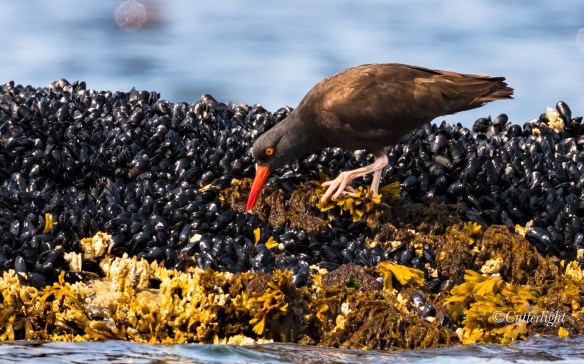
black oystercatcher foraging mussel bed

Doubtless there is all manner of deliciousness to be pried from this bed of blue mussels, and the Black Oystercatcher has the bill that fits the bill. Why the bright color? Thees matters usually have to with intraspecies identification and mating, with a nice bright bill and eye signifying health and good genes to a prospective partner.

Oystercatchers appear to mate for life. Females lay two or three eggs in a nest the male has casually scraped out above the tide line, usually on a small, rocky island. Though the young can walk soon after hatching, parents spend considerable time teaching them the ins and outs of foraging.

Black Oystercatcher Range Map: with permission from The Cornell Lab of Ornithology, Birds of the World

Black Oystercatcher Haematopus bachmani
Order: Charadriiformes
Haematopus: Greek haima = blood + pous = foot
bachmaniNamed by John James Audubon for his friend John Bachman

Status at Chignik Lake: This marine species is occasional along the shorelines of nearby Chignik Lagoon and Chignik Bay

David Narver, Birds of the Chignik River Drainage, summers 1960-63As this is a marine species, not reported

Alaska Peninsula and Becharof National Wildlife Refuge Bird List, 2010:
Uncommon in all seasons

Aniakchak National Monument and Preserve Bird List: Present

Table of Contents and Complete List of Birds of Chignik Lake

© Photographs, images and text by Jack Donachy unless otherwise noted.

For a list of reference materials used in this project, see: Birds of Chignik Lake

Birds of Chignik Lake: Semipalmated Plover

semipalmated plover alaska

Semipalmated Plover, male in his striking breeding plumage. The partial webbing between this bird’s toes is visible; it is this partial webbing from which the term “semipalmated” is derived. Denali Highway, Alaska

As I may have mentioned elsewhere, finally obtaining a small boat here on the Chignik opened up new worlds in terms of wildlife viewing in general, birding in particular, fishing and all around exploring. As to the birding, with the greater range the scow provided we immediately began cataloguing species new to us in the drainage, The little Semipalmated Plover, already a favorite from other birding ventures, was among the first of these new-to-us Chignik species.

semipalmated plover juvenile chignik river

Semipalmated Plover juveniles, Chignik River, July 24, 2020. These plovers typically occurred on river gravel bars and shorelines in mixed flocks of Western and Least Sandpipers

As we didn’t acquire our scow until July, there is still documentation to be done. The Semipalmateds we encountered appeared to all be juveniles. According to Herbert K. Job, writing in Birds of America*, this isn’t unusual. He reported flocks of nothing but young birds migrating into the Atlantic seaboard in September, a month or so after adults had arrived from their northern breeding grounds. At any rate, we took lots of photos, searched through them carefully on the large screen of our computer, and found no adults. This coming spring, we will begin early searching the various shorelines, river bars and rocky islands for signs of adult birds and breeding.

semipalmated plover nest denali highway alaska

If you didn’t know they were there, you’d probably miss them, but even when you feel certain a nest may be nearby, the eggs can be quite difficult to locate. The nest itself is a barely discernible depression lined with twigs and leaves. The precocial young will leave the nest upon hatching and although the parents will stay close, the little ones will find their own food. There may be nothing in the avian world quite so cute as the scurrying ping-pong ball of fluff a young shore peep resembles. Approximately four weeks after hatching, they’ll be able to fly. (Denali Highway, Alaska)

Semipalmated Plover Range Map: with permission from The Cornell Lab of Ornithology, Birds of the World

Semipalmated plover Charadrius semipalmatus
Order: Charadriiformes
CharadriusLatin derived from Greek kharadrios for a bird found in river valleys
semipalmatusLatin – semi = half + palmatus = palm – referring to this species’ partly webbed feet

Status at Chignik Lake: Occasional to Common in Summer; Status in Spring uncertain; Absent in Fall and Winter

David Narver, Birds of the Chignik River Drainage, summers 1960-63Occasional

Alaska Peninsula and Becharof National Wildlife Refuge Bird List, 2010:
Uncommon in Spring, Summer & Fall; Not Reported in Winter

Aniakchak National Monument and Preserve Bird List: Present

able of Contents and Complete List of Birds of Chignik Lake

© Photographs, images and text by Jack Donachy unless otherwise noted.

For a list of reference materials used in this project, see: Birds of Chignik Lake

Again to The Lake

It is good to be back. This was the view from our living room window this morning. If you look closely on the water, you can see the rings and dimples of salmon parr feeding on emerging midges.

May 22, Chignik Lake: After a day of glorious sunshine – which prompted us to go for a hike (a crane, two snipe, our first-of-the-year Savannah Sparrows, several other birds, wild violets) I woke this morning to drizzle with more in the forecast for the next few days. We’ll still get out. There’ll be sunbreaks, and we have rainwear. 

This rainbow arcing over the village featured in the view out our front door this morning. Our home is part of the school campus, to which these buildings also belong – additional housing (mostly vacant) to the right, the school itself to the left. Situated between the far house and the school is the diesel generator building, indicated by the two small smoke stacks. The mountains in the background received fresh snow just yesterday.

The department of Fish & Game will begin counting salmon on the first of June, just 10 days from this writing. A spate of small planes flying in personnel and supplies to the facility at the weir will occur any time now. Two friends set nets yesterday, but I haven’t yet had an opportunity to talk with them to see if they caught any early salmon. 

The landscape goes from brown to green with amazing rapidity this time of year. The lawn will be permitted to grow wild until after the dandelions have gone to down. Our finch population – Pine Grosbeaks, Pine Siskins and Common Redpolls – feast on the seeds. (See “Finches of the Dandelion Jungle.”)

The landscape is beginning to really green up. At 56.25° north (about the same as Edinburgh, Scotland), the climate here is perennially cool. First light, announced daily by a Golden-crowned Sparrow singing in earnest from the alders outside our bedroom window, came at 5:09 this morning. Last light won’t depart till 11:51 PM, so we’re already getting more than 19½ hours of daylight. Sunrise and Sunset times occurred at 6:04 AM and 10:56 PM – nearly 17 hours. Even obscured by clouds, that’s a lot of solar energy for plants rooted in rich volcanic soil and receiving abundant rainfall. During summer, the peninsula coast is as stunningly verdant (and the seaside cliffs, waterfalls sheeting from the tops, nearly as spectacular) as any imagination you might have of the Hawaiian Islands. Inland at The Lake, the summer’s deep and varied hues of green rival that of any emerald land. Already, the beginnings of Chocolate Lilies, Lupine, Wild Geranium, Iris, Horsetail, Cow Parsnip, ferns and more are pushing up… willows decorated with soft, fuzzy catkins, leaf buds on alders and salmonberry bushes near bursting.
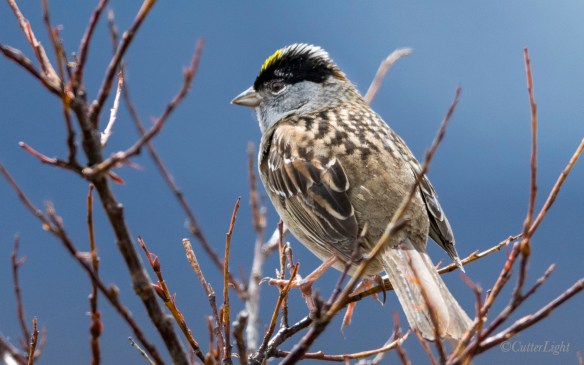
I keep meaning to test my guitar against the Golden-crowned’s song – three notes, four if he begins with a slide on the first note. Coltrane, Davis and Armstrong had greater range, but for sheer clarity of tone these birds are masters. Blow, little sparrow! Blow!

We’ve been working each day to bring our home into shape. Having gathered in a couple of new interior decorating ideas while putting our place in Newhalen together and having had a year away to reimagine a few things in this house, we’ve got it looking better than ever. Yesterday, with Barbra’s help I hung 10 acrylic photographs I took in far flung places from Hokkaido to Mongolia to Alaska’s Kenai Fjords to here in the Chigniks. There’s even a favorite shot from a trout lake in Oregon. 

“Barbra!” a small boy cried out upon seeing us from a Covid-safe distance the other day. “Where did you go? Your whole class missed you!” Both of us were, in the words of Bob Dylan, “born a long way from home.” Amidst a peripatetic life, we finally found that place here at The Lake. Leaving when the school closed last year was difficult. The return has been stirring… at times overwhelming. 

Although the school district provides these rentals as “fully furnished,” at the modest prices they charge one would be correct in assuming that overall the furniture is pretty so-so. The beds are the exception; the mattresses are terrific!

Thinking that we’d be in Newhalen for several years, we acquired a few items – decent bookshelves, coffee and end tables, a small but elegant writing station that adjusts for working while either standing or sitting… even details such as nice throw pillows for the sofa… all of which have added up to make an appreciably more congenial living space. Perhaps our favorite item is a pub-style dining table – a high table with tall chairs. ”Up high” is more comfortable than “down low,” especially for us longer-legged types, and the additional six inches in height is just enough to enhance the vantage and view out the windows. 

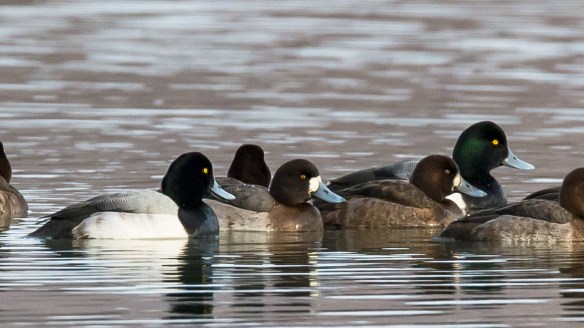
A group of Greater Scaup has been showing up to dive for aquatic vegetation in a cove visible from our dining window and it was from that window that this photograph was taken. Into the breeding season now, most ducks have paired up and dispersed, but along with the scaup, we regularly see both White-winged and Black Scoters on the lake.

Upon returning to The Lake, we were asked to agree to self-quarantine for a period of 14 days. Thus far there have been no cases of Coronavirus in The Chigniks and everyone wants to keep it that way. The Lake is a village of 50 people, many of them elders. Right now, we don’t have a permanent health aid, so our tiny clinic isn’t regularly open. There are two positions available… 

Even by Alaska standards, Chignik Lake is truly tiny and remote. No restaurants. One small store that would just about fit inside an average living room. A short, bumpy, dirt airstrip. A shed with a pair of diesel-fueled generators that supply the village’s electricity and that can pretty much be counted on to cut out or to be shut down for maintenance periodically – (you’re well advised to frequently save any work you’re doing on the computer).

A stunningly plumaged Male Tree Swallow stands watch near a nesting box occupied by his mate. Each time I think I’ve counted all the boxes put up for swallows in this village, I notice a couple more tucked away under the eaves of a house or mounted on a utility pole. Suffice it to say there are dozens. Native Americans’ happy association with these birds goes back beyond recorded history. Having lived in communities that don’t extend such welcoming to these insectivores, we can testify that their presence makes a huge difference in the number of flying bugs. 

Just about anything we need – screws, batteries, wood for birdhouses, baking powder, clothing… everything, really – has to be planned for ahead of time, shopped for online, ordered, and its arrival patiently awaited. Though it’s not common, there have been times when even groceries have taken weeks to make it out here. (The record has been three weeks.) One learns to think about it before ordering anything perishable, and it pays to advise people shipping goods out here to package them with special care to accommodate multiple plane changes and the bumpy landing. A dentist and an eye doctor fly out once a year to spend a day doing examinations. I suppose I’ll take student portraits for the school this year…

You simply can’t be of a frame of mind of “needing” anything “right now.” This is a wonderful place to hone the arts of planning ahead, a mindful approach to living, taking joy in the moment, and patience.
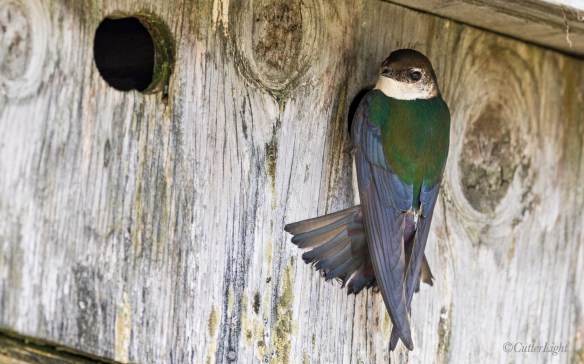
And here’s a male Violet-green Swallow. With midges hatching on the lake on and off throughout the day, the village is frequently filled with the chattering and aerial displays of these beautifully accomplished pilots that seem to redefine air.

There are, of course, difficulties associated with all this. While we do manage to usually have on hand fresh fruit and vegetables (potatoes, cabbage, carrots, parsnips, rutabaga, apples, avocados, grapefruit and Brussels sprouts ship well and can survive the typical two or three-day journey out; cauliflower, sweet corn, snap peas and pears are riskier. But forget about lettuce and most other fruits – those are city-visit foods unless a friend comes out and hand-carries them). Dried mushrooms take the place of fresh, and we go through canned diced tomatoes (and salsa!) like they’re goin’ out of style. 

Of course, we usually have some sort of wild berries on hand – fresh or fresh-frozen blueberries, lingonberries and salmonberries, and from time to time we make a salad of Fireweed shoots or Dandelion greens. We’re lucky in that we love salmon – which we take on flies we’ve tied – and are frequently gifted with moose meat, which we find superior to beef in most dishes. Every once in awhile we luck into some locally-gathered seafood: Tanner (Snow) Crab, clams, urchins, halibut, sea lettuce.

Getting other meat out here is expensive. If we go into town (into Anchorage), we bring back a tote filled with chicken, pork, beef and sometimes seafood such as scallops, shrimp and crab from Costco. Otherwise, we pay one of the bush airline employees to shop for us. She makes the purchases in the morning, gets our meat and and perhaps a few other delicate perishables on the plane that same day and with luck we have it by afternoon. We buy meat once or twice a year, repackage it into serving-sized portions, vacuum seal it and freeze it. 

We bake all our own bread – the best way of assuring fresh, quality loaves.

I took this photo, one of many tributaries in the Chignik drainage, as we flew into The Lake on May 12. One of these tributaries has a small run of Steelhead… and we finally figured out which one it is. So… If we can get up there…

There are other inconveniences. We’ve been waiting eagerly for our Hondas (ATV’s/quads) to ship out. Getting our boat out here is proving to be quite a logistical puzzle. Shopping online can be challenging. Often you’d just like to hold an item you’re thinking about purchasing in your hands – leaf through a few pages of a book, try on a pair of jeans, feel the grip of a kitchen utensil, evaluate fly-tying materials with your fingertips or see for yourself just how large or small a certain item is. But you can’t, so you make your best guess and hope whatever it is fits well enough or suits the purpose you have in mind.

You learn to look past some things. A shirt with slightly frayed cuffs still has “some good wear in it.” Something that could use a fresh coat of paint “can go awhile longer without one.” A window pane that has a bit of a problem is lived with, because getting the materials out here and figuring out how to make the repair… isn’t going to happen anytime soon.

There are benefits of making a mental contract to live with these inconveniences. (Many benefits, actually.) One of which is that none of the three Chignik villages have had cases of Coronavirus. A health team recently flew in and tested all three villages.

Of all the places I’ve lived, it is in this house that the rain falls on the roof like music and sometimes reminds me of similar music that lulled me to sleep in the Philippines and a small house where I lived in a quiet part of Japan. 

I’ve never lived any place where each morning begins with birdsong as it does here. In that regard, it’s like a permanent vacation on a favorite childhood lake – three far-too-short days in a tent or rented cabin supplanted by a life in a tidy, cozy lakeside home.

And there’s this… which only recently (upon moving back here) came to me. Imagine a sort of stock “beautiful view” from a window. An apartment high up in a skyscraper overlooking a city; a house commanding a view of a beach or a rocky coastline; or a window framing a vista of mountains – the Rockies, the Alps. 

All of these images are lovely.

Yet they are somewhat static. 

Except for the effect the relatively slow progression of seasonal change may bring to the view, or the changing light from day to day and hour to hour… to take in these views once is to take them in for the next several weeks or even months without much anticipation of change.

The view outside our windows is dynamic. The weather moving from sea to sea across this narrow peninsula is dramatic, the moods set by changing light sometimes stunning. There is wildlife – birds, bears, shoaling and leaping salmon, insect hatches, hungry seals, otters, foxes, an occasional wolf, eagles, owls… and there’s the comings and goings of friends (and everyone in this village is a friend) as they launch their boats or come in with the day’s catch, a freshly taken moose, or a shipment that was delivered to The Bay. 

Male Common Redpoll outside our kitchen window.

This morning, as I was proofreading this piece of writing, I saw the season’s very first school of salmon heading up the lake. Between now and October, hundreds of thousands more will follow, mostly Reds but also Pinks, Silvers, Kings, a very few Steelhead, lots of sea run char and close to the ocean, Chums.
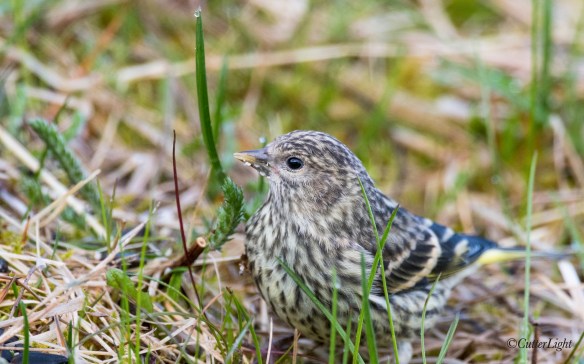
Pine Siskins (above), redpolls, Golden-crowned Sparrows, Pine Grosbeaks and magpies have been daily visitors to our yard to take advantage of the seeds I put out for them. Watching them as we wash dishes makes the chore go faster.

Quiet. The entire time I have been writing this morning, (both yesterday and  today) the only sounds have been the off and on hum of the refrigerator (sometimes at night, I unplug it for awhile… real, blessed quiet), the gentle whistle of water coming to boil in our coffee kettle, the songs and cries of birds – thrushes, swallows, warblers, sparrows, redpolls, siskins, magpies, ravens, ducks, gulls -, and the steady music of rain on the roof. 

Today we will tackle the organization of the fishing & photography room.

I’ve been striving to practice three hours a day on the guitar. 

          O snail,
          Climb Mount Fuji
          But slowly, slowly!
                                   Issa


Birds of Chignik Lake: Merlin – Lady of the Lake

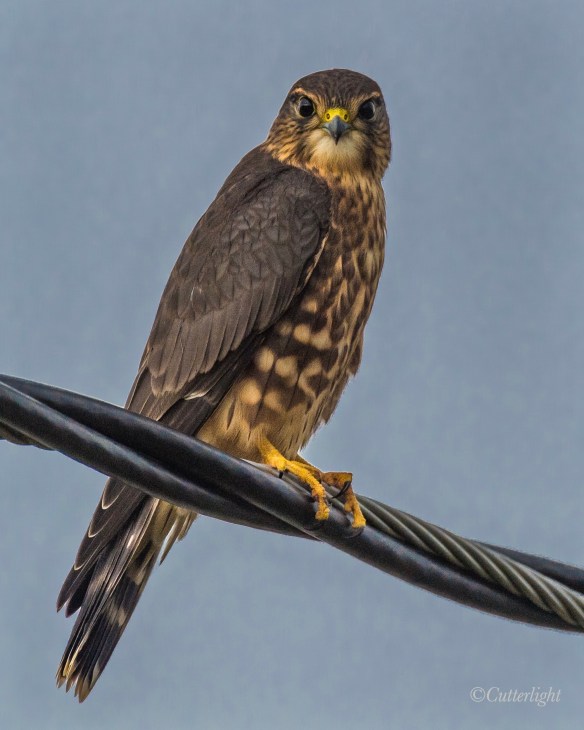
Male Merlin, Chignik Lake. In medieval times in Europe, Merlins were knows as “Lady Hawks” as it was noble women who most often used them in falconry. They are powerful fliers and deft hunters, adapted to chase down passerines, small shorebirds and occasional quail. (August 22, 2018)

Although I’m not certain as to the precise whereabouts, somewhere along the Chignik River there is a magpie nest or similar assemblage of sticks no longer used by its original inhabitants that a pair of Merlins move into each year and make their own. Merlins like nests; they just don’t like building them.

Hunting at White Spruce Grove. (Chignik Lake, August 19, 2016)

It takes a sharp eye to spot these little falcons – they zip by in a blur. My first encounter with Chignik Lake’s Merlins came shortly after I arrived that first year and decided to take on this project. On a dewy morning in mid-August, I hiked the half-mile to the grove of White Spruce where I planned to look for birds. Along the way, I noticed a phenomenon I’d never before seen: a slug was descending from a spruce bough by means of a very fine strand of… mucous? That’s what the filament appeared to be. Our slugs are tiny (and our snails are even tinier – I’ll show you when I write up the article on Pacific Wrens), but even so, I found it surprising that whatever this slug was discharging would be strong enough to support its weight. Perhaps this behavior is old hat to macalogists, but I couldn’t find much information about it.

A new one for me – slug thread. (Chignik Lake, August 19, 2016)

I’d set up my camera tripod on the falling-in porch of a tumbling down house atop a bluff that gave me a view overlooking a patch of red-ripe currants and the river in one direction, a hillside salmonberry brake in another, and a vantage right into the tops of the trees at White Spruce Grove in another. At the time, I was shooting with a Nikon D4 and a Nikkor 200-400 lens with a 1.4 teleconverter, giving me an effective range of 550 mm – albeit with a bit of a focusing challenge.

Birds, berries, and salmon, the bluff overlooking The Bend on the Chignik River is one of my favorite places to shoot. (Chignik Lake, August 16, 2016)

That morning, I’d already documented Sandhill Cranes, Wilson’s, Yellow and Orange-crowned Warblers, Fox Sparrows, Hermit Thrushes, a Pacific Wren, Black-capped Chickadees, Glaucous-winged Gulls, Mew Gulls, Bald Eagles, magpies, Common Ravens and a Wilson’s Snipe that exploded from a tangle of Alders right in front of me and practically flew into my head. The Lake’s swallows – Violet-greens, Tree and Bank – had departed by the beginning of August. Most of the Fireweed had gone to seed, but Yarrow and Wild Geranium were still in bloom.  Out on the river, early Silvers – Coho Salmon – were announcing their arrival with leaps and resounding splashes. Further down, I could hear a kingfisher’s rattle.

At about 10 inches in length and weighing less than half a pound, these falcons are tiny dynamos. Unlike Peregrine Falcons, they don’t dive from above at their prey, but instead either chase down the passerines they feed on or attack them from below. (Chignik Lake, August 17, 2018)

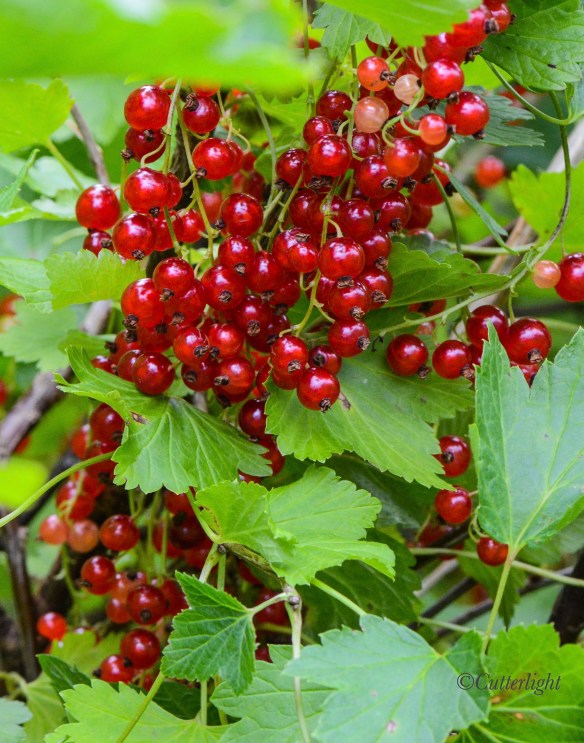
Feral Currants (Chignik Lake, August 17, 2016)

By the first week in August, the salmonberry season is over and the swallows are gone. Down at The Bend, raspberries begin to ripen. Fireweed starts to go to seed as the raspberries pass their peak. Then the currants ripen – cascades of red jewels. Up at the berry bog, the blueberries are ready. The Silvers are in, but the warblers will soon be leaving and when they’re gone, so to will be the Merlins. With so many choices tugging in different directions, life at The Lake can be rather hectic.

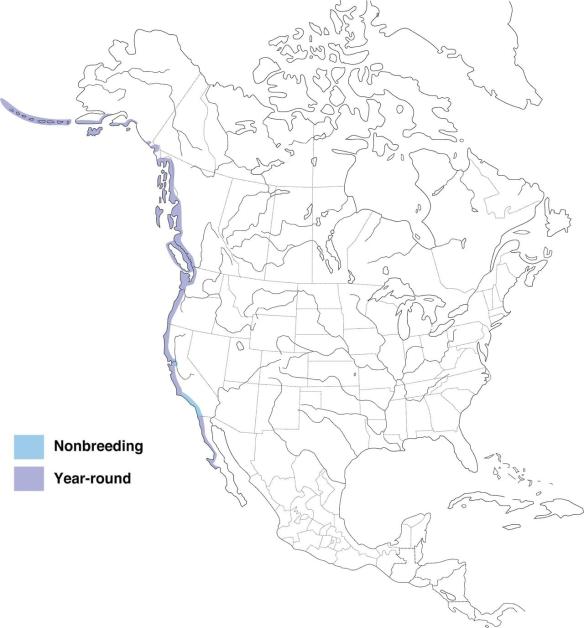
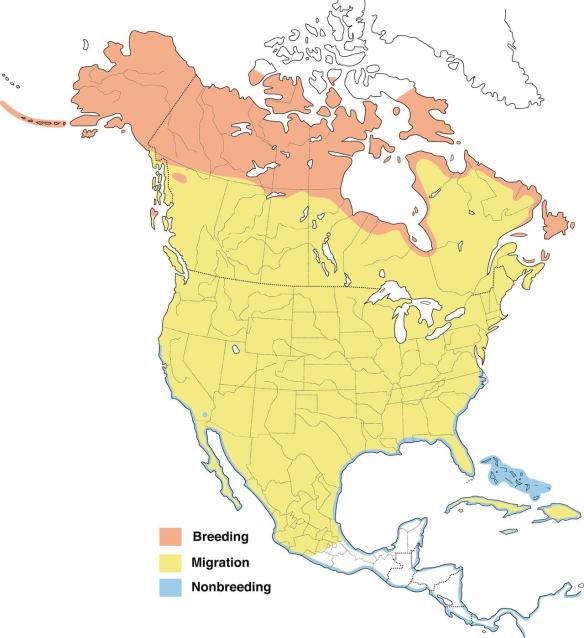
Merlin Range Map: with permission from The Cornell Lab of Ornithology, Birds of the World

Merlin Falco columbarius
Order: Falconiformes
Family: Falconidae
Falco: from Latin falcis = sickle
columbarius: from Latin columba = dove

Status at Chignik Lake, 2016-19: Regular inhabitants during summer. Absent in other Seasons

David Narver, Birds of the Chignik River Drainage, summers 1960-63: Rare on Chignik River (Listed as Pigeon Hawk)

Alaska Peninsula and Becharof National Wildlife Refuge Bird List, 2010Uncommon in Spring, Summer and Fall; Rare in Winter

Aniakchak National Monument and Preserve Bird List: Not Reported

loon silhouette

Previous: Bald Eagle – the Song of Summer

Next Article: Peregrine Falcon

*For a clickable list of bird species and additional information about this project, click here: Birds of Chignik Lake

© Photographs, images and text by Jack Donachy unless otherwise noted.

Nature Watching & Nest Finding: An Exercise in Mindfulness

Male Common Merganser, Chignik Lake, March 23, 2017

I have a particular photograph that, when I got it, I was quite stoked. It’s beautiful. Everyone who has seen it says it’s a great picture. But I look at it now…

It’s a shot of a Common Merganser taking wing. Click. Capture. The camera settings were correct. The light was wonderful. The moment is frozen in time.

He was feeding. Diving. Occasionally coming up with a small fish of some kind. Stocking  calories on a cold winter day.

I moved closer. And closer. And I flushed him.

See the nest? Spring through summer, anytime you flush a bird – and especially if a bird is behaving as though it is injured, tread carefully; there’s probably a nest nearby.

The speckling, which breaks up their silhouette, makes these Semipalmated Plover eggs especially difficult to see from a distance – unless you’re looking for them. (Interior Alaska, June 2017)

It’s a dilemma. Ongoing. As a naturalist, a photographer, a student of wildlife, I want to get close. I am drawn toward invading a being’s space. I want to see them in detail. I want to find their nest or den. I want to see what they are eating. I want to learn where they roost or rest.

But I really don’t want to disturb them. Most of my favorite photographs of animals are those in which they aren’t looking at me – photos in which they are going about their business hunting, eating, digesting, loafing, soaking up sunshine or huddling against a storm.

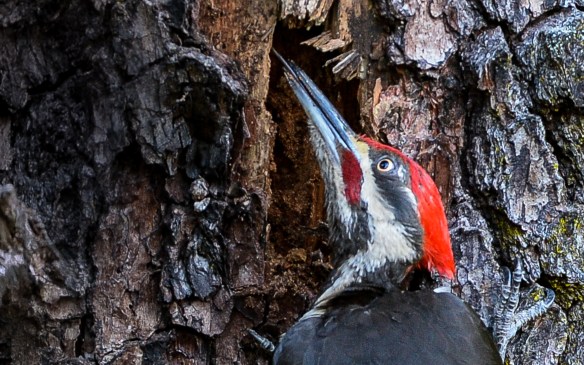
This is how I hope to capture birds – going about their business, oblivious to me. (Pileated Woodpecker, Oregon, June 2012)

As sportsmen and naturalists, we disturb animals all the time. We flush birds. We invade habitat. If my fishing season was limited to catching only what I need to stock my freezer, it would be a mighty short season. But I love to fish. So I fish for charr and trout that I have no intention of keeping, and I cast flies for salmon long after I’ve got plenty of fillets to get me through another year, letting go the additional Silvers that come to hand after I’ve got my quota.

This is not a dilemma to be solved, I think. Rather it is one to keep in mind.

As soon as we step foot in nature, we’re going to have an impact. Plants and invertebrates will be crushed underfoot. Birds will be flushed. A friend of mine walking on a river island once heard a crunch underfoot. He lifted his shoe to find a dripping smear of yolk and albumen from the crushed remains of a Killdeer’s nest. He felt really bad about that. If the world was populated only by bird-loving naturalists, I suppose evolution would have arranged for eggs in shades of neon and florescence.

Let’s hope all four of these greenish, brown-speckled eggs made it into fully fledged Siberian Rubythroats. (Hokkaido, Japan, June 2017)

In recent years, I’ve become pretty good at finding birds’ nests – a skill I’m reluctant to put into practice unless circumstances make it necessary. Hiking through an overgrown field in Hokkaido, Japan, a Siberian Rubythroat burst into flight practically beneath my feet. I knew from experience that there was undoubtedly a nest nearby, and that I’d better take great care with each footstep until I either located the nest and avoided trampling it or had gingerly stepped altogether clear of the area.  

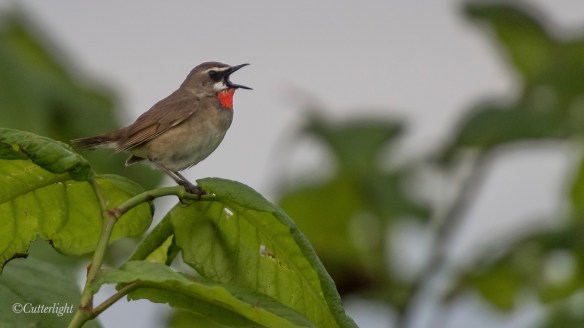
Singing his heart out not far from the above nest, this male Siberian Rubythroat has staked out his small piece of Hokkaido. (June 2017)

I once flushed a mallard off her nest. Didn’t know she had a nest until I walked closer to where she had been. I quickly backed away, but it was too late. Before I could get completely out of the area, a pair of crows were happily going to town on eggs that would not become ducklings. Initially, I was mad at the duck for choosing such an open place to build a nest. But the fault was mine; I didn’t know enough about duck behavior to understand that she was brooding.

Those crows knew, though. Smart birds.

Birds are amazingly aware of their surroundings, and so I have little doubt that this merganser and her brood were aware of my presence. But I was tucked away behind vegetation photographing terns. She passed by with a circumspect eye directed my way, but not in panic. Good. A short distance upriver, they resumed feeding. (Tuul River, Mongolia, July 2015)

loon silhouette

Previous: Red-breasted Merganser – Not just Flashy. Fast!

Next Article: Northern Harrier – Rare but There

Birds of Chignik Lake: Common Merganser – She Wears the Crown

Another stickleback bites the dust. Along with sculpins, the Chignik’s Three-spine and Nine-spine Sticklebacks frequently feature in the Common Merganser’s diet. (Female Common Merganser, Chignik Lake, March 14, 2017)

Often called Saw-bills for their serrated, fish-grabbing bills, Common Mergansers are one of the Chignik’s more common wintertime ducks. And happily for naturalists photographers, they’re one of the more approachable species. This is probably due to the fact that they aren’t much sought by gunners.

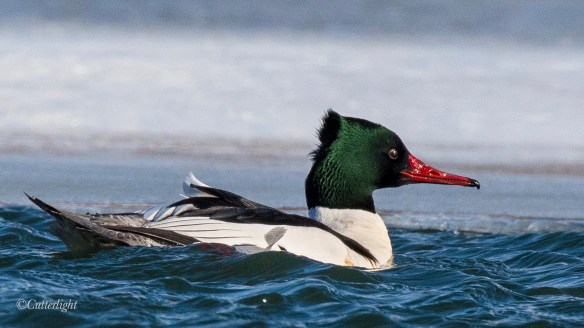
In typical duck fashion, the drakes are indeed strikingly handsome. Here a breeze out of the north is pushing the feathers on his crown up a bit, but they’re considerably shorter and never so dramatically displayed as the hen’s, making Common Mergansers the only species of duck in which the hen shows more of a crown than does the drake. (Chignik Lake, March 14, 2017)

The reason mergansers aren’t much hunted was nicely summed up by Edward Howe Forbush in Birds of America when he wrote: Its flesh as ordinarily cooked is so rank and strong that its flavor is not much superior to that of an old kerosene lamp-wick… As a result, their numbers are stable in North America and appear to be expanding in Europe, where they are known as the Goosander.

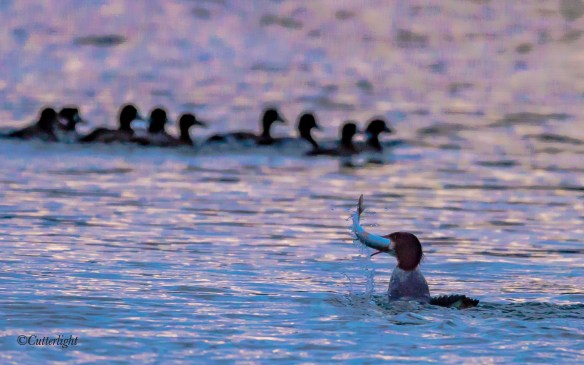
Dawn hadn’t yet broken over the lake’s southern mountains when I looked out my window to see a group of a dozen or so mergansers working together to herd Dolly Varden Char against the shoreline. I snuck down to the lake, positioned myself behind a spruce tree and made a few photographs. During my youth back in Pennsylvania, we’d have called a char of that size a “nice keeper.” This merganser is probably a first-year bird and could be either a male or a female. The ducks in the background are Greater Scaup with a drake Common Goldeneye (second from left) mixed in. (December 12, 2016)

Common Mergansers primarily nest in tree cavities, and as they are large ducks (a little over two feet long on average), they require large trees. This would appear to be a key limiting factor in their range and distribution, and the main reason they are not commonly found in The Chigniks during the mid-spring through summer breeding season. As such, this is a species that would benefit from the installation of nesting boxes.

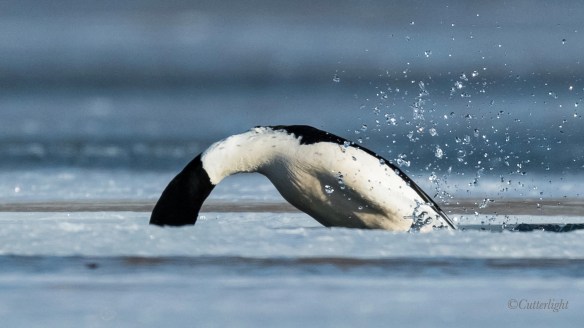
Deadly efficient piscivores, mergansers disappear in an arcing dive in a flash. Once they locate a school of fish, virtually every dive is successful, leaving them plenty of time to sleep or loaf on the water surface, shoreline, rocks or ice. (Chignik Lake, January 31, 2017)

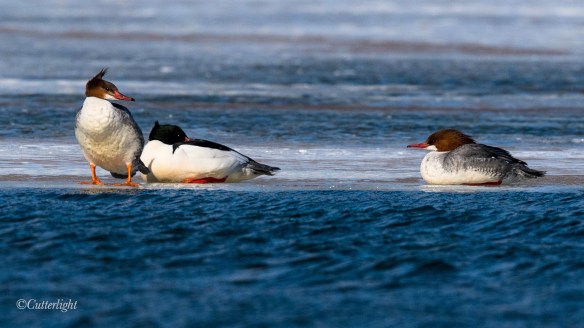
Bellies filled with fresh fish, it’s time to loaf and catch some rays. The longer the ice remains, the longer the mergansers hang around in spring. As soon as forested ponds and lakes in the interior become ice free, these mergansers will be gone. But I have to wonder if nesting boxes of the right size might induce a pair to stay at the lake. (Chignik Lake, March 23, 2017)

Common Merganser Range Map: with permission from The Cornell Lab of Ornithology, Birds of the World

Common Merganser Mergus merganser
Order: Anseriformes
Family: Anatidae
Mergus: from Latin for an unspecified waterbird
mergansercompound word from the Latin “mergus” as per genus name + “anser” = goose

Status at Chignik Lake, 2016-19: Common from late summer through early Spring

David Narver, Birds of the Chignik River Drainage, summers 1960-63: Not Reported

Alaska Peninsula and Becharof National Wildlife Refuge Bird List, 2010Common in Spring and Winter; Rare in Summer; Uncommon in Fall

Aniakchak National Monument and Preserve Bird List: Present

loon silhouette

Previous: Bufflehead – Our Smallest Diving Duck

Next Article: Red-breasted Merganser – Not just Flashy. Fast!

*For a clickable list of bird species and additional information about this project, click here: Birds of Chignik Lake

© Photographs, images and text by Jack Donachy unless otherwise noted.

Birds of Chignik Lake: Greater Scaup

There seem to always be scaup somewhere in the Chignik System. Flocks regularly show up on the lake from fall through spring, particularly during colder winters. (Chignik Lake, January 3, 2017)

Many a winter’s day at The Lake was made more cheerful by an arriving flock of scaup. Although as few as one or two might show up, the more usual case from late fall through spring was that if there was one on the lake, there were at least a dozen or more, sometimes quite a few more. Early in the day they could sometimes be found cruising the shoreline near our home in the village. But as boats were launched and returned, they moved to the other side of the lake, a distance of approximately half-a-mile and well out of photography range. There they’d remain, day in and day out, their numbers growing as weather became increasingly inclement, usually joined by Common Goldeneyes and other ducks.

Although the male’s head often appears black, in the right light it has a distinctive green sheen which takes on a purple hue during breeding. Females sport a white mask at the base of the bill. Note the blue bill with its splotch of black lipstick and the yellow eyes. ( Chignik Lake, January 18, 2017)

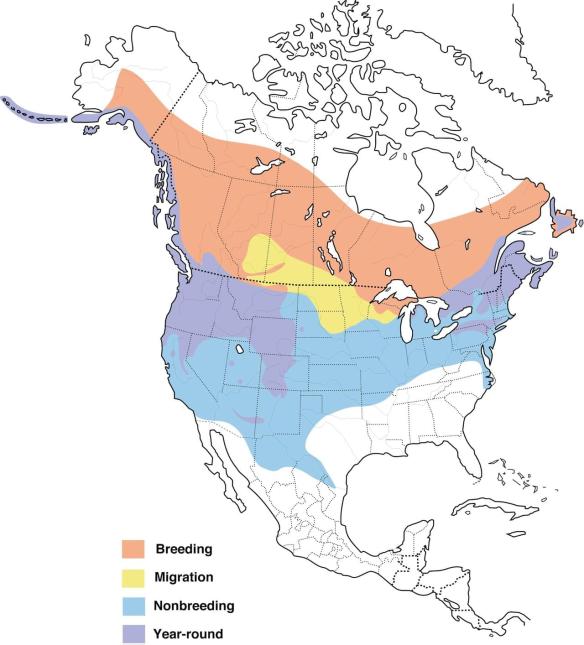
I have carefully glassed individual scaup on the lake, pored over my photographs to compare images with those in field guides and can say with some confidence that there were no Lesser Scaup among the birds that visited our river and lake. I don’t know why this should be so, as both species are common in Alaska. Nonetheless, a variety of range maps are consistent in agreement that only the Greater Scaup is to be found on the peninsula. Let’s see… head a little larger, more round – but also more sloped…, slightly whiter body, a little more white in the wing stripe in flight, somewhat larger dark splotch on bill, a bit larger overall… One vexingly relative comparison after another… I give up. What does the range map indicate again?

The scaup we observed appeared to feed mainly on aquatic vegetation with an occasional freshwater clam mixed in. This female has found a mollusk of some kind. It is believed that the word scaup is a Scottish variant of the northern English term “scalp,” which means “mussel bed.” (Chignik River, January 27, 2017)

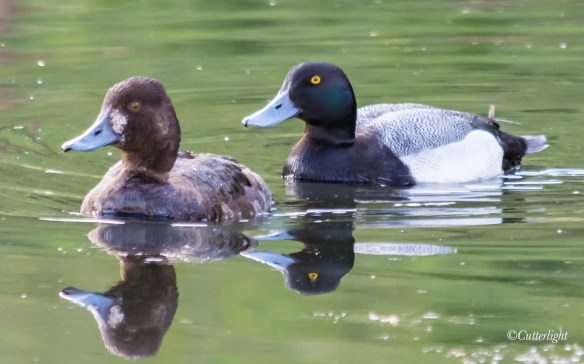
Greaters? Lessers? (Denali Highway, Interior Alaska, June 2, 2017)

The text Birds of North America1, which despite having been written over 100 years ago continues to gain my appreciation, states that the two species vary “principally…in size.” Which seems to be as useful and honest a thing as one might say about making a field identification of scaup. That’s not to say the difference isn’t important. The extent to which any two species – or even strains of species – differ in habitat requirements and preferences makes each a bell-weather for the ecosystem it depends on. But as field observers, whether the being we are considering is a redpoll, a scaup, a steelhead or a char, it may not always be possible to know, in the field, precisely what variety of redpoll, scaup, steelhead or char we have before us.

As to the mated pair in the preceding photograph… my guess is Lesser Scaup. The female’s head appears to have a peak or corner at the rear, the male is showing a fair amount of purple in its head and only a small splotch of black on the end of its bill. The barring on his back is fairly coarse… but in the end, I can identify nothing definitive to say with certainty one way or the other. Perhaps some kind reader with greater experience than mine will come to the rescue.

Two hens, two drakes skim above Chignik Lake in silvery early morning light. (January 26, 2017)

1Birds of North America, T. Gilbert Pearson, ed., Garden City Books, Garden City, New York, 1917

Greater Scaup Range Map: with permission from The Cornell Lab of Ornithology, Birds of the World

Greater Scaup Aythya marila
Order: Anseriformes
Family: Anatidae
Aythya: from Ancient Greek, a term used by Aristotle believed to describe a duck or seabird
marila: from Greek for coal dust

Status at Chignik Lake, 2016-19: Common and generally Abundant

David Narver, Birds of the Chignik River Drainage, summers 1960-63: Abundant on Black Lake; Common on Chignik Lake

Alaska Peninsula and Becharof National Wildlife Refuge Bird List, 2010Common in Spring, Summer & Fall; Uncommon in Winter

Aniakchak National Monument and Preserve Bird List:

loon silhouette

Previous Article: Life on the Frozen Chignik

Next Article: Ring-necked Duck

*For a clickable list of bird species and additional information about this project, click here: Birds of Chignik Lake

© All photographs, images and text by Jack Donachy unless otherwise noted.