Lemon Brioche Croissants

Flaky and buttery croissants made from scratch using brioche dough. Stuff them with anything you like – I chose homemade lemon curd.

We leave for the summer in six days. After surveying the pantry for what will not survive three months, we determined the lemon juice, coconut and salsa are on the “must finish” list. Obviously, no recipe is going to take care of all three ingredients in one fell swoop — not one I’d want to eat, anyway! Salsa chicken and rice will be on this week’s menu. Coconut butter cookies for the staff potluck. And lemon curd stuffed croissants for breakfast.

From a culinary and baking standpoint, this summer should be interesting. We’ve cooked for weeks at a time in our camper. We’ve also cooked for weeks on a Coleman stove while tent and boat camping. This summer, it will be all galley cooking on our sailboat, Bandon. We’re both eager to outfit her galley with the least amount of quality tools that will help us with the most culinary tasks. We are also excited to fish the south central waters of Alaska and cook up the freshest and tastiest seafood for ourselves and our guests. Stay tuned to see what will be created from the galley of Bandon!

Lemon Brioche Croissants

makes 8 croissants

Ingredients

  • 1/2 cup whole milk
  • 1/8 cup granulated sugar
  • 2 eggs
  • 1 1/2 – 2 cups all-purpose flour
  • 1/2 tbsp instant yeast
  • 1/2 tsp salt
  • 3/4 cup soft unsalted butter
  • 3/4 cup lemon curd or other filling (see below for separate lemon curd recipe)

Directions

  1. Pour milk in saucepan and heat until lukewarm.
  2. Pour milk in mixing bowl. Add sugar. Mix until incorporated.
  3. Beat eggs. Pour eggs into milk mixture. Mix until incorporated.
  4. Add 1/2 cup of flour. Mix until incorporated.
  5. Add yeast and a second 1/2 cup of flour. Mix until incorporated. I switched to a dough hook on the mixer at this point.
  6. Add salt and last 1/2 cup of flour. Mix again until incorporated. Dough should be sticky.
  7. Mix butter into dough in increments of about 2 tbsp at a time.
  8. Once the butter is completed incorporated, cover dough with plastic wrap and refrigerate for at least 4 hours, or overnight.
  9. After at least 4 hours, place the dough on a lightly floured surface.
  10. Roll the dough out to form a circle with about a 15-inch diameter.
  11. Cut dough into 8 pieces (pizza style) using a pizza wheel, forming 8 triangles.
  12. Place a heaping tbsp of lemon curd near the base of the triangle.
  13. Roll dough from base of triangle toward point.
  14. Curve into a crescent shape and pinch ends closed.
  15. Place croissants on parchment-lined baking sheet and cover sheet with plastic wrap. Let rest for 45 minutes.
  16. Preheat oven to 350 degrees F while dough is resting. Bake croissants for 15 – 20 minutes until lightly browned.
  17. Cool on a wire rack.

Lemon Curd

Ingredients

  • 1/2 cup lemon juice
  • 3/4 cup granulated sugar
  • 2 eggs
  • 1/2 cup (1 stick) softened unsalted butter
  • zest of one orange (about a tablespoon)

Directions

  1. Mix together lemon juice, sugar, eggs, and zest. Mix in butter 1/4 cup at a time.
  2. Place bowl on simmering pot of water (double boiler). Stirring constantly, cook until mixture reaches 160 degrees F (about 10 minutes).
  3. Store covered in refrigerator. I used a mason jar.

The above recipe used about half of the lemon curd. Enjoy the extra on scones, with yogurt, or to replace jam in any other recipe.

Croissant recipe adapted from http://www.cookingbread.com/classes/class_lemon_brioche_croissants.html

Lemon curd recipe adapted from http://www.recipegirl.com/2008/11/10/meyer-lemon-curd/
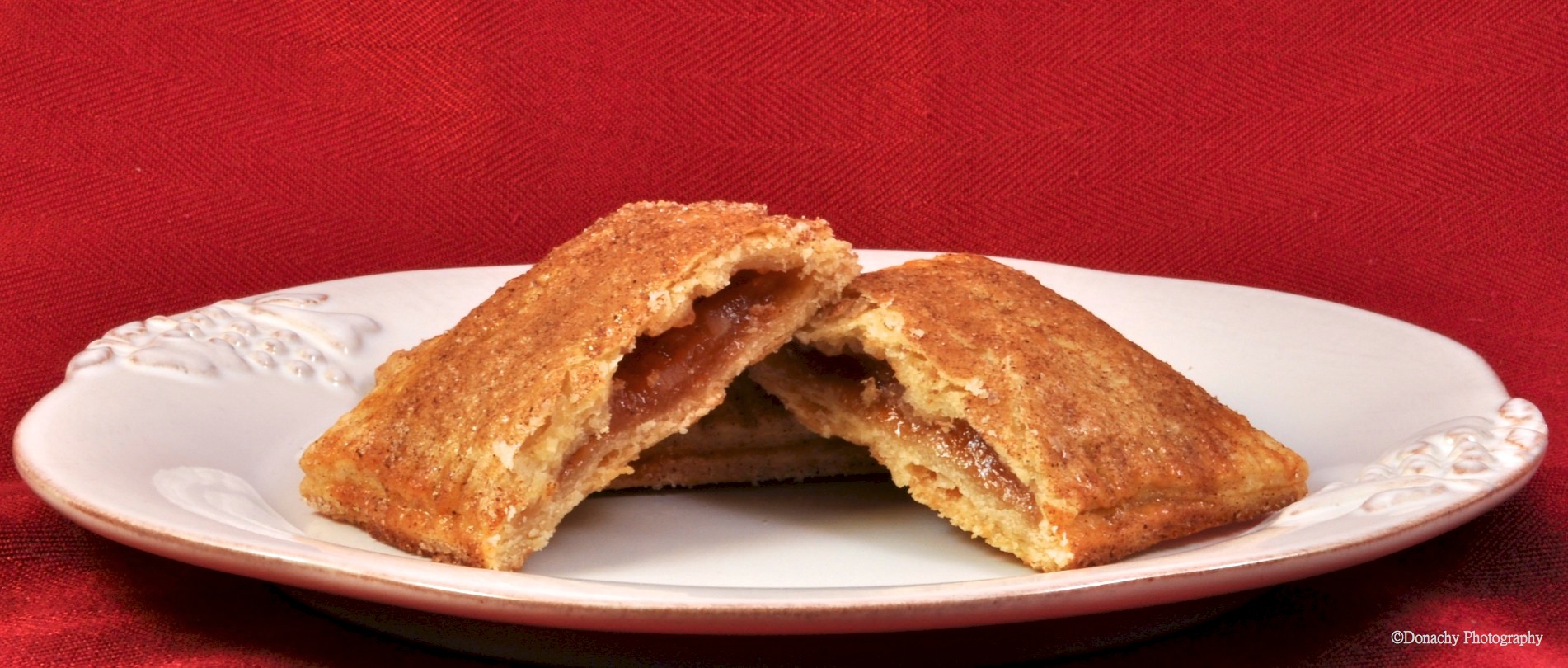
Way Better Than Pop Tarts

Flaky stuffed pillows of pie crust sprinkled with cinnamon sugar. One bite of these, and you’ll never look a Pop-Tart straight in the face again.

Back in the day, my childhood home was known as the “health food” house. (It was also known as the “twigs and berries” house.) My mom primarily shopped at the health food coop. She didn’t allow processed sugar, and so when I saw my friends eat those tantalizingly sugar-laced Pop-Tarts (as advertised on TV), I could only imagine how wonderful they must taste. Mmm… Flaky golden crust, sweet and smooth icing, bursting with delicious chocolate or thick, sugary berry jam.

Well, one day, I worked up the courage to sneak one! Oh yes, my sister and I became masterful at sneaking sugar. At our secret hiding spot, my friend handed me one of these foil-wrapped treasures. I held it in my hands, heart beating with anticipation. Then I ripped into the wrapping, took a giant bite and…

Blech! The flavorless, cardboard-like confection I held in my hands bore no semblance to the treats that came popping out of toasters in TV land.  Later in life, I tried a health food version of a Pop-Tart and, again, ended up wishing I hadn’t.

Because of those experiences, I’m not a person who walks through life thinking about Pop-Tarts. So, coming up with the idea to make today’s creation caught me by surprise. A couple of months ago, I’d made some fantastic pear butter. It has the best texture, aroma, and flavor. It seemed a waste to leave it in the freezer over the summer. I thawed it and started my search for recipes. I thought the pear butter would be delicious layered between some kind of pastry. I envisioned a layer of mellow cheese (think mascarpone) topped with the pear butter.  I started my Internet search with the sole word “tart” just to see what would result. (Fortunately, I had the “safe” filter on my browser, otherwise who knows what images “tart” might have conjured forth.) As luck would have it, the third result was homemade pop tarts from Smitten Kitchen.

Way Better Than Pop-Tarts

Makes 9 Pastries

Ingredients

  • 2 cups all-purpose flour
  • 1 tbsp granulated sugar
  • 1/2 tsp salt
  • 2 sticks (1 cup) of unsalted butter
  • 2 large eggs
  • 2 tbsp milk
  • 3/4 cup pear butter or jam
  • 1 tbsp cornstarch mixed with 1 tbsp cold water
  • 1 tsp cinnamon mixed with 3 tsp granulated sugar for the topping
Directions
  1. Preheat oven to 350 degrees F.
  2. Mix flour, sugar and salt. Slice butter into pats. Mix in butter with a pastry blender or your fingers. Do this until butter is pea-sized. It is ready when dough holds together when you squeeze it.
  3. Whisk together one egg and milk.
  4. Stir egg mixture into dough. Dough should form into a ball.
  5. Divide dough in half and shape each half into a rectangle (about 3 x 5 inches).
  6. Roll out one half of the dough on a lightly floured surface. Try to keep the shape rectangular. Roll out until dough is about 1/8 inch thick and is about 9″ x 12.” Cut the dough into nine 3″ x 4″ rectangles. Repeat with second half of dough.
  7. Mix together pear butter (or jam) and cornstarch mixture.
  8. Beat the second egg and brush it on one 3″ x 4″ piece.
  9. Place a heaping tablespoon of pear butter mixture in center of egg-covered dough. Spread out the pear mixture leaving a 1/2″ border.
  10. Place a second 3″ x 4″ dough rectangle on first dough rectangle. Press down on edges to seal the two pieces together.
  11. Use tines of a fork on the perimeter of rectangle to complete the seal and to add a decorative touch.
  12. Repeat with remaining tarts.
  13. Place tarts on parchment-lined baking sheets. Wash the tops with remaining egg mixture. Sprinkle tops with cinnamon-sugar mixture. Prick each tart a few times to allow steam to escape.
  14. Place in oven for 20 minutes. The tarts should be a golden brown. Cool in pan on wire rack.
Adapted from http://smittenkitchen.com/2010/04/homemade-pop-tarts/


Laying in a Year’s Worth of Supplies Part II: The Well-Stocked Kitchen

Penzeys spices have earned a prominent place in our well-stocked kitchen. We recently received an order of items we wanted to make sure we have on hand when we return to Point Hope at the end of the summer. From left to right in the foreground: arbol peppers, star anise and chipotle peppers. 

As I write this, I’m surrounded by several stacks of Rubbermaid totes. Each stack has four to seven nested totes duck taped together, ready to be mailed to Anchorage where they’ll be filled with dry goods and mailed back up here for the next school year. We’re down to the tail end of most of our groceries, which is the way it should be with only 10 days remaining before we fly down to south-central Alaska for the summer.

Planning out a well-stocked kitchen, experimenting with new dishes and baked goods, and writing this blog make the extra effort and expense of laying in everything we need for our kitchen worth it. In addition to mail-ordering spices to supplement what we already have on hand, we’ve prepared a five-page Excel spreadsheet shopping list we’ll take care of in Anchorage. And, of course, there are the ice chests we mailed down earlier, waiting to be filled with some of the world’s best seafood – the salmon, halibut and rockfish we catch and package ourselves. Come late summer when we return to the village, our kitchen will be ready!

Various types of salt, cooking oils and a full compliment of herbs and spices inspire an eclectic approach to cooking and baking, and allow us to create many of our own rubs and grilling sauces.

Although the theme of our summer posts will shift to fishing, hiking, boating and sailing, we’ll continue to write about the cooking we do for ourselves and our guests. And during the summer, we’ll finally be able to enjoy wine and beer with our meals!

Click here to see A Year’s Worth of Food: Provisioning for the Alaska Bush, Part I

Cloudberry Cake: An Arctic Treat

Cloudberry jam is baked right into the top of this moist vanilla cake. Try it with a hot cup of tea and a scoop of vanilla bean ice cream.

 Continuing with the clean-out-the-pantry theme, I had a couple jars of cloudberry freezer jam left from our fall berry picking. These delicious orange berries of the far north are only available for a few short weeks at the end of the Alaska summer. Growing in patches on small mounds across the boggy tundra, Akpik (the Inupiaq word for the berries) are at first a brilliant red before turning orange during their peak ripeness. We picked two gallons and turned them into some of the best jam, sorbet and ice cream we’ve ever eaten. Prized wherever they grow, (they’re protected by law in some European locales) cloudberries have a distinctive sweet flavor with a hint of agreeable tartness. They have become our favorite berry.

Cloudberry Cake

Ingredients

  • 1 cup granulated sugar
  • 5 eggs
  • 1 cup unsweetened applesauce
  • 1 tsp vanilla extract
  • 2 tbsp sour cream
  • 2 cups all-purpose flour
  • 2 tsp baking powder
  • 2 cups cloudberry jam (or other jam)

Directions

  1. Preheat oven to 350 degrees F.
  2. Beat sugar and eggs until pale yellow (about 5 minutes). Beat in applesauce. Add vanilla and sour cream. Mix again.
  3. Sift flour and baking powder together. Stir into egg mixture.
  4. Grease a 9-inch springform pan.
  5. Pour batter into springform pan.
  6. Dot the jam on top of the cake batter. Poke some of the jam down into the batter.  Bake 45 minutes or until a toothpick or cake tester comes out clean.

Matcha Green Tea Cookies

As our school year comes to a close, I searched our pantry for baking inspiration. It is a dual goal – bake something interesting and use something up that may not weather sitting for three months in a cabinet. Today’s ingredient? Matcha green tea. This is a powdered or finely milled form of shade-grown tea, which is used in Japanese tea ceremonies. It is very flavorful. Increasingly, matcha is finding its way as an ingredient into other food where it adds color and flavor.

This is probably not an everyday pantry item. Jack and I greatly enjoy tea. Before we moved up to Alaska, we purchased lots of tea from a favorite shop in California that was (sadly) closing. We had one opened bag of this delicious powder with exactly three teaspoons left… the perfect amount for a cookie recipe! If you would like to try this recipe, we suggest checking with a tea shop that carries Japanese teas.

Matcha Green Tea Cookies

Ingredients

  • 7 tbsp softened, unsalted butter
  • 6 tbsp confectioner’s sugar
  • 1 egg yolk and 1 egg
  • 1 tsp vanilla extract
  • 3/4 cup all-purpose flour
  • 6 tbsp finely ground almonds
  • 3 tsp matcha powder
  • 2 tbsp granulated or turbinado sugar

Directions

  1. In a medium mixing bowl, cream together butter and confectioner’s sugar. Add eggs and vanilla. Blend thoroughly. Set aside.
  2. In a separate bowl, sift together flour and matcha powder. Add in almonds. Mix thoroughly.
  3. Add flour mixture to butter mixture. Mix until dough comes together into a ball.
  4. Shape dough into a log with about a 2-inch diameter. Wrap in plastic wrap and chill in the refrigerator.
  5. Preheat the oven to 350 degrees F.
  6. Line baking sheets with parchment paper.
  7. Sprinkle granulated or turbinado sugar onto a plate. Roll chilled log in sugar, pressing log into sugar to coat.
  8. Using a sharp knife, cut 1/2 slices. Place slices on baking sheet leaving room between cookies for slight spreading.
  9. Bake for 12 minutes or until cookies are lightly browned on the edges.
  10. Cool on baking sheet for 2 minutes before transferring to a wire cooling rack.

Recipe adapted from http://chocolateandzucchini.com/archives/2009/10/matcha_shortbread_cookies.php

A Year’s Worth of Food: Provisioning for the Alaska Bush, Part I

Salmon, halibut and rockfish fillets from fish caught in Resurrection Bay, vacuum sealed and flash frozen for fresh-from-the sea taste, ready to make the trip north to Point Hope. And a plug for Alaskan seafood: it’s wild, sustainable, healthy, and some of the best-tasting on the planet!

One of the biggest challenges living in the bush presents is provisioning for a year’s worth of meals. When we  moved to Alaska, Barbra and I brought with us some of the skills we’d acquired in our lives in Oregon and California.

For starters, we’ve always had Costco memberships and we use those memberships to stock up on bulk purchases from rice to olive oil to meat, fish and poultry. To make this work, we use a FoodSaver vacuum-pack system to repackage meat in smaller portions, which we then freeze. In addition to having some of the very best meat, poultry and fish available – and at prices well below specialty stores carrying products of comparable quality – Costco also carries the best frozen fruits and vegetables we have found. Their Executive Membership, which costs more than a regular membership, offers a 2% rebate on purchases, and thus more than pays for itself, meaning that we don’t incur a membership cost. But even if we had to pay a nominal fee, we’d still be Costco members. They treat their employees well, and they offer quality products and service. And buying in bulk is green: less packaging (much of our repackaging material is reusable), and fewer trips to the store means less fuel consumption.

In our life before Alaska, we were already harvesting most of our seafood and freezing (and smoking) it. Annual berry-picking pilgrimages provided us with a year’s worth of blueberries – a fruit that not only is delicious and versatile, but which freezes well, too.

The challenge we faced upon moving to the bush was getting all this food, and other supplies, out to the village. Here’s the short explanation of the solution: Rubbermaid Roughneck Totes and Coleman Xtreme 52-quart coolers.

.      .

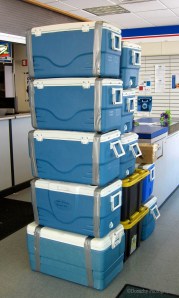
Left: Drilling holes in lids and totes to be zip-tied shut for parcel post. Right: Empty coolers at the post office, ready to be mailed south where they’ll be filled with frozen and cold food at the end of the summer and checked on our planes north to the village.

We drill the Rubbermaid totes so that the lids can be zip-tied (cable-tied) to the tub. Rubbermaid totes are tough and unaffected by cold temperatures. Cheaper totes don’t hold up, and in the long-run are expensive because they have to be replaced as they break down. All of our dry good are mailed up parcel post in these tubs. We’ve mailed hardy vegetables (squashes, potatoes and onions) and hard cheeses in these tubs as well. In Alaska’s cool temperatures, they’ve been fine.

The coolers travel on the plane when we fly up. There are better coolers than Coleman Xtremes, but so far these have been fine. The price is right, they’re tougher than really cheap coolers, and they weigh in at a reasonably light weight – an important consideration. The 52-quart size is manageable even when fully loaded with frozen food.

We stuff at least eight of these coolers with as much fish, meat, chicken and frozen vegetables and berries as we can and pay the extra luggage fee. We’ve been sealing these coolers with duck tape, but this summer we’re planning to experiment with a solution that won’t require having to use and throw away a roll or two of tape each time we ship.

New York Strip steaks (left) and filet mignon (right), purchased in bulk from Costco are packaged with one of each per vacuum-sealed pack for a Porterhouse without the bone. Meat, poultry and fish packaged and frozen this way will keep for over a year; the result is that we waste virtually nothing.

Chocolate Dipped Coconut Macaroons

In our world of BPA warnings for canned products and ingredients in processed foods that I can’t pronounce (and have no clue what they are), Jack and I have decided to limit our use of canned products and make as much as we can from scratch. My search for a coconut macaroon recipe resulted in recipe after recipe indicating the need for sweetened condensed milk. I hesitated. First of all, canned milk was bound to cost a fortune in our little Arctic store and second, it would be in a can.

Eventually I found a homemade substitute, which, in addition to being less expensive and more natural, had none of that can aftertaste common to many canned products. With the help of a stick blender whipping 1 cup of powdered milk, 2/3 cup of sugar, 1/3 cup of boiling water, and 3 tablespoons of butter, I soon had 14 ounces of sweetened condensed milk. This homemade version keeps well covered in the refrigerator.

Coconut macaroons were always a top fix for sweet cravings for me. When I was a starving student, I would wait until Passover passed so I could buy cans of Manischewitz macaroons that had been marked down. They were tasty, but I these bite-sized treats would taste better fresh. Baked at home, they are a bit crunchy on the outside and chewy on the inside. If you shape them like a pyramid, they are easy to dip into melted chocolate, for a nice presentation.

Chocolate Dipped Coconut Macaroons

Ingredients

  • 2/3 cup sweetened condensed milk
  • 2 egg whites
  • 1 1/2 tsp vanilla extract
  • dash of salt
  • 3 1/2 cups of unsweetened flaked coconut
  • 10 oz. semi-sweet chocolate chips
Directions
  1. Preheat oven to 325 degrees F. Line two baking sheets with parchment paper.
  2. In a large bowl, stir together the sweetened condensed milk, egg white, vanilla and salt until combined.
  3. Stir in coconut until well blended.
  4. I used a cookie scoop to make uniform mounds on the baking sheets.
  5. Use wet hands to form mounds into pyramids. (Keep a bowl of cold water handy for this process.)
  6. Bake, one sheet at a time, until cookies are lightly browned, 15 – 20 minutes. (Don’t put away pan or throw out paper, yet.)
  7. Cool cookies on baking sheet until set, about 2 minutes. Then move to wire cooling racks.
  8. Melt chocolate chips in a double boiler, or in a heat-proof bowl over a simmering pot of water. Stir until smooth. Remove from heat.
  9. Holding the macaroon by its pyramid top, dip the bottom of the macaroon into the melted chocolate. Place the dipped macaroon back on the parchment-covered baking sheet. Repeat process with all the macaroons.
  10. Refrigerate the macaroons until the chocolate sets, about 15 minutes.

Recipe adapted from http://www.browneyedbaker.com/2009/06/19/chocolate-dipped-coconut-macaroons/.

Classic Chocolate Chip Cookies With a Twist

Ahh… Rows and rows of soft, moist, freshly baked chocolate chip cookies with orange zest fill a kitchen with one of the best aromas on earth.

When I was in high school, one of my favorite after-school activities was hanging out with my friends baking cookies. Our go-to cookie recipe was the original Nestle Toll House chocolate chip cookie recipe right off the back of the bag. We enjoyed batches straight out of the oven. After years of experimenting with different recipes, I’ve returned to the original because it is simply the best. In a way, these cookies are a metaphor for a life in which I, too, have returned to many of the things that brought me joy as a young woman.

I was talking to a friend earlier this year who is working on a family cookbook. She is collecting recipes that, in some way, each tell a story about family members. Most of the recipes have been created by her family. But when the subject of chocolate chip cookies came up, they all agreed that the Nestle recipe is unbeatable.

So, I bring you the original Nestle Toll House chocolate chip cookie… with a very slight twist. I added a teaspoon of orange zest because, lately, I’ve been on an orange and chocolate kick. Chocolate just seems to taste better with the zing of orange zest. (Were we not in a dry village, Grand Marnier would work beautifully with chocolate, too.)

Nestle® Toll House® Chocolate Chip Cookies

Ingredients

  • 2 1/4 cups all-purpose flour
  • 1 tsp baking soda
  • 1 tsp salt
  • 1 cup (2 sticks) butter, softened
  • 3/4 cup granulated sugar
  • 3/4 cup packed brown sugar
  • 1 tsp vanilla extract
  • 2 large eggs
  • 2 cups semi-sweet chocolate chips (chocolate morsels)
  • 1 cup chopped pecans (or other nuts)
  • 1 tsp orange zest (optional)

Directions

  1. Preheat oven to 375 degrees F.
  2. Combine flour, baking soda and salt in a small bowl.
  3. Beat butter, granulated sugar, brown sugar and vanilla extract in a large bowl until creamy. Add eggs, one at a time, beating well after each addition. Stir in zest.
  4. Gradually beat in flour mixture.
  5. Stir in chocolate morsels and nuts.
  6. Drop by rounded tablespoons onto ungreased baking sheets.
  7. Bake for 9 – 11 minutes or until golden brown.
  8. Cool on baking sheets for 2 minutes. Remove to wire  racks to completely cool.

Makes about 4 dozen cookies.

Alaskan Seafood Fettuccini with Shrimp, Sea Scallops and Salmon

Freshly made fettuccine tossed in olive oil and Italian seasonings and topped with a medley of Alaskan seafood sautéed in olive oil, garlic and tarragon.

Tarragon has long been among our favorite all-around herbs for many seafood dishes, and it really shines in this simple-to-prepare entrée. Sometimes referred to as dragon’s herb or dragon’s-wort, tarragon adds a gentle sweetness that hints at anise or fennel, but is more subtle.

The basic dish evolved from a piece of advice an older gentleman – an immigrant from Italy – shared with me some years ago when he observed that in his opinion the best tasting and easiest pasta dish is made by sautéing chopped garlic in olive oil and tossing the pasta in that and nothing more. Perhaps a little basil, marjoram or oregano might be added, he allowed.

In this dish, I’ve added chopped sweet onion, tomatoes and three kinds of seafood to the olive oil and garlic. Tarragon, sea salt and freshly cracked pepper flavor the seafood. When I lived in South Carolina, I used to make this dish with white shrimp which I was able to cast a net for, and instead of salmon, I used freshly caught striped bass or pompano.

For two servings:

Pasta Ingredients

  • pasta for two people (fettuccini, angel hair or spaghetti)
  • 1 tsp dried oregano or 1 tbsp fresh
  • 1 tsp dried basil or 1 tbsp fresh
  • 3 tbsp extra virgin olive oil
Directions:
  1. Cook pasta according to directions.
  2. Drain pasta. Place in large bowl. Add olive oil and herbs and toss.
Seafood Ingredients
  • equal portions of wild salmon fillet (skin removed, or not), sea scallops and shrimp. Use about 1/4 pound seafood per person or slightly more.
  • 1/4 cup chopped sweet onion
  • 3/4 cup diced tomatoes, canned or fresh, seeds removed
  • 1 1/2 tbsp chopped garlic
  • 3 tablespoons olive oil
  • 1 tbsp dried tarragon or 3 tbsp fresh
  • sea salt to taste
  • freshly ground pepper to taste

Directions:

  1. Cut salmon into 1/2-inch to 3/4-inch cubes. Slice sea scallops into 3 or 4 slices. Peel and devein shrimp.
  2. In a bowl, mix together seafood, garlic, tarragon, sea salt and pepper. Set aside.
  3. Add olive oil to a frying pan and heat over medium-high heat.
  4. Add onions and cook for two minutes, stirring occasionally.
  5. Add remaining ingredients. Stir frequently for about 1 1/2 to 3 minutes. Avoid overcooking. (Remember: seafood will continue cooking after being removed from heat.)
  6. Serve pasta. Top with seafood medley.
  7. Add additional ground pepper, grated Parmesan, pine nuts or a sprig of fresh tarragon.

Enjoy this with a crisp, well-chilled sauvignon blanc.

Homemade Flour Tortillas (Sans Lard)

These homemade tortillas are a little thicker and more airy than store-bought. They are definitely tastier and healthier!

For the past few years, we’ve used frozen, uncooked tortillas from Costco. One thing that separates the tortillas from Costco from run-of-the-mill grocery store fare is that they have to be lightly fried right before serving. The downside is that, like most tortillas, they are made with lard. The quest began for a tortilla recipe which could be made at home that had healthier ingredients.

Right from the beginning, I could see that my main challenge would be rolling the dough thin enough (without having overly thin spots or holes). Of course, there are purpose-deisgned tortilla presses, but acquiring another gadget flies in the face of streamlining our galley.

After searching through virtual stacks of recipes on the Internet, I found a blog offering a recipe for a “Texas tortilla.” The author promised a healthy, puffy, tasty Tex-Mex style tortilla. Armed with a recipe, a rolling pin, and sheets of parchment paper, I finally achieved my goal of homemade flour tortillas. I’ve tried substituting one cup of wheat flour for one cup of white flour, resulting in a heartier tortilla. Each time I’ve made them, they’ve come out tasty, and I’m getting faster at it. And they come out a little rounder each time, too!

Homemade Flour Tortillas

Ingredients

  • 2 cups all-purpose flour
  • 1 1/2 tsp baking powder
  • 1 tsp salt
  • 2 tsp vegetable oil
  • 3/4 cup room temperature milk

Directions

  1. Sift together flour, baking powder, and salt.
  2. Mix in oil.
  3. Slowly add in milk. Stir until a loose, sticky ball is formed.
  4. Turn out onto a lightly floured surface and knead for 2 minutes.
  5. Place ball of dough in bowl. Cover with damp cloth and let rest for 20 minutes.
  6. Break dough into 8 even pieces. Roll each piece into a ball. Cover with damp cloth and let rest for 10 minutes.
  7. Take one dough ball and flatten by hand into a circle. Place flattened dough on lightly floured surface. Cover with parchment paper. Roll out with rolling pin, just as you would a pie crust. The result should be a flat, circular tortilla about 8″ in diameter and 1/8″ or less thick. Continue with remaining dough balls. Stack finished tortillas, using parchment paper to keep them separate.
  8. In a hot, dry skillet, cook tortillas about 30 seconds on each side. I use wooden chopsticks for flipping. Keep cooked tortillas wrapped under a clean cloth towel until ready for serving.

Tortillas can be prepared a day in advance and kept them in the refrigerator to save preparation time.

This recipe was adapted from http://homesicktexan.blogspot.com/2007/03/and-end-to-my-quest-flour-tortillas.html.