Bacon-Wrapped Smelts (Hooligans, Eulachons or Candlefish)

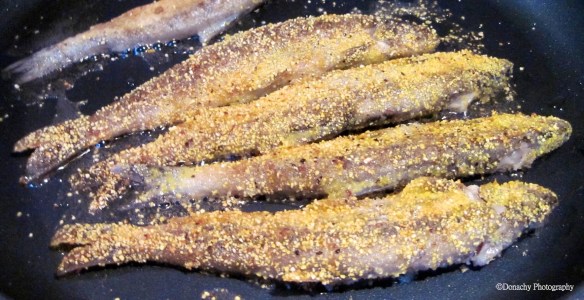
Freshly caught smelt prepared two ways: In the foreground, the fish was rolled in polenta. The smelt in back was dusted in seasoned flour. The fish were pan fried, wrapped in bacon and placed on whole leaves of Romain lettuce to be eaten from head to tail, bones and all. A sprig of asparagus and a few dollops of bright orange flying fish roe (tobiko) finishes the lettuce taco.

As I write this, one of the small rivers flowing into Resurrection Bay is jammed full of smelt. Specifically Thaleichthys pacificus, commonly referred to as hooligans. The AFS (American Fisheries Society) has settled on the name eulachon (pronounced you-luh-chawn), from the Chinook Indian name for the fish. Early west coast explorers and settlers called them candlefish because the spawning fish are so full of fat (about 15% of body weight) that when dried, they can be lit and will burn like a candle.

In the foreground: Polenta is especially coarse cornmeal. Seasoned with salt and pepper, rolling smelt in polenta gives these soft-fleshed fish a nice crunch when pan friend. In the back: another way to prepare smelt for the frying pan is by dropping them into a Ziplock bag containing seasoned flour and giving them a few shakes. Tarragon, fennel, marjoram and salt and pepper are a good start when seasoning these fish. Tongs make this a neat job. Note the asparagus in the pan on the stove.
The meat and bones of eulachons are quite soft. So soft, in fact, that when pan fried, the bones are barely noticeable. Their flavor is wonderful, but they definitely benefit from the addition of some crunch.

When the smelt are running in a river with a healthy population, getting enough for a meal or two is easy. On large rivers, a long-handled net might be necessary. But on this river, the fish were thick and close to shore. Two scoops of the net, and we had all the fish we needed.

Like their relatives, the salmon, eulachon are anadromous. They spend most of their life in the ocean, feeding on plankton, and then return to their natal streams and rivers to spawn, after which they die. Males arrive first and comprise virtually all the fish in the early part of the run. Later the females show up. Ideally, it’s the females you want, as a fresh fish laden with ripe eggs is a delicacy.

The males are quite good, too. In either case, cleaning these small fish (they average about eight inches/20 centimeters) is a simple matter of rinsing them in clean, cold water. There is no need to gill, gut or scale them.

A seemingly endless school of eulachons makes its way up an Alaskan river.

Fishing and Camping along Oregon’s Deschutes River

Edged by a thin strip of green, the Deschutes River is born in mountains southwest of Bend. Brookies – aggressive and abundant – dominate the headwaters where it flows out of Little Lava Lake. When the river hits Crane Prairie Reservoir, rainbows (and largemouth bass) dominate. Once the river drops into canyon country north of Bend, redbands come into their own. Although canyon trout typically don’t run large, there’s a good chance you’ll have the water to yourselves, as we did. Further downstream, steelhead attract attention from fly fishermen who spend hours swinging flies in hopes of that one, elusive, electrifying grab. (Click on any of the photos for a larger view.)

In June of 2009, Maia and I spent a week camped along the Deschutes River near Bend, Oregon where we were enrolled in an Orvis Fly Fishing School – an experience we highly recommend to any parent-son/daughter, husband-wife or fishing partner team looking to boost their skills and knowledge. (We’d love to take one of their saltwater fly fishing or wing shooting schools in the future.)

Tumalo State Park proved to be an excellent location for our headquarters. Tent friendly, it was both quiet and conveniently close to Bend and the region’s excellent fly fishing. In addition to the Deschutes Canyon, we also explored the nearby Metolius River, Lava Lake, Little Lava Lake and the Upper Deschutes.

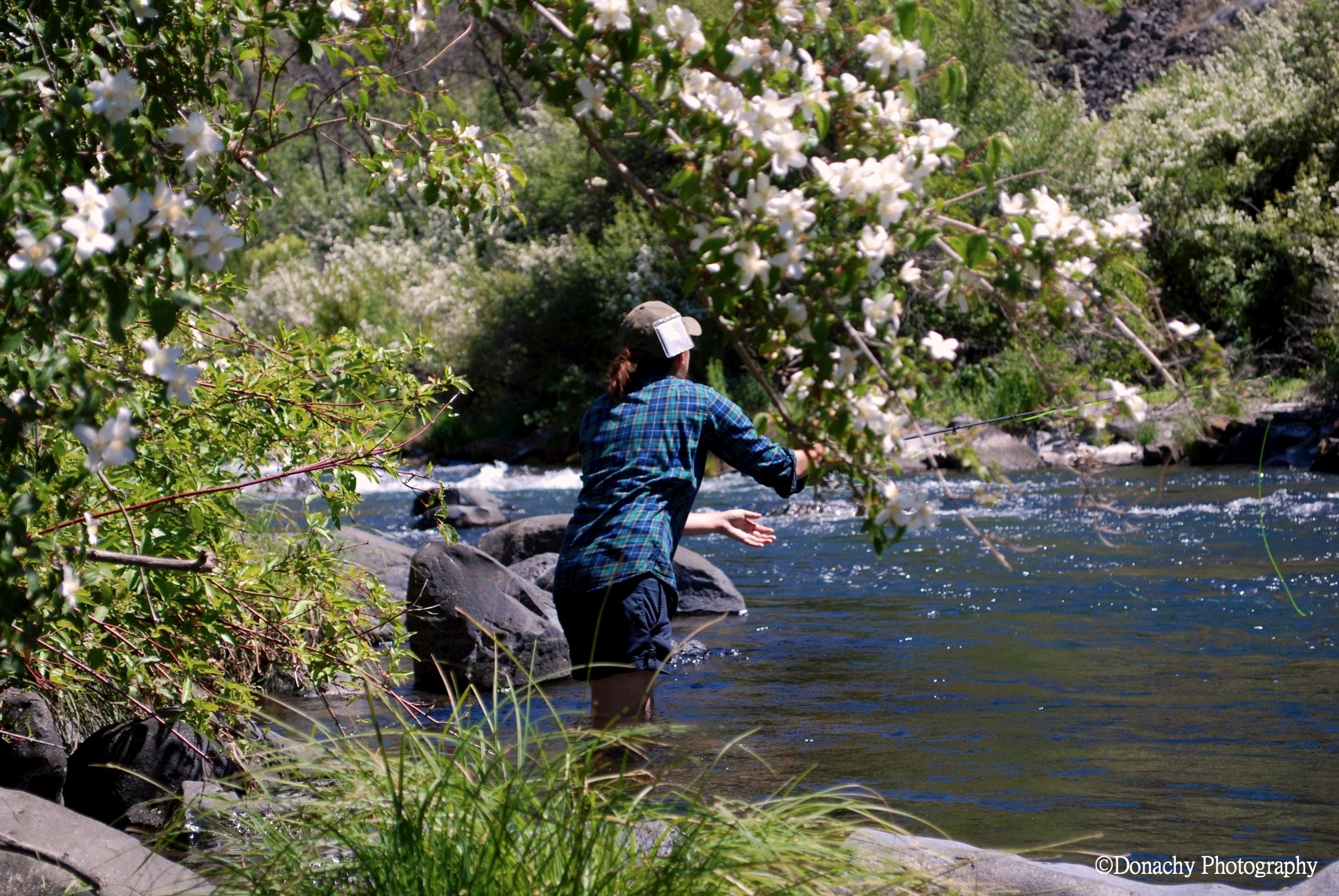
Fishing an elk hair caddis, Maia coaxed a pair of the Deschute’s redband trout from this canyon pool.

The redbands of the canyon are not large, but numbers are good, the water is beautiful and the setting is dramatic.

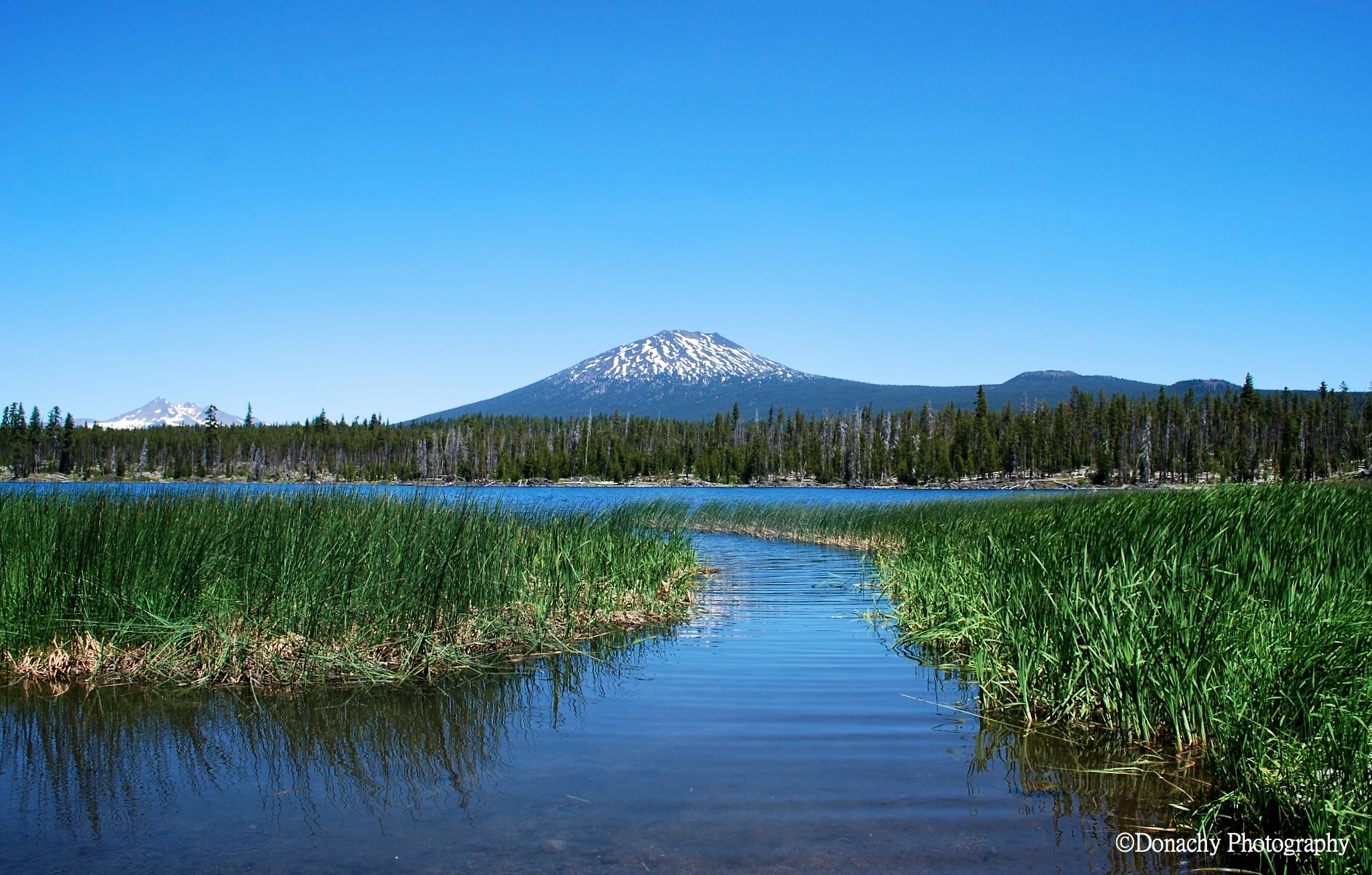
The float tube launch on Lava Lake seems to lay out a path to Mount Bachelor, one of Oregon’s premier ski destinations.

As Maia and I were preparing to launch our float tubes on Lava Lake, a fly fisherman who appeared to be in his 70’s was just coming in. “Wanna see what I’ll be having for breakfast?” he asked with a playful grin. He then pulled from a wet canvas creel a fat, 18 inch rainbow. The silvery fish had undoubtedly been stocked as a fingerling and grown heavy on a diet rich with scuds and aquatic insects. “Been coming here for decades,” he said. “Fishing’s still good, and you can’t beat the setting.” Since we were after a trout or two for dinner that night, we were heartened by his success. And sure enough, in addition to a couple of smaller trout, a rainbow just shy of two pounds fell to an bead head olive wooly bugger in the short time we spent on the lake.

After a dinner of salad, pan-friend New York strip steak, freshly caught trout and multi-colored Peruvian potatoes, we relaxed in front of our campfire enjoying a finger or two of Scotch, reminiscing about the day’s fishing, about the fishing we’d had other days going all the way back to afternoons spent float fishing for bluegills and bass on our home river in Japan when Maia was only three, and dreaming about trips we’d take in the future…

Until I lived in Oregon, I’d never seen garter snakes hunt fish. This one was working the margins of Lava Lake.

We had read about Hosmer Lake’s unique (and quite challenging) Atlantic Salmon and Brook Trout fishing. Kicking around in our float tubes in water only slightly less clear than air, we could see fish – big ones – nearly 20 feet deep. The white edges on their fins gave the brookies away; the others, we surmised, must be the salmon. The fish were beyond us on this particular day, but what a lovely piece of water. Excellent nature watching, too – birds, otters, wild flowers along the shore, and, of course, the fish in aquarium-like conditions.

In the week we spent sampling the fishing near Bend, we barely scratched the surface. In addition to miles of river, there are several lakes accessible by vehicle and numerous  hike-in fisheries. Area campground fees range from reasonable to downright cheap, and Bend itself is a cool city of about 80,000 that merits time set aside for exploration.

There is a Lake…

At a remote lake we discovered by chance, the trout are not as long as your leg. Lots and lots (and lots) of 14 to 18 inchers though.

Weighing in at about 15 pounds (including flippers), Super Cat pontoons inflate quickly, can be worn like backpacks, and fish comfortably.

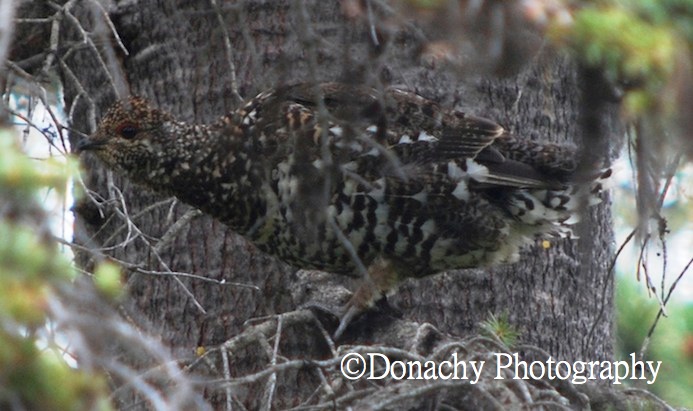
The walk in to remote waters is part of the adventure. On this particular hike, there were wildflowers, game tracks, berries, and a well-camouflaged covey of grouse perched in spruce trees.

Each summer, Maia, Barbra and I make it a point to meet up somewhere to fish, cook together, catch up with each other’s lives, and enjoy good wine and beer and stories. The fishing is secondary, but catching is definitely more fun than not catching. This is the kind of lake where you lose count of the fish turned, hooked or landed and settle into a gentle rhythm of casting, kicking and intense line watching, vigilant for the slightest twitch.

It is a beautiful and rare thing these days to fish a lake – no matter how remote – free from even a solitary scrap of litter. Such was the case on this lake. There was a hiking trail, and part of it traversed a log and board walk over a marshy area, but it was clear that those who know about this lake care about it. Save for a few mountain goats high up on a slope overlooking the lake, a pair of ospreys occasionally circling overhead and a small family of loons, we had the pristine water to ourselves.

On many remote (and not so remote) lakes, a size 8 or 10 bead head nymph dressed in olive, brown or black and jazzed up with something that sparkles is a killing pattern, and such was the case on this day. Lush beds of weeks were visible in the clear water. That’s where the insects were, and of course, the trout.

With a healthy population of trout and several size classes represented, we kept four smaller fish for dinner back at our campsite on a different lake. Evidence of a diet rich with scuds (freshwater shrimp), their flesh was as red as sockeye salmon flesh.

It’s difficult to improve on salt, ground pepper, and glowing charcoal when cooking just-caught fish. Accompanied with freshly picked sweet corn, roasted potatoes and a bottle of Chardonnay enjoyed around a campfire as the evening sky grew dark, our conversation was punctuated by an occasional pop from the fire and loons calling back and forth across the lake. 

Yelloweye & Grits: Breakfast Onboard Gillie

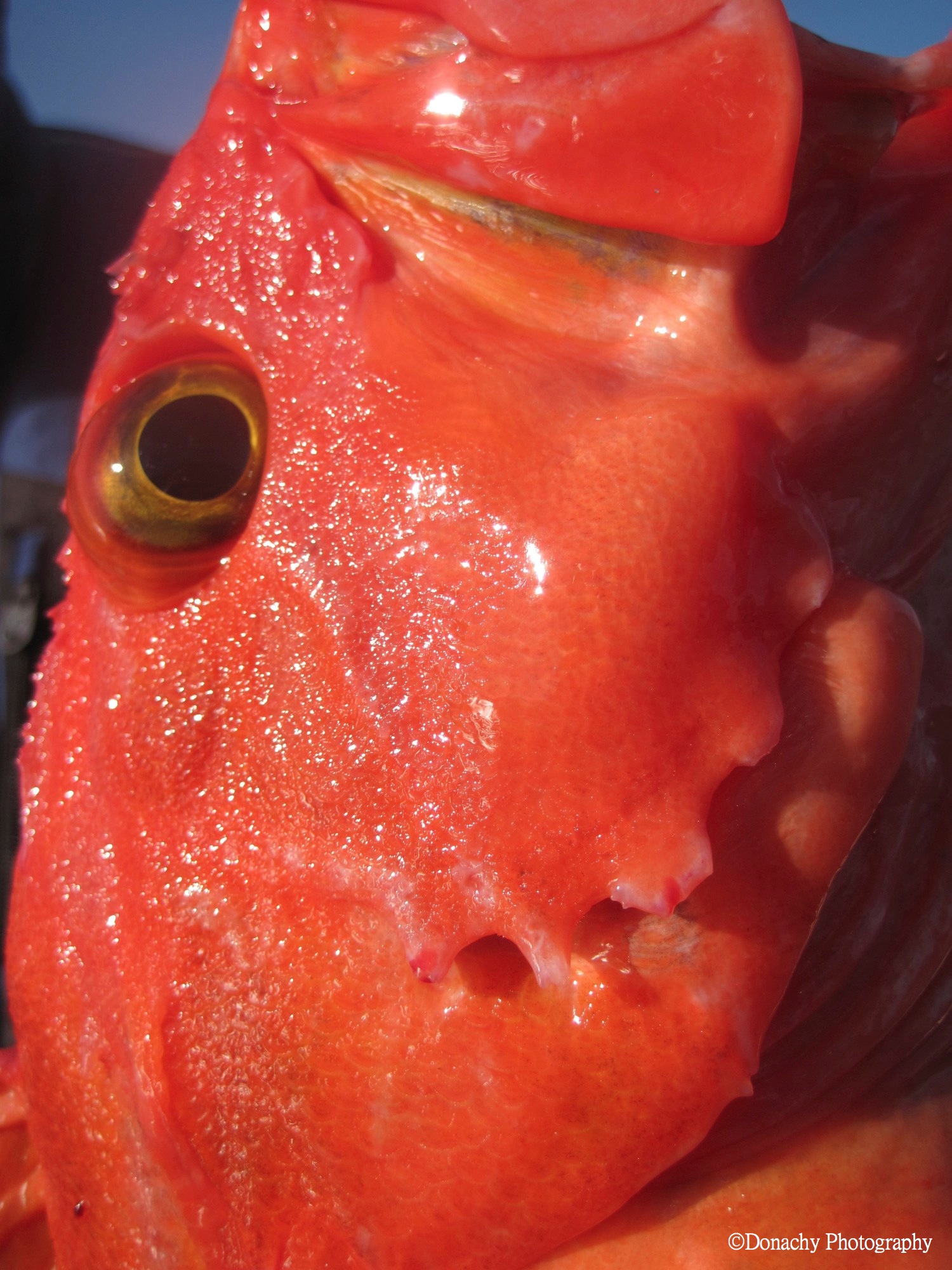
Yelloweye rockfish (Sebastus ruberrimus), a species of the Pacific Coast from Baja Mexico to Prince William Sound Alaska, is prized for its delicate flavor.

We’d spent most of the night on our C-Dory, drifting over deep water on Prince William Sound, admiring the moon and stars in the clear summer sky, talking about our life and occasionally dropping heavy, water-slicing knife jigs to the rocky bottom 160 feet below. Fishing was slow – a few small lingcod notwithstanding. The night was as still as a painting, the inky water mirroring the heavenly lights. With the engine cut off, the quiet was enveloping. When the yelloweye hit, I knew right away it wasn’t another ling. “Might be our yelloweye!” I said to Barbra as I worked the fish up from the depths.

And sure enough, it was. Barbra expertly scooped it up in the net, I did a quick fillet job, put it in a plastic container which I set in our cooler, and we headed back to port for some well-earned sleep. It was already early morning, though not quite yet dawn.

A few hours later when we woke, the sun was already high in the sky and the marina was bustling with activity. With daylight burnin’, we walked up the dock to the showers, blue skies and a few puffy white clouds overhead, deep green hanging on the mountains rimming the harbor.

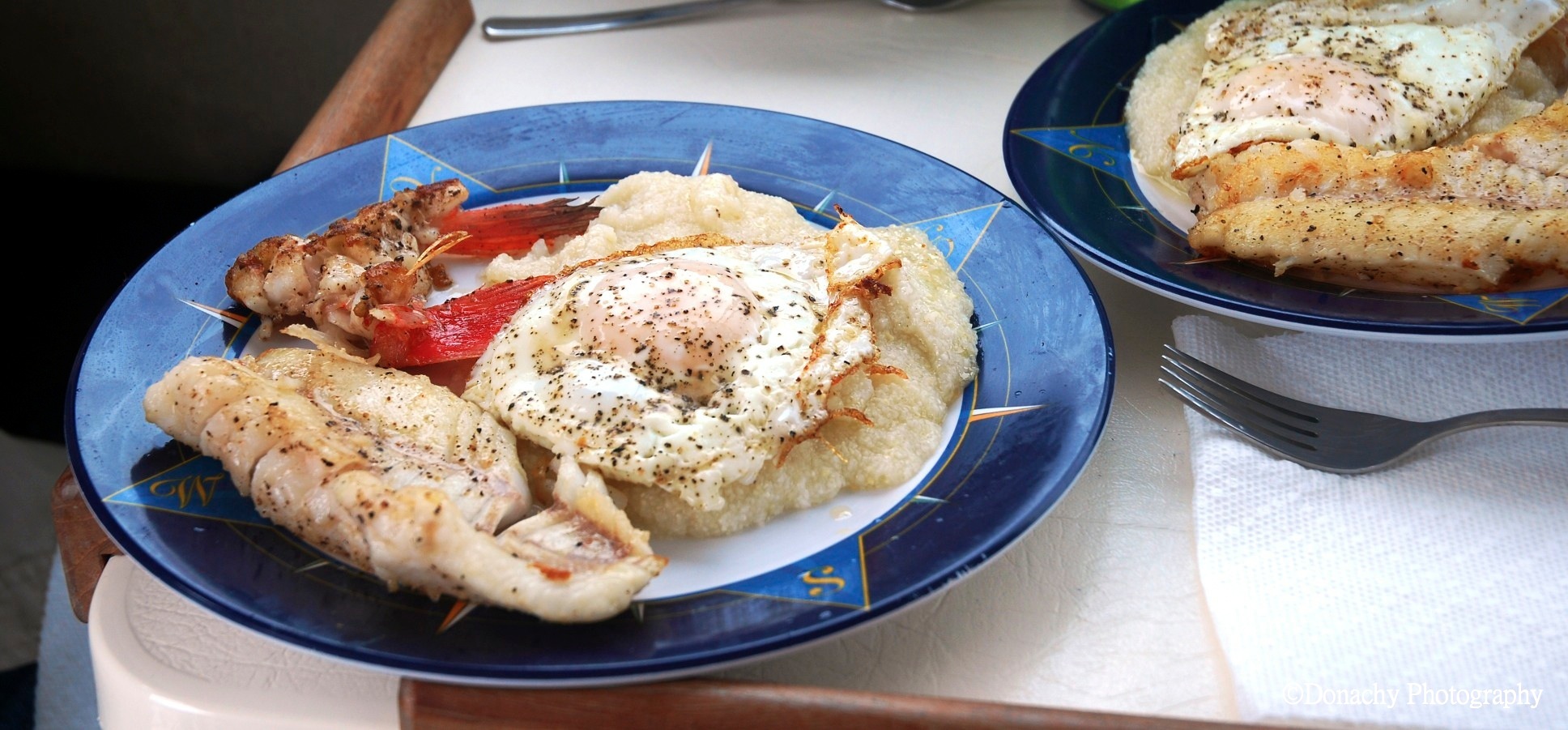
Back onboard Gillie I put the Coleman stove on the aft deck, fired it up, and after Barbra made coffee I fixed a fisherman’s breakfast of southern-style grits topped with easy-over eggs and a couple of yelloweye fillets along with the collars – that especially sweet piece of meat that includes the pectoral fin muscle. (The collar looks a little like a lobster in the above photo.)

Not a fancy breakfast, but a special one. I kept the seasoning simple: a little sea salt and black pepper ground coarse. The steaming plates of food accompanied by French roast coffee made for a great start to another day in paradise.

Harvesting Chickens Alaska Style

There are days when it seems, as Barbra says, like you could put one of your socks on a hook and catch halibut. Two-fish limits are the norm even on slow days. This brace of 20 and 25 pound fish came back-to-back and fell for twister-tails on five-ounce jigs in 80 feet of water near Homer. Halibut this size are referred to as “chicken halibut” and make for fine dining indeed.

We love Alaska, but between the cold and our wanderlust, it’s unlikely we’ll remain here permanently. We dream about sailboats and warm beaches, about driving our camper all over Canada and the U.S., and about one day maybe owning a home on a few acres, complete with a clean, wood burning stove, a large vegetable garden, perhaps some fruit trees and of course a few chickens for eggs and for roasting. The good life comes in many forms!

One thing that has dismayed us as we’ve looked for our next utopia is the state of many of America’s freshwater fisheries. Log onto a few of our states’ department of natural resources pages, look at fish consumption advisories, and a pattern soon emerges. Mercury and polychlorinated biphenyls (PCBs) contaminate most freshwater bodies, and some even contain unhealthy amounts of DDT–a chemical we’d thought was no longer a problem. Warnings and advisories recommending limited consumption of fish are the norm rather than the exception all across America as fallout from coal fired power plants, cement plants and other sources have laced our waters with unhealthy amounts of toxins. In some waters, it is recommended that no fish be eaten. More commonly – in our view shockingly – anglers and their families are advised to limit their consumption to just one meal of walleye, lake trout, bass or other fish per week or even less!

That’s not very many fish dinners.

The good news is that, thanks to increased awareness which has led to increased regulation of industry, levels of contaminants on many waters are tending downwards. Yes, keeping toxins out of our environment is expensive, but when we take into consideration health issues and quality of life, letting polluters pollute is even more costly. We have the means to keep our country clean, and that’s precisely what we should be doing. If industries won’t comply, then, yes, we need our government to intervene.

Meanwhile, we feel very fortunate to live in a place where, with very few exceptions, people can eat as many meals of fish as they desire with the confidence that they are enhancing, not harming, their health. And so, at this point in our life, our “chickens” are of the finned variety. For now, our halibut omelets are made with store-bought eggs and Tillamook cheddar cheese. Maybe one day they’ll be made with eggs from our own chickens and cheese from our own kitchen!

Arctic Grayling Shioyaki with Roe – A Yellowstone Connection

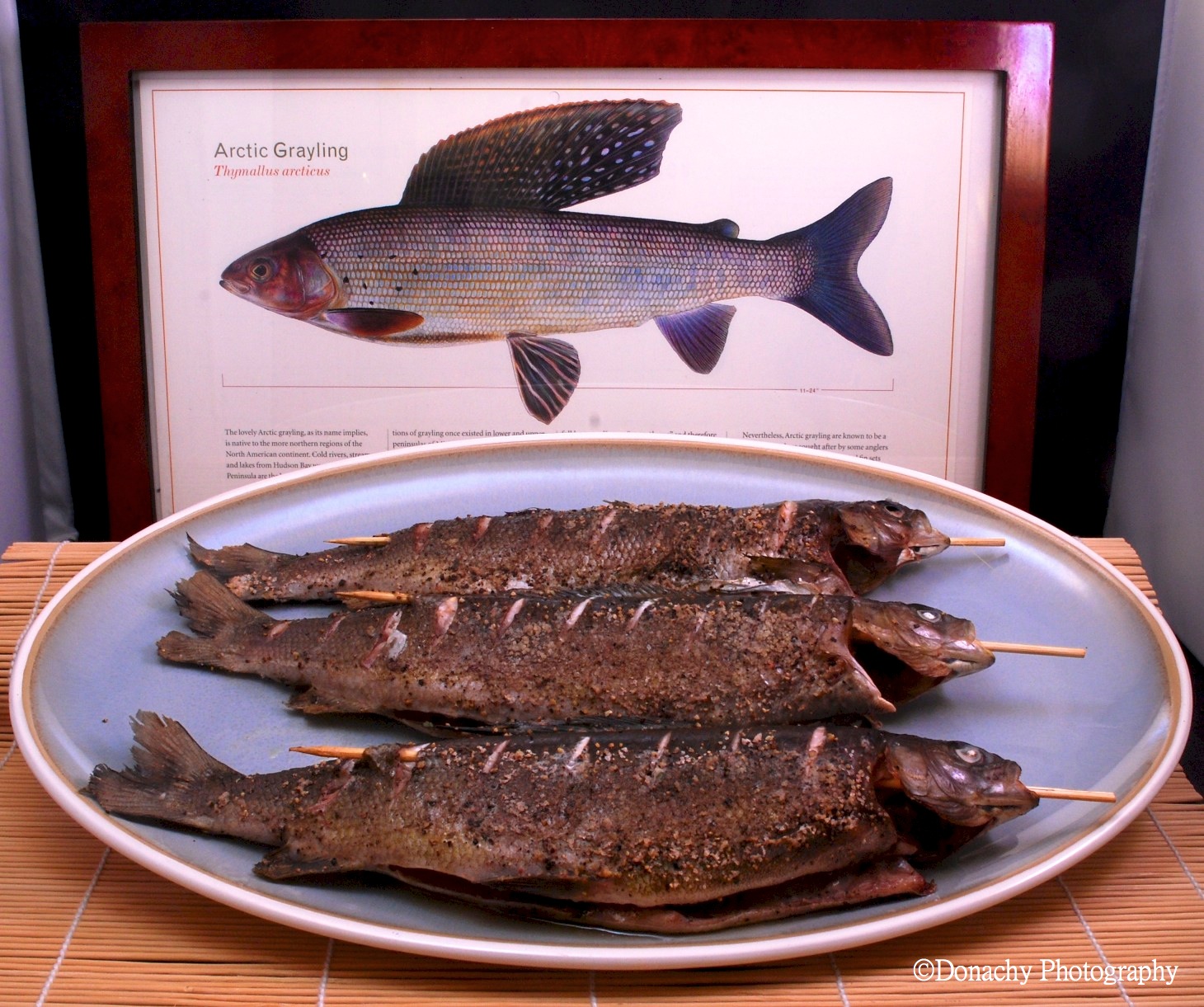
Arctic grayling are abundant throughout much of Alaska. I was happy to finally have an opportunity to taste them. I skewered these three, cut a few diagonal slashes in their skin, and salted and broiled them in the fashion that Japanese prepare charr, trout and small salmon. Two of the fish had nice sacs of roe with I cured as one would cure salmon roe in making ikura. The grayling themselves were unremarkable, but the roe was quite delicious.

One summer several years ago I tent camped alongside the Madison River in Yellowstone National Park. It was glorious. Recent fires had changed the ecosystem. Not destroyed it. Changed it. Along with Yellowstone’s iconic bison, elk were abundant, the big bulls absolutely magnificent with their velvet-covered racks. We encountered moose, sandhill cranes, several black bears and a grizzly, and listened in awe as a pack of wolves howling across a valley broke the quiet one evening. It was during this stay that Maia took her first-ever fly caught trout, beautifully marked  cutthroats from Cascade Creek. We still talk about how we had to cross that stream a couple of times to avoid basking bison.

One of the highlights of that visit to Yellowstone was a morning spent alone, fishing the Gibbon River from the lip above the 80-foot falls upstream a mile or so. Although I got a late start and the sun was already high in a cloudless sky, brown trout in the eight to 13 inch range were cooperative, most of them falling to a #14 pheasant tail nymph. Mountain flowers seemed to be in bloom everywhere, birds were out in force, and I had the river completely to myself.

And then I came to the hole. Rip-rap on one side, a rock wall on the other and a log jam at the tail pushed the water into a long pool I estimated to be eight to 10 feet deep–the deepest water I’d encountered. With brush growing along the edges and with the depths guarded by drowned snags, tell-tail strands of monofilament suggested this piece of water was fairly hard-fished. So I took a while to contemplate my approach. Wishing to get as deep as possible, the first thing I did was lengthen my leader and switch to a weighted pheasant tail. I then waded to the shallows at the tail of the pool, gauged the light breeze, and executed a cast upstream to allow for a long drift right down the heart of the pool. Stripping in bright green line as it drifted toward me, I imagined my little fly descending ever deeper. Just as the last of the green line floated above a forked log at the deepest part of the pool, it ever so slightly hesitated. I gave the line a quick strip as I lifted my rod and immediately felt the weight of a decent fish. From the manner in which it fought, I knew right away it wasn’t another brown, and it certainly wasn’t a rainbow. Whitefish? I had no idea. Somehow I managed to keep clear of the snags, and a few moments later my jaw dropped as an Arctic grayling coasted into view. I’d never caught one before, and had no idea they were a possibility in any of Yellowstone’s rivers. I led it to the gravelly shallows near my feet, gently cupped it in my hand and spread it’s amazing, sail-like dorsal fin. The dark fin, wet and flecked with iridescent blue, glistened in the sun and I was reminded that this is why one should always carry a camera. Mine, of course, was up in my car. I let the silvery-gray fish slip from my hand and sink back to the depths. Moments later, following the same pattern, a second grayling presented itself to me, this one a fraction of an inch smaller than the first.

Arctic grayling (Thymallus arcticus) are an ancient fish, their ancestors having preceded their charr, trout and salmon brethren in branching off from a common ancestor some 60 million years ago. As the earth has continued to warm since the last Ice Age, grayling have retreated to ever fewer waters in the lower-48. There aren’t many places where they can still be found, and most of these are high altitude lakes in the northern Rockies. Fluvial grayling–river grayling–are fairly rare in the lower-48. In holding those fish, in being in their presence, I felt a connection to a vanished epoch populated by mastodons and mammoths, sabertooth cats, dire wolves and other species long since vanished. Although those fish were only 11 or 12 inches in length, to me, they were trophies–as fined as any fish I’ve ever landed. I’ve long thought that if and when I settle down, I would like to have fiberglas replica mounts, or perhaps a painting, made of those two  grayling, loafing near the submerged snag where I found them in that deep pool on the Gibbon River.

A Perfect Night

Full moon over Prince William Sound near Whittier, Alaska

Summer days in Alaska are long–near midsummer, they are nearly endless. In our home states of California and Pennsylvania, fall is the season we like best. Up here, it’s summer.

We were camping on our boat in the marina at Whittier one summer in early August. The fishing had been only so-so, but with massive glaciers spilling into protected bays and rafts of sea otters in the nearby waters, the nature viewing was spectacular. On our last day, at about 6:00 p.m. with the sun out and clear skies above, Jack and I decided to take the C-Dory out for an evening cruise. We motored out as the last of the boats of fishermen and sightseers were heading in. We didn’t really have a plan. We just wanted to be out on the water.

Once we got a few miles beyond the harbor, we found a spot to fish and so we cut the motor. There was not another boat in sight. It was as if no one else in the world existed. Surrounded by mountain peaks dusted in the remainder of last winter’s snow, the sea was glassy-calm. Gillie barely rocked as we drifted silently with the current. The slowly setting sun, lit up the few low clouds. As the sun slipped below the horizon, the full moon glowed against a dark blue sky.

We began to pick up fish here and there–mostly small lingcod. The moon climbed higher in the sky and shone brighter and brighter, it’s reflection dancing across the water as our own movements caused the boat to rock. At times we broke the quiet with talk about different possibilities for the future. But for long stretches we were quiet, lost in our own thoughts, washed in this phenomenal night.

The shaker lings continued to periodically attack our jigs, and then Jack connected with something that fought differently. He worked the fish up from 160 feet down and I did net duties on a beautiful yelloweye rock fish. With a fish in the cooler that would provide for a gourmet breakfast the following morning, it was a good place to call it a night. I started up the engine and guided us home across the moonlit water.

C-Dory 22 Angler: A Boat for Alaska

The Gillie: Our 2008 C-Dory 22 Angler taking a cruise on the Sacramento River

“Gillie” is a Scottish term that refers to a fishing or hunting attendant, much like a guide. As such, armed with an excellent electronic fish-finding unit, a dependable 90 hp Honda engine (and an 8 hp kicker), and enough open deck to comfortably fish two or three anglers (four in a pinch), this boat has proved to be a reliable gillie. Barbra and I have spent many nights both on the water and on land snuggly tucked away in the cuddy cabin, and the dinette table in the pilot house is just big enough for the two of us to enjoy a meal. These boats are capable of storing an amazing amount of gear, the hull is tough, and on flat water loaded down with fishing gear and four medium-sized adults, it tops out around 25 knots (about 29 mph). Inside the pilot house with the Alaskan bulkhead door closed, making long runs is both warm and quiet. The 90 hp Honda trolls beautifully when we’re running rigs for salmon, and the shallow draft (well under two feet) allows us to get in the rocks in pursuit of species close to shore.

Ask a typical boat owner what the best boat is, and they’re likely to tell you, “The one I own right now.” That’s how we feel about our C-Dory. With a beam of only 7’9″, it’s a breeze to tow, yet it’s enough boat to feel safe on fairly big water–from the California coast to the ocean bays of Alaska. You’ve probably heard the quip that goes, “The two happiest days in a boater’s life are the day he buys the boat and the day he sells it.” Not with a C-Dory. The happiest days are the ones we have it on the water.

Setting the Net

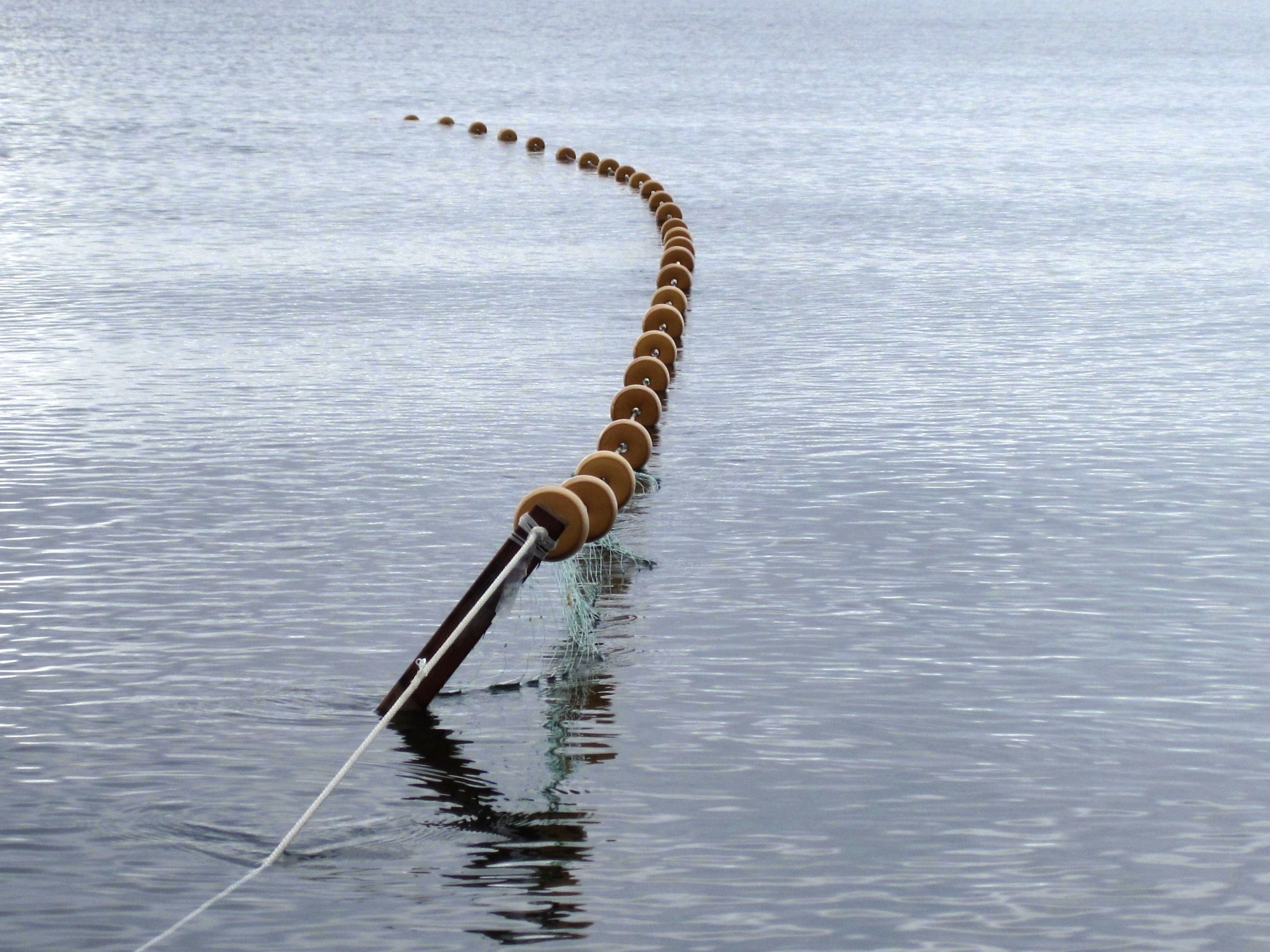
September 4: We’d be wanting to learn how to set a net from shore, so when a couple invited us to come fishing with them, we jumped at the opportunity. The way nets are set here is pretty ingenious.

The first order of business is to get a big enough weight out from shore to securely anchor the far end of the net. In Shishmaref and lots of other places, they use small dingies or other watercraft to accomplish this. But the current runs strong near Point Hope, and high winds can come up quickly. In the past, lone anglers launching small boats off the beach led to drownings. So a different method for getting the cloth sacks of rocks which serve as weights out into deeper water was developed. Here fishermen use long poles–sometimes lengths of two-by-fours nailed together. The fish often run quite close to shore, so even 25 feet or so can be far enough and a 30 foot net set is all you need. The pole is threaded through a loop on the top of the weight, enough floatation in the form of plastic buoys is attached to the end of the pole to keep everything floating as its pushed out, and then the pole is pulled back and the weight drops to the bottom.

Meanwhile, a long line has been run through one end of the net, top to bottom along a piece of wood attached to the net and is also run through the weight. With the ends of the line tied together to form one long loops, and controlled from the beach, this line is pulled until one end of the net is snugged up against the weight. The top and bottom lines are adjusted so that the net is positioned upright, and the lines are tied off to two stakes on the beach. At the other end of the net–the one closest to the beach–another line holds the net in place and is similarly tethered. Corks keep the top of the net up, and a lead line keeps the bottom of the net down. It sounds a bit complicated, but in practice the whole process is fairly simple and intuitive.

Once the net is set, the fishing is much like any kind of fishing anywhere. You wait, hoping to see the tell-tale dancing of corks, or maybe a splash as a large fish entrapped in the net swims to the surface. Up here the quarry are salmon (pinks, silvers and Chinook), and the highly prized “trout,” i.e. sea-run Dolly Varden. While you wait for the fish to come along, you might see grey whales or even Orcas, seals, or maybe a walrus. Hundreds of thousands of seabirds nest and roost on the cliffs of Cape Thomson to the south, so the sea is usually alive with murres, gulls, puffins and more.

Where There’s Only Sky and Water


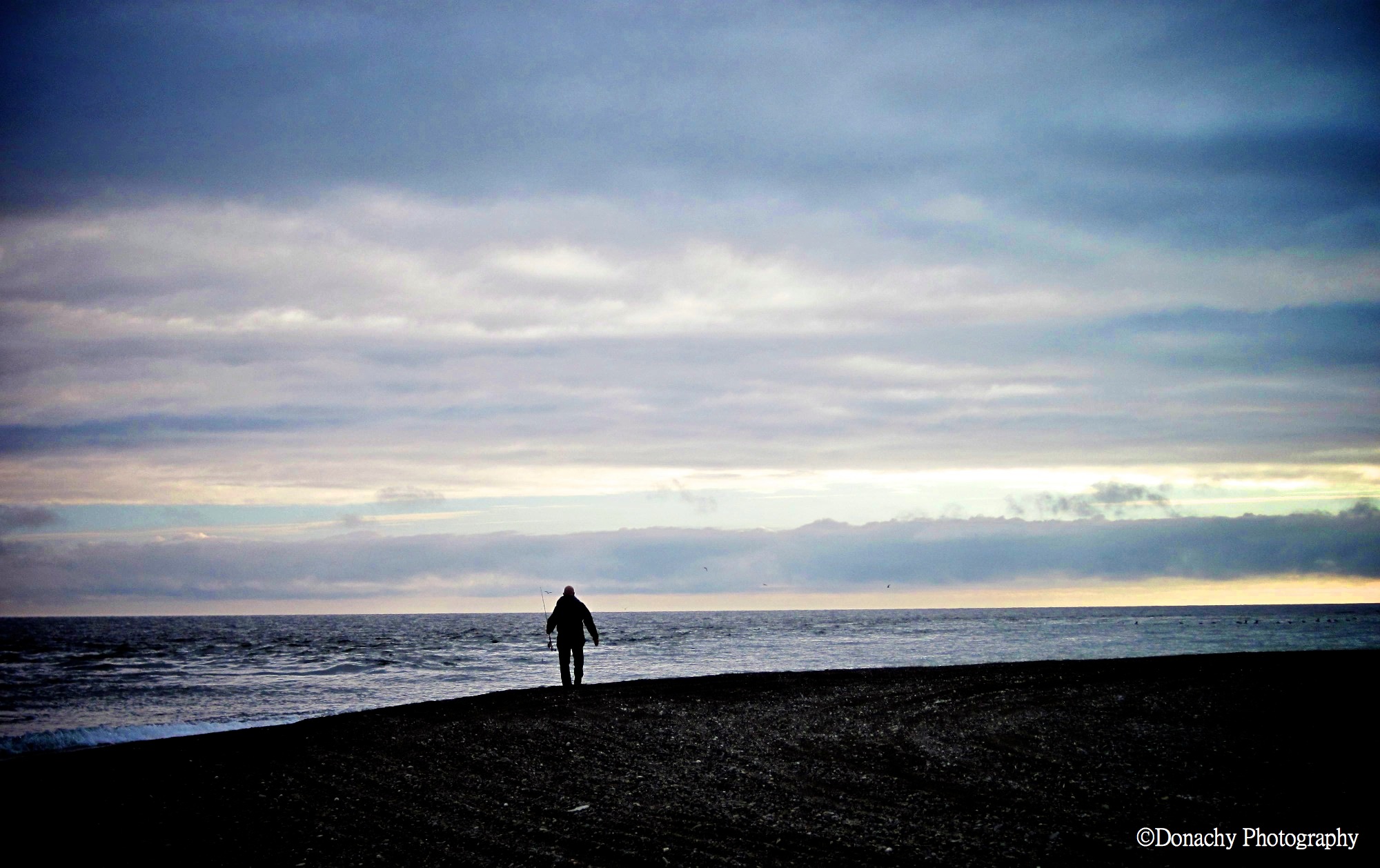
A solitary surf fisherman in late August hoping to intercept the last of the pink salmon or a roving school of Dolly Varden on the point at Point Hope, Alaska.

Surf fishing is addicting. Part of the magic lies in not knowing when or even if the fish will show up. So you fall into a rhythm, walking up or down the beach casting, waiting for the lure to land, and beginning your retrieve. As you fall into this rhythm, invariably your mind wanders… back to fish you’ve caught and fish you’ve lost on this beach or on other beaches, back to something your dad, or a coach, or a friend said to you a long time ago, back to places you’ve been and to people who have slipped into and out of your life. At other times, you find yourself looking into the future, forward to the day when your mortgage is paid off, or to a day when you are at last able to travel to some dream destination. Your feet are planted more or less firmly on sand or pebbles. Behind you are cities and towns, offices, classrooms, dinner parties, appointments, work, triumphs and regrets, small talk, clocks, calendars… Before you, stretching out as far as you can see, there is only sky and water and the possibility that on the next cast you’ll be woken from your reverie, everything suddenly solid, your rod bent into a graceful, lively arc.