Spring! April in the World’s Coldest Capital

Bohemian waxwing april 2015 n

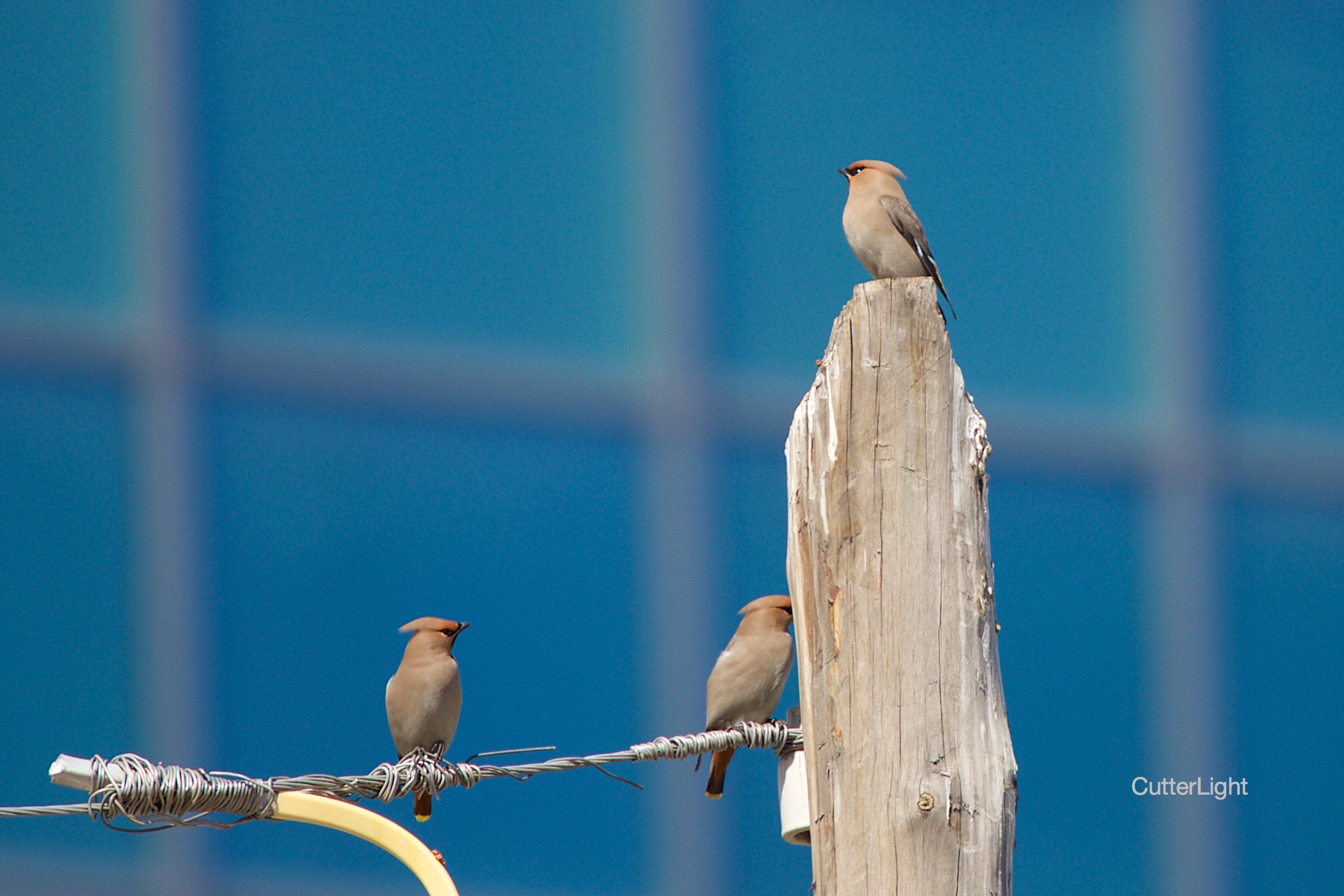
Warmer temperatures are bringing flocks of new birds to Ulaanbaatar. These Bohemian Waxwings won’t stick around long; they’re on their way to nesting grounds in Siberia.

One day temperatures are in the 50’s or 60’s (in the teens, Celsius). The next day it’s below freezing with snowfall. And so it has been for the past few weeks from late March through mid-April. Welcome to Ulaanbaatar, Mongolia – officially recognized as the world’s coldest capital city. As transplants from Alaska, it feels like home – albeit a little warmer than our former north-of-the-Arctic-Circle village of Point Hope.

pussy willows catkins n

Pussy Willows – flowers of willow trees – have begun pushing out of their buds along the banks of Ulaanbaatar’s Tuul River.

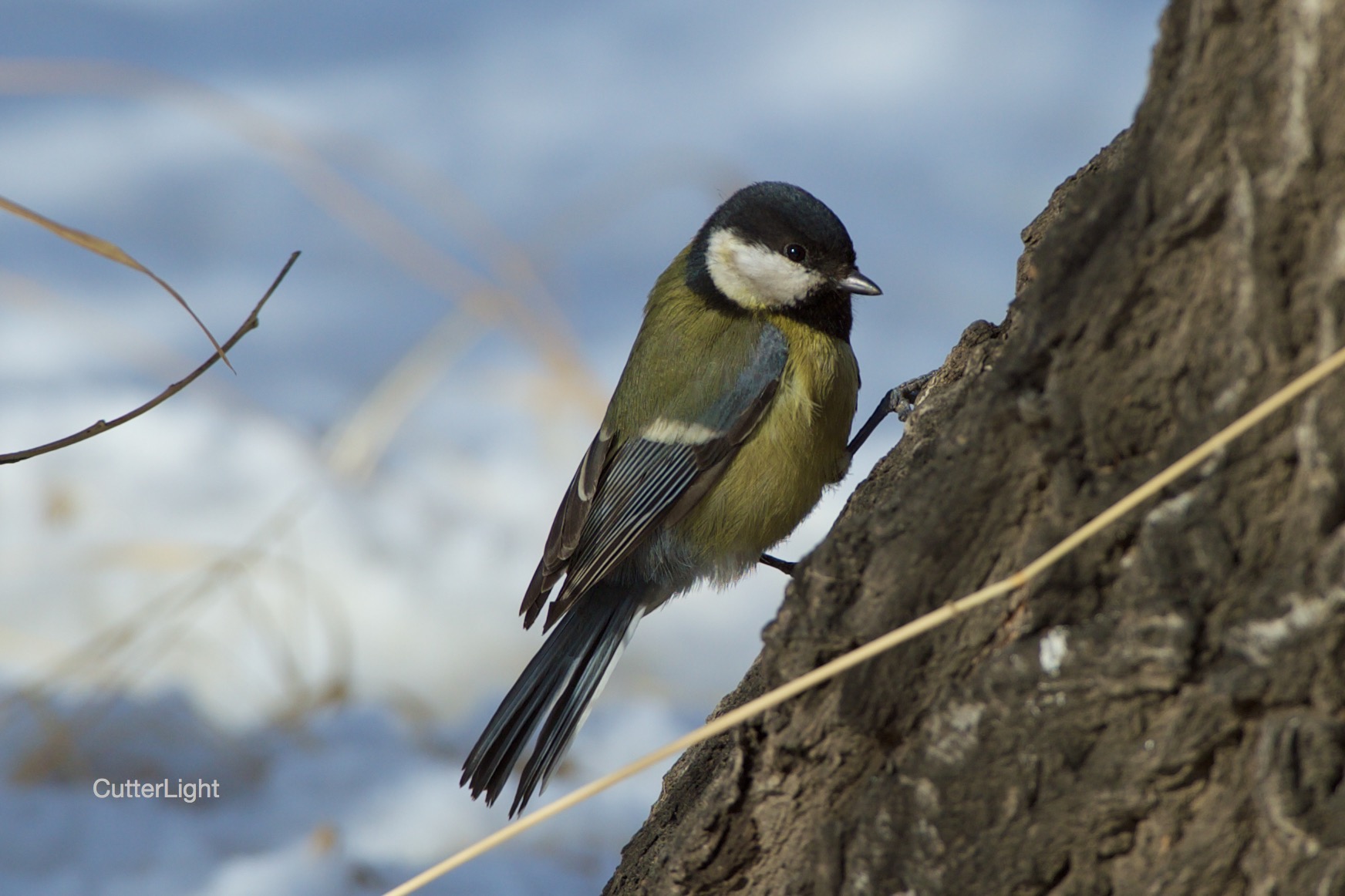
great tit profile tree n

Great tits, above and below, are common residents along the Tuul River as well as in the nearby mountain forests.

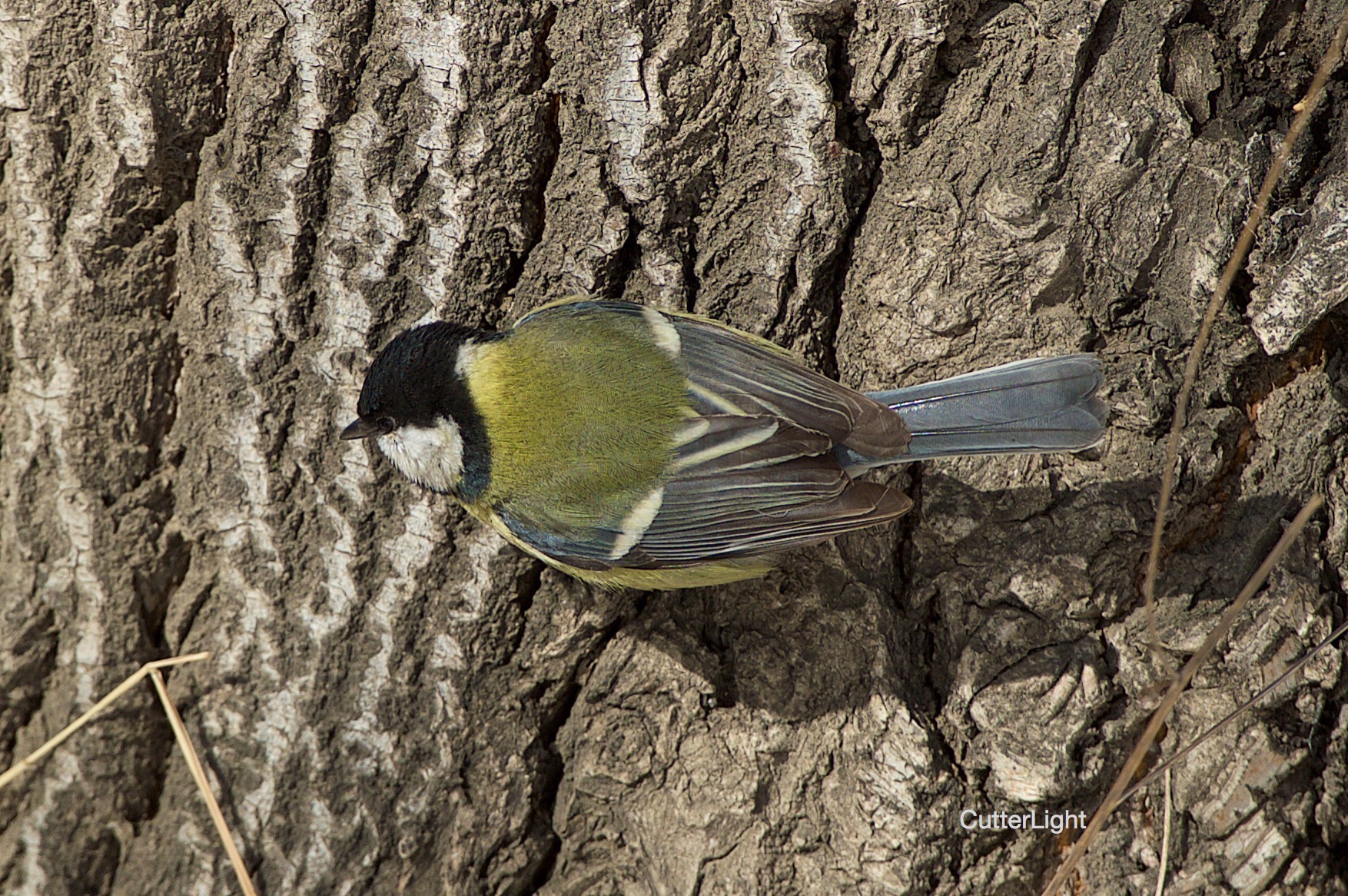
great tit back tree n

Such interesting little birds, all camouflage and color from the head to the mid-back, an abrupt line, and then symmetry from the mid-back through the tail, which, in nature, is its own form of camouflage.

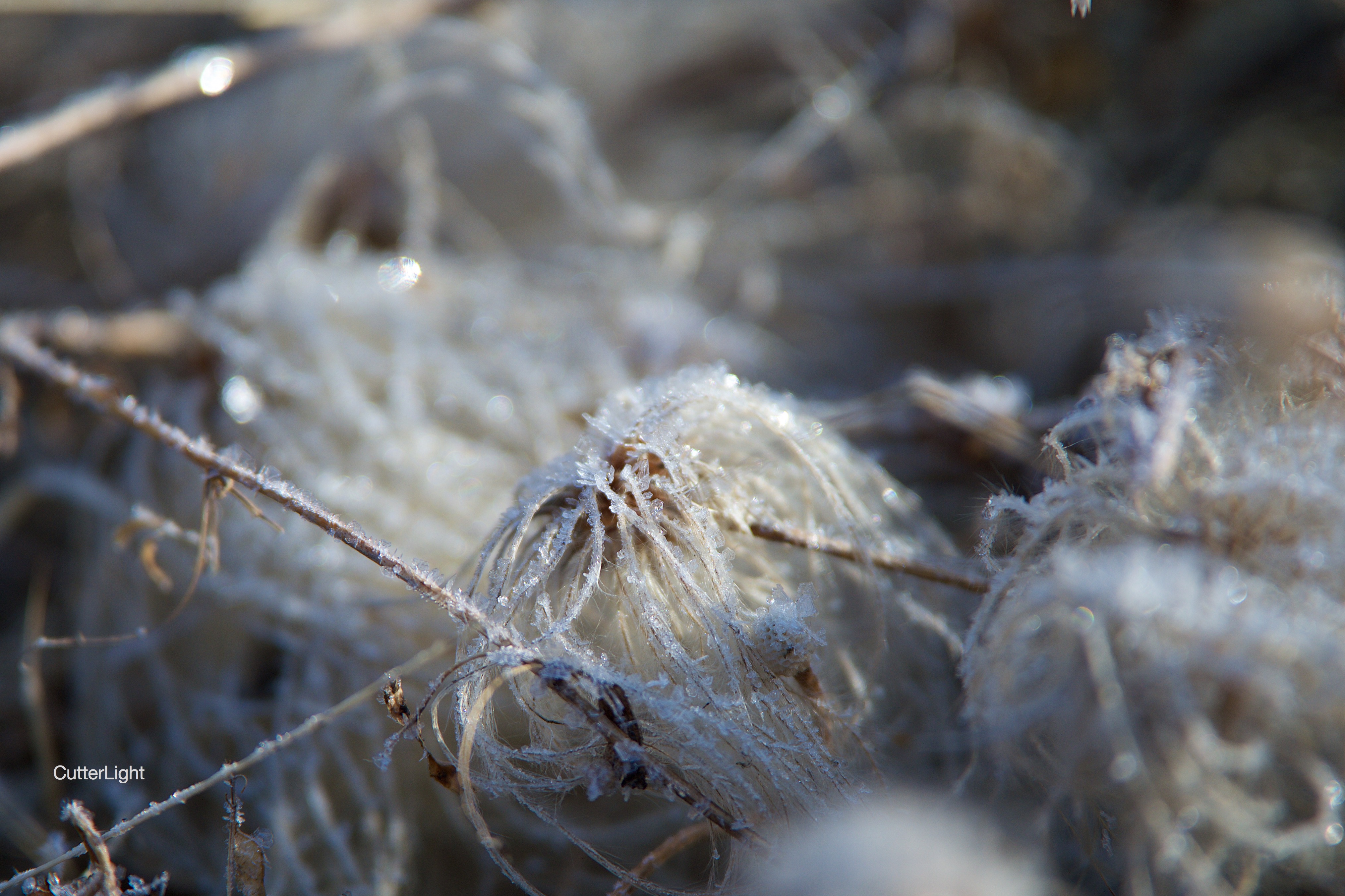
frost jellyfish weed april 2015 n

Early morning frost turned the withered remnant of last fall’s flowers into frozen jellyfish.

jellyfish weed april 2015 n

By late morning, the sun had melted most of the frost…

long-tailed rosefinch n

…while in shaded pockets where snow still lingered, newly arrived long-tailed rosefinches filled up on last year’s store of seeds. The willows and grasses along the Tuul provide the perfect habitat for many species of birds. And, judging by tracks in the snow, rabbits as well.

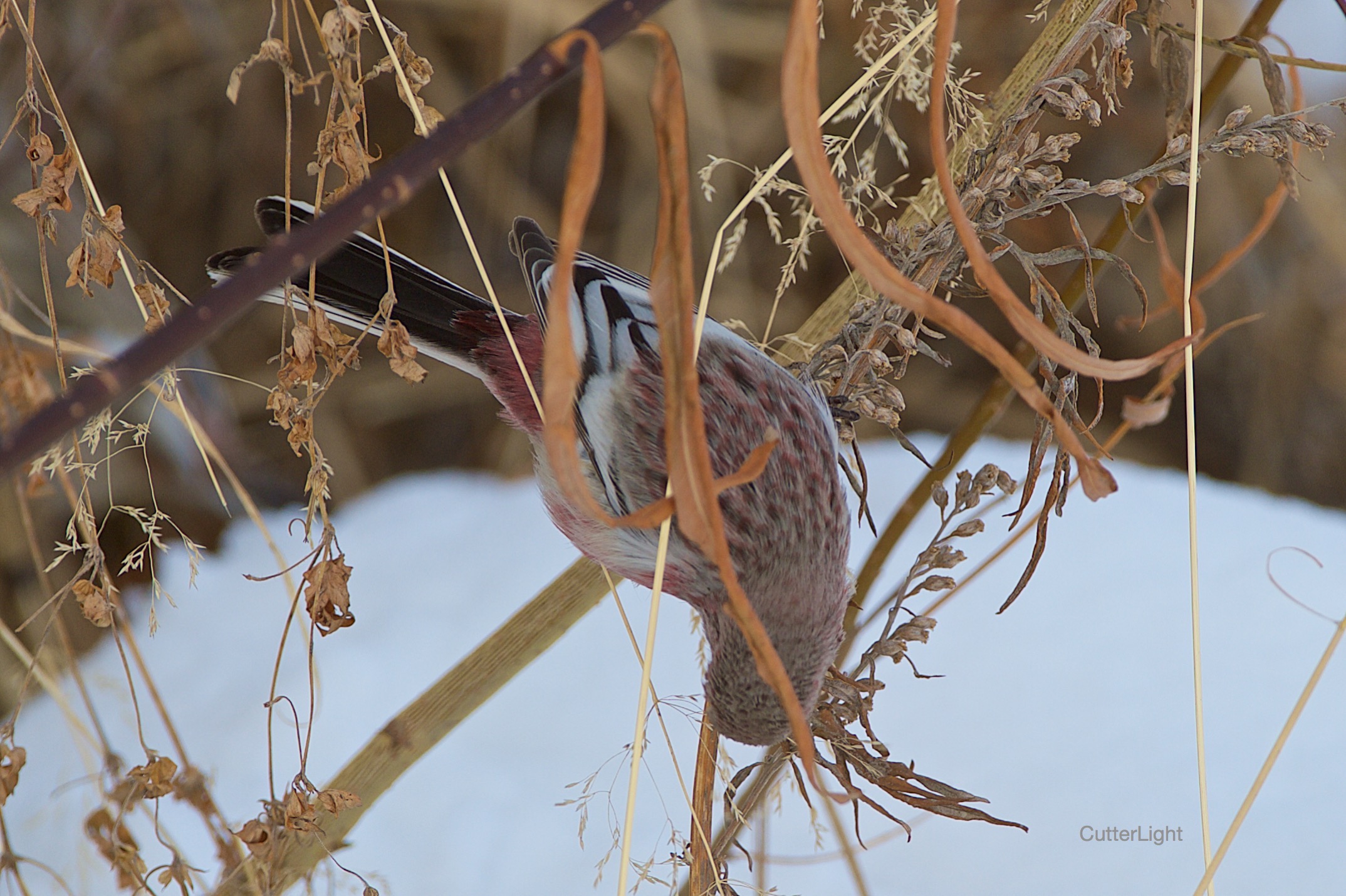
long-tailed rose finch upside down n

Finches become acrobats in pursuit of a good meal.

female long-tailed rose finch n

As is typically the case among passerines, the colors of the female long-tails are subdued compared to their male counterparts.

Magpie March 2015 n

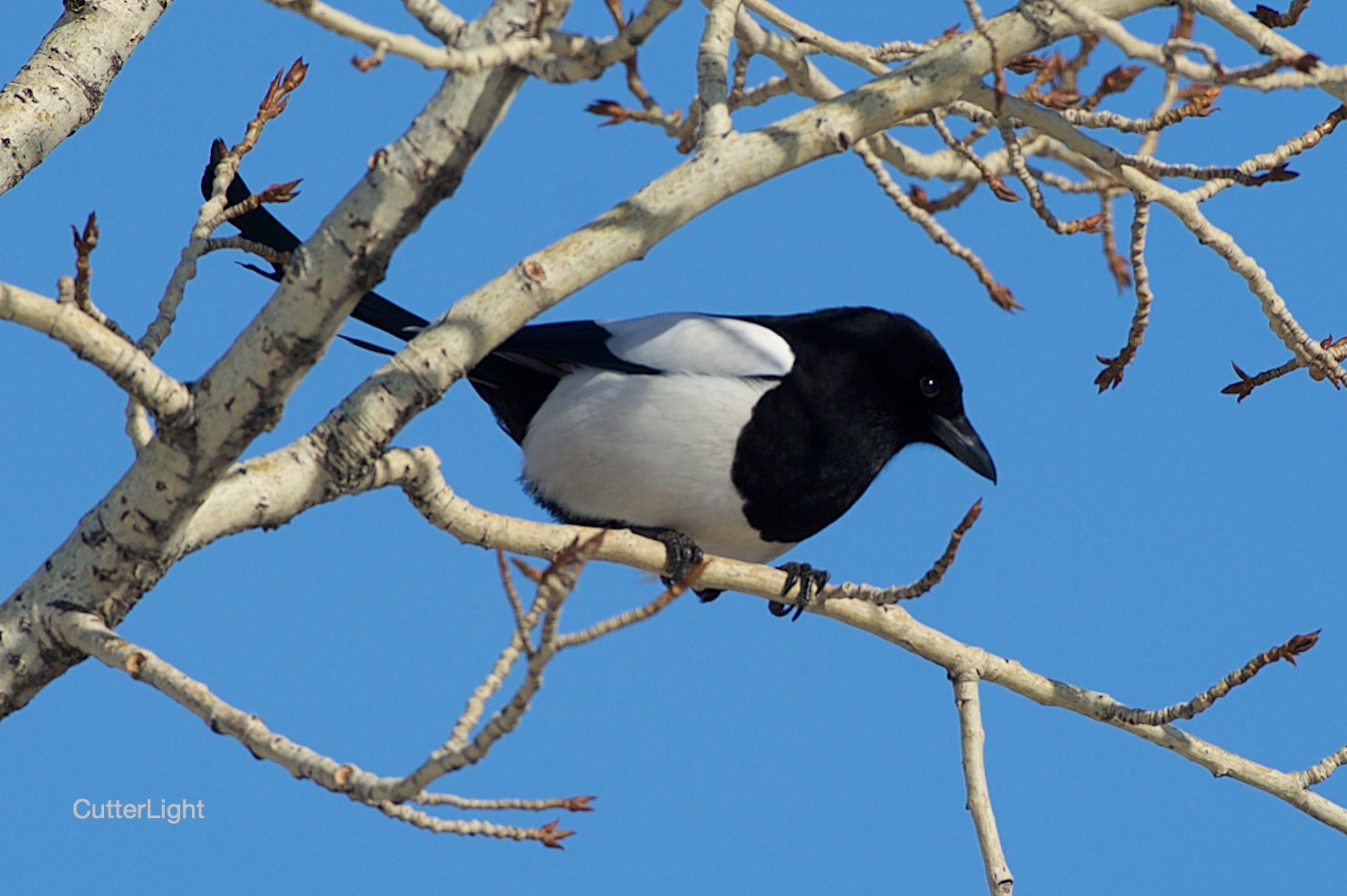
Magpies were out in force, searching for nesting material to add to the massive jumbles of sticks they build in trees. It must work. They return to the same nests year after year, building them ever higher. Note the hooked beak; passerines beware. Magpies are predators, and no mistake.

big tree w sun april Tuul n

The Tuul River green belt is our favorite place in Ulaanbaatar. In addition to providing habitat for year-round resident birds and summer nesters, the abundant seeds provide critical fuel for passerines migrating further north.  The belt is also important hunting grounds for kestrels and other birds of prey as they make their way to their own nesting grounds. The banks of the Tuul are what’s left of an increasingly fragmented ecosystem. We’ve even caught fleeting glimpses of some type of quail or partridge in the thick willow undergrowth!

Snow and a Memory of Snow: 10 Photographs during a Spring Snowfall in Ulaanbaatar

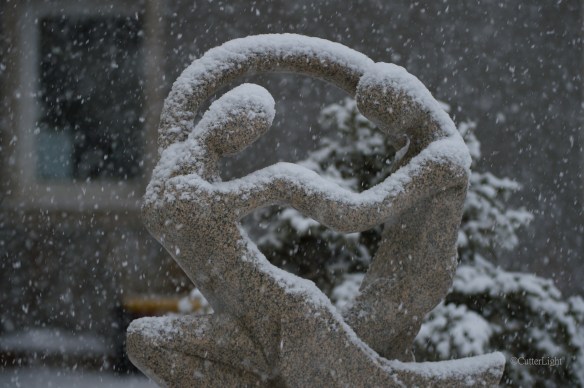
granite dancers in snow soft n

Granite Dancers in Spring Snow  I walk passed this sculpture at least two times a day, every day, but this was the first time I photographed it. On this day, I knew before I left the apartment that I wanted to record it in the particular light that was falling. The snow was a bonus, adding depth and additional movement. Nikon D4, Nikkor 200-400mm f/4G IF-ED II, 200mm, ISO 100, f/4, 1/200

Watching the snow fall from inside our apartment building, I was reminded of a favorite haiku by Basho. Come! Let’s go snow-viewing/till we’re buried!

granite dancers in snow sharp n

Granite Dancers in Spring Snow, high contrast This is the same exposure as above. I brought up the contrast and saturation and sharpened the edges. This image might be more marketable as a postcard, but I prefer the softer, previous image, which, to me, feels more intimate.

Which do you like?
UB apt building snowy day enhanced a n

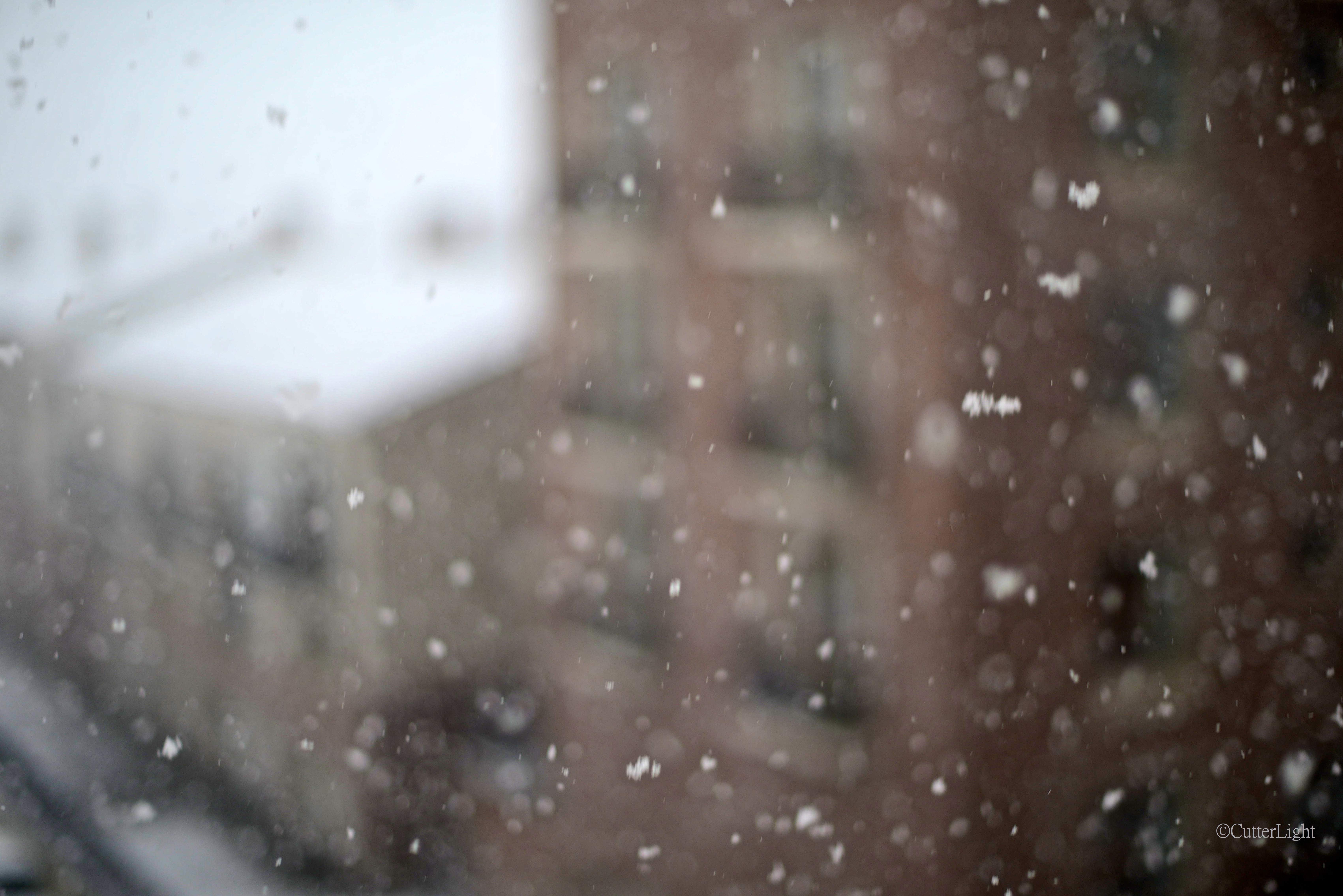
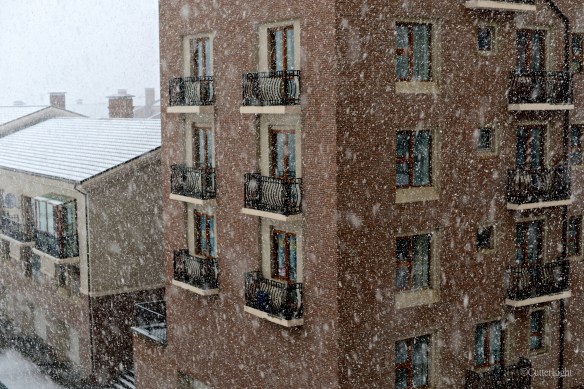
Brick Apartment Building in Snowfall, Ulaanbaatar  This is the view out the window of my apartment in Ulaanbaatar, Mongolia. On most days, it is uninteresting to me, the occasional pigeon roosting on our windowsill notwithstanding. But on this day, the scene was transformed into something magical. I set the ISO low to preserve as much contrast as possible. Then, in processing, I brought up the contrast even more, exaggerating the blue in the window panes and the black of the railings. Nikon D800, Nikkor 50mm f1.4G, ISO 100, f/3.5, 1/125
UB apt row snowy day b n

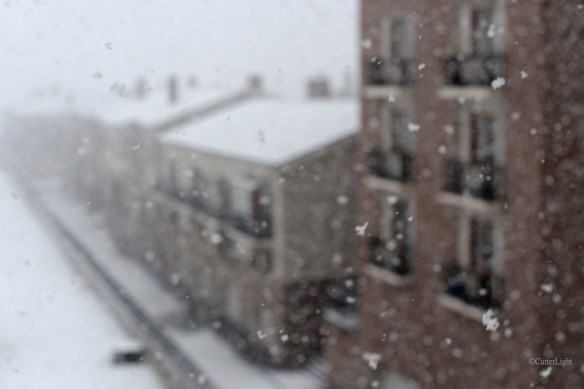
It’s Snowing in UB  I’m not entirely sure why, but this photo and the next one tug at my gut in the way really good writing does. For me, there’s something lonesome… longing… in these shots where the focus is almost on the nearest snowflakes but not quite on anything. I imagine someone far from home, perhaps recently moved from the Mongolian steppe, or any place in the world, looking out on a city… no people, no traffic, nothing… focusing on nothing, longing for home. Nikon D800, Nikkor 50mm f/1.4G, ISO 1250, f/5, 1/1000
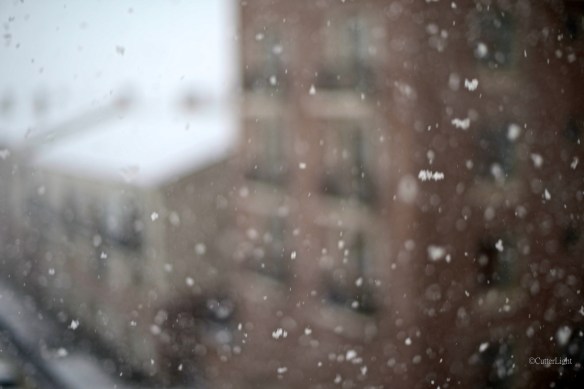
Snow and a Memory of Snow n

Snow and a Memory of Snow  As in the above photo, the focus is close to the viewer, yet indistinct. For me, these shots evoke a sense of thoughts being elsewhere. A person from snow country could look out the window on snowfall in any city in the world and in a moment be taken back to a memory in a small town or city, a ger out on the steppe, a woodland cabin, or anywhere. Anyway, that’s what I was going for in this image. This is probably the most purposeful, intended image I’ve taken so far. I applied a small technique to get the focal point where I wanted it to be. The image was inspired by the song It’s Snowin in Brooklyn by Ferron, a song I heard just one time on a snowy night in Boulder, Colorado back in 1985 and which has been stuck in my head all these many years till I recently rediscovered it thanks to an Internet search based on a single line from the song. Nikon D800, Nikkor 50mm f/1.4G, ISO 100, f/1.4, 1/800

UB apt snowy day streak d n

Snow Streaks on Brick  For a brief few moments, a breeze kicked up, gently driving the snow diagonally. I used settings one might employ to capture rushing streams and waterfalls to capture the faint, oblique lines the driven snow was painting on the brick. In processing, by bringing up the contrast and increasing color saturation, I was able to accentuate the blackness of the railings and the blueness in the windowpanes. The splash of light and the yellow pot in the window on the right add a place for the eye to wander to in this photo. Nikon D800, Nikkor 24-70 f.2.8G ED, ISO 640, Focal Length 70mm, f/22, 1/5

woman w green umbrella snowy day n

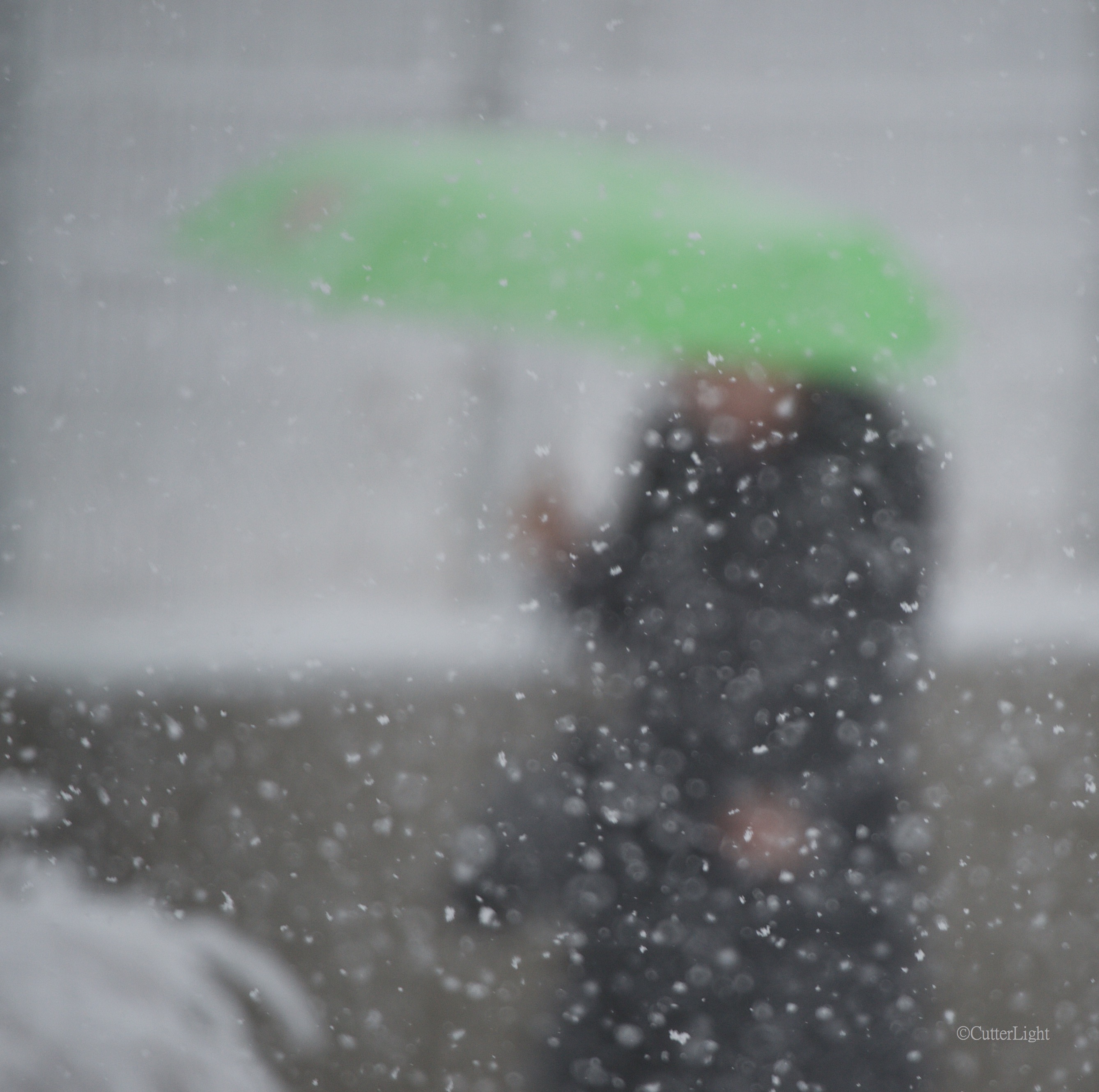
Woman with Green Umbrella, Snowy Day, Ulaanbaatar  I saw her walking down the street toward our apartment when she was in the distance and began thinking about how I would compose the shot. I wanted to create a watery blur, reminiscent of an impressionist painting – evocative perhaps, of Andre Kohl’s studies of women carrying umbrellas. I’m not sure how well the green works, and even as I was framing this shot I was imagining processing it in black and white. Were I to shoot this again, I think I would decrease the shutter speed. (See next picture.) Nikon D4, Nikkor 200-400mm f/4g IF-ED II, ISO400, Focal Length 200mm, f/4, 1/640
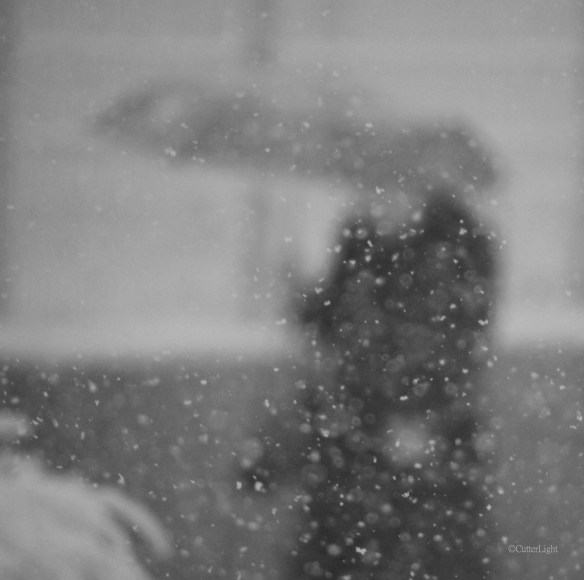
woman w umbrella b n w snowy day n

Impression of a Woman with Umbrella This is the above photo processed as a black and white shot. What do you think? I prefer this one, partly for the way the umbrella and the woman’s features are only suggested. Again, a slower shutter speed might have further enhanced the image I was striving for.

house sparrows snowy day n

House Sparrows Framed in Spring Snow, Ulaanbaatar We pass by flocks of these friendly little guys each day on our walk to and from school. These are birds of the city – ubiquitous in northern temperate climates the world over. In fact, even in the trees along the river that runs through Ulaanbaatar, this species becomes less common, and by the time one has hiked up the forested mountain on the edge of town, they disappear altogether, so specifically adapted to co-habitation with humans have they become. But on this day, they presented themselves in fresh light, framed in falling snow. I wanted a shallow depth of field because the background could have been a distraction, and so I focused on the female and let the three males blur out a little.  Nikon D4, Nikkor 200-400mm f/4g IF-ED II, ISO400, Focal Length 400mm, f/4, 1/640

kestrel snowy day n

First Kestrel of Spring, Snowy Morning, Ulaanbaatar, March 26, 2015  Mongolia is home to many birds of prey, most of which fly south in late fall. I first spotted this kestrel – a type of small falcon – earlier in the week when it and a harrier were circling above our apartment building. The harrier has since moved on, but I continue to see this or other kestrels in the city. An abundance of sparrows (above photo) and plenty of buildings to use as perches make this a good place for small birds of prey to get something to eat as they migrate to their nesting sites in the mountains.

            The snow was falling heavily when I heard the kestrel’s chirp from high above. I swung my lens skyward knowing I’d only get a shot or two before the glass was covered with snow. Autofocus was useless, so I did my best to manually focus while panning with the bird with a two-pound camera attached to a seven-pound lens. This image is significantly cropped and not very clear. I value it for the documentation of the year’s first kestrel, one of our favorite birds. Nikon D4, Nikkor 200-400mm f/4g IF-ED II, ISO400, Focal Length 400mm, f/4, 1/640

So what do you think?

When it was time to come back in, we were, in fact, buried in heavy, wet snow and a little worried about our cameras. But they held up fine. The next day we hiked down to the river to check the willows, poplars and pines for newly arriving songbirds. I still have to go through those photos. Next time!

Fire and Ice Needles: Dawn, Hustai National Park, Mongolia

ice needles at dawn n

Stalked a group of stag red deer

up a draw to the top of a rise 

where the sun broke fiery and cold

lighting feather grass and ice needles

suspended in the negative something air.

Along the ridge, winter-hard antlers

lit with sunlight

scattered into the dawn.

– Hustai National Park, Mongolia, 2014

Jack Donachy


Takhi – A Success Story in the Land of Chinggis Khan

Takhi w magpie full n

Magpie and takhi (Przewalski’s horse) – old friends reacquainted in a scene that has played out for many thousands of years but that was sadly interrupted in those decades during which the takhi were extinct in the wild. 

In 1967, somewhere on the arid steppe of Mongolia’s Western Gobi Dessert, the last small herd of wild takhi was seen. Two years later, only one horse remained. And then Equus przewalskii vanished completely from the wild. Although closely related to modern domestic horses, takhi were never tamed. This differentiates their status as “truly wild” from the ferrel mustangs of America which are descendants of domestic horses.

In their natural environment, wolves were their main predators, and the dry, harsh, cold conditions of the steppe would invariably claim victims each winter. But the main cause of the demise of the takhi was probably due to its being hunted for meat.

Takhi nursing winter n

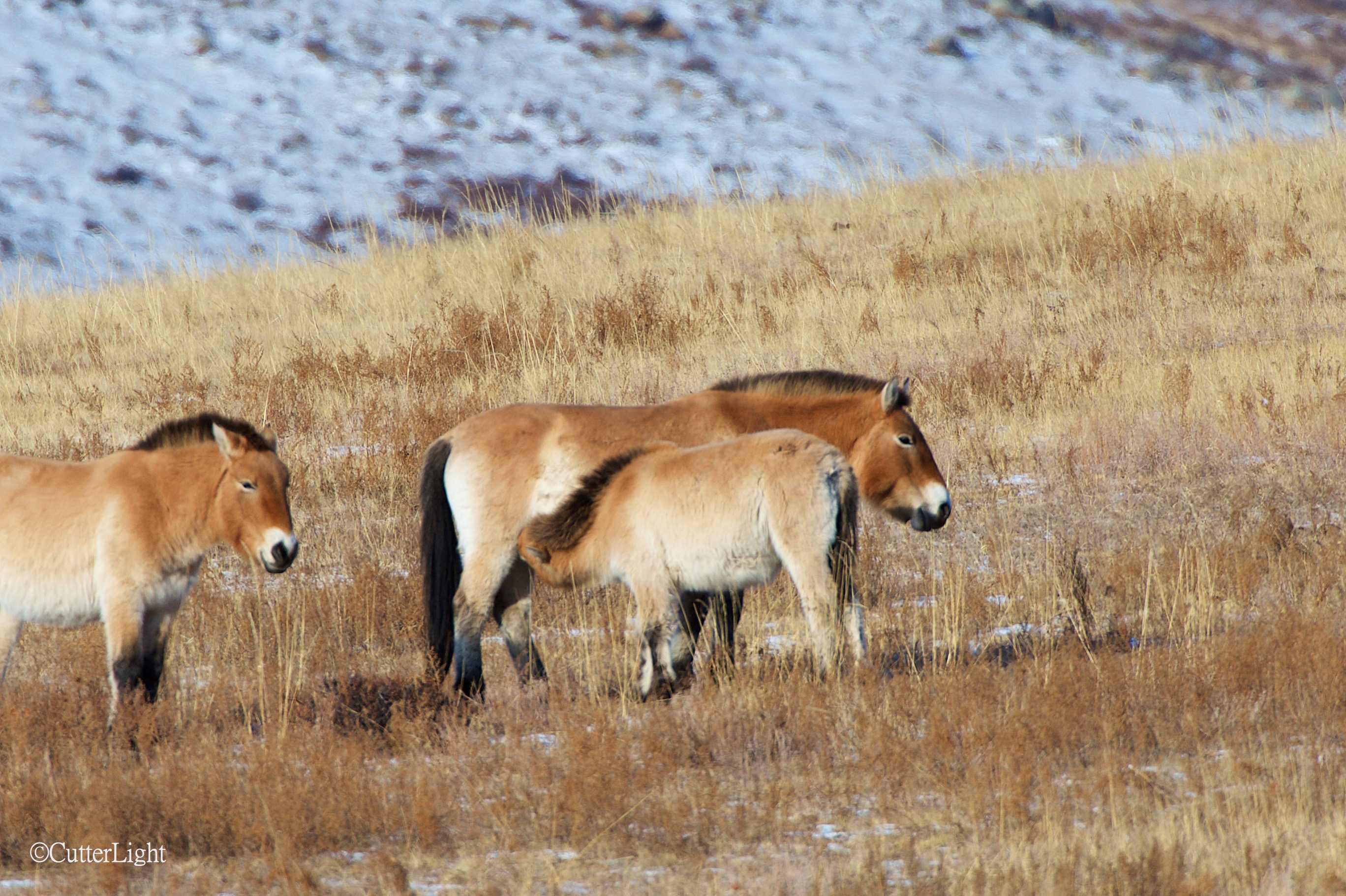
Takhi form small family groups comprised of a lead stallion, two or three mares, and their offspring. These family groups loosely intermingle with other families as well as with bachelor stallions which often travel in pairs or groups of three. Stocky and with zebra-like manes, takhi are comparatively small, standing only about 48 – 56 inches tall at the shoulders. They have 66 chromosomes, two more than any other species of horse. 

By 1970, the only living specimens existed in a few zoos and private ranches. Extinct in the wild, it seemed only a matter of time till their official extinction from the planet would be announced.

Then something truly remarkable occurred. In a cooperative venture between the Zoological Society of London and Mongolian biologists, the horses were reintroduced to Mongolia’s Khustai (Hustai) National Park where they’ve been thriving even since.

takhi with red deer n

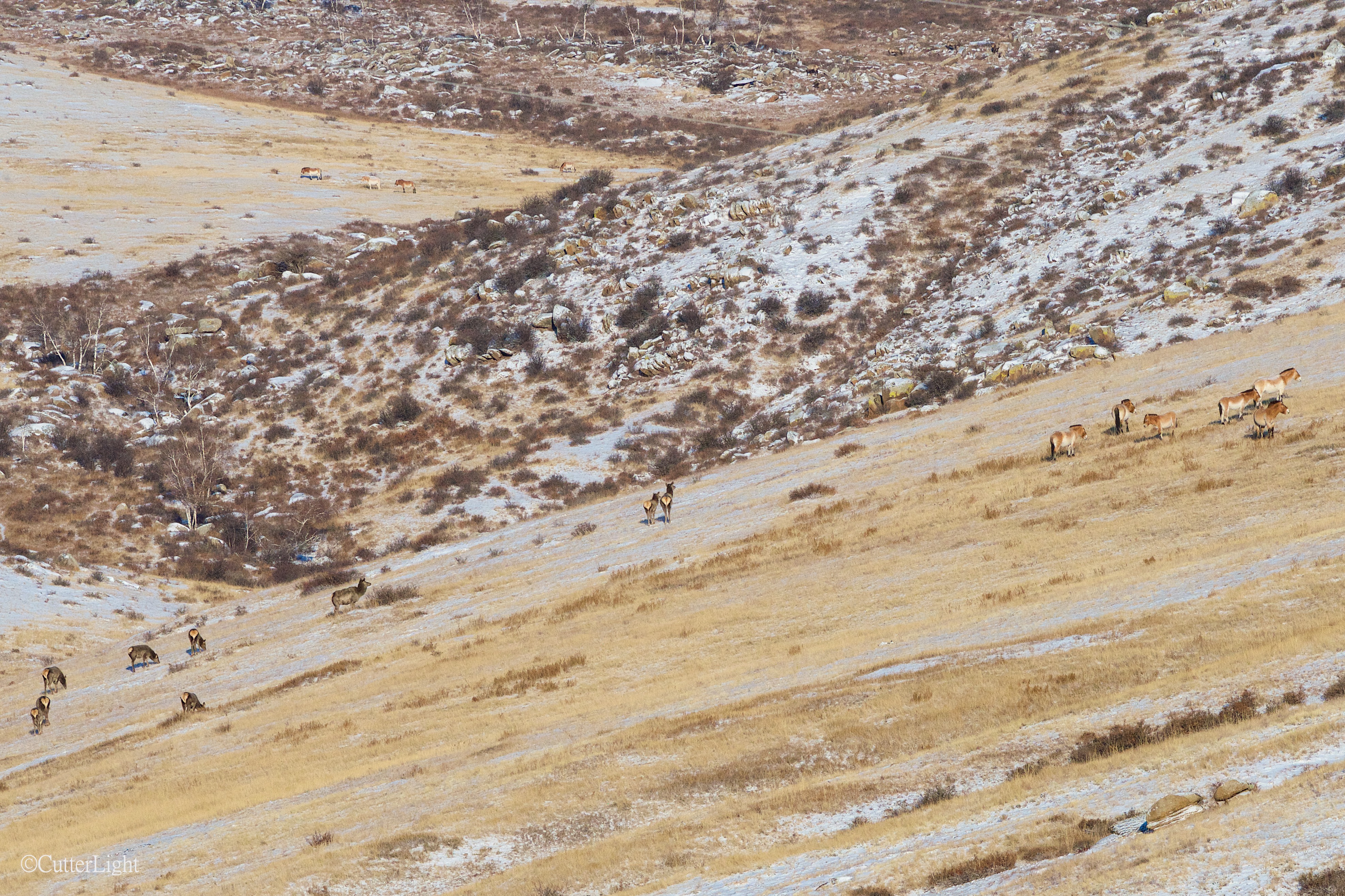
On a morning bright with ice needles in the air and a fresh dusting of snow on the ground, takhi and female red deer (Cervus elaphus) share a piece of rugged terrain in Mongolia’s Khustai National Park. 

takhi stallion pair n

In full winter coats, these wild takhi are as beautiful as they are tough.

We counted ourselves as lucky to have spent a few days in Khustai during some of the coldest stretches of winter. The deeply rutted dirt roads were quiet, wildlife was abundant, and the horses seemed only mildly curious regarding our presence.

takhi in summer field

Takhi can readily be viewed in summertime as well. We can’t say which season is more beautiful. There are wild horses in this world still. That is beautiful.

Climbing Khongoryn Els: The Gobi Desert’s Singing Dunes

dunes big with human n

Towering nearly 200 meters high, Mongolia’s Khongoryn Els are among approximately 30 “singing dunes” worldwide. Precise balances of humidity, silicon content and sand grain size and shape must be perfect to achieve the deeply vibrating hum these dunes produce. Click any photo to enlarge. 

With each step up the steep slope of the dunes, we simultaneously gained and lost elevation, slipping back with the shifting sand. Although the mid-October day was cool, we were stripped down to jeans and shirts, and would have been more comfortable in shorts. By the midway point, we were drenched with sweat. And that’s about when we began to notice it – an unmistakable vibration that began in our feet and traveled through our leg bones up through our hips accompanied by a low, resonate hum. The sound was audible – sort of like monks chanting “ohmmmmmm” from somewhere deep in their throats.

sculpted dunes 1 n

Wind sculpted sand has fascinated humans for millennia. Views like this were our reward for hiking to the top of the dunes.

barbra climbing dunes n

Water bottle in tow, Barbra takes a breather halfway up the tallest dune. Livestock look like mere dots on the shores of the distant shallow lake. The water is a morning gathering place for doves in the thousands… perhaps tens of thousands.

OLYMPUS DIGITAL CAMERA

The top of the dunes felt like the top of the world –  the perfect place to make sand angels. 

sea of dunes n

Although much of the Gobi Desert is rocky and wet enough to support plant life, the area of the singing dunes is an ocean of ever-shifting sand. See Yolyn Am Canyon: Wildlife Safari amidst Remnants of the Gobi’s last Glacier and The Gobi Desert’s Valley of the Lammergeier.

dunes sculpted contrast n

Dusk was closing in by the time we descended the Khongoryn Els, creating dramatic contrasts along the dunes’ curving edges. 

One of the funnest runs of our lives was racing down the dunes barefoot – a 200 meter decent, big strides landing in soft, cool sand, only slightly tilted away from vertical.


Yolyn Am Canyon, Mongolia: Wildlife Safari amidst Remnants of the Gobi Desert’s Last Glacier

ibex bull disappearing n

When this magnificent male Siberian ibex turned his back to us and disappeared, our hearts sank. But moments later, he reemerged for a second photo op. His group of females, young males and yearlings was tucked away up a narrow arm of Mongolia’s remote Yolyn Am Canyon.

ovoo Yolin Am Canyon n

Ovoos – sacred mounds of stones and other objects – are common throughout Mongolia. This one is a testament to the special place Yolyn Am Canyon holds in the hearts of the Mongolian people. Translated as “The Valley of the Lammergeiers” (a raptor also known as bearded vultures), the canyon is home to abundant wildlife, some of it rare.

On the evening of day four of our tour from Ulaanbaatar through the Gobi Desert, we stayed in a ger on the outskirts of Mongolia’s Yolyn Am Canyon. Situated at elevation in a narrow valley surrounded by jagged peaks, sunlight only briefly reaches the canyon’s floor each day. Until recent times, ice remained in the valley throughout the year, which made Yolyn Am the Gobi’s last glacier. In recent years, the ice is gone by August or September. By the time of our visit in mid-October, however, ice had returned to the spring creek that flows through the valley’s shadows.

chaffinch n

It is the universal story across our planet: Where there is water, there is life. The spring creek emerging from the stone mountains of Yolyn Am are an oasis sought out by diminutive passerines such as this chaffinch (Fringilla sp) as well as charismatic megafauna such as the park’s argali bighorn sheep and Siberian ibex.

chaffinch bathing n

Fringed with October ice even in the sunny portions of the canyon, this water makes for a chilly bath.

pica fight 2 n

Dense populations of Daurian pika (Ochotona dauurica) and other rodents sometimes lead to disputes. With winter’s icy lock looming, it is critical that each pika lay claim to a food source and stock up enough grass and seed to get them through the coming dark and cold. When stakes are high, these relatives of rabbits go at it with teeth bared and kicks flying.

Pika vanquished n

Ears back and chin down, the vanquished rival retreats to his burrow.

Walking through the narrow canyon in late morning light, we found ourselves surrounded by innumerable pikas, gerbils, wheatears, horned larks, buntings and other passerines. The abundance of wildlife was a revelation, and for me, an avid birder, it was hard to take my eyes of the creek bank and sunny glades where most of the action was going on.

And then magic happened.

“Jack!” one or our party exclaimed. “Ibex!” I followed the line of his index finger to a far off ridge where, unmistakably silhouetted against a famously blue Mongolian sky stood a beautiful example of a mature male Siberian Ibex. In such flawless relief against the sky and perfectly still, it looked like a statue. Far off in the distance, it was staring directly at us and no doubt had been for some time.

I crouched low and began pacing myself toward it. Forty strides, stop, shoot. Forty strides, stop, shoot. Along the way I passed up the very shot of red-billed choughs (Pyrrhocorax pyrrhocorax brachipus)  – a crow-like bird with a distinctive bright red bill and matching legs – I’d been hoping to get on this trip. I kept closing ground on the ibex, and although still well out of range, I reasoned that with every set of 20 paces I might be getting slightly better shots.

And then I looked down to where my left foot was about to fall near the edge of the creek and saw something I hadn’t even considered would be a possibility on this cool October morning…

Halys pit viper n

Which of us more surprised the other is impossible to say. For a brief moment, I considered stopping to reposition this 22 inch (55 cm)  snake, or to at least get a better photographic angle on him. But the ibex… Ironically, it turns out that seeing a Halys pit viper (Gloydius halys) is more unusual than seeing an ibex. On the other hand, as the name “pit viper” suggests, it’s just as well I didn’t mess around with this guy. Besides, on this cold day in a land where raptors are abundant, it was in the snake’s best interest that I left him alone.

ibex bull 2nd look n

This was a thrill. The ibex was still far off and way up, but he couldn’t have been any more beautifully silhouetted against the October sky atop this classic, jagged ridge. And then he disappeared for the last time. When I turned around to find Barbra and our group, they were pointing up a narrow canyon arm I’d just passed. The arm was on the other side of the ridge over which the male had disappeared, so I suspected this is where the rest of his group might be. The chase was on!

Somewhere between walking and running, I began scrambling as fast as I could up a wild side canyon. For one short stretch where a feeder spring tumbled over a mossy rock face, the ascent was almost vertical and I struggled between the camera gear I was carrying and finding hand-holds. But once I got up on the bench, there they were. Six, no, eight… maybe a dozen ibex represented by young males with their horns just beginning to gain weight and curl, females, younger animals and kids. They were watching me, but they had the high ground and I was on the opposite side of the canyon. They didn’t seem particularly nervous, so I continued scrambling, breaking a trail as I climbed.

young ibex looking at me n

With sturdy legs and heavily muscled bodies, the wild goats are stunning. 

As I stepped through the low undergrowth, I suddenly recognized an unmistakable smell. Wild juniper. I reluctantly took my eyes off the ibex and looked down to see a vast carpet of berried shrubs blanketing the side of the canyon I was climbing. Still making my way to higher ground and watching the animals on the opposite canyon wall, I found myself almost instinctively thinking, “This would be the perfect place for…”

At that very moment the ground around my feet exploded in a wind-rush thrum of blurred wings. Chukar!

chukar w lichen rock n

Shooting in manual, I was spinning dials like mad on my camera to adjust from the sunny slopes on the opposite canyon wall where the ibex were to the shade where this hen chukar was kind enough to pose on a lichen-stained rock complimenting her colors. The rest of the covey – her brood, I’m guessing – kited off to the opposite canyon wall and began calling each other back together. 

white-winged snow finch im back n

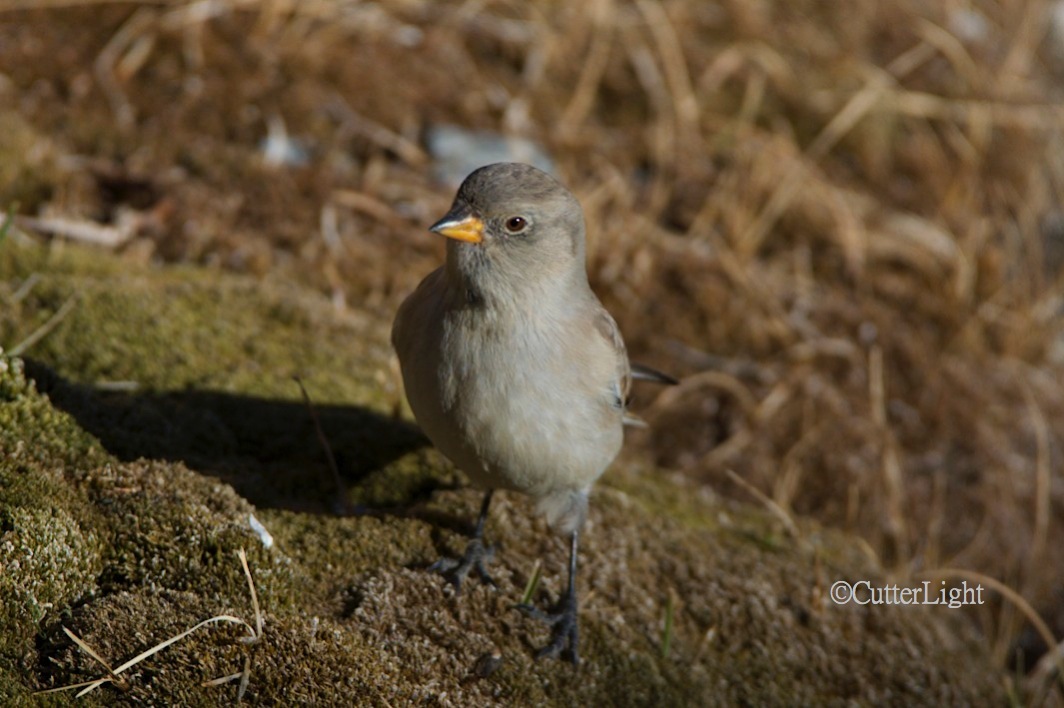
It seems that everywhere we looked that day, wildlife was abundant and cooperative. This young white-winged snow bunting (Montifringilla nivalis) insistently remained underfoot till I snapped a few shots.

white-winged snow finch im n

Our day-hike through Yolyn Am ended with shadows and cold crowding us out of the canyon, and though we could have walked further, we began to reckon that a warm ger and a hot meal sounded pretty good.

frozen water Yolin Am Canyon n

Ice – the great aquifer of arid highlands. It is this frozen water, slowly melting through the summer, that keeps the Yolyn Am Canyon wet and fecund. We couldn’t help but wonder what changes are in store for this magical place as the planet continues to warm.

red-billed choughs sunset n

A flock of red-billed choughs gathers in the canyon’s last light before flying to their roosts.

Next: Further South in the Yolyn Am Canyon – more ibex, gerbils, a lammergeier, rough-legged hawks, and a rare saker falcon in “The Valley of the Lammergeiers.”

Day 3: Tsagaan Suvarga, The Gobi Desert’s White Cliffs – Gazelles and Ger Life

camel skull & white cliffs n

In the distance, Mongolia’s Tsagaan Suvarga – The White Cliffs. In the foreground, a camel skull. A zud (harsh winter) can wipe out hundreds of thousands or even millions of livestock. And yet a hardy breed of people thrive here and in a land where humans and their herds of animals have coexisted with nature for millennia, wild animals are surprisingly abundant.

As we continued our journey south, the land unfolding before us bore little resemblance to what we had imagined the Gobi would be like. Throughout the journey, our van passed through nearly endless mixed flocks of passerines – wheatears, larks, buntings and sparrows. Eagles, hawks, ravens and vultures soared overhead. And there were times when gazelle seemed to be everywhere.

barbra photo camel n

Initially, we had no idea what to expect from the domesticated Bactrian camels we encountered, so we approached with caution. As it turned out, they were even-tempered and in some cases not opposed to having their heads scratched. With thick coats of fur, sturdy legs, heavily muscled bodies and the capacity to go for a full week without water, these magnificent animals have evolved to thrive in one of the world’s harshest environments.

“Would you ride one?” Barbra asked playfully motioning toward the group of camels standing a few meters from us. I could tell by the smile on her face and the twinkle in her eyes that she was in.

“Maybe,” I replied with some hesitation. They appeared to be docile enough.  “But not in circles in some tourist camp. If I get on a camel, it’s going to be to go somewhere.”

In fact, we’d get our opportunity in a couple of days. Between seeing several mammal and bird species that were new to us and after eating and drinking things we’d previously only read about (and in a couple of instances had never heard of) this proved to be a trip of firsts.

gazelle bull vocalizing n

A thick-necked buck (center) vocalizes an alarm to his group of females and young. Mongolian gazelle (Procapra gutturosa) are the definition of skittish. It took our group several attempts before we began to learn how to approach these shy animals closely enough to get decent photographs.

Almost constantly on the move and sometimes covering thousands of square miles in a given year, Mongolian gazelle have adopted a nomadic lifestyle well-suited to the arid steppe and desert. Hunted both legally and illegally, their numbers remain robust at more than a million individuals. On our trip from Ulaanbaatar to the Gobi, we encountered thousands.

gazelle galloping kicking up dirt n

Pounding hooves and flying dirt. Standing about as tall as a man’s knee at the shoulder, these diminutive ungulates are capable of speeds up to 40 miles an hour (65 kph). (Click any of these photos to enlarge them.)

With seven of us in the van along with camera gear, sleeping gear, cooking gear, small chairs, tubs of food, extra water, eight three-liter boxes of wine, gifts for our host families, day packs and clothing bags rattling over steppe and desert, you might suspect we felt crowded and uncomfortable. It amazed us that we did not. We never tired of seeing the wildlife and landscapes and anticipating what might be around the next hill.

Nonetheless, after a day of bouncing across the open range, we were always happy to pull into our next ger, meet our hosts, and settle in.

hostess airating tea horizongtal

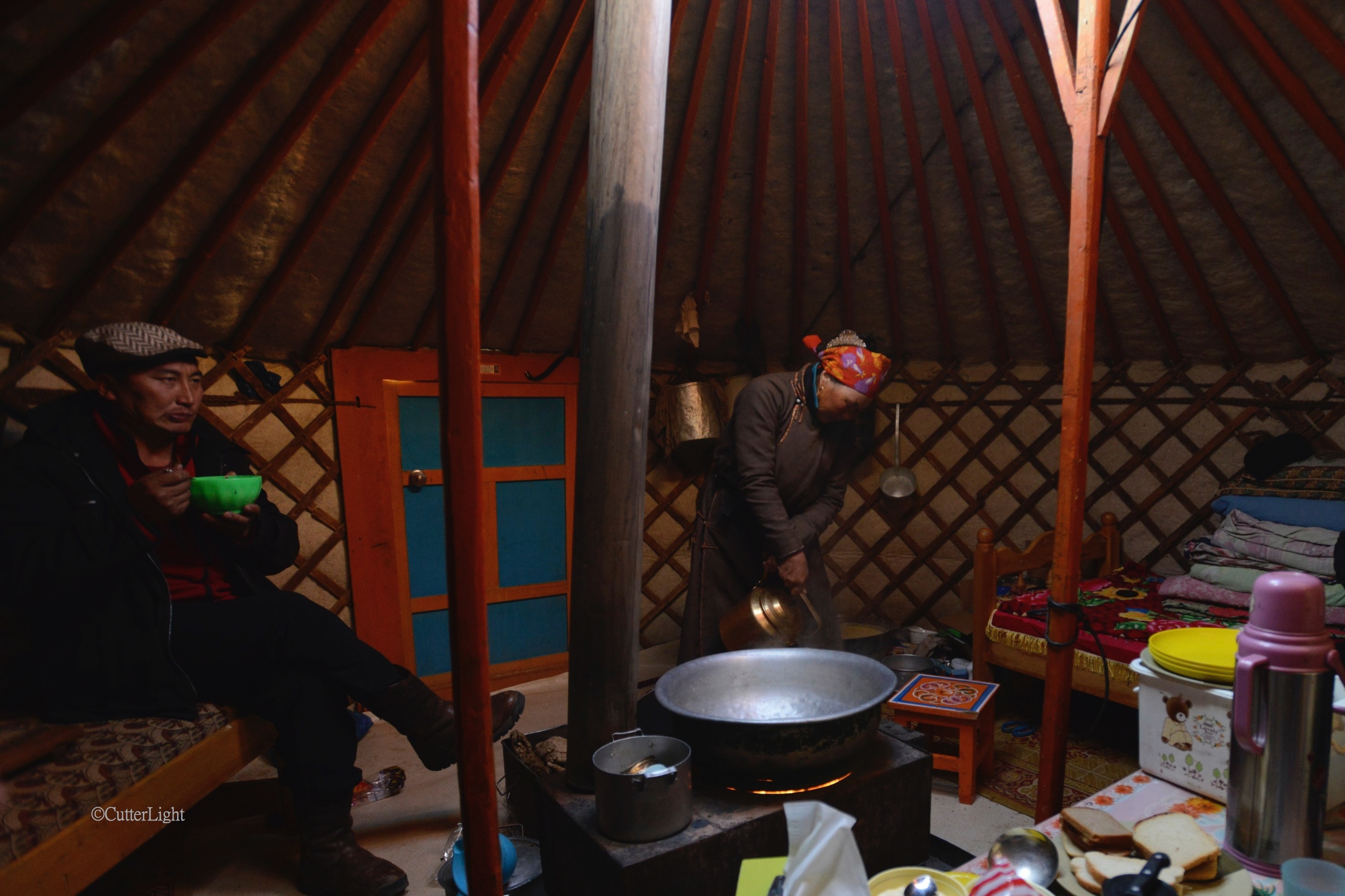
Our hostess aerates a steaming pot of yamani suute tsai (suu – te – tsay) . Goat milk tea is a staple beverage in many Mongolian gers. Adamant non milk drinkers, Barbra and I loved the warmth, nutrition and flavor of this drink and came to look forward to a steamy bowl of it (or of the equally delicious temeeni suite tsai – camel milk tea) before dinner each evening. 

Gers are eminently well-suited to the life of nomadic herdsmen and their families. Round and with conical roofs, there are no flat walls or edges to catch the wind. Covered with felt, they are well insulated. At around 500 square feet, (46 square meters) these one-room homes are an answer to the “tiny house” movement’s quest for a comfortable, efficient living space.

In modern times, many gers feature solar panels and batteries to power TVs and lights. A centrally-positioned steel stove, generally fueled with dry dung, serves as both a cook-stove and a heating system. Typical gers are appointed with wooden-framed beds, a small dining table, a few chairs, and perhaps a chest of drawers or two, all generally brightly colored. If you look around carefully, you’re likely to notice a rifle tucked away somewhere; wolves are still a threat to livestock in many locales, and foxes are common. There is no running water.

red motorcycle & ger n

Although many herdsmen tend their animals on horseback, motorcycles have proved their usefulness as well.

OLYMPUS DIGITAL CAMERA

In the last remaining light of the day, our host prepares a young sheep for dinner. His wife used the entrails to whip up the best country sausage we’ve ever tasted. Nothing was wasted. As the eldest in our group, I was offered dibs on the heart, kidneys, lungs, blood sausage, liver and the highly prized, succulently fatty tail. Some of these were epicurean firsts. Salted and otherwise very lightly seasoned, all were quite toothsome. The cigarette, which our host hand-rolled prior to beginning this chore, never left his lips.

nimka & ger life n

Breakfast. Our driver, Nimka, relaxes with a bowl of goat milk tea in which homemade sausage from the previous night’s meal is steeping.

Jack sipping goat milk tea w sausage n

Following Nimka’s lead, I have a bowl of the same. It was absolutely delicious.

rustic bucket & Ladle n

No doubt the key to the excellent flavor of everything was its freshness. Here is the bucket our hosts used for milking the goats.

photographer jack @ white cliffs n

Looking out over the desert plain from a vantage point on the White Cliffs. Day by day, hour by hour, we found ourselves falling in love with this country.

Next stop: Yolin Am Canyon: Remnants of the Gobi’s last glacier. Ibex, Picas, Raptors and more…

Gobi Desert Trek Day II: The Central Mongolian Steppe from Ikh Khayrkhan Uul to Baga Gazaryn Uul

horses in salt lake n

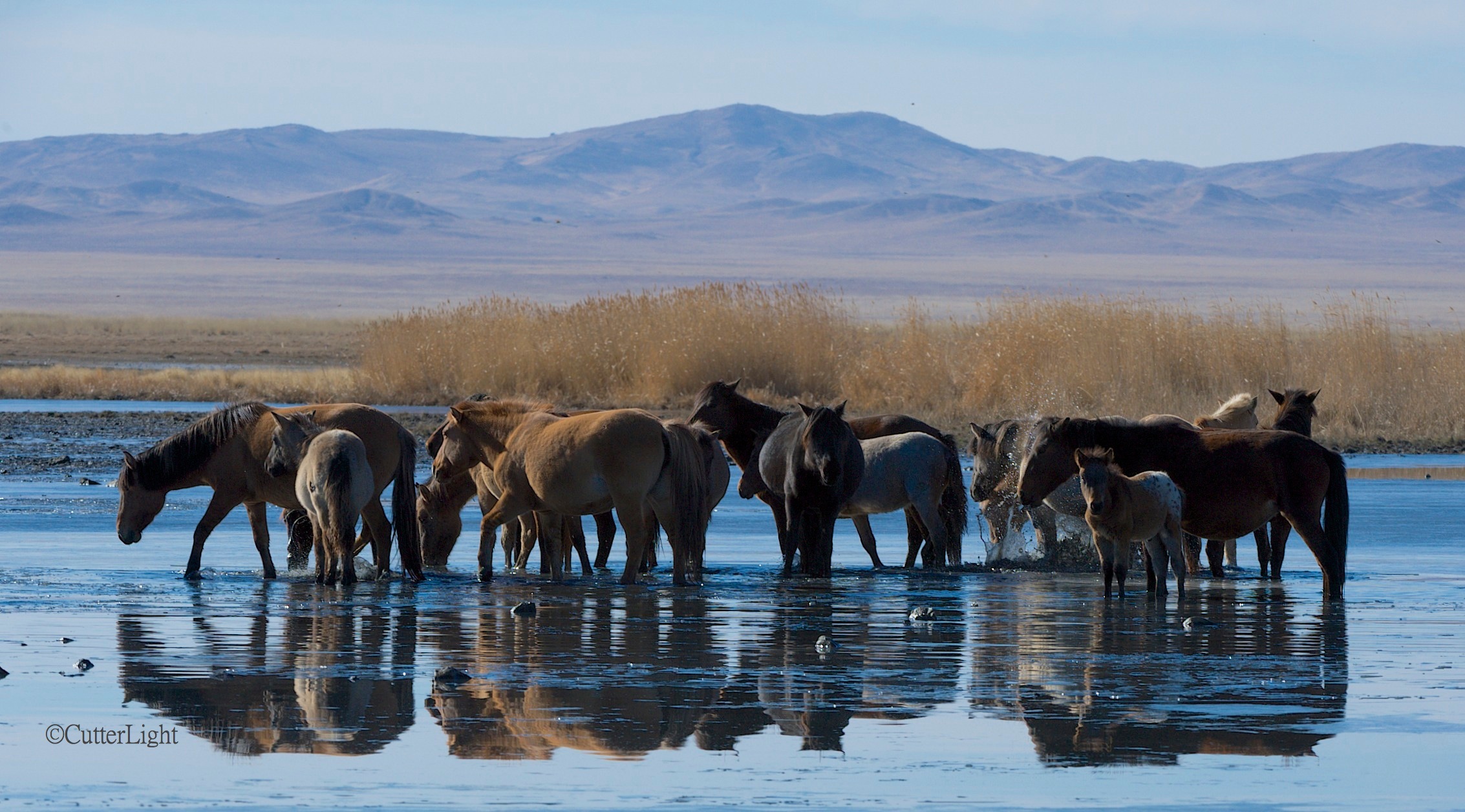
It’s a tough breed of horses that call Mongolia home. Most Mongolians were practically born in the saddle, and even Ulaanbaatar’s urbanites ride them with ease. But these horses are never truly tamed in the western sense of that word. Here a group wades a small salt lake on a mid-October morning a few ticks above freezing.

We woke after spending our first night in a ger to a world of frosted grass and blue skies. After breakfast and some casual rock climbing on nearby outcrops, we piled into the van and resumed our journey south to the Gobi Desert.

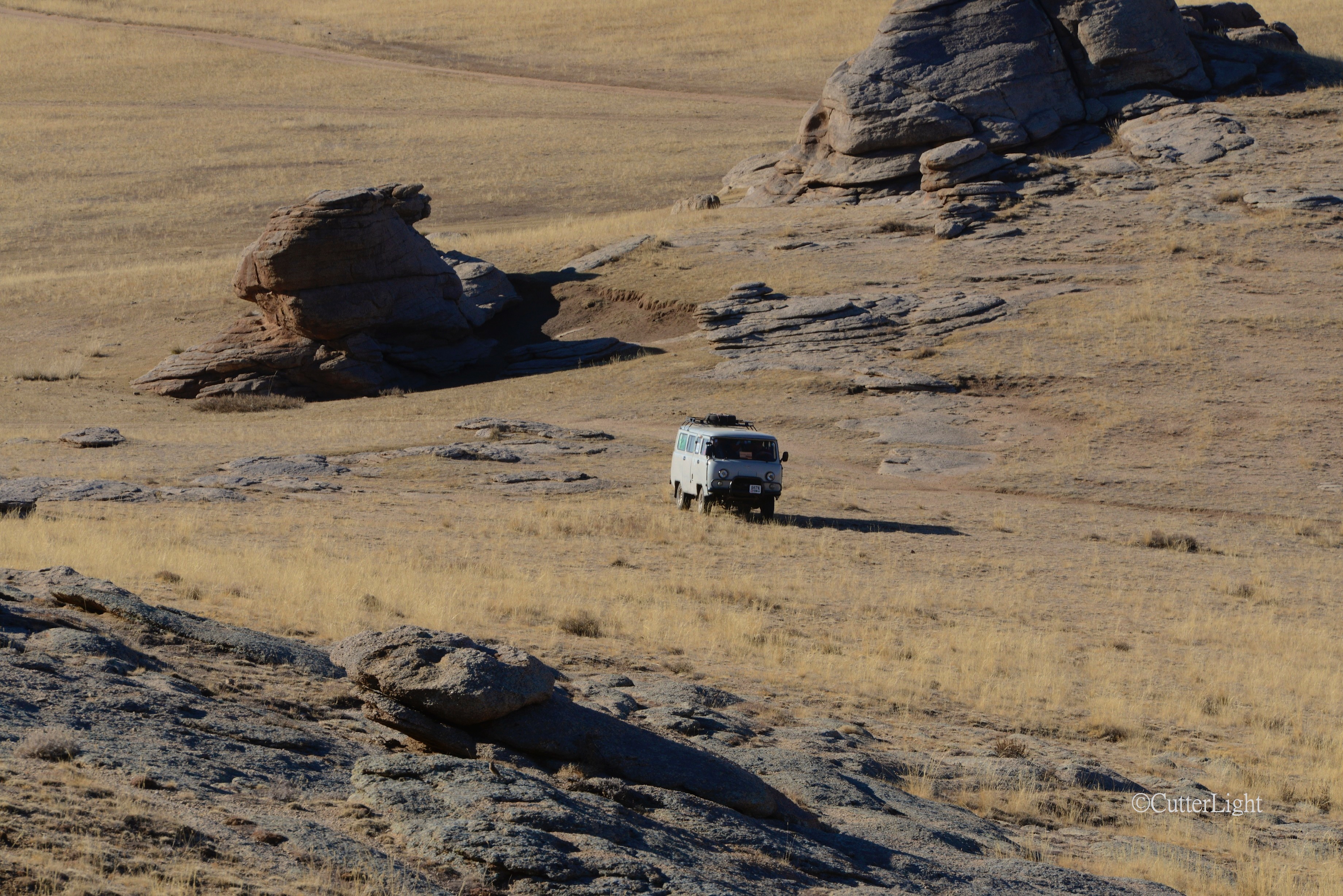
russian van off road n

Beefy and easy to keep running, four-wheel drive Russian-built vans are standard on the Mongolian steppe. 

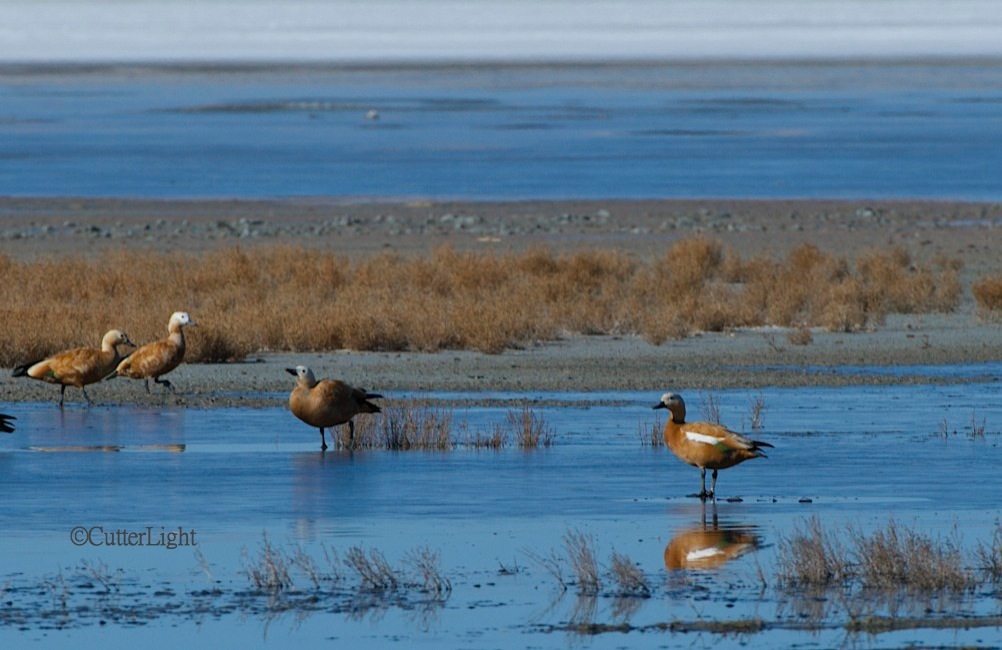
ruddy shelducs salt lake n

Ruddy shelducks (Tadorna furruginea). The white edge along the lakeshore at the top of this photo is salt.  Known for their affinity for brackish water, ruddy shelduck numbers are declining worldwide as salty wetlands are drained for agriculture. In addition to the horses in the photo above, the lake was also populated with common shelducks and teal. 

common shelducks salty lake n

Heads down and tails up, common shelducks (Tadorna tadornain muted late fall plumage sift through the lake’s briny muck. Meanwhile, hundreds of passerines, including scores of horned larks, flitted through the air and along the shoreline.

The sun moved higher into the sky. With the soft morning light leaving the lake’s waters, it was time to climb back into the van. The vastness of the land, dotted here and there with horses, cattle, goats, sheep and wild gazelle, continued to mesmerize us. But ever so subtly, we noticed that the grass itself was becoming more sparse.

Off in the distance, a group of especially large-looking horses caught our attention. As we drew closer, humps emerged from their backs. Camels! In less than a morning’s drive, we found ourselves transitioning from the lush grasslands of the steppe to the northern edge of one of the world’s great deserts: the Gobi.

OLYMPUS DIGITAL CAMERA

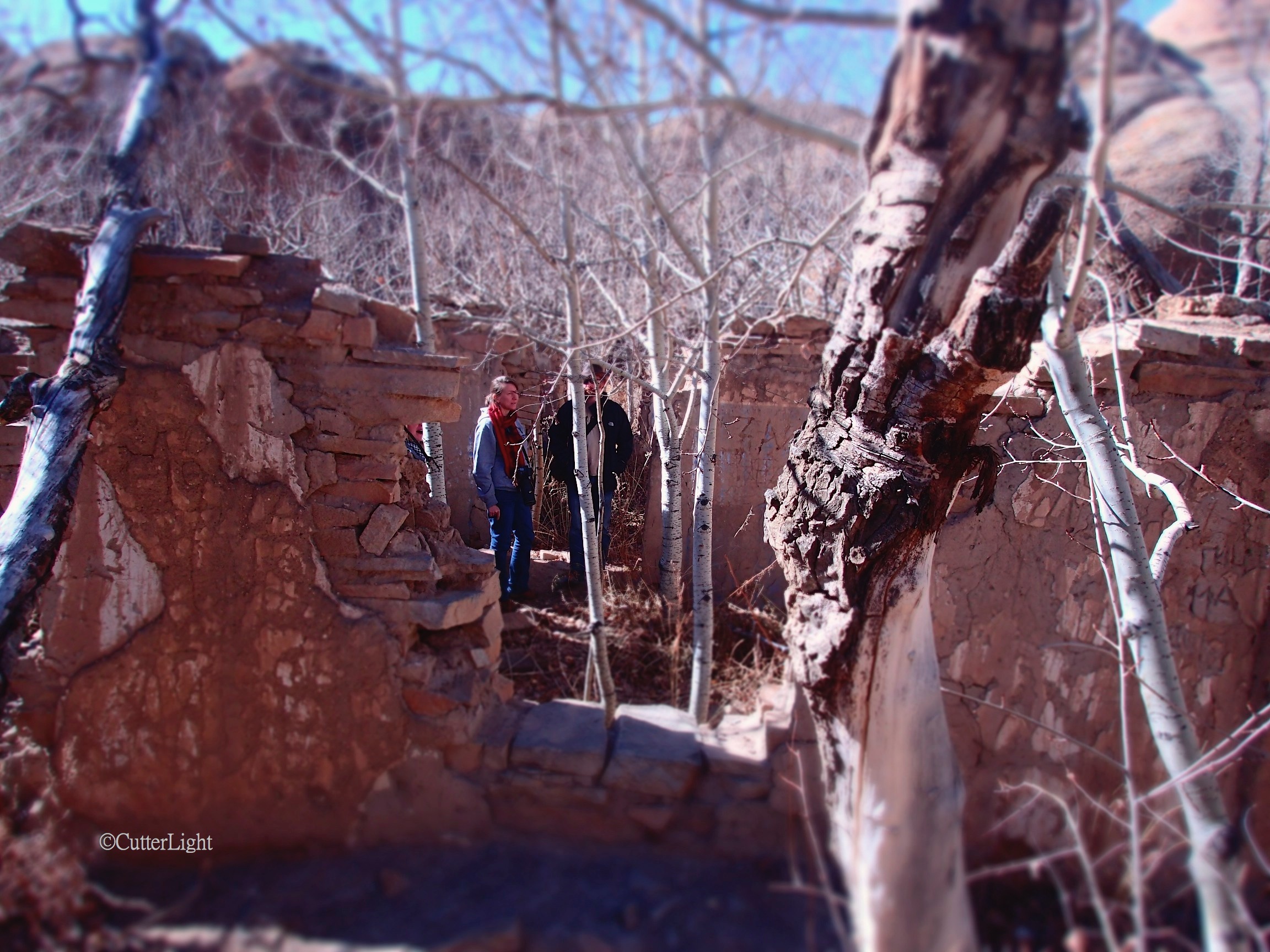
Birch trees tell a tale of water just below the ground’s surface in an otherwise parched landscape, and it was here a band of monks established a monastery long since abandoned and fallen to ruins. 

OLYMPUS DIGITAL CAMERA

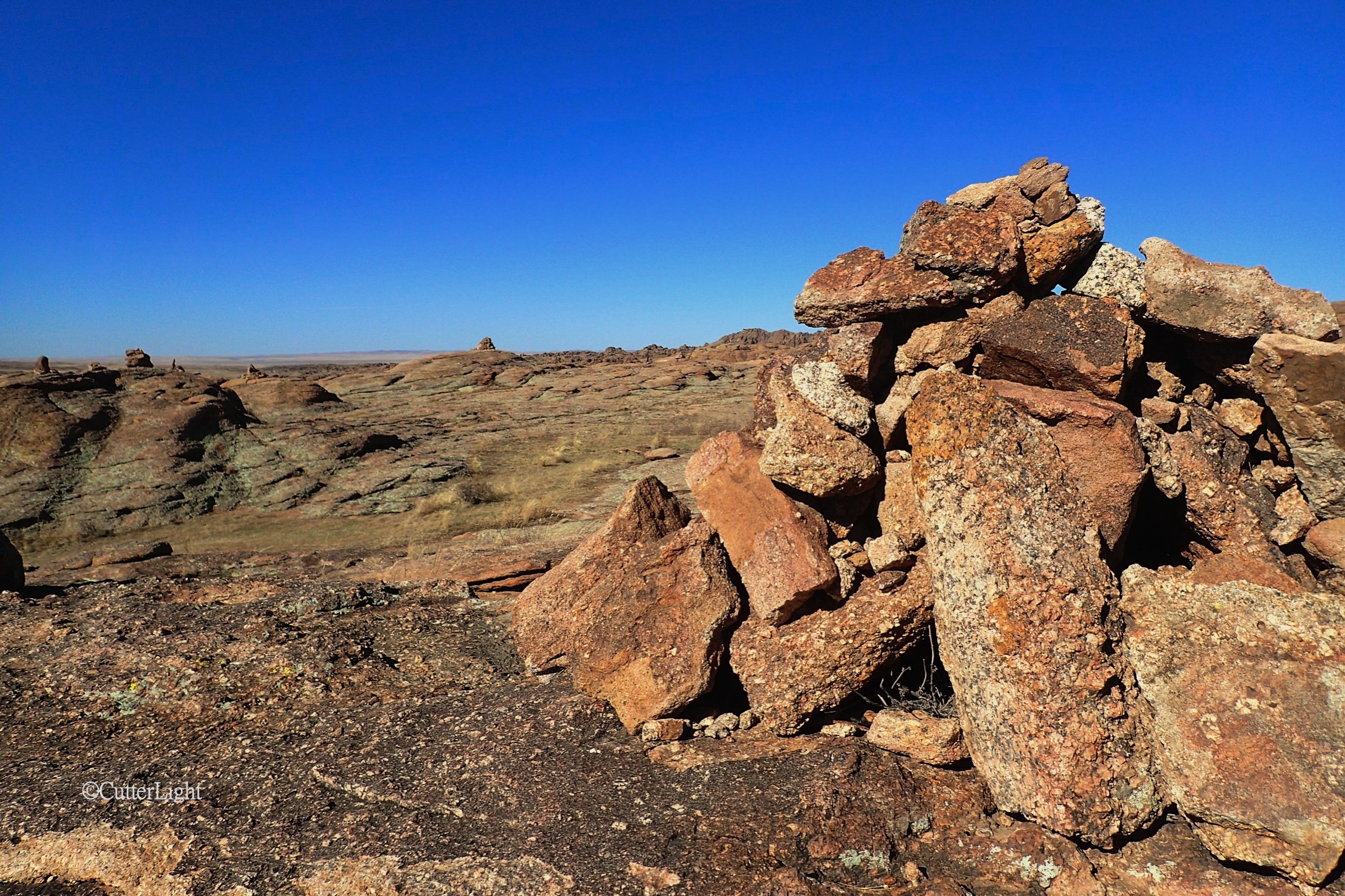
And yet in a sense, the monastery is still alive and vibrant as these nearby ovoos attest. It is the custom in Mongolia to add rocks and other items to these cairns and walk around them clockwise three times out of respect for the sky and earth and to ensure a safe journey.

grasshopper_new

Brown with late autumn, this familiar grasshopper is a testament to species similarity throughout the Northern Hemisphere. Existing in tremendous numbers in a country where pesticides are still all but unheard of, these hopping protein pills account for the huge number of birds here.

OLYMPUS DIGITAL CAMERA

Featuring a dinner of stew with Mongolian-style noodles, goat milk tea, and six liters of wine along with our hosts’  airag (fermented mare’s milk), our second night was celebratory. 

That night, we stayed with a nomadic family in their winter camp. Their gers and ungated livestock enclosures (where the otherwise free-ranging animals spend the night) were tucked away from the coming winter wind among rock outcrops.

Nomadic Mongolian herders don’t travel constantly; they maintain two to four seasonal camps. As the seasons change, they pack up their gers, gather their livestock, and take advantage of fresh pasture.

Twice at this camp – once in the evening and once in the morning – we flushed out large coveys of some type of partridge. Both times the birds flew directly into the low sun, so that all we got was the sudden wind-rush thrum of wings, hearts stopped dead in our chests, and winged silhouettes. As usual, rock buntings and other finch-like birds were abundant.

red rocks at sunset n

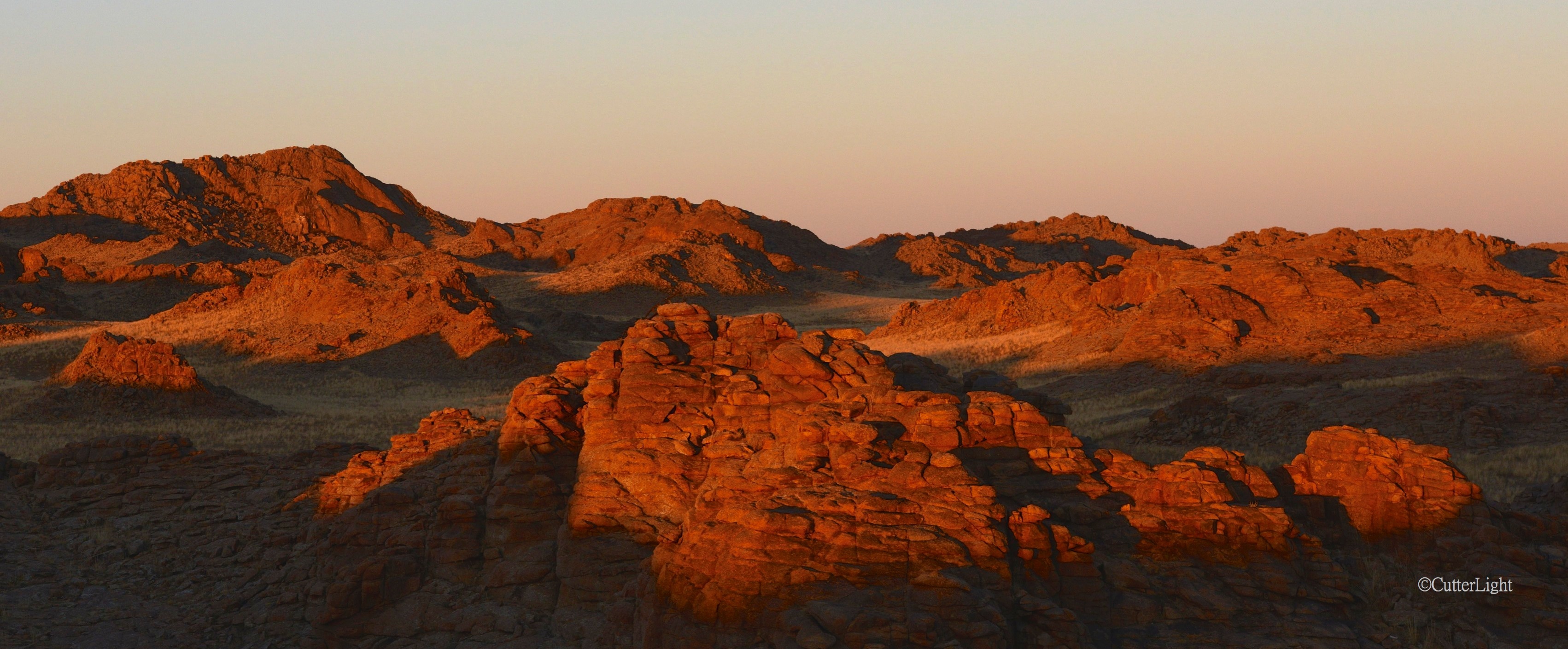
Sunset on another day in the cold, spare paradise we were discovering. Below, the night sky.

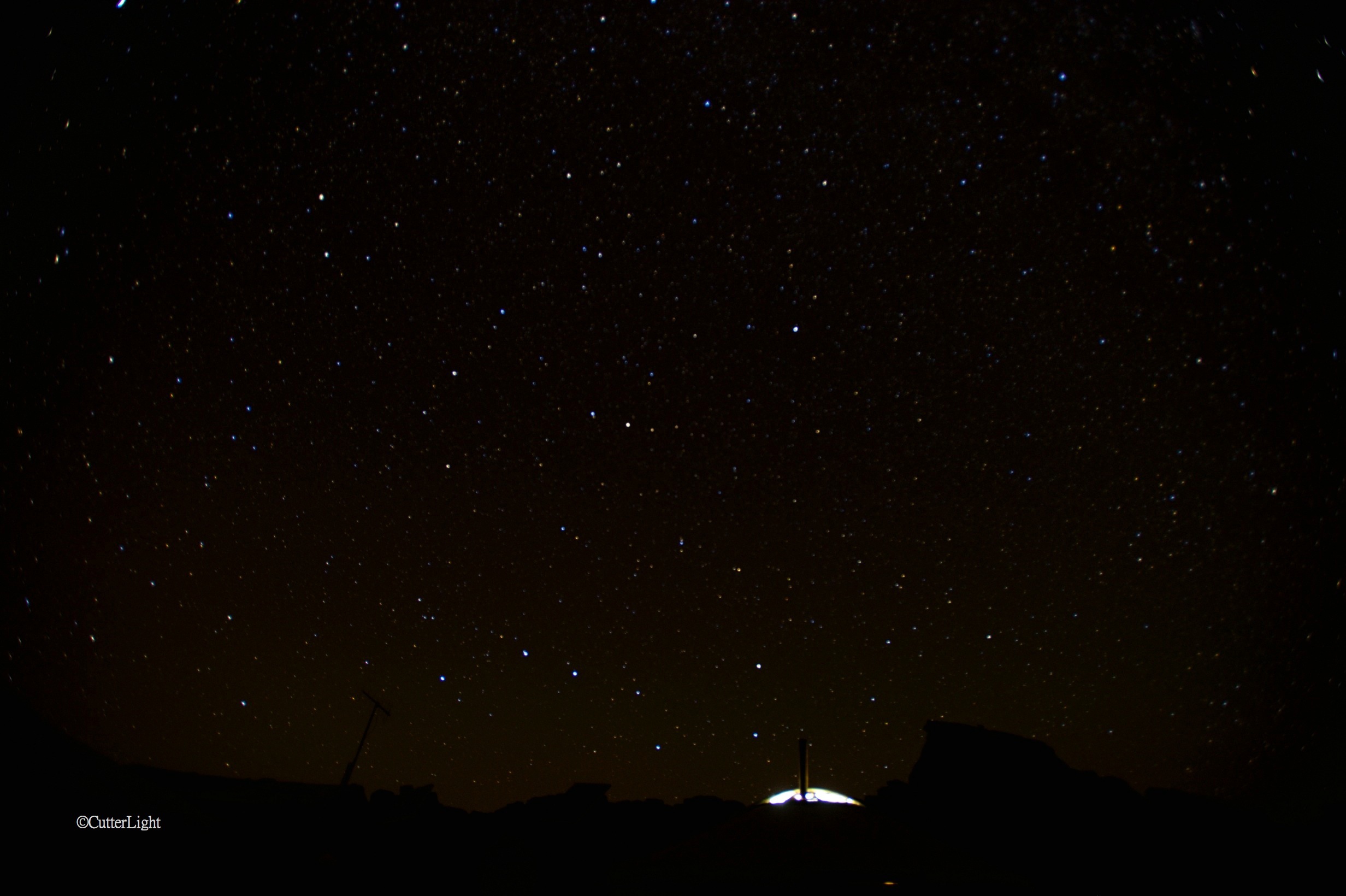
big dipper over ger n

Dipper scooping out the horizon… dome of the felt-covered ger glowing white on the sky… Fire inside against the chill of the night… Straight above, the wash of the Milky Way… 

Next: The Middle Gobi Desert: Life in a Mongolian ger.

Coming soon: Raptors, Gazelles, Ibex, Picas and a Pit Viper


Ulaanbaatar to the Singing Dunes of Khongoryn Els – Eight Days in Mongolia’s Gobi Desert: Part I

gers & horses in big country n

Roughly 75 miles (120 km) from Ulaanbaatar, grazing horses and the first ger we stayed in are dwarfed against vast grasslands rimmed in mountains. Although the mountains appear low, the grasslands themselves are over 4,000 feet above sea level. With abundant wildlife, few villages and virtually no paved highways, the Mongolian steppe is one of the world’s great high plains wildernesses.

We have no idea how our driver, Nimka, and our guide, Otgo, found the first ger we stayed in. Pitch dark except for the wash of the Milky Way in the night sky and the headlights from our van, Nimka steered from one set of indistinct dirt tracks in the grass to another. My insistence that we stop for a look at herds of gazelle coupled with our late-in-the-day start from Ulaanbaatar, Mongolia’s capital, had us arriving well after dark.

And then, suddenly, there it was. A faint glow gradually assumed the round shape of a nomadic family’s home. Nimka eased the van to a stop, introductions were made, and we soon were inside. A bowl filled to brimming with airag – fermented mare’s milk – was ladled out from a large leather bag hanging on one side of the ger’s wall and passed around.

OLYMPUS DIGITAL CAMERA

Proudly displayed on a rustic, hand-decorated wooden frame, this leather bag contains airag, the fermented mare’s milk that is the traditional welcoming offer in many gers throughout Mongolia. Slightly sour, slightly alcoholic, slightly sweet…

In addition to the airag, the couple who owned the ger prepared a large wok-shaped pot of mutton stew – hearty fare and welcome as we hadn’t eaten since noon. This was our first experience staying with a family in their ger, and initially it was a bit awkward. Our hosts spoke no English. We spoke almost no Mongolian. Would it be OK to take photos? Should we bring in a box of wine and offer it? And, uh… is there an outhouse or something?

Our guide Otgo, spoke excellent English and quickly helped us get acclimated. Upon entering a ger, one is to move clockwise. The oldest male in the party (in this case, me) is expected to sit at the “top” of the ger, directly across from the door. We’d be rolling out sleeping bags at bedtime. As for an outhouse… pick a bush, clump of tall grass or rock outcrop to duck behind, and for the “big jobs,” dig out a hole with the heel of your shoe.

OLYMPUS DIGITAL CAMERA

With a diameter of around 25 feet (7.6 meters), a typical ger has about 500 square feet (46 square meters) of living space. The ger’s centerpiece is a steel stove with a wok-like pot designed to fit perfectly. Outside temperatures at night dipped to freezing in mid-October, but a steady feed of dry manure kept the ger warm to roasting. 

OLYMPUS DIGITAL CAMERA

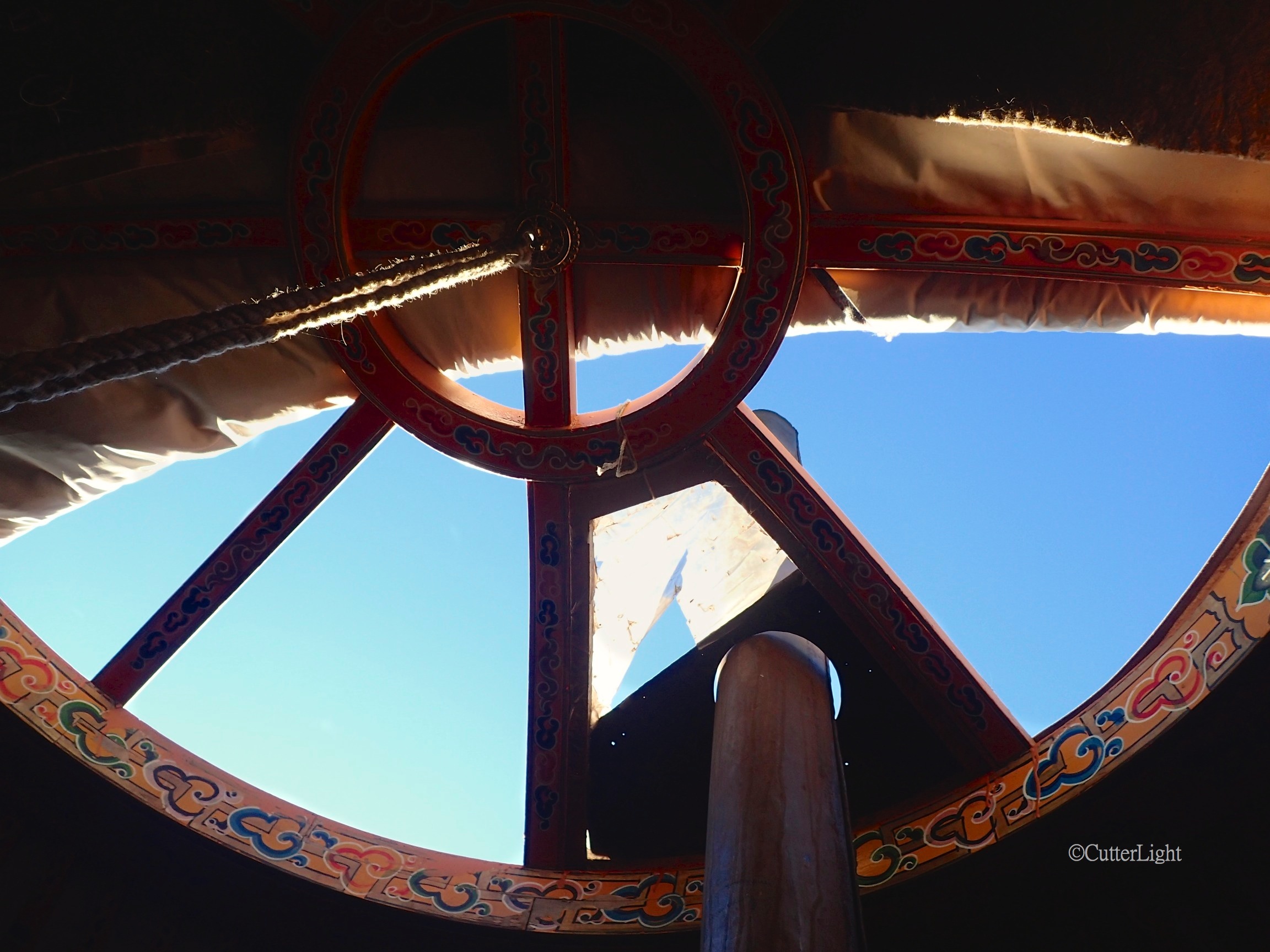
The stove’s chimney extends through an opening in the center of the ger. The sun hadn’t been up long when we sat down to breakfast: coffee, tea, cheese and bread and jam.

OLYMPUS DIGITAL CAMERA

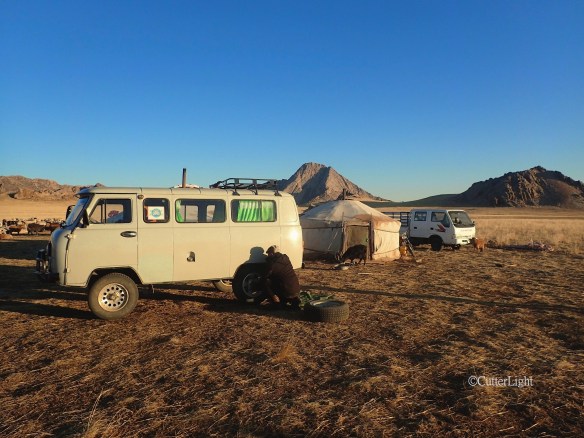
After breakfast, Nimka got to work changing one of the tires on his tough, Russan-built four-wheel drive van. This was the first of four flats during our eight-day trip.

OLYMPUS DIGITAL CAMERA

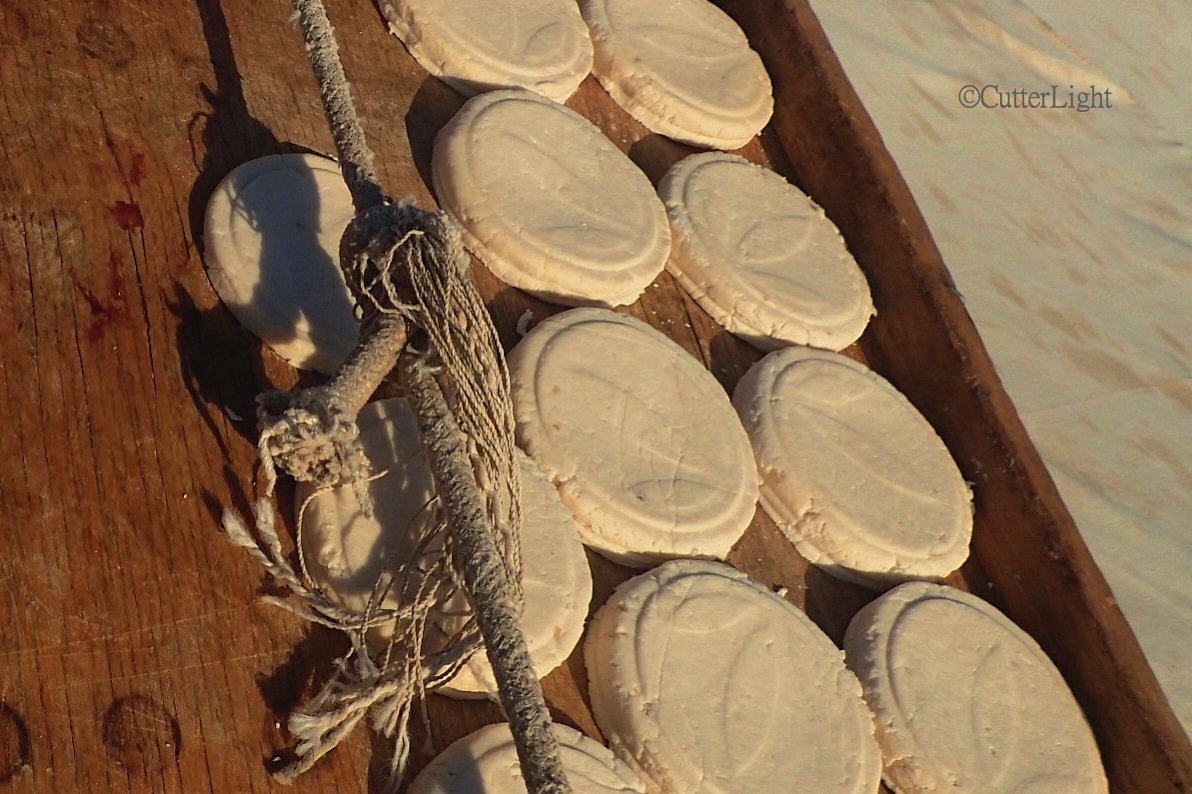
Freshly-made aaruul, a type of dried milk curd, cures in the early morning sun atop the roof of the ger. Once it’s dry, aaruul can be kept almost indefinitely. This was the food that fueled Chinggis Khan and his armies as they conquered the largest area of land ever to fall under one empire. Tasting like sour milk, aaruul is an acquired taste for most non-Mongolians.

horse with beautiful mane & tail n

Legendary for their endurance, the horses of Mongolia are sturdy, tough and beautiful. 

horse brand n

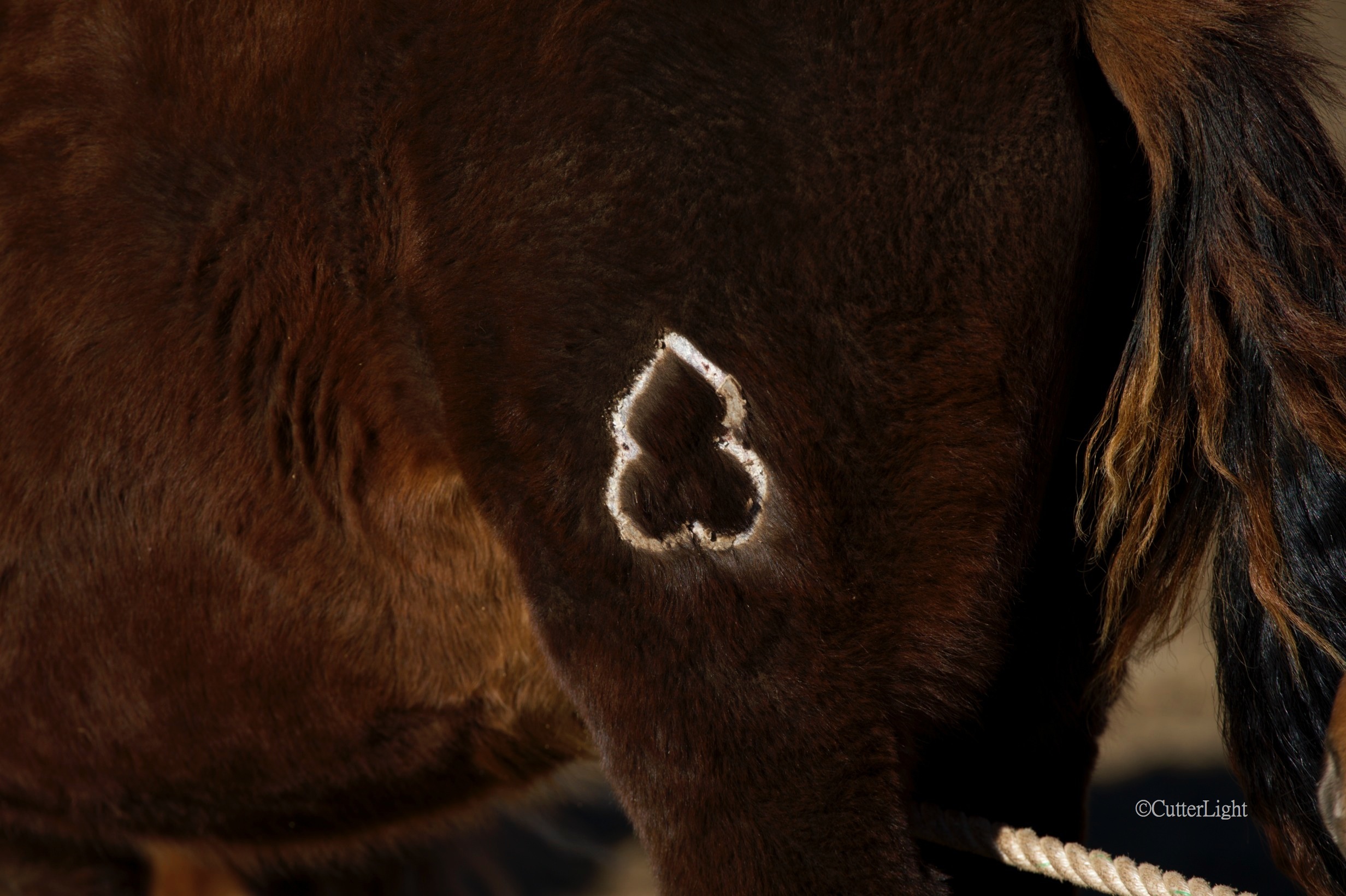
There essentially are no fences in the Mongolian countryside.

mongolian dog n

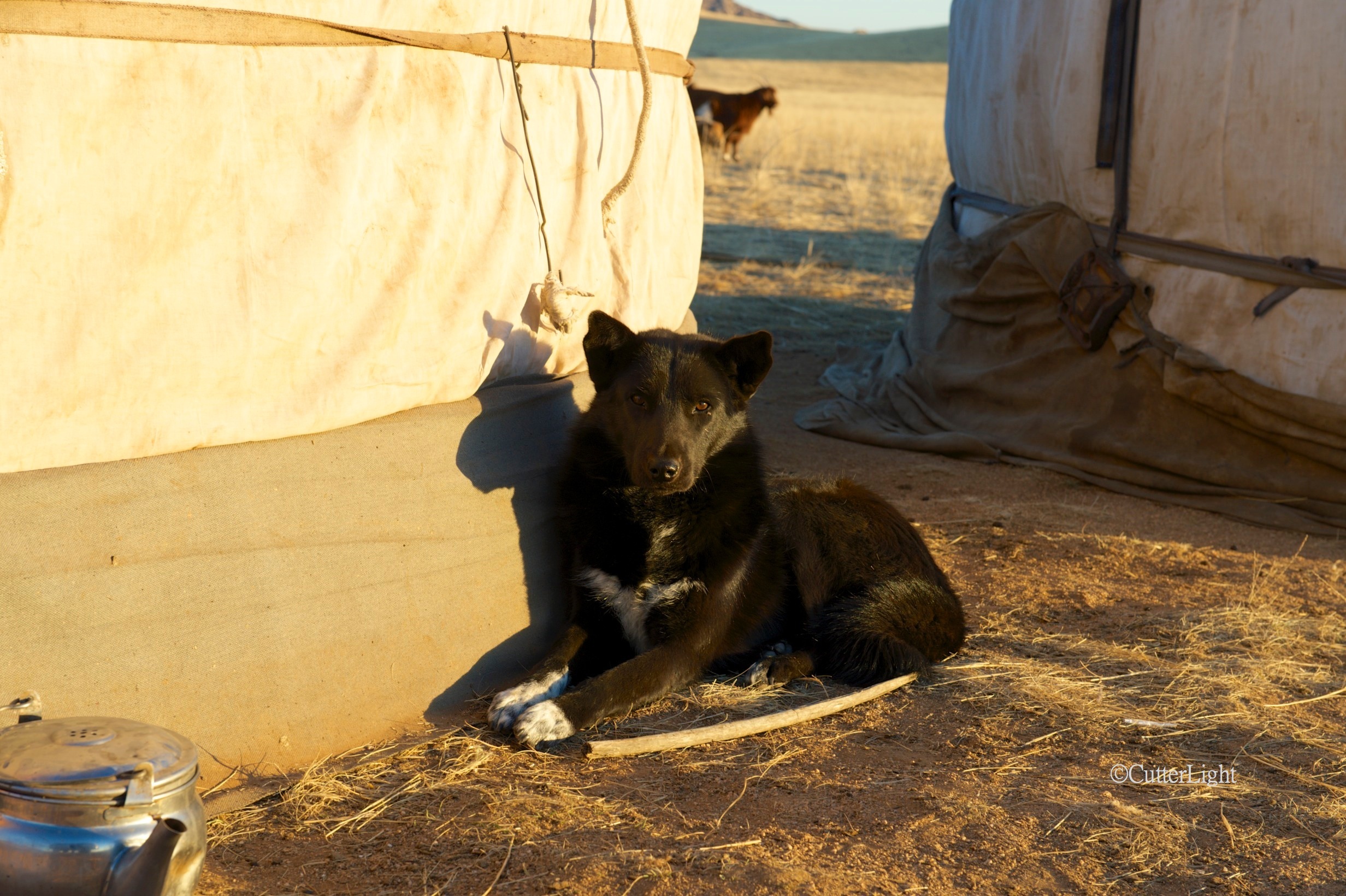
Dogs such as this handsome fellow are an integral part of herders’ lives. While not abundant, wolves are still part of the Mongolian landscape. This guy was quite friendly, as were most of the dogs we encountered.

1st ger landscape w cattle n

A string of cattle makes its way along tire tracks that pass for the local road near the first ger we stayed at. Over the next few posts, we will share more of what we saw and experienced on our trip to the Gobi, including encounters with thousands of Monglian gazelle, countless birds of prey, groups of Siberian ibex, dinosaur fossils, exotic traditional Mongolian cuisine, a sojourn into the desert by camel, and even a pit viper. Stay tuned!

The Wild Right Outside Ulaanbaatar: Hiking Mongolia’s Bogd Khan Mountain

bogdkahn hikers with lit up larches n

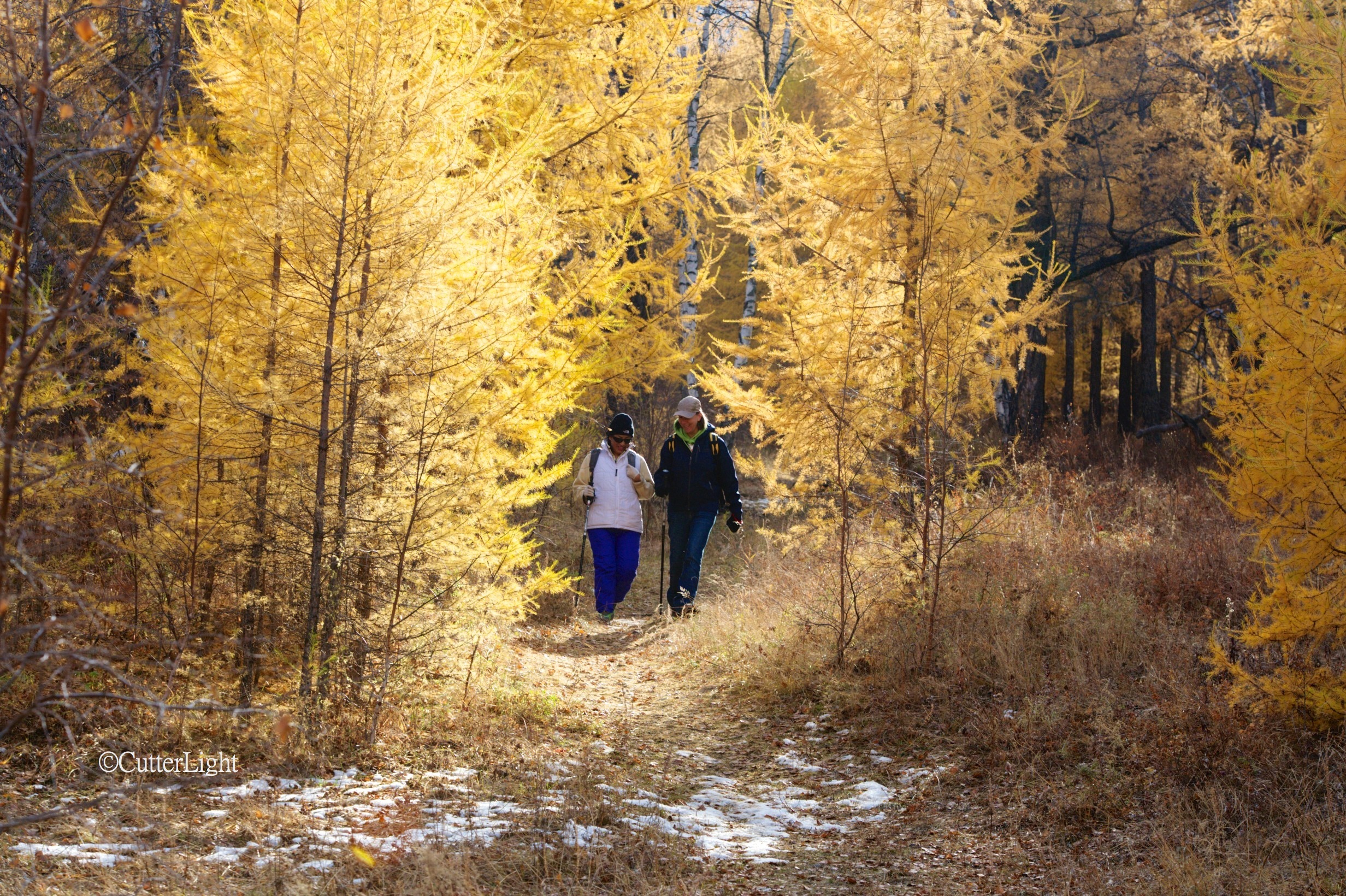
Yellow with fall, larch trees light the trail as Barbra and a friend make their way down from the summit of Bogd Khan Mountain. A Unesco Heritage Site, Bogd Khan rises 3,000 feet (914 meters) above the southern edge of the city of Ulaanbaatar, itself over 4,000 feet (1,310 meters) above sea level. Considered sacred by Mongolians, the mountain is home to numerous species of birds and other animals, some of which are rare.

Sciurus vulgaris eurasian red squirrel n

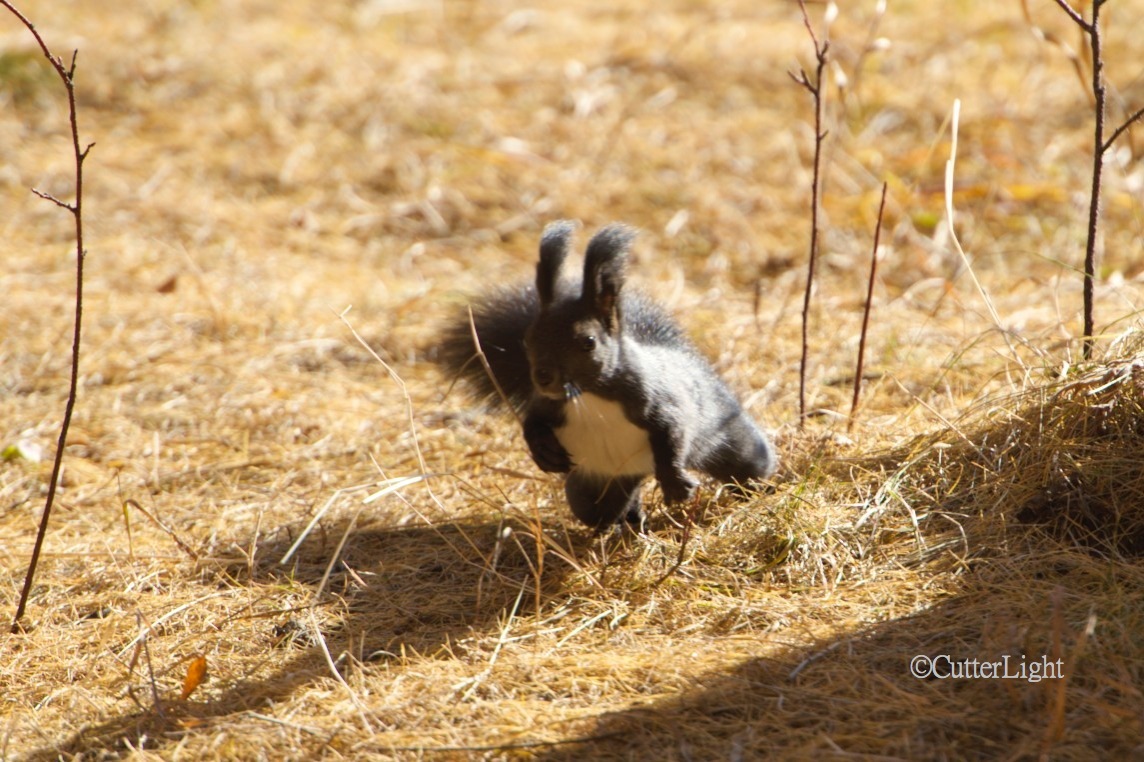
The Eurasian red squirrels (Sciurus vulgaris) of Bogd Khan are nearly black. Siberian Pine and Scotch pine provide ample forage for the forest’s squirrels and chipmunks; abundant birds of prey and foxes keep them on their toes. Prompted by increasingly cold nights, this one was a whir of activity as he scampered from tree base to tree base in an attempt to build his stash of pine seeds. 

red squirrel n

We followed a looping path up the mountain and back down, pausing at the summit for lunch under Mongolia’s signature blue skies. The hike took us through deciduous forests of mostly larch (Larix siberia) and birch (Betula paltyphylla) in the lower elevations, gradually giving way to evergreen forests predominated by Siberian and Scotch pine as we we climbed higher. 

icy stream with gold n

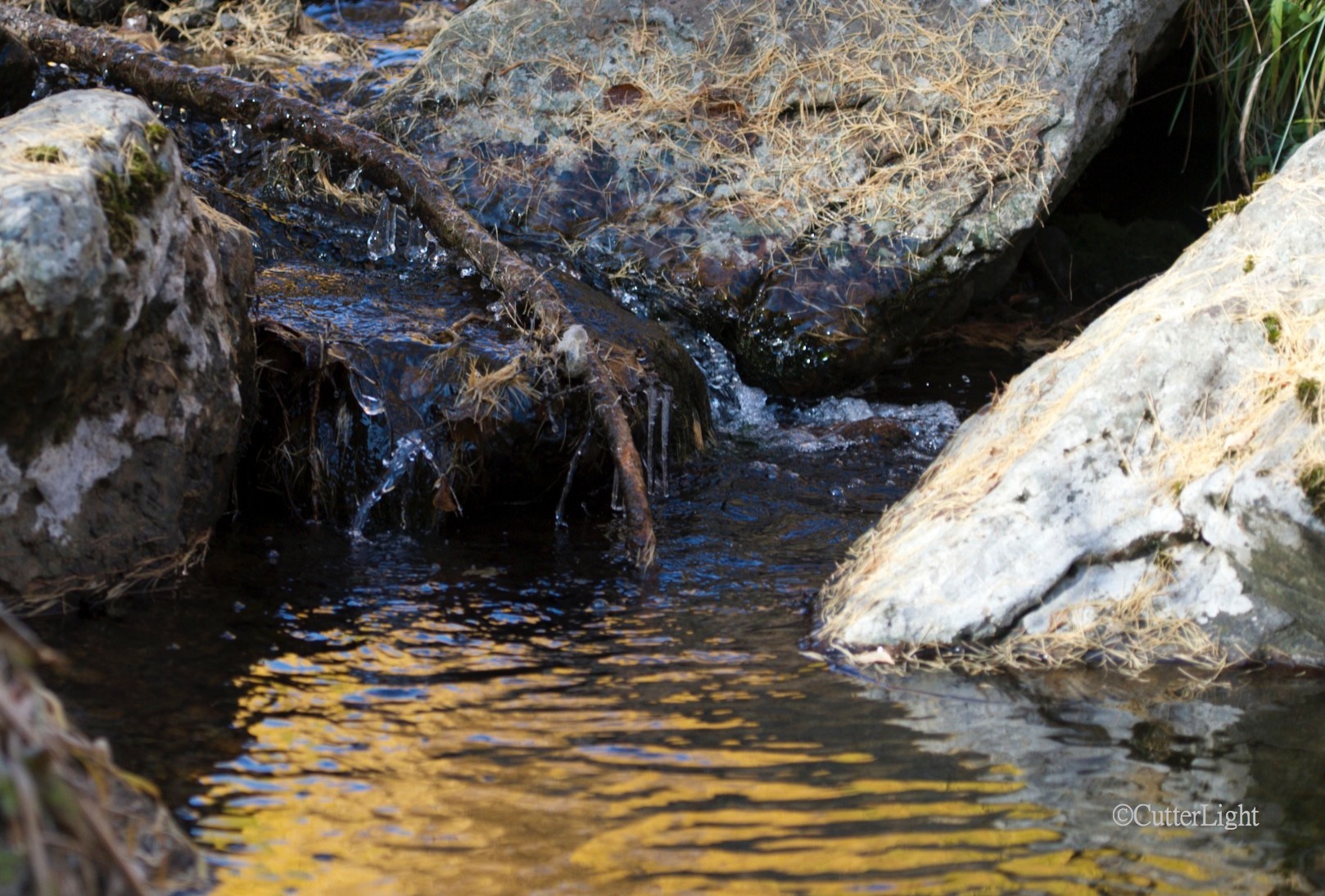
Recently nighttime temperatures have been plunging well below freezing with daytime highs climbing into the 40’s (degrees Fahrenheit), perfect fall hiking weather. This icy little brook is lit with the gold of larch trees and morning sunlight. 

Last embers of fall n

Catching the slanting rays of early sunlight, some of the last embers of red glow in this small meadow on the shoulders of Bogd Khan. Just weeks ago raptors such as black kites seemed to be everywhere. Now ravens and crows have taken over the skies. Winter is coming.

great tits Parus major n

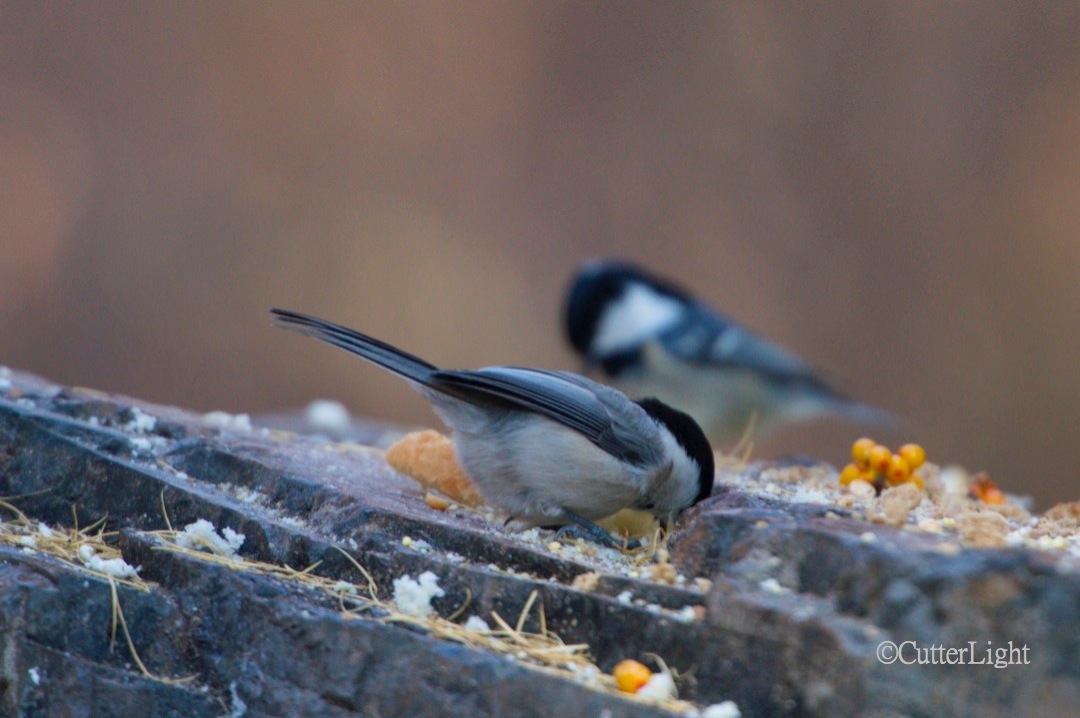
A previous hiker left a snack for these great tits (Parus major), including sea-buckthorn berries. They look and sound very much like their North American cousins, black-capped chickadees. 

eurasian nuthatch sitta europaea n

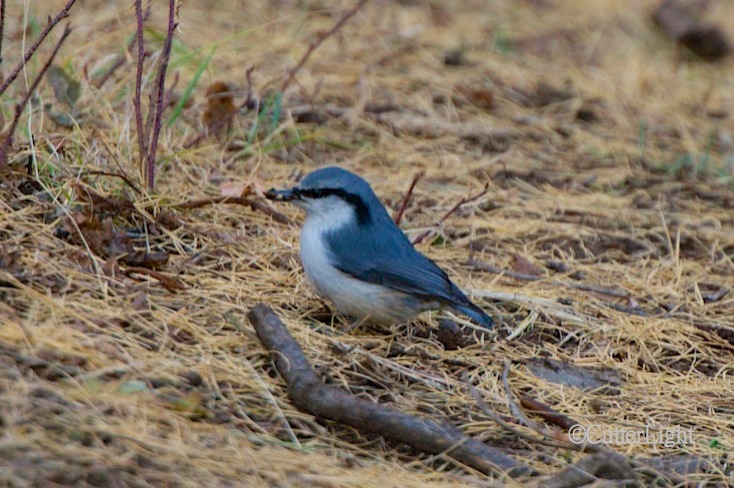
Another common resident of Mongolia’s forests is the Eurasian nuthatch, (Sitta europaea). This one is sorting through larch needles for insects and seeds. 

vulpus vulpus young red fox n

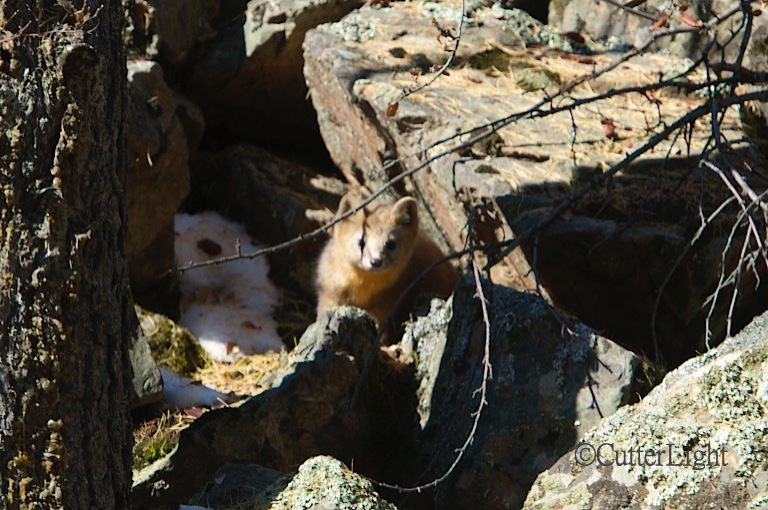
A first for us, this sable (Martes zibellina) appeared to be hunting when we startled each other. 

red fox hunting n

This little guy was quite skittish and didn’t hang around long before he took off for less populated (by us) hunting grounds. Picas, gerbils, squirrels and other rodents are abundant throughout the steppe and forests of Mongolia. Already thickened up for winter, his coat looks luxurious.

siberian chipmunk eutamias sibiricus n

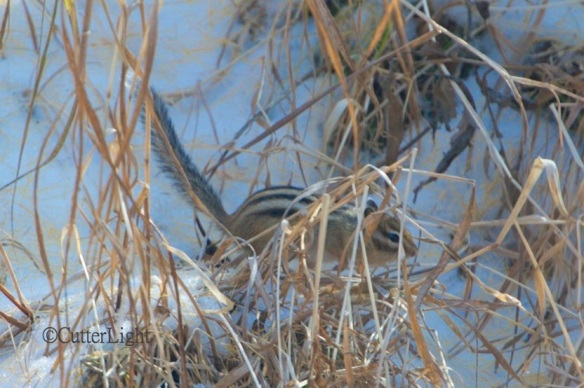
With foxes and sables on the prowl, this Siberian chipmunk didn’t sit still for even a second as he crammed his cheeks with seeds. Ranging from northern Japan through Europe, this is the only non-North American species of chipmunk. 

great tit n

As we gained altitude, stands of deciduous trees gave way to evergreens. The chirps and peeps of secretive birds followed us up the mountain.

garrulus glandarius brandtiieurasian jay n

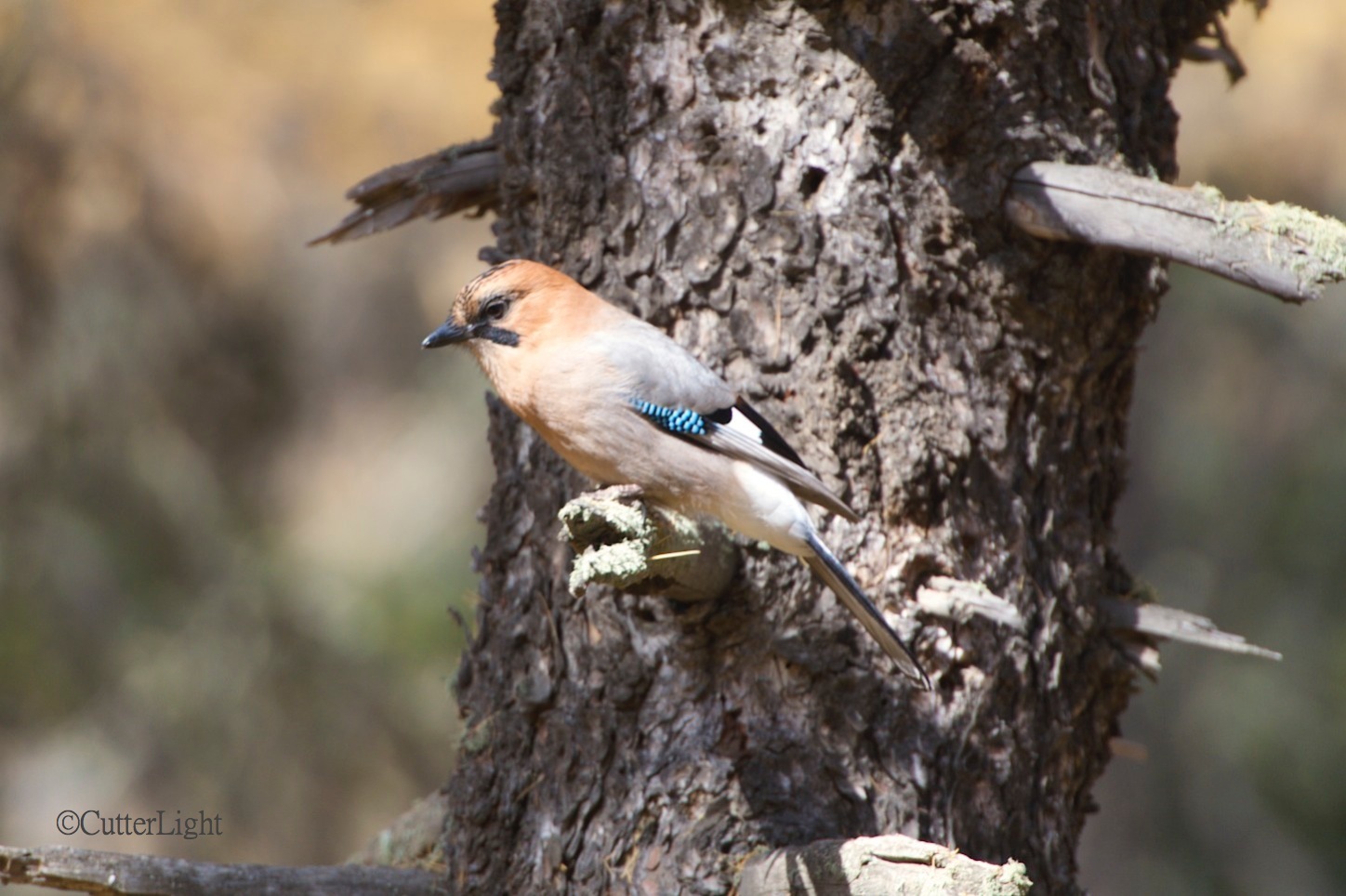
The jay from which all jays get their name – the Eurasian jay – was a bird we had really wanted to get a look at. The subspecies locally common in Mongolia, (Garrulus glandarius Brandtii) is one of the most colorful among this group. They appeared to us to be considerably larger than either the blue jay or the Steller’s jay of North America.

siberian jay in flight n

hike through fire-damaged bodkhan n

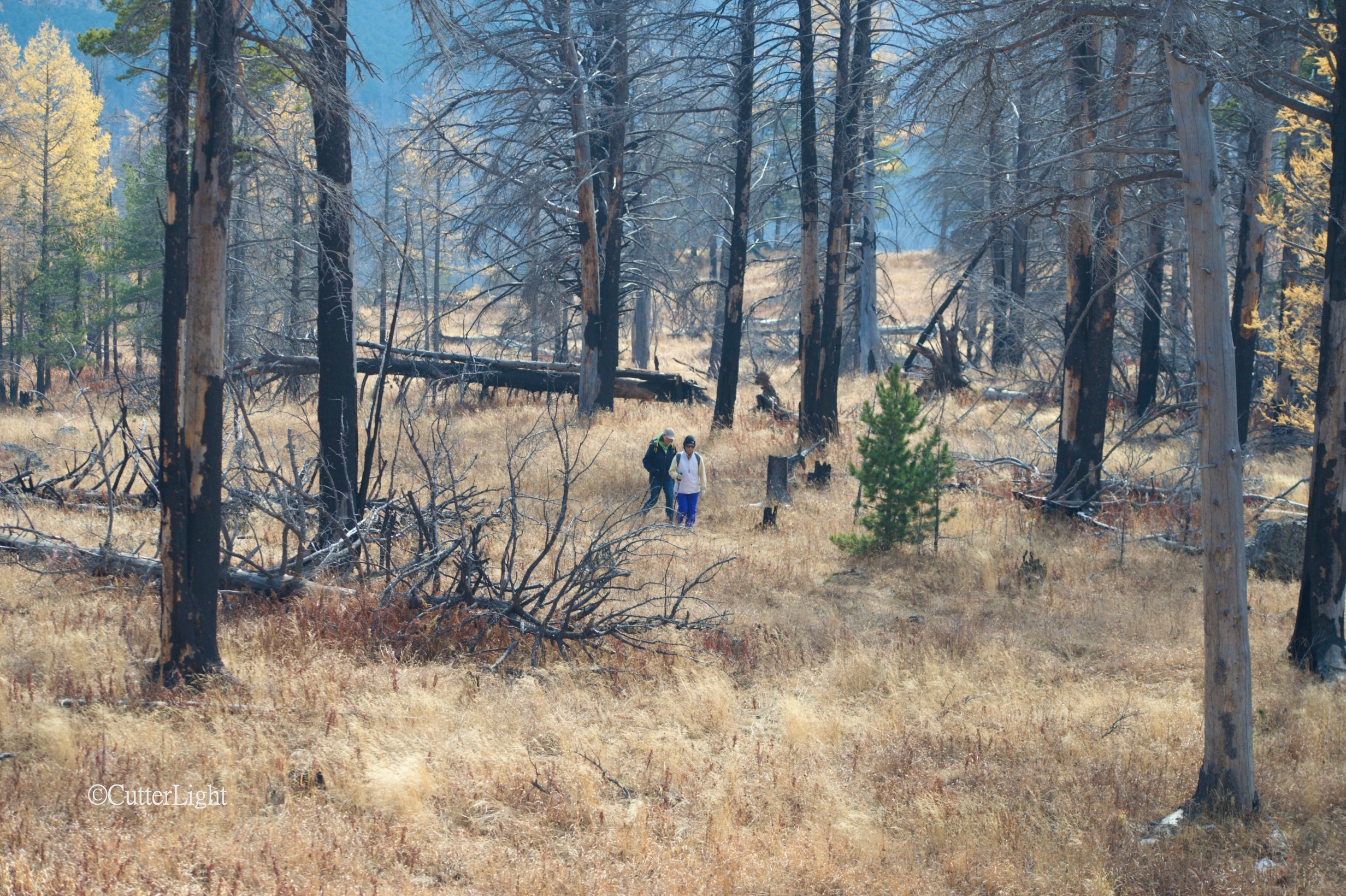
Fire opened the canopy in an area near the summit of Bogd Khan allowing a grassy meadow, laced with deer trails, to emerge. We’re looking forward to making this hike in warmer seasons when wildflowers are in bloom.

lichen chartreuse n

This splash of chartreuse from a rock-hugging lichen was startling.

yellow wildflower fall bloom n

As was the unexpected yellow in this small, late-blooming flower.

bodkhan fall larches birches n

And then their were landscapes like this… jumbles of birch and larch that seemed to be lit from within. 

OLYMPUS DIGITAL CAMERA

We emerged from the forest as the sun was beginning to sink below the mountain ridge, tired in the best possible way. It is a fortunate family that lives in this ger on the edge of this great forest.