Wonderfully Silky, Sumptuous Chanterelle Mushroom Soup

Forget everything you know about mushroom soup and slip a spoon into chanterelle magic.

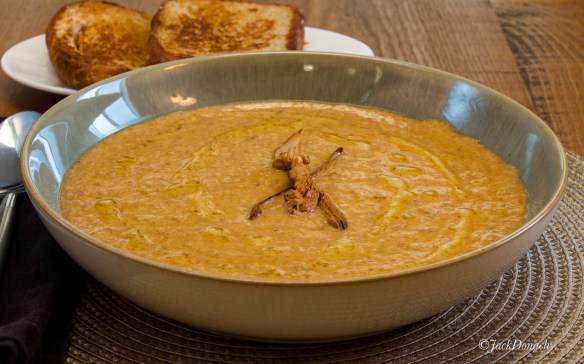
This past fall when Costco (which we can now have delivered to our home in the Alaska bush) offered fresh, wild-picked chanterelle mushrooms, I couldn’t resist ordering a few pounds. I wasn’t sure what I wanted to do with them other than savor them with a little olive oil, garlic and mozzarella on one of Barbra’s homemade thin pizza crusts, or perhaps present them in an egg-white omelette, but I was confident I’d find something. An internet search brought up Escoffier’s Chanterelle Soup. Reading through the recipe, I began mentally picking out the bottle of Chardonnay I’d pull from the rack to serve with it.

While I stayed fairly true to Auguste Escoffier’s Veloute Agnes Sorel – based on the various English versions of the recipe I scanned through – I made a few adjustments, particularly the second time around. We don’t stock brandy, but we have bourbon on hand; that was an easy swap and it worked well. The chicken broth the original recipe calls for is fine… but we felt that lobster stock, made with Better than Bouillon’s Lobster Base, worked exceptionally well. And toward the end of cooking, a taste suggested that not only serving a Chard with this soup would make for an excellent pairing, but that a quarter cup or so to finish the soup might be warranted as well. In fact, we were amazed at the way in which a little Chardonnay brought this soup together, making the already subtle, silky transitions in the flavors of cream, butter, bourbon, saffron and chanterelles even smoother.

This is not a difficult recipe, but it does have distinct preparation steps. A velouté (vәl-ü-tā) must be created – a mixture of butter, flour and broth. And in the creation of a liaison of egg yolks and cream lies much of the secret of this soup’s silky feel.

Oh, and don’t skimp on the saffron.

Ingredients  (Serves 4+)

For the Velouté

  • 6 cups lobster stock (use Better than Bouillon Lobster Base)
  • 2 tbsp unsalted butter
  • 2 tbsp all purpose flour

For the Soup

  • 1 pound of chanterelle mushrooms, chopped fine
  • salt
  • 1/2 cup shallots, chopped fine
  • 1 tbsp unsalted butter
  • 3 egg yolks
  • 1/2 cup heavy whipping cream
  • 2 oz bourbon
  • saffron – approximately 2 full pinches
  • 1/4 cup or slightly more of Chardonnay
  • salt to taste/if necessary
  • a few especially nice chanterelles set aside as a garnish for each bowl

Directions

  1. Heat the stock, but try to keep the temperature just below simmering.
  2. Meanwhile, in a separate pot or pan (a large sauteuse pan works well for this) over medium-low heat, melt the butter until it begins to froth. Whisk in the flour. Continue whisking until mixture is cooked through and smooth, but do not allow to brown. This is called a roux.
  3. Whisk the broth into the roux and bring to a low simmer, stirring frequently. Cook this down by about a fourth or slightly more. Don’t let it boil. A very gentle simmer will reduce the velouté in about 30 minutes.
  4. Meanwhile, sweat the chopped mushrooms and shallots with a little salt over medium-low heat in a dry pan. Stir occasionally and cook till the shallots are translucent and the mushrooms have given up moisture and have browned. When they’re ready, add a tablespoon of butter and stir together.
  5. Crumble the saffron into the bourbon. This can be done earlier. The idea is to allow the saffron to begin releasing its flavor and color.
  6. Add the bourbon and saffron mixture to the mushroom mixture. Turn the heat up and stir until most of the bourbon has evaporated.
  7. Purée the mushroom mixture in a food processor or with a stick blender.
  8. When the velouté has cooked down by 1/4 or slightly less of its original volume, add the mushroom purée and stir well. Try to keep the temperature just below simmering or at a very low simmer. When the mushroom mixture is thoroughly incorporated, turn the heat to low to keep the soup hot without simmering.
  9. In a mixing bowl, whisk together the egg yolks and cream. This is a liaison. The intention here is to create a binding agent that will thicken the soup.
  10. Into the egg yolk and cream mixture, whisk in about 1/4 cup of soup at a time. By introducing the hot soup a little at a time while whisking, you will ensure that the liaison remains smooth and doesn’t break up. Once you’ve whisked in a total of about two cups of soup, you can now stir all of the liaison into the soup. Again, keep the soup hot, but at or below a very low simmer. Do not let it boil.
  11. Add 1/4 cup of Chardonnay. Give the soup a taste. Add a little more wine or salt, if necessary.
  12. To serve, garnish each bowl with a chanterelle and perhaps a drizzle of melted butter. Enjoy with a crusty piece of bread and a favorite Chardonnay.

Changes and Milestones, a Question and an Answer

Full Moon at Sunrise, October 15, Newhalen Alaska
I had been looking at this particular landscape about five miles from our house ever since June when we moved to Newhalen. The scene had elements of a good photo, but I just couldn’t see a picture. Then, one morning a few weeks ago as a full moon was hanging low on the horizon, the rising sun put some nice color in the sky. Sensing that their might be a moment, I drove out and there it was.

I began 2019 with four major goals. I wanted to:

– send out a few articles to magazines for publication

– write a book

– run a half-marathon after my 60th birthday, and

– starting from scratch with very little meaningful background in music, I wanted to put in 500 hours on the guitar and see where that got me

After putting together a couple of articles I quickly abandoned the first goal as both too time-consuming and not reflective of the kind of writing I want to do, and therefore not where I want to put my energy at this point in my life and career.

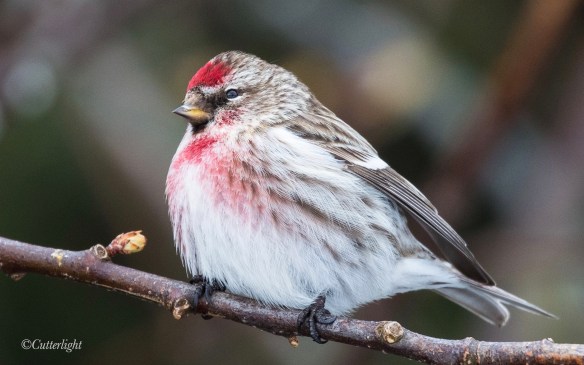
From Gavia pacifica (Pacific Loon) to Pinicola enucleator (Pine Grosbeak), I documented some 80 species of birds at Chignik Lake, including species that had never before been recorded in the region. Redpolls (above) were among our favorites.

Nonetheless, writing remains a central part of my life, and while I didn’t finish a book, I’ve begun. Over the coming weeks (and months), look for Birds of Chignik Lake to be published in installments on Cutterlight. It is my hope that I’ll be able to make a meaningful contribution to the work of others. Perhaps I’ll even be able to interest a publisher in producing a printed edition of this book when it’s finished. Either way, I’m excited to have begun the book and I’m eager to begin sharing my findings on Cutterlight.

Commitment to a fitness regimen paid off, and on October 23, running side by side, Barbra and I completed our first half-marathon in over 10 years. We did this as a “virtual run,” signing up for the Long Beach Half-Marathon (a race we did in person 12 or 13 years ago), and having documented our successful completion of the run up here in Newhalen, we’re now awaiting our finisher medals and T-shirts which should be arriving in the mail soon. Time was never part of the objective; my racing days are behind me. But I am happy to report that we remained injury free and were able to complete the full 13.1 miles running the entire distance. This bodes well for another season of hiking up and down salmon and trout rivers.

The nearby Tazimina River flows through a spectacularly wild  landscape. Cold and pristine enough to drink from, it’s loaded with large grayling, trout, and in fall, salmon.

All of this was terrific – including the manner in which not achieving the first goal led to the positive outcome of more clearly defining what it is I want to do with my writing and my time. I’m in the process of putting together templates for each of the 80-some species I recorded at Chignik Lake, and with other foundational work already done – and with permission from the Cornell Lab of Ornithology to use their range maps secured – I hope to begin publishing installments later this month. And finally, fresh off the success of our October half, we’ve already signed up for another event, the February 2 Huntington Beach Surf City Half-Marathon. This is another race we did on site some years ago (coinciding with the Pittsburgh Steelers scoring their sixth Super Bowl victory), and that we’ll participate in virtually up here in Newhalen.

That leaves just the final and most important of the four 2019 goals to account for – the goal that I believed would help me answer a question that has been on my mind since December 31 of 2018.

Can a 60-year-old person learn to play the guitar to any meaningful skill level starting essentially from scratch?

As I mentioned in a previous article, the Internet seems to offer no answer to this question, though it’s clear others have posed it.

Again, this is not about having learned at a younger age and continuing to play into one’s seventh decade. Nor is it about picking up an instrument again after a hiatus of a few years. My question had nothing to do with learning to pick the notes to Happy Birthday or similar songs, as one site suggests. And it’s certainly not about “deriving benefits,” or finally playing well enough that the “cat stops yowling,” as per a particularly insulting Washington Post article.

We age. Our memories grow less sharp, our hearing less keen. Fingers slow. Nails grow brittle. New skills are acquired less easily. Even sitting for a long period of time in a given position can present challenges that our younger selves didn’t imagine. Over the years, injuries accumulate – a broken finger here, a finger sliced to the bone there – injuries long forgotten… till you sit down with a guitar in your hands.

It’s a simple question, and the manner in which expert upon expert appears to avoid directly answering it left me fearing that… Well, time marches on. At some point windows close. Patronizing assurances that begin with “Anyone can…” are invariably fibs.

At the beginning of the year, I made a commitment to stick with it, put in 500 hours with no expectations, and discover what I might discover. Good, bad or indifferent, I promised to report what I learned.

Yesterday morning, I completed my 500th hour of practice. I will report soon.

To read more about my journey with the guitar, type Learning to Play the Guitar in the “Search Cutterlight Articles” bar near the top of the page.

Hot off the Grill: Two-Cheese Alaska Salmon Burgers

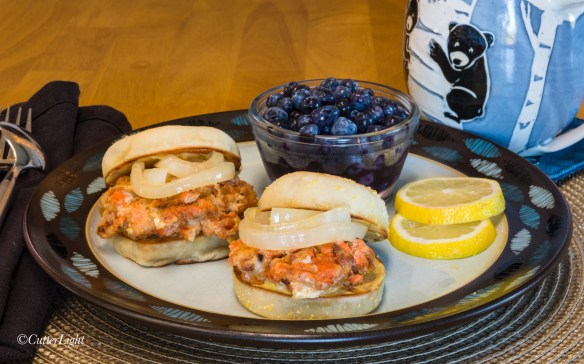
Wild Alaska Salmon on pan toasted homemade English muffins, wild Alaska blueberries and a big mug of coffee – a wild way to start the weekend.

This is easy. Take a wild salmon fillet, remove the skin, chop up the fillet and put it in a bowl. Add equal parts grated mozzarella and crumbled goat cheese. Sprinkle in a spicy seasoning – something with smoked chipotle is especially nice. No salt needed as the cheese should be salty enough. That’s it. Now shape the mixture into burgers and fry in olive oil, flipping once.

Served on English muffins that have been pan toasted in olive oil, these make for a terrific weekend brunch. Or put the burgers in traditional hamburger buns. Try them with a little Dijon mustard. Bon appétit!

Wild About Wild Mushrooms – Lentil and Wild Porcini Pâté

Wild Alaskan porcini mushrooms star in this pâté recipe – the perfect snack or appetizer served on rice crackers, summer squash or zucchini. 

Many years ago, Jack and I took a mushroom foraging class from a park ranger in Oregon. With the help of our instructor, we learned about local mushrooms and actually found one King Bolete mushroom. At the end of that experience, I had more fear of “false mushrooms” that could make me sick or even kill me than anything else. Since then, I’ve been on countless hikes and found countless mushrooms I wouldn’t dare eat – even though they look perfectly safe. When we moved to Newhalen and began fishing and foraging for berries, we began noticing mushrooms the color of browned bread. Big ones. As usual, Jack and I wondered if they were edible. After one quick wondering, we resigned ourselves to knowing our mushrooms would come from a store and went back to the task at hand.

We were delighted to learn that one of the locals here in Newhalen is an expert on mushrooms. She volunteered to take a few of us out a couple of weeks ago and teach us about Newhalen fungi. Turns out, all those big mushrooms we had been seeing are types of boletes (otherwise known as porcini) and are not just edible, but are delicious!

Many people dry these mushrooms. We also heard that they can be frozen. After a bit of experimenting, we decided to vacuum-pack them and freeze them for the winter. Of course, we’ve kept out a few for now. Many have already starred in our recent evening meals – sautéed with garlic in olive oil to serve over pasta and atop Swiss mushroom burgers. Mmmm. Both of us are alive and kicking and now armed with confidence to continue foraging for these delicious beauties on our local hikes.

I came up with this mushroom pâté recipe a couple of years ago with store-bought ingredients. It was created with an intent to mimic one of my favorite Jewish foods – chopped chicken liver. This recipe not only tastes surprisingly like the delicious spread from my memory, but it brings it into the category of good for you, not just tasty. Traditional chopped chicken liver recipes are loaded with flavorful, but not so healthy fats. The chicken liver itself is low in fat but is high in cholesterol. You can use store-bought crimini, button, or shiitake mushrooms. But if you have access to wild porcini or other wild mushrooms, they will up the flavor of this pâté. Also, don’t save this recipe for a special occasion. This scrumptious mushroom and lentil spread is packed with flavor, is low in fat and cholesterol and high in fiber and protein, which makes it a go-to for a pre-run snack or a mid-afternoon pick-me-up.

Nutrition Info Lentil Wild Porcini Pâté

Wild Porcini Mushroom and Lentil Pâté

Ingredients

  • 2 cups cooked lentils, any color
  • 2 cups chopped wild porcini mushrooms
  • 4 tbsp extra virgin olive oil
  • 1 small onion, diced
  • 4 cloves garlic, diced
  • 1 cup almond flour
  • 1 tbsp freshly squeezed lemon juice
  • 1 tbsp soy sauce
  • 1 tsp rosemary
  • 1 tsp thyme
  • 1 tsp honey
  • pinch cayenne pepper
  • salt to taste
  • extra olive oil, needed

Directions

  1. In a large sauté pan, heat 4 tbsp olive oil over medium heat.
  2. Add onions and sauté until translucent.
  3. Add garlic and sauté for 2 minutes.
  4. Add mushrooms and cook until they are soft and cooked through. Remove from heat and set aside.
  5.  In a large bowl, combine almond flour, lemon juice, soy sauce, rosemary, thyme, sage, honey, and cayenne.
  6. Stir in mushroom mixture.
  7. Using a stick blender (or food processor), purée the mixture.
  8. Add in cooked lentils.
  9. Purée the mixture until smooth.
  10. If the mixture feels too thick, thin it with additional olive oil.
  11. Salt to taste.

The Bounty of Newhalen, Alaska

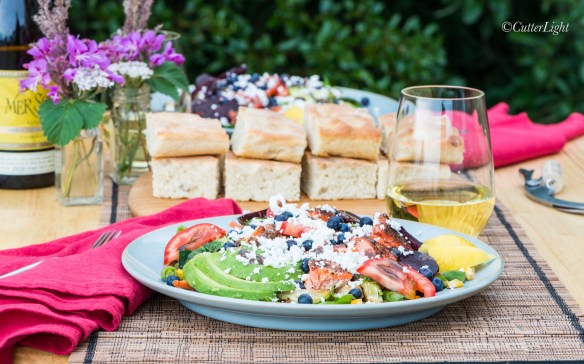
Start with greens from a friend’s garden. Layer on chopped summer squash, zucchini and roasted beets from the Farm Lodge. Add slices of tomato and avocado from same-day-Costco-delivery. Sprinkle with feta cheese and squirts of lemon from Fred Meyer mail order. Top off the salad with local hand-picked blueberries and cedar-plank grilled wild sockeye salmon from the Newhalen River. Serve with homemade onion focaccia and a glass of lightly chilled, deliciously buttery chardonnay. Now that’s a meal!

Jack and I have moved a few times. Well, many times compared to the average American. According to a quick search, several articles agree that the average American moves just over 11 times in their lifetime after the age of one. Defining moving as leaving one residence and occupying another for over three months, our most recent move puts Jack’s count at 21 and my count at 18. It’s a good thing that, generally speaking, we both enjoy moving.

As for our moves together – eight in all, we’ve always looked forward to figuring out where to relocate, learning about unfamiliar places and embracing the opportunities that come with new. This last move was different though. This time moving wasn’t a choice. That put a huge damper on our normal excitement. In fact, it was the most difficult move we have experienced together. We didn’t want to leave Chignik Lake. I didn’t want to leave my students or my school. They are a terrific group of kids supported by a wonderful group of parents and a great community. We didn’t want to leave the little wilderness village surrounded by stunning mountains. We didn’t want to leave the lake and the adjoining river that serves as the main highway – by skiff – in a mostly roadless landscape. We didn’t want to leave the salmon, the birds we were documenting, and the charismatic megafauna like wolverine, wolves, foxes, moose, otters and brown bears that were regular parts of our lives there.

Last spring, when the school enrollment was hanging steady at two fewer than the state-required ten, the school board voted to close the school and move me to another site. The site with said opening was in Newhalen, Alaska. (See Where in the world is Newhalen, Alaska?) Last April, I had a chance to come visit Newhalen and scope it out. It was during that trip that this lovely village began courting me. I couldn’t have asked for a more beautiful flight from Chignik Lake to Newhalen. The sky was clear and blue. The portion of the flight over Lake Iliamna was stunning – imagine a huge multi-hued blue lake rimmed by snow-capped mountains. “Wow!” I mouthed to myself as we landed in nearby Iliamna. It wasn’t Chignik Lake, but it sure was beautiful. During my visit, I learned several appealing things about the Newhalen area that made the location very attractive. It would be easy to bring our truck and fishing boat over. I found out that there were many nearby places to hike and boat. All the people I met were very welcoming and seemed happy we would be joining the community.

Back home in Chignik Lake, as the process of packing and shipping continued and the cloud of leaving our home hovered, the memory of the blue-hued lake faded along with all the appealing details.

Then, in June, we moved. As we began settling into our new home, Newhalen took up courting where she had left off back in April. As promised, Sockeye salmon began their run in earnest up the Newhalen River in July. In a matter of a few easy outings, armed with flies we had tied, Jack and I filled our freezer with our goal of 100 pounds of filets. Those days were mostly sunny, clear and warm. The scenery at the new fishing hole at the Newhalen Rapids was astoundingly beautiful.

As the salmon finished their run, it became time for berry picking. We’ve lived in the bush long enough to know not to ask where to pick berries. People always have their secret spots and obviously are not keen to share that specific knowledge. Turns out the best spot to pick blueberries in Newhalen is Anywhere! I had heard that there were lots of berries, but brother, lots of berries is an understatement. Oh, Newhalen, you are really working your magic.

The bounty of Newhalen is not just about what naturally occurs in this locale. Many people garden around here. We have already been lucky enough to be the beneficiaries of fresh strawberries and salad greens straight from the garden onto our plates! We were happy to learn that the Farm Lodge will regularly deliver its greenhouse fare to us in Newhalen, as it did to Chignik Lake. The icing on the cake turned out to be same-day delivery of produce (and anything else we need) from Costco in Anchorage. Did you read that? Same. Day.

As bonafide foodies, we are now officially in hog heaven. Newhalen continues to do her magic. We will always have an abiding love for Chignik Lake. But if you can’t be with the one you love, love the place you’re in. 😉

River Heart

What a wonderful name – Chocolate Lily. They’re blooming everywhere, including right outside our door.

As a soft drizzle fell in the small hours this morning, I could hear bears on the beach outside our bedroom window, thick pads pressing into wet sand with subtle, sandy crunches. Salmon have begun showing up. Not in the numbers the river is accustomed to receiving – by now a couple of hundred thousand Sockeyes should have passed through the weir downriver -, but some. Tens of thousands. It won’t be enough to allow the local commercial fishermen to set their gear, but enough for friends and neighbors to set nets for subsistence fishing. Each day now when the tide is right they launch and then later return to the beach in their skiffs, 18-foot Lunds sporting faded maroon stripes around the hull. These days they bring back salmon and since a lot of those fish end up being cleaned right there at the lakeshore, eagles and a few gulls hang around during the day. The bears come at night, looking for heads, spawn sacs and other scraps. A mother and two cubs have been showing up almost every night. It’s not worth trying to make a picture in the dim light, but we get up to look anyway. “Petting the whale,” Joel Sartore calls it – setting cameras aside to simply watch and enjoy.

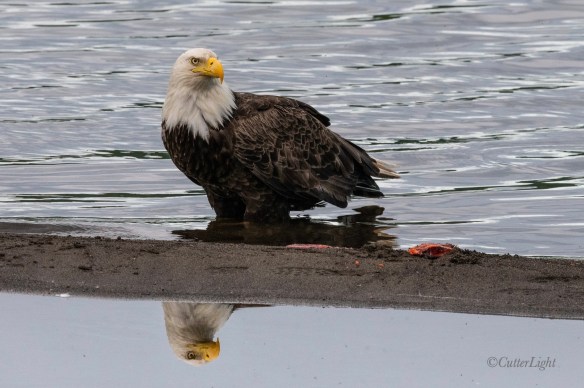
This mature bald eagle has been coming around to fill up on salmon scraps left on the beach. One of the things we’ve most enjoyed about our life at The Lake has been the live and let live attitude toward wildlife that generally prevails. A few moose and an occasional caribou are taken, but no one begrudges our eagles, bears and foxes what’s leftover after the salmon have been split for smoking and canning.

Our plane, the bush plane that will fly us away from this village we have called home to our new village in Newhalen, will arrive sometime this afternoon. At this point the cupboards and shelves in our house are empty and our voices echo – a hollow sound that reflects the hollowness in our chests. Twenty-six places. I listed them up the other day as I was writing to a friend. During my adult life, I’ve lived in 26 different communities for at least a month. I’ve rarely stayed anywhere longer than a couple of years. I like to see new places. I like change.

Cinquefoil, I think. More specifically, Norwegian Cinquefoil. Maybe. Most people around here don’t really have lawns. A palette of salmonberry brakes, lush wild grasses and wildflowers line the dirt and gravel thoroughfares and continue without interruption right up to porches and doorsteps. Our own house is surrounded by a thick growth of Horsetail Fern, Fireweed, Chocolate Lilies, Dandelions, grasses, Cinquefoil, Nootka Lupine and Wild Geranium.

This time is different. We wanted to stay. The simple story is that Chignik Lake School, where Barbra teaches, didn’t make the minimum enrollment of 10 students necessary to stay open. The school board voted to close the school and to transfer Barbra to another, larger school up the peninsula. It has been difficult to reconcile leaving this community, these mountains and this river.

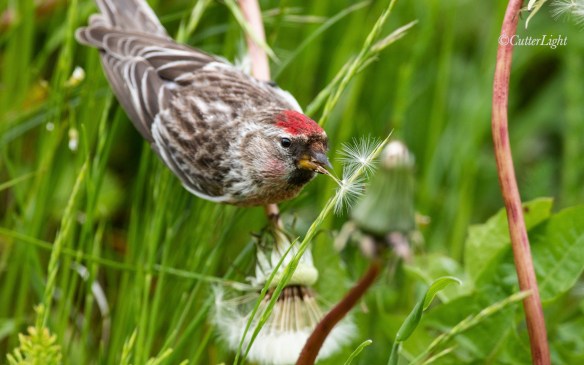
Redpolls (above), Pine Siskins and Pine Grosbeaks have been visiting daily to feast on Dandelion seeds around the playground outside our door. We watch them out the window as we cook and wash dishes and have been heartened by their cheerful songs and chatter  throughout the day as we come and go. I cautiously eased open our front door and took this photograph from our kellydoor, the local nomenclature for mudroom. If you haven’t checked out our video of these Dandelion seed eating finches, you can find it here: Finches of the Dandelion Jungle

I grew up near the Clarion River, had favorite trout streams and lakes in Pennsylvania and went out into the world to find myself living within easy distance of other waters – close enough to certain rivers, streams, bays and beaches that I could duck out at halftime from watching a March Madness basketball game and be back before the game’s end with a couple of Sea Trout for dinner, hop on a bicycle and be on one of Japan’s top Sea Bass venues, walk up a small river to cast flies for Rainbow Trout after college classes, or watch Largemouth Bass chase smelt from the balcony of my apartment. There were other waters, too.

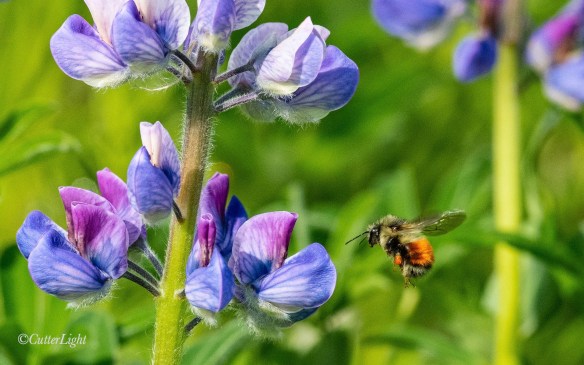
We love our big, orange and yellow Bumble Bees. And our Lupine.

But I’ve never had what I would call a home water. I don’t know how others might define such a thing, but Roderick Haig-Brown’s accounts of his life along Vancouver Island’s Campbell River used to tug at me with an emotion that lies somewhere between awe and envy, an I’d like to have that one day feeling.

A pair of Golden-crowned Sparrows nested beneath a willow thicket right next to our home, and although we’ve heard the young ones chirping for food, we’ve never bothered to look too closely for the nest for fear of leading Magpies to the location. Keeping the little ones fed appears to be a full-time job. I got this photo yesterday morning.

The Chignik did not immediately fill the longing for a home water. We fished. We caught fish – a few char but mostly salmon, mostly Silvers – and it was very satisfying. That we could actually see fish coming up the lake from our dining room windows, lift our fly rods from their pegs on the wall and walk down to the water exceeded anything I’d ever expected to have. But this abundance and proximity by themselves did not make the water feel like home.

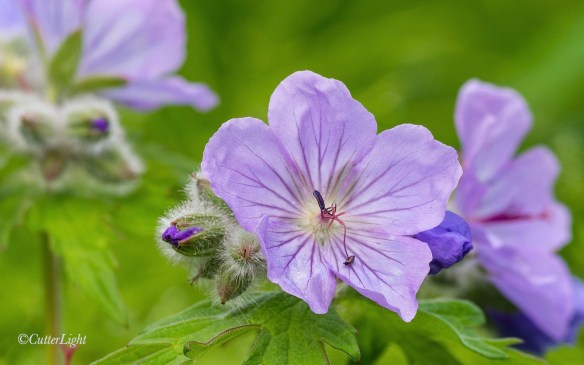
One of the first flowers to appear in spring, only Yarrow will still be blooming in autumn when the last pale purple Wild Geranium petals fall to the ground.

There were the otters we came to recognize, mink prints in wet sand, the bears we encountered and got to know, the eagles that watched us. There was the way that, over time, we came to know the river’s music – the flow of the river itself and the lapping of waves on the lake shore – but also the kingfisher’s rattle, ducks quacking, Tundra Swans bugling, the raucous music of Sandhill Cranes, the fierce Chignik winds that filled the valley and whistled and howled and sometimes shook the house, snipe winnowing softly in evenings, the startling sound of a salmon leaping and falling, unseen, back into a downstream pool. There were nights when we would like awake in our bed, listening quietly as Harbor Seals chased down freshly arrived Coho in the dark, catching them and hurling them into the air to chase down and catch again… evenings and dawns when the eerie, supremely wild howl of wolves echoed across the lake and up and down the river valley… bears grunting and splashing on the beach below our window… winter days when heavy, wet snow put a hush on the world. We came to know where the Great Horned Owls roosted in a grove of spruce trees at a bend on the river where we caught our first salmon, a place where Barbra found a perfectly knapped stone knife Native fisherman long before us had undoubtedly used to split salmon and where we picked berries by the gallon.

Young Eagles waiting for someone to come in with fish.

Through all of this and more, The Chignik came to feel like home, and while I could list many more of the river’s attributes and our experiences along its shores and on its waters, I suppose what it comes down to is love and I don’t have the words to explain that.

Just a few more seeds… Look at that swollen crop! This Pine Grosbeak seems determined to cram himself as full as he possibly can. One of the first things that struck us about our home on The Chignik was the shear abundance around us. Vegetation grows as thick and lush as in a jungle, local Brown Bears are some of the world’s largest and a season’s tally of salmon isn’t measured in thousands or even tens of thousands but in hundreds of thousands and millions. 

I suppose it is natural, upon leaving a place, to consider the things that were left unexplored, stones unturned, projects unfinished. I topped off at 75 the number of bird species I was able to identify in and near the village, but just two days ago I got a glimpse of something that may have been new – an Arctic Warbler? It would have been one of several “first documentations” for this area. I can’t say for certain, and so the matter must be left at that. It’s time to go. We were still learning about the fishing, still getting to know our friends and neighbors, still savoring every day here.

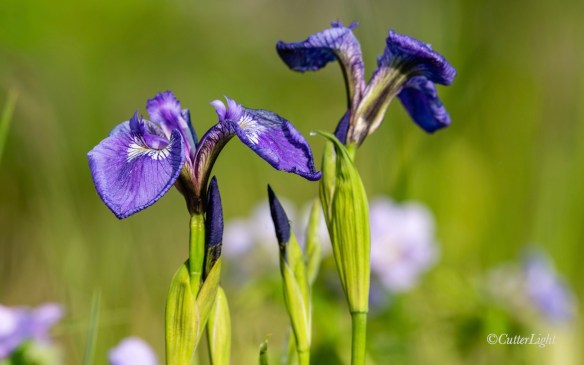
We thought we would have to leave before my favorite flower, wild Irises, came into bloom. But in these past few days, they’ve begun bursting open. We’re glad we got to see them. 

After the Fog Burned off – Eagles

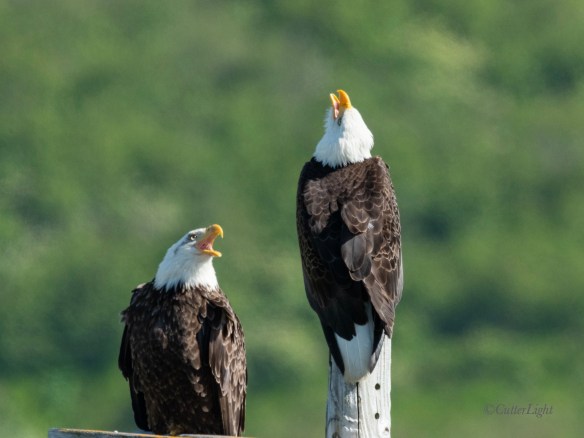
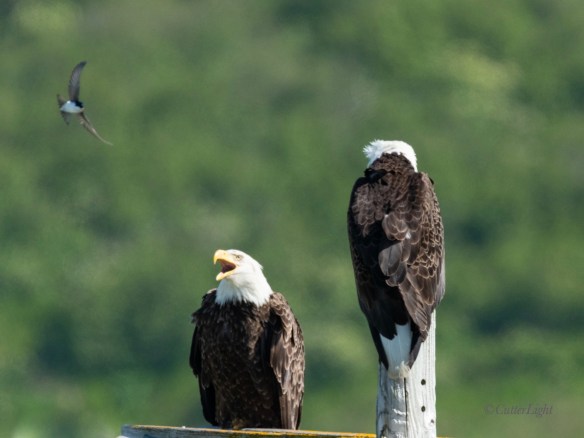
As swallows swooped and soared, this pair of Bald Eagles began a chorus of their characteristic high-pitched piping. The sunshine must’ve felt as good to them as it did to us.

Two days in a row we’ve woken to heavy fog here at The Lake. It wasn’t forecast either day. Yesterday by mid-morning, the mist had burned off. When it did, the birds came out in force. From our vantage point on the deck outside my “office,” Barbra and I saw or heard Pine Grosbeaks, Pine Siskins, Redpolls, Wilson’s Warblers, Ravens, Magpies, Golden-crowned Sparrows, American Robins, Fox Sparrows, Violet-green Swallows, Tree Swallows and out on the lake a small group of Black Scoters and a few passing Glaucus-winged Gulls. But the stars of the morning were a pair of mature Bald Eagles that took up perches on a favorite utility pole near the lakeshore.

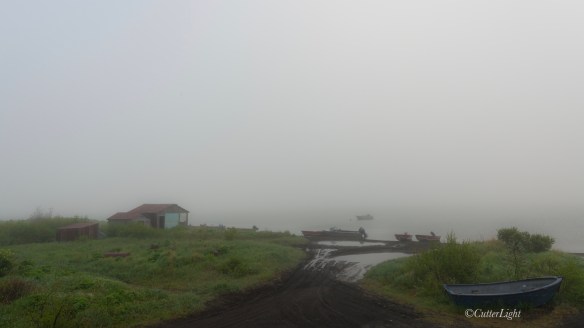
This was the view from our dining room window yesterday morning just after dawn. The village of Chignik Lake lies only a few miles upriver from a bay on the Alaska Gulf, so we get our share of wet weather. 

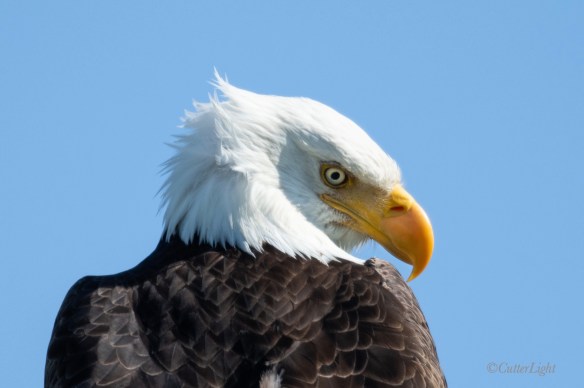
As the sun began peeking through the fog, the first eagle to arrive did its best to dry its soggy wings. Either that, or this is one of those rare Peacock Eagles.

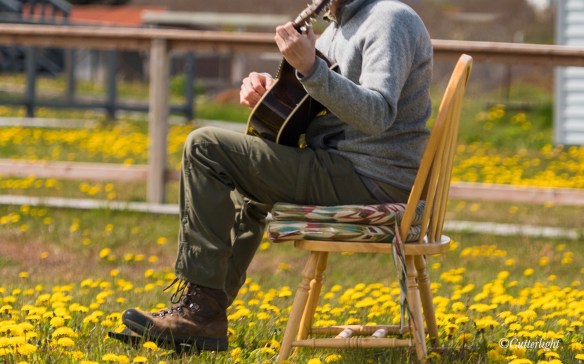
His (her?) mate hadn’t yet arrived and I moved a little closer to capture a portrait. Once the fog lifted, we had a day of blue skies. Temperatures climbed into the 60’s so we took the opportunity to work on our “Alaska Tans” – defined as tans that cover the backs of one’s hands, face and neck down to the level of a shirt or coat collar. But by early afternoon, it was warm enough (mid-60’s) to sit outside in a just a shirt, shorts and bare feet and read (Barbra) and play guitar (me).

While I worked on photos, Barbra scanned for birds from the deck outside her former classroom. Off in the distance to the right, along the far edge of the lake, the second eagle can be seen soaring low. (You might have to enlarge this photo.) The duplex in front of Barbra is where we live – on the righthand side. 

There are at least 50 nesting boxes in this bird-loving village of only about 50 to 70 residents. The boxes are occupied almost exclusively by either Violet-green or Tree Swallows. Both species seem inclined to investigate anything out of the ordinary in their neighborhood – us, eagles, other birds. The real threats to swallows are Chignik Lake’s abundant Magpies – notorious nest robbers. In years past, Merlins, Northern Shrikes and occasional Sharp-shinned Hawks have also posed a threat, but none of these species appear to be present this year – at least so far.

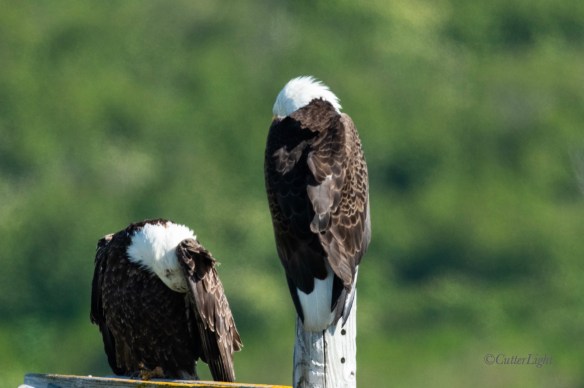
A mated pair? Siblings? Friends? (Do eagles have friends?) It was interesting to watch these two repeatedly mirror each other’s behavior. We’ve read about these dreaded Dracula Eagles – another rare sighting.

As I mentioned, we’ve had two consecutive mornings of heavy fog. Inspired by the way the morning cleared up yesterday, last evening we prepared our pack raft in anticipation of doing a three-mile river float today. Unfortunately, the weatherman got it completely wrong. The fog only grudgingly lifted late in the morning and instead of the calm that had been forecast, winds – the bane of rafting – kicked up. So I spent the morning working on photos. Yet hope springs eternal. The prediction for tomorrow morning is for partial sunshine and calm, so perhaps we can get in one last river float before we have to pack up the gear and mail it to Newhalen. Every hour of these final days at The Lake is a time to savor.

If you enjoyed this post and would like to see some of the birds mentioned and more of the landscape around Chignik Lake, check out the link below:

Morning Nature Walk, the Chigniks

Hope your day is going well!

Shioyaki Wild-Caught Alaska Salmon – It couldn’t be Easier, Even if You aren’t an Experienced Cook

Sea salt, olive oil and heat are the only ingredients you need to turn out great salmon every time. Particularly if you’re just getting into cooking and you try this recipe, we’d love to hear from you with any comments or questions and of course a report on how your salmon came out!

Over the years, one question has repeatedly come our way: “I really don’t do much cooking, but I’d like to be able to make salmon. Is there an easy recipe you know of?”

Not only is the answer to this question a resounding “Yes,” the recipe happens to be our favorite. I learned about shioyaki (salting and cooking) when I lived in Japan where shioyaki can refer either to charcoal grilled fish or, more commonly in home kitchens, broiling.

In addition to being the definition of simplicity, the genius of this recipe is that, unlike more elaborate recipes, the salt brings out rather than masks the flavor of the fish. This is exactly what you want when dealing with a fresh, wild-caught salmon. On the other hand, because the flavors are simple, the finished dish is easily enhanced with toppings. Try it with raspberry chipotle sauce (easily made at home) or with Mae Ploy Sweet Chili Sauce. Here’s how it’s done.

Ingredients & Preparation

  • You’ll need a broiling sheet. A standard cookie sheet works fine, but a heavier sheet is even better.
  • Salmon fillets – any species of wild-caught salmon
  • A favorite kosher salt or sea salt. We’ve found coarse Grey Sea Salt to work especially well.
  • Extra virgin olive oil

Directions

  1. Place oven rack in center or one position below center. (This is the one “trick” you might need to experiment with. Ovens vary. So don’t be discouraged if your first attempt doesn’t work out as you expected. Adjust the rack position and go for it again! Once you have this dialed in, the rest is a snap.)
  2. Place the broiling sheet in the oven and preheat on Broil. (10 minutes is generally the right amount of time.)
  3. Meanwhile, rinse salmon fillet(s) in cold water. Pat dry with paper towel and place skin side down on cutting board.
  4. Sprinkle salt on fillet.
  5. Put a little olive oil on the hot broiling sheet – enough to cover the area where you’ll place the fillet.
  6. Place salmon fillet skin side down on prepared sheet and place in oven. It should vigorously sizzle when it touches the sheet. If it doesn’t, simply place the sheet back in the oven and continue preheating.
  7. Cooking time will vary depending on fillet thickness. 8 to 10 minutes is usually about right. An oil-like liquid will begin to emerge from the top of the fillet when it is done. Again, if your first attempt produces an undercooked or overcooked fillet, make a note, stick it on your fridge, and adjust the cooking time. If the fillet comes out overly dry on top or burnt, you probably need to lower the rack. Keep simple notes till you get it dialed in.

Fillets prepared this way are superb served on rice, on pasta, served along with tartar sauce or avocado spread as a sandwich or broken into pieces to top a superb Alaska-style pizza. Going for an added touch with a glass of wine? It’s tough to beat a lightly chilled Chardonnay.

See also:

Alaska Silver Salmon Pizza

Raspberry Chipotle Sauce Recipe

Broiled Salmon Spine: Getting the Most out of Every Salmon


Springtime Alaska: Who Needs Asparagus? Poached Eggs on Sautéed Fireweed Shoots

Poached egg yolk mixes with garlic-infused yogurt to make a sumptuously tangy dressing for sautéed fireweed.

When we first moved to Alaska, a friend suggested we swing by the Fireweed Festival in Trapper Creek. I’d already fallen for fireweed the previous summer during our initial visit to this great state. The love was based on this beautiful flowering plant’s visual appeal as it blanketed summertime hillsides in stunning fuchsia. Any festival evoking those images had to be good, so there was no way we’d pass up a festival in fireweed’s honor! In addition to local crafts and great live music, there was a food stall dedicated to teaching the culinary uses of this ubiquitous plant. I walked away from the stall with a new book on harvesting Alaska’s wild plants and new ideas of how to use fireweed in our kitchen. One thing that stuck with me from talking with the people at the festival is that new fireweed shoots can be used just like asparagus in any recipe. True? Absolutely! 

My internet news feed is made up mostly of recipe posts from blogs I follow. I have to tell you it is a much more gentle and uplifting type of reading than the mainstream media feed offers. Jack and I had planned to grill bacon-wrapped fireweed exactly as one would asparagus to continue testing whether all asparagus recipes work with fireweed shoots. But before we could get to that experiment, a recipe for asparagus with yogurt dressing popped up on my news feed. I immediately envisioned a recipe makeover, and with everything I needed available in my ever-shrinking, pre-move pantry, I got to work.

This dish is quick to make. I recommend preparing the yogurt dressing ahead of time to ensure that the garlic becomes infused. We served this dish as the salad course of our dinner, but it would work wonderfully as part of a light lunch or as a side dish for brunch. Make sure you have crusty pieces of sourdough bread available to sop up the extra dressing. It tastes too good to waste!

Now is the time to get out and harvest these young fireweed shoots. I like them best when they are about six inches tall and still mostly purple. The ones with an agreeable snap (just like a nice skinny asparagus stalk) when harvested (near the ground) taste best. The fireweed near our lake is now fully green and too old to harvest. A hike to higher elevations should still provide fresh young shoots to pick.

Poached Eggs on Sautéed Fireweed Shoots for Two

(recipe can easily be doubled or tripled)

Ingredients

  • 2 large eggs
  • 2 tbsp white vinegar
  • 1/4 cup almonds, slice and toast them, or buy them sliced and toast them
  • 1/4 cup plain yogurt (strained or Greek-style if you can find it)
  • 1/2 tablespoons lemon juice
  • 1/4 teaspoon smoked paprika
  • 1 small clove garlic, minced
  • pinch salt
  • 1 tablespoon olive oil
  • 1/2 pound fireweed shoots

Directions

  1. Combine yogurt, lemon juice, paprika, garlic and salt. Place in covered container in fridge. Can be made a day to a couple of hours ahead of time.
  2. Place olive oil in a medium pan over medium heat.
  3. In a separate saucepan, bring 3 cups water to a simmer. Add vinegar. Gently crack eggs into hot water being careful not to break the yolk. Cook until whites appear to be cooked through, about 3 minutes.
  4. Sauté fireweed in pan while eggs are poaching.
  5. Place fireweed on serving dish. Place poached eggs on fireweed. Drizzle with yogurt dressing. Top with toasted almonds.
  6. Serve immediately with crusty toasted sourdough bread.

Recipe inspired from The Smitten Kitchen.

He Wasn’t Our Dog – a Tribute to Our Friend, Buster

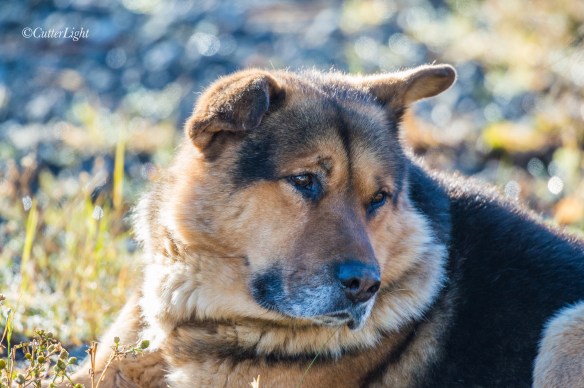
If there was ever a more naturally contented being, we’ve not met. But there was often a lot going on inside that big, lovable head.

 He wasn’t our dog.

Shortly after we moved to The Lake, he began showing up, handsome with his barrel chest, slim hips and soft brown coat. Instantly lovable with those floppy, puppyish ears, sparkling brown eyes and that big head he liked to push into a hand to be petted. We didn’t know his name. So we called him Friendly. He seemed to always have a smile in his eyes, his bushy tail swishing back and forth hopefully whenever he saw us. We’d seen it before, a semi-feral village dog making the rounds, looking for a scrap of meat here, a bone there, maybe a dog biscuit or a bowl of last night’s leftovers.

But there was something different about this dog. In fact, there was a lot different about him. For starters, he traveled alone, doing his best to assume a live and let live attitude toward other dogs. He didn’t slink or skulk, bark or yip without good reason, beg or cower. He presented himself as a perfectly happy, intelligent, calm, confident being, and yet no one really seemed to own him. The backstory, we found out later, is that he had spent part of his early life as a truly feral “dump” dog, getting by on whatever he could scrounge. We were told that someone had eventually adopted him, but although he had places where he could often count on getting a meal, no one seemed to consistently take care of him.

It turned out that his name was Buster. When we began addressing him as such, it was apparent that he knew his name.

“We’re not going to start feeding him,” we reminded ourselves.

After all, he wasn’t our dog.

Hurts to look at. With the closest vet two bush flights and hundreds of miles away, removing these quills was difficult for the people involved and excruciatingly painful for Buster. This was his second such “lesson.” What is it with dogs and porcupines?

Even without the incentive of food, Buster began hanging out with us. On my daily birding walks, I could usually count on him to show up, seemingly out of nowhere, and falling into step. It seemed that he recognized the cadence of my stride and, as sometimes happens between two beings, that he’d taken a liking to me. When I arrived at wherever I was going to set up my tripod and camera for the morning – looking for ducks out on the river or lake, or songbirds at the White Spruce Grove – he’d position himself as closely to me as he reasonably could and then quietly, patiently and faithful watch alongside. Buster loved to be petted, and he had an endearing habit of pushing his head into my leg to remind me how much he loved being petted. For my part I couldn’t have asked for a better fellow birder. He had the capacity to remain still for a very long time and his alertness probably helped keep me more watchful. And so we spent mornings like that, enjoying sunshine, enduring rain and snow, staying low against the wind, documenting birds that in some instances had never before been recorded on this remote peninsula.

As I packed up and slung my tripod over my shoulder at the end of those birding sessions, Buster would spring to his feet, jog ahead of me a few paces, look back and give his head a little jerk in the direction we were heading, back to my house. It was as if he was saying, “C’mon, Jack! Let’s go get something to eat!”
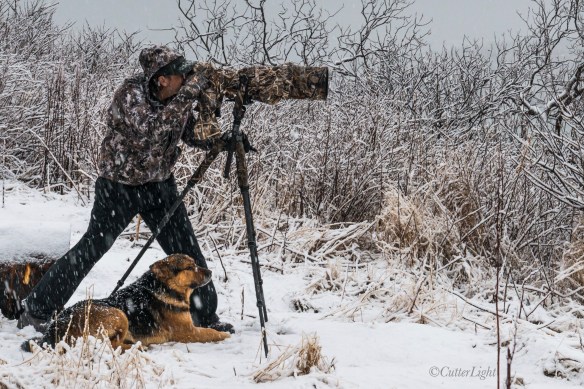
There are bird dogs and there are bird dogs. Buster had the kind of toughness about him common to village dogs. Weather? What weather?

That’s how it started. A friend comes along and keeps you company for hours on end like that, both of us heading home hungry… You can’t not fix your buddy something to eat.

At first I’d dig around in the fridge for whatever leftovers might be on hand – a piece of salmon, gristly scraps of moose, or bones I’d left a little extra meat on for him. But before long dog biscuits and a quality dog food became part of our regular grocery orders. And of course a good friend like Buster needed a proper bowl. And a brush.

Between the good food and the regular brushings, which he loved, our already handsome friend was soon sporting a beautiful coat. His visits to our house became more regular and lasted longer until at some point we realized he was showing up almost without fail for breakfast each morning.  In fact, quite often he was spending the entire night sleeping below our bedroom window.

We, who had vowed “No dogs, no pets,” were being adopted.

Buster, the quintessential outdoors dog, never did get used to coming into our home. Although he was always welcome, he usually would only stay for awhile, and only as long as he could sit or lie next to one of us. Indoors seemed to be too warm for him. So he was content to lie outside our windows, all the better if his vantage point provided him with a view of one of us working at a desk or cooking in the kitchen. As far as I could tell, he’d never been trained, not even to sit. But he was one of the most well-mannered dogs we’ve ever known. Every so often he might give out a single, throaty bark – Buster’s way of mentioning that he might be ready for a snack.

And so it went for two years. The three of us hiked together up to Clarks River and along other trails for miles in all weather. He accompanied me out onto the ice that first year when the lake froze hard and ducks gathered in a small area of remaining open water. There were no trappers in the village that year, and so along with lots of birds, many of which were new to us, a number of foxes regularly showed up in the village and a family of river otters patrolled the lake and river. Every other dog in the village went dog-bonkers anytime one of these wild mammals was present.

That first winter when the lake froze, the wildlife viewing was enthralling. I spent hours on the frozen lake almost every day while it lasted. But on this morning out on the ice, I was collecting landscape pictures. Buster had his eye on a group of ducks milling around in open water.

Not Buster. In the spirit of full disclosure, the first time we encountered otters together, he did run off toward them… And promptly found himself sliding off a ledge of thick ice along the bone-chilling Chignik River, his eyes wide with panic as he looked to me for help and tried to scramble out. I guided him downriver to a break in the ice, asked him if he’d learned anything about ice while he shook himself off, and then we went home where I dried him with a warm towel and we both got something to eat. We saw otters after that, but he never again chased after them – at least not in my presence.

And the foxes? He was curled up in the snow outside our window one evening when a certain fox came by. Buster barely looked up. Instead, the fox started barking at him!

Bears and wolves were a different story though, and we came to appreciate Buster’s selective vigilance. When he let loose with his deep-throated bark, you could bet one of these two predators was around – and that Buster was doing his duty to keep them moving along.
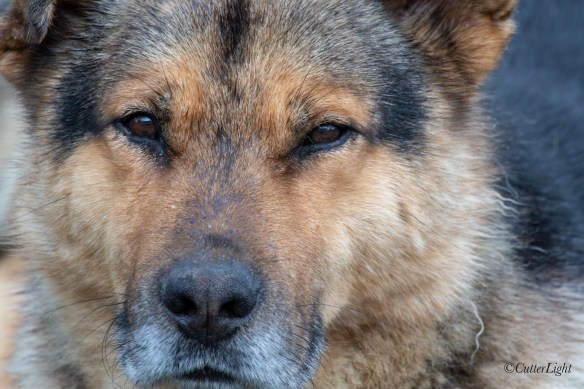
Toward the end, when the mere act of standing was painful, a wolf – probably a pack scout – had been showing up in the village fairly regularly. An enduring memory is of Buster one evening pulling himself to his feet, propping himself against our house, and letting loose a barrage of fierce barking. The courageous old General, still on duty.

It was those slim hips that ultimately were his demise. When we returned to The Lake late this last summer, it was clear he was beginning to have mobility difficulties. He still had that optimistic smile in his eyes and an expression of sheer joy upon seeing us, and he was still getting around pretty well, but he was beginning to walk sideways. We knew our friend might not see another spring.

Through fall, Buster continued to be a constant companion. But as winter settled in, I had to begin discouraging him from trying to accompany me out into the field. It hurt us both, made worse by the fact that I’m sure Buster didn’t understand why his pal wouldn’t let him come along anymore.

He was losing control of his hind legs. He began falling down. Eventually he stopped trying to follow.

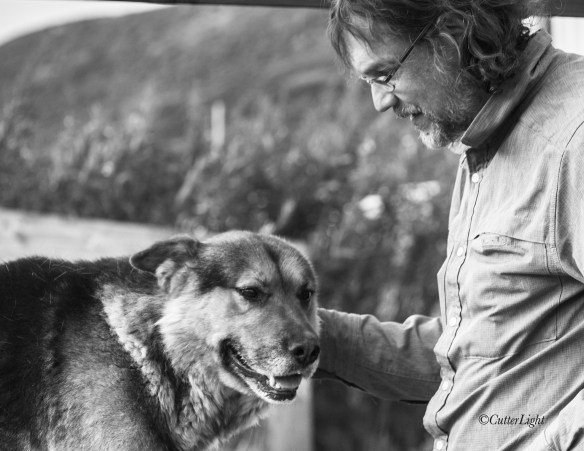
I am indebted to Barbra for taking pictures of me and my friend. A Tufted Duck – an uncommon to rare visitor from Asia to parts of Alaska – had mixed itself in with a few scaup, and I was spending a lot of time at The Bend on the Chignik River attempting to get photos. That’s where Barbra found us when she finished teaching on this snowy January day one year. 

But he still came by our house nearly every day. One especially nasty winter night Buster showed up at our front door quite ill. His nose was dry and hot to the touch, his eyes watery and listless. Fearing the worst, we had him come inside. I rolled out a sleeping bag on the kitchen floor so I could stay with him while he slept on the cool linoleum. The next morning he was greatly improved… for the time being.

Buster’s final days were difficult. In his last weeks, a small dog became his constant companion, watching over Buster as he hobbled around. Little Rex would chase magpies and other dogs away from Buster’s food dish, reach out with his paw to touch Buster and then curl up and sleep next to the old man. For Buster’s part, he showed enormous courage. He was in pain, and I have to imagine beyond frustration with his inability to get around as he once had. But there was still the brightness and optimism in his eyes that had drawn us to him the first time we met.

All the time we had known Buster, there was nothing he enjoyed more than a big bowl of food or a couple of biscuits. He was, after all, a dog, though perhaps much like many of us, food presented by a friend or loved one carries with it the additional pleasure of conveying a sense of being appreciated, loved and cared for. But toward the end, he wouldn’t begin eating until we petted him and talked to him for awhile.

He wasn’t our dog.

We had to keep reminding ourselves of that, and that decisions about how his last days should be handled had to be left to his owners. What we could do was help Buster be as comfortable and as loved as possible any time he came to our house, which he was still somehow managing to do almost every day.

What a wonderful friend. I don’t think we’ve ever known a being with a greater heart or a more optimistic outlook toward life.

He wasn’t our dog. He was our friend. And he is missed.