Urban Birding: First Flight – Isabelline Wheatear Chicks Feeding and Fledging

Isabelline wheatear juv 1st flight n

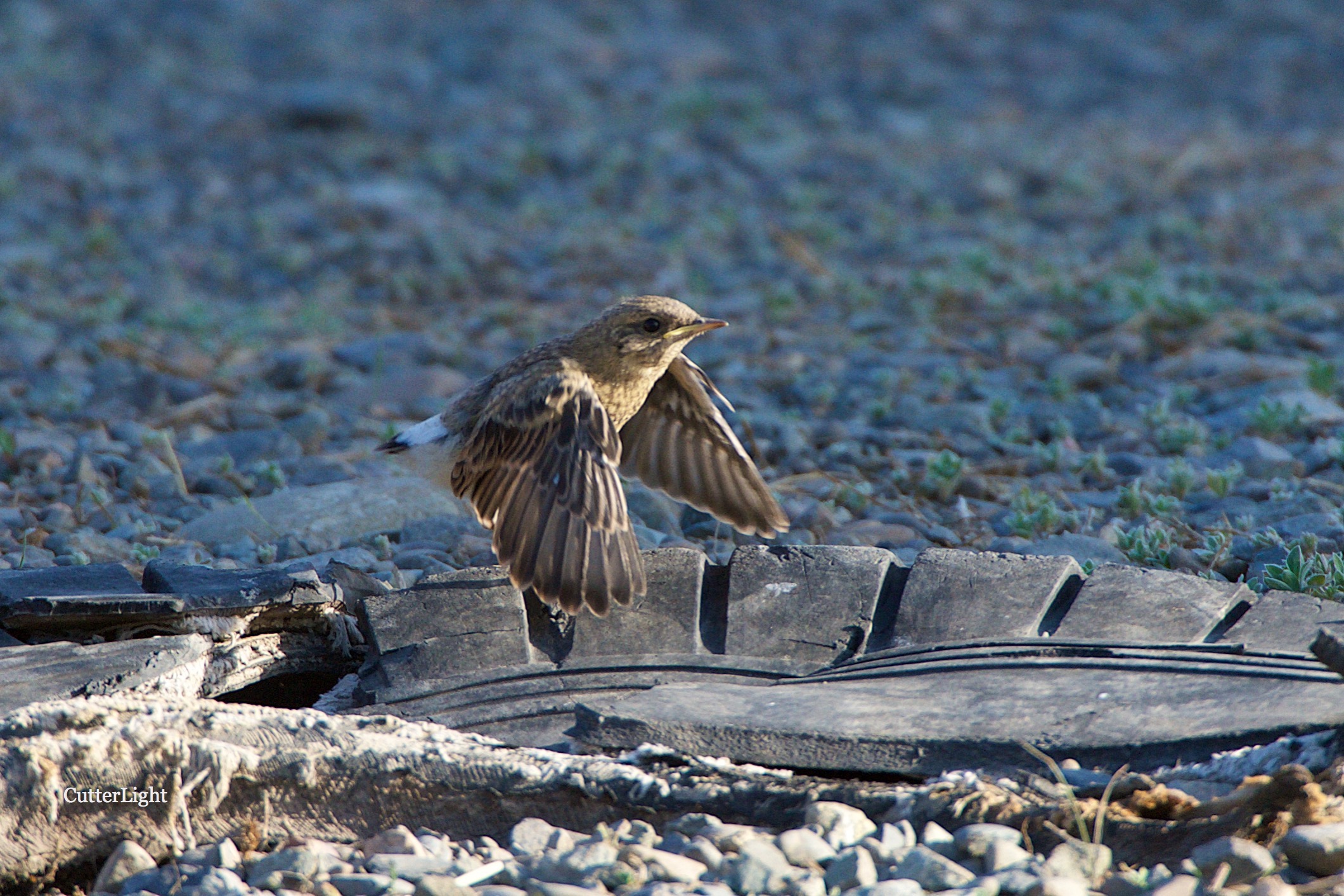
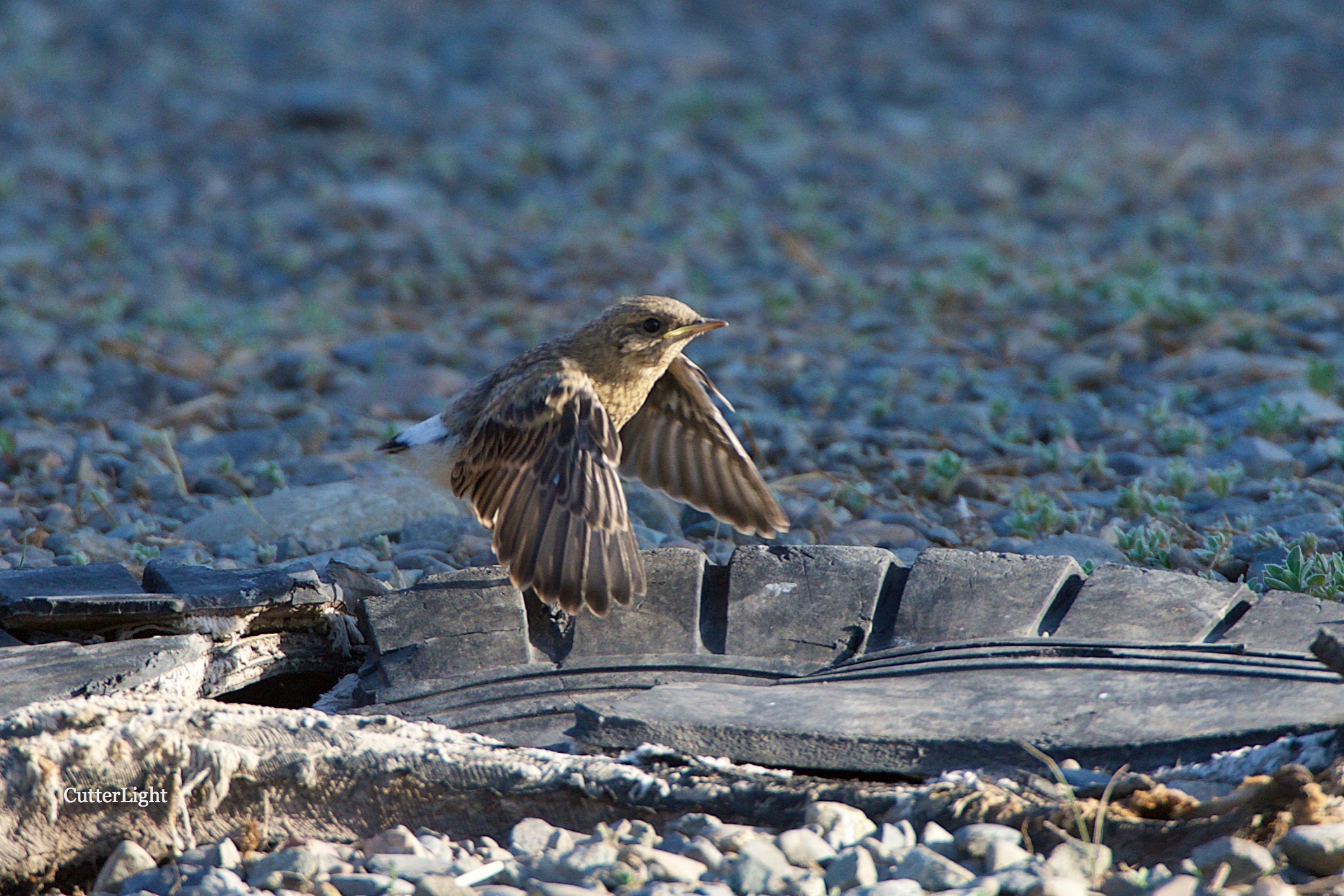
Tired of waiting for mom, this isabelline wheatear chick (Oenanthe isabellina) faced the morning sun and achieved its first airborne moments. (11 additional photos.)

Many species of animals are highly adaptable – if given half a chance. Until recently, this construction site in Ulaanbaatar, Mongolia, was steppe grasslands. Chock full of the abandoned rodent holes isabelline wheatears seek out to make their nests, it was perfect habitat for these passerines.

Isabelline wheatear mom feed 2 juv grub 1 n

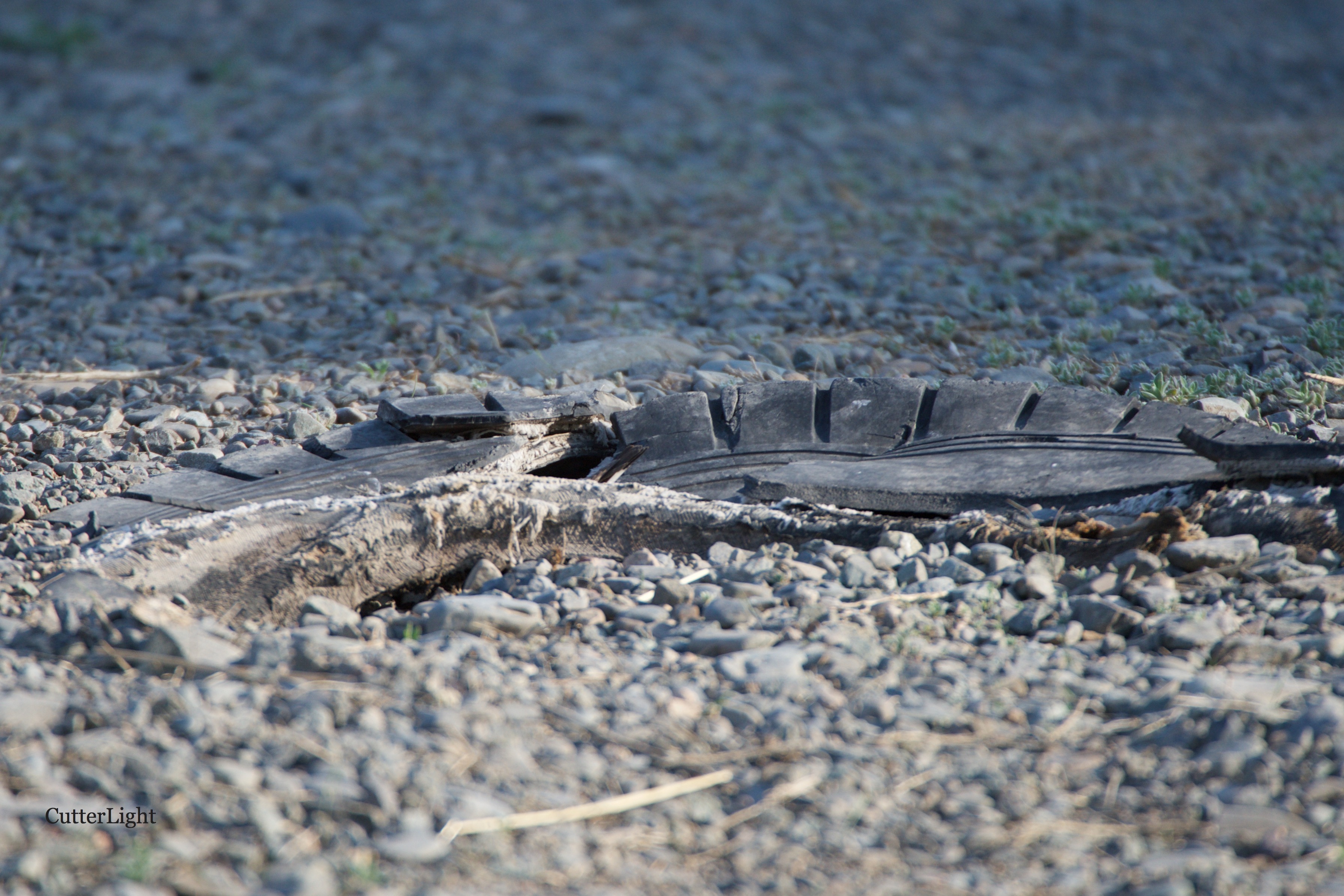
But as Mongolia’s population continues to grow, the grasslands which once seemed limitless are shrinking. This fortunate adult and her mate successfully reared a pair of chicks in a cavity beneath an old truck tire. Here, safe from the stray dogs that plague this city, and unnoticed in a lot that has yet to be developed, the chicks’ parents have been able to forage the steady supply of grubs and insects their offspring thrive on.

Isabelline wheatear feeding grub 2 n

Unfortunately, these will likely be the last wheatears to brood on this lot. On our morning run today, we noticed that the bulldozers have arrived. Yet another apartment building and adjoining parking lot will replace the last remnants of suitable habitat.
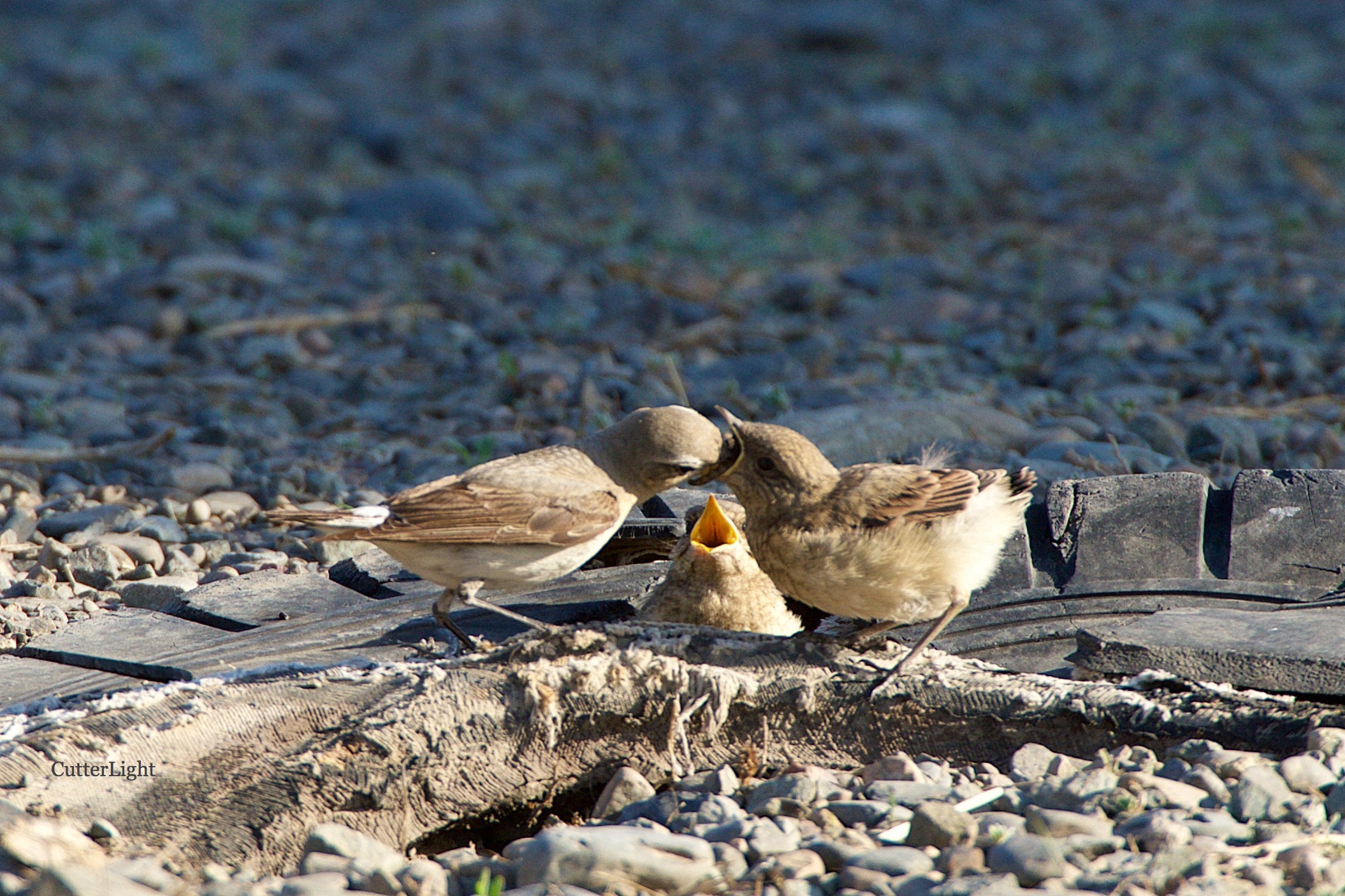
Isabelline wheater mom n juv feeding n

We had been observing the adult wheatears in this area for some time. But only on this, the final day the birds were here, did we realize a nest and chicks were in such close proximity. We shot these photos through a locked gate, at a far enough distance that it was a challenge to get clear captures.

At one point we observed an interesting behavior. The chicks were pecking at a piece of plastic. The mother, observing this and perhaps understanding, somehow, that ingesting the plastic could be fatal to her offspring, picked up the rubbish and flew off several meters from the nest before dropping it and returning.
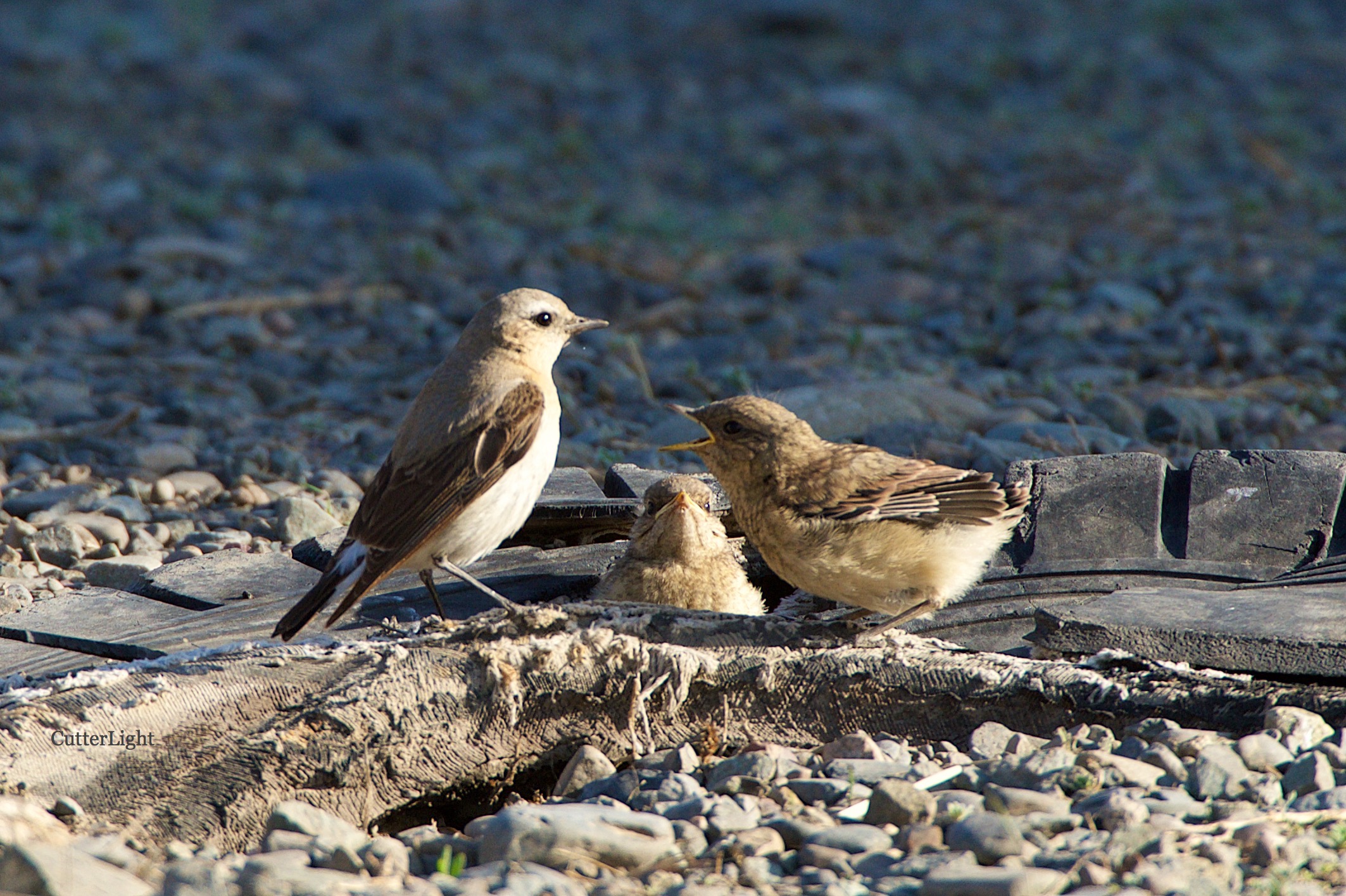
Isabelline wheater feeding looking for more 3 n

There seemed to be no sating the young birds’ appetites…Isabelline wheatear mom feeding chicks 1 nThe adults returned again and again…
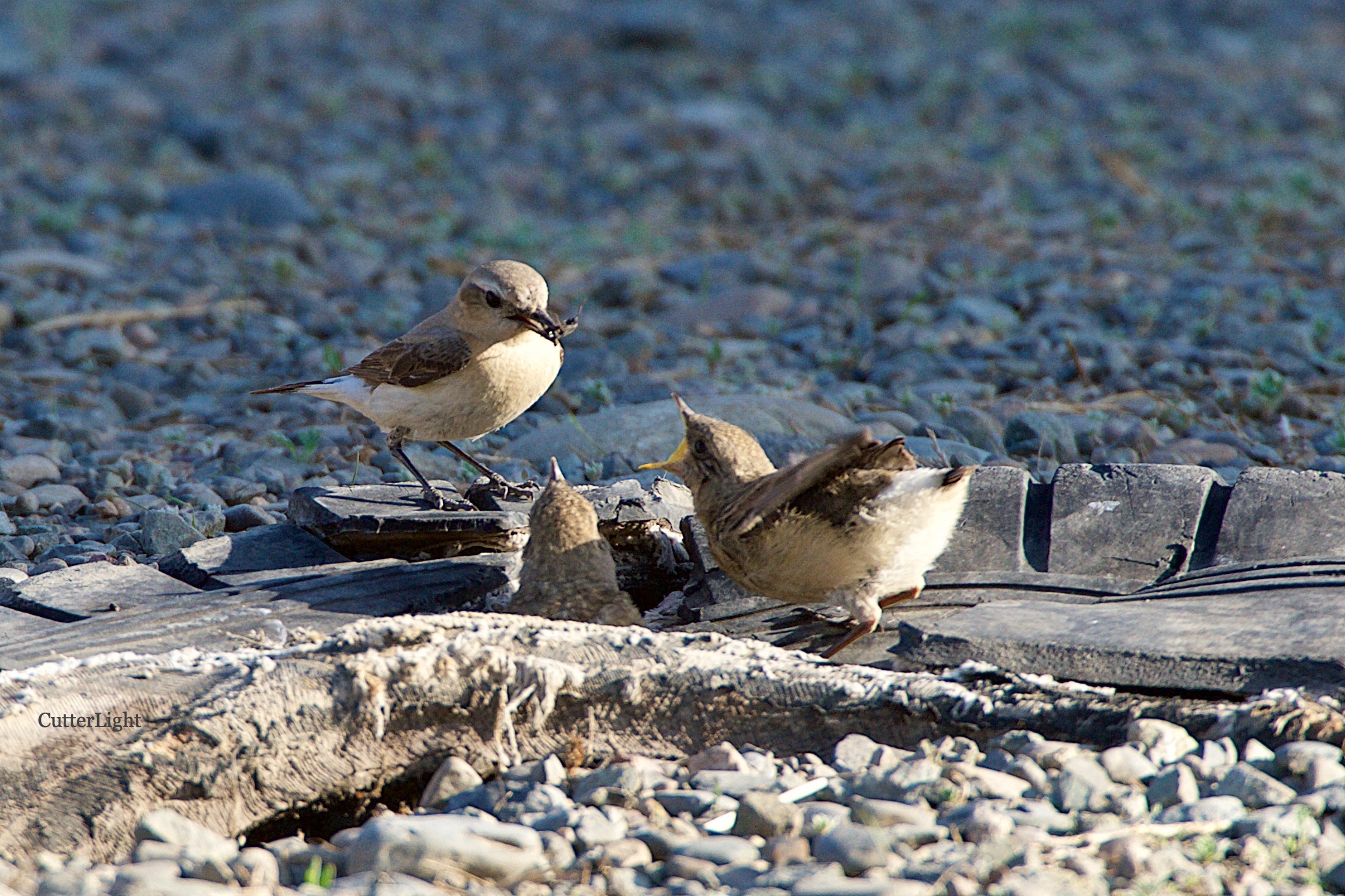
Isabelline wheater chicks waiting for mom n

With much anticipation…

Isabelline wheatear chick stretching wings n

Their stubby wings and chubby bodies hardly seemed to bode well for flight. Was it out of boredom or hunger – or something even more primal – that prompted one of the birds to begin vigorously stretching its wings?
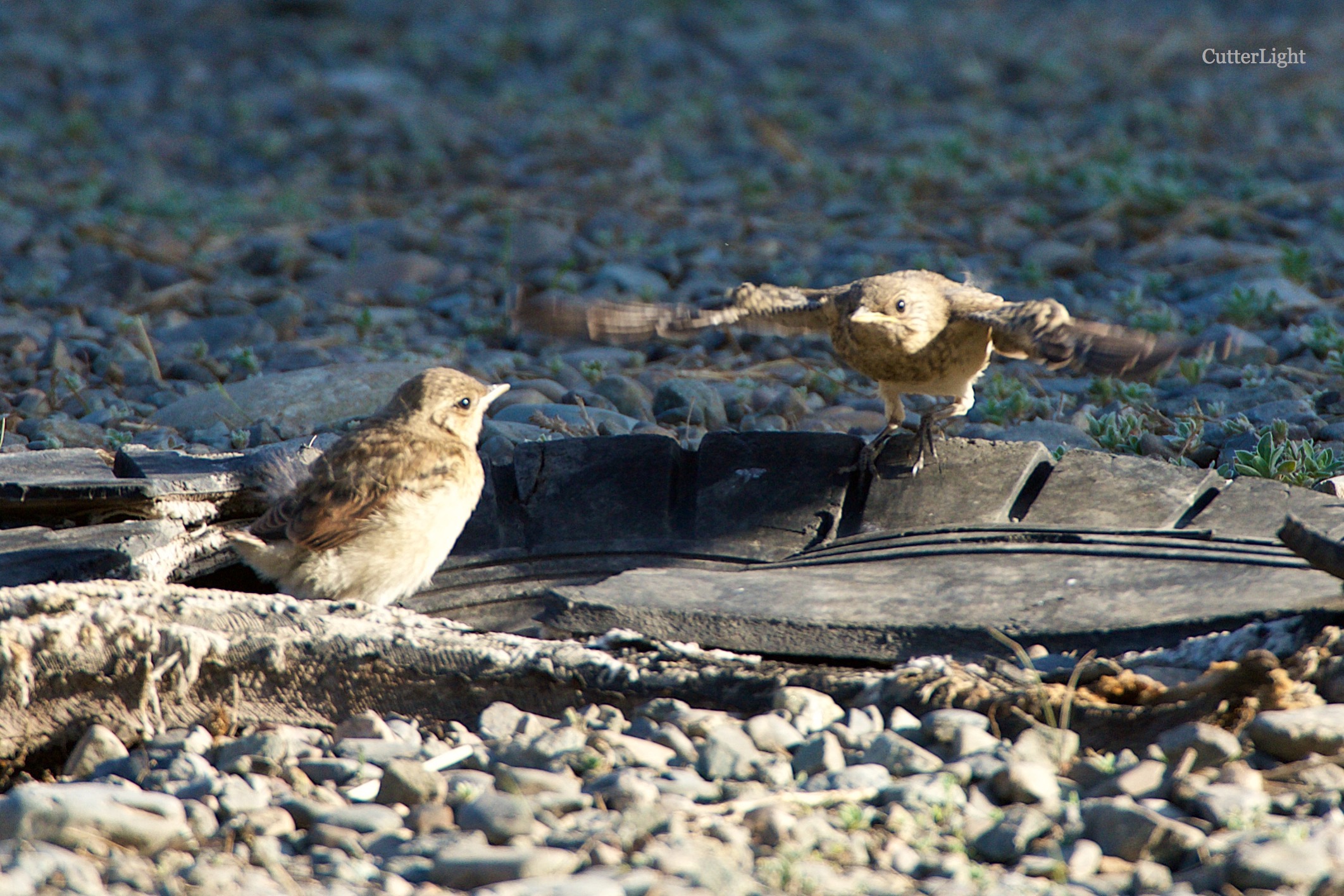
isabelline wheaters flight attempt n

Suddenly it occurred to us. These little guys are going to fledge, right now!
Isabelline wheatear juv 1st flight n

And just like that…Isabelline wheater mom last look around nest n

The female returned for a final look at her empty nest, then caught up with the chicks. They hid behind a a pile of rusted junk, and that was the last we saw of them.
Isabelline wheatear empty nest n

Who would suspect that a a nest of birds was once here, hidden safe and well-fed beneath this rotting tire?

Isabelline wheateater juv on ledge n

A while later, we encountered this juvenile perched on the ledge of an apartment near ours. Where will they go next year? It’s a question with no easy answer in a world that continues to fill up with people.

Long-tailed Rosefinch: Tuul River, Ulaanbaatar

Pallas Rosefinch male n

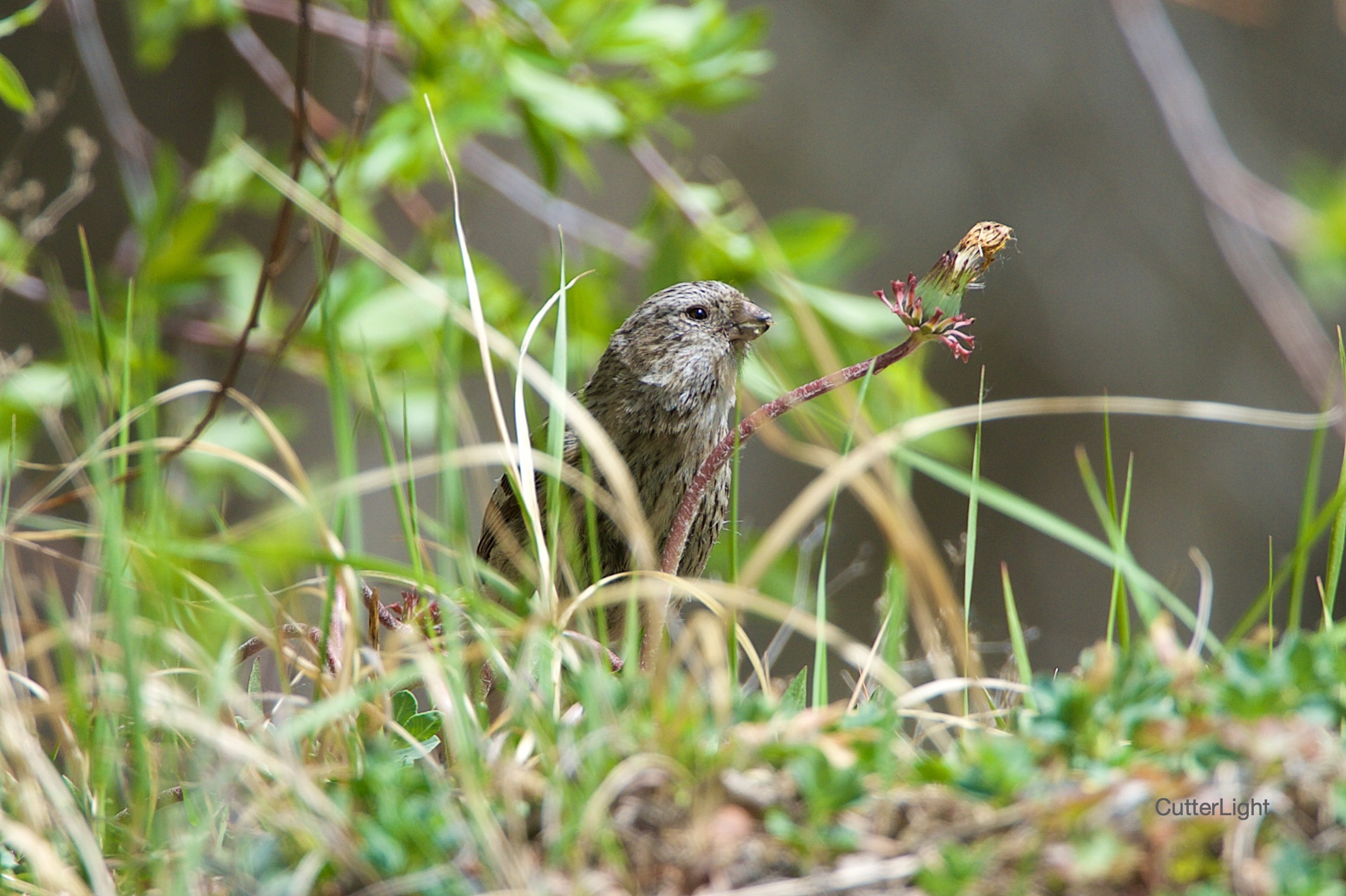
After a long winter, this striking male long-tailed rosefinch (Carpodacus sibiricus) was fattening up on fresh willow seeds near the Tuul River. 

pallas rosefinch female n

And here’s the female. Although residents of Mongolia, these birds were likely passing through Ulaanbaatar on their way to higher elevations to the north. Rosefinches are mainly seed eaters. There are several species throughout the Northern Hemisphere. 

Penduline Tits: Nest-Builders Extraordinaire

Penduline tit gathering nesting material

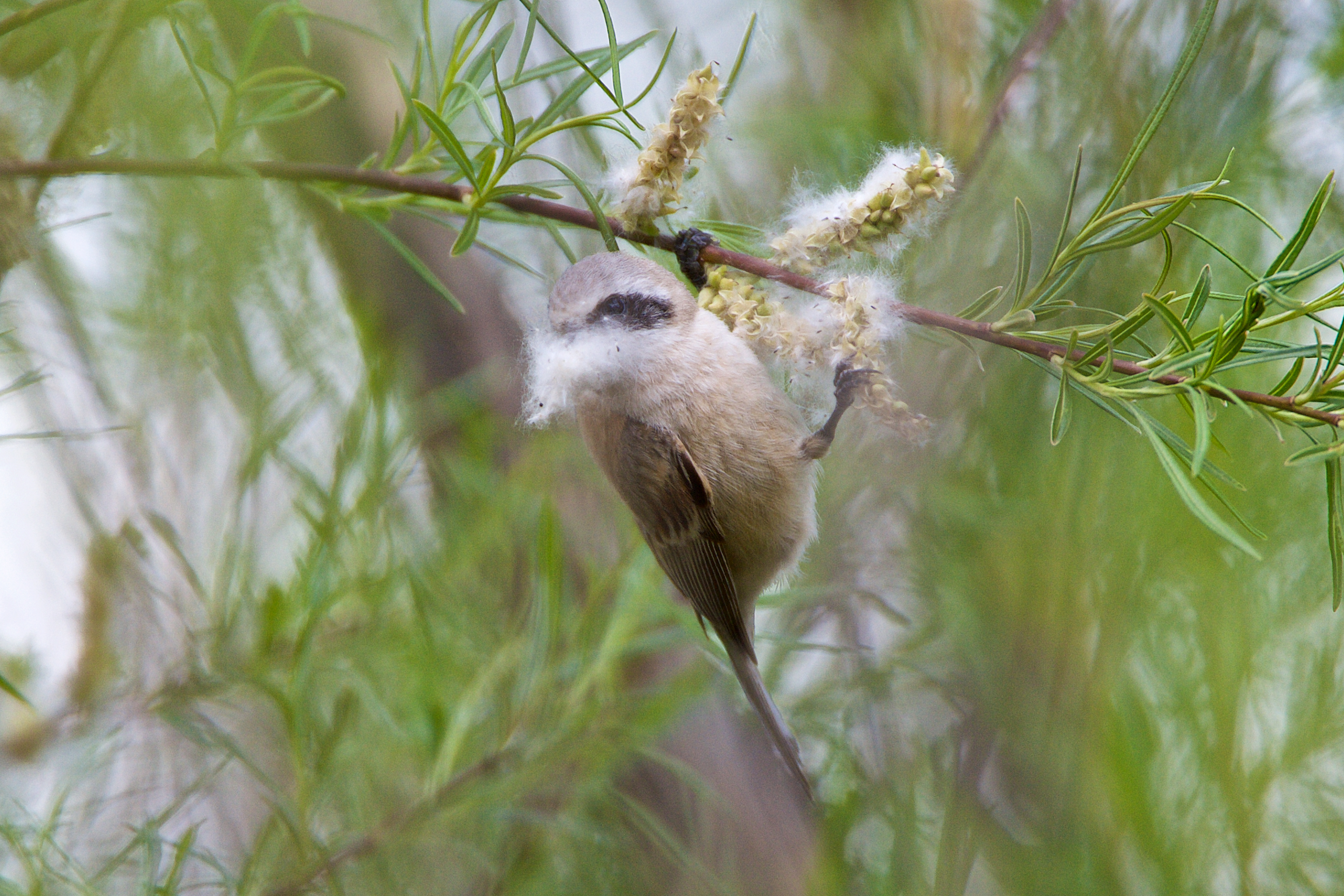
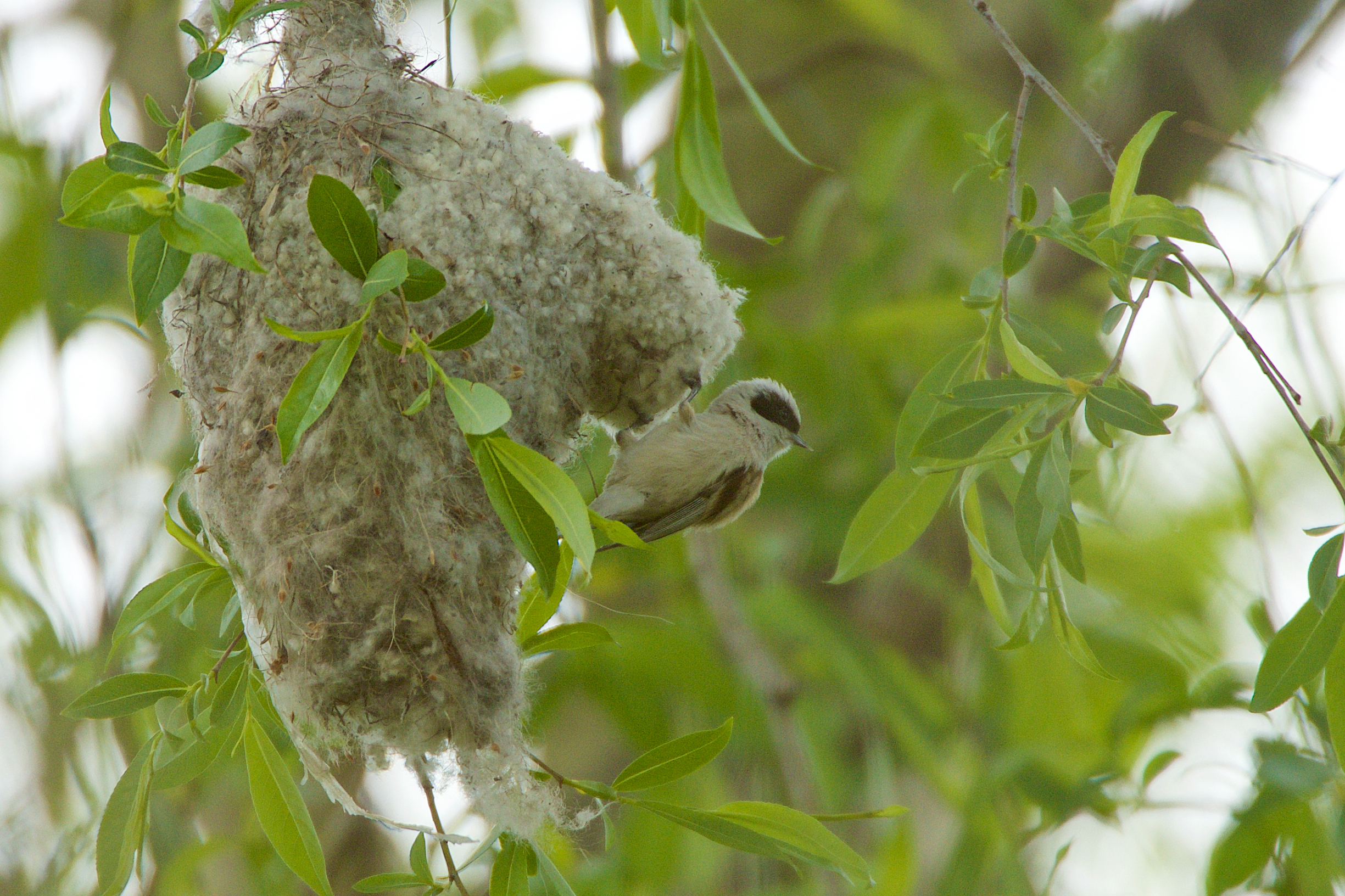
His face stuffed with down from willow catkins, this male white-crowned penduline tit (Remix coronatus) was hard at work finishing one the bird world’s most unique nests. (Eight more photos)

During this past winter, we found a couple of mitten-shaped nests suspended from bare branches near the Tuul River. The birds were long gone, but I looked up the nest: Penduline tits, a new species for us and one we hoped to see when they returned in springtime. So, on a recent evening as I was walking along the river, I was listening for something I hadn’t heard before. With the willows and poplars now leafing out, I figured song was my best bet at locating nesting pendulines.

Sure enough, not long into my walk I heard something I hadn’t heard before – a twittering and song that sounded like it came from a small passerine. I followed the voice till I thought I was as close as I dare get without spooking whatever was singing, quietly set up my camera and tripod, froze, listened, tried to part the dense willow tangles with my eyes, caught movement and hoped the bird would present itself where I could get a decent photo.

Above is my first photo of a penduline tit.

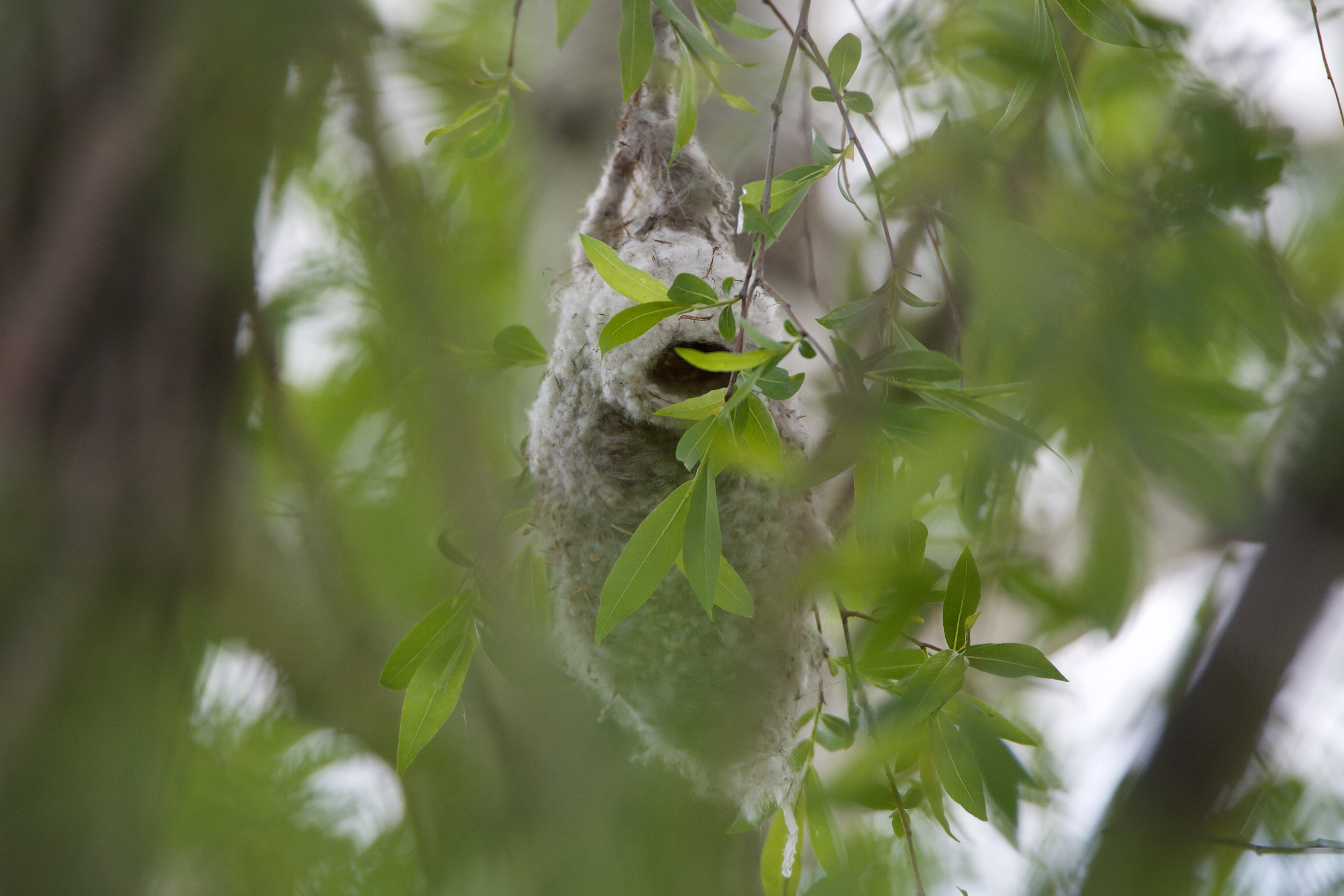
Penduline tit nest hidden plain sight

Hidden in plain view…

I knew that finding the bird was no guarantee I’d find his nest, but using clues from the nests we’d stumbled upon over the winter, I located the same sort of tree in the same sort of setting, looked carefully among the boughs about 17 feet up, and there it was, hidden in plain view. Penduline tits do not reuse their nests, but they do seek out the same habitat year after year.

There was cloud cover off and on, it was getting late in the day, and the light was all wrong to shoot the nest from the front, so I moved to the side. I was concerned about spooking him off his nest (the males do most of the building), so I kept a distance and tucked in behind some small willows.

Penduline tit nest profile detail

Cottony-soft and virtually impervious to rain and predators, these tough, tightly-woven nests were used as children’s slippers in Europe in the past. The Masai of Africa used those of a related species as purses. This one was swaying and rocking in the fresh spring breezes.

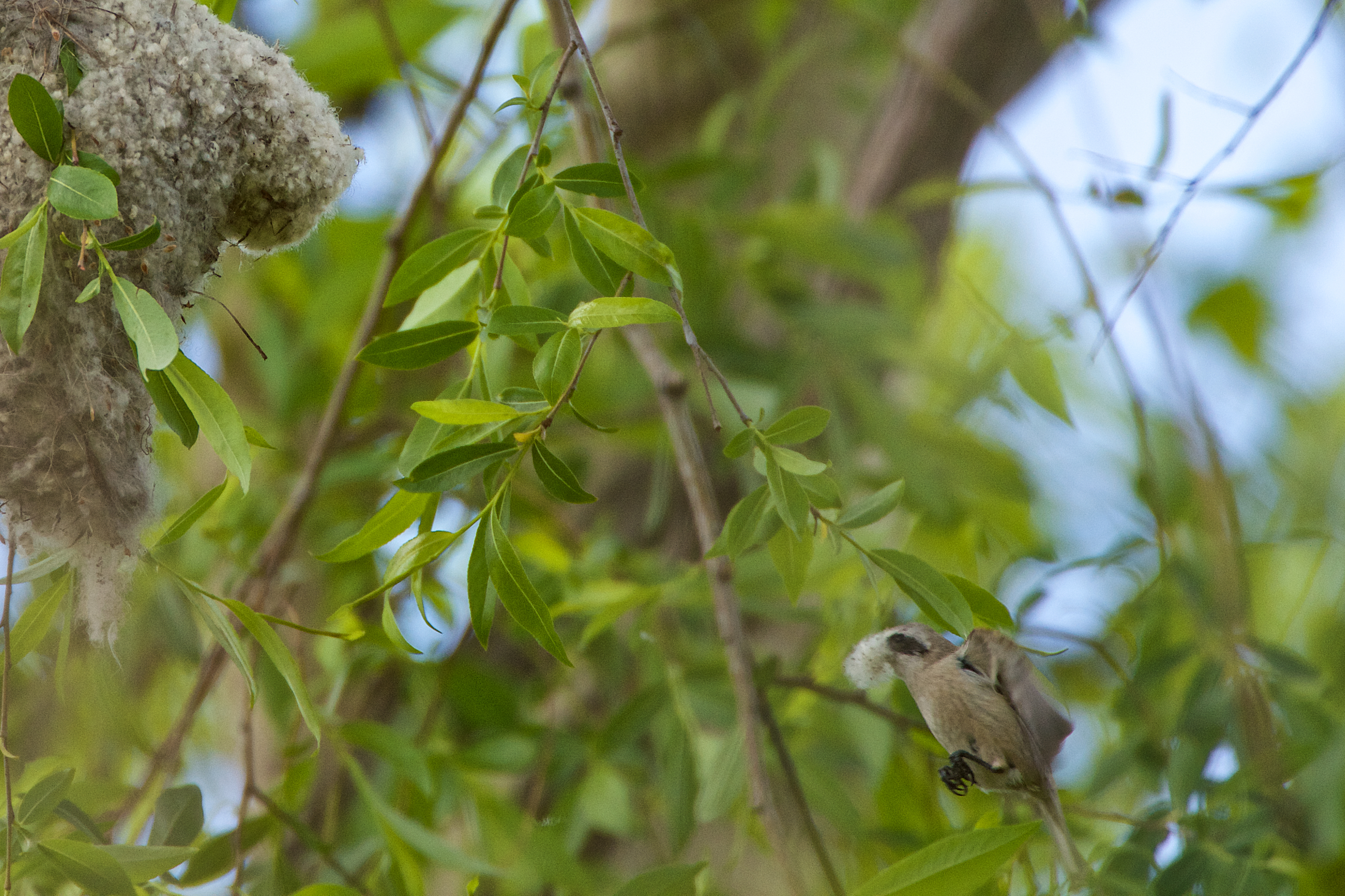
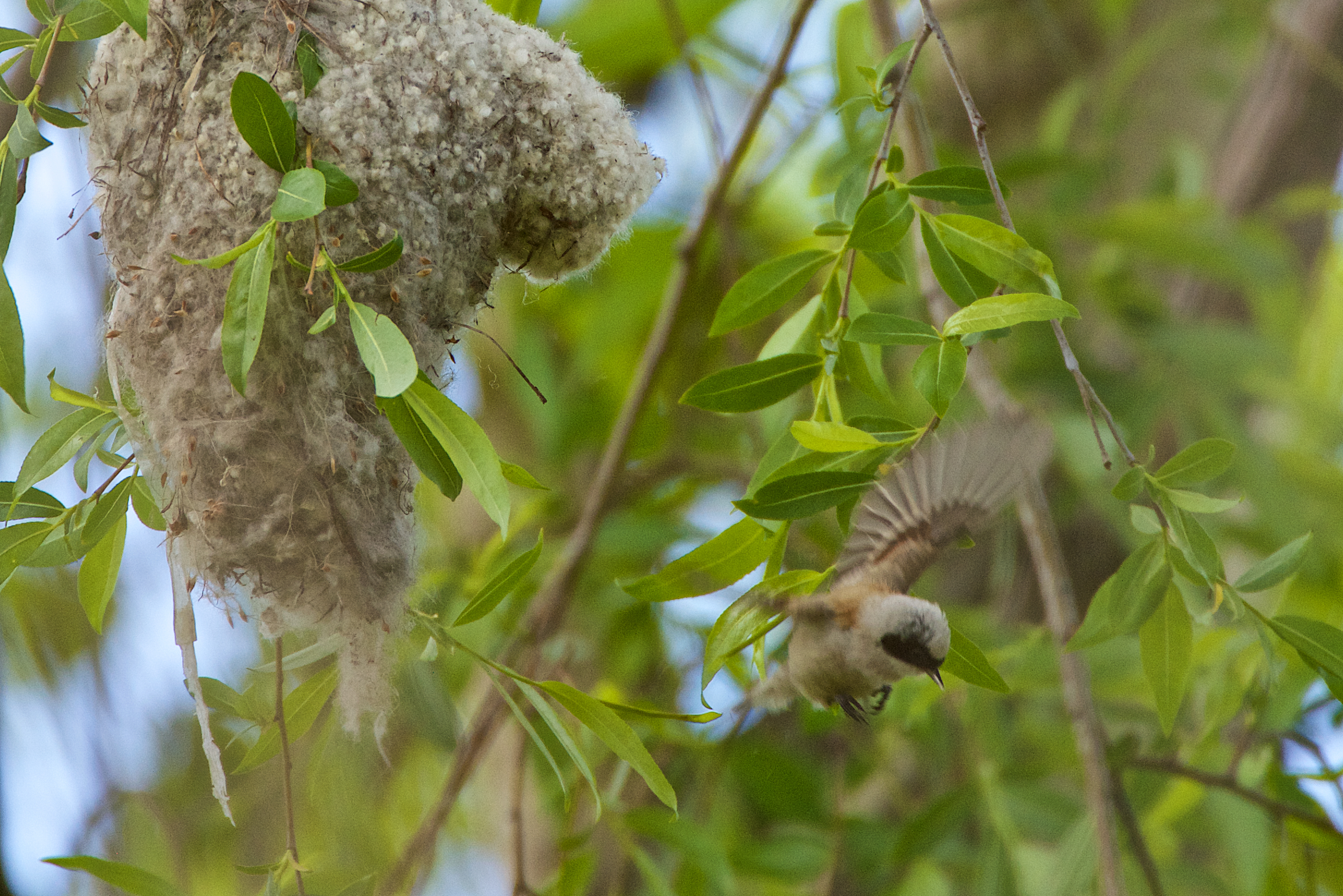
Penduline tit flying to nest w material

Intervals of several minutes passed between the bird’s visit to his nest. I waited still and quiet, my ears straining for his voice among the songs and sounds of rose finches, azure tits, magpies, sparrows and other birds in the riverine forest. I was able to spend a fair amount of time with this little fellow. Above, he is heading into his nest with more downy material.

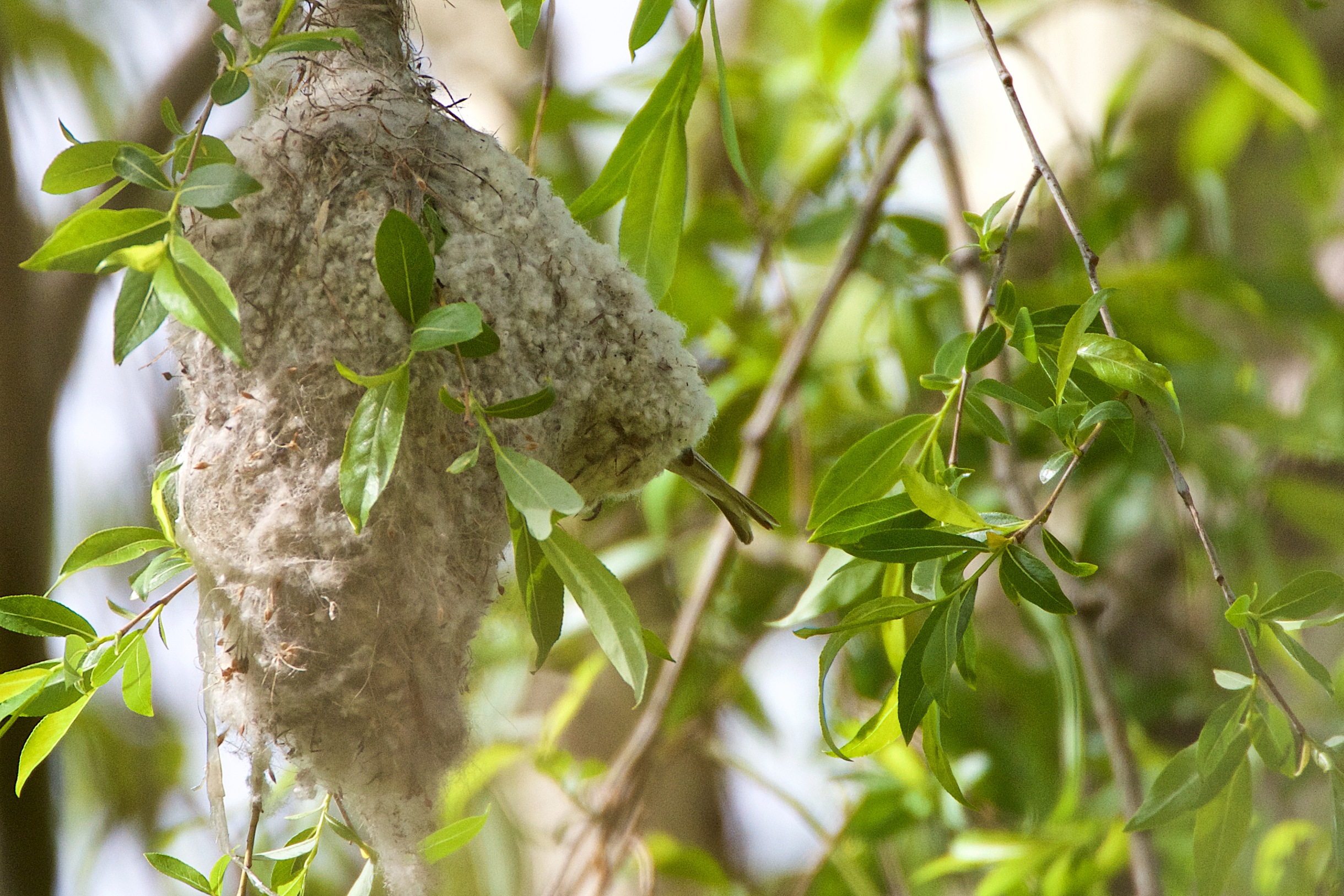
Pendulin tit entering nest

In this frame I caught him just as he was disappearing into his nest. I read that there is a flap, which the bird must open, inside the nest.

Pendulin tit tail feathers

A slight pause just before completely entering… 

Penduline tit taking a look fm nest

A quick look over his shoulder…

Penduline tit taking off fm nest

   …and off again for more material.

Pendulin tit working into evening

He was still hard at work when it was time for me to call it an evening and meet up with Barbra…

Click these links to read more about our birding and hiking adventures near Ulaanbaatar, Mongolia

Urban Birding in the World’s Coldest Capital City: A Winter Walk along Ulaanbaatar’s Tuul River

Crows Ice Fishing for Caddis Larva: Tuul River, Mongolia

Connected by Waxwings

Connected by Waxwings

Bohemian Waxwing feathers close n

Like drops of bright red sealing wax, pigment is enclosed in the translucent sheathing of extended secondary feather shafts, giving waxwings their name.

In the midst of the 11-minute walk from our apartment to our school in Ulaanbaatar earlier this week we heard a familiar “wheezing” sound from nearby treetops. The friend we were walking with must’ve thought we were crazy as I abruptly spun around and began crossing the road toward the origin of the sound. But Barbra knew what it was about. “Waxwings!” I exclaimed as I approached the tree where they were perched. Barbra confirmed the sighting. “Yep! Look at their crowns.”

Bohemian waxwing april 2015 n

For the past few days, small flocks of Bohemian waxwings have been putting smiles on our faces. On their way to nesting grounds in the conifer forests of Siberia, these flocks don’t hang around long. Until recently the southern edge of Ulaanbaatar near the Tuul River was covered in berry bushes, poplars and willows. Each year, less and less of this habitat remains as Ulaanbaatar’s human population grows…

bohemian waxwings in habitat n

…but here and there a small patch of what it used to be remains. Every little bit of this habitat is increasingly critical. Even a few berry bushes edging apartment buildings helps.

If you’ve never seen waxwings in good light, I’m not sure I can adequately describe them. Their primary wing feathers are streaked with pure white and edged in yellow the color of daffodils in sunlight. The just-dipped-in-paint sheen on these feathers is reminiscent of crayon gone over with watercolor paint. But it’s the candy apple tips of their secondary wing feathers that give waxwings their name. The red is not on feathers. Rather, it’s opalescent pigment encased in modified, translucent feather shafts.

bohemian waxwing eating red berries n

During their nesting season, waxwings often eat insects. The rest of the year, it’s berries, berries, apples, and more berries – sometimes hundreds of berries in a single day. We walk past these bushes every day and never noticed the winter-preserved berries still clinging to them. But the waxwings noticed. They need this fuel as they fly on to Siberia.

You could be almost anywhere in the Northern Hemisphere and never see a single waxwing. Ottawa, Canada; Sacramento, California; Clarion, Pennsylvania; Sapporo, Japan; – to name a few places where waxwings may or may not be. And, in the wrong light, you might pass right by them and dismiss them as robins or sparrows.

Wheezing. That’s what gives them away. If you hear birds wheezing, look closely. Get them in the right light. You won’t believe what you see.

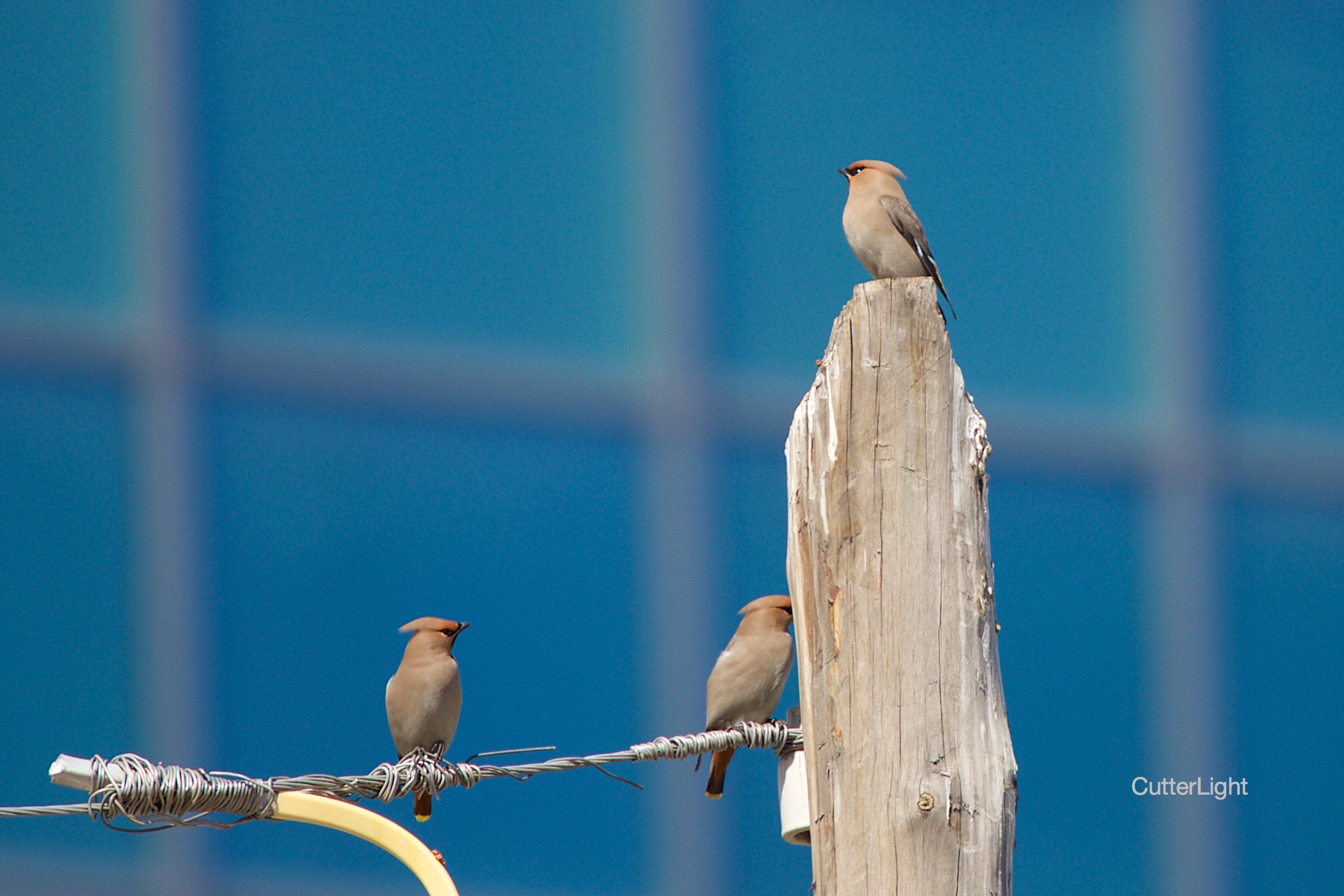
Bohemian waxwing on wire n

The only bird with a brown crest – as though the black eye paint and warrior feathers weren’t distinctive enough.

My first sighting of waxwings occurred many years ago on western Pennsylvania’s North Fork of Redbank Creek. I was fly-fishing in early spring, and as I worked my way around a bend in the stream I came upon a leafless poplar that was as lit up as a Christmas tree with waxwings. I thought I’d never seen anything as beautiful in my life. The paint-dipped tips of their feather seemed to glow in the evening light and I stood motionless in the water, mesmerized till they suddenly filled the sky.

bohemian waxwing flight n

This photo shows that the waxwing’s red wing tips are featherless extensions of wing shafts.

In mid-winter, they light up the holly bushes on the campus of the College of Charleston where I earned my master’s degree.

In Sacramento, they filled the camphor tree in our front yard – gorging on berries, wheezing their calls to each other, brightening our day.

The birds we encountered in the lower 48 were cedar waxwings, smaller relatives of bohemians. But here we are, many thousands of miles removed from Pennsylvania trout steams, holly bushes in the Deep South and a lovely, mid-town bungalow in California.

Connected by waxwings.

Bohemian waxwing pair looking north n

A pair of waxwings look north against the pale dusk in Ulaanbaatar. They still have hundreds of miles to go before reaching the conifer forests of Siberia where they’ll build their nests and bring the next generation of waxwings into the world. Not many berry bushes here anymore, and a hunk of metal overlooking a construction site makes for a cold roost.

Spring! April in the World’s Coldest Capital

Bohemian waxwing april 2015 n

Warmer temperatures are bringing flocks of new birds to Ulaanbaatar. These Bohemian Waxwings won’t stick around long; they’re on their way to nesting grounds in Siberia.

One day temperatures are in the 50’s or 60’s (in the teens, Celsius). The next day it’s below freezing with snowfall. And so it has been for the past few weeks from late March through mid-April. Welcome to Ulaanbaatar, Mongolia – officially recognized as the world’s coldest capital city. As transplants from Alaska, it feels like home – albeit a little warmer than our former north-of-the-Arctic-Circle village of Point Hope.

pussy willows catkins n

Pussy Willows – flowers of willow trees – have begun pushing out of their buds along the banks of Ulaanbaatar’s Tuul River.

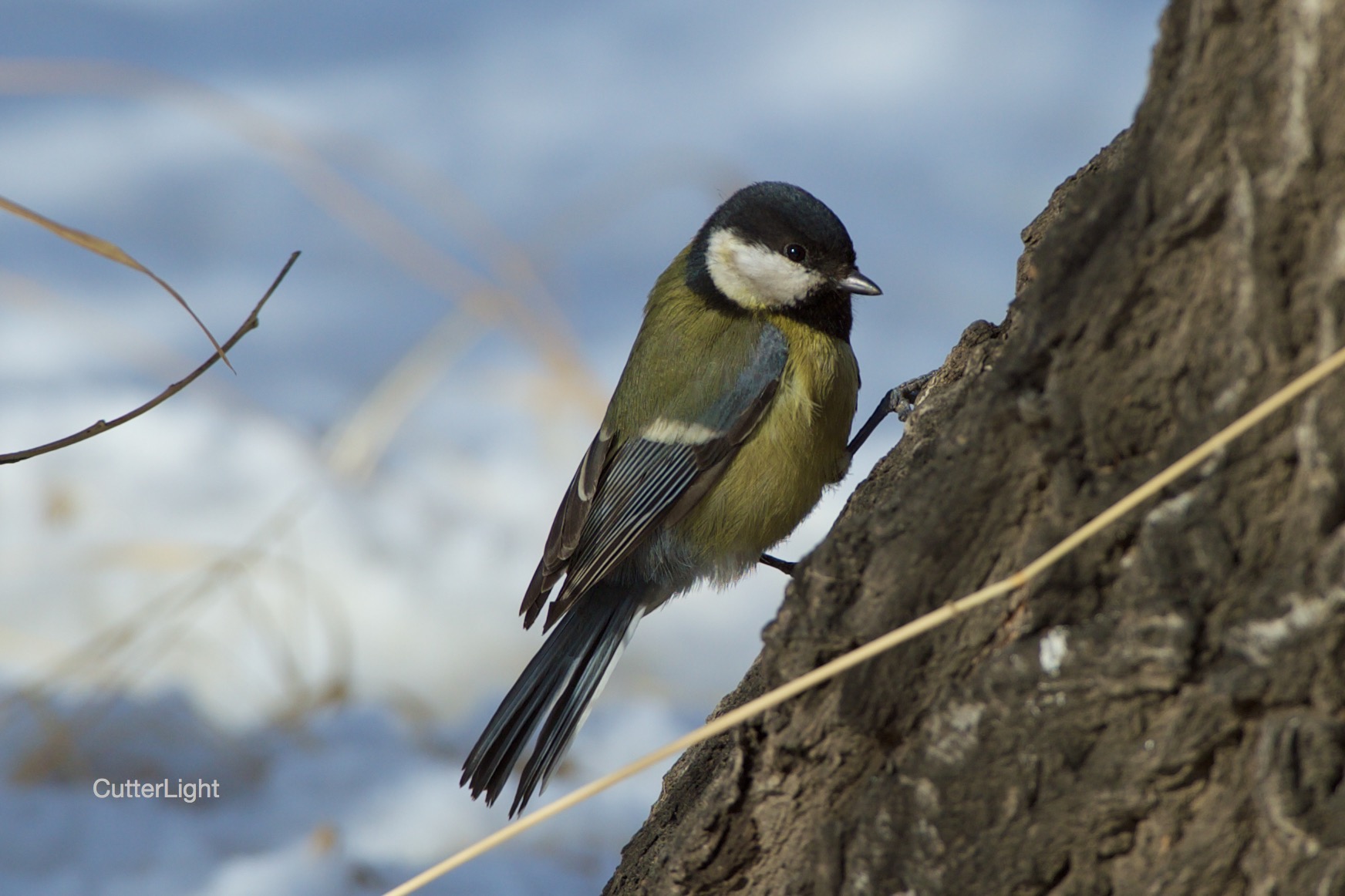
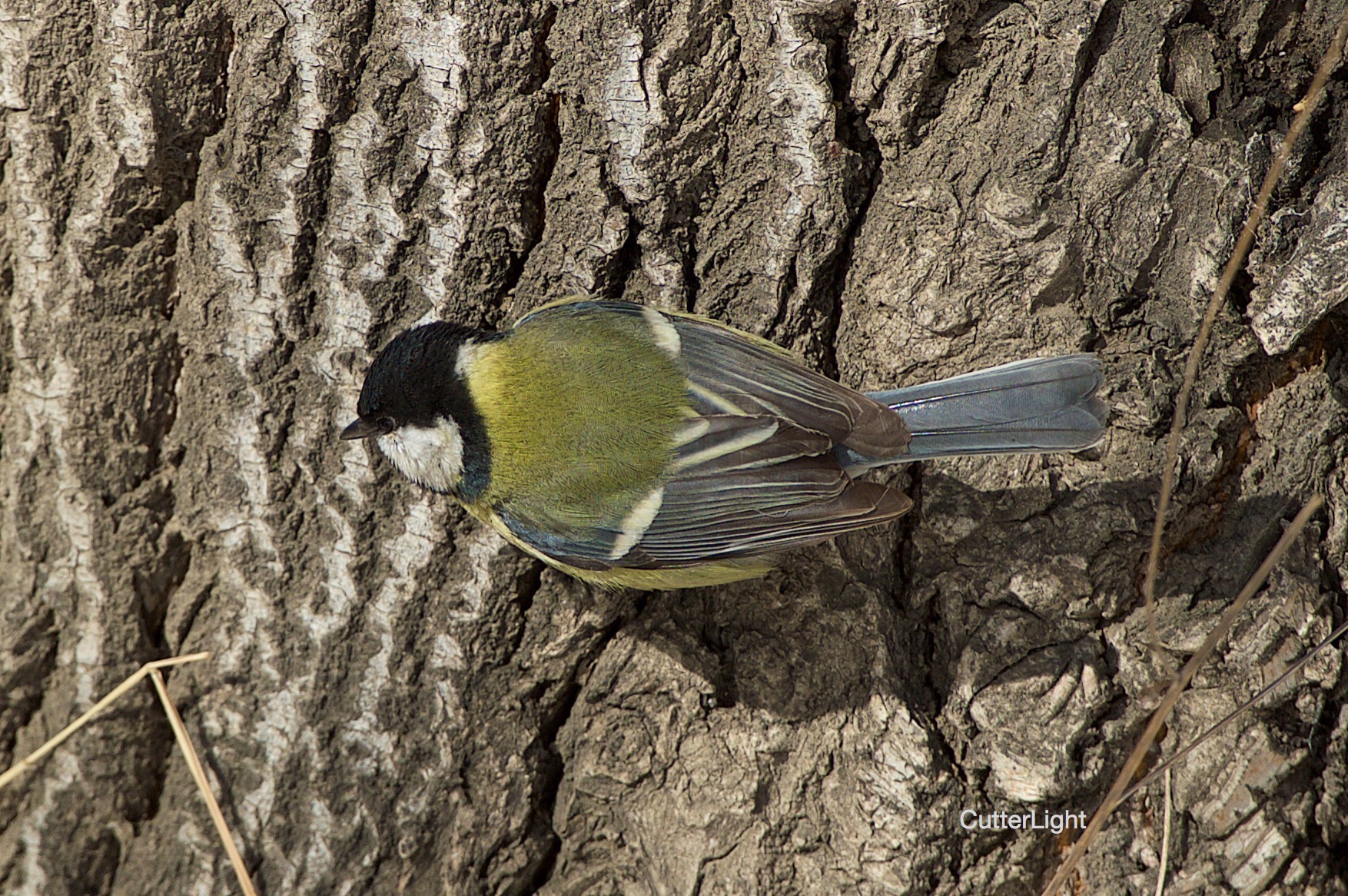
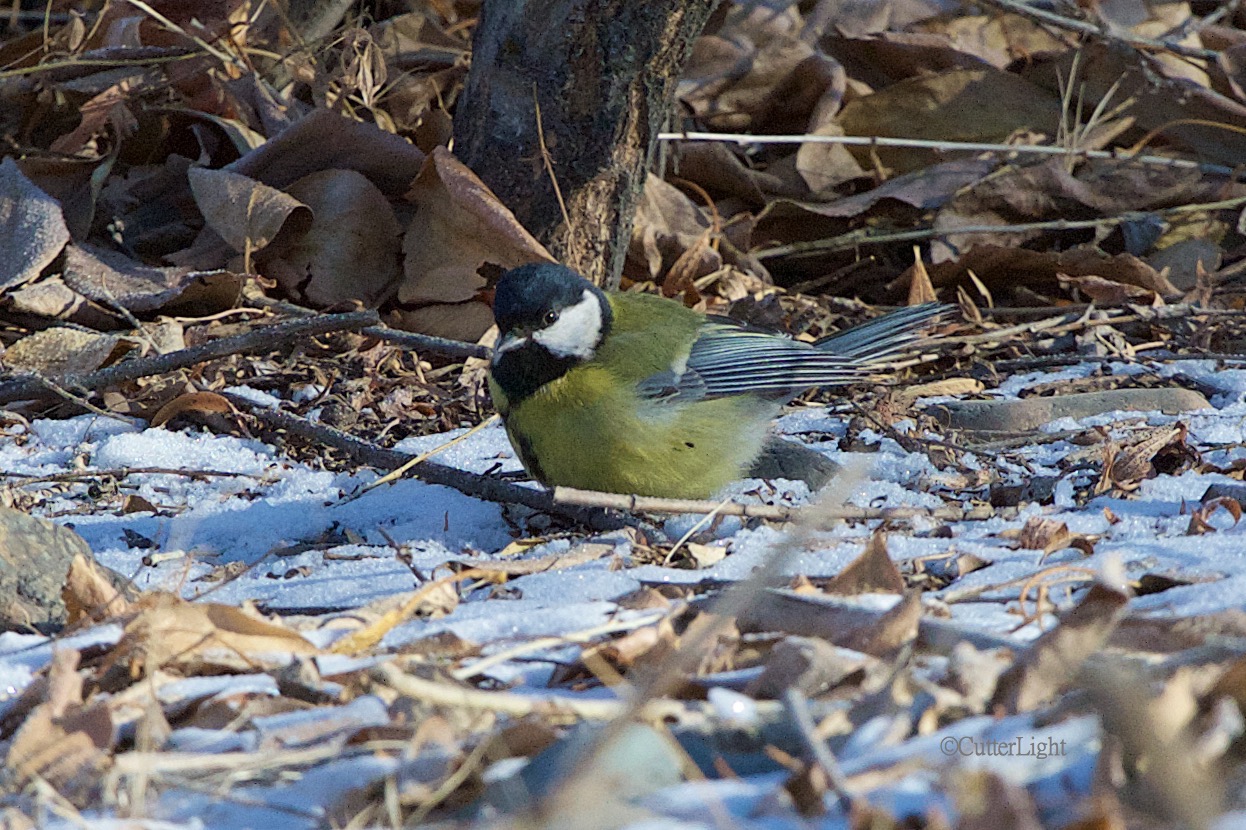
great tit profile tree n

Great tits, above and below, are common residents along the Tuul River as well as in the nearby mountain forests.

great tit back tree n

Such interesting little birds, all camouflage and color from the head to the mid-back, an abrupt line, and then symmetry from the mid-back through the tail, which, in nature, is its own form of camouflage.

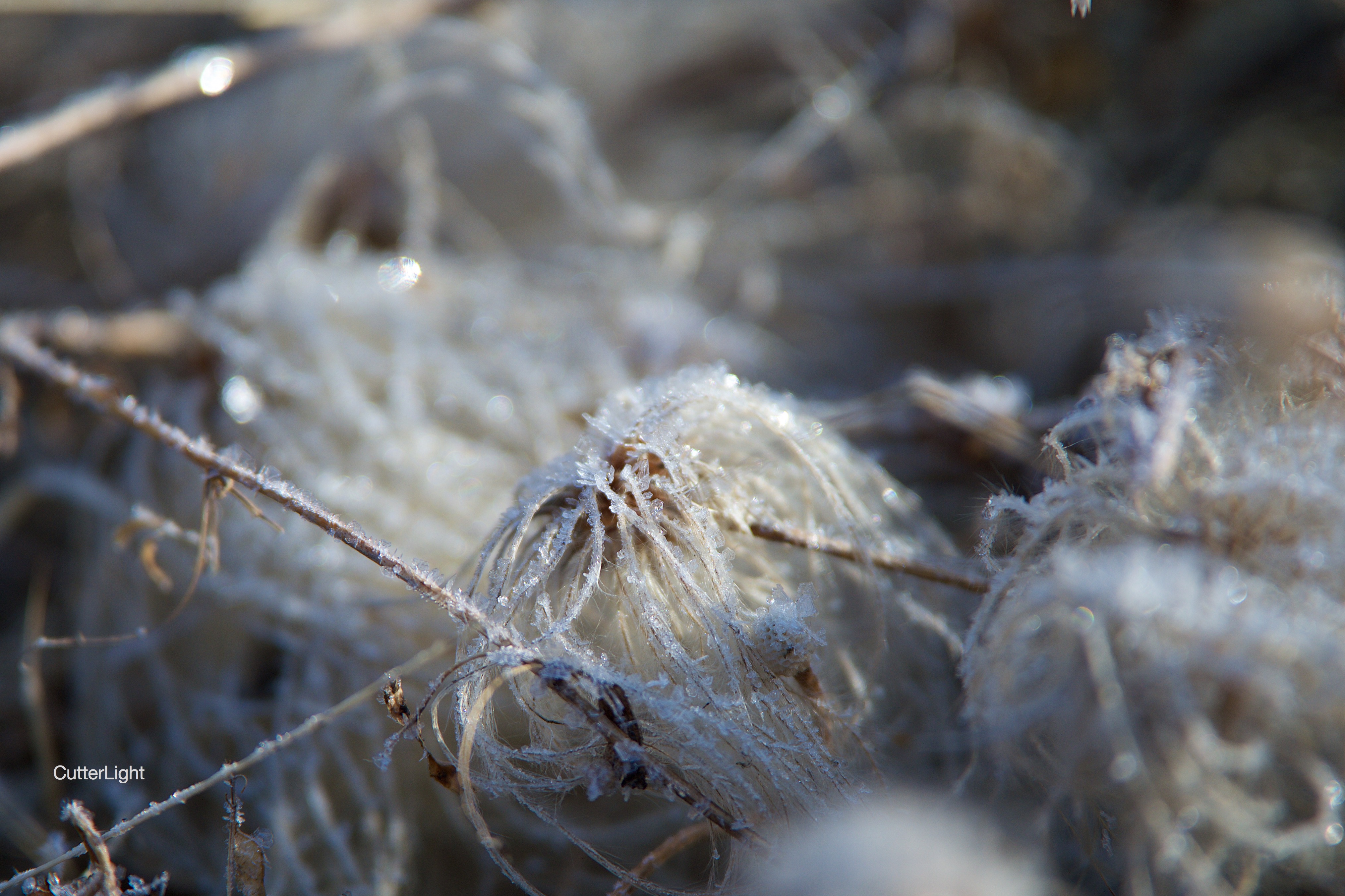
frost jellyfish weed april 2015 n

Early morning frost turned the withered remnant of last fall’s flowers into frozen jellyfish.

jellyfish weed april 2015 n

By late morning, the sun had melted most of the frost…

long-tailed rosefinch n

…while in shaded pockets where snow still lingered, newly arrived long-tailed rosefinches filled up on last year’s store of seeds. The willows and grasses along the Tuul provide the perfect habitat for many species of birds. And, judging by tracks in the snow, rabbits as well.

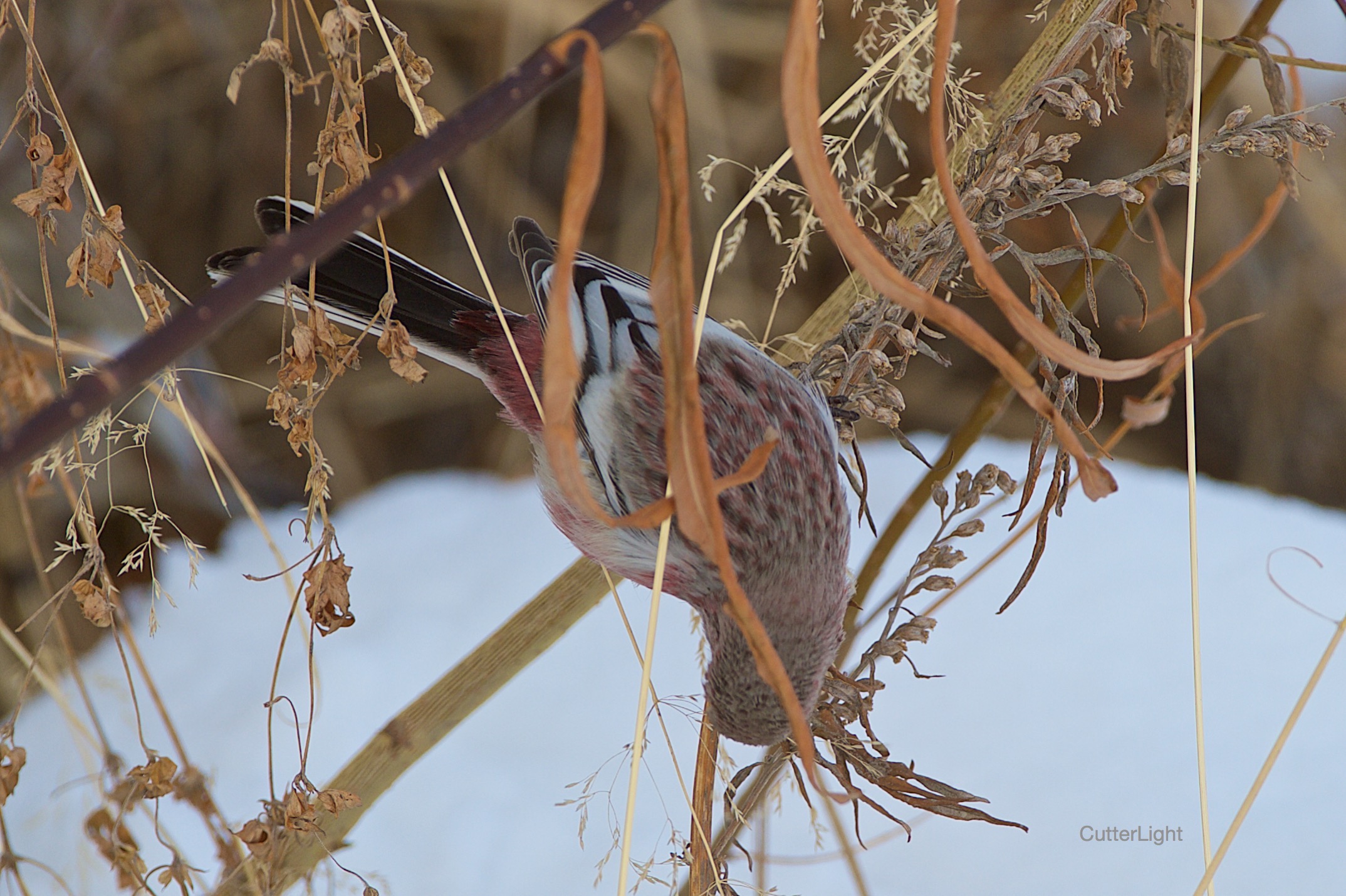
long-tailed rose finch upside down n

Finches become acrobats in pursuit of a good meal.

female long-tailed rose finch n

As is typically the case among passerines, the colors of the female long-tails are subdued compared to their male counterparts.

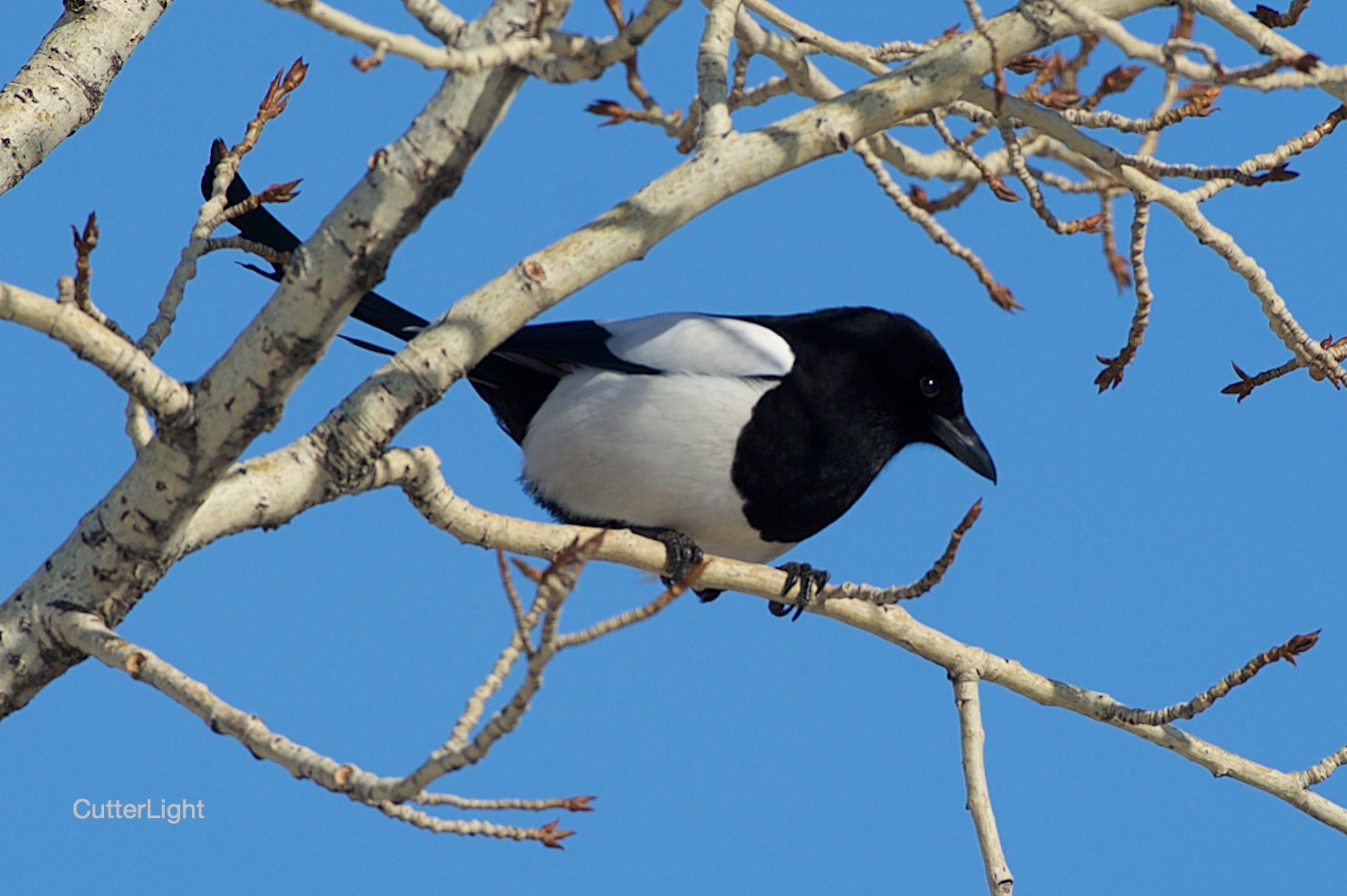
Magpie March 2015 n

Magpies were out in force, searching for nesting material to add to the massive jumbles of sticks they build in trees. It must work. They return to the same nests year after year, building them ever higher. Note the hooked beak; passerines beware. Magpies are predators, and no mistake.

big tree w sun april Tuul n

The Tuul River green belt is our favorite place in Ulaanbaatar. In addition to providing habitat for year-round resident birds and summer nesters, the abundant seeds provide critical fuel for passerines migrating further north.  The belt is also important hunting grounds for kestrels and other birds of prey as they make their way to their own nesting grounds. The banks of the Tuul are what’s left of an increasingly fragmented ecosystem. We’ve even caught fleeting glimpses of some type of quail or partridge in the thick willow undergrowth!

Mongolia’s Impressive Red Deer

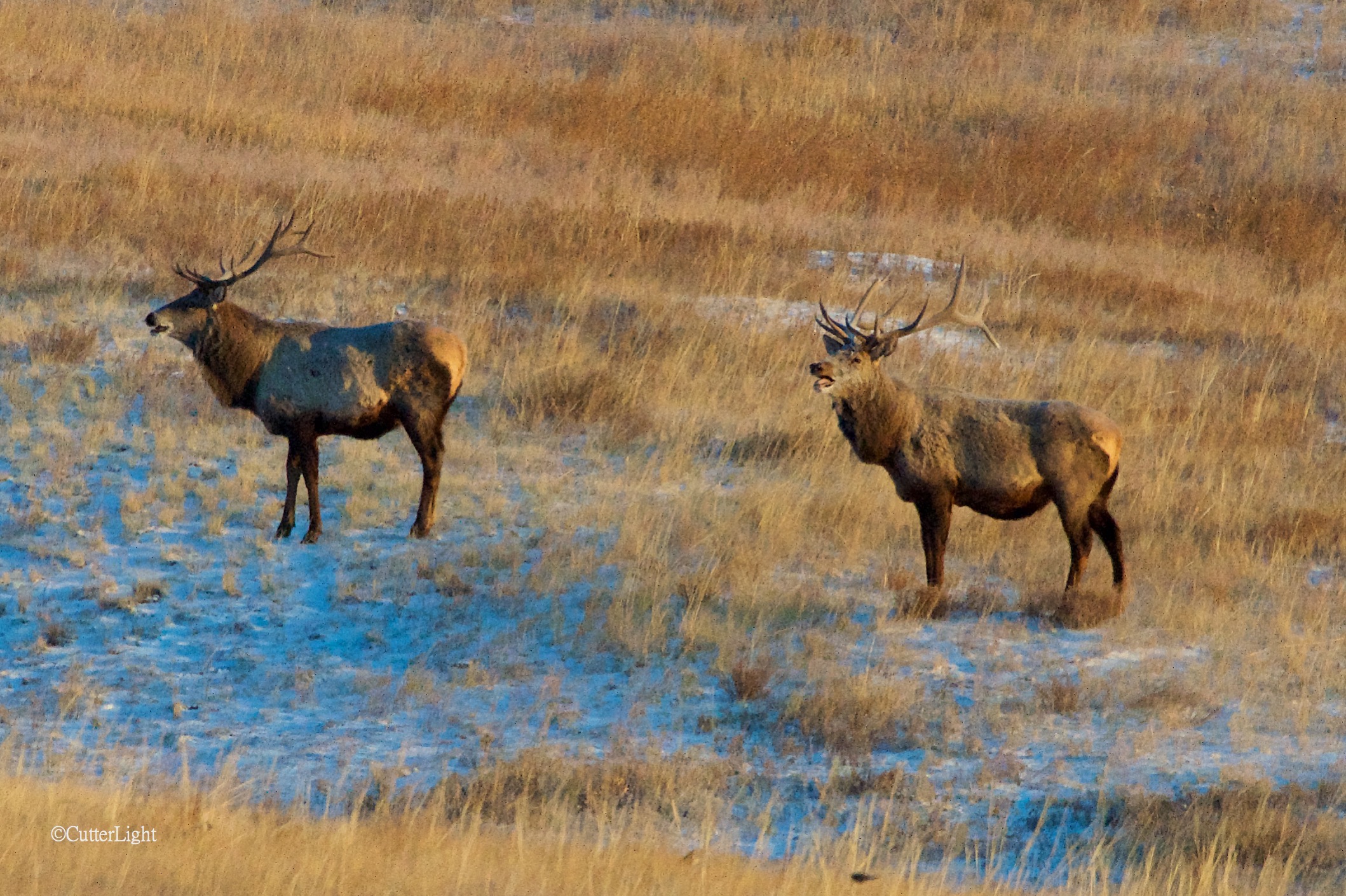
red deer stag pair n

Red deer stags (Cervus elaphus) in early morning light. Among the world’s largest deer, this species shares an extinct ancestor in common with North American elk: Megaloceros, the massive Irish elk. 

Historically, red deer ranged from the British Isles east through Mongolia and other parts of Asia and south into northern Africa. Until about two decades ago, their numbers in Mongolia were strong with some 130,000 individuals taking advantage of forest, steppe and mountain habitat. In recent years, however, poaching has decimated red deer herds in this country as their antlers command increasingly high prices as an ingredient in traditional medicines in China and elsewhere. Even National Football League players in America have been implicated in purchasing these medicines. Elk and red deer grow new antlers each year. When the antlers are growing, they are covered in soft tissue and are said to be “in velvet.” This is when the antlers are valuable.

Here’s the problem for the elk and deer. Some studies indicate there may actually be health benefits gained from using medicinal antler and regardless of the science, a lot of people believe they derive benefit from the antler. The trade is annually running over 1.5 billion U.S. dollars, and it is destroying populations of these magnificent animals. Although no recent population surveys have been conducted, it is believed that there are now fewer than 10,000 red deer in Mongolia.

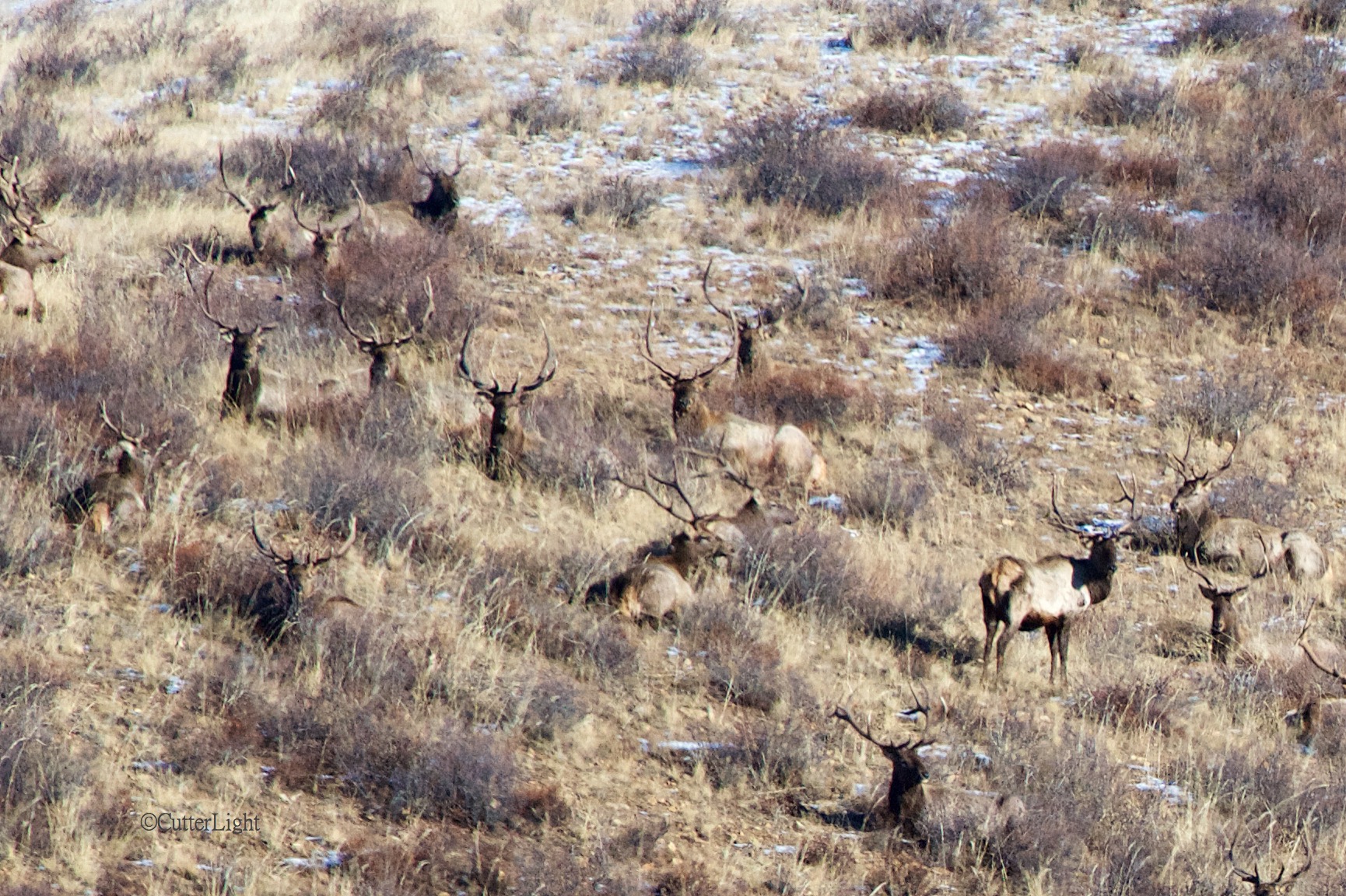
red deer males bedded down n

On a recent trip to Mongolia’s Hustai National Park, we encountered a herd of approximately 100 mature male red deer. Separated by sex during the winter months, females were miles away in a different part of the park. These stags will drop their anglers in early spring.

Among deer, only Alces alces – called moose in North America and Eurasian elk in Europe and Asia, North American elk (wapiti), and sambar deer are larger. Adult male red deer attain weights between 550 – 770 pounds (250 – 345 kg). Some subspecies grow even larger. The extinct Irish elk, Megaloceros, which occupied much of the same range as modern-day red deer, was believed to have attained a weight of 1,500 pounds (700 kg) and had truly massive, moose-like antlers – perhaps contributing to its demise. Because of their value as a food and game species (these are the “harts” and “stags” of European hunting lore), red deer have been introduced to New Zealand, Australia, Chili and Argentina.

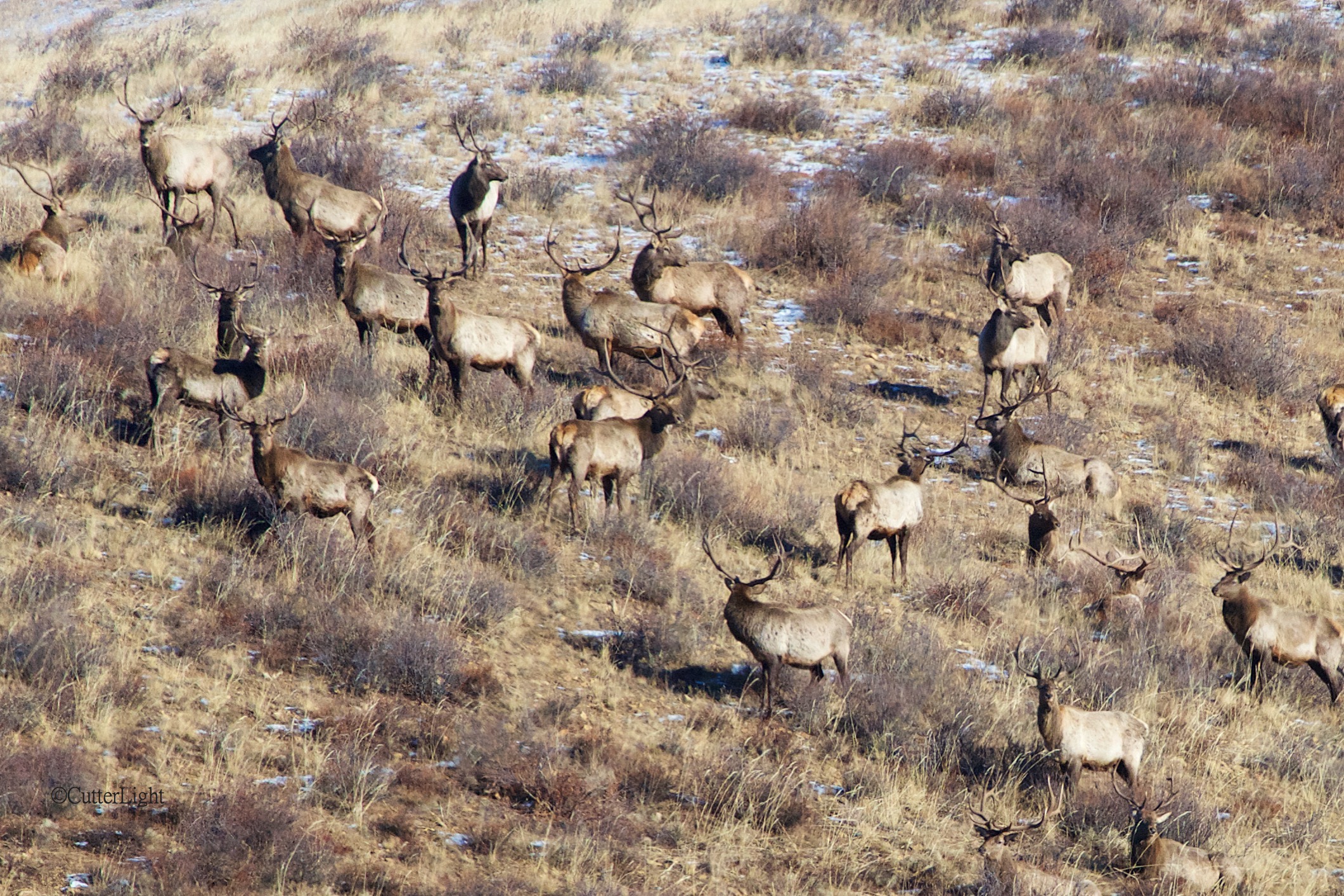
red deer males on alert n

We stalked these deer stooping and crawling for about half a mile (1 kilometer). Suddenly nearly all of them stood up – 100 animals including the ones outside the frame of this photo -, made nervous by an approaching rider on a horse.

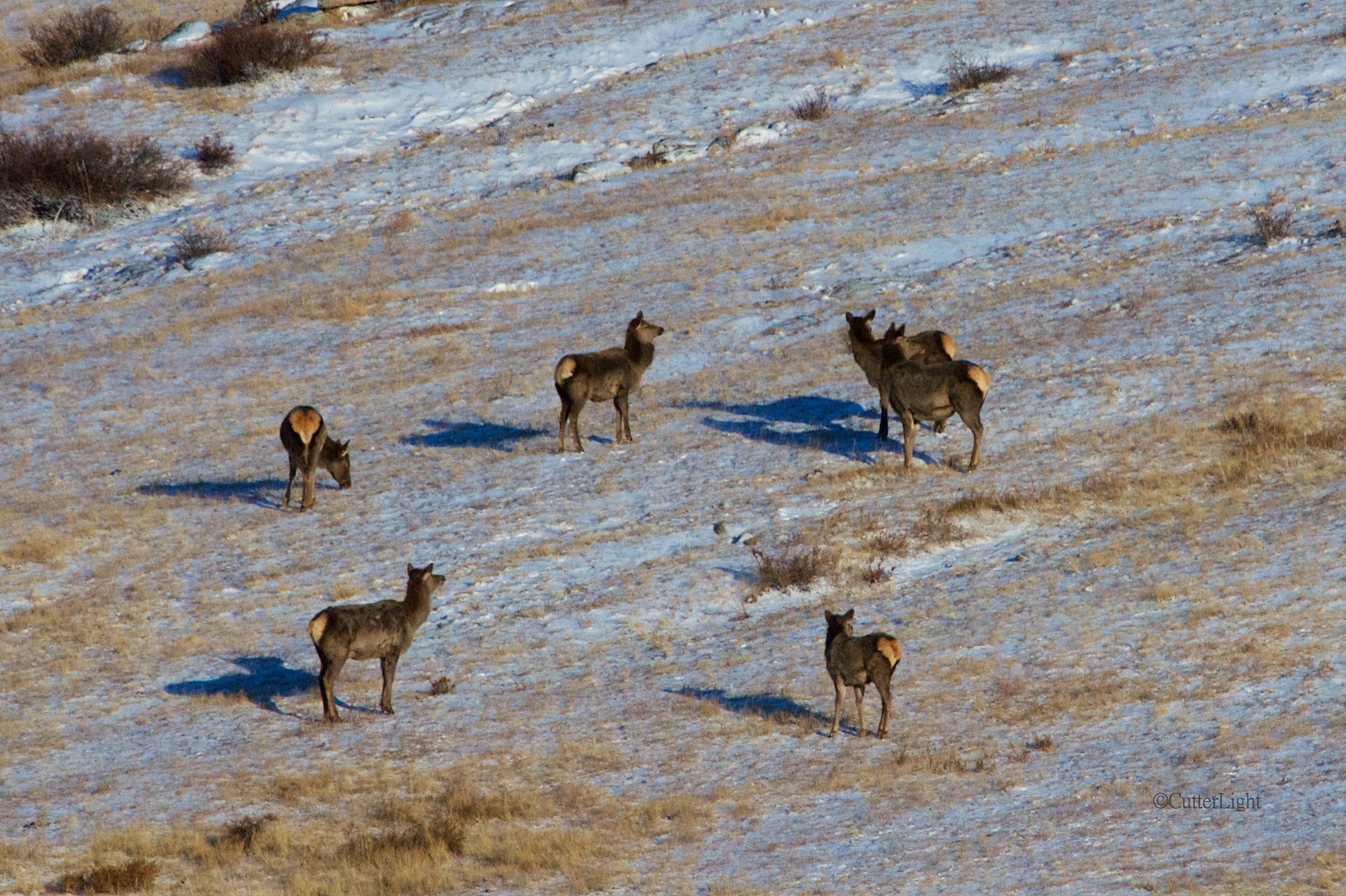
red deer femals on snow n

Rutting season occurs in autumn. The rest of the year females and young form distinct groups away from the mature males.

OLYMPUS DIGITAL CAMERA

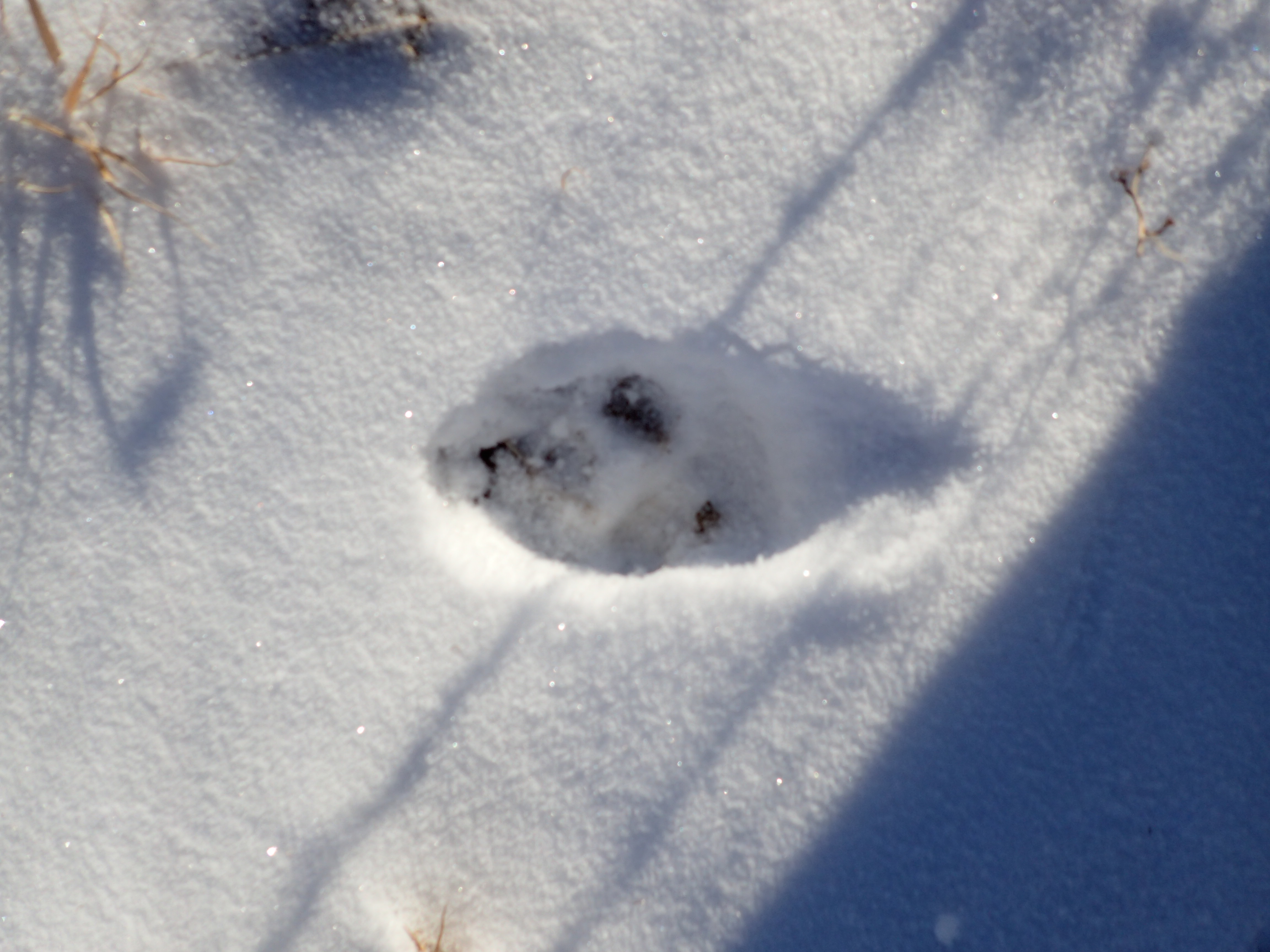
It’s not just poachers that prompt vigilance among red deer. This wolf track spotted near a herd of females and young was fresh.

red deer 3 males gathering scent n

Some scent on the air kept causing the largest of these three males to look back. 

red deer running over hill n

Dozens of stags stream over a break in the hillside. In a land where nomads and their herds have shared the landscape with wild animals for millennia, the countryside would seem empty without the red deer. As Mongolia’s human population continues to grow, it will become increasingly necessary that places such as Hustai National Park are protected if the deer are to continue to thrive.

Takhi – A Success Story in the Land of Chinggis Khan

Takhi w magpie full n

Magpie and takhi (Przewalski’s horse) – old friends reacquainted in a scene that has played out for many thousands of years but that was sadly interrupted in those decades during which the takhi were extinct in the wild. 

In 1967, somewhere on the arid steppe of Mongolia’s Western Gobi Dessert, the last small herd of wild takhi was seen. Two years later, only one horse remained. And then Equus przewalskii vanished completely from the wild. Although closely related to modern domestic horses, takhi were never tamed. This differentiates their status as “truly wild” from the ferrel mustangs of America which are descendants of domestic horses.

In their natural environment, wolves were their main predators, and the dry, harsh, cold conditions of the steppe would invariably claim victims each winter. But the main cause of the demise of the takhi was probably due to its being hunted for meat.

Takhi nursing winter n

Takhi form small family groups comprised of a lead stallion, two or three mares, and their offspring. These family groups loosely intermingle with other families as well as with bachelor stallions which often travel in pairs or groups of three. Stocky and with zebra-like manes, takhi are comparatively small, standing only about 48 – 56 inches tall at the shoulders. They have 66 chromosomes, two more than any other species of horse. 

By 1970, the only living specimens existed in a few zoos and private ranches. Extinct in the wild, it seemed only a matter of time till their official extinction from the planet would be announced.

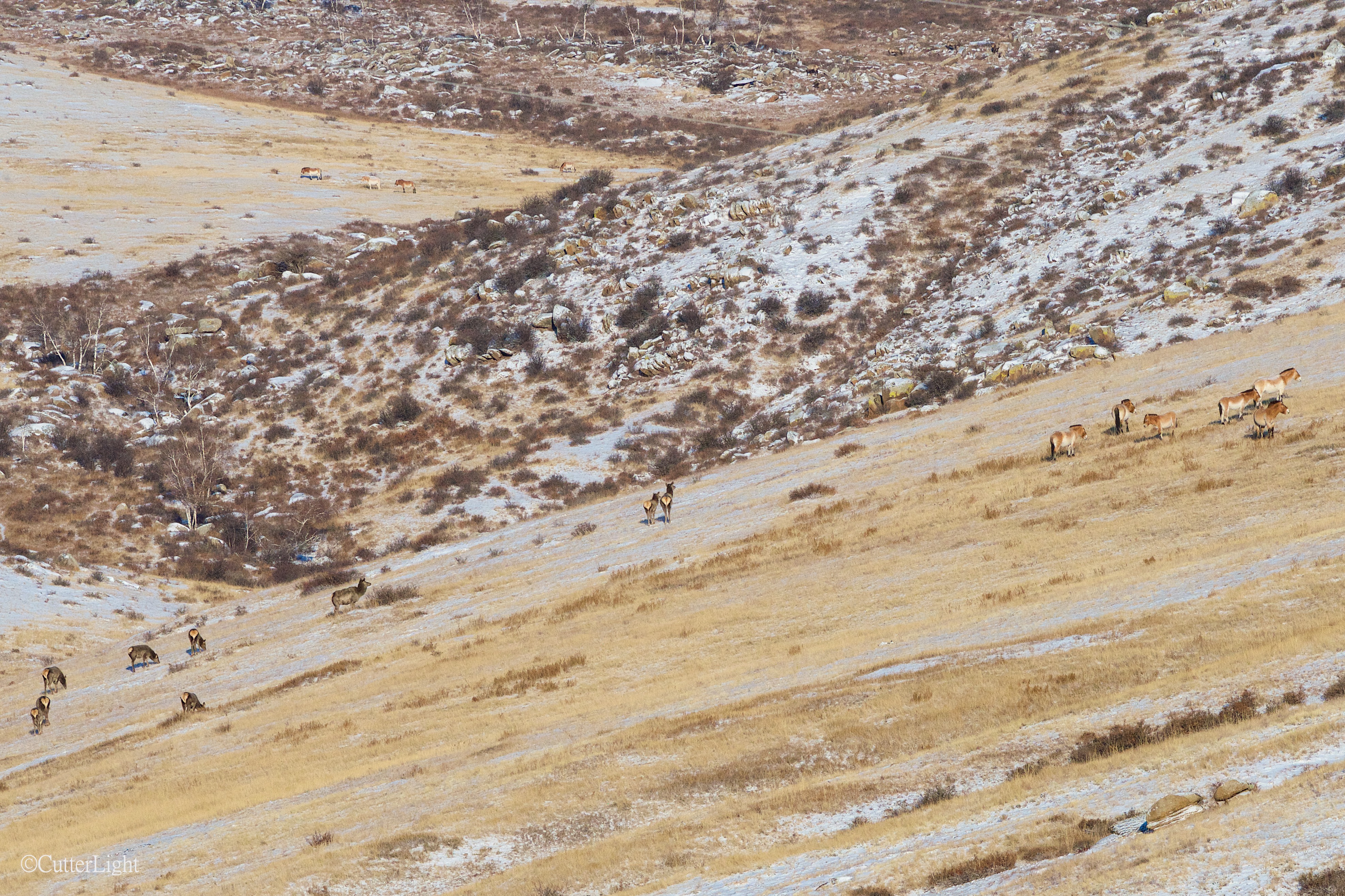
Then something truly remarkable occurred. In a cooperative venture between the Zoological Society of London and Mongolian biologists, the horses were reintroduced to Mongolia’s Khustai (Hustai) National Park where they’ve been thriving even since.

takhi with red deer n

On a morning bright with ice needles in the air and a fresh dusting of snow on the ground, takhi and female red deer (Cervus elaphus) share a piece of rugged terrain in Mongolia’s Khustai National Park. 

takhi stallion pair n

In full winter coats, these wild takhi are as beautiful as they are tough.

We counted ourselves as lucky to have spent a few days in Khustai during some of the coldest stretches of winter. The deeply rutted dirt roads were quiet, wildlife was abundant, and the horses seemed only mildly curious regarding our presence.

takhi in summer field

Takhi can readily be viewed in summertime as well. We can’t say which season is more beautiful. There are wild horses in this world still. That is beautiful.

Big, Beautiful Grizz Chillin’ at the Edge of an Alaskan Forest

Grizzley admiring nails n

We caught this Alaskan grizzly bear chillin’ on the edge of a forest on a cool, overcast morning in mid-summer. With nails like that, who wouldn’t lie around admiring them? (Six more photos.)

Grizzley looking straight on n

The previous day, I (yours truly, Jack Donachy) managed to drop and break “the big lens.” But this sleepy guy barely paid us any attention as we photographed him from the safety of our Chevy, so the 70-200 mm with a 1.4 teleconverter got us close enough. Hard to say how many cars had driven by this big, blonde-brown hulk without noticing that morning. We stayed with him – and he with us – for about half an hour.

Grizzly the Thinker n

He’d doze off for a bit, wake up, think about whether or not to get up (or maybe he was trying to remember where he’d left his car keys last night), give a little sigh and then drop off to sleep again. 

grizzly sleeping  a n

Grizzly looking to his right n

And then he’d wake and take a look around.

Grizzly picking up scent n

Eventually a scent on the air caught his attention…

Grizzly ambling off diorama n

And he ambled off. Almost looks like he’s posed in a diorama. The overcast morning light really made the colors pop.

Crows Ice Fishing for Caddis Larvae: Tuul River, Mongolia

carion crow flock tuul  n mountains n

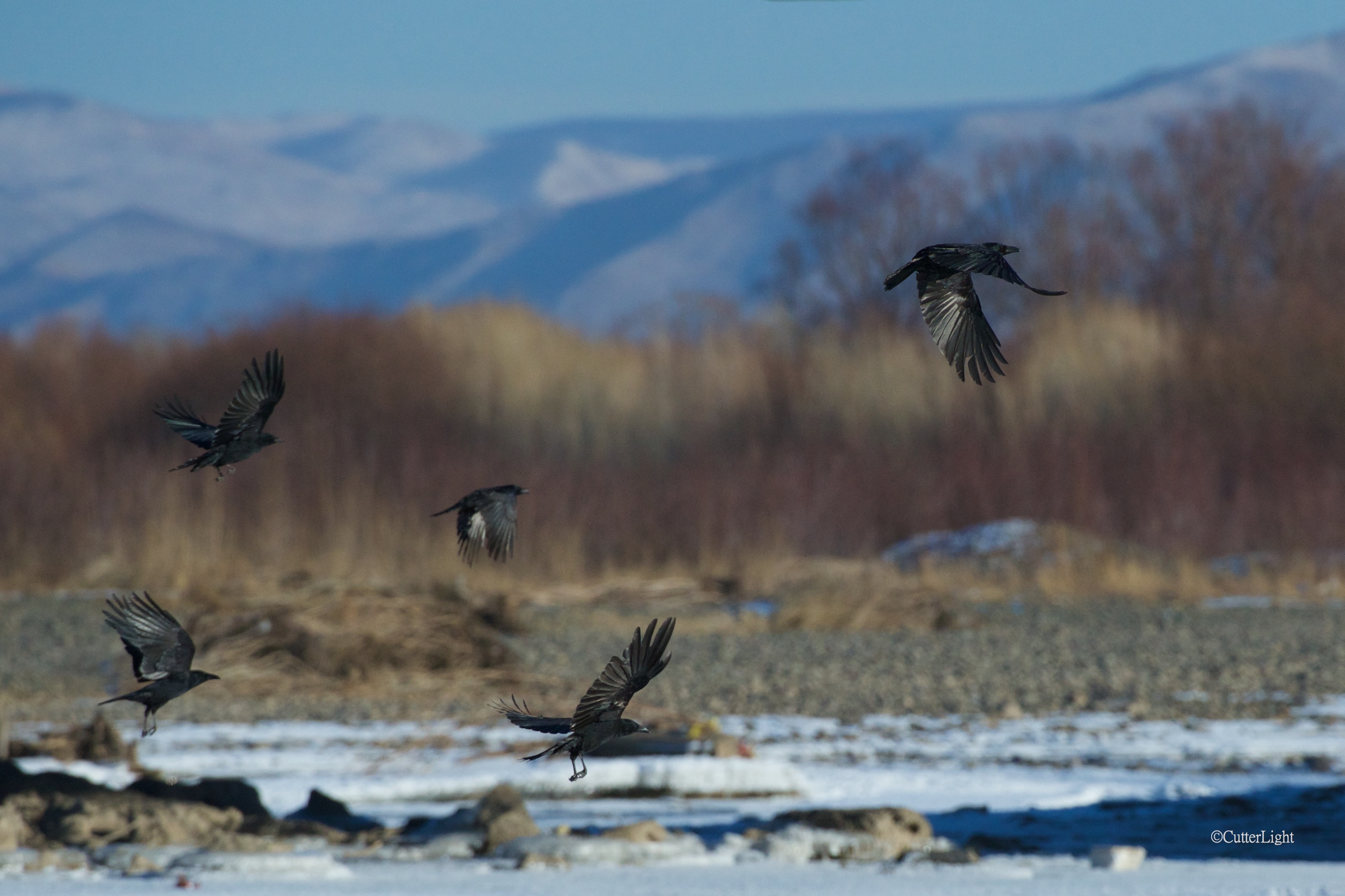
Corvids – a group which includes crows, ravens, rooks, jays, magpies and nutcrackers – fascinate. On a frigid December afternoon, we found them ice-fishing for caddis larvae in Mongolia’s Tuul River in the heart of Ulaanbaatar. (Click any of the photos for a larger view.)

The most intelligent of all birds, and with a brain-to-body-mass ratio rivaling that of the great apes and cetaceans, crows and their allies often exhibit remarkable behavior. Members of this family have been observed using and to some degree engineering purpose-specific tools – the only nonhuman animal other than the great apes to do so. There’s little doubt that certain feeding behaviors adopted by crows have been learned by watching other birds and animals.

carrion crows wings n cadis n

Note the object in the beak of the crow on the left. It’s a caddis larva casing.

The Tuul River flows through Ulaanbaatar, Mongolia’s capital city. Despite urbanization, the river’s water quality remains high – good enough to support species of trout as well as sensitive aquatic insects such as mayflies, stoneflies and caddisflies – species which spend the early part of their lives as larvae on the bottoms of clean rivers and streams. The Tuul is fast-flowing. Consequently, despite weeks on end of sub-freezing temperatures, here and there pockets of water remain open over shallow, stony, silt-free bottom.

OLYMPUS DIGITAL CAMERA

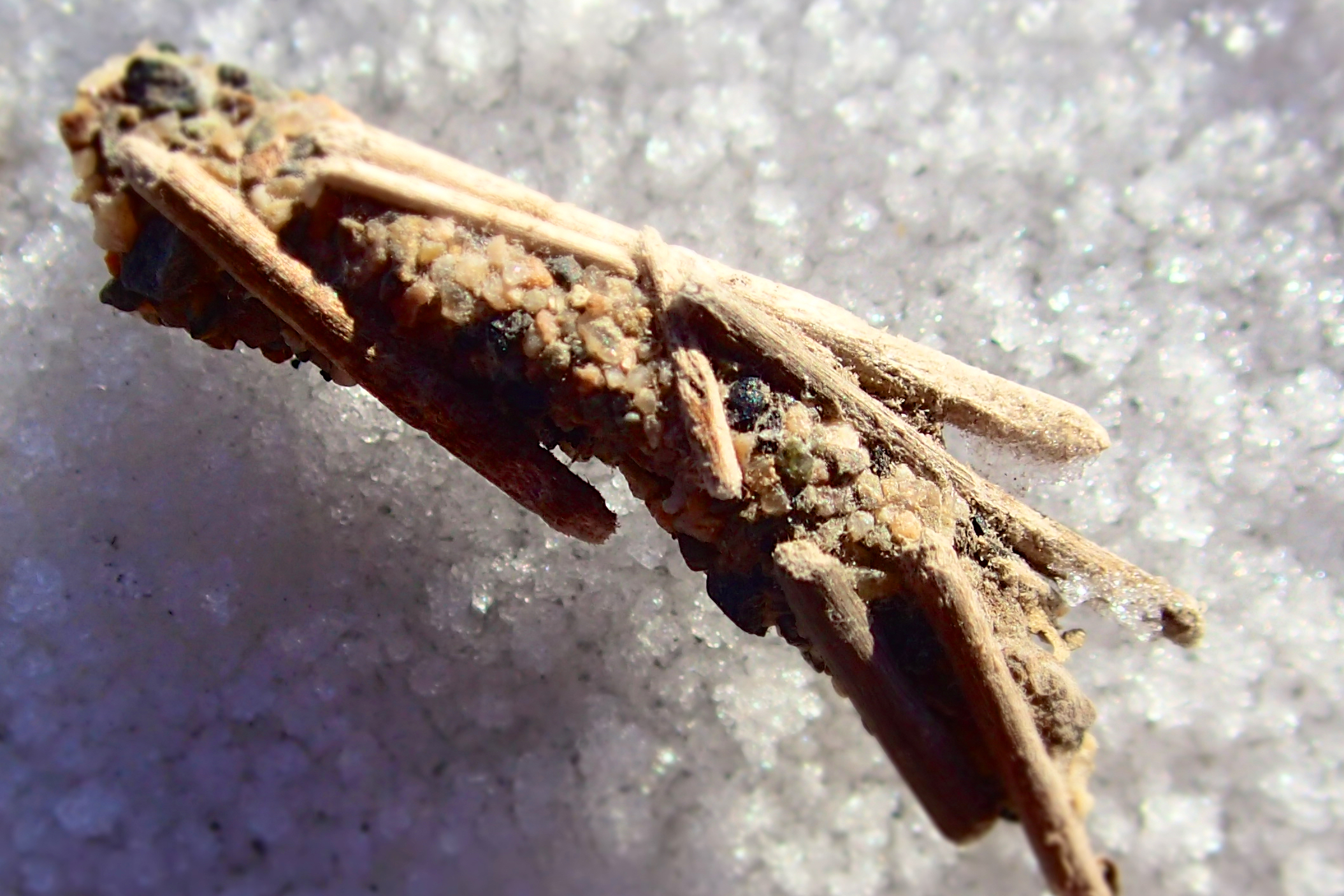
We took a cue from watching the crows and began scanning the ice for caddis larvae casings. As our eyes tuned into the proper size and shape, the empty husks appeared everywhere. This casing, constructed of tiny sticks and pebbles, is about 1.5 inches long (3.8 cm) and belonged to a member of the Northern case maker caddisfly family. 

Perhaps the crows learned of the abundance of wintertime food in these areas of open water by watching dippers – a robin-sized bird that happily plunges into pools and riffles in all seasons in search of aquatic insects and small fish. In fact, on this day we saw a white-throated dipper submerge itself in one of the riffles where the crows were feeding and come up with a small fish.

carion crow w caddis n

Here a carrion crow (Corvus corone) has his prize – a caddis larva pried from its pebble and stick casing.

Not adapted to plunge into water, the crows were fishing from the edge of the ice – thus gaining access to water not overly deep, but deep enough to provide habitat for slow-moving caddis larvae. Resourceful birds, are crows.

Urban Birding in the World’s Coldest Capital City: A Winter Walk along Ulaanbaatar’s Tuul River

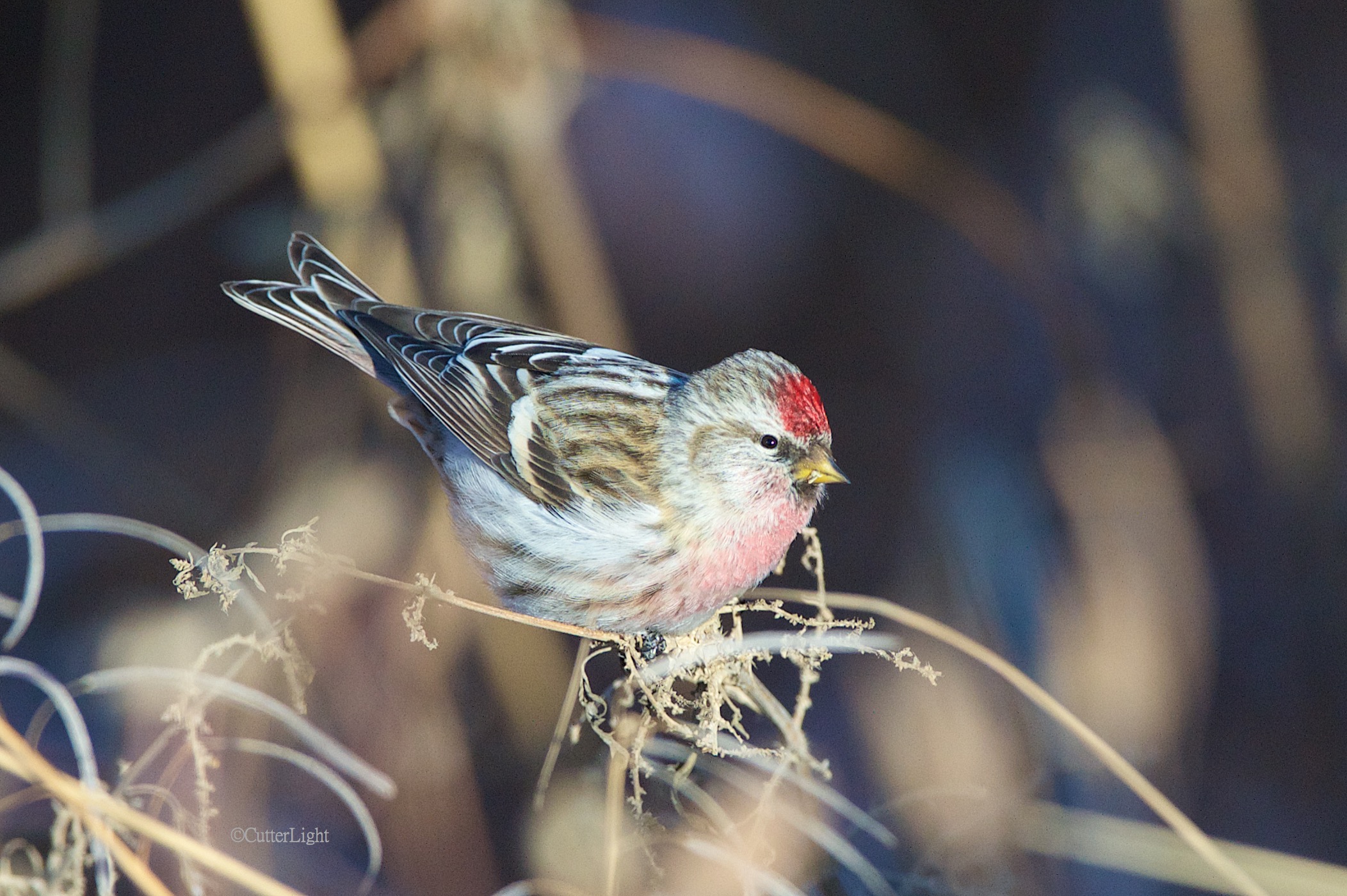
redpole on dark background 2 n

Redpoll, (Acanthis flammea)                                     Mongolian: Дөлөн цэгцүүхэй,

On a December morning with temperatures hovering around -13 degrees Farhenheit (-25 C) we fueled up with bacon and grits and walked from our apartment to the nearby Tuul River to check out the local bird scene.

Ulaanbaatar from frozen tuul n

Mist gently lifts from a patch of open water on Mongolia’s Tuul River. Along the shoreline to the right, frosted willows appear as sprays of white. In the background, dawn arrives on Ulaanbaatar, a rapidly growing city of just over one million inhabitants doing their best to stay warm with the country’s abundant coal. 

great tit ground n

Great tit, (Parus major)                                               Mongolian: Их хөхбух

Relatives of the familiar chickadees of North America, these are one of the more common and colorful passerines in and around Ulaanbaatar.

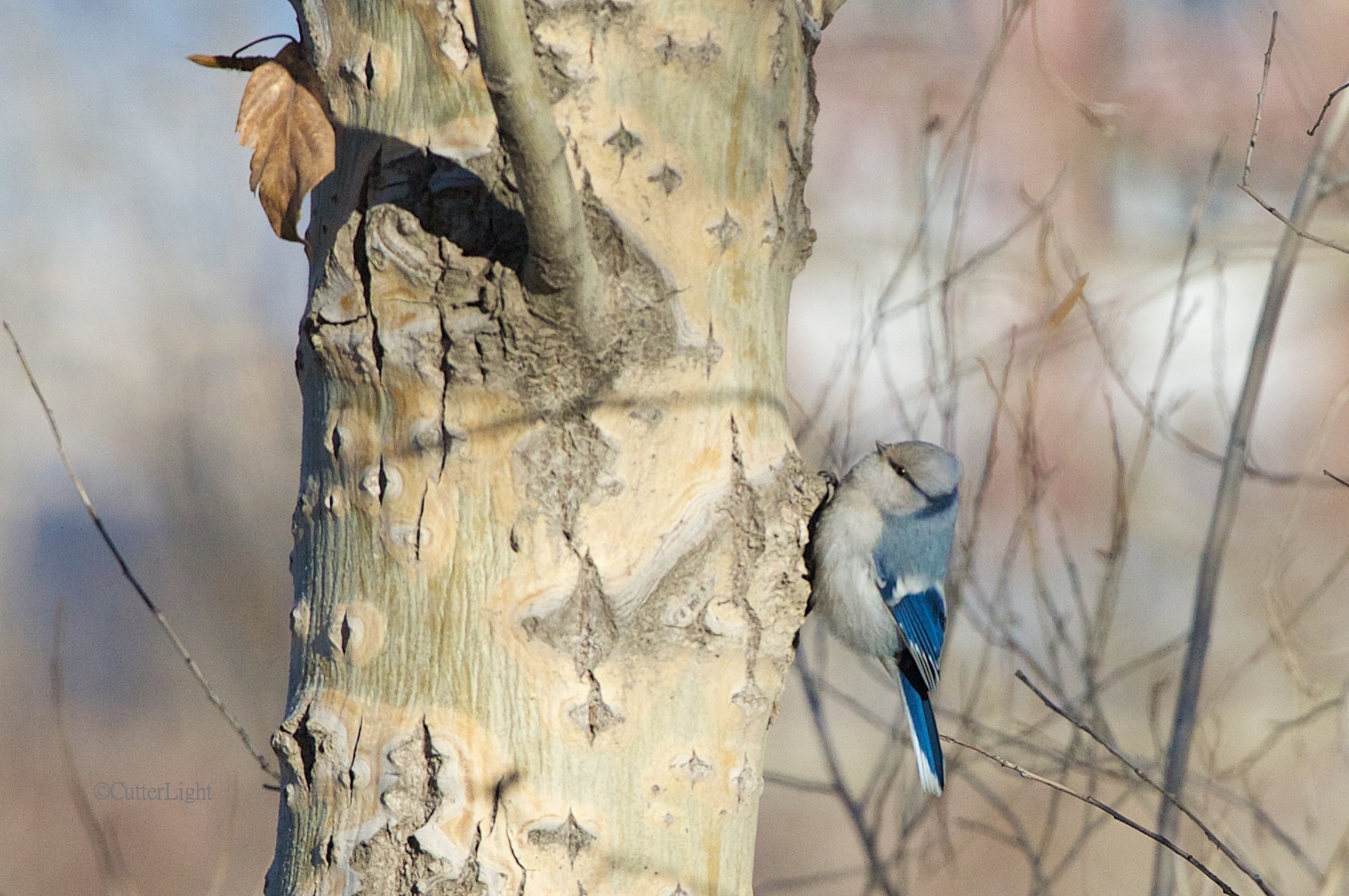
azure tit on tree n

Azure tit, (Parus cyanus)                                               Mongolian: Номин хөхбух

Abundant but more shy than great tits, these beautiful little birds are seldom seen in the city itself, but we saw several during our walk along the Tuul.

penduline tit nest n

We found two of these mitten-shaped nests – the work of white-capped penduline tits, (Remiz coronatus), (Бургасны ураншувуу). Like the buds of the tree it’s hanging from, the nest is dormant. Although the birds who made this nest will not use it again, male penduline tits, which arrive before females in the spring, use abandoned nests as indicators of suitable breeding habitat. Some Mongolians and other Asians hold a belief that these nests have medicinal powers – a belief unsupported by science – and collect them, a practice which has directly resulted in a decline in penduline tit numbers.

eurasian tree sparrow front n

Eurasian tree sparrow, (Passer montanus)                   Mongolian: Хээрийн бор шувуу

Much like pigeons, tree sparrows seem to show up wherever humans live. Presumably these friendly little birds have essentially co-evolved with people. Within the city of Ulaanbaatar they occur in flocks in a variety of habitats. But along the Tuul River, their numbers thin as passerines more adept at thriving without the spoils of humans outcompete them. By the time one crosses the river and enters the forests of Bogd Kahn Mountain, tree sparrows are almost entirely replaced by tits, finches, nuthatches and other birds.

eurasian magpy shimmering n

Eurasian (or common) magpie, (Pica pica)                  Mongolian: Алаг шаазгай

In urban settings magpies are often quite approachable, however the magpies along the Tuul proved wary. We worked to get this photo of a bird puffed up against the cold, a streak of emerald-green shimmering along the length of the tail. Generally scavengers and foragers, the magpie’s hooked beak is a tell-tale sign that it will assume the role of predator given the opportunity.

carrion crows wings n cadis n

Carrion crows, (Corvus corone)                                         Mongolian: Хар хэрээ

We found a group of crows targeting caddisfly larvae in a shallow riffle that hadn’t yet frozen, as is evident by the caddisfly casing in the beak of the bird on the left. The crows were using the edge of the ice to access this bounty. Perhaps they learned this behavior by observing dipper birds, a species that also frequents open water such as this during winter to feed on insects and small fish.

OLYMPUS DIGITAL CAMERA

Scattered across the ice near the riffle where the crows were feeding, we found a number of empty caddis larvae casings. The larva that built this home from fragments of wood and tiny pebbles probably belongs to the Northern case maker group, family Limnephilidae. The fact that caddisflies are apparently abundant in this stretch of the Tuul indicates that despite urban development, water quality remains good.
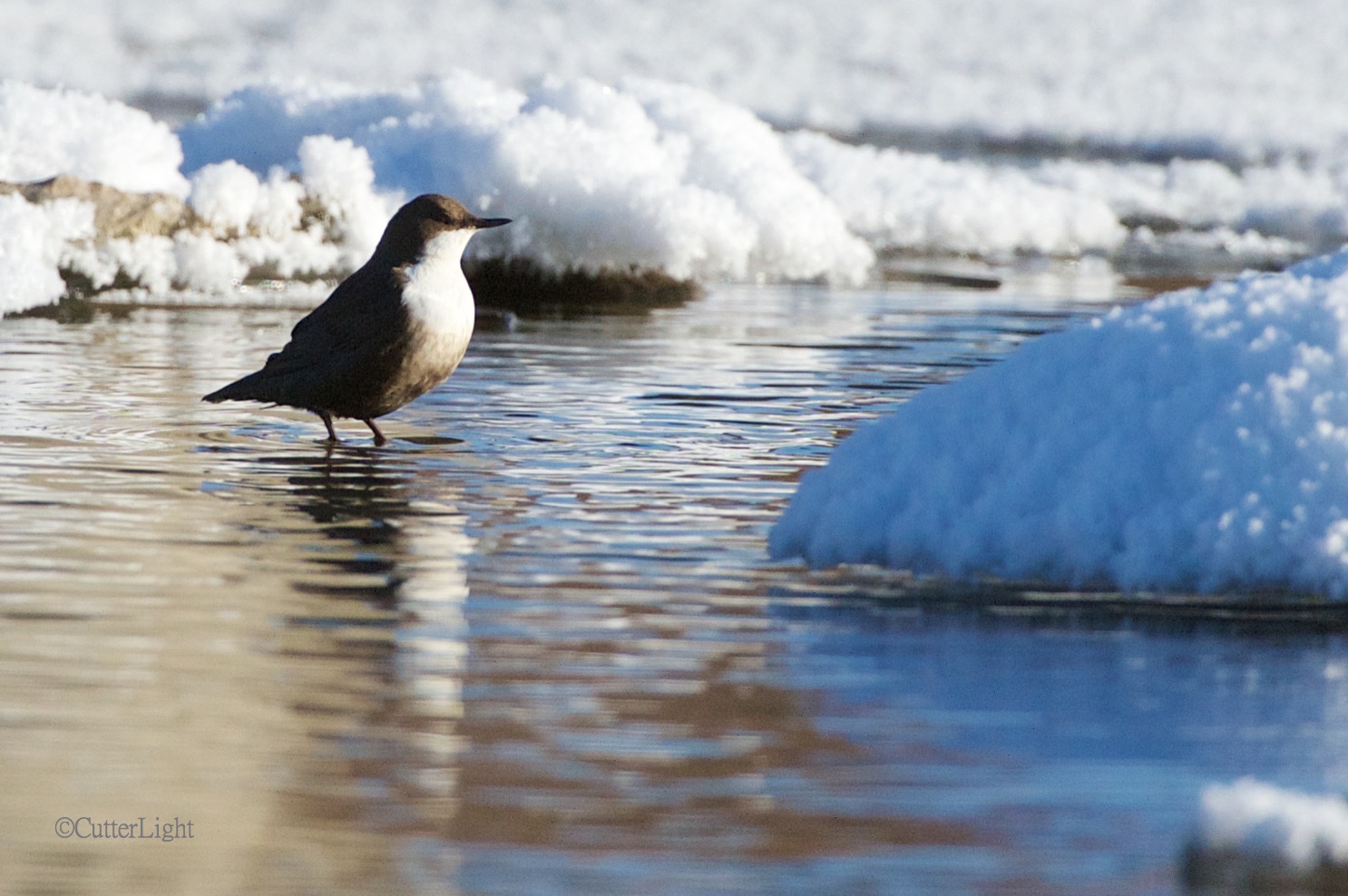
white throated dipper Tuul n

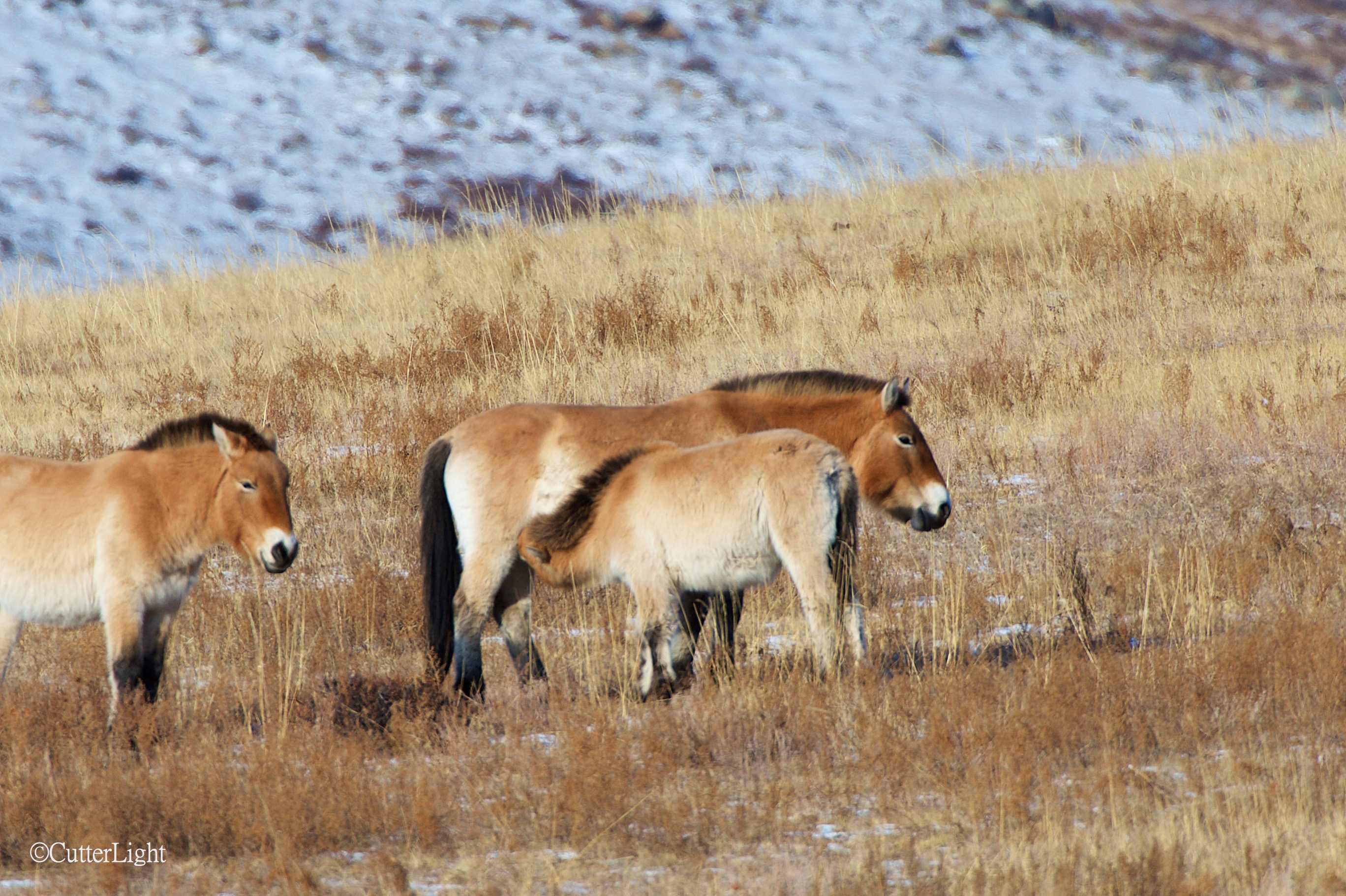
White-throated dipper, (Cinclus cinclus)                  Mongolian: Гялааномруу хараацай,

Bee-like rapid wingbeats and an electric buzzing cry alerted us to the presence of a dipper bird near the same water the crows were using. What threw us was the flash of white as the bird zoomed by; in America and Japan we’d seen only brown dippers. This one disappeared under the icy water and came up with a fairly large minnow. Any day we can check off a new species is a good day.

The mix of willows, poplars, cottonwood and pines along the banks of the Tuul, as well as the river itself, constitute a biologically rich greenbelt in the heart of a rapidly growing city. Here’s to hoping that the citizens of Ulaanbaatar recognize what a treasure this is and insist on its protection.

We invite comments, corrections, discussion and further information from our readers.