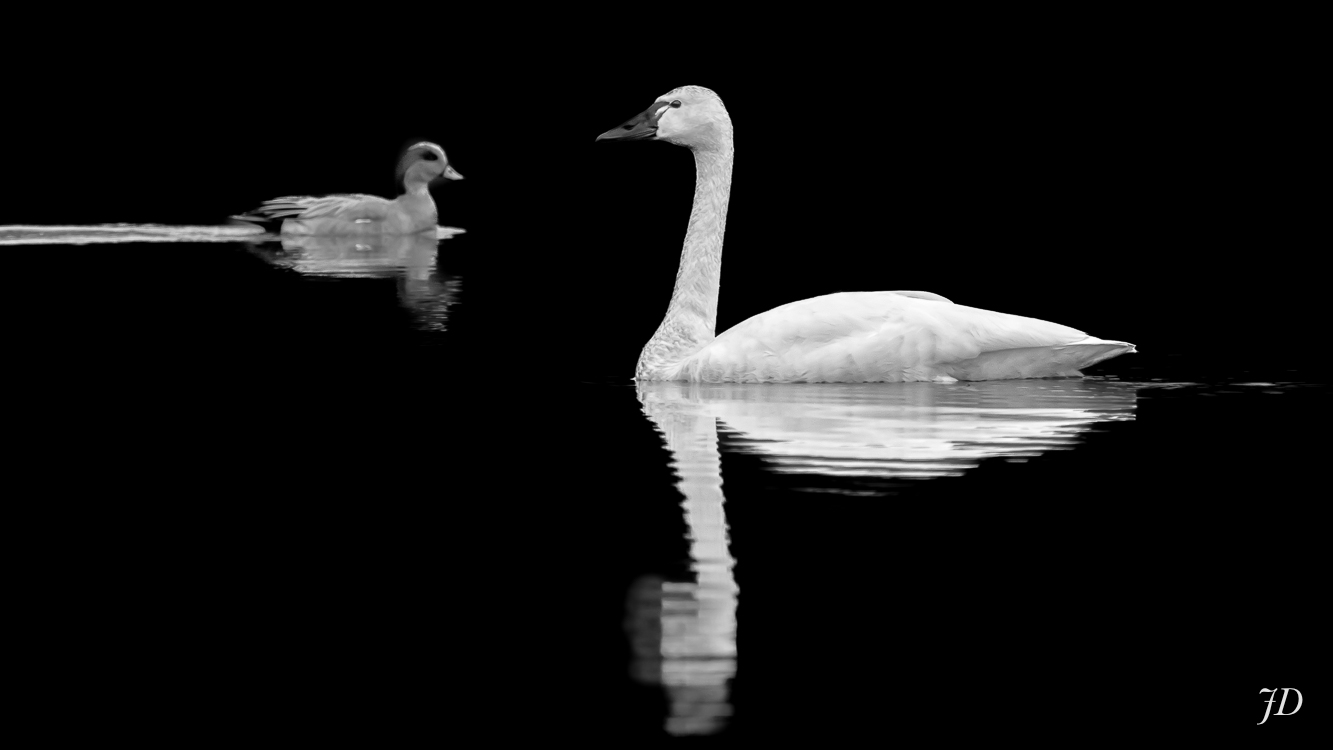
Tundra Swan with American Wigeon at Broad Pool Broad Pool on Chignik River, Alaska Peninsula, May 4, 2019
The best place to look for returning Tundra Swans (Cygnus columbians) on the Chignik is at Broad Pool, about a mile downriver from the village. One evening the swans announce their arrival with far off, lonesome-sounding notes and by morning they’ve settled at the pool. There the slow-moving, weedy water provides food for the swans as well as for migrating dabbling ducks such as Mallards, Green-winged Teal, Northern Pintails and American Wigeons. Diving ducks, mostly Common Goldeneyes, Buffleheads, Greater Scaup and both Common and Red-breasted Mergansers are also likely to be present. At this time, the banks are covered in scraggly, winter-brown grasses, sedges, willows and alders and there may still by ice along the river’s edge. By the end of the month the ice is gone and the swans and most of the ducks will have dispersed to nesting areas further up the drainage, but at least one pair of Mallards and another of wigeons usually stay to nest along along the margins of Broad Pool. They are often joined there by a brood or two of Black Scoters.
Heave Ho Fred Shangin, cigarette hangin’ as per, puts his back into a pot of Tanner Crabs from Castle Bay off the gulf side of the Alaska Peninsula. May 6, 2018
Going through these many thousands of photos from The Lake and beyond – while at the same time these past few days putting together a magazine piece paying tribute to a recently deceased mentor and friend from my Pennsylvania youth – I find myself recognizing that as photographers one type of image we might not capture often enough is portraits of friends. The best of these photos are often environmental-documentary portraits – my own hybrid category to describe pictures that capture the subject in an authentic act of life in a setting that tellsthe viewer about that person’s life. There’s an art to it… the photo that isn’t staged; that doesn’t depict the subject self-consciously looking into the lens (or self-consciously looking away from the lens); an image that captures an authentic moment rather than a pose.
For me, learning to make these types of images has been predicated on a lengthy process of growth toward freedom from my own limiting shyness. Coupled with the kind of confidence that enables a photographer to make such portraits is, I think, a necessary agreement – tacit or verbalized – that gives the photographer permission to shoot at will (with appropriate discretion).
Strictly environmental portraits are in most cases staged. In making such an image, the photographer might have the subject sit at her fly-tying table as she ties or gives the impression of tying a fly. Noticing clutter, the photographer tidies up the scene. Further compositional considerations prompt lighting manipulation – perhaps nothing more than slightly moving a lamp or opening or closing a curtain, but manipulation nonetheless. Clothing choices are given thought, a certain tilt of the subject’s head is decided upon as favorable, perhaps a few already-tied flies are placed in the foreground, a book arranged so that it’s title can be read. Images such as this have their place, but to me there’s a compelling cool in a real-time photograph – a moment frozen, captured, documented as is with no quick brush through the subject’s hair, the everyday jacket with its stains, imperfect lighting, maybe a little motion blur or grain.
And in the case of the above photograph, one hangin’.
Red-breasted Merganser at Dawn with Char and Scaup: monochromeDecember 19, 2016Red-breasted Merganser at Dawn with Char and Scaup: color
All summer and well into fall, we could often see salmon and char from our dining table window as they migrated along the lakeshore beach. The char could be there in any season, following the salmon to gorge on eggs and then making their own spawning run. At other times the char would cruise the lake shoreline chasing down the fry, parr and smolts of Sockeye and Coho Salmon. At that time they would readily come to streamers, and even in winter you could sometimes get a couple of fresh fish for the evening meal.
More interesting than fishing for the char was watching the mergansers and otters go after them. The diving ducks often worked cooperatively, cruising along the shoreline with purpose reminiscent of soldiers on patrol. When they found a school of Dollies they’d herd them against the shoreline or sometimes against ice sheets. The otters behaved in a similar manner, and when there were a lot of char around the otters and the mergansers would set aside some of their natural caution and you could find yourself pretty close to the action if you sat still and waited.
Although it was late in the morning when I took the above photograph, the sun was just barely beginning to emerge over the mountains south-east of the lake. At first it was too dark to shoot, so I positioned myself behind a natural blind of tall, winter-brown grass and waited. There were about half-a-dozen merganser hens, or a hen and her first-year offspring, patrolling the shoreline, catching fish. Then this one came up with the catch of the day just as a flock of Greater Scaup were passing behind her.
Inupiat whaling on the frozen Chukchi Sea near Point Hope, Alaska. April 26, 2012
As Bowhead Whales go, this was a small one – perhaps 10 tons or so. We had hiked approximately three miles from the village of Point Hope across the frozen Chukchi Sea to the camp where we had heard a whale had been caught. Locals had traveled by snowmachine and honda (snowmobile and ATV). There is always the danger of encountering a Polar Bear in this environment, and so we were armed. After snapping this picture I handed the camera to Barbra and took a place on the rope.
The open water in this picture is called a lead – an opening between two sheets of ice. You can see, across the water, the jumble of ice along the edge. Sea ice is often not the smooth sheet of white one might imagine. It continuously buckles, pushes up along pressure ridges, drifts apart and then presses back together. In a way, it behaves like the Earth’s tectonic plates, buckling, heaving, colliding, lifting. And so in order to make a whaling camp, trails must first be made through these places where jagged ridges of ice, individual chunks the size of cars, some much larger, must be broken through and smoothed out.
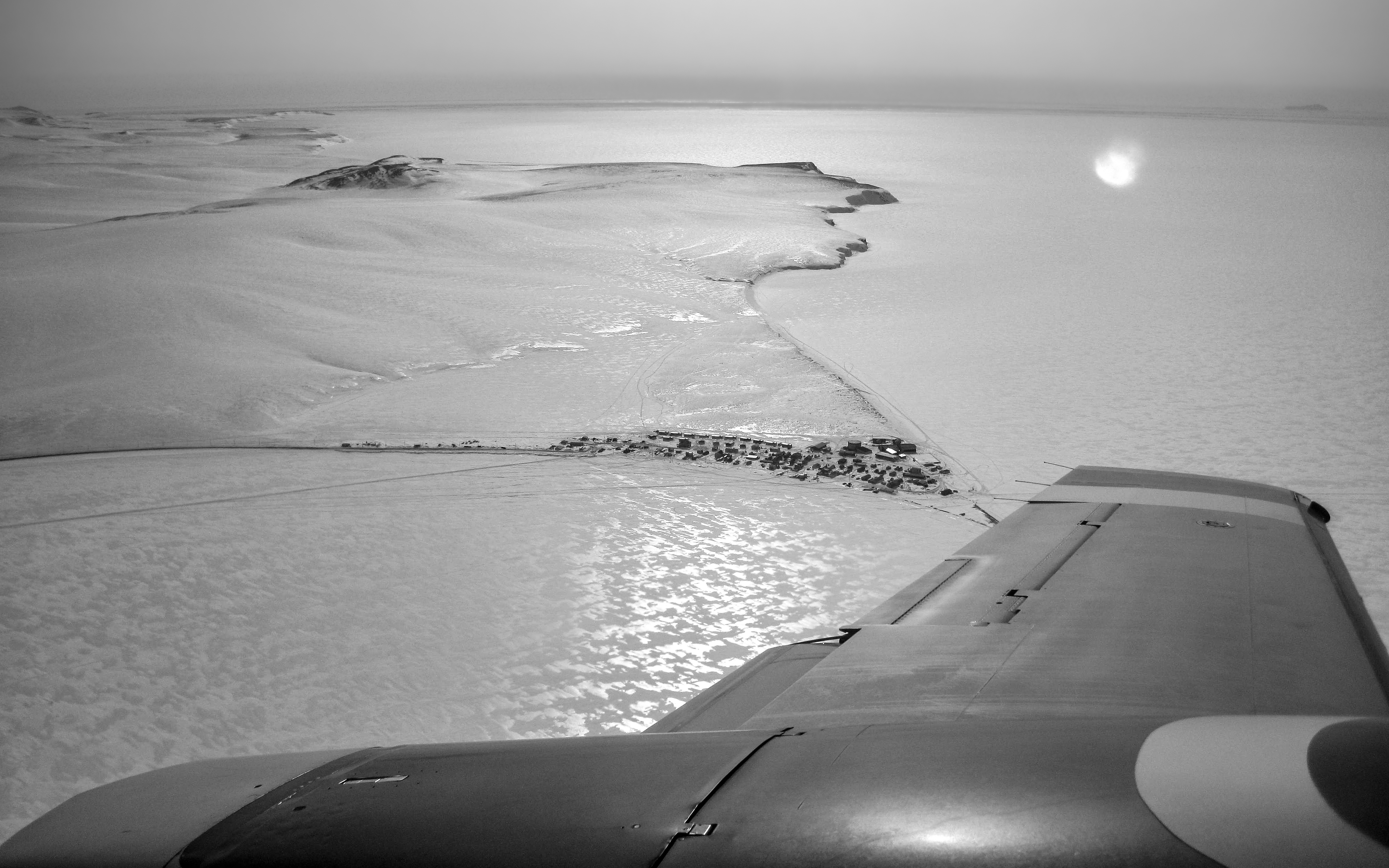
Flying into the village of Shishmaref for the first time was an unforgettable thrill. This wintertime photograph, in which the barrier island upon which Shishmaref is located appears to be connected to land, belies the village’s isolation. That is ice, not terra firma, surrounding Sarichef Island which encompasses only 2.8 square miles and rises no higher than 13 feet above the surrounding sea. The village itself is home to fewer than 600 mostly Inupiat residents. Tucked up against the ever encroaching Chukchi Sea, Shishmaref lies a mere 20 miles below the Arctic Circle, 105 miles from the Siberian coastline across the Bering Strait, 601 miles from Anchorage and 2,939 miles from L.A. The wintertime winds, with a fetch of perhaps thousands of miles across frozen northern seas, blew at times with terrifying ferocity and cold, on one memorable occasion all but burying the village in snow.
In the next few photos to come, I will try to show a bit about life in this remote village which is perhaps best known as being on the vanguard of the impacts of climate warming, but where also there is beautifully crafted artwork and a spirit of resilience. As always, your comments are welcome.



 CutterLight