Teuri Island: The Place to be for Rhinoceros Auklets

Rhinoceros Auklet Breeding Grounds, Teuri Island
Hokkaido, Japan, June 18, 2018

Not a lot appears to be going on in the above daytime photograph taken on Teuri Island’s cliff-lined northwest. The 2.1 square mile island (5.5 square km) hosts the breeding grounds for several species of birds, most notably seabirds. The holes in the above photograph are the burrows of Rhinoceros Auklets, a species for which Teuri serves as the world’s largest breeding ground.

While it doesn’t appear that much is going on in the photograph – a few gulls milling around notwithstanding – at the end of each burrow, which may be up to six meters (20 feet) in length, a Rhinoceros Auklet chick is waiting for twilight when parents will return from the sea, stomachs, gullets and bills crammed with catches of sand lances and squid. Gulls – primarily Slaty-backed which also breed on the island – will intercept some of the returning adults, but most will make it past the parasitic phalanx. Recent estimates put the auklet population at around 400,000 breeding pairs. Add in the chicks and the species count rises to over a million. Perhaps you can imagine the sight and the cacophony as night gathers and hundreds of thousands of adult auklets return, evading squawking gulls, somehow locating the specific burrow each parent calls home.

Teuri is also an excellent place to see Spectacled Guillemots, Common Guillemots and other seabirds as well as passerines such as Blue Rock Thrushes and Siberian Rubythroats. Regular, bicycle-friendly ferries from Haboro make it easy to get out to the island, and if you don’t choose to stay at the lovely campground (which you’re likely to have to yourself) there are wonderful inns offering comfortable accomodations and truly some of the world’s best fresh seafood.

Juxtaposition: Two Views of Flying into Japan

Above Tokyo, Flying into Narita Airport on Japan’s Main Island, Honshu
The ancient poets of Tang and Sung Dynasty China called city life “chaos and dust.”
Approaching Chitose Airport, 33 miles SW of Sapporo on Japan’s most Northerly Island, Hokkaido
A much more agreeable landscape for a bicycle trek

Toya-ko Campground

Lake Toya Campground
Hokkaido, June 7, 2018

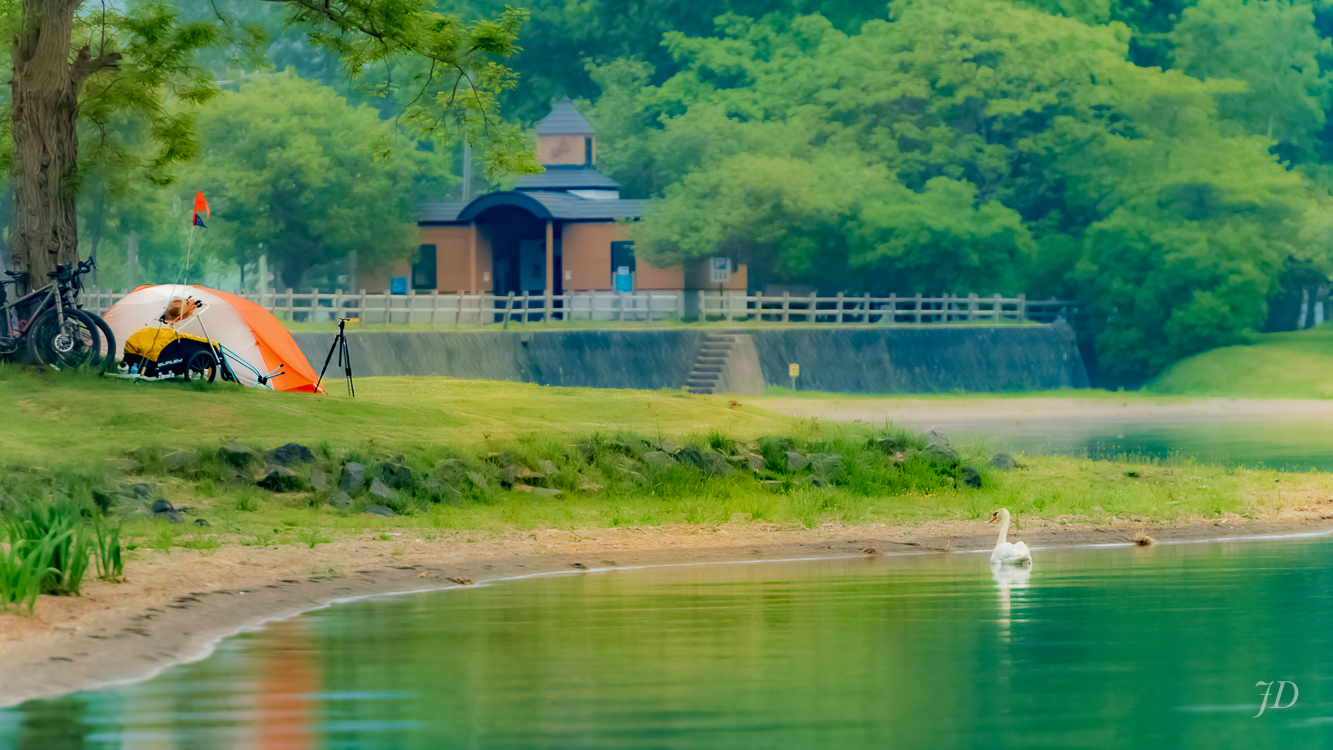
We found one terrific (often idyllic) campsite after another during our Hokkaido trek. Above is Nakatoya Campground on the shores of Toya-ko (Lake Toya). The lake formed in an ancient volcano caldera, complete with an island near the center – similar to Oregon’s Crater Lake. Overall, Hokkaido’s campgrounds were quiet, clean, and inexpensive. In fact, several were free and if memory serves even the most expensive site was only about $20 (in 2018). Most ranged from five to 10 dollars per camper per night.

In the past, language might have been a barrier to traveling in Japan. I speak some Japanese, which was immensely helpful, but these days with language apps right there on your phone, most locals eager to assist well-mannered visitors, and a lot of printed material such as highway signs, menus, national park information and so on written in English, even language differences need not impeded a tour of this wonderful, lightly-visited island. On a latitude approximating that of Oregon and Massachusetts, summertime biking in Hokkaido is pleasant, particularly along the coast.

I had forgotten that I’d softened so many of these Hokkaido images… Dreamy summertime bike trek.

Date in Morning Fog

Date in Morning Fog
Hokkaido, June 7, 2018

On the morning of the sixth day of our Hokkaido trek, we passed through Date (dah-tā), a seaside town southwest of Sapporo on the shore of Uchiura Bay. The town is known for maricultural products such as scallops and sea urchins. This photo is another early experiment in softening rather than sharpening an image.

Seawall Foggy Morning with Fishermen, Hokkaido

Seawall Foggy Morning with Fishermen
Hokkaido, Japan, June 4, 2018

This photo is an early experiment with softening rather than sharpening an image… taken before I appreciated how important careful note-taking is… I think this is in the harbor of Hagino.

We arrived in Japan on May 28, spent three days in the Crown Prince Hotel in Chitose, Hokkaido getting acclimated – figuring out where we might purchase fuel for our camp stove, re-assembling our bicycles and so forth -, and then on June 1 we embarked on a 67-day, 1,300 mile bicycle-camping trek circumnavigating most of coastal Hokkaido. For both of us, the trek was a fulfillment of childhood dreams of a self-guided bicycle trek in a foreign country. It was quite possibly The Most exhilarating adventure either of us had ever undertaken.

I paid for a significant part of the trip when I published an article in Adventure Cycling Magazine, which if you’re interested you can find here. We also published several articles about this trip right here on Cutterlight. The easiest way to access those is to simply type Hokkaido in the search box in the upper right of any Cutterlight page.

As I go through the 1,342 photographs from this trip (that’s after the initial culling), I’m not sure how many new images I’ll have to post. But I will underscore the feeling Barbra and I came away with after the trip. Go! If you’ve ever thought that a bicycle trek is something you might want to experience – think back to when you were 12 or 13 or 8 or 58 and riding in a car passed a couple or a small group of bike trekkers and wondered what it was like… wondered if you could do something like that – our answer is Why not?

Downward Fox – The New in the New Year & Life a Little Closer to the Quick

Downward Fox – There’s nothing quite as satisfying in the moment as a good stretch at the beginning of a day. Wherever you are, we hope your day is going well.

Between the two camps regarding testing new ideas at the beginning of each new year – the one camp advocating for trying new things, the other camp taking Eeyore’s “What’s the point?” position -, we are firmly in the camp advocating for trying out new things. I emphasize here trying out new things. We are not fans of New Year’s Resolutions. The very term, “resolution,” feels like a lead weight – leading to the even weightier prospect of “failure.”

Simply giving something a try – a gentle approach to change – is more suited to us. And so for the year 2024 I’ve begun (nearly) daily morning meditation. A few minutes of calm stillness, seated/kneeling on a low, cushioned wooden meditation bench, doing my best to empty my mind for a little while, sometimes allowing a selection of Mark Isham’s light orchestral arrangements to play in the background, other times keeping things as quiet as I can, is proving to be refreshing.

Additionally, we’ve both decided to go alcohol (and marijuana) free. It’s been about two months now. So far, so good. Surprising to both of us is that we haven’t missed the beers, wines and spirits that have often been integral to our gustatory and social lives. Of course, there is money to be saved by such a venture. And increasingly the scientific/medical consensus is recognizing that there is no health benefit to alcohol, that even modest consumption appears to be somewhat harmful. In good health but older now, having recently purchased a home (and imagining new art for this home), we’re mindful of both of those factors. But they weren’t the primary motivations behind this decision.

One of the happiest moments in our shared life these past few years occurred toward the very end of our bicycle trek in Hokkaido. We had just pushed up a long hill – a small mountain, actually – and then had the reward of the effortless sunshine summer day warm breeze on our faces coast down the other side.

In that moment, we were transported back to sheer joy of freedom total immersion in a moment childhood memories. Way leads to way. Thought to thought. We embraced and enjoyed experiencing wines and other drinks in that season. But all of that had become a distraction, on several levels. Time to experience something else. It has been an enjoyable two months… completely sober in every moment, and thus, at least for us, living more in the moment, a little closer to the quick of Now.

Bicycle Trekking in Hokkaido, Japan – Vlog 2: Shiraoi to Hell Valley and on to Lake Toya

This is the second installment from our videos about bicycle trekking and camping in Hokkaido. In this leg of our 1,300 mile tour, we pushed and cruised from Shiraoi to Jigokudani and then on to Lake Toya in Shikotsu-Toya National Park. Listen for the singing cicadas and the bubbling mud pots in the first part of the video. In the second part of the vlog, Barbra kicks in with her “amazing” commentary! Barbra says – I promise to bring a thesaurus next time. 🙂

Thick-billed Crow’s Lucky Day

Got ‘em!

A few days ago we were in Rausu, Hokkaido at a bed and breakfast where Blakiston’s Fish Owls can be seen. From head to toe and wing tip to wing tip, these are the world’s largest owls – and one of the rarest. We had hoped to get a look and maybe some photographs. 

In the stream that flows in front of the property, the minshiku owners have created a small pool which they keep stocked with trout. Most nights this time of year a breeding pair of fish owls take turns showing up at the pool to forage for themselves and their chicks. We got some nice photos of both the female and the male owl which we’ll include in an article at a later date.

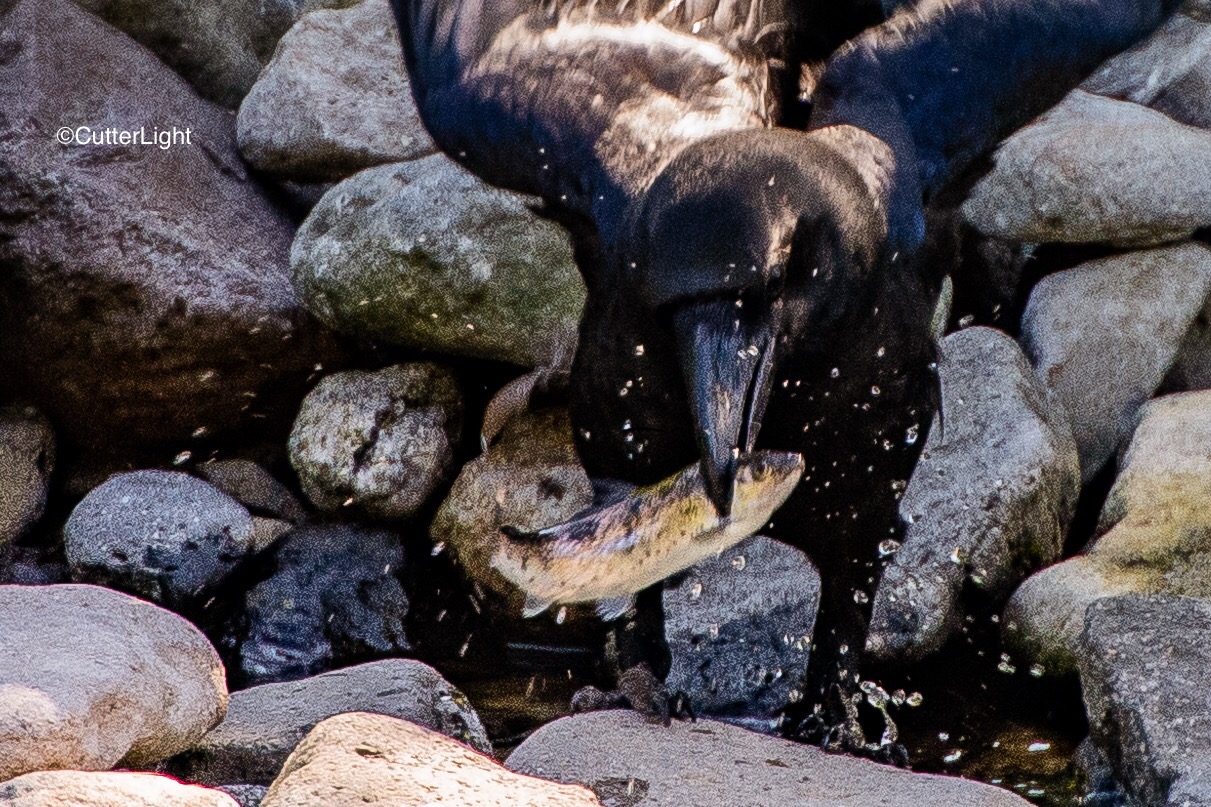
In addition to the owls, minks – a species introduced from America – are occasional nighttime visitors to the pool. In wintertime, bears follow spawning salmon up the stream. One afternoon I was watching the pool, camera in lap, when a Thick-billed Crow landed in a nearby tree. I knew right away what he had in mind, so I focused on the pool and waited. What I wasn’t prepared for was the short work he made of catching this trout. 

Knee Deep in Trout and Char (somewhere in Hokkaido)

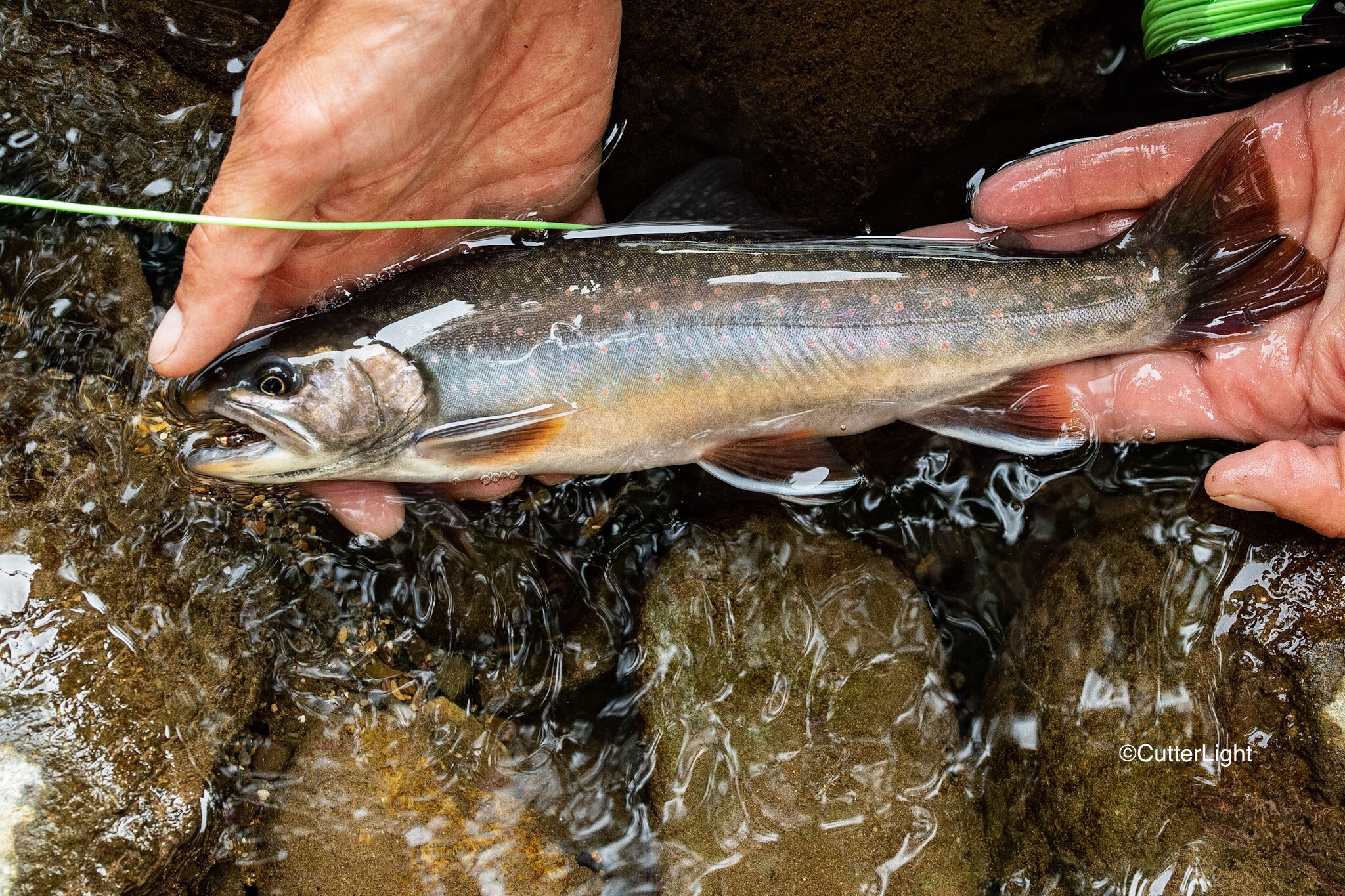
Iwana (Dolly Varden Char) are one of Hokkaido’s most celebrated cold-water fish.

I have an incurable habit of looking into water for fish. It doesn’t matter what kind of water. At the beach I check the translucent prisms of waves for whatever might be cruising the surf. Coming upon pools on rivers during hikes I make efforts to position myself so that I’m looking into shade rather than glare so that I can maybe catch a glimpse of something with fins. I’ll even check out coin fountains in the off chance that a carp or even a goldfish might be swimming around. But bridges on quiet country roads crossing pretty little trout streams are especially inviting. There’s almost always a pool below the bridge, and if the water has a population of trout, there are often a few of them hanging out right there. No matter how hard-fished the water might be, it’s worth a look.

Yamame could literally be translated as “Mountain Girl” – a lovely name for a lovely fish. More commonly the stream-dwelling form of this species is called “Cherry Trout.” Similar to Cutthroat and Rainbow Trout of the Pacific Northwest, (to which yamame are related), some go to sea where they attain sizes measured in pounds and return to their natal rivers to spawn bright as polished chrome – Cherry Salmon.

And so there we were, mid-afternoon, straddling our bikes and leaning over the the concrete side of a bridge on a quiet road running through a mix of forest and farmland somewhere in Hokkaido. The water was perfectly clear, but the trout and char are so adeptly camouflaged to match the stony bottoms of these streams that unless one moves they are all but impossible to pick out. 

One moved. As it rose to take something off the surface I could even see its spots. A char of some type. I hadn’t done any fishing yet in Hokkaido. This fish was telling me it was time I did.

I didn’t expect the fish to be large and they weren’t. But in the space of about two hours I covered a couple hundred yards of this silvery mountain stream and caught two dozen or so fish  About half of them were iwana. The others were yamame. A few came to a parachute Adams – my favorite dry fly searching pattern. A lot more came to a pheasant tail nymph – my favorite nymph. A couple of overly eager types tried to eat the pea-sized orange strike indicator I was using. 

A younger version of myself would have kept a few of these fish for the frying pan. But these days I fish for trout in part to simply confirm that they are present, and I wanted these fish to remain present. So Barbra took a couple of photos and I released everything to continue living out their lives in this silvery piece of water and light somewhere in Hokkaido.

There wasn’t a single human footprint along the banks, much less a path. Knee deep in a cold mountain stream full of trout and char – sitting on top of the world, legs hanging free.

Tunnels of Love – Light at the end of the Tunnel – Tunnel Vision: A Bicyclist’s Point of View

A kind snow tunnel – not too long, plenty of light, and just enough shoulder.

There is something about tunnels, sometimes dark and scary, sometimes magical and transformative.

When I was very young, my family drove around in a Volkswagen Beetle. I remember enjoying the magic of the immediate darkness of tunnels. The dark would be simultaneously met with the crackle of static on the radio as we lost reception. Then the heartbeat of yellow lights would blink into the windows from the dim tunnel lighting providing a rhythm to accompany the radio static. With a jolt from this world, the Beetle would be blasted back into the light and back into normal. It was fascinating to my young imagination.

Some welcome! Eighteen meters tall (almost 60 feet), the demon of Noboribetsu would be the perfect host to some of the tunnels we traversed.

Fast forward to our current bike trek in Hokkaido. Our ride has brought a whole new stream of consciousness to the tunnel. In recent years, hadn’t given much thought to these marvels of modern engineering, the exception being the time I drove our pickup while towing our fishing vessel Gillie through the unnervingly narrow tunnel that leads to the town of Whittier, Alaska. Steering wheel gripped tightly in my hands, I could feel the boat trailer sashaying back and forth on the slick railroad tracks that transversed the abyss. But that is another story.
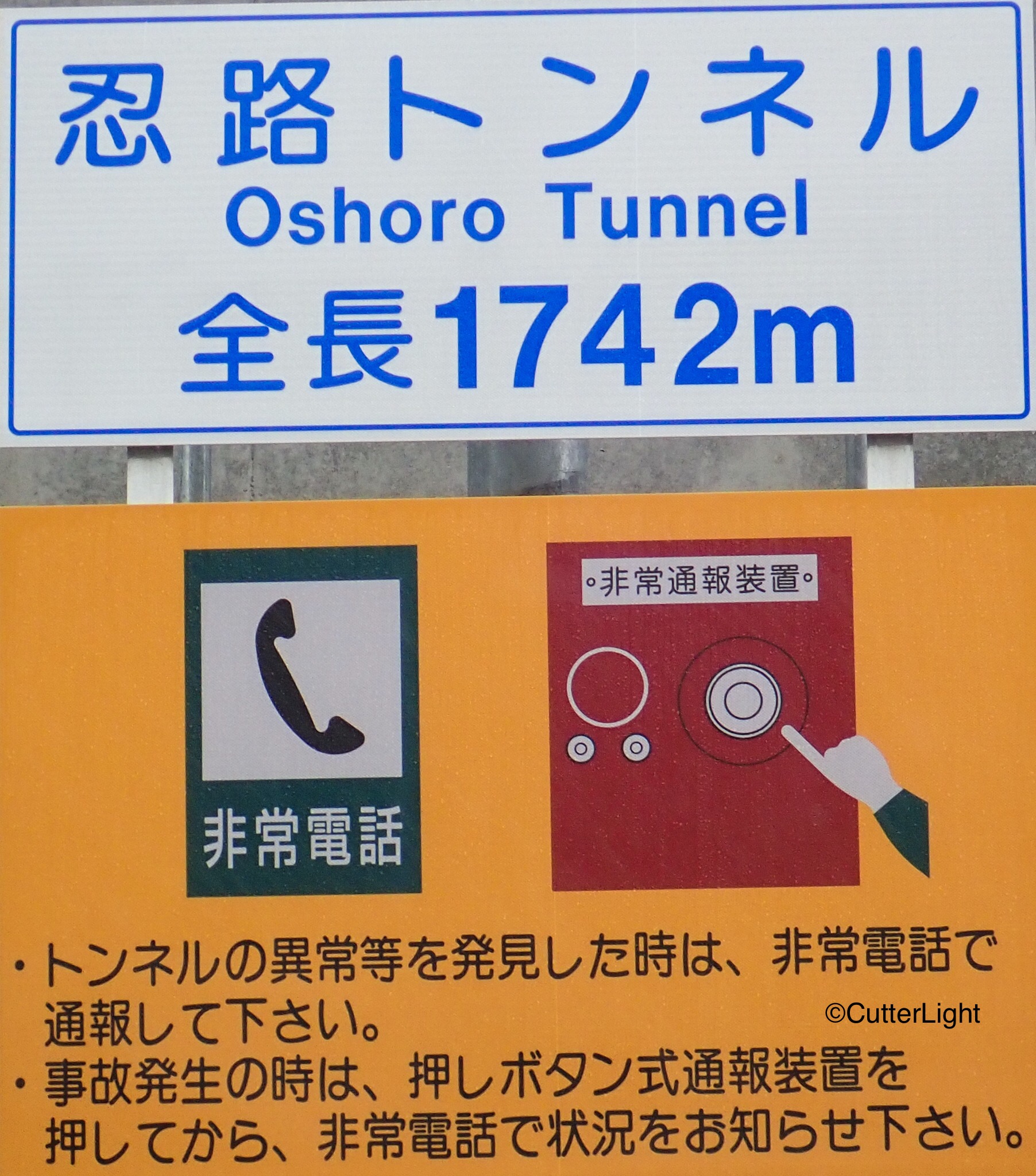
The first “real” tunnel seemed long, but at just over a mile, it turned out to be merely average.

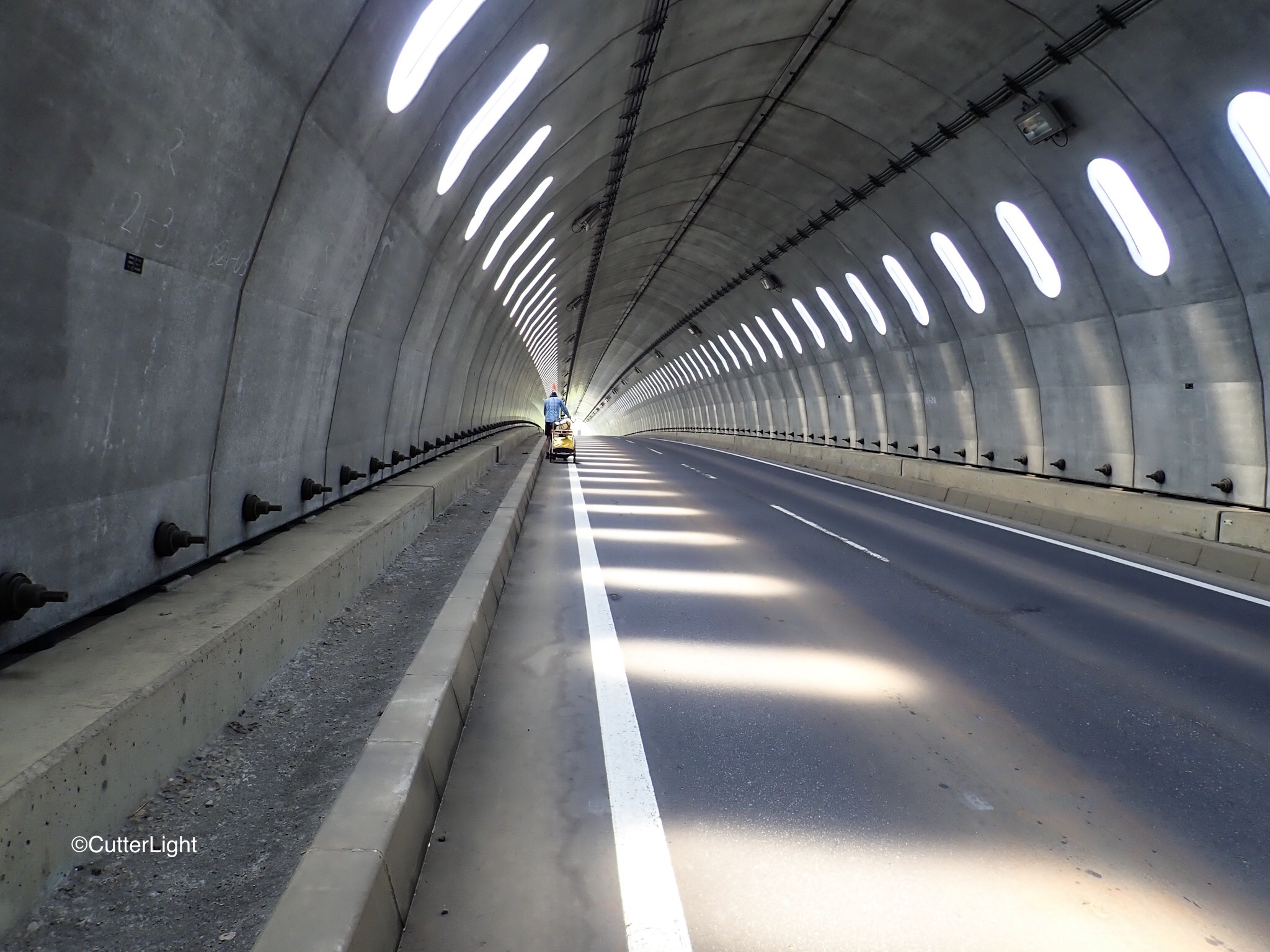
Our introduction to the tunnel by bicycle happened the very first day of our Hokkaido trek. It was a kind introduction as the tunnel was of the type designed to keep the heavy winter snowfalls off the road. Wrapped tight to a mountain pass, the tunnel’s outside wall featured a series of openings where sunlight poured in, giving the space a comfortable, open feeling. Moreover, there was a large enough shoulder to ensure safe passage even for our somewhat Rubinesque, trailer-towing bikes. Though several hundred meters in length, this first light-filled tunnel with its wide sidewalk was a breeze.

Our first “real” tunnel – dank, dark, cold, long and narrow – came later. We hugged the shoulder, our safety lights blinking, pedaling as fast as possible, worried that approaching vehicles wouldn’t see us in time. The amplified roar of oncoming traffic echoed and mixed with the odor of mold, grease, diesel and exhaust fumes and in that dark tube we experienced the paradox of simultaneously feeling that we we traveling very fast while making little progress. Jack found the energy in his legs to pull ahead, even while pulling the trailer. My nerves must have been apparent as a kind driver slowed behind me and escorted me to daylight.

At this point, I can’t believe how many tunnels we’ve gone through. The best tunnels have been the snow tunnels. They rank high because of the natural light and their relative brevity. On rare occasions, we’ve traveled through tunnels with a sidewalk separated by a safety railing. But even these tunnels can’t muffle the brain-rattling sounds of roaring trucks and screaming motorcycles, and there’s always the sense that you’ve got to concentrate on maintaining an unerringly straight course lest you pin yourself to some protrusion jutting out from the soot-stained tunnel wall.

One day, we had a relatively short ride from Yoichi to Otaru along Hokkaido’s southwest coast. The map showed tunnels…lots of tunnels…between the two towns and in fact the ride felt almost like a constant tunnel as even when we weren’t physically inside a tube we were psychologically preparing for one. This day featured our worst tunnel experience.

As usual, we were swallowed into the tunnel in question just as we had been swallowed into the semi-darkness and wet chill of previous tunnels. We rode on a sidewalk, which was just wide enough to handle our bike’s girth with panniers and the trailer. But perhaps a kilometer into the dimness and utterly without warning, the sidewalk shrunk to half its size. The next thing I knew, Jack’s front panniers hit the railings and he screeched to a stop. Escaping with a bloodied knuckle and a mouthful of expletives, we survived the tunnel by crowding into the flanks of our bikes and walking the remainder of the way, our shins absorbing a few pedal bites in the process, the experience bringing fresh gratitude for the light at the end of the tunnel!

After a wonderful two-days in the city of Otaru, we steeled our nerves for the ride up the coast. The ride would be beautiful. But there would be tunnels. Lots and some really long ones. Rattled from the most recent tunnel experience, at the first one we encountered we opted to push our bikes through on the very narrow sidewalk. Just wide enough to accommodate our bikes in this fashion, the sidewalk seemed to have been installed for maintenance workers rather than pedestrians. Our plan was for me to follow Jack closely and shout a warning if the outside trailer wheel got too close to the edge of the walk. Using this strategy was maybe safer, but it seemed like it took forever.

As we traveled up the coast, traffic grew lighter. We couldn’t stomach another long walk through another dark and deafening tunnel and the one we were now facing was truly a beast – two nearly adjoining tunnels spanning almost four miles. It was time to shore up our confidence and place some faith our fellow drivers. We strapped on headlamps and, as I was in the rear position, I added a couple of blinking lights to my rig and off we went.
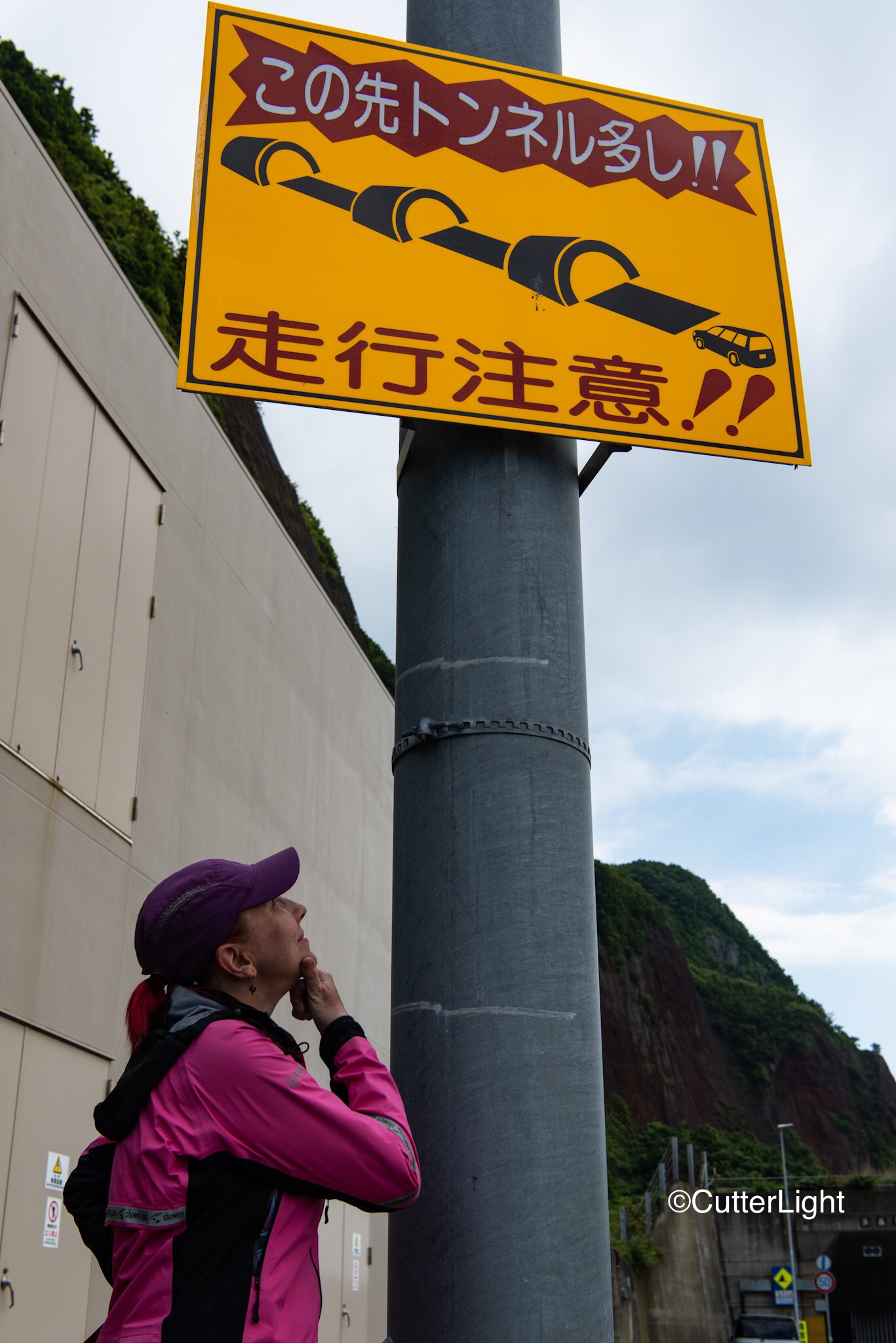
Translation? Tunnel after tunnel after tunnel after tunnel!”

At some point, I had adopted a strategy of singing in the tunnels in order to drown out the deafening noises and to distract myself from my own nerves. I didn’t just sing. I sang at the top of my lungs. This turned out to work pretty well – once Jack didn’t take my singing noises as anguished cries for help. And so for most of four miles I belted out any song that came to mind.

Time to take in some sunshine, enjoy lunch, and scan for birds.

Once we had finally put the beast behind us, we pulled off the road for a rest and a celebratory lunch. Apparently you can burn some serious calories pedaling like a dervish while simultaneously singing at the top of your lungs!

Tinged with the unknown and eliciting perhaps mixed emotions of safety and danger, tunnels remain fascinating to me. For a little while, they take you out of the world in which you’ve been residing, close in around you, carry you along in a way that demands a kind of trust… and then deliver you to some newly lighted world on the other side.
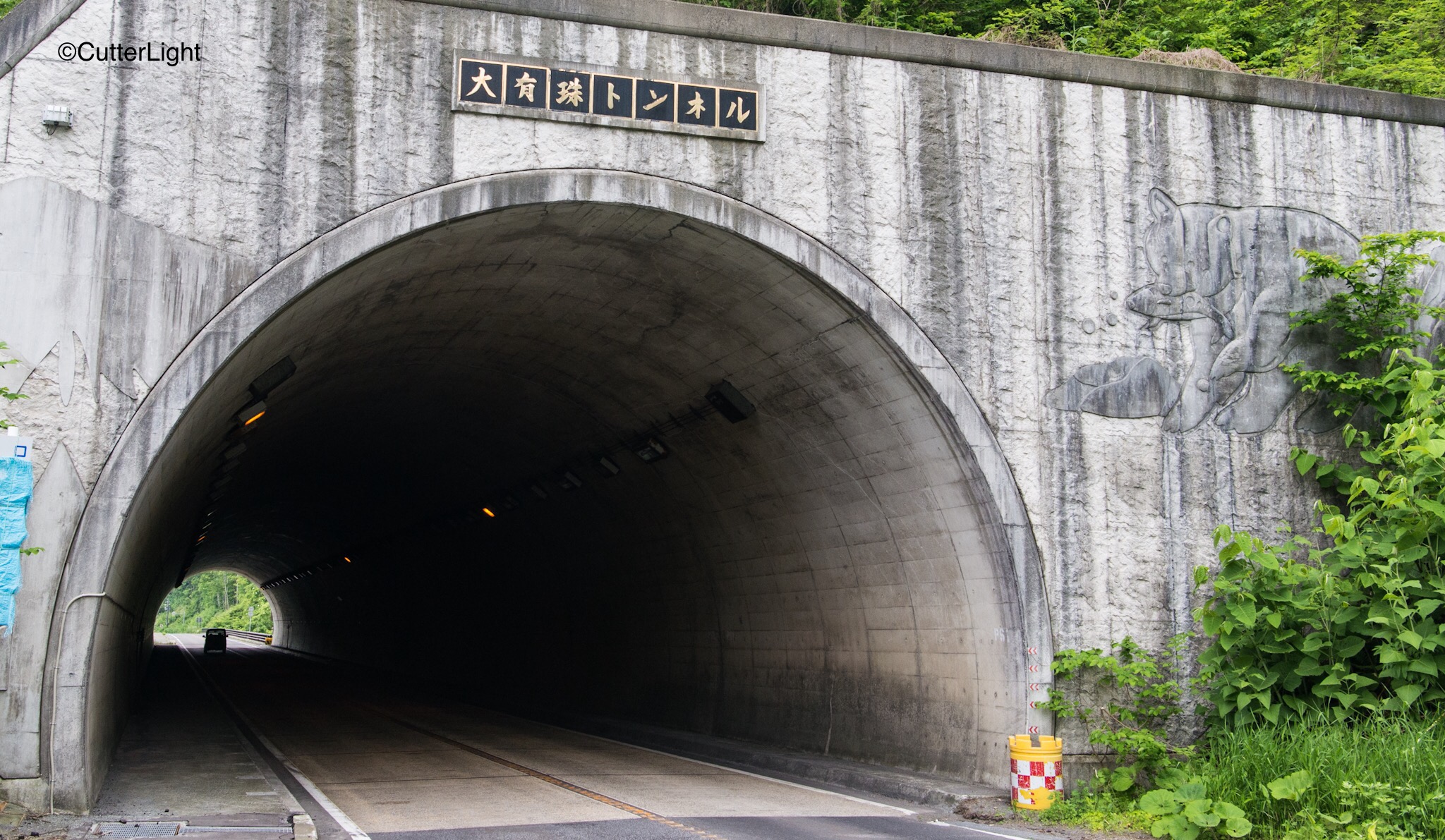
A happy bear eating salmon at one end and light at the other. A perfect tunnel.