Polar Numbing Stinging Cold

It’s cold in Point Hope.

Better words for cold according to the thesaurus –Siberian, algid, arctic, below freezing, below zero, benumbing, biting, bitter, blasting, bleak, boreal, brisk, brumal, chill, chilled, cool, crisp, cutting, frigid, frore, frosty, frozen, gelid, glacial, having goose bumps, hawkish, hiemal, hyperborean, icebox, iced, icy, inclement,intense, keen, nipping, nippy, numbed, numbing, one-dog night, penetrating, piercing, polar, raw, rimy, severe, sharp, shivery, sleety, snappy, snowy, stinging, two-dog night, wintry

We were warned when we left Shishmaref – “It’s cold up there.” We thought a few degrees colder would not make too much of a difference. Hmmmm…. I’ve been comparing Shishmaref to Point Hope. It’s true, it is only a few degrees colder here. But this week the “real feel” temperatures have been hovering around minus 40! When the high says 4 degrees, it’s likely that we may hit the high at 3 o’clock in the morning, not mid-day as you might guess. The sun does peek over the horizon, but not enough to warm anything yet. So, we are relying on wind currents to bring us some warmer air flows.

Last year, Jack bought a wolf ruff for my parka. One of our Shishmaref friends finished it and attached it to my coat. It makes a huge difference in blocking the wind. I have polar fleece pants with a wind-blocker lining. I have thick neoprene “muck” boots. I often wear two hats–one with a face blocker. For me, all these are necessities, even for the relatively short walks to school, the post office, or to the store.  One of my students walked home from the school last Saturday without a hat and got frostbite on her ear!

I can feel every crack in my armor.  If my mitten exposes my wrist, it hurts. The slit between my hat and the face blocker stings with cold.

The words in the thesaurus don’t do justice to the cold up here.

Way-Better-Than-Pecan-Pie Bars

When I was first introduced to pecan pie, I didn’t like it. I love sweets, but pecan pie was too gloppy. I was disappointed that it had more “goo” than pecans. The idea of pecan pie is a good one, but I’ve always thought it could be improved. Jack says I’ve just never had good pecan pie. I bet he’s right. 😉

Today, I found a blog that had a recipe which seem to do the trick. Amy at Elephant Eats took all the flavors of pecan pie (plus chocolate) and converted it to a cookie bar.

I did make a few changes. First of all, I halved the recipe. Although we have visitors to help us eat our confections, there is no need to have too many sweets around…they are too tempting. I also increased the pecans to avoid the disappointment of “too much goo and not enough pecans.” They came out terrific. And they are way better than pecan pie!

One last piece of advice – no matter how much your husband begs you, don’t cut into these bars until they are cool. They will fall apart!

Ingredients

  • 1 1/2 cups flour
  • 1 cup sugar
  • 1/2 cup softened unsalted butter
  • 1/4 teaspoon salt
  • 3/4 cup dark Caro syrup
  • 1/2 cup semi-sweet chocolate chips
  • 2 eggs
  • 3/4 teaspoon vanilla
  • 2 cups chopped pecans

Directions

1. Preheat oven to 350 F.

2. Grease bottom and sides of a 7 1/2″ x 11″ pyrex glass pan.

3. In bowl, mix flour, 1/4 cup of sugar, butter, and salt until it resembles coarse crumbs. Press into bottom of pan. Bake for 20 minutes.

4. In a pot, using low heat, stir corn syrup and chocolate until it’s melted and well blended. Remove from heat. Stir in the rest of the sugar, eggs, and vanilla until blended. Stir in pecans.

5. Pour filling over hot crust. Bake for 30 minutes or until firm around edges, but slightly soft in center. Cool on wire rack. Cut into bars.

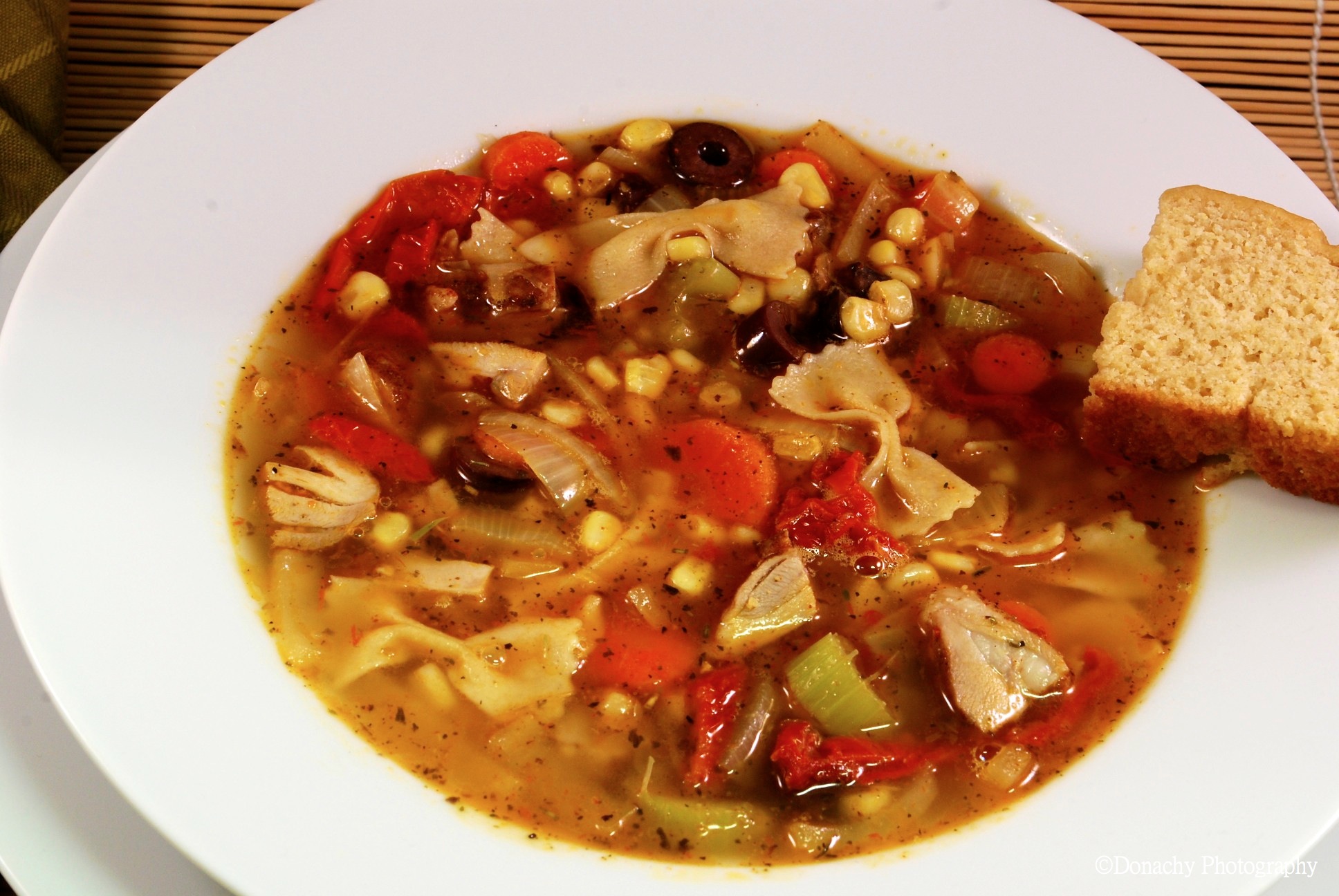
Spicy Chicken Farfalle Soup

A hot bowl of spicy chicken and bow tie soup is just the thing on a cold January day.

We’re both fans of Southwestern style rubs. Penzey Spices makes a good one, as does Dean & Deluca. I’m sure there are others. I whipped up this wonderfully spicy chicken noodle soup using leftover chicken thighs I’d rubbed and broiled for last night’s dinner. Vary your ingredients according to how much chicken you have on hand and what’s in your pantry. By the way, if you haven’t tried Better Than Bouillon brand, it really is–better than bouillon. Much better. In addition to plain chicken and beef, they make 42 other styles of soup base including a lobster base that is absolutely delicious.

Ingredients:

  • skinless, boneless chicken thighs rubbed with Southwestern-style seasoning and broiled
  • sweet onions, chopped coarse
  • carrots, chopped coarse
  • celery, chopped coarse
  • sweet corn
  • garlic, chopped coarse
  • Kalamata olives, chopped coarse
  • sun-dried tomatoes, chopped coarse
  • mushrooms, chopped coarse
  • fresh bow tie (or other) pasta
  • Cholula sauce
  • Better Than Bouillon, chicken flavor
  • olive oil
  • Italian herbs (fresh or dried)
  • smoked sea salt
  • freshly ground black pepper
  • (If I had fresh, hot red peppers, I would have used them)

1. Cut chicken into small pieces and set aside.

2. Place enough water in a pot to cover the ingredients. Add bouillon and bring to a boil.

3. Heat olive oil in a skillet. Add chopped vegetables, starting with the carrots and onions as they require more cooking time. Add Italian herbs and stir in well. After two or three minutes, add celery, olives, garlic and mushrooms. Cook until onions are just turning translucent and carrots and celery are just barely crunchy.

4. Add sautéed vegetables to boiling water. Add chicken, Cholula sauce to taste, a few grinds of pepper and the smoked sea salt.

5. Add fresh pasta and continue boiling till just done. (If using store-bought pasta, it is better to add it to the boiling water before adding the other ingredients to cook it to desired tenderness without overcooking the vegetables.)

6. Serve piping hot.

Arctic School Bus

When I heard that Point Hope had a school bus, my first thought was that a bus seemed extravagant in a village that stretches barely over 1/2 mile  from tip to tip. Not only do we have a school bus, but it’s a shiny, brand-new school bus that just came off the barge this summer. Wow, I thought, our school district is rich!

Once winter set in, my perspective changed. These days, walking the scant 150 feet from the front door of our house to the school is no small enterprise. Bundled up from toe to nose and nearly getting blown off my feet by icy blasts of wind, I totally get the school bus. Within minutes, any skin exposed to this wind begins to hurt! Who would walk to school in those conditions? There are days I wish I could take the school bus.

Salmon Burgers with Caesar Slaw

Fried mashed potatoes (made with golds, russets and purple Peruvian potatoes) accompanies a serving of Caesar slaw & salmon burger.

We’re about halfway through the school year. That means it’s time to assess where we are on groceries in order to tweak our list for next year. It also means our menus from here to the end of the year need to include food based on quantities and expiration dates. Recently I reorganized our freezers and was surprised (and pleased!) to see how much salmon we have left. Vacuum-sealed, it will keep through the summer and welcome us into the next school year. Even so, the abundance of salmon inspired us to find some new recipes to try with one of our favorite fish. Jack is famous for his “shio-yaki” style fish. This is fish broiled with a simple seasoning of salt and pepper–easy and one of the best ways to showcase the flavor of good fish. But I figured it was time we gave our culinary skills a stretch. So…

Salmon Burgers alone are not an earth-shattering idea, but serving the burgers atop a Caesar-syle slaw made for a truly noteworthy entrée. Enhanced by the color of the purple cabbage and of the salmon burgers themselves, every bite was wonderful–from the initial crunch to the flavor of the medley of salty anchovies, freshly cracked pepper, lemon, and dijon mustard.

To make the salmon burgers, start with 3/4 pound of salmon prepared shio-yaki style.

Shio-yaki salmon (shio = salt; yaki = broiled or char-broiled)

  • 3/4 lb fresh salmon fillet, skin on
  • sea salt & freshly cracked black pepper
  • olive oil

Place pan under broiler and preheat. Place salmon skin-side down on a cutting board and rub in sea salt and pepper. Let stand for a few minutes. When broiler pan is hot, spray or brush with olive oil and place salmon fillet skin-side down. Salmon should sizzle when it hits the pan. Cook approximately 10 minutes per inch, or until white fat can be seen coming out of the salmon. Avoid overcooking.

Salmon Burgers: (Makes 5 burgers)

  • 3/4 pound cooked or canned salmon, flaked. Include chopped skin, if desired. (See above for cooking suggestion)
  • freshly ground pepper to taste
  • sea salt (optional)
  • 1 tablespoon lemon juice
  • 2 cloves garlic, chopped fine
  • 2 cups Saltine cracker crumbs
  • 1 teaspoon dried basil
  • 1 teaspoon dried tarragon
  • egg whites from 2 eggs, lightly beaten

Place flaked salmon, ground pepper, salt, lemon juice, garlic, basil, tarragon, cracker crumbs, and egg whites in a glass mixing bowl. Mix together and make patties to the size desired. (Makes five nice-sized burgers.)

Add about three tablespoons of olive oil to a large skillet and heat on medium high. Cook the salmon burgers about 3 minutes on each side.

Caesar Slaw: (Makes enough slaw for 2+ servings)

  • 3 cups chopped purple cabbage
  • 1 tablespoon dijon mustard
  • 1/2 teaspoon freshly cracked black pepper (or more to taste)
  • 1 tablespoon lemon juice
  • 1 tablespoon Worcestershire sauce
  • 1 clove garlic, finely chopped
  • 4 anchovies (about 3/4 tablespoon–about 1/2 of a tin) finely chopped
  • 1/4 cup olive oil

In a glass bowl, add pepper, garlic, lemon juice, Worcestershire sauce, anchovies, dijon mustard and olive oil. Mix together using a whisk or spoon. Add the cabbage and mix thoroughly, until all is coated.

Place a serving of Caesar slaw on a plate, then the salmon burger atop the slaw. Try it with a favorite lager!

Stay tuned for our next salmon adventures. Yum!

Bringing in 2012

On the final evening of 2011, Eskimo dancing and storytelling were featured in the school gym before Point Hope ushered in the new year with a display of fireworks over the frozen sea. We braved the -20 degree walk to school to see the activities in the school gym. The return walk home, with the wind in our faces, convinced us to try to watch the fireworks through the windows of our cozy, warm home while enjoying snacks and a hot beverage.

In our lower 48 life, we would have torn open a package of instant hot cocoa and pepped it up with peppermint schnapps. Necessity is the mother of invention up here: 4 1/2 tablespoons of Ghirardelli cocoa powder, 3 cups of vanilla soy milk, 2 tablespoons of sugar and 6 leftover candy canes crushed to powder with a meat mallet, all placed in a small pot and heated while whisking the ingredients and Voila! Three Arctic hot chocolate “dry” Snugglers – creamy and sweet with a lovely hint of mint.

And for a crunchy snack to go with our drinks: 2 cups of almonds, 1 cup of sugar, 1/2 cup of water and 1 tablespoon of cinnamon, cooked in a pot on medium high heat until the water was evaporated (about 15 minutes). Cool on a waxed-paper covered baking sheet. The cinnamon almonds were reminiscent of the nuts one might have purchased from a street vendor during a Victorian Christmas in years past.

Best wishes to all for a terrific 2012!

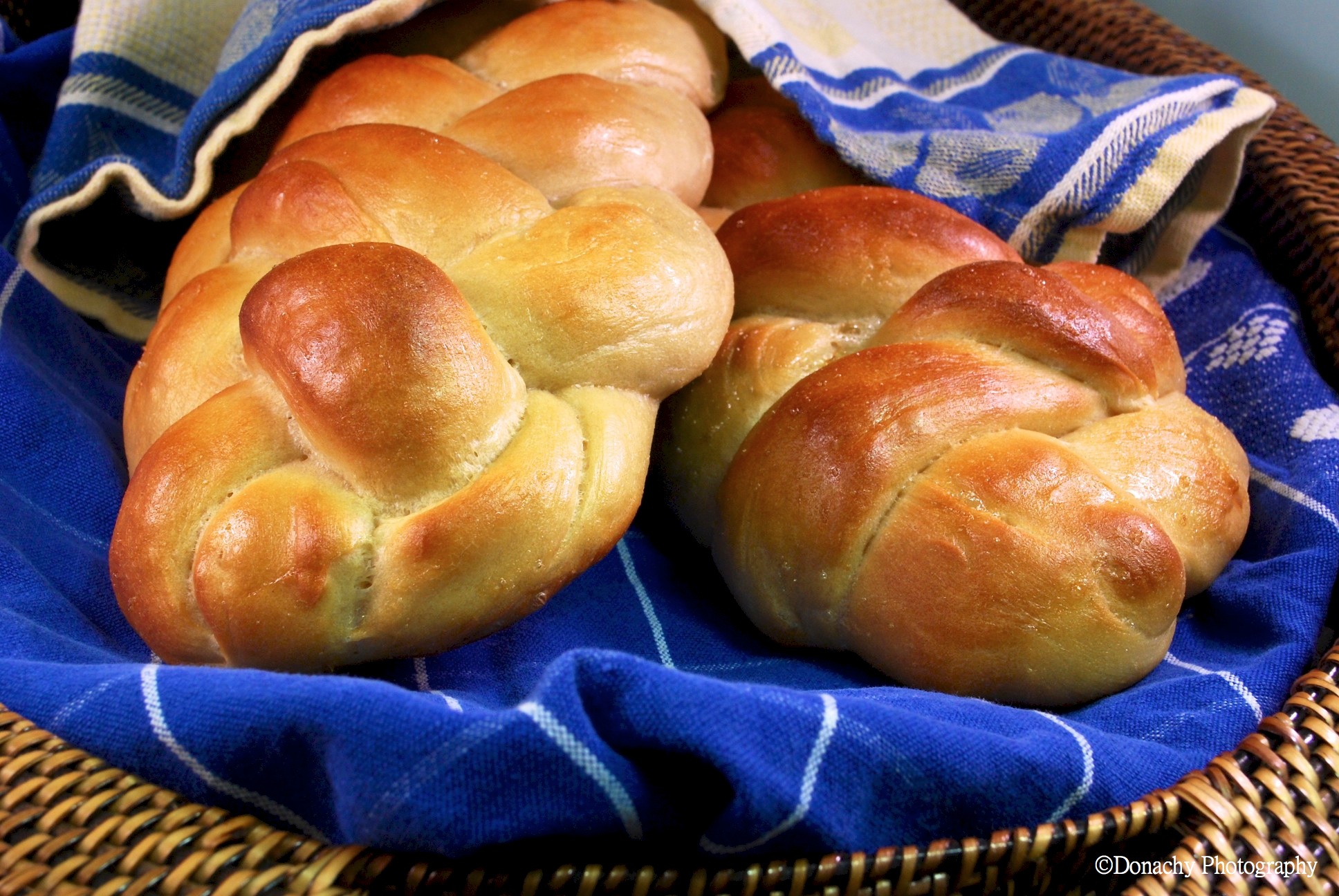
Züpfe – Delicious Swiss Bread

The bread loaves are nestled in kitchen towels to hide the fact that we ate half of one of the loaves before I could take a photo!

Two similar breads came to mind for my next baking adventure. Swiss Zopf, which is known as Züpfe in the Bernese region of Switzerland, and Challah, a traditional sabbath bread in the Jewish tradition. I was lucky enough to enjoy both when I was young. They are similar in texture and in their beautiful braided presentation.

Yesterday’s decision to create loaves of Züpfe was based on my being able to adapt the dough to my bread machine. The temperature in our house doesn’t seem conducive to bread rising. The same problem exists when I try to let bread rise in the oven. To modify Victoria’s recipe for my Zojirushi bread machine, I mixed all the wet ingredients and placed them at the bottom of the pan. I layered on the bread flour and the yeast. Per many suggestions by recipe users, I also added one teaspoon of salt. After the bread dough processed in the machine, I braided the dough using a four-strand braid and let it rise on a parchment covered baking sheet for about an hour in a barely heated oven before finally baking it. It doubled in size!

Honestly, when I was finished braiding the bread, I had one of those I-am-so-impressed-with-myself moments. At these moments, I totally get the end zone celebration dance. Then it came out of the oven – wow! I proudly paraded the baked beauties through the house so that Jack and Maia would be impressed. The final victory? Hot slices of deliciously soft bread slathered in butter.

Thank you to Victoria Marler and her recipe at  http://allrecipes.com/recipe/zopf. Her recipe follows for the traditional baking of Swiss Zopf bread loaves.

Ingredients

  • 1 (.25 ounce) package active dry yeast
  • 1 1/3 cups warm milk
  • 1 egg yolk
  • 2 tablespoons butter, softened
  • 3 1/2 cups bread flour
  • 1 egg white
  • 1 tablespoon water

Directions

  1. In a large bowl, dissolve yeast in warm milk. Let stand until creamy, about 10 minutes. Add the egg yolk, butter and 2 cups of bread flour; stir well to combine. Stir in the remaining flour, 1/2 cup at a time, beating well after each addition. When the dough has pulled together, turn it out onto a lightly floured surface and knead until smooth and elastic, about 8 minutes.
  2. Divide the dough into 3 equal pieces and roll each piece into a 14 inch long cylinder. Braid the pieces together and place on a lightly greased baking sheet. Cover with a damp cloth and let rise until doubled in size, about 1 hour. Meanwhile, preheat oven to 425 degrees F (220 degrees C).
  3. In a small bowl, beat together egg white and water. Brush risen loaf with egg wash and bake in preheated oven for 20 to 25, until golden.

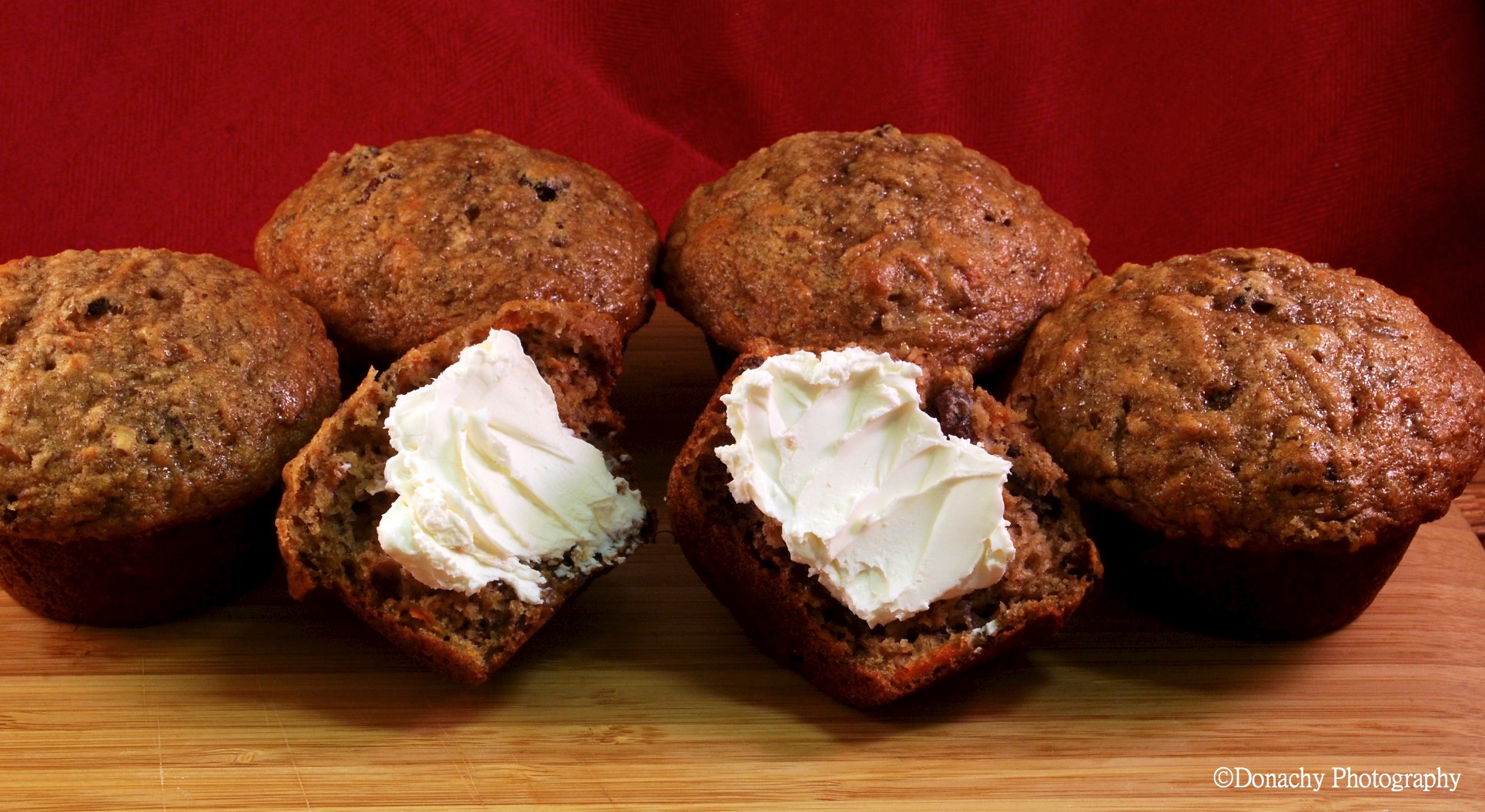
Sunshine Muffins

Some mornings just seem to call for fresh baked muffins. In just 45 minutes, we were enjoying steaming cups of coffee with these muffins which are chock full of grated carrots and pears, nuts and raisins. We love these muffins smeared with cream cheese. All the healthy ingredients make me feel like I’ve had a dose of sunshine–a great feeling on a morning when it’s negative 9 degrees outside and we still have eleven days to go until we see the sunrise. The recipe below can be easily modified based on what’s in the kitchen.

Sunshine Muffins:

  • 2 cups all-purpose flour
  • 1 1/4 cups white sugar
  • 2 teaspoons baking soda
  • 2 teaspoons ground cinnamon
  • 1/4 teaspoon salt
  • 2 cups shredded carrots
  • 1 pear – peeled, cored and shredded
  • 1/2 cup raisins
  • 1/2 cup chopped pecans
  • 1/2 cup mashed overripe banana
  • 1/2 cup applesauce
  • 4 eggs
  • 2 teaspoons vanilla extract
  1. Preheat oven to 350 degrees F (175 degrees C). Grease 12 muffin cups, or line with paper muffin liners.
  2. In a large bowl, mix together flour, sugar, baking soda, cinnamon, and salt. Stir in the carrot, raisins, nuts, and shredded pear.
  3. In a separate bowl, beat together eggs, applesauce, mashed banana, and vanilla. Stir egg mixture into the carrot/flour mixture, just until moistened. Scoop batter into prepared muffin cups.
  4. Bake in preheated oven for 25 minutes, until a wooden toothpick inserted into center of a muffin comes out clean.

Yields 12 muffins.

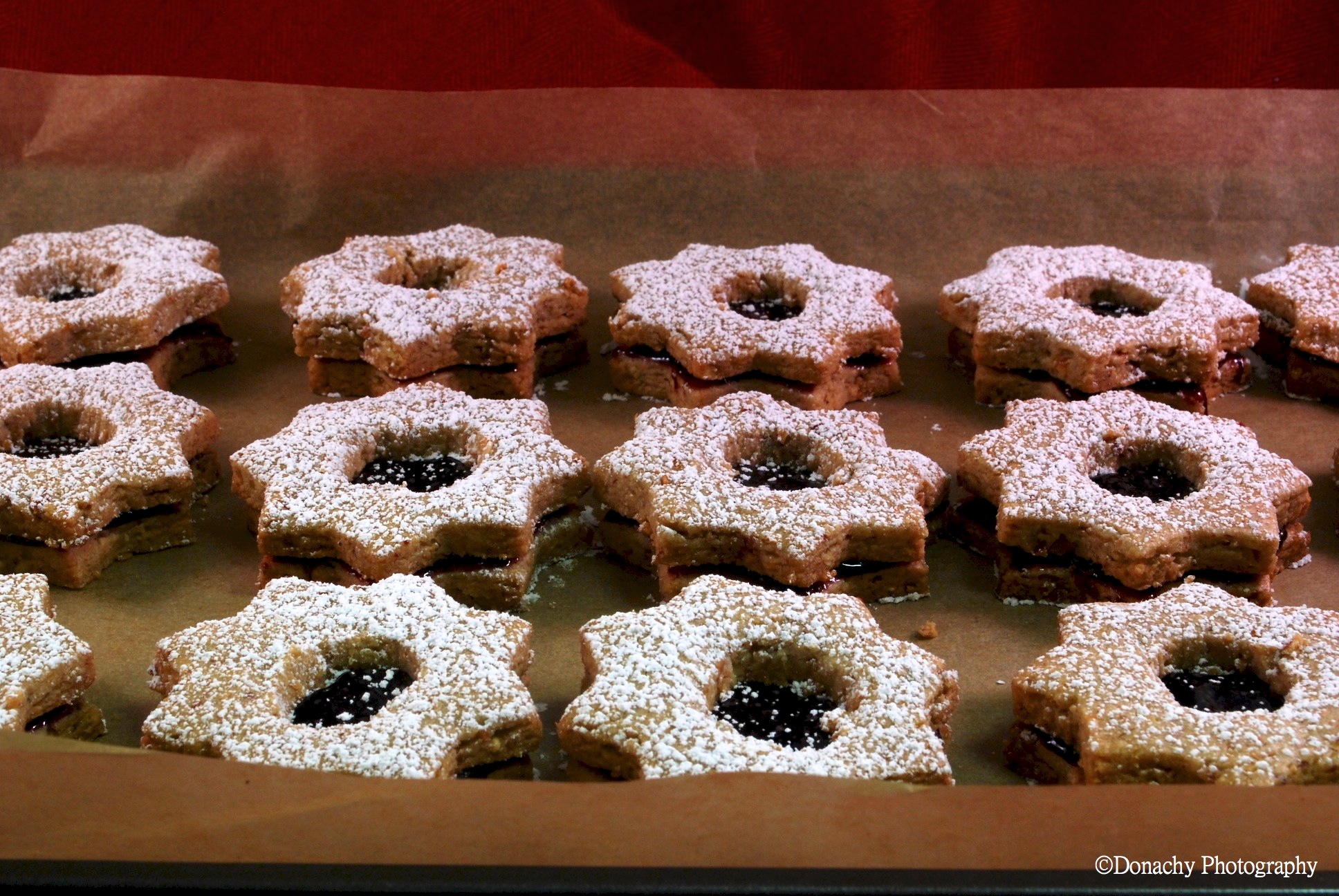
A Merry Christmas with Linzer Cookies

Happy Holidays!

Tired of cookies yet? We’re not. I’m still baking through memories from my youth. Linzer cookies remind me of visits to my family in Switzerland. My aunt would take me to Swiss bakeries with shelves full of tasty choices. Linzer was a regular choice.

I knew that sandwich-type cookies were going to be more effort than others that I’ve made, and I was right. My kitchen has limited gadgetry which makes for a really hands-on experience. I followed this recipe from the Williams-Sonoma Baking Book. The first step is toasting the almonds and then chopping them fine. I did this with a hand-powered nut chopper. I probably should have prepared this before my Insanity workout; it seemed to take a really long time to chop with wobbly muscles. Zesting an orange means carefully peeling off the outside layer and mincing the peel with a large sharp kitchen knife. When the chilled dough came out of the fridge, it felt too crumbly. I worked with it anyway, following the advice to roll the dough between sheets of waxed paper. The whole process took several hours. All in in, the cookies turned out wonderfully. Jack’s review, “The finest tea cookie I’ve ever tasted.” Today, they will go to a Christmas cookie exchange. Hopefully the recipients will enjoy them, too.

Gather some elves (preferably the kind that make cookies), put on some good music, and here’s the recipe:

Linzer Cookies (courtesy of The Wiliams-Sonoma Baking Book p. 12)

Makes about 1 dozen cookies.

Ingredients

  • 1 cup almonds, toasted
  • 1/2 cup unsalted butter, at room temperature
  • 1/2 cup granulated sugar
  • 1 large egg yolk
  • 1 tsp finely grated orange zest
  • 3/4 tsp pure vanilla extract
  • 1/4 tsp pure almond extract
  • 1 cup all-purpose flour
  • 1/2 tsp ground cinnamon
  • 1/4 tsp salt
  • 1/4 cup seedless raspberry jam
  • Confectioners’ sugar for dusting

Toast almonds by spreading them in a single layer on a baking sheet and bake them in a 350 degree oven for about 8 minutes. In a food processor, finely grind the cooled toasted almonds using short pulses. Set aside. In a large bowl, using an electric mixer on high speed, cream the butter until fluffy and pale yellow. Add the granulated sugar and continue beating until combined. Add the egg yolk, orange zest, vanilla, an almond extract and beat on low speed until well blended.

Sift flour, cinnamon, and salt together into another bowl. Add the ground almonds and stir to blend. Add the flour-nut mixture to the butter mixture and mix on low speed or stir with a wooden spoon until blended. The dough should be soft. Turn the dough out of the bowl, divide into 4 equal portions, and wrap each in plastic wrap. Refrigerate until chilled, about 1 hour.

Preheat the oven to 350 degrees. Lightly grease 2 baking sheets or line them with parchment (baking) paper. Remove 1 portion of the dough at a time from the refrigerator, place between 2 sheets of waxed paper, and roll out to 1/4 inch thickness. Using a cookie cutter about 2 1/2 inches in diameter, cut out the cookies. Cut a hole in the center of half of the cookies with a 1 1/4 inch cutter. Repeat to roll out remaining dough portions, then reroll the dough scraps as needed to make 24 cutouts in all, cutting holes in half of them. If the dough becomes sticky, wrap it and chill in the freezer for about 10 minutes before rolling out.

Using a thin spatula, carefully transfer the cookies to the prepared pans, Bake until firm to the touch, about 12 minutes. Transfer the pans to wire racks. Loosen the cookies from the pans with the spatula, but leave in place on the pans until cooled.

To assemble, spread the solid cookies with about 1 teaspoon of the raspberry jam to within about 1/4 inch of the edges. Using a fine-mesh sieve, dust the cookies with the center cut-out (the cookies that go on top) with confections’ sugar. Top the solid cookies with the cutout cookies.

Enjoy these cookies with a steaming cup of hot tea.

Bowhead Whale Stew

An original caribou antler and walrus ivory carving by Edwin Weyiouanna guards a bowl of bowhead whale stew.

Outside it was -11 degrees Fahrenheit. The steady 25 mile per hour wind brought the chill down to negative 40, making it a good day to stay inside and cook a big pot of comfort food.

I could feel the frigid north wind seeping in around the edges of the window over the kitchen sink as I stared apprehensively at the three, one-pound cubes of thawed whale meat draining in the stainless steel basin. The odor of the dark red meat was decidedly un-beef-like, but it was mild and agreeable nonetheless – not at all gamey or fishy. The texture was a bit like that of fresh halibut – soft and dense. The meat of the bowhead whale, the largest genus of right whale, might be compared to especially tender filet mignon. I had no idea what cooking would do to the texture, or what the meat would taste like. “Good beef,” I hoped as I rinsed the meat and considered my next move.

For the past 27 years, Craig Claiborne’s The New York Times Cookbook has been a faithful companion – my go-to reference when I’m not sure what to do next in the kitchen. I turned to Claiborne’s basic recipe for beef stew, made a few modifications to take into account what we have on hand and our own tastes, and proceeded from there. The end product was probably the best meat stew we’ve ever had (allowing for the fact that our creation would have been improved with the addition of three cups of good red wine, which is, of course, unavailable up here.) The meat was wonderfully tender and no more strongly flavored than, say, strip steak, and complimented the seasonings and other textures in the stew beautifully. I served three piping hot bowls of stew with freshly baked cornbread muffins while daughter Maia cued up the film The Triplets of Belleville on our big movie screen – the perfect recipe for staying warm north of the Arctic Circle.