Ink and Light: Watching for Whales and a thought about roads less traveled (and places seldom fished)

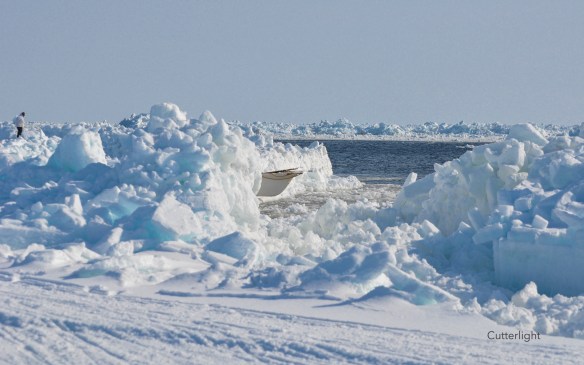
Watching for Whales: Point Hope, Alaska

The Inupiat Eskimos of Point Hope, Alaska (population 750) harvest an average of five to 10 Bowhead Whales each spring as part of their subsistence traditions. The season begins in March as whaling crews begin making trails over the frozen sea – at times an arduous task as the sea ice has often buckled up into fairly tall, jagged ridges and it may be several miles over frozen ocean to reach the open leads where the Bowhead and Belugas migrate. Crews still use traditional umiaks, boats made by stretching the skin of Bearded Seals over handcrafted wooden frames. Managed for sustainability, the Chukchi Sea’s Bowhead Whale population is increasing.

When I recall places like this, I wish nothing more than for this to be he way it is for the rest of my life – pointing a pickup truck upstream, upriver, up tide, cutting through forests or along beaches, looking for fish in places only a few people know about, can get to… have time for.
Jack Donachy – from Gravel Lick, 1991

Barbra and I lived in Point Hope, Alaska, from 2011 – 2014.

Ink and Light: Silver on Ice and lines from John Masefield

Silver on Ice: Onboard Gillie, Gulf of Alaska outside Resurrection Bay

Also known as Silver Salmon, tens of thousands to hundreds of thousands of Coho Salmon return to Resurrection Bay near Seward, Alaska each summer where they constitute the greatest Coho Salmon sport fishery in the world. 

I must go down to the sea again, for the call of the running tide
Is a wild call and a clear call that may not be denied;
And all I ask is a windy day with the white clouds flying,
And the flung spray and the blown spume, and the sea-gulls crying.
John Masefield – Sea Fever, 1912

John Masefield (1878-1967) went to sea at the age of 16. About a year later he deserted ship, initially thereafter living as a vagrant and taking odd jobs, but the awe he experienced on the open sea never left him. Masefield was England’s Poet Laureate from 1930-1967.

Ink and Light: Snow Birds and Basho

Snow Birds: House Sparrows, Ulaanbaatar, Mongolia

Come!
Let’s go snow-viewing
till we’re buried!
Matsuo Basho, 1644 – 1694

House Sparrow males and females are dimorphic: a female is center in this photo, accompanied by three males. This species has adapted so well to life with people, they’ve become nearly ubiquitous in places of human habitation throughout the world – and nearly absent in more natural environments.

Basho suffered from severe bouts of depression, occasionally becoming recluse for long periods of time. A solitary nature took him on a number of journeys, alone, along routes that were often well off the beaten path. The Edo Five Routes which he followed on one of his earliest journeys were considered to be among Japan’s most dangerous roads; When he first embarked on this trek, he expected to be killed by thieves or to simply die along the way. Widely regarded as the world’s finest master of hokku (haiku), his poetic travel log Oku no Hosomichi (The Narrow Road to the Interior) is considered to be his finest work. 

Ink and Light: The Bones of Tikigaq and a Tribute to Tatanka Yotanka, Sitting Bull

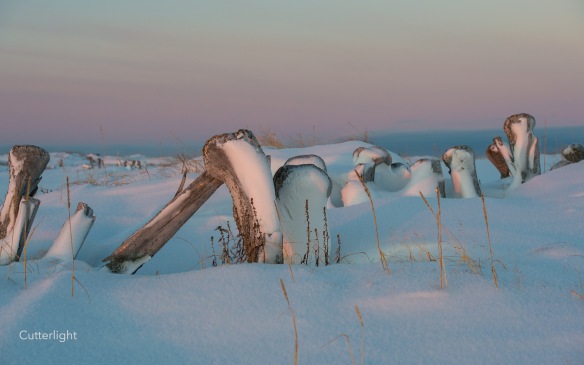
x whale bone ruins Tikigaq copy n

Whale Bones and Ruins: Old Tikigaq Village, Point Hope, Alaska

Tikigaq’s sod, driftwood and whalebone igloos (homes) were occupied until the mid-1970’s when the village was abandoned due to erosion from the sea. By this time, some of the houses were wired for electricity. Sigluaks, freezers dug deep in the permafrost at Tikigaq, are still used by the people of nearby Point Hope to store the whale meat they’ve harvested.

If a man loses anything
and goes back and looks carefully for it
he will find it…
Tȟatȟáŋka Íyotȟake (Sitting Bull) – Pine Ridge Reservation Speech, 1883

Tatanka Yotanka (1831-1890) was a Lakota Sioux holy man who earned his place in history through his fierce resistance to white encroachment on Lakota lands. A vision he had seemed to foretell the victory a combined force of Sioux and Cheyenne would have over United States troops led by General Custer at The Battle of Little Bighorn in 1876. In 1880, Tatanka Yotanka was assassinated by Indian Agency Police at Fort Yates on the Standing Rock Agency (reservation) who feared that he would lead an uprising. His remains are buried near his birthplace in Mobridge, South Dakota. A monument marks the site.

Ink and Light: “Point Hope” – The Aurora Borealis & Jack London

x-point-hope-copy-n

Point Hope: Point Hope, Alaska

Solar winds disrupting Earth’s magnetic field cause the Aurora Borealis. They are often most spectacular on finger-numbingly cold nights in the depths of winter.

Point Hope is an Inupiaq Eskimo village of about 750 inhabitants located 200 miles above the Arctic Circle on Alaska’s North Slope. Originally known as Tikigaq (index finger for the slender peninsula that once extended into the Chukchi Sea before erosion took it away), the area is one of the oldest continuously inhabited places in North America. Subsistence hunting for caribou and Bowhead Whales continues to be an important part of the culture. With no roads existing beyond the village, the local airport (lit up in the above photo) is an important lifeline to and from the outside world.

…the aurora borealis flaming coldly overhead,
…the stars leaping in the frost dance,
…the land numb and frozen under its pall of snow…
Jack London – from The Call of the Wild, 1903

  – Jack London (1876-1916) was one of the first authors to become wealthy writing fiction. Mostly self-educated, after stints as a hobo, a sailor, and 30 days in the Erie County Penitentiary in the state of New York for vagrancy, he made his way to California where he attended high school and began writing in earnest.

How Have Long Life: Life Philosophy from Alaska’s Longest Reindeer Herder

winter sky_n

The sun doesn’t rise now. In its absence, there is darkness and dusk. And there is beauty in the pink hues and  blue silhouettes of midday.

Words to live by from the longest reindeer herder, Chester Asakak Seveck.

For long live and joy life,

I believe these things –

Keep busy and do good work.

Have much good exercise.

Eat good food,

no waste anything

and every day enjoy what it gives

and do not spoil this day with much worry of tomorrow.

Be happy.

I know this way

how I be “Longest Reindeer Herder.”

Start 1908, finish 1954,

altogether 46 years herd reindeer.

From Longest Reindeer Herder: A true life story of an Alaskan Eskimo covering the period from 1890 to 1973, by Chester Asakak Seveck