Mumble Creek Brookie That Stream that Shall Not be Named, Pennsylvania, May 2021
A few weeks ago here on Cutterlight I published a tribute to a recently passed friend and mentor, Bill Kodrich. Concurrently, I sent the article to the fly-fishing zine Hatch Magazine hoping to get Bill a bit more ink and appreciation. The editor asked for a longer piece, which I was happy to supply. The article went live on Hatch this morning. I wrote the piece as not only a tribute to Bill, but as a reminder of two things to consider as we move through life: That mentorship matters; and that when we join with others and put our shoulders to the wheel, big change is possible. Here’s the link: Environmental Stewardship and a Good Piece of Pie
Paradise Sunrise – Salmon water on the Chignik River
It wasn’t so long ago that I was at the stage in life where a number of iconic figures in the art and entertainment world had begun to pass out of this life. I am far from being a celebrity hound, but as I scanned the news headlines each morning, it was always a sad and somewhat mildly shocking thing to see that an actor, singer or other icon I’d long admired had been admitted to a hospital for the kinds of illnesses that portend the end, or that indeed the end had come. The mild shock in such moments stems no doubt from the reminder that in fact we are all, all of us, “in the queue.”
More recently, feathered in among these iconic entertainment artists, the mentor-friends of my boyhood have been departing. The deaths that have hit closest have been among the men with whom I had the honor of hunting and fishing, men who I studied closely and learned from. The lessons included the proper handling of firearms, where to look in a pool for trout, various forms of woodcraft and the like, of course, but more importantly my association with these men provided vital guideposts along my own path toward – and into – adulthood.
Bill Kodrich 1933-2024
I doubt that there was anyone who had a greater influence on my young life than did Bill Kodrich. The winter when I was 12, he taught me to tie flies, the very first of which was a white-winged Coachman… I can still remember my clumsy fingers fumbling to tie in matched sections of Mallard wing. That spring at the small pond on his property, Bill let me borrow one of his fly rods as he showed me how to cast a fly line. Later, he brought me into the fold of Trout Unlimited, an organization in which my wife and I are proud to be life-time members. (Bill, who was a biology professor at Clarion State College/University, served as Pennsylvania’s TU President and in 1991 received TU’s Distinguished Service Award.
As important as those early lessons were, it has been Bill’s example that has had the greater impact. Were one to glance at my various tools, fly boxes, cookware and so forth, one might notice every drill bit accounted for and in its proper place, flies arranged in tidy rows, cookware stored thoughtfully, clean and cared for. “This is the way Bill would do it,” I’ve said to Barbra or thought to myself countless times – and will continue to do so, a fly rod wiped clean and returned to its proper place on wall pegs after a day’s fishing bringing back fond memories of Clarion and of hunting and fishing with Bill and studying his example. In fact, I find that as I pass by vegetable gardens here and there, compared with the impeccably well-ordered rows Bill attended to, all are somewhat wanting. And it’s seldom that I have a really good piece of pie and he doesn’t come to mind. “We’ve got to fuel up if we’re going to be spending the day…” hunting or fishing.
The testament of Bill’s life – of the lives of all of these mentors from my youth – is that even a little attention cast to a young person can have an impact that lasts a lifetime. It is a legacy grander and more meaningful than the largest mansion, a pile of money to the sky, or fame in any measure.
Pink Salmon Spawning, Post Office Creek – Locals call the pretty little stream bisecting Chignik Lake village The Crick. We thought it deserved a more honored sobriquet, and so since it cuts through a culvert and passes beneath the road near what used to be the post office, we called it post office creek. It is populated with char and sculpins and very occasionally salmon spawn there. September 19, 2017
Under a Broken Sky – Barbra swinging a Rocket Man streamer for Silvers at Paradise Bend, October 7, 2018
During the several years we fished the water at Paradise Bend (our name for an expansive area of tidally influenced braided runs and gravelled, vegetated islands), we only encountered other anglers on one occasion. Their guide had them casting in the wrong places – unproductive water unlikely to hold salmon. In due time their casts became listless, eventually gave way to billed caps lifted and head-scratching, and then to searching glances at each and beseeching looks toward the guide. They left fishless, and that was the only time we encountered anglers on “our” pool.
Paradise is a very special place, often beautifully lit by morning light, frequented by some of the world’s largest Brown Bears, traversed by moose, mink, fox, otter and wolf, shorelines decorated in season by magenta fireweed, sunflower-like arnica, marsh marigold and a dozen other showy blooms. At any time of year the water is free of ice you might hear the ratchety call of a kingfisher, and all summer long there are the songs of thrushes, sparrows and warblers to cheer the day. Gulls and eagles scavenge the islands when the fish are in, and in spring the wide, weedy shallows load up with Tundra Swans and hundreds of ducks. The ducks, particularly Mallards and Green-winged Teal, return en force in fall, and it was near Paradise that I encountered a brilliantly marked male Spotted Redshanks – a rare stray from Asia.
Tucked back in a bend off the main channel where boats never ran, it was easy to lose oneself during a morning at Paradise. Schools of newly arriving Coho pushing up tidal-bore-like bulges of smooth water as they arrived in the main pool were a thrill, and the fishing could be agreeably challenging in the clear, shallow water where we could watch the fish come to our flies. At the take, we would strip-set and then brace for long runs punctuated by cartwheeling acrobatics. There were more productive pools on the river, but none more enjoyable to fish.
Maybe even more satisfying than these periods of activity were the times in between, the water temporarily empty of salmon, the big sky, the vast landscape, bird song, rushing water and quiet… a place to let thoughts find their own way and perhaps to visit with a friend or love from the past who, for whatever reason, is now absent. There are a lot of reasons to take down a fly rod from its wall pegs and go to the water. There is the fishing, of course… but there are times when the promise of uninterrupted thought is the more compelling motivation.
Sawbill: Red-breasted Merganser with salmon parr catch, Chignik Lake, Alaska, 12/31/16. One of my first photos of this species. Note the formidable serrations on the bill, hence the colloquial “Sawbill” sobriquet. The image, as it pertains to The Lake, is somewhat misleading as a piece of documentation. In my observation, our diving ducks were far more likely to make a meal of sticklebacks than of salmon parr.
It has been a daunting task, going through not merely thousands, but tens of thousands of photographs Barbra and I have taken during the 16 years of our marriage. In the early days, I did not shoot. It took Barbra’s coaching to instill in me the confidence to pursue a photography dreams I had set aside long before I met her.
Recollections grow blurry with time. Add to that the fact that we often didn’t see what we may think we saw; that frequently we didn’t experience what we thought we experienced. Anyone who has ever faithfully kept a journal and then gone back later to reread events recorded there will invariably think to themself, “Huh… that’s not the way I remember it,” a firmly held memory tripped up by one’s own written record. No one can accurately write about their own life and pretend that it is some sort of self-biography.
All memoir is fiction, and rightly belongs in that section of the bookshop or library next to other novels. It is folly to call memoir “autobiography” and tuck up next to the truer stuff of biography. With that understanding, we proceed.
Four months into my 12th year, the fall of 1971, I discovered on my father’s bookshelves A. J. McClane’s McClane’s Standard Fishing Encyclopedia and International Angling Guide a 1,057-page tome that changed my life and in retrospect provided a vital stepping stone along a path that led to The Chignik. Filled with angling lore, photographs, fish recipes, fly patterns, fly-rod theory, and species by species, state by state, country by country descriptive synopses it was, from the time it was published in 1965 on through the 1970’s, the one volume virtually every serious student of angling had on their shelves. The color plates featuring dozens of flies, accompanied by recipes for their patterns, made the book a must all by themselves. It was from that book, at the age of 11, that I learned to tie an Alaska Mary Ann, a fly of no meaningful application on the Brook Trout and stocked Rainbows and Browns of my Pennsylvania youth, but which I kept in my fly box as a kind of talisman holding within its wisp of white calf tail wing, jungle cock eye and silver tinsel ribbing a life I dreamed of.
I wasn’t permitted to be in the small library where McClane’s was shelved, but arriving home from school each day well before my parents returned from their teaching jobs at the local state college gave me an hour or so of privacy with this wonderful book before the sound of the kitchen door opening signaled me to spring up from the oriental carpet where I’d been kneeling over the book, return it to its place, quietly ease the den door shut, slip out of the room and sprint up the stairs to my bedroom. Minutes later, I would come back down the stairs and find my parents in the kitchen. All the while my younger sisters would have been in the downstair TV room, glued to and hypnotized by reruns of Gilligan’s Island and similar fare.
Anyway, at some point it came to me that 1) angling connected the world as did virtually no other pastime, far more widely and passionately practiced than anything else I could think of and that 2) A. J. McClane, editor-author of this massive compendium of angling expertise, angling editor of Field and Stream magazine, regarded as the foremost angling journalist of his time, would not live forever. Someone would become the next A. J. McClane.
Why not me?
My first mistake in attempting to embark on this journey was to share this dream with my parents. She put a needle in the balloon of my hopes with a single syllable laugh. He dismissed my aspirations with the same two-word opinion he voiced anytime I expressed a hope or goal. You’re delusional.
Nonetheless, when I mentioned to him the book I’d found and asked to borrow it, he allowed me to take it to my room. I doubt he had ever read more than a few pages out of it and probably hadn’t touched it in years. So the book became mine, and I pored over it. That Christmas, I once again engaged in the annual futility of asking for a for Christmas present. I wasn’t allowed to cook in her kitchen, so for the immediate future I had no means of beginning to acquire McClane’s culinary skills, but a friend of my father’s had recently taught me to tie flies and to cast a fly line and I was getting the hang of all that. I needed a camera. The little bit of money I’d made painting my godfather’s garage that summer had already been spent on clothing for school. So I asked my college educated, college teaching parents for a camera. “That’s all I want,” I told them. “I need a good camera. Don’t get me anything else. Just a good camera.” I supplied them with a specific model that was popular at the time. I suppose the term for what I was hoping for would be an “enthusiast’s” camera – something of sufficient quality to learn with.
I should have know better, having been through this charade with them every Christmas of my sentient life. That year, in addition to the usual packages of underwear (for Christmas… sigh… I should have given her a dusting cloth and a can of Pledge), there was the usual assortment of stuff I had no use for – enough of it that, added together, it would easily have paid for the camera I had pleaded for along with many rolls of film.
There was a camera… a Kodak Hawkeye Instamatic II… a ridiculous “all plastic” model from which it was impossible to coax a decent image. The camera was a promotional gimmick available for free at department stores. Purchase a couple rolls of film and a couple more of “magic cubes” flashcubes, and Kodak made money off of it. I have an image in my head of showing the camera to an uncle who was a skilled amateur photographer and the way he silently turned it over in his hand as though trying to make sense of it while searching for something positive to say, finally concluding that there was nothing to say before simply saying “Here you go,” as he handed it back to me and turning a quizzical look toward his sister. That spring, on a trip to Washington, D.C., I saw seven and eight year olds with the camera. It was of no use to me.
Lacking the means to pursue McClane-esque dreams on my own and with no support to be had from my parents, I honed my expertise in one of the great gifts I learned living with them: the art of turning my attention elsewhere. Along any path, on any journey, one is likely to encounter obstacles. The ability to find a path around those obstacles, to continue moving forward in life, cannot be overestimated in its value. Resilience. Head up, looking for an open window when a door is closed. My parents did not mean to teach me this art; I’ll never know exactly what their intent was. But the art of moving forward is the finest thing I learned while negotiating my way through life with them.
Years passed. Decades. I never completely got the idea of photography out of my head… but it seemed that the older I got, the more trepidation I had about picking up a camera and beginning to learn. When a friend invited me to attend a photography exhibit during a visit to L.A., the art I was looking at seemed so far beyond anything I might be capable of that, then in my 40’s, I concluded I would never by a photographer.
Enter Barbra.
When I began seeing her, she was shooting with digital bodies matched with an assortment of lenses. She’d taken classes at the college level, and in the pre-digital era had converted a closet into her own darkroom. It was all way beyond me, but I couldn’t conceal my curiosity. Cueing off my obvious interest, she repeatedly encouraged me to give it a go. With feelings tugging me in contradictory directions, initially I demurred. Months passed before I worked up the courage to finally ask her to show me how her D90 worked.
That seems like a lifetime ago. Year by year, new skills, new knowledge and growing enthusiasm have led to acquiring ever more sophisticated gear – and, in this digital age – an ever growing body of images. Using Lightroom (think of it as a digital darkroom with a searchable database and library) to retouch and catalog these images, I’d been doing a steady job of keeping up with our pictures till a disaster of the most fortuitous kind struck.
While transferring Lightroom files to a new computer, we wiped out all the key-working and all the edits. Countless hours of work vanished.
Turns out, that was a good thing.
Because my original key-wording was a mess. I didn’t initially understand that “key word” is best thought of as a, single, word. So I had photos tagged with long phrases, and hence a long list of keyword phrases which resulted in a headache of cluster and a difficult to search data base.
The photo retouching I had done in those days was subpar as well. Practice makes better. The more retouching I performed, the better I became at it. Not only that, my eye developed. Even before we lost all those edits, looking back on my files I was beginning to see that my early edits needed work – that in many cases, I would be better off resetting the photo to its original state and starting over.
So…
At this point, I’ve gone through our scanned photos, wedding photos, Sacramento Days, Alaska-Canada Highway, Seward Summers, Shishmaref, Point Hope, Mongolia, San Francisco. Along the way, I eliminated thousands of pictures, key-worded and retouched the keepers… and continued learning.
At last, I have reached the tens of thousands of images we created at The Lake. My view is that if a picture is worth keeping, it’s worth cataloging so that it can readily be located, and it’s worth retouching (cropping, adjusting exposure, hue, vibrance, contrast, sharpness) to bring out its best qualities. I have a friend whose father left behind, at death, thousands of photographic slides. “What am I supposed to do with this?” he said, mild exasperation in his voice as he motioned towards cabinet drawers jammed full of uncatalogued slides.
Either hire someone to go through and curate them or make a bonfire, I suggested.
I can’t bring myself to add up how many photos are yet to be finished. When climbing a mountain, a glance at the summit should be enough; after that, it is best to keep one’s eyes on the path just ahead.
Seven year’s of images from the Alaska peninsula, plus our bicycle trek in Hokkaido and other summertime adventures during those years. But it’s good work, the kind that puts a smile on my face as I revisit happy memories. I confess that I teared up when I opened the first image from our Lake years – an aerial landscape of endless, jagged, snow-capped peaks as we flew down the Alaska Peninsula for the first time to live among Alutiiq Native Americans in a tiny wilderness village along one of the world’s last, great, seldom-touched salmon rivers. The extraordinary fly-fishing that followed; the bird project; the flowers and wildlife and landscapes and people.
I’ll continue to post a photo each day or so from this massive library – a sample of those that I really like. My hope is to finish sometime this spring, at which point I’ll be ready to move forward with the next project.
Perhaps there is no species of fish more stunningly marked than a char in spawning colors. Regardless of their size or the particular species (there are dozens scattered across the Northern Hemisphere), the beauty of a fall char offers a special reward for a fly-fishing outing to the cold, clean rivers, streams and brooks they inhabit. The term char is thought to derive from the old Irish ceara or cera, which refers to the blood red coloration sported by some char.
The specimen in the above photo is of the species Salvelinus malma, Dolly Varden, caught on September 25, 2016 on a local creek. While many char inhabit only fresh water, others, such as the 18-inch male in this picture, spend part of their lifecycle at sea. This fish had migrated to a small stream where he was fattening up on salmon eggs prior to his own spawning event. While the char of the Chigniks don’t attain the massive size of certain populations elsewhere (30 pounders have been recorded), their spirit as a game fish when taken on a light fly or tenkara outfit and their striking coloration make char of any species among our favorites. And by the way, if you’ve never treated yourself to a meal of char, check for farmed Arctic Char where you purchase fish. Unlike farmed salmon, which we strongly advise avoiding, farmed char are a sustainable, ecologically smart choice. Served whole or filleted, the meat is sumptuous. (Olympus Tough TG-3, 1/320 at f/32, ISO 100)
If you’d like to read more about cooking and fishing for char…
T-shirt and jeans, belly down, bare elbows on scratchy, crazy-red carpet my mother had insisted on, chin propped in cupped hands, I pored yet again over one of the articles in the magazines my grandfather had given to me and that were permanently scattered across my bedroom floor. I had, once again, escaped… to a world barely touched, to wilderness rivers, large fish, peace, calm… quiet.
All of it was fascinating, enthralling to my young mind. It was only 50 years ago, but the world was a different place. Less explored. Less trammeled. Discovery on a grand scale was still possible. And so whether I was reading for the fourth, fifth or 11th time an article about fishing for the exotic Mahseer of India, skittish Bonefish in the Bahamas, ginormous Northern Pike in a seldom seen Canadian lake or mammoth Striped Bass in the Massachusetts surf, I found myself absorbed in the mystery of possibility and promise.
Early in life, I joined a fraternity whose members’ first contact with Latin was the binomial Salmo salar – “Salmon leaper,” Atlantic Salmon. Back then, there were still lots of Atlantics in the Canadian maritime provinces. They thrived in rivers with magical names: Miramichi, Grand Cascapedia, Restigouche… Scenes brought to life by writers such as A. J. McClane and Lee Wulff.
At the same time, Pacific Coho and Chinook in staggering numbers ranged all the way from northern California to sub-Arctic Alaska. A guy with a car, gumption and gas money could explore the West Coast fishing on his own, following in the steps of legends like Zane Grey and Bill Schaadt. I’d show my dad the articles, the photos of big fish – bass, pike, muskies, salmon, all of it. He’d rattle his Pittsburgh Press newspaper with a shake, look up for a moment, and absently say something like “That looks interesting,” in the way people say something looks interesting when, in fact, they have little interest in it.
Years passed by. Years became decades. As time slipped away, so did the salmon fishing I’d read of. Dams, development, timbering practices, pollution, overfishing, salmon farming, hatcheries… The 70s, 80s, 90s and the first two decades of the 21st century have visited a thousand cuts on salmon and their rivers. Throughout the world, from the Pacific Northwest to the Gaspé Peninsula to Scotland, Norway and beyond, the fish have responded by retreating. As rivers with strong runs of salmon have been pared down, the water that remains generally falls into one of two categories: those accessible only through outfitters, lodge owners and guides; and those where you can expect to fish among a crowd.
Neither option holds much appeal beside the dreams of exploration, adventure and discovery inspired by copies of Field and Stream, Outdoor Life and Sports Afield read in boyhood.
It has been a long, winding, unpredictable path that has brought me to this river. Most days Barbra and I have the fishing to ourselves, save for bears, otters, seals and eagles. We know it is unlikely to last… But for now, we are here and there are fish and there is quiet and solitude and dreams and dreams come true. (Barbra made this lovely photo on August 24, 2020. Tackle: Orvis Helios II 8-weight, Galvan T-8, WF floating line, 10′ leader w/ 20lb tippet, Chartreuse Rocket Man #2. Nikon D800, 24-70mm f/2.8, 1/640 at 7.1, 48mm, ISO 800)
I’ve been making A. J. McClane’s Lobster Cheddar Bisque for quite a few years. The original recipe appears in my all-time favorite book on cooking fish, McClane’s North American Fish Cookery. Although by now I’ve strayed from the original recipe, spending time in the kitchen with an icon whose books and articles influenced me to seek the life I’m now living is invariably pleasant.
In addition to the connection with one of my personal culinary and angling heroes, I enjoy creating this bisque with ingredients that are in their own right touchstones. The Tillamook cheddar I use takes me back to the years I spent on the Oregon coast; the Coho salmon I used to catch in those days is replaced in this current iteration with Chignik River Sockeye. In Oregon, a friend’s gift of a large paper bag filled with freshly picked chanterelles inspired one version of this soup; the morels we recently came into from interior Alaska have inspired another.
1/2 pound pan-fried Sockeye salmon, boned, skinned and flaked or cut into bite-sized pieces
*1¼ cups or so of morel mushrooms, cut so that a slice of morel and a chunk of salmon might both fit in a soup spoon
soy sauce
part of a red bell pepper, diced fairly fine. (I used a little over a tablespoon of Penzeys dried bell pepper.)
¼ cup shallots, diced fine (I used Penzeys dried shallots.)
2 tablespoons flower as a thickening agent. (White rice flower works best for this as it imparts very little flavor. But regular all purpose flower is fine.)
1 tablespoon each olive oil and butter (for sautéing the mushrooms)
3 cups milk
1¾ cups shredded cheddar cheese
1 or two tablespoons Better than Bouillon lobster base (optional). This is salty, so if you use it, be sure to taste as you go.
⅛ teaspoon ground nutmeg
1 teaspoon smokey mesquite seasoning
½ teaspoon smoked paprika
*When sautéing the mushrooms, a splash of Sherry or Chardonnay and a dash of soy sauce can be nice. It’s up to you.
Directions
Heat olive oil and butter in the pot or sauteuse pan you will use to make the bisque. Medium heat.
When the butter mixture begins to bubble, add the sliced mushrooms and toss to coat. Sauté the mushrooms for about two minutes. Add the shallots, bell peppers, a splash of white wine and soy sauce to finish. Lower heat.
Vigorously stir in flour. Add milk, seasonings and lobster base. Stir till mixture begins to thicken. Keep it hot, but don’t let it boil.
Add salmon and cheddar cheese. Taste the soup and add additional seasonings as necessary.
Garnish with a pinch of paprika. Serve piping hot with a favorite bread.
Provided the soup wasn’t allowed to boil, it refrigerates well.
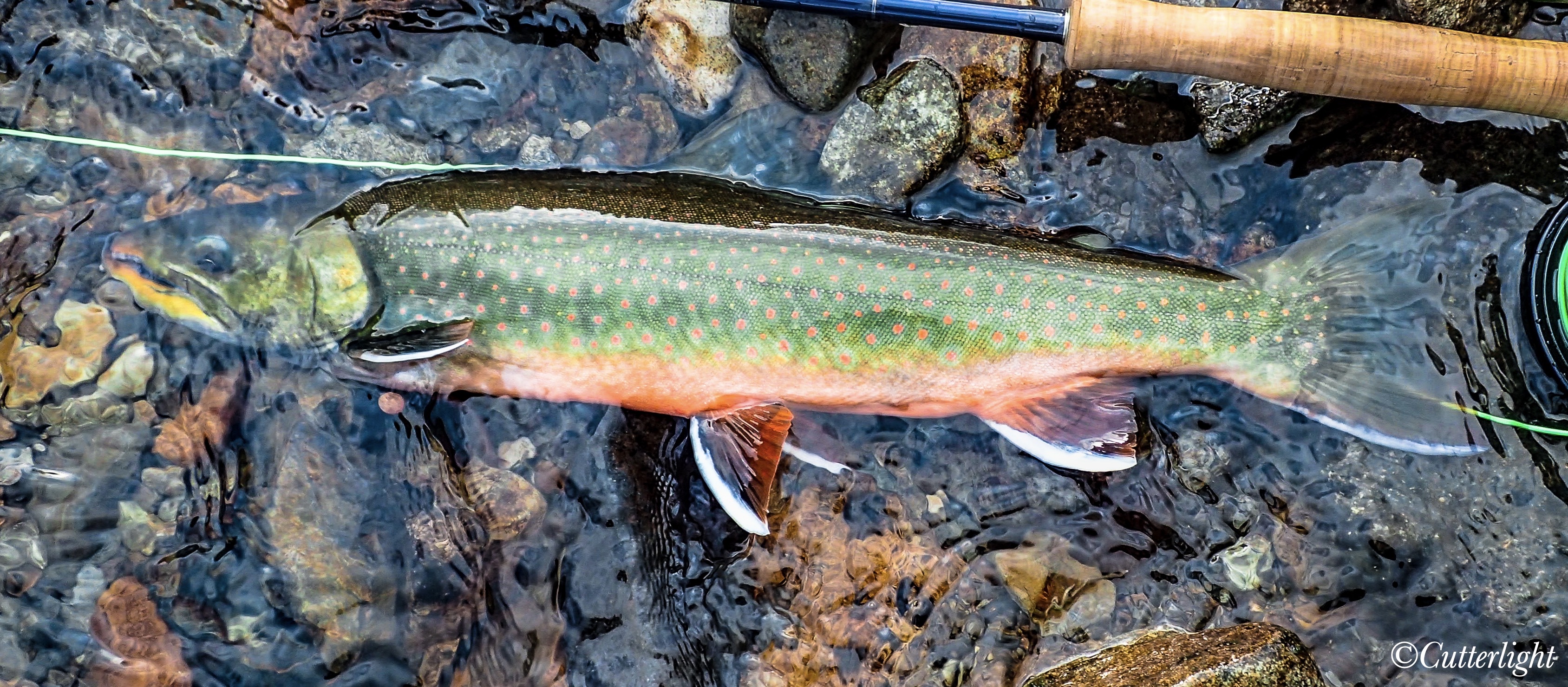
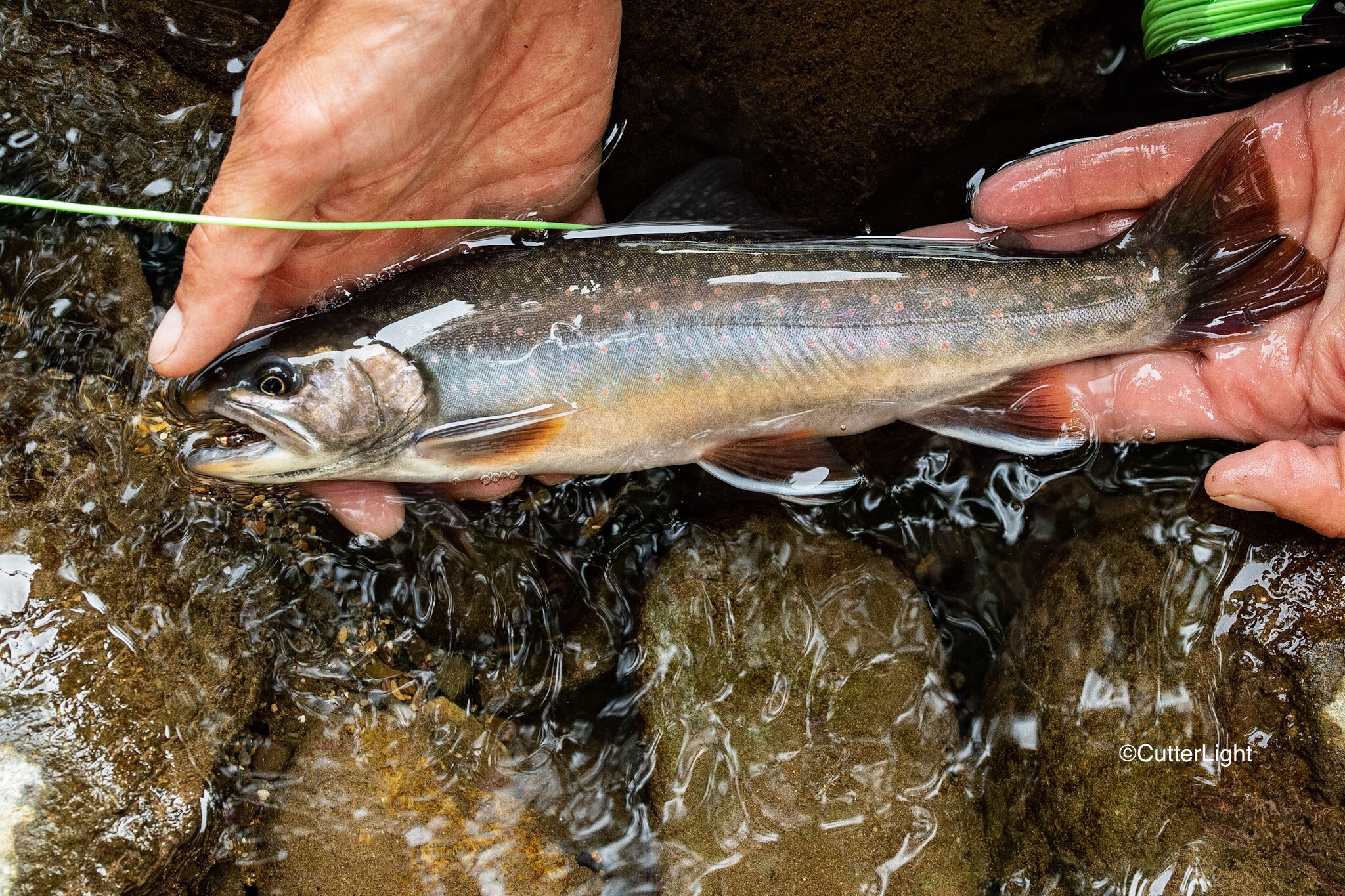
Iwana (Dolly Varden Char) are one of Hokkaido’s most celebrated cold-water fish.
I have an incurable habit of looking into water for fish. It doesn’t matter what kind of water. At the beach I check the translucent prisms of waves for whatever might be cruising the surf. Coming upon pools on rivers during hikes I make efforts to position myself so that I’m looking into shade rather than glare so that I can maybe catch a glimpse of something with fins. I’ll even check out coin fountains in the off chance that a carp or even a goldfish might be swimming around. But bridges on quiet country roads crossing pretty little trout streams are especially inviting. There’s almost always a pool below the bridge, and if the water has a population of trout, there are often a few of them hanging out right there. No matter how hard-fished the water might be, it’s worth a look.
Yamame could literally be translated as “Mountain Girl” – a lovely name for a lovely fish. More commonly the stream-dwelling form of this species is called “Cherry Trout.” Similar to Cutthroat and Rainbow Trout of the Pacific Northwest, (to which yamame are related), some go to sea where they attain sizes measured in pounds and return to their natal rivers to spawn bright as polished chrome – Cherry Salmon.
And so there we were, mid-afternoon, straddling our bikes and leaning over the the concrete side of a bridge on a quiet road running through a mix of forest and farmland somewhere in Hokkaido. The water was perfectly clear, but the trout and char are so adeptly camouflaged to match the stony bottoms of these streams that unless one moves they are all but impossible to pick out.
One moved. As it rose to take something off the surface I could even see its spots. A char of some type. I hadn’t done any fishing yet in Hokkaido. This fish was telling me it was time I did.
I didn’t expect the fish to be large and they weren’t. But in the space of about two hours I covered a couple hundred yards of this silvery mountain stream and caught two dozen or so fish About half of them were iwana. The others were yamame. A few came to a parachute Adams – my favorite dry fly searching pattern. A lot more came to a pheasant tail nymph – my favorite nymph. A couple of overly eager types tried to eat the pea-sized orange strike indicator I was using.
A younger version of myself would have kept a few of these fish for the frying pan. But these days I fish for trout in part to simply confirm that they are present, and I wanted these fish to remain present. So Barbra took a couple of photos and I released everything to continue living out their lives in this silvery piece of water and light somewhere in Hokkaido.
There wasn’t a single human footprint along the banks, much less a path. Knee deep in a cold mountain stream full of trout and char – sitting on top of the world, legs hanging free.






 CutterLight