Yolan Am (Lammergeier Valley): a disappearing ice field in Mongolia’s Gobi Desert

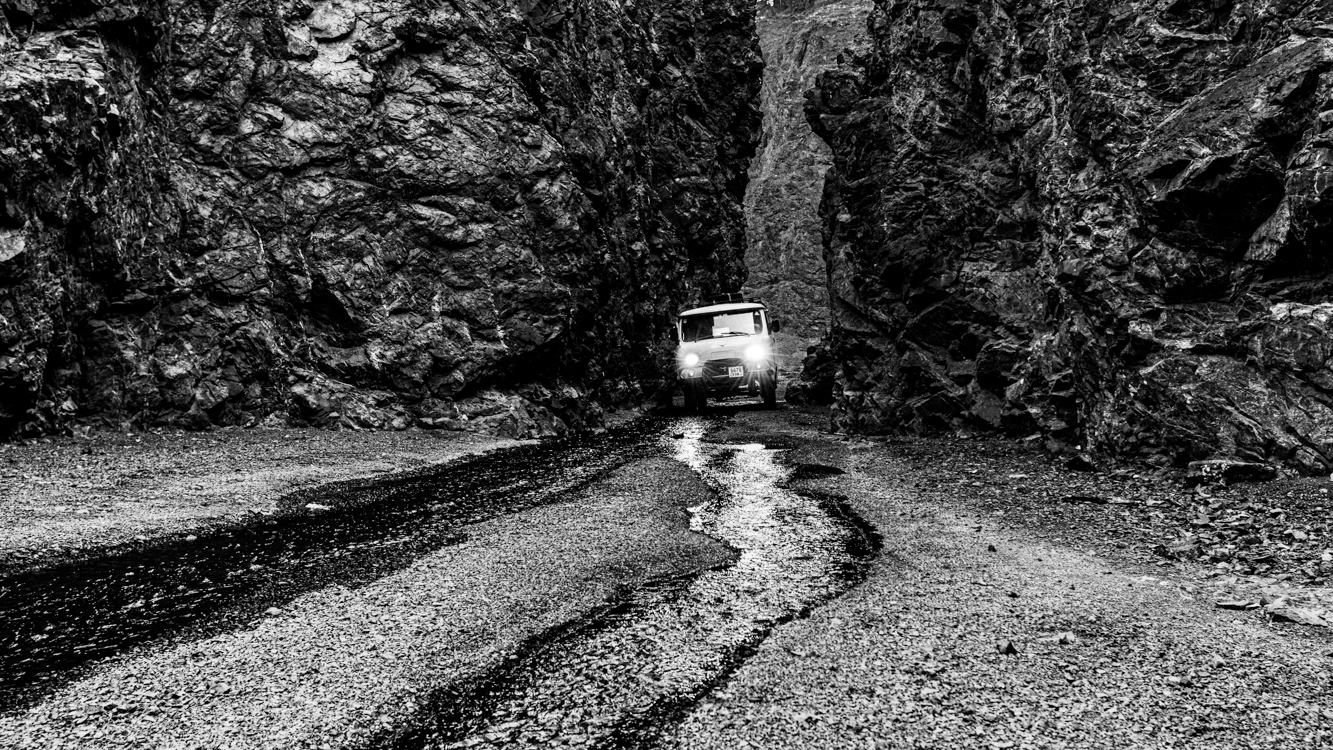
Our driver maneuvers the Russian-built van we were traveling in through a narrow passage in Yolan Am, a gorge in the Gobi Desert named for the Lammergeiers (Bearded Vultures) which are fairly common there. The stream is you see in this photograph is what remains of a thick ice field that builds up in the gorge each winter. In years past, the ice remained year-round. These days, the ice is mostly gone by fall. Gobi Desert, Mongolia, October 19, 2014.

Our brief time in Yolan Am, a narrow gorge in the northern Gobi Desert, was a highlight of our two years in Mongolia. We encountered a number of Siberian Ibex there – the Eurasian wild Mountain Goat, the males of which sport massive, backward curving horns -, a Central Asian Pit Viper, raptors including eagles and Lammergeiers, Red-billed Choughs, Chukars and other birds, Mongolian Pikas, gerbils and other wildlife. We stayed in a nearby ger, a yurt-like home common in the Mongolian countryside, and kept our energy up on traditional Mongolian fare (goat meat and mutton are commonly featured).

The Yolan Am Ice Field, which formerly became several meters thick over the course of each winter and remained throughout the year, now becomes a small stream by early fall. If you get the opportunity, by all means go. The entire Gobi Desert region is fascinating. And things are changing. Quickly.

After the Dzud (зуд): Camel Skull, Gobi Desert

Camel Skull, Gobi Desert, Mongolia, October 18, 2014

A dzud (zud, зуд) is a weather-related phenomenon in arid parts of central Asia. It could be heavy snow or ice; or a lack of snow or rain; severe cold; drought. Any widespread weather pattern that prevents livestock from obtaining sufficient food or water. Mass deaths… and economic disaster for the semi-nomadic families who follow their animals – goats, sheep, yaks, camels, horses – from place to place across steppelands, grasslands and desert. Roughly a third of Mongolia’s 3.3 million people live this life – among the world’s last nomadic herdsman.

Icehenge

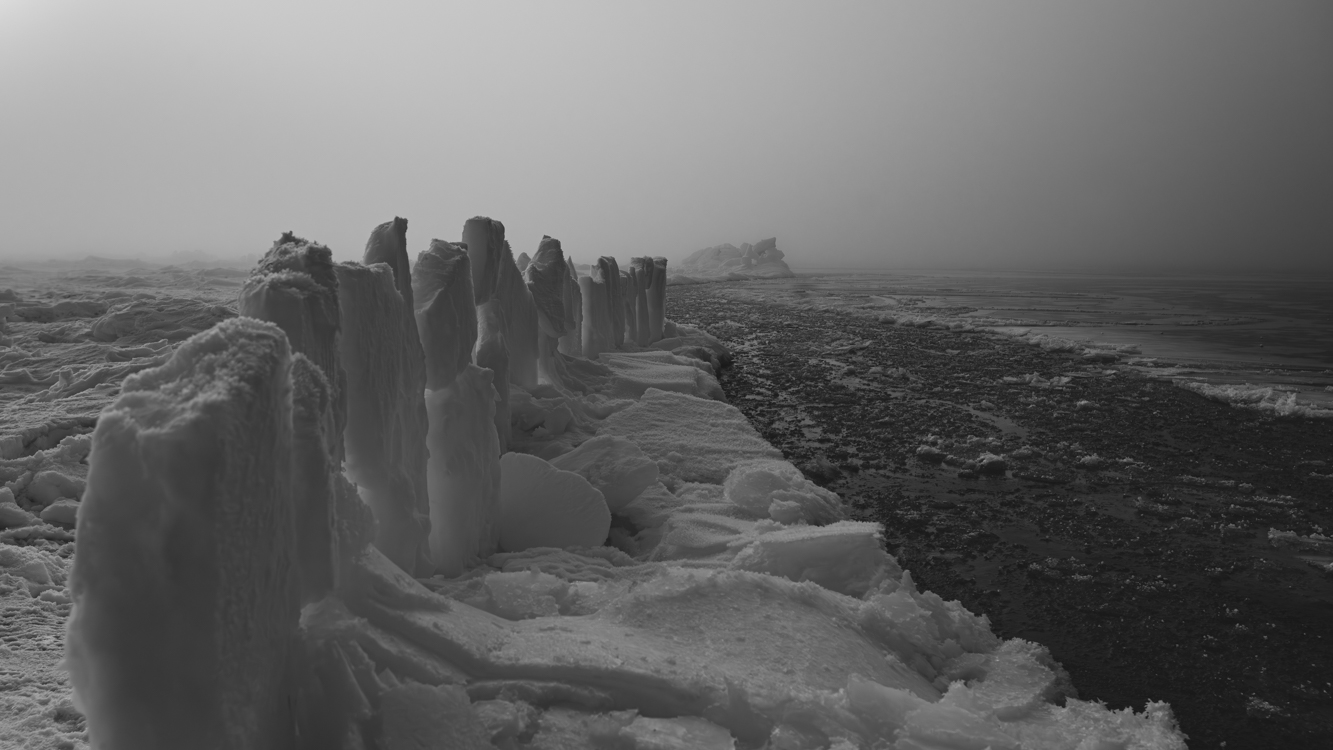
Black and white photograph of a hunting blind made of large ice slabs positioned along the edge of Arctic sea ice by Inupiat whalers.
Three miles out on the frozen Chukchi Sea, 125 miles north of the Arctic Circle, thick fog lifts to reveal slabs of ice positioned by Inupiat whalers to serve as a hunting blind along the edge of a slushy lead. Both Bowhead and Beluga Whales are taken as they migrate through these open lanes between sheets of ice. Near Point Hope. Alaska, May 3, 2012

The Catch: Bringing a Whale up on Sea Ice in Arctic Alaska

Inupiat whaling on the frozen Chukchi Sea near Point Hope, Alaska. April 26, 2012

As Bowhead Whales go, this was a small one – perhaps 10 tons or so. We had hiked approximately three miles from the village of Point Hope across the frozen Chukchi Sea to the camp where we had heard a whale had been caught. Locals had traveled by snowmachine and honda (snowmobile and ATV). There is always the danger of encountering a Polar Bear in this environment, and so we were armed. After snapping this picture I handed the camera to Barbra and took a place on the rope.

The open water in this picture is called a lead – an opening between two sheets of ice. You can see, across the water, the jumble of ice along the edge. Sea ice is often not the smooth sheet of white one might imagine. It continuously buckles, pushes up along pressure ridges, drifts apart and then presses back together. In a way, it behaves like the Earth’s tectonic plates, buckling, heaving, colliding, lifting. And so in order to make a whaling camp, trails must first be made through these places where jagged ridges of ice, individual chunks the size of cars, some much larger, must be broken through and smoothed out.

It is a lot of work to take a whale.

The Bones of Tikigaq: Whaling Festival Site, Point Hope, Alaska

The Bones of Tikigaq
Whaling Festival Site, Point Hope, Alaska. The larger bones presented as arches are the jawbones of Bowhead Whales. Traditionally, the skull is returned to the sea so that the whale’s spirit is properly released. Point Hope, Alaska, August 12, 2012

Pedal Bike

In bush communities such as Shishmaref, virtually everything comes into the village either by plane or by barge. Trucks, boats, hondas*, snowmachines*, pipes, building materials, food, clothing, clothing washers, bags of chips, cases of pop, birthday presents… It’s not practical to ship out empty detergent bottles, worn out dryers, broken down vehicles or broken toys. So most of the refuse goes to a local dump. In these modern times, when most of what is consumed takes a very long time to return to its elemental or mineral form, whatever isn’t burned remains there – buried or piled high. And there it will remain till the sea comes one day. (Photograph by Barbra Donachy, October 31, 2010)

* “Honda” is the Alaskan term for quad or ATV. “Snowmachine” is Alaskan for snowmobile. Out in the bush, bicycles are often called pedal bikes to distinguish them from hondas/ATVs, which are also often called bikes.

Ravenous Sea

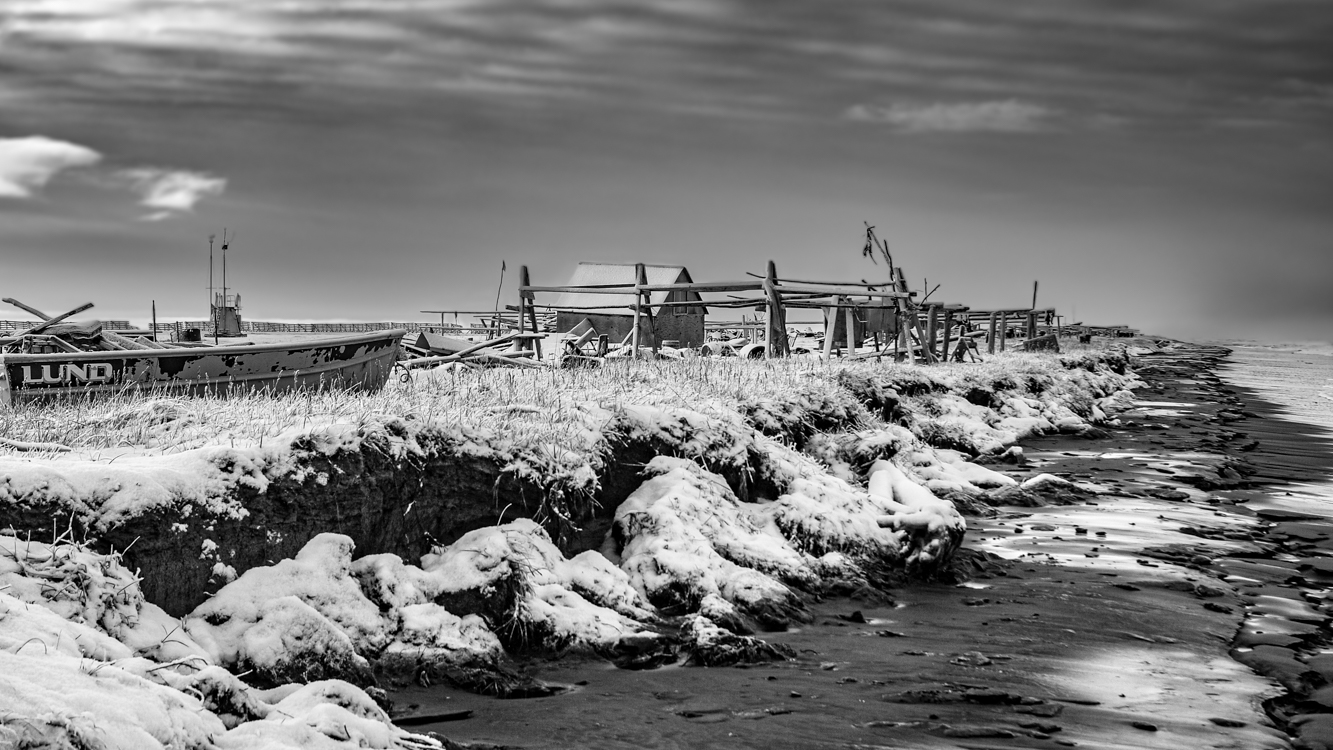
This camp along the shore of the Chukchi Sea almost looks like an ocean going vessel, the cabin itself the wheelhouse, a flag marking the vessel’s bow as it faces a fall sea. Snow but no ice, you can see how the ravenous ocean eats at the shoreline of tiny Sarichef Island. All this will be gone one day… perhaps in not so many years. October 31, 2010

Disappearing Island

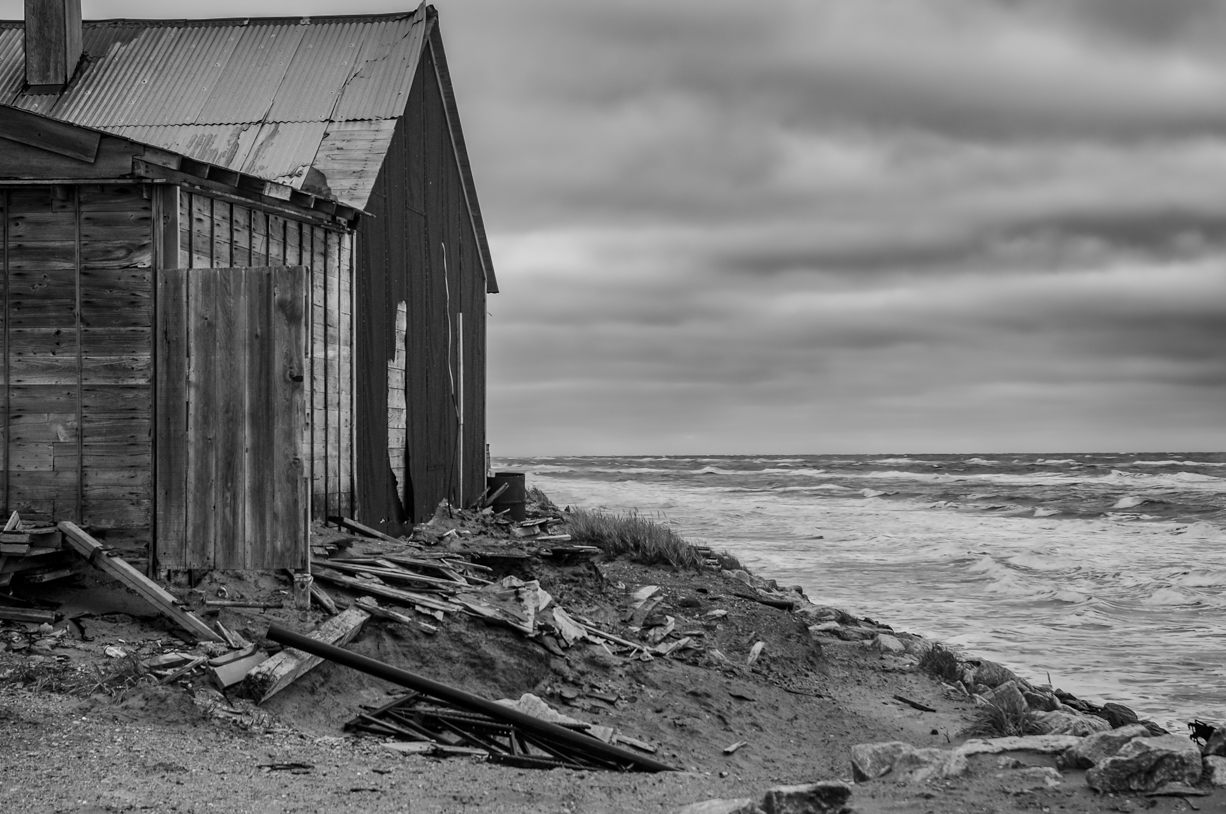
An abandoned home in Shishmaref faces an encroaching sea.

It is reported that since 1969, the ocean has eaten away 200 feet of land along the coast of already tiny Sarichef Island where Shishmaref is located. In the past, a sheet of ice forming in fall and lasting through spring kept the Chukchi sea blanketed and calm. Warming sea temperatures in the Arctic mean the ocean is freezing later. When fall and winter storms occur, packing winds that have traveled uninterrupted over thousands of miles of open sea, the surf thus generated claws at the barrier island without mercy. Particularly violent storms can rip away massive chunks of land. Entire homes have been washed away, a fate this abandoned house appears to be facing. Photograph: October 10, 2010