
Chignik River, September 22, 2018


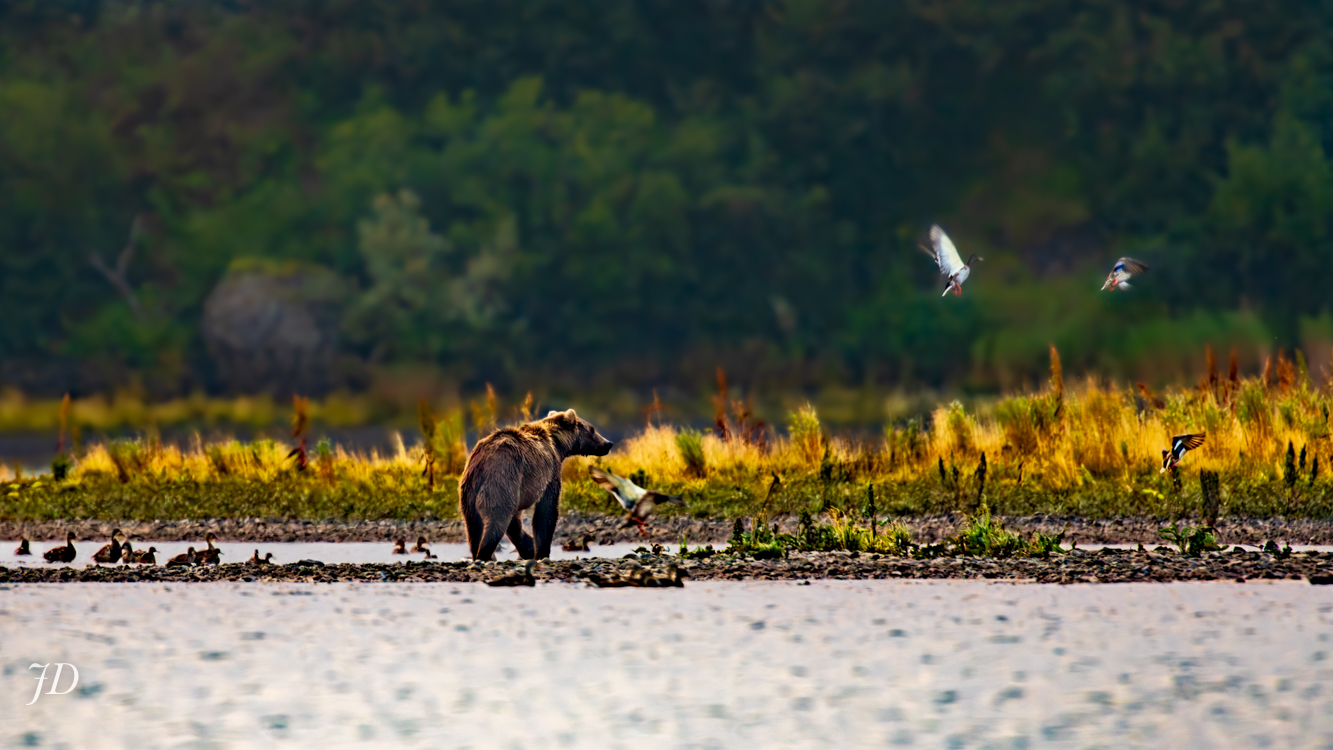
Behind me from where I stood as I composed this photograph, a dirt and gravel road travels a winding path along steep hillsides for about three miles to the Chignik Lake airfield, a bouncy dirt airstrip capable of handling the nine-seat bush planes and smaller aircraft that regularly travel the Alaska Peninsula. For the first two-and-a-half miles from the boat landing the road hugs steep hills, often within view of the river. Traveling the road from June through November, it’s common – at times almost a given – that you’ll see one of more of the Chignik’s massive brown bears. Sandhill Cranes, Tundra Swans, eagles and any number of passerines are frequently encountered in summer, and at any time of year a glimpse of foxes, moose, wolves and even wolverines is possible. Take note of the local hares you might catch sight of – Tundra Hares, the largest hares in the world.
The road is the road… the road to The Pad… the Top Road. Three miles. On one end, unless you are on a Honda (an ATV), you would need to board a plane to travel further by vehicle. On the other end, you need a skiff. There is no overland connection with any other community. Mountains, rough terrain and jungle-thick alders make travel by foot even to the village of Chignik Lagoon – just six miles down the peninsula from Chignik Lake – impractical. Whether one travels by air or by sea, it is 353 miles to Homer, Alaska – the closest place a road connecting with the North American mainland can be joined.
Is “wilderness village” an oxymoron?

Chinook Salmon begin entering the Chignik in late June. They continue spawning into August. By September, spawning has ended and the spent salmon begin giving into the current, death at hand the big fish slowly drifting back downriver – easy meals for the Chignik’s Harbor Seals.

I went to the woods because I wished to live deliberately, to front only the essential facts of life, and see if I could not learn what it had to teach, and not, when I came to die, discover that I had not lived. Henry Thoreau, Walden
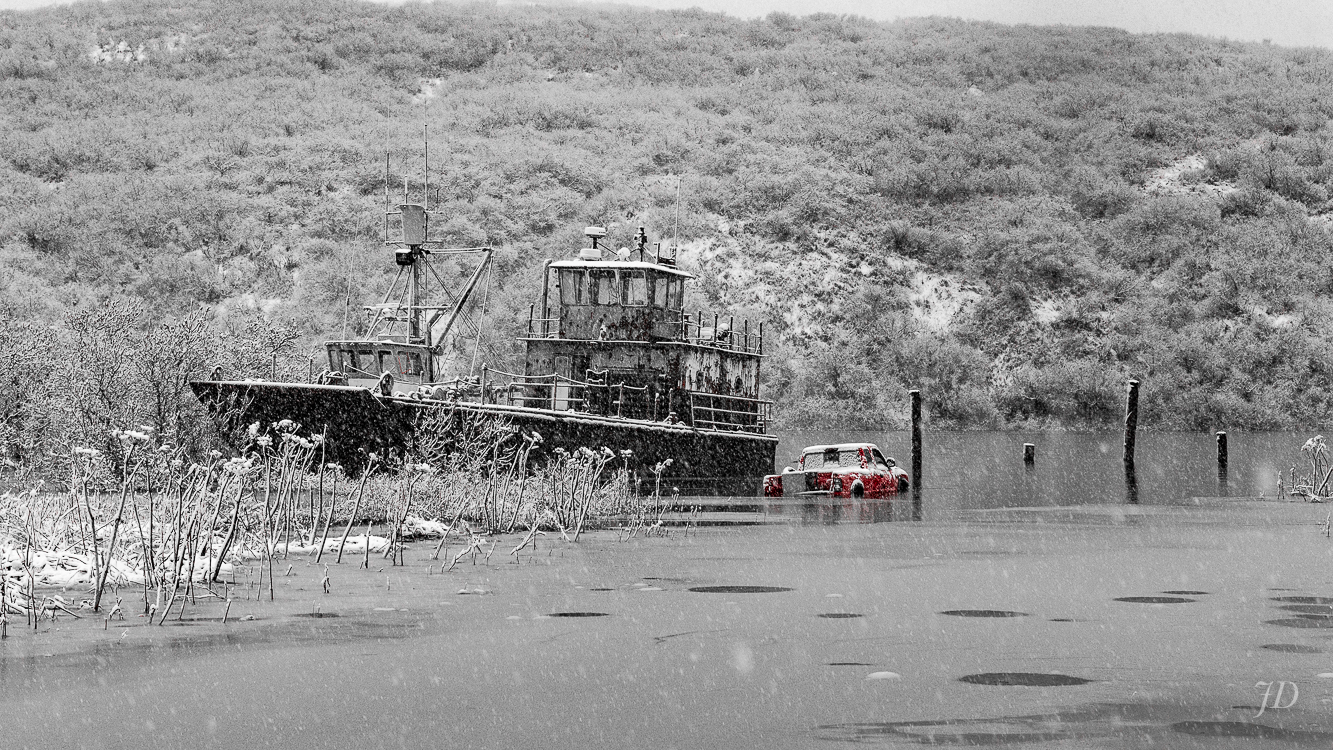
Located about four miles up from the salt estuary, this is the scene at the barge landing on the Chignik River during one of the big 11-foot tides that occur there when the gravitational pull of a full or new moon is at its peak. Upriver from here, the Chignik becomes unnavigable to large vessels, even at high-water. At low-water, this is a good place watch for bears, seals, otters and every so often moose. People have seen wolves here and, infrequently, lynx. This is where I once saw a nattily marked male Spotted Redshank, a bird that very rarely strays to North America from its native Asia and where on a different occasion a gyrfalcon swooped down and hovered just above me, as though to investigate. Occasional boat traffic notwithstanding, the landing is set in wilderness.
When the big tides roll up the river they bring salt scent and sea wrack, and even in the lake six miles and more up from the salt chuck the current pushes backwards and the receding water leaves behind eelgrass from the estuary. Depending on how you look at it, the landing is either the beginning or end of Chignik Lake’s lone road – three miles of dirt and gravel hugging steep hills as it winds above the river and then cuts through the village to connect the boat landing with the dirt airstrip. In fall, 10 and 11 foot tides are used to barge fuel up the river to the landing where it is loaded onto trucks that complete the short haul into the village. This is also how large equipment and building materials are brought into Chignik Lake which is otherwise accessible only by small plane.
You gotta watch where you park. These big tides come up awfully fast and will snatch a carelessly beached skiff in a blink – as just about all of us have learned through experience at one time or another. I would imagine the wheel bearings on the truck in this photo are pretty much shot… among other things.

When I initially got into studying the Chignik Drainage’s birds, I thought that a loon was a loon was a loon, a species I knew primarily from seeing Common Loons. I assumed that that is what a loon is. It turns out that there are five species of Gavia, four of which occur in the Chignik Drainage. In order of common occurrence, they are: Common Loon, Pacific Loon, Yellow-billed Loon and Red-throated Loon. (Only the rare Arctic Loon is absent from The Chignik.) It is probable that in the salt waters of the nearby Alaskan Gulf that from fall through spring it is the Pacific Loon that is most common.
We encountered Yellow-billeds as wintertime visitors to the main lake and the river outflow just below the lake. In wintertime, their plumage is rather drab (you’ve got to go to the most northern parts of Alaska, or Siberia, to see them in their stunning breeding colors); however, even in winter these, the largest of the five loons, were easily distinguished from Common Loons by their big, lightly-colored, yellow-tinged bills. We found the Yellow-billeds to be shy and to prefer deep water. The only photos I was able to get were taken using a 600mm lens affixed with a 2.0 teleconverter of far off specimens – and even those images require significant cropping to present a picture such as the one above. Still, Yellow-billeds are uncommon to rare and adding them to the Chignik Drainage List – perhaps a first documentation and almost certainly a first photograph – was a thrill.
Any documentation of this sort is important. As the planet continues to rapidly warm – due largely to a certain overpopulated species’ reliance on burning fossil fuels and turning forests to farmland – things are changing. Fast. (It’s not just that the climate is warming – it’s been doing so for a very long time. It’s the recent rapidity at which it is warming.) Audubon’s climate model projects a 64% loss of winter range for Yellow-billed Loons in coming decades. Not centuries. Decades.
Wherever you live, it is likely that you can see changes in flora and fauna over time. And these changes are not due only do warming. Although in pure numbers countable trees have increased in many areas, most of this new growth is in the form of pulp and timber forests – trees destined to be cut down just as they are reaching maturity. As fewer forests are allowed to reach and sustain maturity, there is less mast (acorns, other nuts, seeds and seed-bearing cones) for animals to forage and often fewer nesting sites as well. Wild grasslands have nearly disappeared from our landscapes. In many locales, streams, rivers and lakes have become warmer, shallower and increasingly over-nutrified owing to run-off from fertilized lawns and farms. So grab a pair of binoculars, a notebook, your iPhone or camera and get out and observe. The regular outings might prove to be a great education, and a daily walk is invigorating.


 CutterLight