Waterbird Greater Yellowlegs (Tringa melanoleuca) Paradise Bend, Chignik River, Alaska Peninsula, May 17, 2019
May and June of 2019 became somewhat of a turning point both in terms of photography and our relationship with the Chignik. The school at Chignik Lake had failed to meet the state’s requirement for a minimum enrollment of 10 students from kindergarten through grade 12 and was therefore to be closed at the end of May. Barbra was reassigned to the school at Newhalen, 278 miles Northeast up the peninsula, above where the ball of the hip joint might be, on the mainland. We were heartbroken about the move. Artistically, I felt as though I was just beginning to figure out my relationship with the river. Emotionally, we were both deeply attached to the people and the landscape at The Lake.
With the move scheduled for late June (we flew ourselves and everything we owned out on a small plane chartered for us by the school district), I was doing my best to take advantage of good days… good light… and reimagining what our experience at The Lake had meant… what the essence of it had been. And so I began breaking away from strictly representational documentary, looking for images that captured not merely what things looked like, but how we would remember them. JD
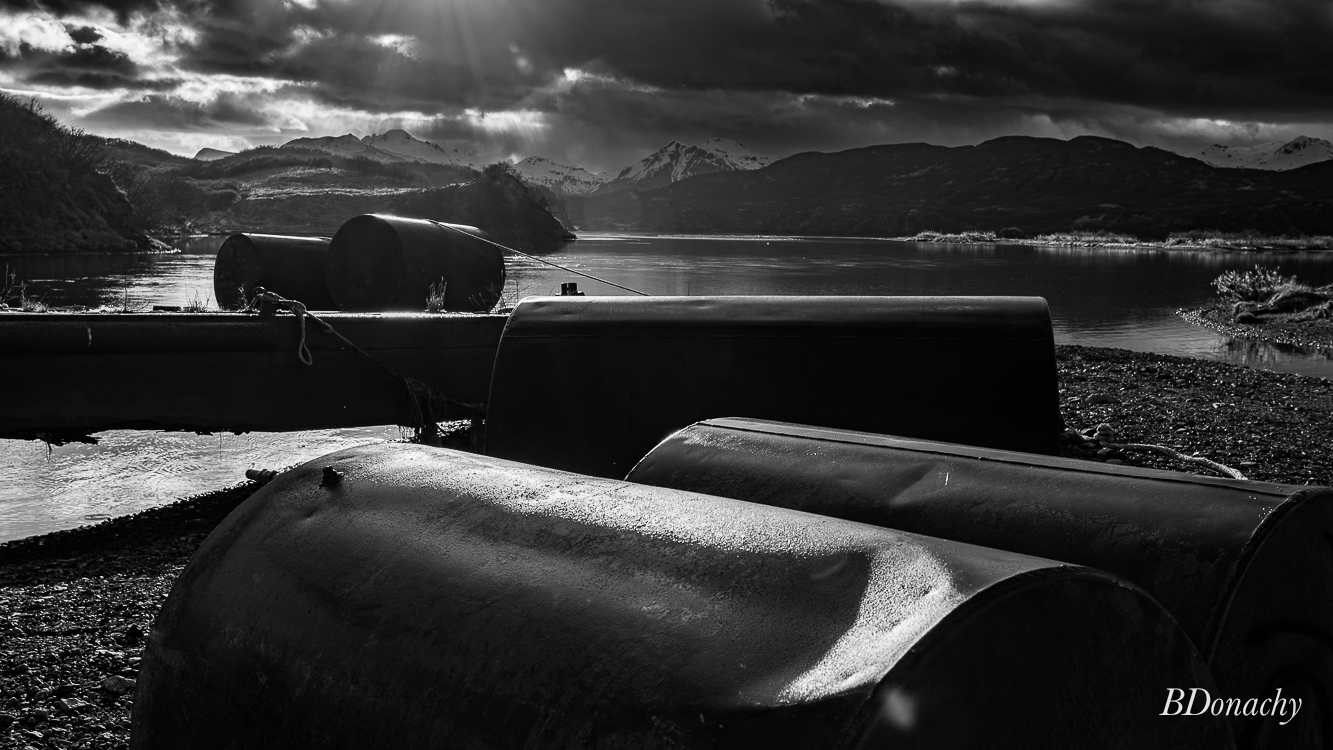
Fuel Oil Drums at The Pad Chignik River Barge Landing, May 16, 2019
Barbra has an eye for moody images such as this early morning landscape of diesel oil drums at the barge landing on Chignik River. The scene is the terminus of the three-mile road that travels from the airstrip, winds through the village of Chignik Lake (population 50 something), and then follows the river along steep hillsides till it ends here at the landing. These drums are barged to this point, about six miles upriver from the salt water lagoon, on high tides of about 10 feet or more. On lesser tides, the river is too shallow for the barges to run. From here, the fuel is loaded onto a truck and carried to the diesel generators that provide the village’s electricity. Gasoline, too, along with any sort of large stuff such as vehicles and building material is brought into the village in this fashion.
Such are some of the logistical consideration in a wilderness village.
The Lake: Waning Crescent with Venus I captured this image from our living room window on September 8, 2018
Month by month, photo by photo I’m making progress with this daunting task, key-wording, culling, editing, retouching the tens of thousands of photographs we’ve accumulated. The collection goes back to old print photographs we scanned into Lightroom, continues through our years together in Sacrament and on into our years in Alaska which have been punctuated with travels elsewhere and a two-year span in Mongolia.
Usually I’ve drawn energy from this project as I revisit memories and track the progress we’ve made as photographers. My editing and retouching skills have dramatically improved, and that too has been satisfying. But there have been low periods as well. Recently I pitched a story to the editor of a magazine. He liked the draft I showed him and asked for more. I finished the piece, sent it in… and nothing. It’s as though I’ve been ghosted. Unpleasant.
And so I find myself revisiting old questions. Have I lost the touch? Usually editors are enthusiastic about my work. Does “lost the touch” really mean “gotten too old?” Which leads to a downward spiral into the really big question I find hanging over my head at times: What if nothing ever comes of all this? What if this late-in-life push is, ultimately, pointless?
Things can get dark. But, are you enjoying your life? Barbra asks, trying to be helpful and cheering. The answer to her question is (on most days) an unequivocal Yes. And yet… and yet…
Faith in the past as an indicator tells me this moment of doubt will pass. That same past tells me that the only way to know is to keep moving forward. I suppose I could construct a metaphor about moons waning, disappearing… and then finding themselves again and waxing into fullness.
Heave Ho Fred Shangin, cigarette hangin’ as per, puts his back into a pot of Tanner Crabs from Castle Bay off the gulf side of the Alaska Peninsula. May 6, 2018
Going through these many thousands of photos from The Lake and beyond – while at the same time these past few days putting together a magazine piece paying tribute to a recently deceased mentor and friend from my Pennsylvania youth – I find myself recognizing that as photographers one type of image we might not capture often enough is portraits of friends. The best of these photos are often environmental-documentary portraits – my own hybrid category to describe pictures that capture the subject in an authentic act of life in a setting that tellsthe viewer about that person’s life. There’s an art to it… the photo that isn’t staged; that doesn’t depict the subject self-consciously looking into the lens (or self-consciously looking away from the lens); an image that captures an authentic moment rather than a pose.
For me, learning to make these types of images has been predicated on a lengthy process of growth toward freedom from my own limiting shyness. Coupled with the kind of confidence that enables a photographer to make such portraits is, I think, a necessary agreement – tacit or verbalized – that gives the photographer permission to shoot at will (with appropriate discretion).
Strictly environmental portraits are in most cases staged. In making such an image, the photographer might have the subject sit at her fly-tying table as she ties or gives the impression of tying a fly. Noticing clutter, the photographer tidies up the scene. Further compositional considerations prompt lighting manipulation – perhaps nothing more than slightly moving a lamp or opening or closing a curtain, but manipulation nonetheless. Clothing choices are given thought, a certain tilt of the subject’s head is decided upon as favorable, perhaps a few already-tied flies are placed in the foreground, a book arranged so that it’s title can be read. Images such as this have their place, but to me there’s a compelling cool in a real-time photograph – a moment frozen, captured, documented as is with no quick brush through the subject’s hair, the everyday jacket with its stains, imperfect lighting, maybe a little motion blur or grain.
And in the case of the above photograph, one hangin’.
Tundra Swans at Black Lake – The jagged Aleutian Mountains loom in the background over this bay on remote Black Lake on the Alaska Peninsula. A flock of approximately six dozen Tundra Swans rests on ice in the foreground. Not readily discernible in this photo, a few ducks, mostly Mallards, are milling about in the open water near the ice. This broad, shallow, weedy lake at the headwaters of the Chignik River Drainage provides waterfowl habitat as well as an important nursery for salmon that spawn in various tributaries. The most practical way to access the remote waters of Black Lake is by skiff – about 17 winding miles from the village of Chignik Lake up Chignik Lake and then up Black River.January 3, 2018
Pink Salmon Spawning, Post Office Creek – Locals call the pretty little stream bisecting Chignik Lake village The Crick. We thought it deserved a more honored sobriquet, and so since it cuts through a culvert and passes beneath the road near what used to be the post office, we called it post office creek. It is populated with char and sculpins and very occasionally salmon spawn there. September 19, 2017
We came across this herdsman tending goats in Khustai National Park, Mongolia. August 7, 2013
I rendered this as both a monochrome and a color image – a coin flip as to which I prefer.
I’d been interested… very interested… in photography ever since my early teens, but I didn’t pick up a camera and use it in any meaningful way until we traveled to Arctic Alaska, four years prior to the above photograph. I could have benefitted – perhaps a great deal – from a formal course of study in the subject. I guess. I’m not sure. Generally speaking, there are both benefits and drawbacks imbedded in the process of learning from others; just as there are benefits and drawbacks to learning on one’s own. Despite four years of somewhat purposeful shooting in Alaska, when we arrived in Mongolia I still didn’t really understand how a camera works. Nor did I have a vision of what kind of images I hoped to make. But once in a while I saw something I liked and I did what I could to make a capture… camera settings often somewhat randomly chosen, insufficient thought and visualization as to what the final, retouched image might look like (or what I hoped it would look like)… and any time a human subject was involved, struggling to overcome what is at times almost crippling shyness and apprehension on my part in order to get the picture. Often failing to overcome that apprehension and letting the moment pass.
So the question remains: Would I have benefitted from, for example, attending formal classes in photography at a respected institution under the guidance of expert instructors? Well, yes, for certain in regards to speeding up my learning curve with respect to technical and scientific aspects as to how a camera works and how film or an image sensor interprets light, and to gain a better understanding of the interplay between camera bodies and lenses. I read, on my own, and viewed a number of instructional videos addressing these subjects… and can report that while they were somewhat helpful, there is a lot of misinformation, and incomplete information, and misleading information on these matters – much of it dispensed by experts and by people who present themselves as experts. People who perhaps know what they are talking about or writing about, but who are not teachers and who don’t know how to teach and who have a difficult time imagining or understanding what a student needs to know… or how a student will receive and apply a given piece of information. Setting that aside, I suppose the answer is probably “Yes,” I – or anyone new to photograph – would benefit from interactive instruction where the primary purpose is to acquire knowledge of how a camera works and how light works and how a camera interprets light.
I suspect such a course of study would be helpful in the same way that prior to writing a novel or a magazine article, it’s necessary to have acquired an understanding of punctuation, syntax, paragraph structure and plot. Understanding basic structures – in any endeavor – can spare one from a lot of fumbling around.
But I wonder if, after 10,000 hours of mindful practice (a concept toward mastery I fundamentally accept), the person who began the journey initially studying under a master doesn’t end up more or less at the same place as the person who embarked alone, and vice versa. After all, whether the matter at hand is photography, writing or fly-fishing, once basic skills are acquired it is left to each individual to determine their own path as to how they hope to develop those skills. Realistic or conceptual; poetry or prose; salmon rivers or saltwater flats.
A problem with instruction beyond basic concepts is that it can end up creating a box around the student.
So… I think that, if it’s an option, by all means find someone from whom to learn the fundamentals – in any endeavor. But don’t linger there. Get the basics. And then go out and put them to use… learning more basics along the way, but more importantly, freeing oneself to pursue one’s own passions and to thereby develop one’s own vision.
I suppose the main thing, in any endeavor, is simply to get started.
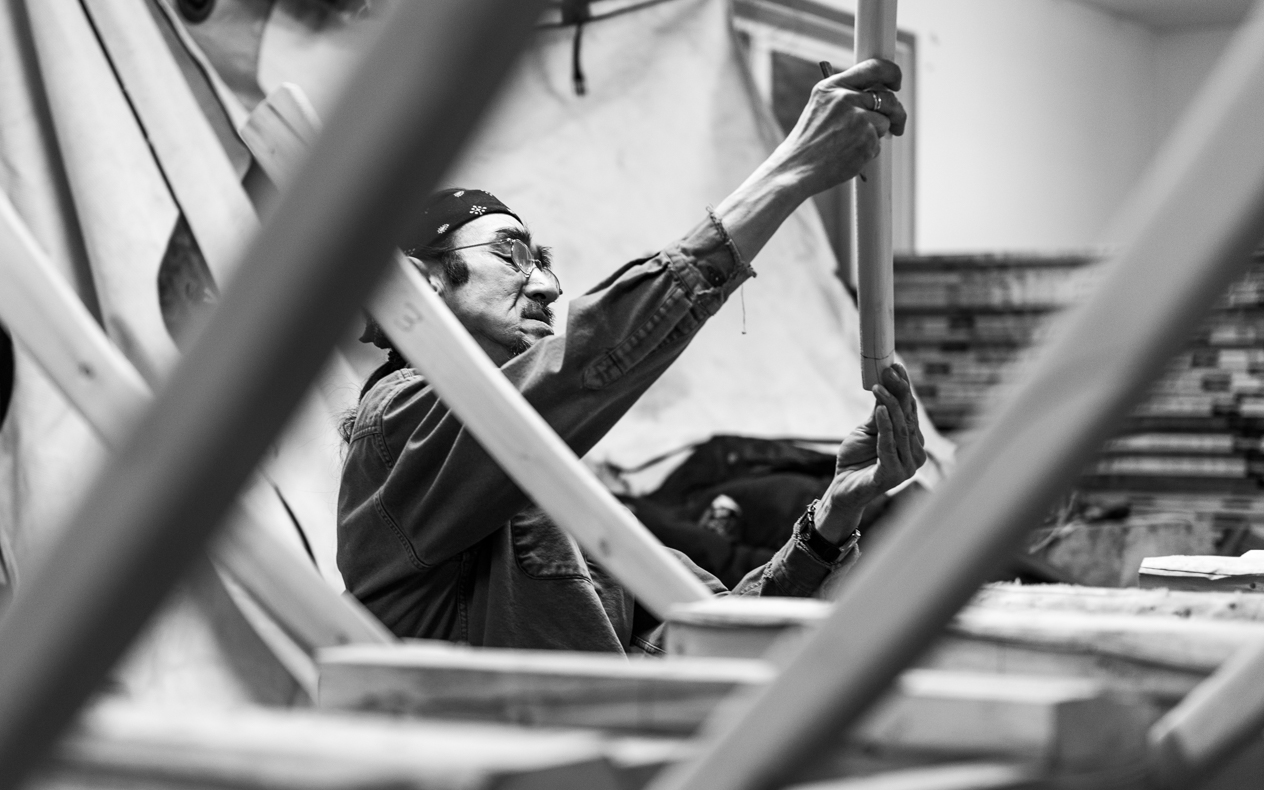
Artist and boatwright Henry “Hanko” Koonook at work on an umiak in his shop. The keel, thwarts and each wooden rib is hand fashioned and precisely fitted. When the frame is finished, it will be covered with the stretched skin of an ugruk (bearded seal). This will be the boat’s hull. Traditional skin boats such as these are still used by Inupiat whaling crews in Point Hope and other villages of the far north. Long may it be so. Point Hope, Alaska, March 21, 2013.
This November 19, 2011 sunset looking out over a Chukchi Sea nearly frozen solid reminded us of a Mark Rothko painting. The quality of light in the far north is often breathtaking.
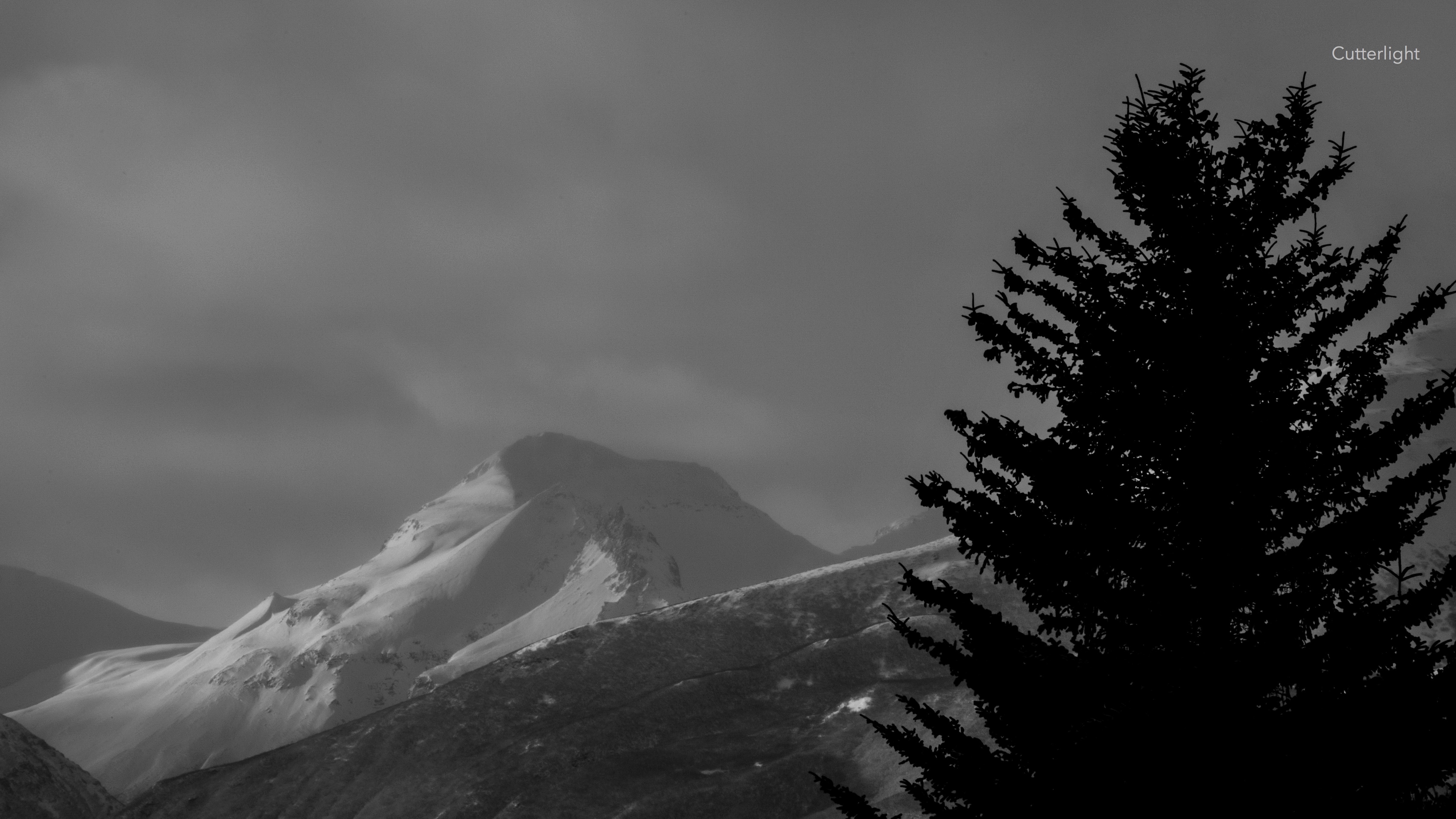
I made this photo just a few feet from my home in Chignik Lake. The challenge was to somehow clean up the assortment of utility poles, wires, satellite dishes and the dissonant array of scrub alder closer to eye level. I actually knew as soon as this assignment (Winter Landscape in Black and White – the second weekly assignment from Outdoor Photographer magazine) was posted the scene I wanted to shoot. I put on a long lens, waited for the right light, and got this frame.





 CutterLight