Holster the Pistol, Take a Breath, Try it Again

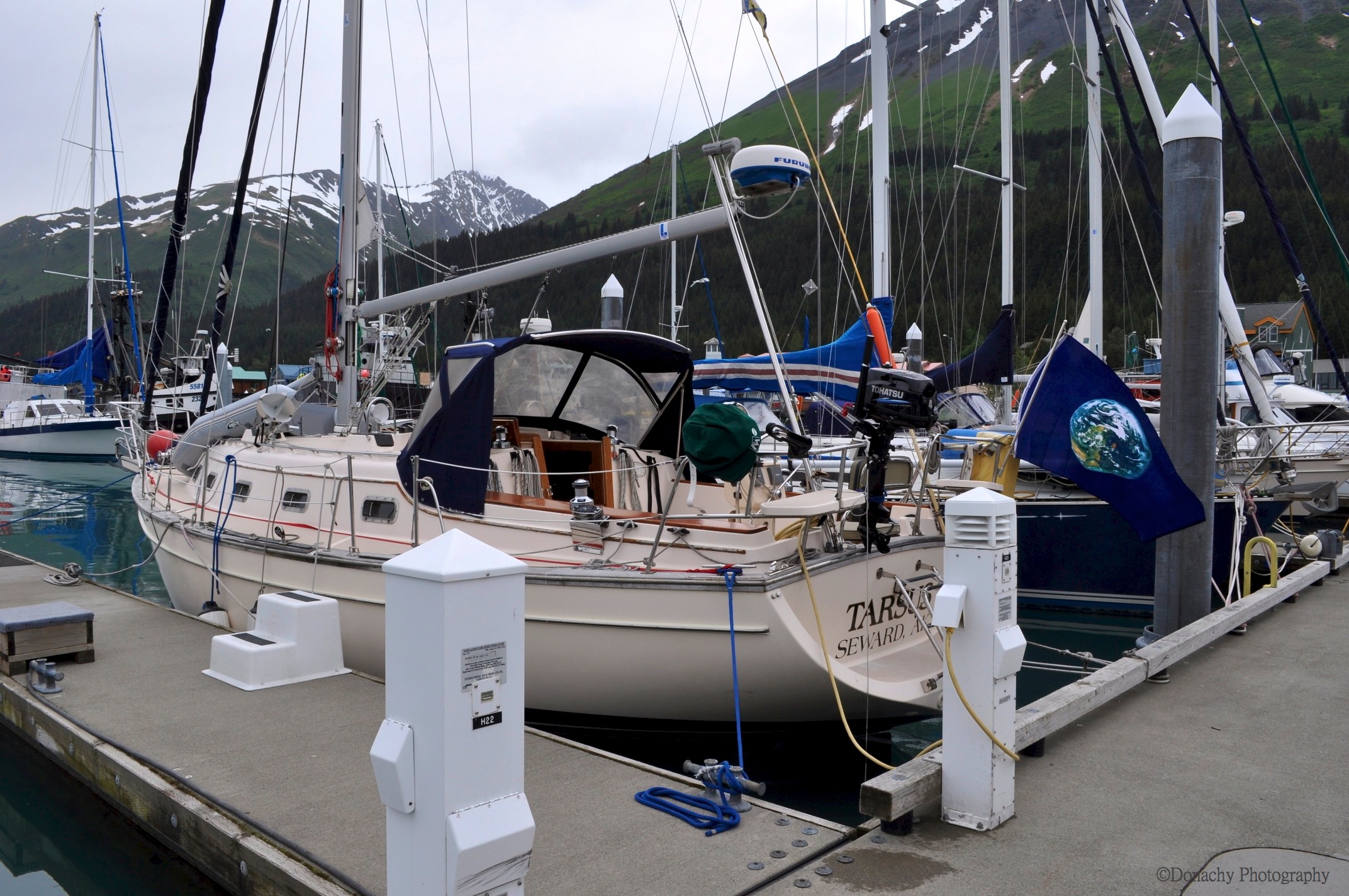
To the uninitiated, this photo may appear to be unremarkable. It’s a boat, tied to a dock. But this photo represents accomplishment and progress in small but important details in our seamanship. (We’re awaiting arrival of the new name letters we’ve ordered for the stern.)

The first time we docked Bandon, we were assigned a generously long, open slip at the end of H Dock in Seward. Nonetheless, having never docked a sailboat on our own before, bringing it in was intimidating. The boat’s 35 feet seemed to morph into 350 feet, and although there probably weren’t more than a handful of onlookers, it felt like we were in the middle of the Super Dome on Super Bowl Sunday, hearts in our throats.

There’s an art to docking, and some boats are easier to maneuver than others. Features such as twin engines and bow thrusters, which our Island Packet does not have, make precision docking easier. Features such as a full keel – which renders it all but impossible to turn the stern when in reverse – make the job more challenging. And then there are the prevailing winds pushing on the bow during the docking procedure, and the inevitable audience that inexperience seems to draw.

But the last time we brought the boat in – after a three-day cruise around Resurrection Bay – we managed to line it up and back it in… if not perfectly, at least competently. It felt good to make obvious progress with yet another aspect of seamanship. And there’s a real pay-off to docking stern first in our assigned slip: the prevailing winds are such that in the evening when we’re relaxing in our cockpit, the dodger (the canvas and clear vinyl hood above the companionway) acts as a windshield when the bow’s pointing south.

Take a walk along most docks, and it soon becomes evident that there are any number of ways to secure a boat to a horn cleat. Some work better than others. You don’t want to create a knot that might jam, but you don’t want a knot that will slip, either. The first few times we tied off, we pretty much guessed at what we were doing – resulting in the beginner’s mistake of too many wraps, and too many hitches. Now we get it: a couple turns of the line across the horns finished with a single weather hitch is both tidy and secure.

As with many things in life, if you’ve never been shown how to do something – including how to begin the task, what the process looks and feels like, and how the end product should appear – even simple tasks can prove challenging. Is this what it’s supposed to look like? and Why is this so difficult? become frequent refrains. Often times manuals appear to be written and illustrated for people who already have some expertise or background in the subject and make little sense until after you’ve figured out how something works.

Barbra rebedding a chainplate for the second time – the first go at it having gone quite wrong. We still may not have gotten it right, and will give it another go till we seal up the rain leak we’ve been trying to chase down. 

There’s nothing like having access to a patient, knowledgable mentor to walk one through the steps of new tasks – and to do so as often as needed until the task is mastered. But most of the time, a combination of self-study, intuition, trial and error and a willingness to occasionally screw up and break things suffices instead. The first time we set the anchor, I wanted to pull out a pistol and shoot the whole system in the fashion of General George Patton shooting a jeep that wouldn’t start. The windlass repeatedly jammed, we had a heck of a time holding the boat in position and for the life of us, we could not figure out when the anchor was on the bottom as the chain, heavy and dense, hung straight down from the bow. We put the engine in reverse, backed up until the chain went taut and our movement stopped, and then spent a fitful night worrying that the anchor wasn’t set at all and we’d wake up to find our boat grounded.

But the anchor held, and the next morning it came up with chunks of clay and mud clinging to it, indicating it had dug in just as it should have. The next time we set the anchor, the process went smoothly… leaving us wondering how in the world it could have been so difficult the first time.

And so it goes. With a lot of what we do, the first attempt is chaotic, filled with uncertainty and error and no small amount of frustration. But we think and communicate and debrief, and subsequent attempts go more smoothly and fill us with satisfaction and, yes, pride.

Each new thing we learn is a new thing we’ve learned. This summer, our task has been to begin to master some of the most basic elements of sailing, seamanship and boat care. The learning curve, for us, is steep. But by taking things in small steps, it seems achievable. Looking into the future, it is apparent that in sailing, we have found a pass-time and a lifestyle in which there will be no end to additional skills to master, knowledge to acquire, and experiences to cherish. That’s what drew us to this in the first place.
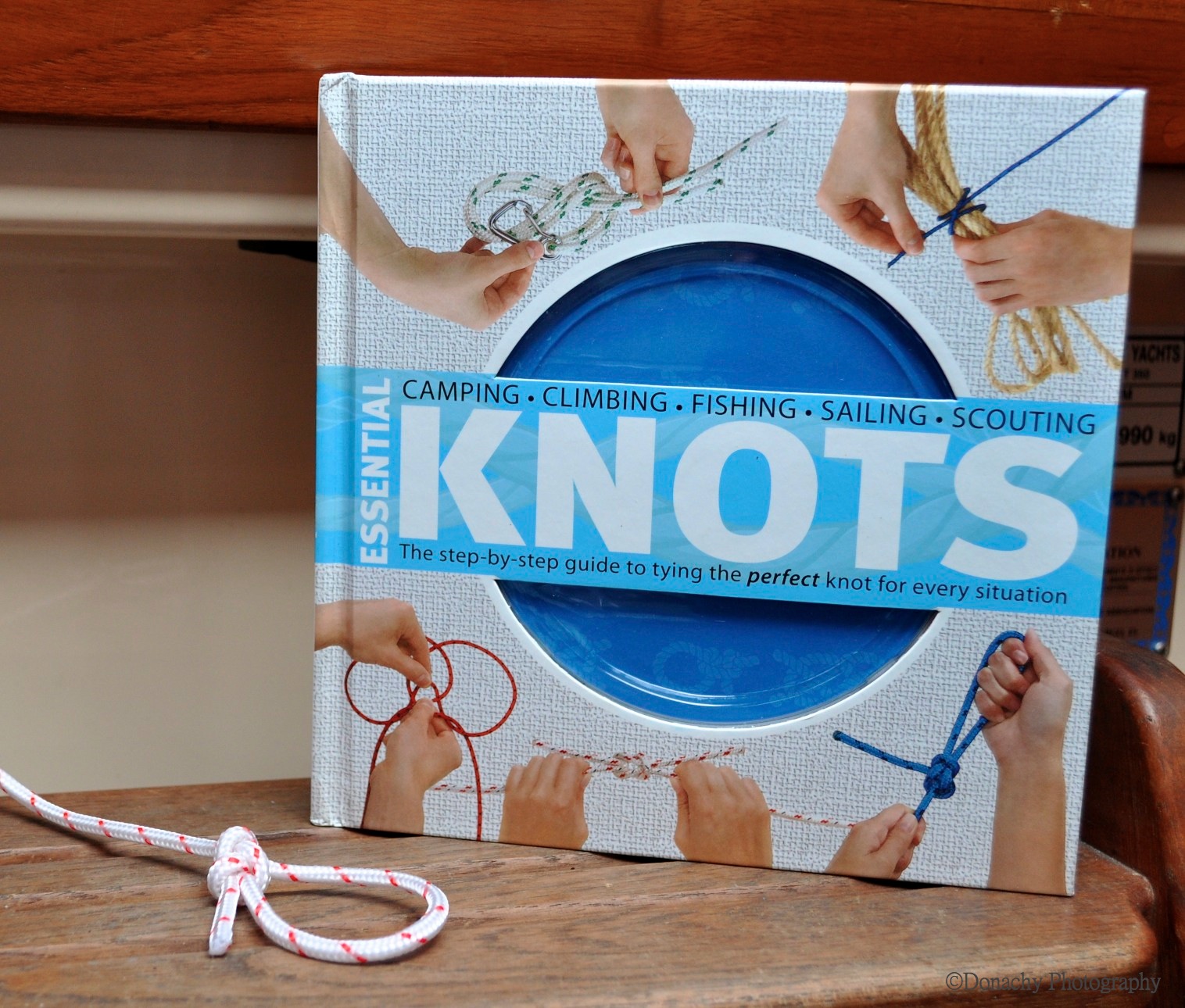
Knots are essential to sailing, and the bowline (above) is a classic with multiple uses. After consecutively tying this knot dozens of times, either one of us could probably tie it in our sleep.
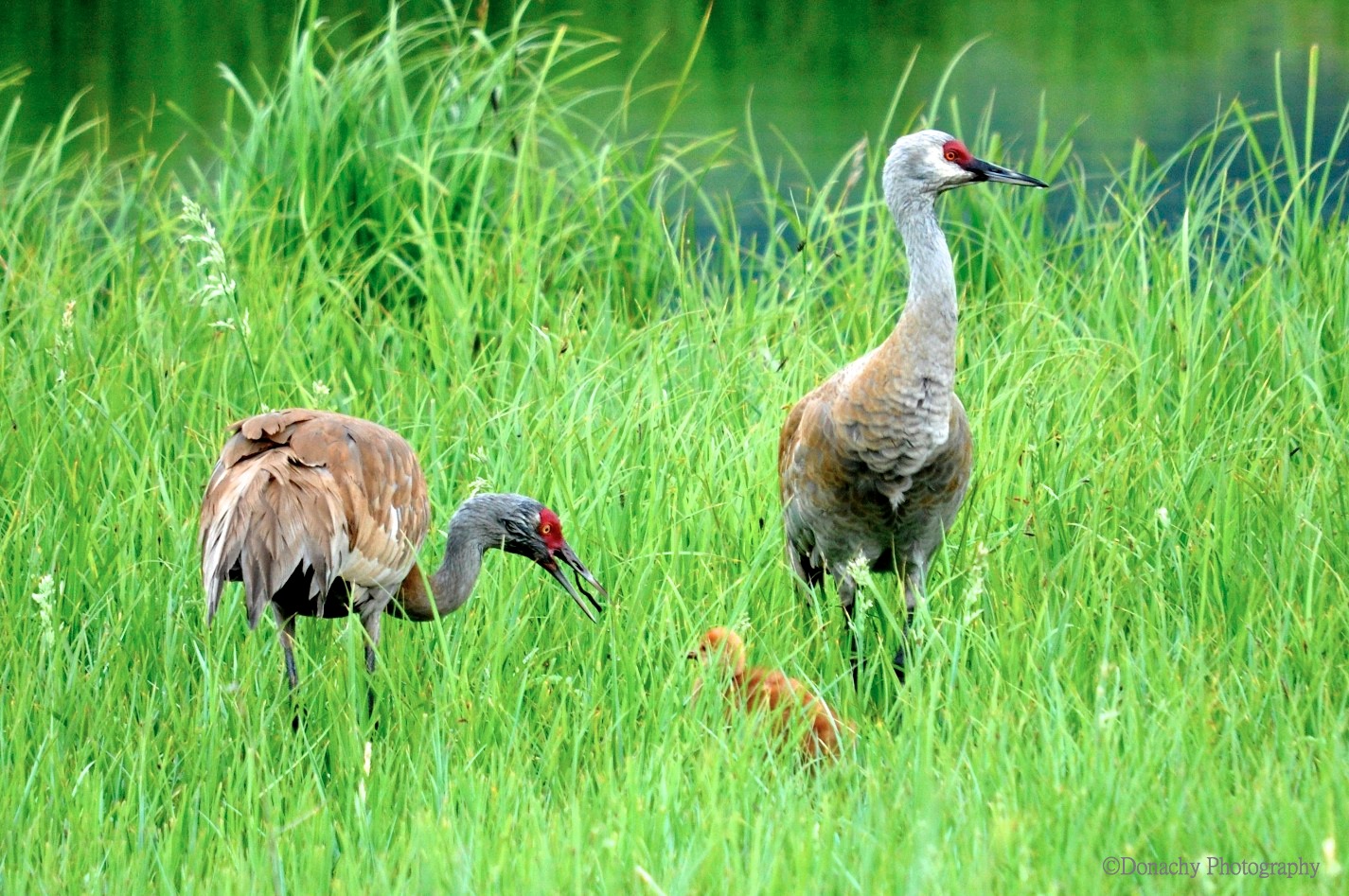
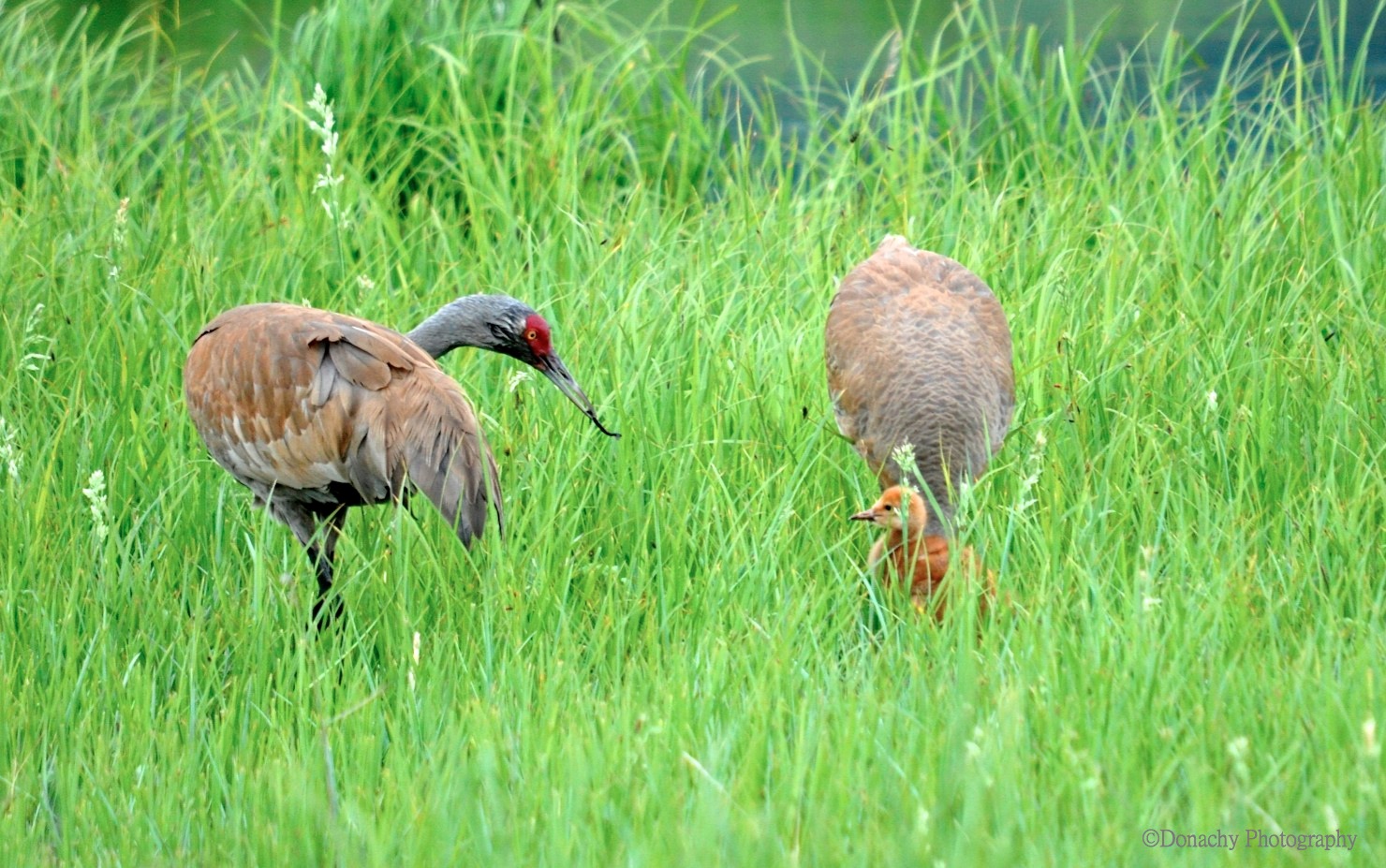
Sandhill Cranes with Chick: Potter Marsh, Alaska

Driving to Anchorage from Seward recently, we spotted these sandhill cranes at Potter Marsh and decided to park the truck and walk out onto the boardwalk for a closer look.

Large birds are cool, and in North America, there aren’t many birds larger than Grus canadensis, sandhill cranes. Adults typically weight 8 to 10 pounds. The stand four to five feet tall and have wingspans of five-and-a-half feet to nearly seven feet. Sandhills are fairly common in the west, and in a few places can be viewed by the hundreds or even thousands. More frequently, they are seen here and there in pairs, in small groups, or as individuals.

The sexes are similar. Plumage ranges from drab gray to rusty brown. Aside from size, the most distinguishing characteristic is the red crown. (Click the photos for a larger view.)

We couldn’t quite make out what the adult bird is feeding the chick. Cranes are catholic in diet. Berries and seeds make up a large portion of their diet, but insects and other small animals figure in as well.

This chick will stay with its parents for 10 months or so – until just before next year’s breeding season when the parents will lay one to three eggs. Sandhills have a life expectancy of about seven years in the wild, but may live up to three times that long. Several subspecies occur throughout the U.S. and across the Pacific to Siberia. Accidentals have been reported in Europe.

Don’t Bogart that Collar, My Friend: Yelloweye Rockfish Melts

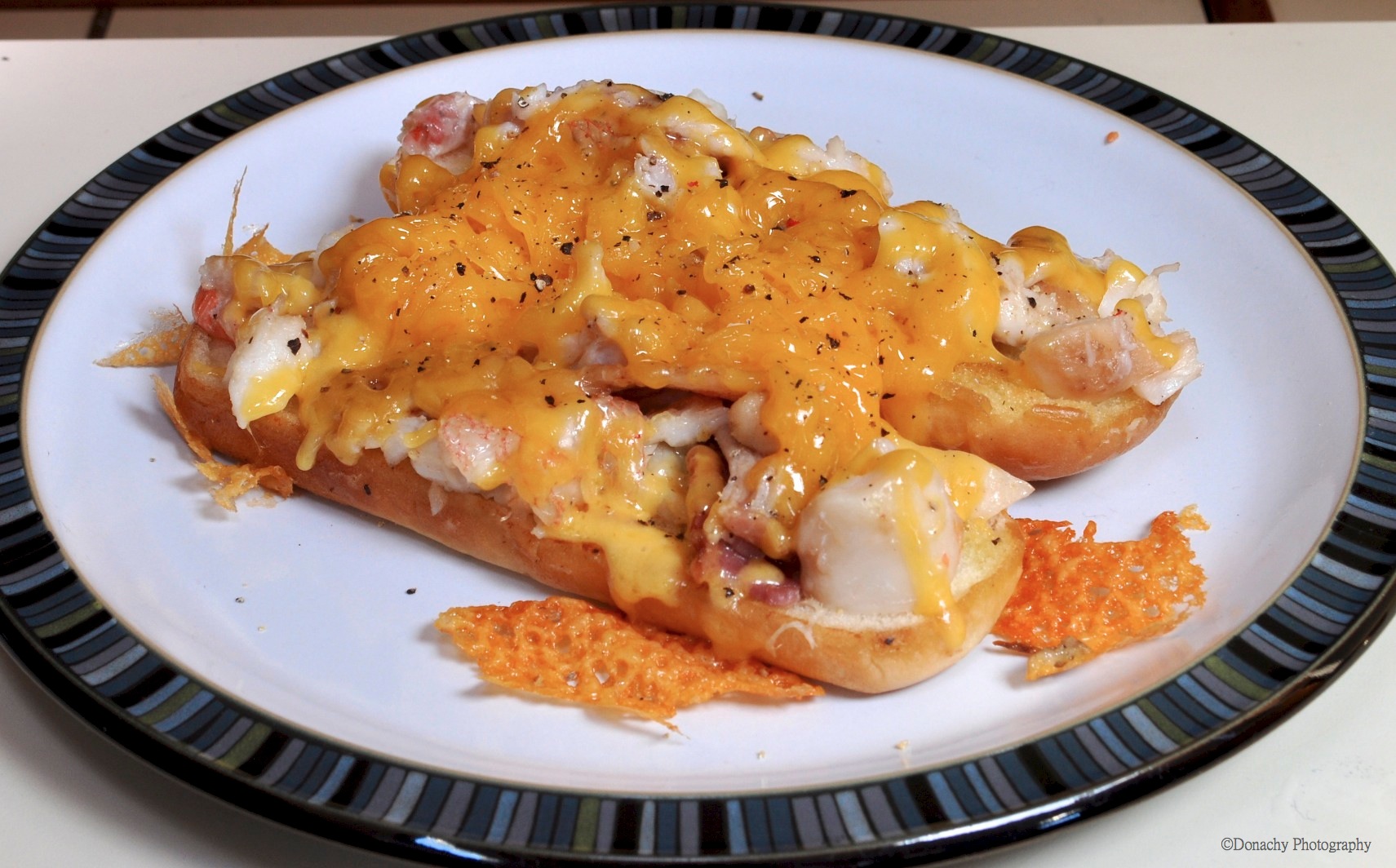
A pan-toasted sourdough bun, a chunky heap of yelloweye rockfish, and Tillamook cheddar cheese along with a couple of grinds each of sea salt and pepper are all you need for a gourmet lunch. The collar meat of yelloweye has a texture and flavor reminiscent of lobster and in similar fashion puffs up when you cook it.

While crab or shrimp are the classic seafoods in a melt, firm, white-meated fish is every bit as good. Enter yelloweye rockfish (Sebastes ruberrimus) collar meat. The large, firm chunks of meat are perfect on melts. Lingcod, halibut, grouper, snapper and freshwater walleye are good candidates for this dish as well, and while collar meat is an excellent choice, any boneless portion of fish works fine.

I like to start with pan-toasted sourdough bread. Heat some olive oil in a frying pan, place in the bread and move the down side around so it become coated with the oil. Cook over medium-lowor low heat till it’s toasted golden brown. Sometimes I add a little butter or some garlic to the olive oil.

Meanwhile, in a separate pan where you’ve also heated a little olive oil, place the fish and cook it over medium-low heat.

If you’ve timed things right, the first side of the bread is toasted and ready to flip at about the same time the seafood is cooked through.

Flip the bread to toast the other side, place the hot, cooked seafood on the toasted side of the bread, cover with shredded cheddar cheese, add a few grinds of pepper and some sea salt, then cover the pan with a lid and continue cooking over low heat till the cheddar is melted.

A few slices of avocado or fresh fruit on the side, a cold lager, iced tea or freshly-squeezed lemon-ade, and you’ve got a quick and easy lunch that will be relished as much by most kids as by gourmets.

Orange-crowned Warbler, Potter Marsh near Anchorage

Oranged-crowned warblers (Vermivora celata) are fairly common, but it’s rare to get a good look at these tiny, active birds. Even less common is finding an individual with an identifiably orange crown. 

Color is often the first thing we go to when attempting to differentiate among like species. The perplexing thing is that color is often misleading.

The orange-crowned warbler’s orange crown is seldom visible. What birders typically see is a small, greenish-yellow-brown bird flitting through alders and willows. A warbler. But which warbler?

If you don’t see an orange crown, another tell is the complete absences of barring on the wings.

Orange-crowned warblers feed on insects, worms, nectar and berries. They’re ground nesters. What a thrill it would be to find a nest, tucked away beneath low-growing willows. When summer ends in Canada and Alaska and the Western United States, orange-crowns migrate to the southern U.S. and Central America.

We were lucky to catch this guy preening on an open branch at the edge of Potter Marsh, on the southern edge of Anchorage, Alaska. He stayed long enough for several photos. Before flitting off into the underbrush, he gave us one final view of his seldom-seen orange crown.

Seward Yacht Club – Swimming Pools, Movie Stars

Seward’s small boat harbor viewed from the second floor balcony of the William H. Seward Yacht Club.

For either one of us, if, back when we were in our teens or twenties and trying to figure out life, someone had told us we’d own a blue water capable sailboat and belong to a yacht club, we’d have thought to ourselves, “Sure. Can I have some of whatever you’re smoking?”

But the Seward Yacht Club fits. Upon becoming members, we were happy to set aside any preconceived notions about “yacht” owners and to simply fall in with a group of really great (generous, hard-working, helpful, welcoming) people who are bound together by a love of boats and water.

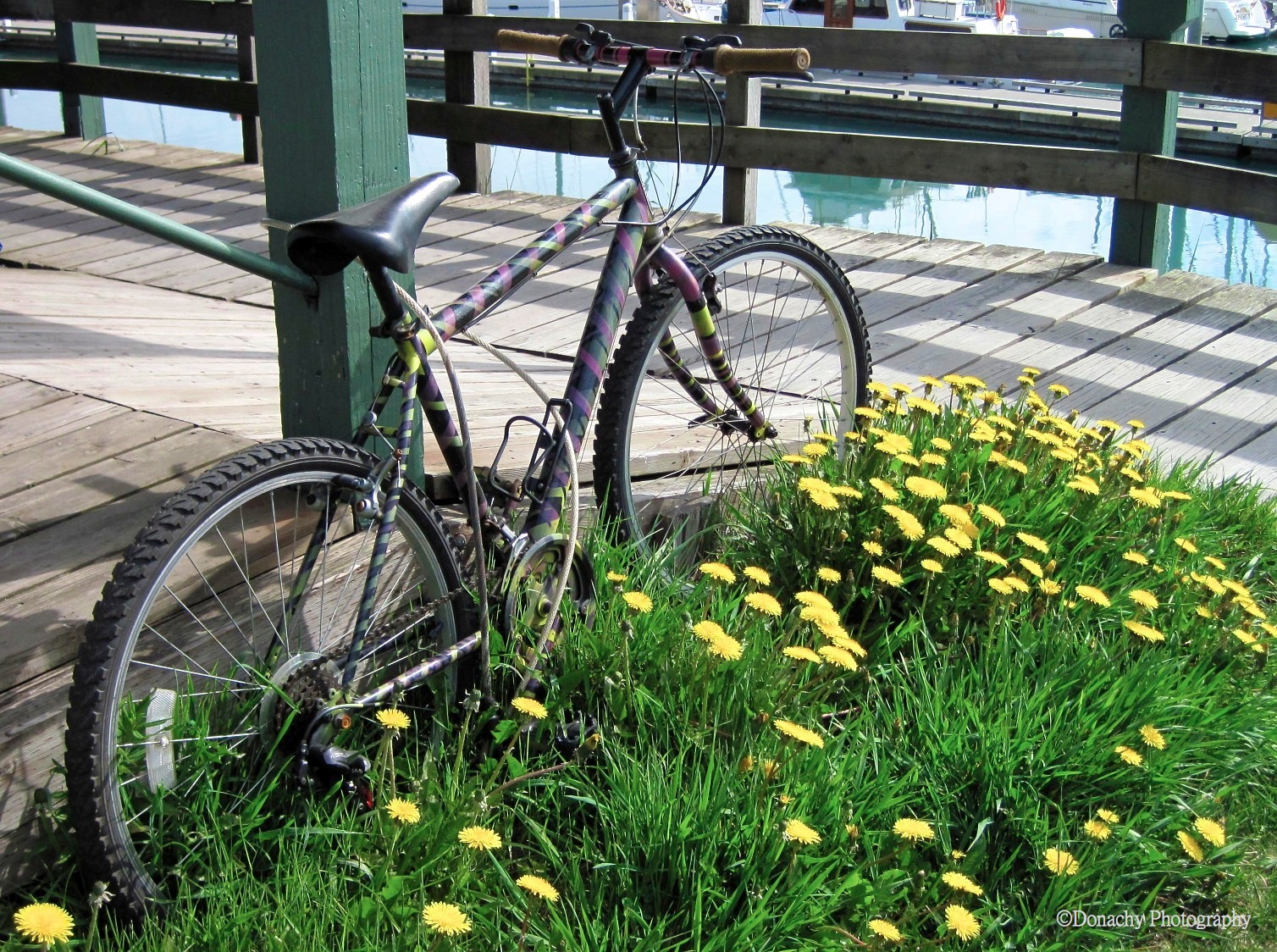
Bikes and the live-aboard lifestyle often go together – this one is parked at the Seward yacht club. It’s nice to belong to a club where the dandelions are left to grow.

In addition to camaraderie, the club provides its members and their guests with showers, a nice kitchen in which to cook a meal, and a fairly extensive library on things nautical.

The small boat harbor at Seward mirrors the yacht club. Boats of all sizes are docked here. A lot of them belong to working fisherman – both guides and commercial fishermen. A lot of the boats belong to people who just plain like water and boats and fishing and have worked hard and been careful with their money, anticipating the day when they could own a boat. It doesn’t seem to matter who you are, where you come from, what kind of boat you have, or what you do on it. People pass each other and most offer a friendly greeting. People take care of their own boats and keep an eye on their neighbors’. It’s a community. Reminds me of the best parts of the small town in western Pennsylvania where I grew up.

Wish there were more places like it.

Getting Wasted on Cheap Vodka

“Higher! Lift it higher!” Barbra strains to hoist a lingcod of about 30 pounds that fell to a jig in 100 feet of water. 

Six-thirty AM and virtually no wind. Gaff – check. Rods rigged and ready – check. Plenty of knife jigs, lead-heads, twister tails – check. A fifth of cheap vodka in a plastic bottle…

Check.

It was our friend Jerry’s last day in Seward, and he had just enough time for a quick out-and-back morning trip. We were looking for his first-ever halibut, along with whatever else might be interested in our jigs.

With Barbra at the helm of our C-Dory, cruising between 15 and 20 knots over calm seas it took us about an hour to get to a place we knew would offer a chance to pick up halibut without running all the way out into the Gulf of Alaska.

Sea birds, vast shoals of herring, porpoises, seals and off in the distance the misty spout of a whale – all against a dramatic Alaskan background of green-sloped, snow-shouldered mountains, glaciers and  rugged, rocky – make any trip out onto the bay a good one.

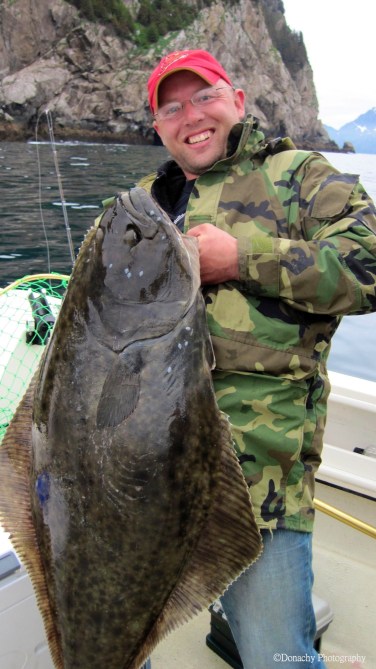
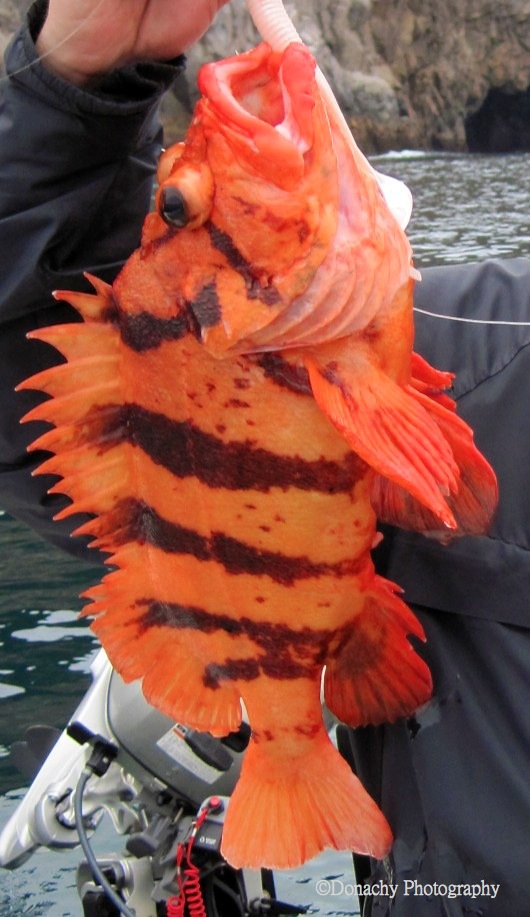
We got a few fish, too. Jerry nailed his first-ever halibut (not to mention a 50-pound-class lingcod – also a first), Barbra got her hands on her first 30-pound lingcod, and I hooked another nice halibut. In three hours of fishing, we caught maybe half-a-dozen lings, the halibut, Pacific cod, greenling, a brilliantly colored sculpin and over a dozen assorted rockfish including blacks, yelloweye, quillbacks, and a beautifully marked tiger.

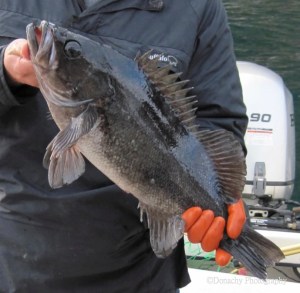
We kept a yelloweye, the tiger (photo on the left), and a halibut.

Since the lings have to be released (the season doesn’t open till July 1, and it is permanently closed within Resurrection Bay), the only one we pulled out of the water for a quick photo was Barbra’s 30-pounder.

But she brought an even larger fish to the boat that day, and the way she caught it was a first for us – one that gave new meaning to the exclamation “Color!” fishermen often call out when they get the first glimpse of a fish coming up from the depths.

Laid across the mouth of one of the most beautifully marked lings we’ve ever seen – a 40 pounder with striking, amber-brown spots – was a bright orange yelloweye rockfish! The jig hook was planted firmly in the yelloweye’s mouth, but had no purchase on the lingcod. The ling’s jaws were simply clamped down on its meal – and  it was giving every bit as good of a fight  as if it had been securely hooked.

We released several nice black rockfish, such as this one Jerry caught.

I knew, based on reading about events like this, that as long as we didn’t raise the ling’s head above water, he’d continue to hold onto the rockfish like a dog playing tug-of-war with a rope. So what did I do? I grabbed Barbra’s leader and lifted the ling’s head above water, causing it to instantly drop the yelloweye and sink back into the depths. Oops…

We thus missed a chance for a really great photo – the bright orange of the yelloweye lying lengthwise across the jaws of a massive lingcod. Ahh… next time!

Interestingly enough, the yelloweye didn’t look particularly damaged. When we released it, it scurried straight for the bottom.

And the vodka?

Jerry and I had read about fishermen using cheap booze – not a .22 rifle, not a .410 shotgun, not a billy – cheap booze to subdue fish. Halibut are notorious for going crazy once they’re on the deck of a boat. They’ve been known to bust up tackle, wreck coolers and even injure their captors. But with a shot or two of alcohol on their gills…

When Jerry got his fish up on the surface, I gaffed it right behind the cheek and pulled its head up out of water. As soon as the fish opened its mouth, Jerry poured a couple shots of vodka down its hatch. The affect was amazing. The fish slumped like an overserved patron passing out on a bar, and we slid it over the gunwale without a struggle . Once we had it on the deck of the C-Dory, we splashed its gills with another shot of vodka for good measure and then hung it over the side of the boat to bleed it out.

Easiest time of it I’ve ever had with a halibut.

Even the little fish are cool: Barbra with a brilliantly marked Pacific sculpin that tried to eat a jig nearly as large as itself.

Minke Whales

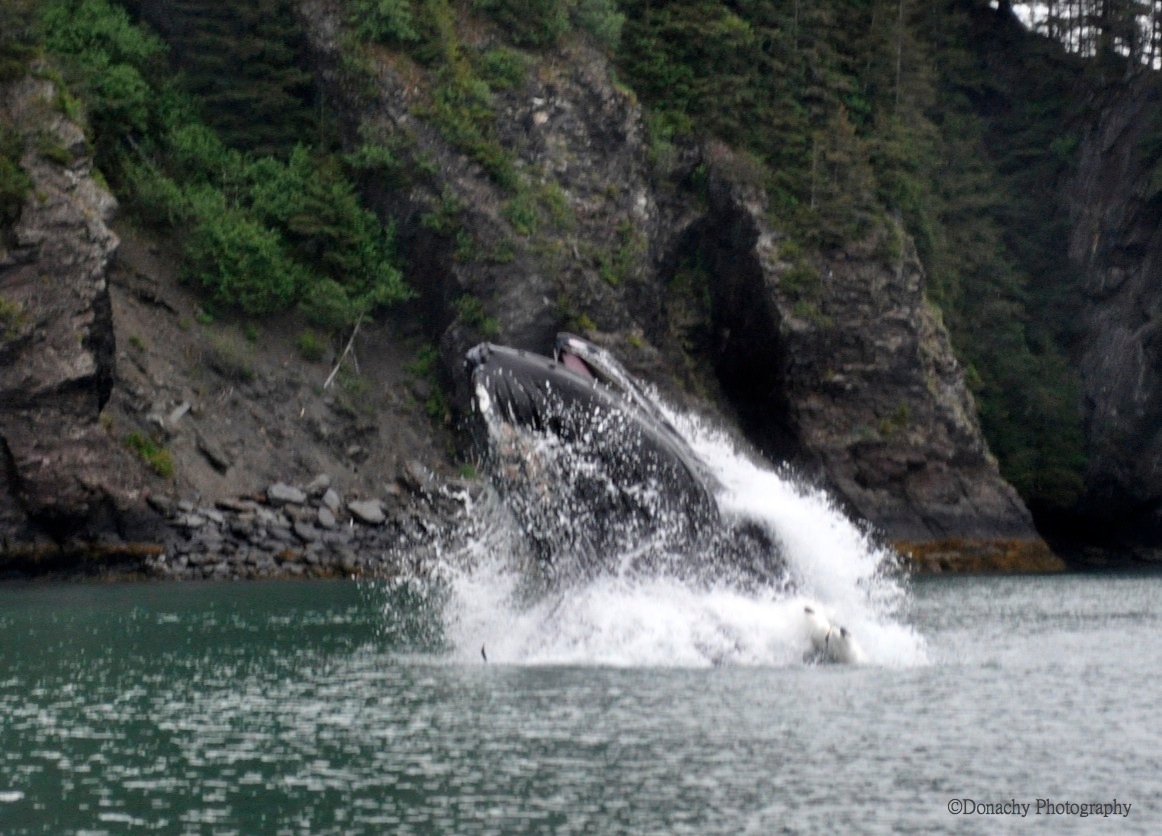
Quintessential Alaska – a whale blows close to moss and fern covered rocks in Resurrection Bay. The water is hundreds of feet deep near shore here – this slope face rises almost vertically to snow-coverd peaks.

Coming back from a fishing excursion the other morning, we spotted a pair of whales near shore, off our forward port (left) quarter. They appeared to be in no hurry and so we, too, slowed down to spend some time watching them. Here and there we noticed telltale herring flipping on the surface – no doubt the reason the whales were in so close to shore. The steep banks would make the perfect place to corral a meal.

Smooth back, pronounce fin and white markings on the side indicate a minke whale – a member of the rorqual whale group. Rorquals feed by opening their massive, expandable mouths and straining small fish, shrimp, krill and other food through baleen. 

Although we kept a fair distance, at one point the whales disappeared. We thought they’d sounded and left the area until suddenly they both came exploding out of the sea on our starboard side. Herring seemed to be flying in attempts to escape the whales’ massive jaws. As whales go, minkes are small, but they still average nearly 30 feet and 10 tons – large enough to reduce a 22-foot boat like ours to fiberglass splinters. This was our first time to see whales so close, let alone lunge-feeding, and rather than snap photos all we could do was watch, jaws agape, exclaiming “Oooo!”

This photo (taken with a Nikon DX 18-55 lens) captures the blowhole and the distinctive white markings of a minke. 

We lingered, hoping to capture a repeat feeding lunge on film. And then it happened.

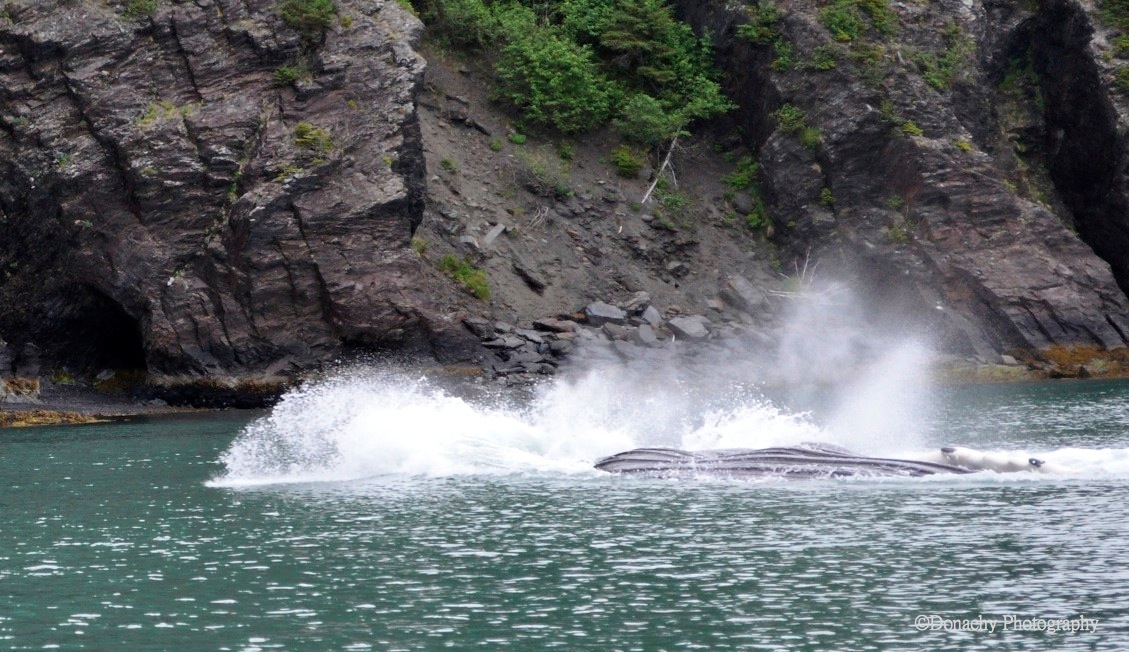
If you look closely, you can see a couple of herring in the spray around this minke whale’s head.

Suddenly the surface of the water began to bubble with jumping herring, and then, as if out of nowhere, a huge head came exploding out of the sea. Fortunately Barbra had the presence of mind to snap photos.

By the early 1900’s, after the world’s whaling fleets had mined most of the large whales out of the ocean, countries such as Norway and Japan, which continued whaling, turned their attention to smaller whales such as minkes. They’re still being hunted, but they remain locally common, and overall populations appear to be stable. Minkes can be found throughout the world’s oceans. An excellent field guide to Northern Pacific whales is Whales and Other Marine Mammals of British Columbia and Alaska, by Tamara Eder.

Dall’s Porpoises – Tasmanian Devils of the Northern Pacific

You might see a pod of them off in the distance, plowing up water in plumes of bubbles and spray, arcing, crossing each others’ paths, zipping like mad across the sea’s surface. As they speed toward your boat, you can almost hear the sound effects that accompany the Tasmanian Devil’s entrance in the Warner Brothers Cartoons. “Dall’s Porpoises!”

At an average length of 6 feet (1.8 m) and distinctively marked in black and white, they look like miniature versions of Orcas. And they love small boats. On any given outing here in Resurrection Bay, you can almost count on a group of these speedsters showing up around your bow. And since they seem to prefer to play around boats that are running fairly slowly, they don’t discriminate between powerboats and sailboats.

Dall’s porpoises frequently come right alongside small boats, seeming to use the vessels as objects to play around and to race against. Here a group of them are cutting back and forth beneath our C-Dory.

Strictly speaking, Dall’s porpoises don’t really “porpoise.” They quickly surface, throwing up rooster tails of spray as they do, take a quick breath and keep on swimming. Fast. Photographing them is a matter of guessing where they’ll show up next and snapping shots until they do.

Like other dolphins and porpoises, Dall’s have teeth. They feed on small fish, such as herring. We’ve noticed that when we’re trolling for salmon, right about the time we spot Dall’s, our rods often start arcing and our reels start singing – probably because both the porpoises and the salmon are keying on herring.

Although groups typically contain a handful of individuals, there are times when they gather by the thousands. They roam both nearshore and offshore waters in the Northern Pacific. Unfortunately, although they are still common, hunting (several countries take an average of 10’s of thousands annually – an unsustainable number) and fatal encounters with fishing nets are reducing their numbers.

A good place to read more is in the book Whales and other Marine Mammals of British Columbia and Alaska, by Tamara Eder.

Yelloweye Rockfish Benedict: Alaskan Breakfast of Champions

Freshly cracked pepper, sea salt and maybe a dash of soy sauce are all the seasoning freshly caught yelloweye want. Topped with hollandaise sauce and served on pan-toasted English muffins with sides of thick bacon, summer squash, ruby red grapefruit and ruby red mimosas, this is the kind of breakfast that makes you happy you’re a fisherman – or married to one! 

Like single malt Scotch and country drives in autumn, when it comes to table fare there are no bad rockfish. But within genus Sebastes, some cook up better than others. In Japan, small but tasty mebaru (Sebastes inermis) are among the most highly prized fish wherever they are found. Here in Alaska, yelloweye (Sebastes ruberrimus), which can grow to over 30 inches (80 centimeters) and 20 pounds (9 kilograms) are the stars. The sweet, delicately flavored meat puffs up slightly when cooked and flakes off in large, firm chunks for a taste and texture that is unparalleled among rockfish.

.

When preparing fillets this way, a good rule of thumb is nine minutes per one inch of thickness, thus a fillet one inch thick will be cooked for about nine minutes.

I pan toast English muffins (or any other toast) by using about three parts olive oil to one part butter (or no butter at all) over low to medium-low heat in a heavy frying pan. Heat the oil, add the bread, toast, flip and do the other side. This produces tasty toast, and you can do it in any kitchen, over a Coleman stove, or in a galley.

Yelloweye Rockfish Benedict

Ingredients:

  • 1 rockfish fillet about 3/4 lb to 1 lb, cut in half to serve 2 people. We generally prefer our fillets scaled, skin on. (Skin removed is fine.)
  • salt
  • pepper
  • soy sauce (optional)
  • olive oil
  • 3 egg yolks
  • 4 tbsp butter
  • 1 tbsp lemon juice
  • healthy pinch or two of cayenne pepper (or mildly fiery chili-based seasoning such as the Southwestern rubs made by Penzys or Dean & Deluca)
  • 2 English muffins, sliced in half, toasted

Directions:

For Hollandaise:

  1. Melt butter in a small pan over low heat.
  2. Set up a double boiler by putting some water in a pot and bring it to boil. In a smaller pot, place egg yolks and lemon juice. Place this smaller pan in the larger pot, but not in the water. The steam will heat the smaller pot.
  3. Vigorously whisk the egg and lemon mixture until it increases in volume.
  4. Slowly drizzle the melted butter into the whisked egg mixture, add a pinch of slat, and continue to whisk until everything is blended.
  5. Set aside. This mixture can be warmed again, if necessary. If it’s too thick, whisk in a few drops of water. Too thin, cook more, being sure to continue whisking/stirring.

To cook the rockfish:

  1. Rinse the fillets, pat dry with paper towels, and place on a cutting board, skin side down. Add freshly cracked pepper and sea salt and set aside.
  2. In a skillet large enough to hold the fillets so that they don’t touch, place enough olive oil to liberally cover the bottom of the pan and heat over medium-low heat.
  3. When the oil is hot enough to make the fish sizzle, add the fillets skin side down. Cook for 5 minutes.
  4. Turn the fillets and sprinkle with salt and freshly cracked pepper. Add about 1/2 tablespoon of soy sauce (optional) and continue cooking for 4 minutes.

To serve:

Place toasted English muffins on plates, place the fillets on the muffins, and spoon on the Hollandaise. Sprinkle on a dusting of cayenne pepper or a similarly fiery pepper-based rub. Serve with seasonal vegetables.  We enjoyed this meal with mimosas made with freshly-squeezed ruby red grapefruit.

Zaru Soba with Alaskan Scallops and Shrimp

Zaru soba (chilled buckwheat noodles) dressed up with fresh seafood makes for a quick but elegant meal. 


A challenge inherent to preparing meals onboard a boat or in a camper is that the stovetops tend to be small, and while this doesn’t necessitate limiting preparation to one or two pans, it steers a cook in that direction. Meals featuring something on a bed of noodles really shine, and one of our favorite types of noodles are soba – which is the Japanese word for buckwheat. Being thin, soba cooks quickly, and since zaru soba is served chilled, it’s no problem to rinse the noodles and set them aside while other food is prepared.

In the past, I’ve made this dish with salmon, halibut and rockfish. On this more recent occasion, I had large Alaskan scallops and fresh Alaskan shrimp on hand. Instead of serving the dish on traditional bamboo (the origin of the word zaru), I opted for pasta bowls.

Zaru Soba with Alaskan Scallops and Shrimp

Ingredients:

  • soba for two people
  • 1/4 pound shrimp, peeled
  • 1/4 pound sea scallops
  • 1/2 cup tsuyu (a dipping sauce available in the Asian section of most grocery stores). Divide into equal parts.
  • 1 sheet of nori (dried seaweed), cut into thin strips
  • 1/4 cup dry sherry or sake
  • olive oil
  • salt
  • 1/2 tbsp Thai seasoning
  • 1 tbsp fresh tarragon chopped course or 1 tsp dried tarragon (optional)
  • 1 green onions, sliced thin

Directions:

  1. Place scallops and shrimp in a mixing bowl. Add Thai seasoning and tarragon and toss together. Set aside.
  2. Boil soba according to the directions on the package. I use much less water than most directions call for and the noodles come out fine, but do salt the water.
  3. When the noodles are finished, pour them into a colander to drain and then rinse with cold water.
  4. Place noodles in pasta bowls. Add tsuyu to each bowl, tossing the noodles in the sauce.
  5. Heat a little olive oil in a large frying pan over medium heat. When oil is hot, add the seasoned scallops and shrimp. Add sherry or sake. Cook for about 1 minute, using a spatula to briskly stir and turn seafood.
  6. Place seafood on noodles. Top with sliced green onions and nori strips and serve. Alternatively, the cooked seafood can be chilled prior to adding to the noodles.

This dish and its variations has become a family favorite. It pairs beautifully with a Willamette Valley Pinot Gris or a crisp Sauvignon Blanc.