Thanks to Lesley Carter for publishing this post on Bucket List Publications!
Off the Beaten Path – In Remote, Wild, Spectacular Mongolia!
Thanks to Lesley Carter for publishing this post on Bucket List Publications!
Off the Beaten Path – In Remote, Wild, Spectacular Mongolia!

We caught this Alaskan grizzly bear chillin’ on the edge of a forest on a cool, overcast morning in mid-summer. With nails like that, who wouldn’t lie around admiring them? (Six more photos.)
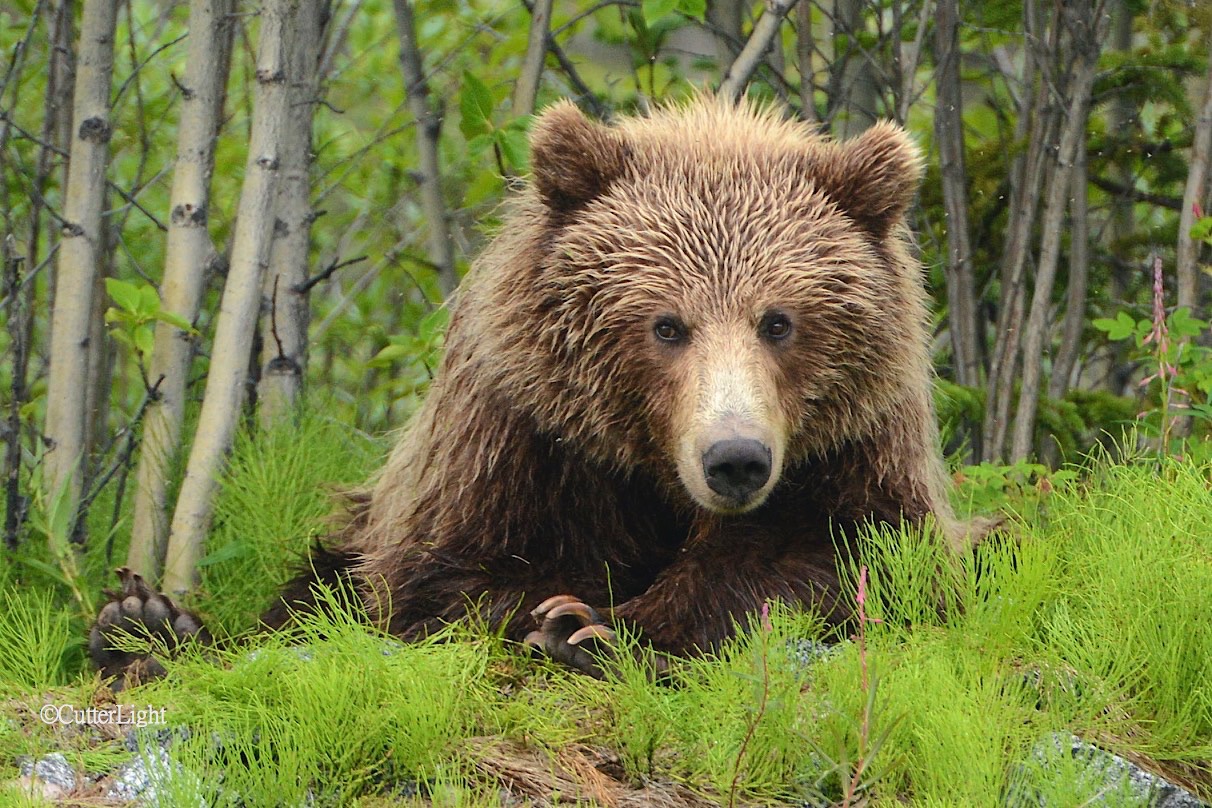
The previous day, I (yours truly, Jack Donachy) managed to drop and break “the big lens.” But this sleepy guy barely paid us any attention as we photographed him from the safety of our Chevy, so the 70-200 mm with a 1.4 teleconverter got us close enough. Hard to say how many cars had driven by this big, blonde-brown hulk without noticing that morning. We stayed with him – and he with us – for about half an hour.

He’d doze off for a bit, wake up, think about whether or not to get up (or maybe he was trying to remember where he’d left his car keys last night), give a little sigh and then drop off to sleep again.


And then he’d wake and take a look around.
Eventually a scent on the air caught his attention…

And he ambled off. Almost looks like he’s posed in a diorama. The overcast morning light really made the colors pop.

All the pleasures of indulging in a whole pie without the downside of consuming a regular-sized pie – these individual apple pies feature sautéed Fuji apples in a brown-sugar-speckled crust topped with gooey caramel dulce de leche sauce.
We love desserts that could, in theory, be shared but are best enjoyed on your own. Click the links to see these delicious ways we’ve end meals with individual serving desserts: pecan persimmon upside down cake, anniversary crème brûlée, fall harvest cakes and, of course, molten lava chocolate cake. Individual miniature desserts are especially enjoyable because you can savor the textures and flavors of the entire pie.
Individual Apple Pies
Ingredients
Crust
Filling
Directions
Dulce de Leche Topping
Ingredients
Directions
Pour 1 can sweetened condensed milk into top of double-boiler pan; cover. Place over boiling water.
Cook over low heat, stirring occasionally, for 40 to 50 minutes, or until thick and light caramel-colored. Remove from heat. Beat until smooth.
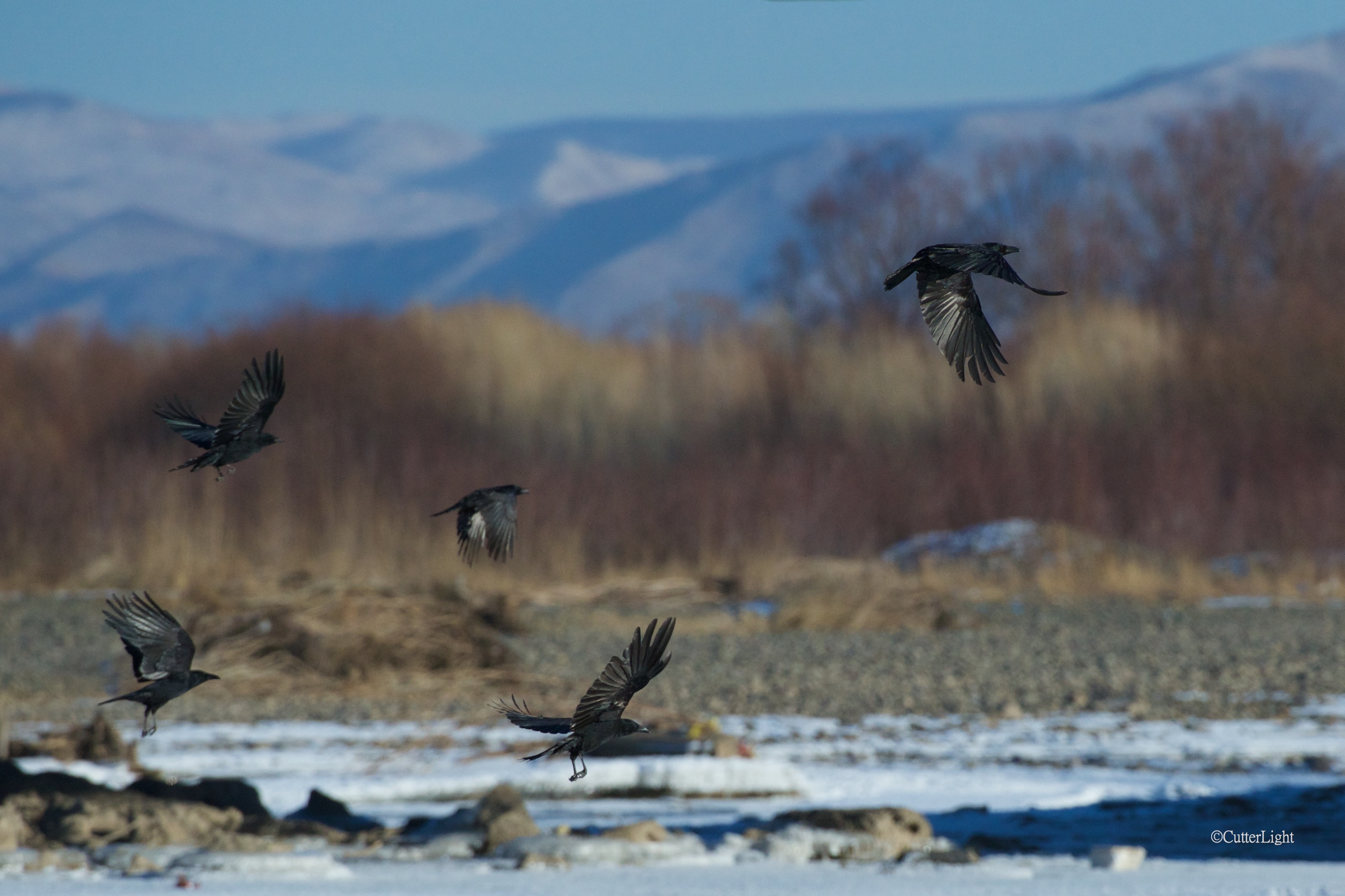
Corvids – a group which includes crows, ravens, rooks, jays, magpies and nutcrackers – fascinate. On a frigid December afternoon, we found them ice-fishing for caddis larvae in Mongolia’s Tuul River in the heart of Ulaanbaatar. (Click any of the photos for a larger view.)
The most intelligent of all birds, and with a brain-to-body-mass ratio rivaling that of the great apes and cetaceans, crows and their allies often exhibit remarkable behavior. Members of this family have been observed using and to some degree engineering purpose-specific tools – the only nonhuman animal other than the great apes to do so. There’s little doubt that certain feeding behaviors adopted by crows have been learned by watching other birds and animals.

Note the object in the beak of the crow on the left. It’s a caddis larva casing.
The Tuul River flows through Ulaanbaatar, Mongolia’s capital city. Despite urbanization, the river’s water quality remains high – good enough to support species of trout as well as sensitive aquatic insects such as mayflies, stoneflies and caddisflies – species which spend the early part of their lives as larvae on the bottoms of clean rivers and streams. The Tuul is fast-flowing. Consequently, despite weeks on end of sub-freezing temperatures, here and there pockets of water remain open over shallow, stony, silt-free bottom.
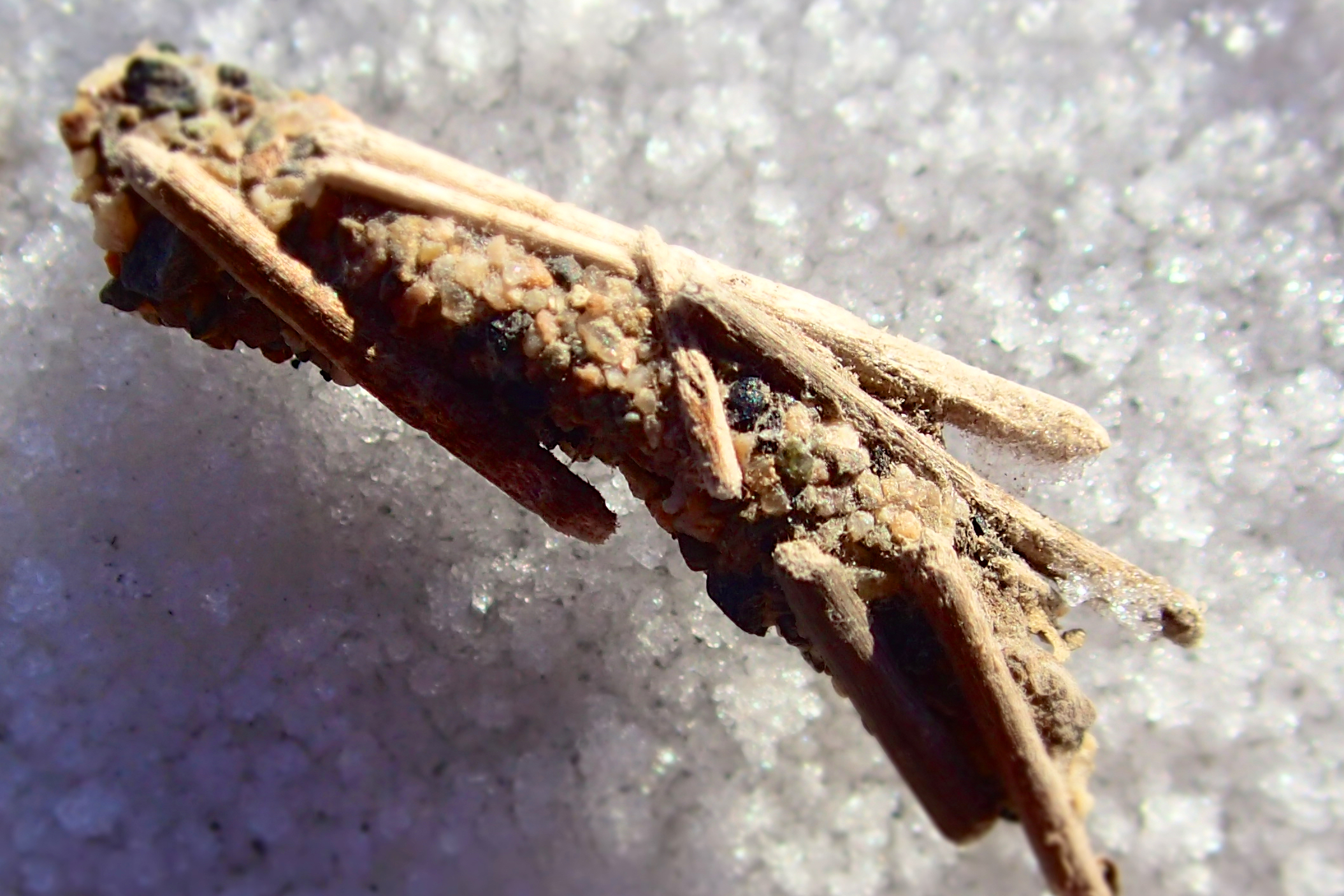
We took a cue from watching the crows and began scanning the ice for caddis larvae casings. As our eyes tuned into the proper size and shape, the empty husks appeared everywhere. This casing, constructed of tiny sticks and pebbles, is about 1.5 inches long (3.8 cm) and belonged to a member of the Northern case maker caddisfly family.
Perhaps the crows learned of the abundance of wintertime food in these areas of open water by watching dippers – a robin-sized bird that happily plunges into pools and riffles in all seasons in search of aquatic insects and small fish. In fact, on this day we saw a white-throated dipper submerge itself in one of the riffles where the crows were feeding and come up with a small fish.

Here a carrion crow (Corvus corone) has his prize – a caddis larva pried from its pebble and stick casing.
Not adapted to plunge into water, the crows were fishing from the edge of the ice – thus gaining access to water not overly deep, but deep enough to provide habitat for slow-moving caddis larvae. Resourceful birds, are crows.

It’s the flamed Cognac (not to mention the half bottle of red wine) that gives this savory dish it’s unique, caramelized flavor. When you light the Cognac, stand back! Can you see the horse head in the flames?
Deep in the heart of winter here in Mongolia, we find ourselves craving traditional cold-weather comfort foods. Beef Bourguignon (also known as Beef Burgundy) is a classic stew from France’s Burgundy region. As is true of many stews and chowders, this dish has its origins as peasant fare, but over time was refined into the not-overly-difficult crowd pleaser familiar today. Why not give it a try some cold winter’s night!
As a stew, ingredients can be substituted fairly freely. (The pearl onions this dish traditionally calls for are difficult to find where we live. Coarsely diced regular onions work fine.) It occurs to us that the addition of rutabaga, pumpkin, parsnips or hard squashes would add appropriate flavors to this dish. Also, remember the basic rule for cooking with wine: use one you’re happy to drink. A full-bodied, dry red is best.
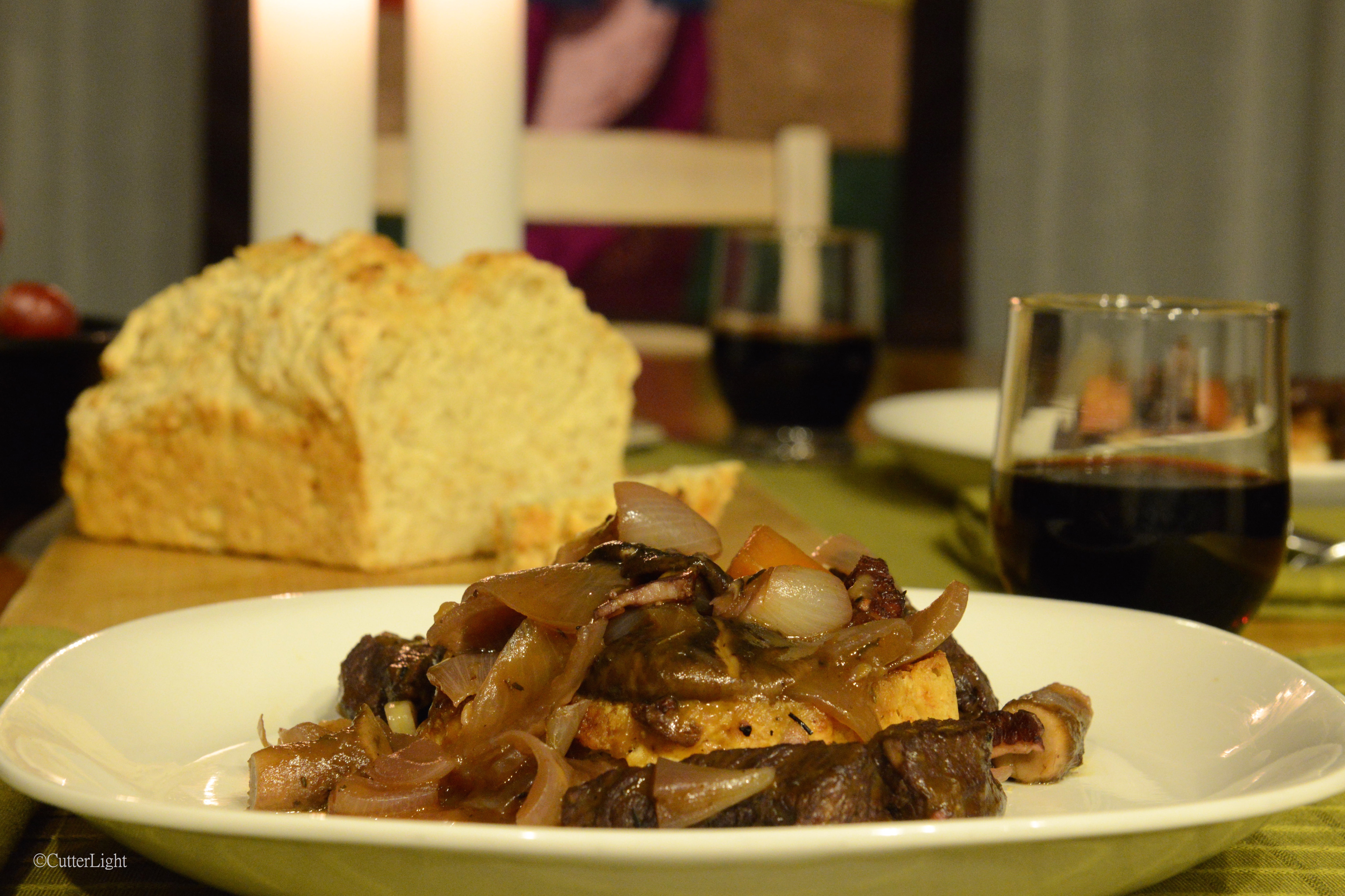
The finished beef bourguignon is traditionally served on toast and is a great excuse (if you need one) to pop the cork on a favorite red wine. The better the toast, the better the entrée. See our method, below.
Ingredients
Directions
Pan-Fried Toast – Use any hearty, rustic bread sliced fairly thick.
Heat about 2 tablespoons of olive oil in a large frying pan over medium to medium low heat. Mince two cloves of garlic (a fine cheese grater works well for this). Spread one side of bread with olive oil and a thin spread of minced garlic. Place bread garlic-side down in pan and fry, being careful not to let the garlic burn. When the garlic is golden brown, flip the bread and fry the other side. The finished bread should be beautifully browned and crisp on the outside.
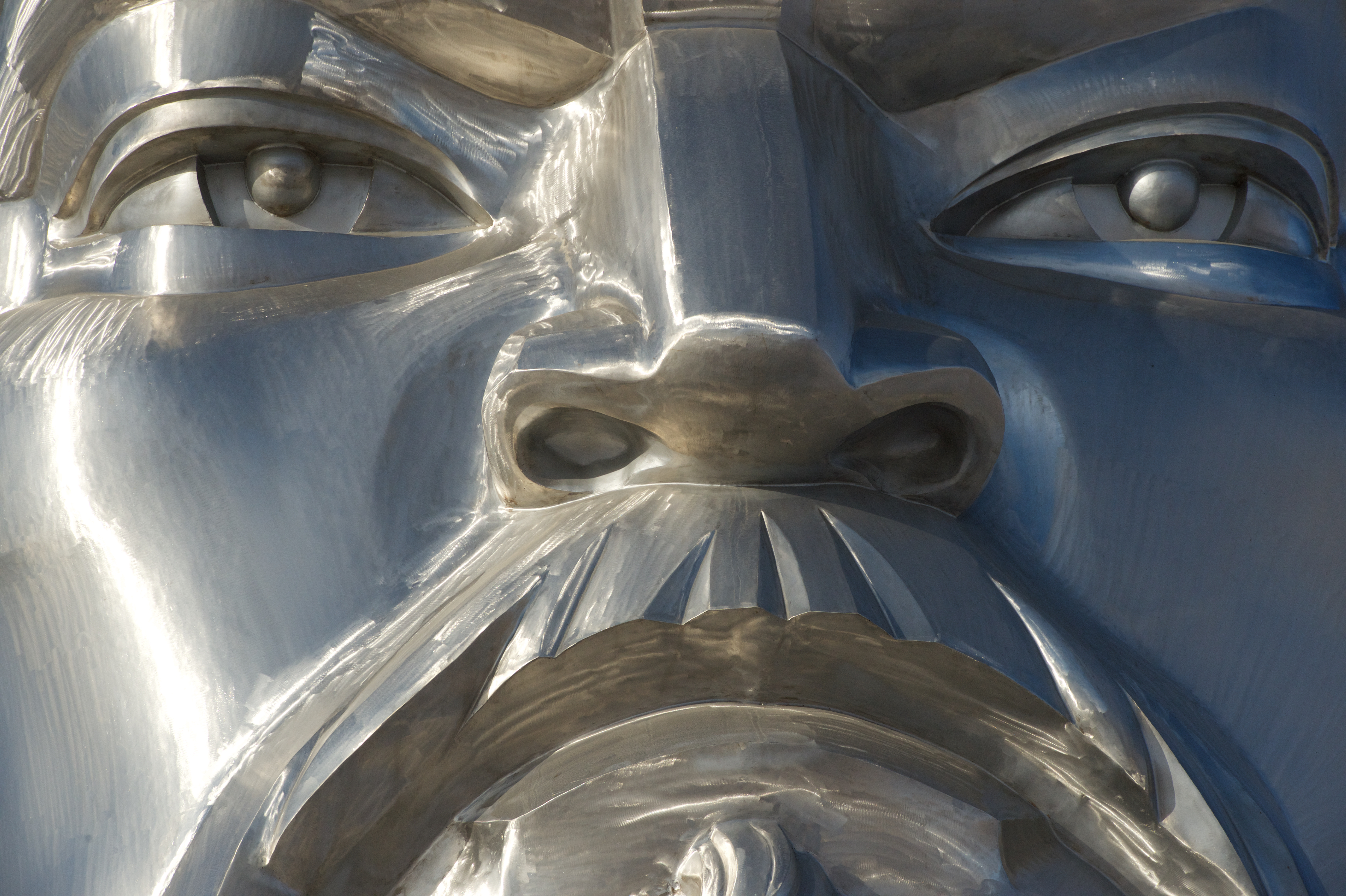
There is no overstating the importance of Chinggis Khan – ruler of all who live in felt tents – to the Mongolian people. Revered in film and in statues such as this 40 meter (131 feet) tall monument , the founder of the Mongolian Empire is evoked in everything from currency to Ulaanbaatar’s international airport to vodka labels.
Sitting at an altitude of 4,429 feet above sea level, just over one million people live in Ulaanbaatar, Mongolia’s capital city. Another 1.7 million Mongolians live in the countryside, either in smaller communities or as nomadic herders on the highland steppe or vegetated regions of the desert. In former times, these grasslands and the nomadic herding culture that accompanied them stretched through Kazakhstan as far west as Hungary, so when Chinggis Kahn proclaimed himself ruler of all who live in the circular, felt-covered tents called gers that were the homes of these nomadic people, he was laying claim to the largest contiguous land mass ever to fall under one empire.

Looking east toward the place of his birth, Chinggis still dominates the rugged Mongolian steppe. Two hundred-fifty tons of stainless steel went into this statue which is situated at the location where a young Temüjin (Chinggis’s boyhood name) found a golden whip and took it mean that he was destined to become a great leader.
At his birth in 1162(?), the land of Tumüjin’s childhood was occupied by numerous, often warring nomadic tribes. Part of Chinggis’s legacy includes uniting these tribes under one rule and in the process creating a national identity for the Mongolian people.
The nomadic culture has died out or essentially been extirpated elsewhere such as in Kazakstan and Hungary. Under Stalin, the Soviets waged an unrelenting campaign to wipe out or drive out nomadic herdsmen, in many locales turning former grazing lands into collective farms and bringing about mass starvation in the process.
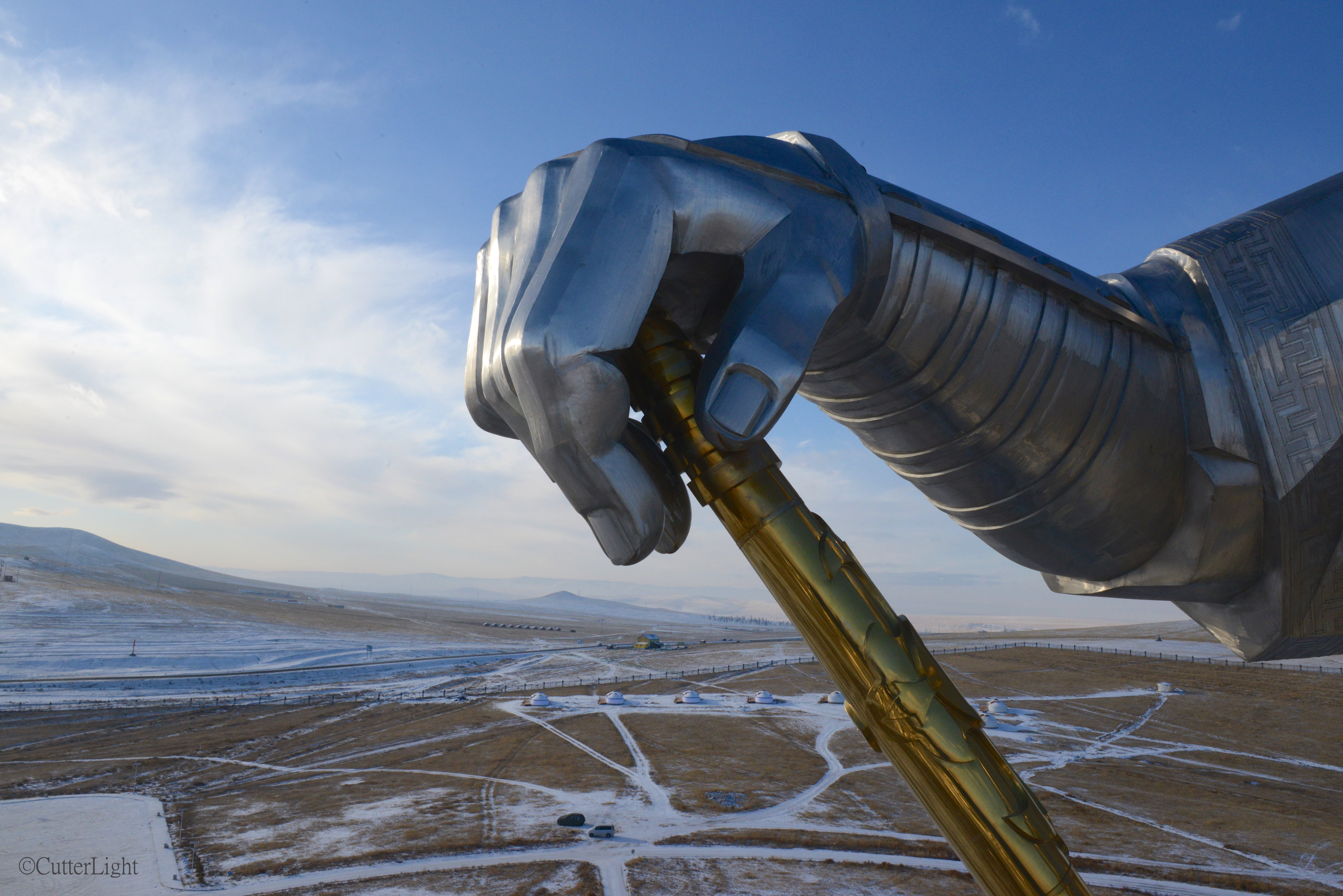
The name Chinggis Khan means “leader of all who live in felt tents.”
But in Mongolia, a land sufficiently insulated and independent enough from both the Russians and the Chinese, hundreds of thousands of Mongolians still live much as they did in the 13th century when Chinggis rose to power. As such, they are the last truly nomadic people in the world.
Millennia of equestrian know-how passed down generation to generation is still showcased in annual tournaments where horse-mounted riders traveling at full gallop demonstrate an ability to pierce man-sized targets with arrows shot from simple bows. It is easy to imagine the terror such skilled, mounted warriors would have invoked in territories where horsemanship was all but unknown. In addition to enemy soldiers felled in battle, under the various Khans, Mongolian armies slaughtered tens of millions of civilians in locales where people had refused invitations to surrender.
At its zenith, the Mongolian Empire stretched from eastern Europe through much of China and Southeast Asia all the way to the shores of the Pacific Ocean. Present day Mongolia lies within the bean-shaped boundary partially covered by the map key.
The positive aspects of Chinggis’s legacy include bringing political stability to the Silk Road and thus to regional commerce, establishing religious tolerance, fostering intellectual growth and greater communication throughout the empire, and quelling the region’s history of tribal and clan warfare by introducing meritocracy to government.

This leather boot, located in the museum below the statue, is the same size as the stainless steel boots on Chinggis’s feet. The statue was completed in 2008 and is currently the largest equestrian statue in the world.
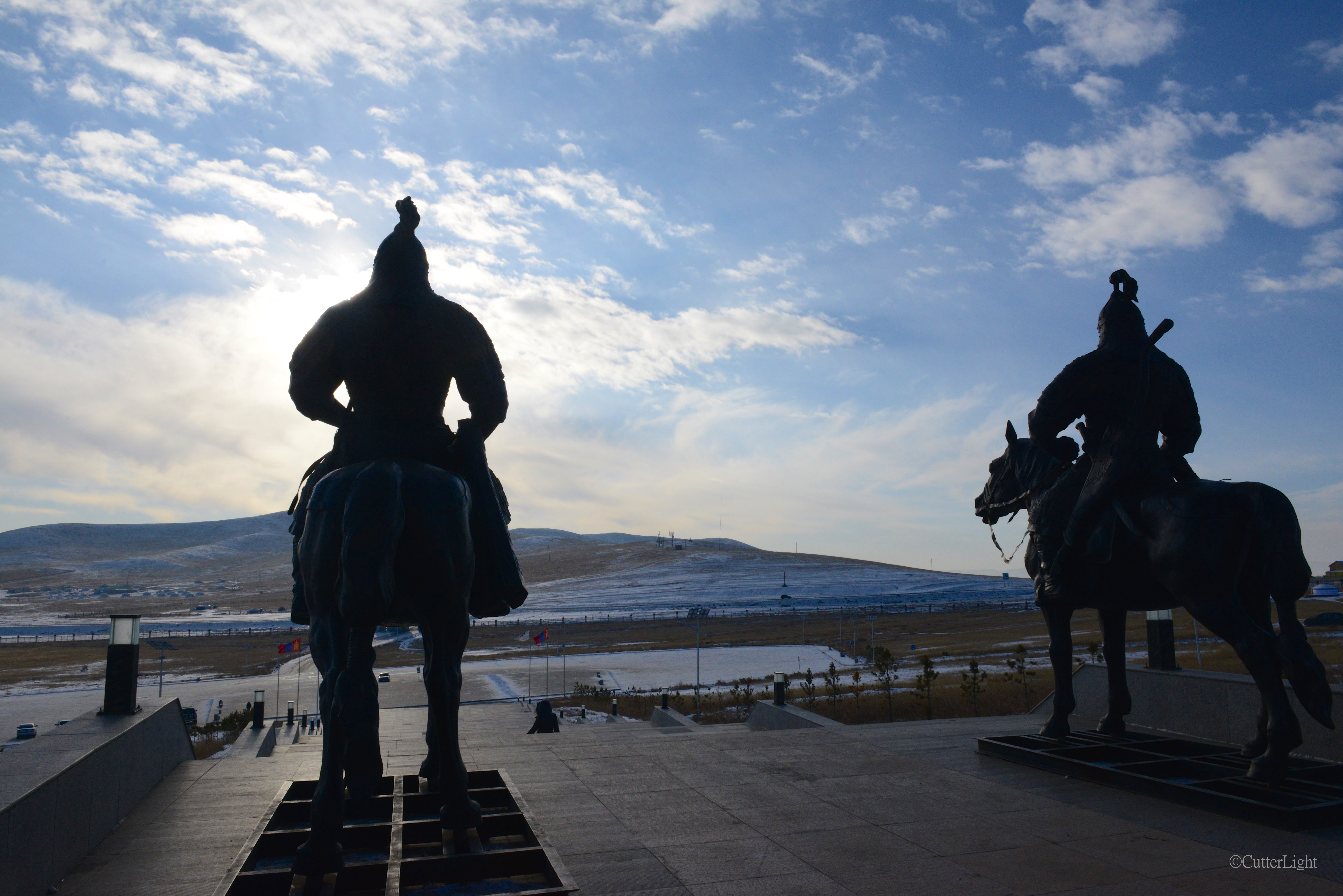
Reminiscent of the soldiers who rode with Chinggis, these vigilant horsemen face the rising January sun. The museum is a collection of period weaponry, jewelry, serving ware and other artifacts, as well as portraits of the 36 Khans who succeeded Chinggis and were appointed as heads of various regions of the empire. Chinggis Khan died in August, 1227. He was about 65 years old. Various accounts have him succumbing to an infected battle wound, a hunting accident, a fall from a horse and the dagger of a woman his army captured. Probably as protection from desecration by rivals, the whereabouts of his burial site remain shrouded in mystery as well…
From the end of the 17th century until 1911, Mongolia was under the control of China. Soon after that, they fell under Russian hegemony and in 1924 were declared a satellite state of the Soviet Empire. It wasn’t until 1989 that Russia withdrew it’s troops from Mongolia. In 1992, Mongolia created a new constitution and a multi-party democracy. Mongolia is thus at once a very young country, and a very old one.

A Lincolnesque statue of Chinggis Khan overlooks Ulaanbaatar’s central square from the steps of the Government Building.
Change is happening quickly in this young democracy; just recently the capital city’s central square, Sükhbaatar Square, was officially renamed Chinggis Khan Square. With an abundance of valuable natural resources (gold, copper, uranium and molybdenum among them) and a resilient, well-educated, optimistic populace, Mongolia’s future looks bright.

We encountered these softball-shaped Daurian partridge (Perdix daurica) in the pre-dawn of a December trip to Mongolia’s Hustai National Park.
Any day we see a new species of bird or other animal is a good day. On a recent three-day trip to Hustai, we had several such encounters. Nothing was any cuter than these relatives of pheasants and quail that would have fit perfectly in our cupped hands.

We startled them, a covey of 14, as they were feeding on seeds on the coldest morning to date this winter in Mongolia. Maybe it was the sub zero (Fahrenheit) temperatures, or the fact that none of us – including the birds – were fully awake. But uncharacteristically they let us hang around and snap a few photos in the blue morning twilight. The orange beard-like feathers and gray side whiskers are part of their fall and winter plumage.

Named for the Daurian region of Russia, the average Daurian partridge is about 11 or 12 inches (28 to 30 cm) from head to tail and weighs around one half to three quarters of a pound (225 to 340 grams). The main part of their diet consists of seeds, which are abundant on Mongolia’s steppe grasslands. Insects and berries also figure into their diet, when available. Partridge are ground nesters, having developed a long-term dislike of heights (such as tree branches) when, Daedalus (father of Icarus of Greek legend) threw his nephew Perdix off the Athena hill in a fit of anger. Not wishing to experience another such fall, members of genus Perdix avoid high places to this day. So the legend goes.

But they do fly, and this is the more usual view of Daurian partridge. Twice, previously, while hiking the Mongolian steppe we’ve had our startled hearts stop in our chests as a thrumming whoosh of wingbeats exploded practically underfoot. Once the birds have flushed, it’s difficult to approach them again, although you can sometimes track them down by listening for their rix, rix, rix, call as they regroup.
We encountered these softball-shaped Daurian partridge (Perdix daurica) in the pre-dawn of a December trip to Mongolia’s Hustai National Park.
Any day we see a new species of bird or other animal is a good day. On a recent three-day trip to Hustai, we had several such encounters. Nothing was any cuter than these relatives of pheasants and quail that would have fit perfectly in our cupped hands.
We startled them, a covey of 14, as they were feeding on seeds on the coldest morning to date this winter in Mongolia. Maybe it was the sub zero (Fahrenheit) temperatures, or the fact that none of us – including the birds – were fully awake. But uncharacteristically they let us hang around and snap a few photos in the blue morning twilight. The orange beard-like feathers and gray side whiskers are part of their fall and winter plumage.
Named for the Daurian region of Russia, the average Daurian partridge is about 11 or 12 inches (28 to 30 cm) from head to tail and weighs around one half to three quarters of a pound (225 to 340 grams). The main part of their diet consists of seeds, which are abundant on Mongolia’s steppe grasslands. Insects and berries also figure into their diet, when available. Partridge are ground nesters, having developed a long-term dislike of heights (such as tree branches) when, Daedalus (father of Icarus of Greek legend) threw his nephew Perdix off the Athena hill in a fit of anger. Not wishing to experience another such fall, members of genus Perdix avoid high places to this day. So the legend goes.
But they do fly, and this is the more usual view of Daurian partridge. Twice, previously, while hiking the Mongolian steppe we’ve had our startled hearts stop in our chests as a thrumming whoosh of wingbeats exploded practically underfoot. Once the birds have flushed, it’s difficult to approach them again, although you can sometimes track them down by listening for their rix, rix, rix, call as they regroup.

An inspiring breakfast: topped with a dollop of sour cream, this apple-filled pancake is like a mile-high crepe, as delicious as it is beautiful .
Morning rituals. Jack and I start every day with a hearty breakfast. This important meal is usually accompanied with a big mug of coffee or tea and a selection of a few poems, which, lucky for me, are read to me by my favorite reader. A day that starts with healthy fuel for the body and sustenance for the mind is likely to be positive and fruitful (wink).
Our breakfast menus traditionally include items like nourishing hot cereals, egg dishes, or something freshly baked. This morning’s menu came straight from the only baking recipe book I have with me here in Mongolia, The Williams-Sonoma Baking Book. If you are only going to have one recipe book, I highly recommend this one. It includes many foundational recipes for breads and desserts which can be easily modified or experimented with. I followed the German Apple Pancake recipe to the T. It came out perfectly. I am already dreaming of this mile-high pancake with farm fresh pears featuring galangal as the centerpiece spice.
German Apple Pancake
Ingredients
Instructions

Moist, sweet almond cake with tart sea buckthorn berries baked in – served atop warm vanilla bean custard, this is a sophisticated and flavorful dessert. Serve with sea buckthorn wine or an ice wine.
Berries are our favorite fruits. In Mongolia, we have added a new berry to our culinary collection – sea buckthorn. With 15 times the vitamin C of oranges, it’s no wonder Mongolians have long sought out this berry for its healthful benefits! We found the berries we used in this cake in our local grocery store. We’ll be on the lookout for this hardy plant in the fall in order to harvest our own.
This almond cake lends itself to pairing with a tart fruit such as currants. I made a cranberry version earlier which I adapted for the sea buckthorns. The almonds and the almond extract give the cake a delicious base that would work with a number of flavors. The cake is delicious without fruit as well.
Sea Buckthorn Berry Almond Cake
Ingredients
Directions

 CutterLight
