
Chukchi Chess
2


In late winter and early spring, our Inupiat friends in Point Hope began talking about “breaking trail” across the frozen Chukchi Sea so that snow machines (snow mobiles) and hondas (ATVs) could be driven out to leads (open lanes in the ice) in order to set up whaling camps. “Breaking trail?” Informed by our experiences with freshwater lakes, we wondered, “Can’t you just drive out across a smooth blanket of ice?”
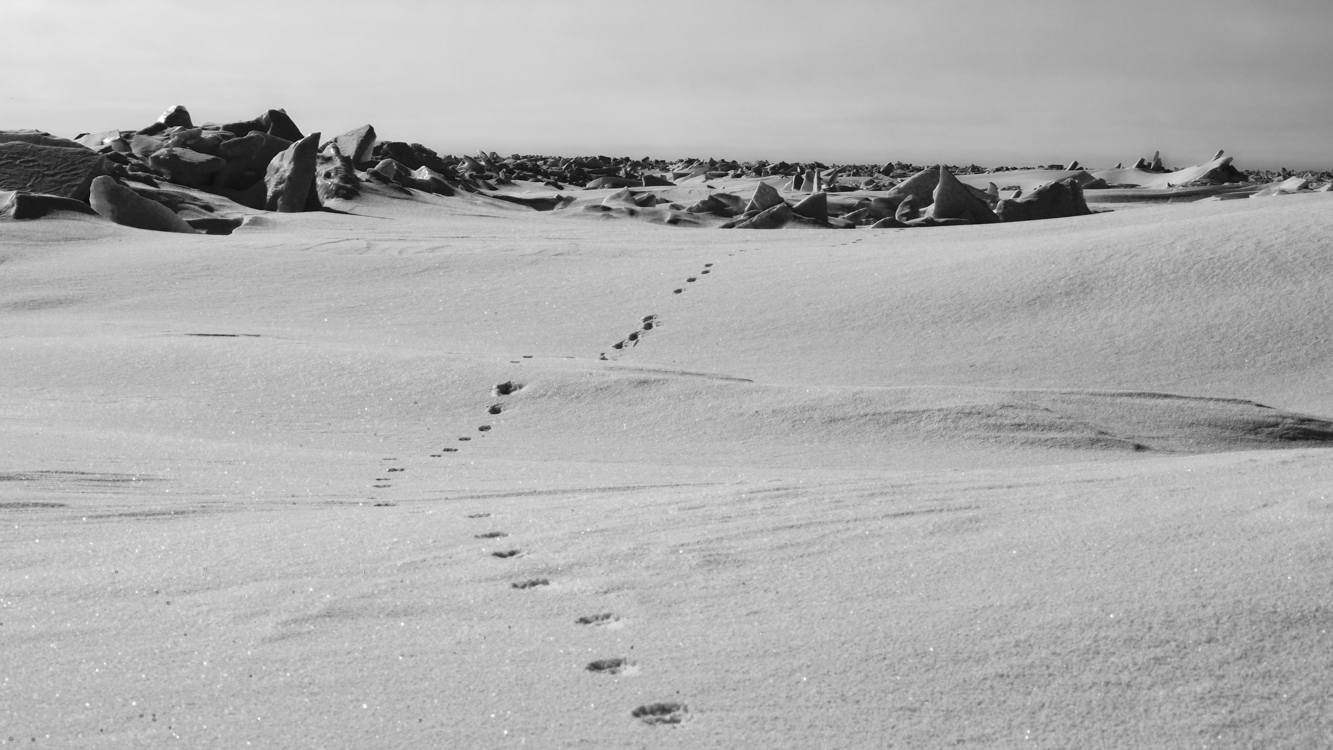
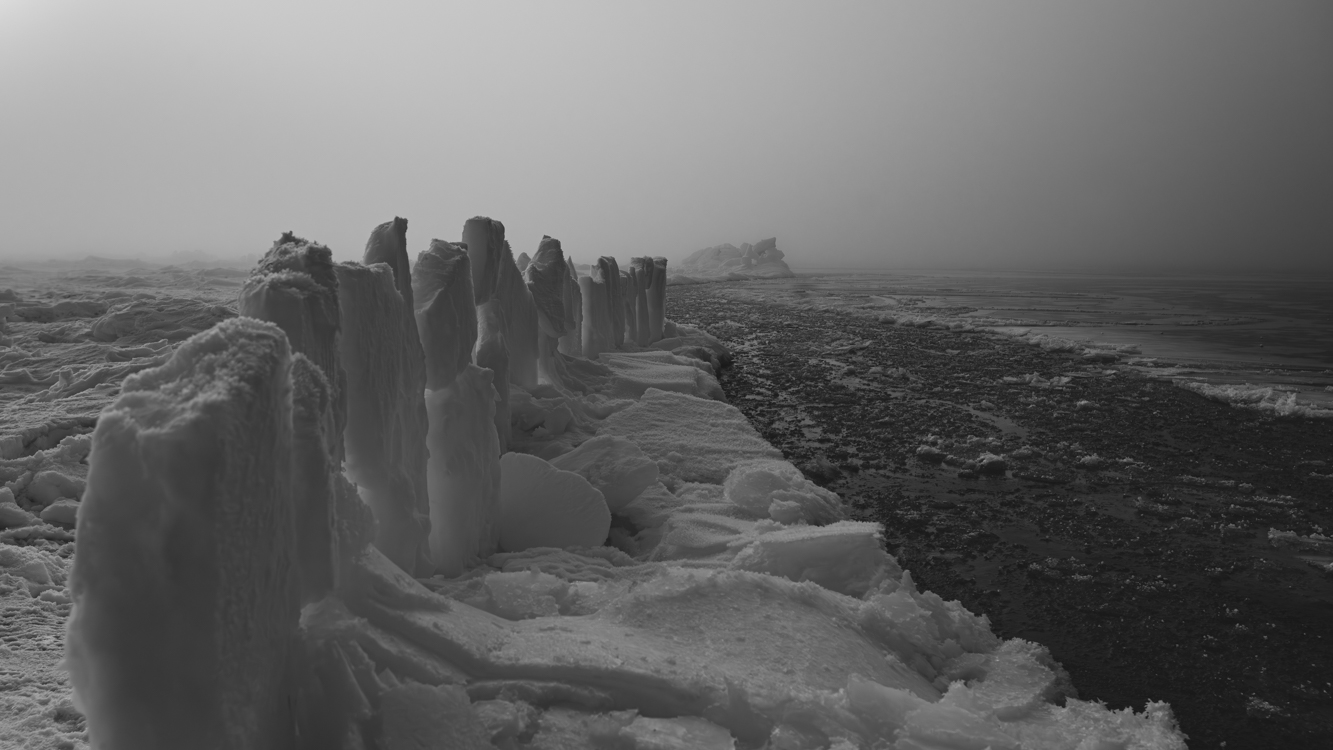
Well, as we learned, a frozen sea isn’t like that. As ice forms and expands and is pushed around by winds and currents, sheets separate (creating leads) and later are pushed together again, the resulting pressure ridges can heave up massive jumbles of jigsaw ice. Some of the chunks are as large as a garage. This was all new to us the first time we hiked out to a camp. In the above photo our eyes are drawn to an otherworldly sphere and pyramid lit blue in pre-dawn light.

One hundred twenty-five miles north of the Arctic Circle, on this date there still remained four hours and three minutes of daylight in Point Hope’s sky. This late in the year the Chukchi Sea was blanketed in ice, the sun barely ascending above the horizon. From November 18 to 19, nine minutes and 52 seconds of daylight were lost. The following day, ten minutes were lost – an additional eight seconds. The next day, 10 more seconds of light disappeared. And so it continued, darkness gathering momentum toward December 6 when the sun vanished, leaving only a glow on the horizon. The sun remained down for 30 days until January 6 when it peeked above the frozen sea at 2:03 PM and remained barely visible for 19 minutes and 20 seconds.
I first encountered art in the style of Mark Rothko’s colorfield paintings (a painting by an art student at the local college) in my teens. Like many others, I was fascinated by the juxtaposition of colors. I would shoot this scene differently now… but will most likely never get the opportunity. Happy to have been there, seen it, and come away with this photograph despite its imperfections.



Saltwater inundation caused by an encroaching sea forced the people of Point Hope to relocate further inland down Tikigaq Peninsula a few decades ago, but I am told that as recently as the 1970’s a few people still inhabited homes such as the one above. In fact, on at least one such structure we saw, there was a junction box for electricity. Along with these igloos (a term which refers not just to structures made of ice, but to any dome-shaped Inupiat dwelling), there were other more familiar-looking homes in old Tikigaq, but those too have long been abandoned to decay back into the Arctic tundra.

As Bowhead Whales go, this was a small one – perhaps 10 tons or so. We had hiked approximately three miles from the village of Point Hope across the frozen Chukchi Sea to the camp where we had heard a whale had been caught. Locals had traveled by snowmachine and honda (snowmobile and ATV). There is always the danger of encountering a Polar Bear in this environment, and so we were armed. After snapping this picture I handed the camera to Barbra and took a place on the rope.
The open water in this picture is called a lead – an opening between two sheets of ice. You can see, across the water, the jumble of ice along the edge. Sea ice is often not the smooth sheet of white one might imagine. It continuously buckles, pushes up along pressure ridges, drifts apart and then presses back together. In a way, it behaves like the Earth’s tectonic plates, buckling, heaving, colliding, lifting. And so in order to make a whaling camp, trails must first be made through these places where jagged ridges of ice, individual chunks the size of cars, some much larger, must be broken through and smoothed out.
It is a lot of work to take a whale.
 CutterLight