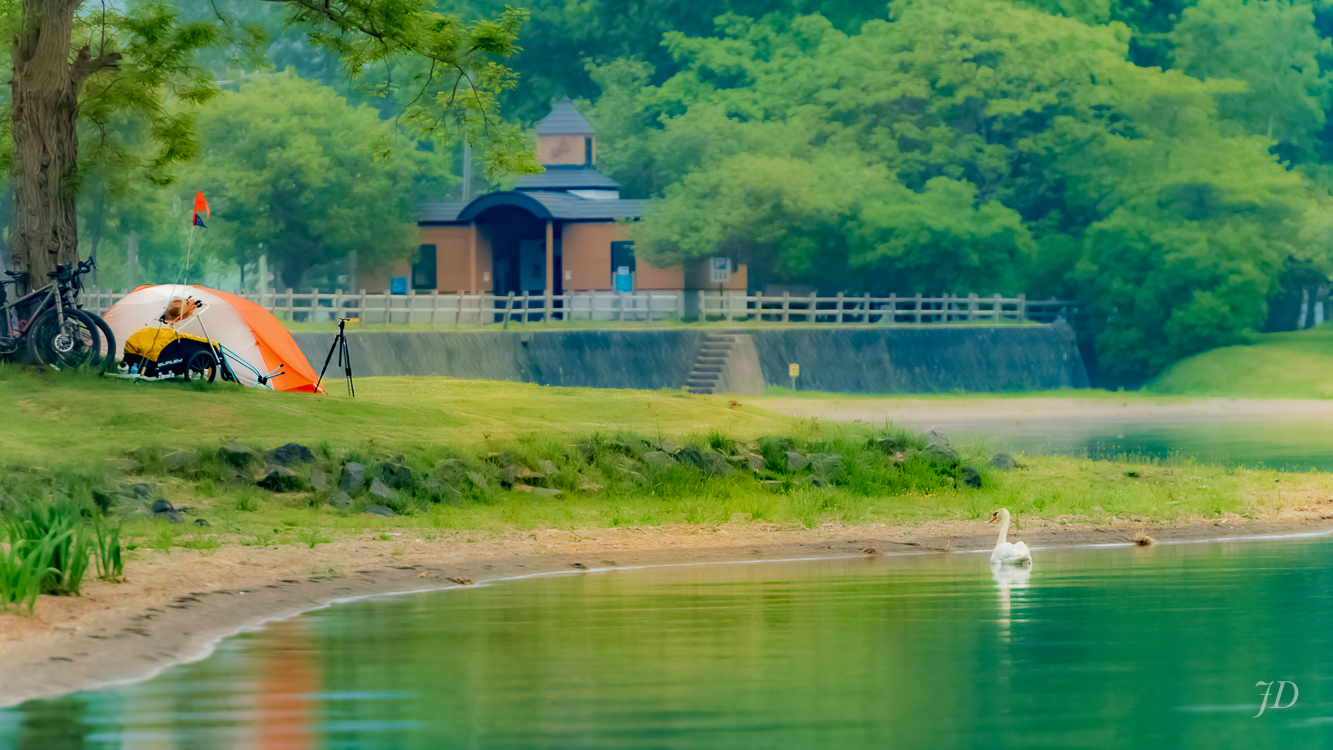
Herring House (Nishin Goten) West Coast of Hokkaido near Haboro – June 17, 2018
Somewhat paralleling the boom and bust of America’s west coast sardine/herring fishery (see Cannery Row), in the late 1800’s through the early 1900’s, fortunes were made and lost on the back of Hokkaido’s west coast herring fishery. The building in the above image is a Nishin Goten, a communal house for the herring fishermen of that era. Inside are the captain’s quarters, other areas where fishermen and other employees (I’m assuming the fishermen’s wives who were vital in processing the catch) could roll out their futons. Such houses featured a kitchen, a place to store slippers (in those days woven from grass) and a bit of furniture. These days, several Nishin Goten are preserved and open to visitors – well worth a stop if you’re traveling Hokkaido’s west coast along the famed Herring Highway.
Above Tokyo, Flying into Narita Airport on Japan’s Main Island, Honshu The ancient poets of Tang and Sung Dynasty China called city life “chaos and dust.” Approaching Chitose Airport, 33 miles SW of Sapporo on Japan’s most Northerly Island, Hokkaido A much more agreeable landscape for a bicycle trek
We found one terrific (often idyllic) campsite after another during our Hokkaido trek. Above is Nakatoya Campground on the shores of Toya-ko (Lake Toya). The lake formed in an ancient volcano caldera, complete with an island near the center – similar to Oregon’s Crater Lake. Overall, Hokkaido’s campgrounds were quiet, clean, and inexpensive. In fact, several were free and if memory serves even the most expensive site was only about $20 (in 2018). Most ranged from five to 10 dollars per camper per night.
In the past, language might have been a barrier to traveling in Japan. I speak some Japanese, which was immensely helpful, but these days with language apps right there on your phone, most locals eager to assist well-mannered visitors, and a lot of printed material such as highway signs, menus, national park information and so on written in English, even language differences need not impeded a tour of this wonderful, lightly-visited island. On a latitude approximating that of Oregon and Massachusetts, summertime biking in Hokkaido is pleasant, particularly along the coast.
I had forgotten that I’d softened so many of these Hokkaido images… Dreamy summertime bike trek.
On the morning of the sixth day of our Hokkaido trek, we passed through Date (dah-tā), a seaside town southwest of Sapporo on the shore of Uchiura Bay. The town is known for maricultural products such as scallops and sea urchins. This photo is another early experiment in softening rather than sharpening an image.
Seawall Foggy Morning with Fishermen Hokkaido, Japan, June 4, 2018
This photo is an early experiment with softening rather than sharpening an image… taken before I appreciated how important careful note-taking is… I think this is in the harbor of Hagino.
We arrived in Japan on May 28, spent three days in the Crown Prince Hotel in Chitose, Hokkaido getting acclimated – figuring out where we might purchase fuel for our camp stove, re-assembling our bicycles and so forth -, and then on June 1 we embarked on a 67-day, 1,300 mile bicycle-camping trek circumnavigating most of coastal Hokkaido. For both of us, the trek was a fulfillment of childhood dreams of a self-guided bicycle trek in a foreign country. It was quite possibly The Most exhilarating adventure either of us had ever undertaken.
I paid for a significant part of the trip when I published an article in Adventure Cycling Magazine, which if you’re interested you can find here. We also published several articles about this trip right here on Cutterlight. The easiest way to access those is to simply type Hokkaido in the search box in the upper right of any Cutterlight page.
As I go through the 1,342 photographs from this trip (that’s after the initial culling), I’m not sure how many new images I’ll have to post. But I will underscore the feeling Barbra and I came away with after the trip. Go! If you’ve ever thought that a bicycle trek is something you might want to experience – think back to when you were 12 or 13 or 8 or 58 and riding in a car passed a couple or a small group of bike trekkers and wondered what it was like… wondered if you could do something like that – our answer is Why not?
Heave Ho Fred Shangin, cigarette hangin’ as per, puts his back into a pot of Tanner Crabs from Castle Bay off the gulf side of the Alaska Peninsula. May 6, 2018
Going through these many thousands of photos from The Lake and beyond – while at the same time these past few days putting together a magazine piece paying tribute to a recently deceased mentor and friend from my Pennsylvania youth – I find myself recognizing that as photographers one type of image we might not capture often enough is portraits of friends. The best of these photos are often environmental-documentary portraits – my own hybrid category to describe pictures that capture the subject in an authentic act of life in a setting that tellsthe viewer about that person’s life. There’s an art to it… the photo that isn’t staged; that doesn’t depict the subject self-consciously looking into the lens (or self-consciously looking away from the lens); an image that captures an authentic moment rather than a pose.
For me, learning to make these types of images has been predicated on a lengthy process of growth toward freedom from my own limiting shyness. Coupled with the kind of confidence that enables a photographer to make such portraits is, I think, a necessary agreement – tacit or verbalized – that gives the photographer permission to shoot at will (with appropriate discretion).
Strictly environmental portraits are in most cases staged. In making such an image, the photographer might have the subject sit at her fly-tying table as she ties or gives the impression of tying a fly. Noticing clutter, the photographer tidies up the scene. Further compositional considerations prompt lighting manipulation – perhaps nothing more than slightly moving a lamp or opening or closing a curtain, but manipulation nonetheless. Clothing choices are given thought, a certain tilt of the subject’s head is decided upon as favorable, perhaps a few already-tied flies are placed in the foreground, a book arranged so that it’s title can be read. Images such as this have their place, but to me there’s a compelling cool in a real-time photograph – a moment frozen, captured, documented as is with no quick brush through the subject’s hair, the everyday jacket with its stains, imperfect lighting, maybe a little motion blur or grain.
And in the case of the above photograph, one hangin’.
Female Transient Orca with Seal against Aleutian Mountain Landscape Training Day
I wasn’t sure what to call this photograph, so I’ve gone with straight description. The Alaska Peninsula’s Aleutian Mountains again provide a dramatic backdrop and (I think) stunning context for this photo of a female Transient Orca and her prey, a thoroughly defeated seal. Looking closely, you can see the seal’s facial whiskers near the Orca’s nose, his body further to the right. She’s lost a bit of skin from her snout, no doubt from raiding the rocky shoreline for catches such as the one she is now contemplating.
While the female Orca was using this living prey to teach her daughters hunting techniques, the male (see the previous two articles) was checking out our skiff.
Throughout our time with this group of Orcas the light was all over the place as clouds closed and opened above. Many images from this shoot came out flat, like blue-tinted monochromes. But a few, such as this one, are nicely lit as the sun just began to emerge from behind clouds.
Incoming Twice the male Orca swam beneath our small skiff, so near the hull we could see him plainly through the Alaska Gulf’s semi-clear water. Each time, he emerged on the other side very close, turning parallel with our watercraft, eyeing us. Using our 20-foot skiff as a comparison, I estimate his length at over 25 feet in length, shimmering, bulky, muscular, liquid, graceful. Was he simply curious? Cautiously keeping us in check while his mate and daughters practiced hunting with the still living seal she’d carried out into open sea to the left of this photo? Showing off? Warning us? Each time the male came in close our hearts rose in our chests, our breath stuck in our throats. I blew those shots, able to fit only a fraction of his massive body in the frame created by the 70mm lens, shutter speed too slow to freeze him as his movements always appeared slower than they actually were. But I did get this capture of him swimming in for one of those dives beneath our boat.
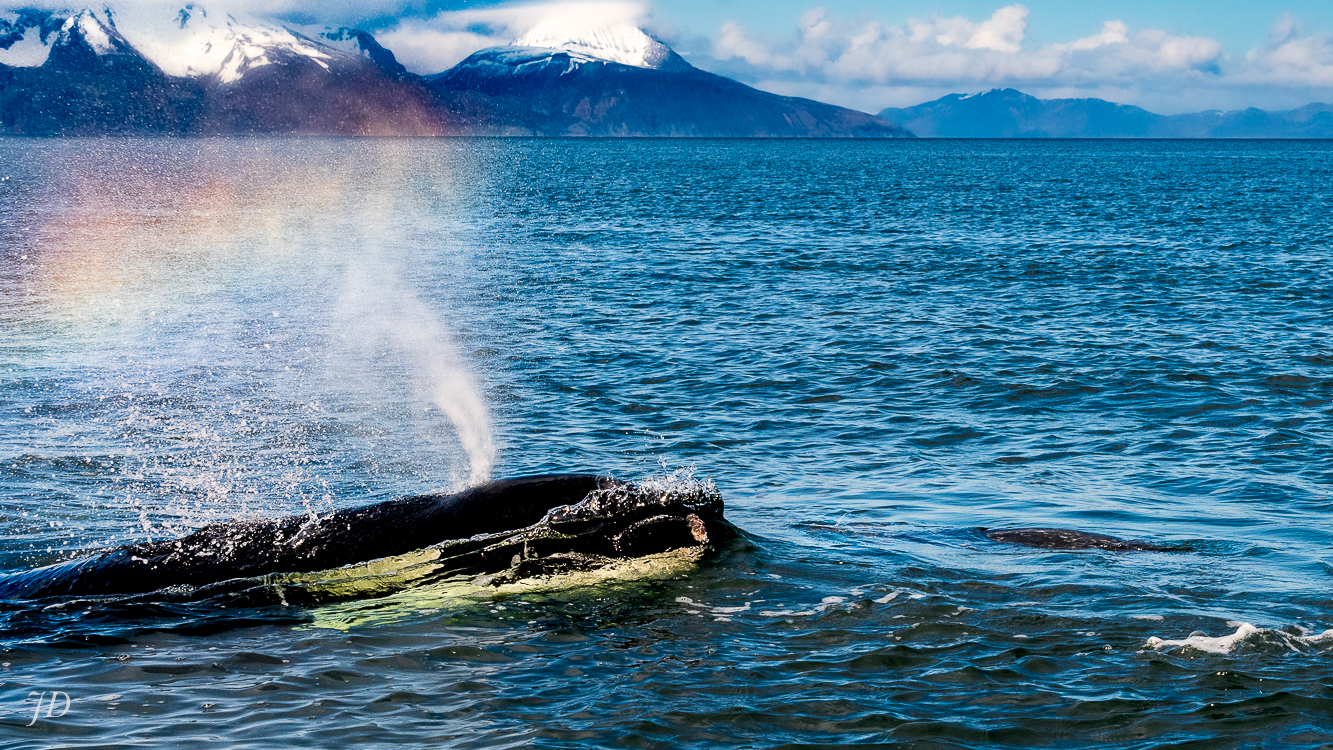
The light was in and out throughout the encounter, the sun at times obscured behind dark clouds, at other times breaking through clear blue skies. Here dappled light is filtered through thin clouds, creating a rainbow-like effect accentuating blues, mauves and purples. This image is interesting for the background landscape as well. The land mass to the left is Nakchamik Island. The smaller island to the right is the smaller of the two Kak Islands. On the right is (I think) Little Castle Cape on the mainland. JD, Chignik Bay, Gulf of Alaska, May 6, 2018
Killers: Father and Daughter, Training Day Chignik Bay, Gulf of Alaska, May 6, 2018
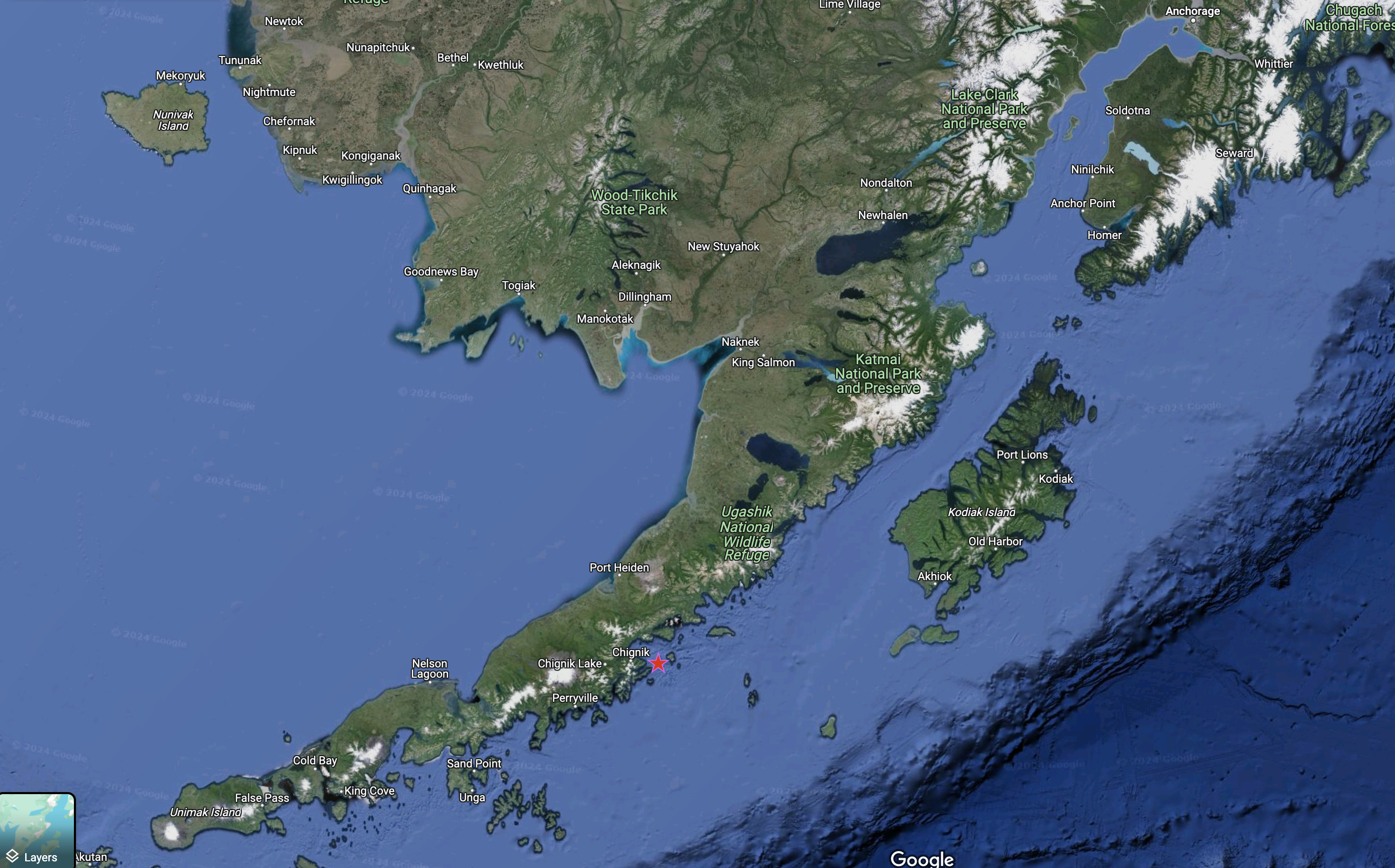
The above photograph is of an adult male and a young female Orca. Killer Whales in the vernacular. Actually, not true whales, but the world’s largest dolphins. They were part of a family of four which also included an adult female and a much younger calf, perhaps also a female. I had been invited along on a crabbing and halibut fishing excursion by my friend Fred Shangin. We were headed to Castle Bay, which meant skiffing from the village of Chignik Lake six miles down the Chignik River, then six miles through Chignik Lagoon, out around Dark Head and then 10 miles down the Alaska Peninsula to Castle Bay. In the above photo, the Orcas are about three miles offshore not far from the seaside village of Chignik. See the Google Maps below:
Anchorage is in the upper right. The red star halfway down the Alaska Peninsula indicates the general area of Chignik and the site of the Training Day photograph above.The purple line indicates the navigational course Fred took us on that day.
These are Transient Orcas, members of the Gulf of Alaska, Aleutian Islands, and Bering Sea (GOA/AI/BS) population.1 As Transients, their primary source of food is marine mammals. When we encountered this family, Fred idled the skiff engine and for the next half hour we watched the parents teach their daughters about hunting seals. First, with the daughters following closely, the adults cruised in tight to the rocky shoreline where they corralled and caught a seal. Rather than kill it, the female gently took the hapless pinniped in her mouth. Barely holding it by her front teeth, she swam out into open water where the adults continued to teach the youngsters lessons they would need to survive.
Training Day, Fred called it.
I was still pretty new to photography and had never shot anything like the scene that unfolded. Lots of mistakes. Several times the male, which was enormous, swam right beneath our little skiff and then emerged, impossibly close, to check us out. At other times the female and even the older of the two daughters came in close, again looking us over. I managed to make a mess of what would have been incredible closeups of these great beings. In fact, the entire family, very much aware of us, seemed at times to be showing off as they taught and learned their own unique art of hunting. However, despite my excitement and fumbling I managed to get a number of interesting pictures, a few of which are difficult to look at if one has any empathy for the little seal.
Once the first seal was finally dispatched (the female performed the messy coupe de grace), the male caught a larger seal for himself. I’ll probably publish additional photos of this remarkable, seldom-witnessed event in the coming days.
1Alaska Department of Fish and Game, Killer Whale (Orcinus orca) Species Profile
Male Golden-crowned Kinglet – Chignik Lake, Sitka Spruce Grove, January 23, 2018 Making our way along a bear trail I hacked open as it descends through a dense alder thicket toward creek bottom, we hear them – cricket-like whisper-chirps. They’re in there somewhere, hidden in a jungle leaves the alders are stubbornly holding onto even as nighttime temperatures dip and we awake to frosted mornings. Kinglets. The Silvers are in, all but the Monkey Flower, Goldenrod and maybe the last of the Yarrow is gone… Fireweed gone to seed, big brown bears fat with Sockeyes, terminal dust on the mountains. Fall on the Chignik.
Golden-crowned Kinglets are another species that is either absent or listed only as “rare” on Alaska Peninsula avian checklists. This might be because they are only a fall through early spring visitor to that part of the world, as is the case at The Lake. Or it could be that even in those non-breeding seasons these hardy little being rely on the shelter provided by mature spruce trees which, for now, only occur near the peninsula’s tiny, scattered villages. JD








 CutterLight