Female Belted Kingfisher Chignik Lake, Alaska Peninsula, October 4, 2018
All Belted Kingfishers sport a broad band of stormy-sea blue across their upper chest. But females possess a second, rust-colored band further down. Both male and female immature specimens, such as the bird in the above photo, can be especially colorful, with rusty-orange mixed in with the upper blue belt and appearing more extensively across the belly and chest. They’re about the size of an American Robin, but bulkier. Their ratchety, rattling calls, which never fail to lift our hearts when we’re on the water, are often the first thing that gives away their presence.
Greater Yellowlegs with a Nine-Spined Stickleback Chignik Lake, Alaska Peninsula, August 20, 2018
There are two species of yellowlegs – Greater, the larger of the two species and featuring a proportionately longer bill, and Lesser, the smaller of the two with a proportionately shorter bill. Until you’ve looked at quite a few of these birds, they are difficult to tell apart unless they’re near each other. We never encountered Lessers at The Lake, but from spring through early fall Greaters were common.
Yellowlegs stalk shoreside margins searching for any small fish. A quick stab is usually all it takes before they come up with a stickleback or salmon parr siscorred chopstick style between their bills. Close examination of photographs hints at small serrations in the roof of the upper bill, helpful in repositioning their catch for a head first swallow. Their piercing calls, delivered in sequences of three and four quick, sharp cries, can sound almost like a car alarm. Unlike most shorebirds, yellowlegs often perch at the very tops of trees, a behavior they share with Wandering Tattlers.
Western Sandpipers, Hartney Bay, Cordova, Alaska, May 3, 2024
This was the scene about six miles from the heart of Cordova this past Friday morning, and this is but a sliver of the many thousands of shorebirds that stop for a short while to fuel up and rest on tidal mudflats near the town as they make their way to nesting grounds further north. Figuring in nearby barrier islands and additional flats in the Copper River delta, some five million shorebirds represented by several species will visit the Cordova area over a few days in early May. While they are here, these Western Sandpipers will double their weight. The delta is absolutely critical to the health of these avian populations as there are only a few places in the world that offer the sheer biomass of invertebrates and biofilm these birds require in order to complete journeys that in many cases cover thousands of miles. Look for a more indepth article on this incredible migratory event in the coming days.
Imperial Diver (Common Loon, Gavia Immer) Chignik Lake, Alaska Peninsula, August 2018
Upon publishing a photograph of a Wilson’s Warbler under the title Black Cap Jazz Singera few days ago, reader Tanja Britton (see Tanja’s blog here), left a note alerting me to the American Ornithological Society’s decision to revisit the common names of species within AOS’s jurisdiction that are predicated on the names of the people (white men) who “discovered” or “identified” the bird in question as well as appellatives assigned by the “discoverer” to “honor” others. This would mean the renaming… the reimagining of a number of birds and our relationships with them: Steller’s Jay, Wilson’s Snipe, Baird’s Sandpiper, Audubon’s Oriole, Bachman’s Sparrow, and so on.
Hurray and about time. This “dibs!” approach to naming the beings we share this planet with could hardly reflect a more juvenile mindset. We, all of us, have the right to choose our own names, to imagine ourselves as we wish to be, to present our own identities and not to be enslaved by someone else’s idea of who we should be. We believe the same dignity should be accorded to all beings. And in fact, even in the instance of an “inanimate” object – such as, say, a salmon pool on a river – if one is looking at that landscape and can think only of imposing a person’s name on it, one is not looking closely enough.
Our view at Cutterlight has long been that if one creates a piece of art such as writing, a painting, a piece of music and so forth and one chooses to attach one’s name to said piece of art, it is appropriate and just that the creator’s name live on with that art for as long as the art lives. But this vain nonsense in pursuit of the illusion of immortality wherein buildings, airports, highways, and birding organizations are arbitrarily named after this person or that has always struck us as one of the least attractive impulses in Euro-American culture. The practice is as divisive as it is arbitrary – a fact we seem to be slowly waking up to as a society.
It is often the attitude among indigenous peoples of the Pacific Northwest that the totem poles they’ve created should be allowed to naturally decay over time rather than preserved. Their view is that all beings and all things have a span in which they exist in a certain state, at the end of which they must be allowed to follow their natural path into the next state of existing.
Amen.
Turning back to the matter of our avian friends…
As the AOS embarks on the enlightened task of reimagining the gray, nondescript names of men attached to various species, let them take one further step and strike from vernacular names disrespectful monikers such as “least,” “dwarf,” “lesser,” “house,” and the sobriquet we find most grating – “common.”
The only thing “common” about Gavia immer, the bird in the above photograph, is the unimaginative minds of whomever agreed this regal being should be so reduced. This bird can reach a bill to tail length of three feet (90 cm), a wingspan of four feet (130cm) and is reported to dive up to 250 feet (76 meters). “Common Loon” my foot.
My favorite fish is the Coho Salmon. I am absolutely fascinated by Lady’s Slipper Orchids. It’s difficult to name a “favorite” anything, and as I reflect on the matter it becomes apparent that it might be even more difficult to explain Why a given something is a favorite. The phrase “an integral part of the journey” flashes in my mind. The species in the above photo is the reason I became a serious birder and threw myself into photography. Oncorhynchus, Cypropedium, Lanius…
What is it in your life that has pulled you into travel, adventure, personal growth, new understandings? JD
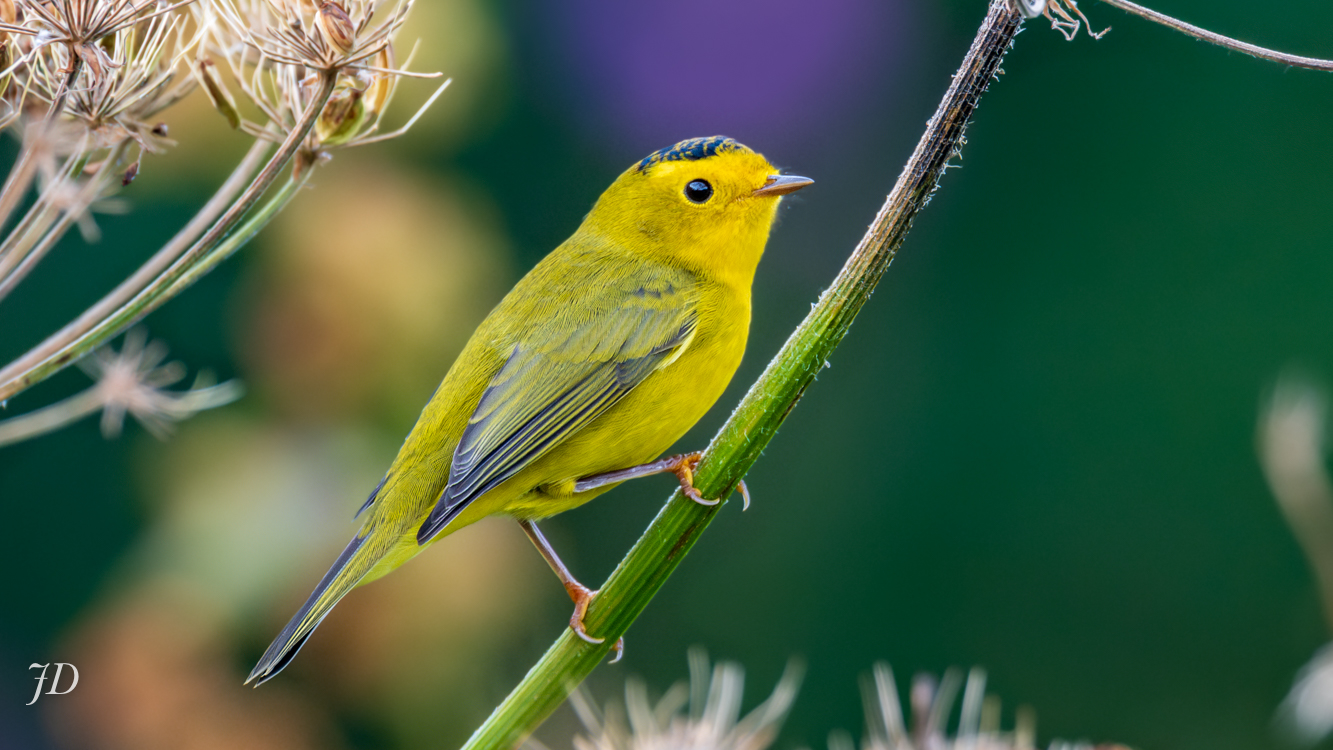
This beautiful bird is regrettably saddled with the name of the man credited with identifying him… a name with an apostrophe s… as though no one else ever knew this bird and that by “discovering” this fine fellow the man now owns him. So let’s not call this happy singer by some name of ownership. He is an artist in his own right, Black Cap Jazz Singer.(Chignik Lake, Alaska, August 2018)
Every being has the right to a dignified name. Every human has the right to choose a name and an identity for himself, herself, themself. JD
Blakiston’s Fish Owl Shiretoko Peninsula, Hokkaido, Japan, July 23, 2018
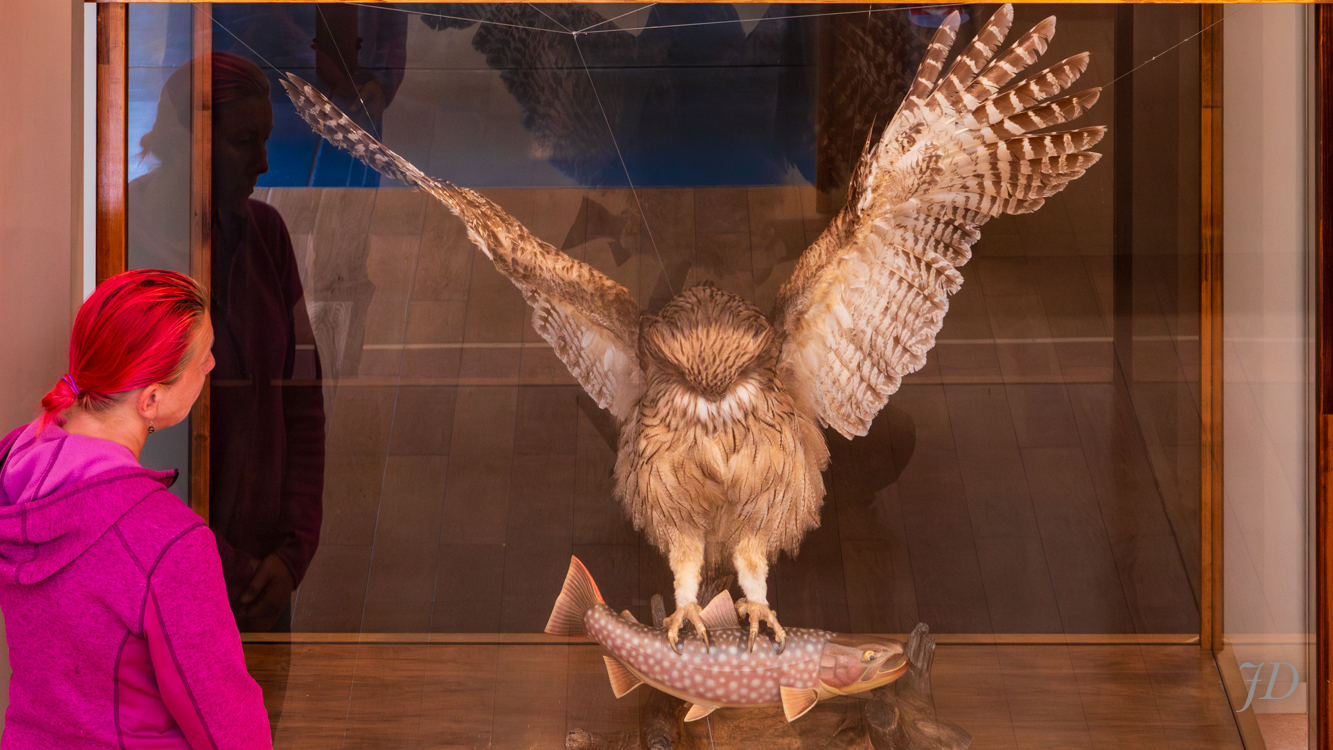
With a wingspan ranging from about 5′ 10″ to 6′ 3″ (170 – 190 cm), Blakiston’s Fish Owls are generally regarded as the world’s largest living species of owl. The photograph above is of one of a known wild pair which have been banded. The owls regularly visit a small stream where a pool has been created with natural rocks and is regularly stocked with Cherry Trout (sakuramasu, O. masau). A small inn with windows overlooking the pool provides guests with opportunities for a glimpse of this rare species which may visit the pool at any time during the night. The indigenous people of Hokkaido, the Ainu, regarded these great owls as spiritual protectors of their villages.
For context, Barbra with this taxidermy specimen grasping a White-spotted Char (Rain Char). Blakiston’s Fish Owl is a type of Eagle Owl and therefore related to the familiar Great Horned Owl of North America. The Great Horned Owl has a wingspan of approximately four feet, two feet less than the Blakiston’s span of around six feet.
Rhinoceros Auklet returning at Dusk with a Catch of Sand Lances and Squid The grayish-white protuberance on the bill – the horn that inspires the Rhinoceros Auklet’s name –is fluorescent and thus highly visible to their fellows when diving for fish or flying in dim light. Teuri Island, Hokkaido, Japan, June 19, 2018
You might encounter this puffin relative just about anywhere along North America’s Pacific coastline, and in fact there are breeding populations scattered from Canada through Alaska’s Aleutian Islands. But perhaps the best place to see Rhinoceros Auklets is on Terui Island off the west coast of Hokkaido where they gather in the hundreds of thousands to nest – the largest Rhinoceros Auklet breeding colony in the world.
The northwest cliffs of Teuri are pockmarked with burrows which the auklets have dug deep into the sandy soil to keep their eggs and chicks safe from gulls and other predators. During the day, the parents leave their chicks behind as they venture out to sea where they dive for food – primarily Sand Lances and squid. As twilight gathers, the adult auklets return to home, somehow sorting out their burrows from among the tens of thousands of similar tunnels. Gulls await the returning auklets, keen on stealing an easy meal. This is an example of why for many species it is so important that their numbers remain vast. Were only a few auklets to return, they’d each make an easy target for the waiting gulls. But with hundreds of thousands flying in, the relatively few gulls are overwhelmed, and although the gulls manage to take a few meals, most of the auklets make it safely to their burrows where hungry chicks are waiting.
On Terui Island, guides are available to take birders out to the nesting site to observe the spectacle of returning auklets. Along a pathway, a few low lights allow for a good view of the birds as they scurry through low, dense vegetation. Some of the auklets will be quite close, but in order to get good photographs a fast lens and a camera capable of handling high ISO values is necessary as using additional lighting is not permitted (and would be wrong, even it were). You’ll be hand-holding and so you have to hope you catch one standing still to momentarily collect its thoughts, as in the above photograph. JD
Rhinoceros Auklet Breeding Grounds, Teuri Island Hokkaido, Japan, June 18, 2018
Not a lot appears to be going on in the above daytime photograph taken on Teuri Island’s cliff-lined northwest. The 2.1 square mile island (5.5 square km) hosts the breeding grounds for several species of birds, most notably seabirds. The holes in the above photograph are the burrows of Rhinoceros Auklets, a species for which Teuri serves as the world’s largest breeding ground.
While it doesn’t appear that much is going on in the photograph – a few gulls milling around notwithstanding – at the end of each burrow, which may be up to six meters (20 feet) in length, a Rhinoceros Auklet chick is waiting for twilight when parents will return from the sea, stomachs, gullets and bills crammed with catches of sand lances and squid. Gulls – primarily Slaty-backed which also breed on the island – will intercept some of the returning adults, but most will make it past the parasitic phalanx. Recent estimates put the auklet population at around 400,000 breeding pairs. Add in the chicks and the species count rises to over a million. Perhaps you can imagine the sight and the cacophony as night gathers and hundreds of thousands of adult auklets return, evading squawking gulls, somehow locating the specific burrow each parent calls home.
Teuri is also an excellent place to see Spectacled Guillemots, Common Guillemots and other seabirds as well as passerines such as Blue Rock Thrushes and Siberian Rubythroats. Regular, bicycle-friendly ferries from Haboro make it easy to get out to the island, and if you don’t choose to stay at the lovely campground (which you’re likely to have to yourself) there are wonderful inns offering comfortable accomodations and truly some of the world’s best fresh seafood.
Male Golden-crowned Kinglet – Chignik Lake, Sitka Spruce Grove, January 23, 2018 Making our way along a bear trail I hacked open as it descends through a dense alder thicket toward creek bottom, we hear them – cricket-like whisper-chirps. They’re in there somewhere, hidden in a jungle leaves the alders are stubbornly holding onto even as nighttime temperatures dip and we awake to frosted mornings. Kinglets. The Silvers are in, all but the Monkey Flower, Goldenrod and maybe the last of the Yarrow is gone… Fireweed gone to seed, big brown bears fat with Sockeyes, terminal dust on the mountains. Fall on the Chignik.
Golden-crowned Kinglets are another species that is either absent or listed only as “rare” on Alaska Peninsula avian checklists. This might be because they are only a fall through early spring visitor to that part of the world, as is the case at The Lake. Or it could be that even in those non-breeding seasons these hardy little being rely on the shelter provided by mature spruce trees which, for now, only occur near the peninsula’s tiny, scattered villages. JD





 CutterLight